AIUEO JLPT Grammar
Meaning
“〜直す” is a sentence pattern used with the masu-stem of verbs to indicate the repetition of an action, such as doing something again, fixing, or correcting something.
How to use it
Verb in ます-form + 直す
In context 5 examples
彼は手紙をもう一度書き直すことにした。
He decided to rewrite the letter.
報告書をやり直す。
Redo the report.
この運動を正しい方法でやり直してください。
Please redo this exercise with the correct method.
やり直さなくていいなんて、ラッキー。
I'm lucky I don't have to start over.
もう話し直しませんよ。
I won't talk about it again.
Read the original source text
Meaning
“〜直す” is a sentence pattern used with the masu-stem of verbs to indicate the repetition of an action, such as doing something again, fixing, or correcting something.
How to use it
動詞ます形+直す
Explanation · 日本語
「〜直す」は、動詞ます形に接続して、再び同じ動作を行うことを表す表現です。何かをもう一度実行する、修正する、改めるといった意味を強調するときに使われます。
文法
Meaning
To do ... again
How to use it
V (ます-form stem) + 直す
In context 10 examples
なんですか、この作文は。もう一度書き直してください。
What is this composition? Please write it again.
早く終わった人は、もう一度間違いがないか見直してください。
If you finish early, please check again to make sure there are no mistakes.
家が古くなってきたので、建て直そうと思っています。
The house is getting old, so I’m thinking of rebuilding it.
冷めたスープをもう一度温め直す。
Reheat the cooled soup.
このサイトはログインしてから一定時間経過すると、もう一度ログインし直さなければならない。
On this site, after a certain amount of time has passed since you logged in, you have to log in again.
もう一度、計画を練り直します。
I’ll rethink the plan.
今電車の中だから、降りてからかけなおします。
I’m on the train now, so I’ll call you back after I get off.
撮影中にカメラのバッテリーがなくなったから、もう一度撮り直す必要がある。
The camera battery ran out during filming, so we need to shoot it again.
転職を考えていたが、先輩の話を聞いて、考え直すことにした。
I was thinking about changing jobs, but after hearing what my senior colleague had to say, I decided to reconsider.
もう一度、やり直し!
Do it over again!
Read the original source text
Meaning
もう一度〜する
How to use it
V(ます形)ます + 直す
絵でわかる日本語
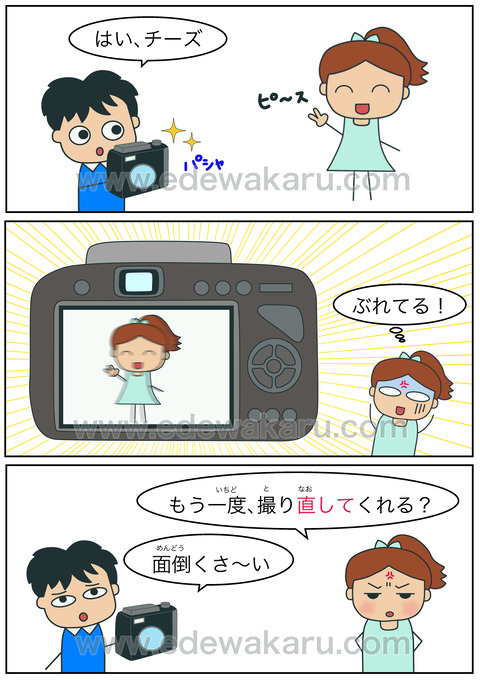
Meaning
To do ... again
How to use it
Verb [ます-form] + 直す
Explanation
“〜直す” is a sentence pattern meaning “do 〜 again.” It is used when you want to say “do 〜 again” in order to correct a mistake, something bad, or something you’re dissatisfied with, and make it right.
“〜直す” is also often used in conversation, so be sure to review it 😉
In context 6 examples
もう一度、写真を撮り直してくれるかな?
→もう一度、写真を撮ってくれるかな?Could you take the photo one more time? → Could you take the photo one more time?
A:服が汚れているよB:え!?昨日洗ったのに…A:もう一回、洗い直したほうがいいね
→もう一度、洗ったほうがいいねA: Your clothes are dirty. B: What!? I washed them yesterday… A: You should wash them again. → You should wash them one more time.
先生:漢字の間違いがたくさんありました。明日までに作文を書き直してきてください学生:…はい
→もう一度、作文を書いてきてくださいTeacher: There were lots of kanji mistakes. Please rewrite your essay by tomorrow. Student: …Yes. → Please write your essay one more time by tomorrow.
間違っているところがないか、見直してから提出してください
→もう一度、見てから提出してくださいPlease check it over for mistakes before submitting it. → Please look at it one more time before submitting it.
A:彼氏と別れようと思っているのB:え!?彼はイケメンだしとてもやさしいじゃん!考え直したら?
→もう一度、考えたら?A: I’m thinking of breaking up with my boyfriend. B: What!? He’s handsome and really nice! Why don’t you think it over? → Why don’t you think about it one more time?
A:もしもし、山田くんいますか?B:今出かけていますA:そうですか。では、またかけ直します
→また、もう一度かけますA: Hello, is Yamada there? B: He’s out right now. A: I see. Then I’ll call again later. → I’ll call one more time later.
Read the original source text
Meaning
もう一度〜する
How to use it
動詞[ます形]+直す
Explanation
「〜直す」は「もう一度〜する」という意味の文型です。間違いや悪いところ、不満に思うところを正しい状態に修正・訂正するために「もう一度〜する」と言いたい時に使われます。
「〜直す」は、会話でもよく使われますので復習をしておきましょう😉
日本語文型辞典
Meaning
Attached to the continuative form of a verb expressing an intentional action, this means to do an action again after having done it once. It is often used when the result of the earlier action was undesirable and the action is repeated in order to correct it. Except in examples such as 「出る」, it attaches almost exclusively to transitive verbs. Other examples include 「言い直す、考え直す、し直す、立て直す、建て直す、作り直す、練り直す、飲み直す、焼き直す、やり直す」.
Attached to the continuative form of an unintentional verb expressing something not subject to human will, this means that things naturally move in a positive direction. 「持ち直す」 means that the economy or someone’s condition recovers. ③–④ express newly recognizing a good point and reassessing something positively. The preceding verbs are limited to a small set, such as those in the examples; in all cases, this differs from use 1 in that 「直す」 does not express the speaker’s intentional correction. Another example is 「気を取り直す」.
How to use it
R-なおす【intentional】
R-なおす【unintentional】
In context 9 examples
出版の際に、論文の一部を書き直した。
When publishing the paper, I rewrote part of it.
俳優がセリフを間違えたため、同じ場面を3度も撮り直さなければならなかった。
Because the actor got his line wrong, we had to shoot the same scene three times.
答案をもう一度見直してください。
Please look over your answers once more.
顔を洗って出直して来い。
Go wash your face and come back.
一度はこの大学をやめようと思ったが、思い直して卒業まで頑張ることにした。
I once thought of quitting this university, but reconsidered and decided to work hard until graduation.
今年になって、景気が持ち直した。
The economy recovered this year.
病人はだいぶ持ち直した。
The patient has recovered considerably.
勇敢な態度を見て、彼にほれ直した。
Seeing his courageous attitude made me fall for him all over again.
部長のことを見直した。
I’ve gained a new appreciation for the department head.
Read the original source text
Meaning
意志的な行為を表す動詞の連用形に付いて、一度行った行為をもう一度行うという意味を表す。前の行為の結果が好ましくないので、それを修正する目的でやり直すような場合が多い。「出る」のような例を除いて、ほとんどの場合他動詞に付く。その他の例は「言い直す、考え直す、し直す、立て直す、建て直す、作り直す、練り直す、飲み直す、焼き直す、やり直す」など。
人間の意志に関わらないことがらを表す無意志的な動詞の連用形に付いて、自然によい方向に向かうという意味を表す。「持ち直す」は景気や病状が回復するという意味。③④は新たによい点を認め再評価するといった意味を表す。前に来る動詞は例に挙げたようなもの限られており、いずれの場合にも、「直す」に話し手の意図的な修正の意味がない点で1の用法とは区別される。他の例としては「気を取り直す」がある。
How to use it
R-なおす【意志的】
R-なおす【無意志的】
日本語NET JLPT文法解説まとめ
Meaning
To do ... again
How to use it
V (ます-form stem) + 直す
Explanation
do something again
In context 10 examples
なんですか、この作文は。もう一度書き直してください。
What is this composition? Please write it again.
早く終わった人は、もう一度間違いがないか見直してください。
If you finish early, please check again to make sure there are no mistakes.
家が古くなってきたので、建て直そうと思っています。
The house is getting old, so I’m thinking of rebuilding it.
冷めたスープをもう一度温め直します。
I’ll reheat the soup that has cooled down.
このサイトはログインしてから一定時間経過すると、もう一度ログインし直さなければならない。
On this site, after a certain amount of time has passed since you logged in, you have to log in again.
もう一度、計画を練り直します。
I’ll rethink the plan.
今電車の中だから、降りてからかけなおします。
I’m on the train now, so I’ll call you back after I get off.
撮影中にカメラのバッテリーがなくなったから、もう一度撮り直す必要がある。
The camera battery ran out during filming, so we need to shoot it again.
転職を考えていたが、先輩の話を聞いて、考え直すことにした。
I was thinking about changing jobs, but after hearing what my senior colleague had to say, I decided to reconsider.
もう一度、やり直し!
Do it over again!
Read the original source text
Meaning
もう一度〜する
How to use it
V(ます形)ます + 直す
Explanation
do something again
毎日のんびり日本語教師
Meaning
Do ~ again
Recover
Change
How to use it
Verb ます-stem + 直す
Explanation
When attached to a volitional verb, it means “do ~ again.” Dissatisfaction with the result of the preceding action is the reason for doing it again.
When attached to a non-volitional verb, it means “return to (the original state) / recover.”
Notes
In addition to its original meaning of “look again,” 「見直す」 also means to reconsider or change one’s opinion.
A similar grammar pattern is 「~返す」, which means to counter or resist in the opposite direction, or to return to the original state and do something again. It does not imply an intention to correct dissatisfaction or a mistake.
① 読み直す
Because there was something one didn’t understand when reading it before, one reads it again and tries to understand it.
② 読み返す
Simply means to read it once more.
In context 10 examples
クライアントからの指示で総合的に考え直す必要がありそうだ。(根据客户的指示好像必须重新考虑。)
At the client’s direction, it looks like we’ll need to reconsider everything as a whole.
不良品を買ったらしく、メーカーに問い合わせて新しく買い直した。
It seems I bought a defective product, so I contacted the manufacturer and bought a new one.
私たちやっぱりやりなおそう?
Should we try again after all?
IDもパスワードも忘れちゃったので登録し直さないといけない。
I forgot both my ID and password, so I have to register again.
途中計算が間違っているみたいだ。もう一度最初から計算し直そう。(好像从途中计算出错了。再从头计算一遍吧。)
It looks like I made a mistake in the calculations partway through. Let’s calculate it again from the beginning.
彼の成長した姿に惚れ直した。
Seeing how much he had grown made me fall for him all over again.
経済指標を見る限り、景気はずいぶん持ち直してきているみたいだ。
Judging by the economic indicators, it seems the economy has been recovering considerably.
この計画は根本的に考え直す必要があると思います。
I think this plan needs to be reconsidered from the ground up.
知識が曖昧なので、基礎から勉強し直そうと思う。
My knowledge is shaky, so I think I’ll go back and study from the basics.
暇だったから好きなアニメを1話から見直した。
I was bored, so I rewatched my favorite anime starting from episode one.
Read the original source text
Meaning
もう一度~する
恢复
转变
How to use it
動ます形+直す
Explanation
意志性の動詞に接続した場合は「もう一度~する」という意味を表します。この時前項の結果に対して不満の気持ちがあるので、それがもう一度する理由になります。
無意志性の動詞に接続した場合は「(元の状態に)戻る/回復する」という意味を表します。
Notes
「見直す」はもう一度見るという本来の意味に加え、再検討する、考えを変えるという意味もあります。
似ている文法に「~返す」がありますが、こちらは逆方向への対抗・反抗、元の状態に戻ってもう一度するという意味です。不満や間違いを訂正する意図はありません。
①読み直す
以前読んだ時には分からないところがあったので、もう一度読んで理解に努める。
②読み返す
単純にただもう一度読むの意。
IMABI
Fix/Error: ~忘れる, ~直す, ~間違える, & ~誤る
Read this IMABI lesson ↗Explanation
Fix/Error: ~忘れる, ~直す, 間違える, & ~誤る
In this lesson, we will learn about various compound verb endings which are used to indicate making or fixing errors in judgment.
”To Forget to do…”: ~忘れる
There are three means of expressing “to forget to do…,” all of which utilize the 一段 verb 忘れる (to forget).
①Verb1 連用形 + ~忘れる
②Verb1 連体形 + のを忘れる
③Verb1 連体形 + ~ことを忘れる
In some scenarios, all three patterns share interchangeability, whereas in others, only one means will be viable. Note, that, although the options presented in Ex. 1 are all viable, how they differ will become apparent as we discuss how each pattern functions.
1a. 電話番号を書き忘れた。
1b. 電話番号を書くのを忘れた。
1c. 電話番号を書くこと忘れた。
I forgot to write (my) phone number.
2a. テイラー君はゴミを出し忘れて、遊んでいた。X
2b. テイラー君はゴミを出すのを忘れて、遊んでいた。〇
2c. テイラー君はゴミを出すことを忘れて、遊んでいた。△
Taylor-kun forgot to take out the trash, and was (out) having fun.
①Verb1 連用形 + ~忘れる
This pattern, depending on the context of the sentence, has three potential interpretations.
①To forget to do something.
②To forget to do something and leave the situation as is.
③To not remember having done something.
3. 鍵を閉め忘れたかもしれない。
I might have forgotten to lock (my door).
4. 電車に傘を置き忘れた。
I left my umbrella behind in the train.
5. まさか僕の顔を見忘れたのか。
Don’t tell me you forgot what I looked like!
Two restrictions that this pattern has is that, regardless of its interpretation, it can only be used with verbs of volition (actions which the agent has intent of doing), and the intent one had had to have at some point been put to memory, but at that crucial moment, you find yourself having forgotten.
6. あ、言い忘れた!
Ah, I forgot to mention (it)!
7. 火を消し忘れた!
I forgot to put out the fire!
Another peculiarity that you will notice with Pattern ① is that the sentences involved, in contrast with those of Patterns ②③ will be far less complex, typically (though not always (Ex. 10)) only constituting of one clause with few complements.
8. ニュージーランド人の女性が、機内で食べ忘れた「チキンサンドイッチ」のせいで30万円の罰金を命じられた。
9. スマホを充電し忘れたまま、出かけてしまった。
I went off while forgetting to charge my smartphone.
10. 毎日決まったお薬を飲んでいても、ついつい飲み忘れてしまうことってあるよね?
Even if it’s a medicine that you have a fixed rule of taking every day, you’ll have moments you unintentionally forget to take it, right?
②Verb1 連体形 + ~のを忘れる
Something that Patterns ①② share is that they can be used with verbs which intrinsically have an end point to indicate that while the agent thought of carrying it out, in the end, they forgot to.
11a. 食べるのに夢中でご飯の写真を撮り忘れた。〇
11b. 食べるのに夢中でご飯の写真を撮るのを忘れた。〇
11c. 食べるのに夢中でご飯の写真を撮ることを忘れた。△
I was so obsessed with eating that I forgot to take picture(s) of the food.
A situation not possible with Pattern ① but is with Pattern ② is forgetting something that is ongoing. Although Pattern ③ can be used in this way, the objectification of the verb is much higher due to the use of こと, and in turn, there needs to be a certain level – even if it is minor – of cause-effect implied when another clause follows (Ex. 13).
12. 青年たちは、時間の経つのも忘れて楽しんでいる。
The young people were having a blast, completely forgetting about the passage of time.
13. 聴講者一同、時間の経つことも忘れて熱心1に耳を傾けました。
All those present attending the lecture were in rapt attention, had even forgotten of the passage of time, and as such were in rapt attention.
An observation that can be made from these examples is that this scenario pertains to verbs with no volition, especially those pertaining to the passage of time.
Though all three patterns may be used with the conjunctive particle て, Patterns ①③ requires that て indicate a cause-effect relationship between the act of forgetting and what happens next, whereas Pattern ② is not restricted by how て can be interpreted.
14. 寝るのも忘れてゲームに没頭した。
I was absorbed in video games, even forgetting to sleep.
15. コーヒーが冷めるのも忘れて読み耽りました。
I got lost in reading (it) so much so that I even forgot about my coffee getting cold.
③Verb1 連体形 + ~ことを忘れる
When the agent has forgotten that they had done something, we see that all three patterns may be used, but Pattern ① is only used with verbs pertaining to placement for this meaning so as to better facilitate the requirement that subsequent clauses relate to a cause-effect relationship and to conjure the meaning of “forgetting to do something and leaving it as is.”
16a. 前に買ったことを忘れて、同じものをもう一度買ってしまったことがある。◎
16b. 前に買ったのを忘れて、同じものをもう一度買ってしまったことがる。〇
16c. 前に買い忘れて、同じものをもう一度買ってしまったことがある。X
I have accidentally bought the same thing again, having forgotten that I had bought it before.
17. 電車に財布を置き忘れて、焦った。
I forgot I left my wallet in the train and (so) panicked.
見忘れる2 from earlier is a notable exception in that it often has this meaning despite not being a verb related to placement; however, one way of relating it them is by thinking of it as portraying the image of someone in one’s mind being misplaced, a.k.a., forgotten.
寝忘れる is yet another example of having forgotten what has passed then leaving a situation as is, but what is forgotten is not the act of sleeping itself but the time that has passed and/or what one was supposed to be doing (like waking up for starters). This can also be interpreted as a separate meaning of 忘れる unique to this verb in which the agent is not in the right state of mind by how far they are committing said act, which is “sleeping.”
18. 今朝もつい寝忘れて失礼しました。
My apologies for oversleeping this morning once again.
Pattern ③ is most appropriate when the verb is one with no volition by the agent. Mental states that one cannot control are great examples. Though Pattern ② would not be ungrammatical in this scenario, the lack of objectification lowers the sense of consequence to the overall context.
19. 人間は悲しむことを忘れてしまった。
Mankind has forgotten (what it is) to mourn.
20. 故人を悼むことを忘れているかのように、親戚一同は遺産相続をめぐって争っていた。
As if the relatives of the deceased individual had forgotten to grieve for the loss of that person, they were all fighting over inheritance.
21. その笑顔を見た涼君は怒るのを忘れて大笑いしてしまった。
Ryo-kun, seeing that smile, burst of laughter, forgetting to be angry.
One situation in which Pattern ③ is heavily preferred is when creating a command/request pertaining to forgetting, often with grammar patterns such as ~てはいけない meaning “mustn’t.” This is due to the high degree of objectification, which only こと can provide. Though using の is not inherently ungrammatical, using Pattern ① would be, as Pattern ① pertains to very unintentional lapses of memory.
22. 人生が短いことを忘れてはいけない。3
(We) mustn’t forget that life is short.
23. 必ず確認することを忘れてはならない。
You must not forget to always verify.
24. 靴を脱ぐのを忘れちゃだめだよ。
You can’t forget to take off your shoes.
Verb1 連用形 + ~直す
The transitive 五段 verb 直す has three basic meanings, all of which are reflected when it is used in compound verbs.
①To repair/fix/correct/redo.
②To alter/convert/translate.
③To put back (something to how it was)
25. 家を建ててからトイレを直したことがなかった。①
(The person) had not ever fixed their toilet(s) since building (their) house.
26.1尺をメートル法に直すと303mmだ。②
When you convert 1 shaku to the metric system, you get 303 mm.
27. 「ツツジ」を漢字に直してください。②
Convert “tsutsuji (azalea)” into Kanji.
28. 布団を直しといてね。③4
Put up the futon.
29. 政治家の方には日本経済を立て直してもらいたい。③
I want for our politicians to revive the Japanese economy.
30. 私が家を建て直した時には屋敷の土地を担保にしました。②
When I renovated my home, I put my estate’s land as collateral.
31. 冷めちゃったから温めなおして。③
(It) got cold, so could you reheat (it)?
32. 誤字脱字がないようにメールを見直してから送信しましょう。①
Be sure to send your e-mail(s) after having reviewed it to make sure there are no mistaken or missing characters.
33. 高校の勉強を一からやり直すのにメリットはありますか?①
Is there any merit to starting my high school studies over from scratch?
34. ユーザーアカウントが管理者権限を持っていない場合、別の管理者権限を持ったユーザーアカウントでログインし直す必要があります。①
In the event that the user account does not have administrator privileges, you must re-login with a separate user account which does have administrator privileges.
35. お留守なら後日出直します。①
If you are not home, I will come back on a later date.
36. 怪しいと思いつつ、電話をかけ直してみたら、着拒されていました。①
Though I thought it was suspicious, when I tried calling back, my number had been blocked.
37. 旅行計画を練ねり直した。①
I revised (my/our) itinerary.
38. 株を買うタイミングを考え直しました。①
I reconsidering the timing for when I would buy (the) stock.
As for how the ~直す compares with its status as an independent verb, typically, the complex nominal phrases created through nominalization by means of using の or こと followed by the independent verb 直す will not be interchangeable with ~直す.
39. [前世でやり残したこと]をやり直すために生まれ変わるのだ。
One is reborn to redo [the things that one did left undone in one’s past life].
40. [すぐ忘れて繰り返すの]を直すにはどうしたらいい?
What should (I/you) do to correct oneself [from forgetting right away and repeating]?
In Ex. 39, we see that the nominalized subordinate clause formed by こと refers to an entity which is the object for やり直す, which itself is a use of ~直す. Then, in Ex., we see の used instead of こと to modify the nominalized subordinate clause due to its relatively lower level of objectification.
In the following example, however, we do see slight overlap. As there is no semantic restraint as to what the subordinate clause of a の-nominalized phrase may contain, we see that both Ex. 41a and Ex. 41b are possible but that Ex. 41b is far more practical, concise, and natural.
41a. 自分たちが最初に戻って注文住宅を検討するのをやり直すならどうするのでしょうか。〇/?
41b. 自分たちが最初に戻って注文住宅を検討し直すならどうするのでしょうか。◎
What should (I/we) do if were to go back to the beginning and redo the discussion of (my/our) custom-built home?
What should (I/we) do if we were to go back to the beginning and rediscuss (I/our) custom-built home? ◎
Structurally, in Ex. 41a. の arguably encompasses all of [自分たちが最初に戻って注文住宅を検討する] into one subordinate clause, whereas in Ex. 41b the subordinate clause which contains ~直す is only [注文住宅を検討し直す] with [自分たちが最初に戻って] being a separate subordinate clause related to the same predicate [どうする]. Consequently, while Ex. 41a describes restarting the whole process, Ex. 41b describes reevaluating the situation.
~直る
There also exists a small number of compound verbs created with ~直る, the intransitive iteration of ~直す. Unlike ~直す which can be used with any verb of volition, ~直る is largely restricted to verbs pertaining to course/posture correction, deriving from a literal use of 直る to mean “to sit properly.” As the chart below demonstrates, certain combinations are very idiomatic.
CompoundMeaning
起き直るTo sit up properly
開き直るTo fight back
出直るFor a stock/economic demand that is down to rebound.
居直るTo sit upright; to take a defiant, aggressive posture
立ち直るTo regain one’s footing; to recover (the market)
立て直るTo pick up/rally
座り直るTo sit upright
向き直るTo turn around
Whereas ~直す usually refers to “redoing” an action but may on occasion refer to returning to a previous state (by “redoing” it), ~直る is only used in the certain of recorrecting to the proper state.
42. 篤君は、真顔で起き直り、片眉を吊り上げた。
Atsushi-kun sat up straight with a serious look on his face and with one eyebrow raised.
43. 由利子は急に向き直って武史のほうを見る。
Yuriko suddenly turned around at looked at Takeshi.
44. 需要は出直る見込みだ。
Demand is expected to rebound.
45. 誤りを詫びるどころか居直って蘊蓄を並べ立てて他の回答者さんを攻撃しているんですよ。
Rather than apologize for their mistakes, (the individual) is being aggressive, listing all these ‘facts,’ and attacking other respondents.
46. 中小企業が元気を出さなければ、経済は立ち直りません。
If small and medium-sized businesses do not pick up steam, the economy will not recover.
立て直る, also seen as 建て直る when the semantics are right, describes the state of the object being recovered having been restored via the act of 立て直す by the agent. In a sense, it is an intransitive from borne from built-in passivation.
47. 表面的に経済が立て直ったとしても、分断をもたらした価値観は続いていく。
Even if the economy were to put on the right track on the surface, the values which brought about division will persist.
On rare occasions, verbs which usually do not take ~直る do so with the added nuance of accomplishing in restoring whatever action which the agent performed back into proper order. Such examples are not indicative of normal or necessarily natural Japanese, as ~直される suffices.
48a. 文章を書き直したときに、自動的に目次や更新日も書き直るようにすることができます。△/X
48b. 文章を書き直したときに、自動的に目次や更新日も書き直されます。〇
48c. 文章を書き直したときに、自動的に目次や更新日も更新できます。◎
When you have rewritten an article, you can have things like the table of contents and date of last update automatically written to how it is. ?
When you have rewritten an article, you can have things like the table of contents and date of last update automatically updated. 〇
~間違える
The transitive verb 間違える means “to make a mistake (in)” or “to confuse one thing for another.” When used in compound verbs, ~間違える describes how one “messed up” in performing the action in question.
49. 自分の名前を書き間違えました。
I wrote my own name wrong.
50. 言い間違えた単語を言い直してもいいですよ。
It’s alright for you to correct a word you messed up saying.
51. 電話番号を聞き間違えました。
I misheard the phone number.
52. 荷物を取り間違えました。
I took the wrong luggage.
53. 東京駅で乗り間違えました。
I got on the wrong (train) at Tokyo Station.
Interestingly, it is also possible to see ~間違う used in compound verbs. 間違う is traditionally viewed as the intransitive form of 間違える, but for many speakers, 間違う and 間違える are most interchangeable in the transitive sense5 (though never interchangeable in the intransitive sense), and this is especially so when they are used as standalone verbs. Generally6, whenever you hear ~間違う as a transitive verb, that is indicative of dialectal preference. However, dialectal preference should never be misconstrued as bad Japanese, as in this instance, the back and forth in these forms is not a new phenomenon.
54. あの老人は僕を孫さんと{見間違えた・見間違った}。
That old man mistook me for his grandchild.
55. おや、名前を聞き間違ったんかい?
Huh, did I hear their name wrong?
Conversely, when turning V1+~間違える・間違う into noun form, we find that ~間違い is heavily preferred, to the point that ~間違え, despite being the form that ought to be taken, sounds unnatural.
56. 子供の可愛らしい言い間違いを耳にすることはありますが、実は、ご両親も{言い間違い ◎・言い間違え △}が多いなんてことはありませんか?
You may often hear your children making cute slips of the tongue, but in reality, don’t you, the parents, have a lot of misspeaks?
57. 電話対応で{聞き間違い ◎・聞き間違え △}を防ぐには、相手の言葉を復唱したり改めて聞き直したりする方法が効果的でしょう。
To prevent mishearing over the phone, methods such as repeating what the other person said or asking again what they are said are effective.
Some often point out that when 間違う and 間違える directly modify a noun that that is when they are most distinct.
58. 間違いやすい日本語
Japanese that is often rendered wrong
59. 間違えやすい日本語
Japanese that is easy for one to confuse (with other things)
From this, we can deduce that this is the one syntactic scenario in which transitivity becomes most relevant, but even so, the difference between the two is still minor considering how the agent is still erring in their Japanese.
Interestingly, 間違えて may be used adverbially to mean “accidentally.” However, this is not synonymous with V1+間違える・間違う, as the action taken itself is a mistaken rather than the execution of the action being wrong. You may also similarly see 間違って used adverbially to mean “in error/mistakenly” in similar fashion as 間違えて. Here, misjudged conduct is more likely to be described with 間違って, whereas mere mishaps are more likely to be described with 間違えて.
60. 間違って女子トイレに入ってしまった。
I accidentally went into the women’s restroom.
61. 料理の最中、塩を入れようと思っていたら、間違えて砂糖を入れてしまった。
Right in the middle of cooking, just as I thought I was putting salt in it, I accidentally put sugar in it.
Note, however, that in either case, one mustn’t confuse the adverbial usages of these て forms when the て form is being used as a conjunctive particle.
62. 確定申告を間違えて罰金を課せられました。
I made an error in my tax return and was issued a fine.
Now, as for how ~【の・こと】を【間違える・間違う】contrasts with everything we have seen so far, consider the following. Whereas ~を間違える・間違う pertain to confusing two entities as you carry out said action, ~間違える・間違う pertain to messing up the orchestration of said action.
63. 間違えて違う曲を歌ってしまいました。
I mistakenly sang the wrong song.
64. 歌い間違えた。
I messed up on the song.
65. 歌うのを間違えました。
I confused what I was to sing.
As for how こと and の differ, the degree to which the object, the type of predicate involved (just like with 忘れる), along with what concrete noun の may stand for determine the grammaticality between these two nominalizing methods.
66. 相手が大事にしていることを間違えた。
I mistook what my partner was cherishing.
67. その後も、何度か話すことを間違えたなと思う場面がありました。
Even afterwards, there were scenes in which I thought I definitely messed up on what I was talking about several times.
68. ボタンを【押し間違えた ◎・押すのを間違えた】ときは、必ず、「終了」を押し、消去してから再度送信先を入力してください。
Whenever you press the wrong button, always press “Close,” then enter the receiver once more after deleting (the previous entry).
69. 振り込むのを間違えた。
I confused (to whom) I was making a bank deposit transfer.
~違える
There is a not so small number of verbs which may be used in conjunction with ~違える in compound verbs to indicate mistaking one thing for another. In some instances, it may be interchangeable with ~間違える. Typically, there is a sense of misunderstanding the situation at fault for the error in action.
70. 前提を取り違えておりました。
I had misunderstood the premise.
71.「文字」を{読み違えた・読み間違えた}とき、言葉はどうかわるのか。
When you misread characters, how does the word change?
72. 大学入試に向かう途中で列車を{乗り違えた・乗り間違えた}受験生のため、本来は止まらない〇〇駅で停車したことが分かった。
It has come to light that (they) stopped a train at ## Station where it would otherwise not stop for a test-taker who took the wrong train on the way to (their) college entrance exam.
73. 明日を日曜日だと思い違えていた。
I was under the assumption tomorrow was Sunday.
74. シャツのボタンを掛け違えたまま出社してしまった。
I went to work with the buttons of my shirt buttoned up wrong.
Whenever the 連用形 of these verbs is used as a noun, we see that, like before, 違え becomes rendered as 違い by most speakers.
75. ボタンの掛け違い7は最後のボタンまで気が付かなかった。
I didn’t realize that I was buttoning up my shirt wrong until the last button.
Confusingly, 寝違える is a notably special phrase which means “to get a crick in one’s neck (while sleeping),” deriving from the concept of “to sleep wrong.” Oddly enough, 寝違え is only seen for its nominal form.
76. 首の寝違えってそもそも何?また、首を寝違えたような痛みが突然出た場合、どのように対応すればいい?
What is a crick in the neck anyway? Also, whenever crick-like pain does happen, how should you deal with it?
~違う
Typically, ~違う in compound verbs indicates crisscrossing, but there are rare examples such as with かける in which it shares interchangeability with ~違える and 間違える・間違う. In this scenario, 掛け違う could be interpreted more specifically as “to crisscross lines” as opposed to “to mistakenly call.”
77. 何度も電話を{掛け違った・掛け違えた ・掛け間違えた ◎・掛け間違った}事によって、出会いに繋がった。
From countlessly making the wrong calls, it led me to meeting (my significant other).
78. この前知り合いらしい人と擦れ違った。
I came across someone earlier who seemed to be someone I knew.
~誤る
The (in)transitive verb 誤あやまる means “to mistake” in either the sense of to “doing something else that you know deviates from the right course of action” or the sense of “mistaking one thing for another (that you should have known better).”
79. 彼は私を兄と見誤りました。
He mistook me for my older brother.
80. 記事を読み誤ったんじゃないか。
Didn’t you misread the article?
81. 冒頭だけアドリブで挨拶しようとして言い誤ったとみられる。
It’s presumed that (they) made the slip of the tongue while attempting to give the start of (their) greeting ad-lib.
誤って can be used adverbially in the sense of “mistakenly,” and it is often used as a more formal way of avoiding 間違って.
82. 誤って上書きしてしまったら元に戻せるの?
If you accidentally overwrite (something), can you restore it back to how it was?
Though ~誤る is rather synonymous with 間違う・間違える, it is not seen with as large a range as verbs8, and as far as nuance is concerned, ~誤る has a more objective sense of wrong doing associated with it.
参照:
失敗を表す複合動詞「V1‐忘れる」の特徴-「V1のを忘れる」「V1‐ことを忘れる」と比較してー
コーパスを利用した複合動詞「‐直る」の意味分析
Though a stretch, the audience would not be able to so eagerly listen to the lecture of they were caught up on what time it is. ↩︎
見忘れる may also still be used to mean “to forget to see/watch,” but it should still pertain to something that one ought to have done. ↩︎
Another feature of ~ことを忘れる that distinguishes it from the other patterns is that it may be paired with adjectival predicates as well as noun-predicates. ↩︎
The sense of “to put up” of the independent verb 直す is only heard in West Japanese dialects; however, its use is incredibly widespread. In Standard Japanese, verbs such as しまう or 片づける are used instead. ↩︎
Some believe that 間違う places more emphasis on incorrect judgment, whereas 間違える more so pertains to mistaking one thing for another. ↩︎
As for 見間違う vs 見間違える, the former is arguably far more common even among Tokyo Dialect speakers. ↩︎
Aside from its literal definition, ボタンを掛け違える may also figuratively mean “to get off on the wrong foot.” ↩︎
見誤る is by far the most commonly used combination with ~誤る. ↩︎
In context 93 examples
電話番号を書き忘れた。
I forgot to write (my) phone number.
電話番号を書くのを忘れた。
I forgot to write (my) phone number.
電話番号を書くこと忘れた。
I forgot to write (my) phone number.
テイラー君はゴミを出し忘れて、遊んでいた。X
Taylor-kun forgot to take out the trash, and was (out) having fun.
テイラー君はゴミを出すのを忘れて、遊んでいた。〇
Taylor-kun forgot to take out the trash, and was (out) having fun.
テイラー君はゴミを出すことを忘れて、遊んでいた。△
Taylor-kun forgot to take out the trash, and was (out) having fun.
鍵を閉め忘れたかもしれない。
I might have forgotten to lock (my door).
電車に傘を置き忘れた。
I left my umbrella behind in the train.
まさか僕の顔を見忘れたのか。
Don’t tell me you forgot what I looked like!
あ、言い忘れた!
Ah, I forgot to mention (it)!
火を消し忘れた!
I forgot to put out the fire!
ニュージーランド人の女性が、機内で食べ忘れた「チキンサンドイッチ」のせいで30万円の罰金を命じられた。
I went off while forgetting to charge my smartphone.
スマホを充電し忘れたまま、出かけてしまった。
I went off while forgetting to charge my smartphone.
毎日決まったお薬を飲んでいても、ついつい飲み忘れてしまうことってあるよね?
Even if it’s a medicine that you have a fixed rule of taking every day, you’ll have moments you unintentionally forget to take it, right?
食べるのに夢中でご飯の写真を撮り忘れた。〇
I was so obsessed with eating that I forgot to take picture(s) of the food.
食べるのに夢中でご飯の写真を撮るのを忘れた。〇
I was so obsessed with eating that I forgot to take picture(s) of the food.
食べるのに夢中でご飯の写真を撮ることを忘れた。△
I was so obsessed with eating that I forgot to take picture(s) of the food.
青年たちは、時間の経つのも忘れて楽しんでいる。
The young people were having a blast, completely forgetting about the passage of time.
聴講者一同、時間の経つことも忘れて熱心1に耳を傾けました。
All those present attending the lecture were in rapt attention, had even forgotten of the passage of time, and as such were in rapt attention.
寝るのも忘れてゲームに没頭した。
I was absorbed in video games, even forgetting to sleep.
コーヒーが冷めるのも忘れて読み耽りました。
I got lost in reading (it) so much so that I even forgot about my coffee getting cold.
前に買ったことを忘れて、同じものをもう一度買ってしまったことがある。◎
I have accidentally bought the same thing again, having forgotten that I had bought it before.
前に買ったのを忘れて、同じものをもう一度買ってしまったことがる。〇
I have accidentally bought the same thing again, having forgotten that I had bought it before.
前に買い忘れて、同じものをもう一度買ってしまったことがある。X
I have accidentally bought the same thing again, having forgotten that I had bought it before.
電車に財布を置き忘れて、焦った。
I forgot I left my wallet in the train and (so) panicked.
今朝もつい寝忘れて失礼しました。
My apologies for oversleeping this morning once again.
人間は悲しむことを忘れてしまった。
Mankind has forgotten (what it is) to mourn.
故人を悼むことを忘れているかのように、親戚一同は遺産相続をめぐって争っていた。
As if the relatives of the deceased individual had forgotten to grieve for the loss of that person, they were all fighting over inheritance.
その笑顔を見た涼君は怒るのを忘れて大笑いしてしまった。
Ryo-kun, seeing that smile, burst of laughter, forgetting to be angry.
人生が短いことを忘れてはいけない。3
(We) mustn’t forget that life is short.
必ず確認することを忘れてはならない。
You must not forget to always verify.
靴を脱ぐのを忘れちゃだめだよ。
You can’t forget to take off your shoes.
家を建ててからトイレを直したことがなかった。①
(The person) had not ever fixed their toilet(s) since building (their) house.
1尺をメートル法に直すと303mmだ。②
When you convert 1 shaku to the metric system, you get 303 mm.
「ツツジ」を漢字に直してください。②
Convert “tsutsuji (azalea)” into Kanji.
布団を直しといてね。③4
Put up the futon.
政治家の方には日本経済を立て直してもらいたい。③
I want for our politicians to revive the Japanese economy.
私が家を建て直した時には屋敷の土地を担保にしました。②
When I renovated my home, I put my estate’s land as collateral.
冷めちゃったから温めなおして。③
(It) got cold, so could you reheat (it)?
誤字脱字がないようにメールを見直してから送信しましょう。①
Be sure to send your e-mail(s) after having reviewed it to make sure there are no mistaken or missing characters.
高校の勉強を一からやり直すのにメリットはありますか?①
Is there any merit to starting my high school studies over from scratch?
ユーザーアカウントが管理者権限を持っていない場合、別の管理者権限を持ったユーザーアカウントでログインし直す必要があります。①
In the event that the user account does not have administrator privileges, you must re-login with a separate user account which does have administrator privileges.
お留守なら後日出直します。①
If you are not home, I will come back on a later date.
怪しいと思いつつ、電話をかけ直してみたら、着拒されていました。①
Though I thought it was suspicious, when I tried calling back, my number had been blocked.
旅行計画を練ねり直した。①
I revised (my/our) itinerary.
株を買うタイミングを考え直しました。①
I reconsidering the timing for when I would buy (the) stock.
[前世でやり残したこと]をやり直すために生まれ変わるのだ。
One is reborn to redo [the things that one did left undone in one’s past life].
[すぐ忘れて繰り返すの]を直すにはどうしたらいい?
What should (I/you) do to correct oneself [from forgetting right away and repeating]?
自分たちが最初に戻って注文住宅を検討するのをやり直すならどうするのでしょうか。〇/?
What should (I/we) do if were to go back to the beginning and redo the discussion of (my/our) custom-built home?
自分たちが最初に戻って注文住宅を検討し直すならどうするのでしょうか。◎
What should (I/we) do if were to go back to the beginning and redo the discussion of (my/our) custom-built home?
篤君は、真顔で起き直り、片眉を吊り上げた。
Atsushi-kun sat up straight with a serious look on his face and with one eyebrow raised.
由利子は急に向き直って武史のほうを見る。
Yuriko suddenly turned around at looked at Takeshi.
需要は出直る見込みだ。
Demand is expected to rebound.
誤りを詫びるどころか居直って蘊蓄を並べ立てて他の回答者さんを攻撃しているんですよ。
Rather than apologize for their mistakes, (the individual) is being aggressive, listing all these ‘facts,’ and attacking other respondents.
中小企業が元気を出さなければ、経済は立ち直りません。
If small and medium-sized businesses do not pick up steam, the economy will not recover.
表面的に経済が立て直ったとしても、分断をもたらした価値観は続いていく。
Even if the economy were to put on the right track on the surface, the values which brought about division will persist.
文章を書き直したときに、自動的に目次や更新日も書き直るようにすることができます。△/X
When you have rewritten an article, you can have things like the table of contents and date of last update automatically written to how it is. ?
文章を書き直したときに、自動的に目次や更新日も書き直されます。〇
When you have rewritten an article, you can have things like the table of contents and date of last update automatically written to how it is. ?
文章を書き直したときに、自動的に目次や更新日も更新できます。◎
When you have rewritten an article, you can have things like the table of contents and date of last update automatically written to how it is. ?
自分の名前を書き間違えました。
I wrote my own name wrong.
言い間違えた単語を言い直してもいいですよ。
It’s alright for you to correct a word you messed up saying.
電話番号を聞き間違えました。
I misheard the phone number.
荷物を取り間違えました。
I took the wrong luggage.
東京駅で乗り間違えました。
I got on the wrong (train) at Tokyo Station.
あの老人は僕を孫さんと{見間違えた・見間違った}。
That old man mistook me for his grandchild.
おや、名前を聞き間違ったんかい?
Huh, did I hear their name wrong?
子供の可愛らしい言い間違いを耳にすることはありますが、実は、ご両親も{言い間違い ◎・言い間違え △}が多いなんてことはありませんか?
You may often hear your children making cute slips of the tongue, but in reality, don’t you, the parents, have a lot of misspeaks?
電話対応で{聞き間違い ◎・聞き間違え △}を防ぐには、相手の言葉を復唱したり改めて聞き直したりする方法が効果的でしょう。
To prevent mishearing over the phone, methods such as repeating what the other person said or asking again what they are said are effective.
間違いやすい日本語
Japanese that is often rendered wrong
間違えやすい日本語
Japanese that is easy for one to confuse (with other things)
間違って女子トイレに入ってしまった。
I accidentally went into the women’s restroom.
料理の最中、塩を入れようと思っていたら、間違えて砂糖を入れてしまった。
Right in the middle of cooking, just as I thought I was putting salt in it, I accidentally put sugar in it.
確定申告を間違えて罰金を課せられました。
I made an error in my tax return and was issued a fine.
間違えて違う曲を歌ってしまいました。
I mistakenly sang the wrong song.
歌い間違えた。
I messed up on the song.
歌うのを間違えました。
I confused what I was to sing.
相手が大事にしていることを間違えた。
I mistook what my partner was cherishing.
その後も、何度か話すことを間違えたなと思う場面がありました。
Even afterwards, there were scenes in which I thought I definitely messed up on what I was talking about several times.
ボタンを【押し間違えた ◎・押すのを間違えた】ときは、必ず、「終了」を押し、消去してから再度送信先を入力してください。
Whenever you press the wrong button, always press “Close,” then enter the receiver once more after deleting (the previous entry).
振り込むのを間違えた。
I confused (to whom) I was making a bank deposit transfer.
前提を取り違えておりました。
I had misunderstood the premise.
「文字」を{読み違えた・読み間違えた}とき、言葉はどうかわるのか。
When you misread characters, how does the word change?
大学入試に向かう途中で列車を{乗り違えた・乗り間違えた}受験生のため、本来は止まらない〇〇駅で停車したことが分かった。
It has come to light that (they) stopped a train at ## Station where it would otherwise not stop for a test-taker who took the wrong train on the way to (their) college entrance exam.
明日を日曜日だと思い違えていた。
I was under the assumption tomorrow was Sunday.
シャツのボタンを掛け違えたまま出社してしまった。
I went to work with the buttons of my shirt buttoned up wrong.
ボタンの掛け違い7は最後のボタンまで気が付かなかった。
I didn’t realize that I was buttoning up my shirt wrong until the last button.
首の寝違えってそもそも何?また、首を寝違えたような痛みが突然出た場合、どのように対応すればいい?
What is a crick in the neck anyway? Also, whenever crick-like pain does happen, how should you deal with it?
何度も電話を{掛け違った・掛け違えた ・掛け間違えた ◎・掛け間違った}事によって、出会いに繋がった。
From countlessly making the wrong calls, it led me to meeting (my significant other).
この前知り合いらしい人と擦れ違った。
I came across someone earlier who seemed to be someone I knew.
彼は私を兄と見誤りました。
He mistook me for my older brother.
記事を読み誤ったんじゃないか。
Didn’t you misread the article?
冒頭だけアドリブで挨拶しようとして言い誤ったとみられる。
It’s presumed that (they) made the slip of the tongue while attempting to give the start of (their) greeting ad-lib.
誤って上書きしてしまったら元に戻せるの?
If you accidentally overwrite (something), can you restore it back to how it was?