AIUEO JLPT Grammar
Meaning
This sentence pattern expresses that the situation is not sufficient or does not fully capture the essence of what is expected, despite commonly held beliefs or expected results. It is often used to negate or add further detail to an opinion or statement.
How to use it
Ordinary sentence + と + いう + ものではない
In context 5 examples
成功は努力すれば必ず手に入るというものではない。
Success does not necessarily come just because you work hard.
謝ればそれで済むというものではないんです。
Just apologizing does not necessarily solve the problem.
お金があれば幸せになれるというものではなかった。
Having money did not necessarily mean you will be happy.
多くの友人がいれば寂しくないというものではない。
Having many friends does not necessarily mean you won’t feel lonely.
親だからといって、子供のすべてを理解できるというものではありません。
Just because you are a parent does not necessarily mean you can understand everything about your child.
Read the original source text
Meaning
This sentence pattern expresses that the situation is not sufficient or does not fully capture the essence of what is expected, despite commonly held beliefs or expected results. It is often used to negate or add further detail to an opinion or statement.
How to use it
普通文と+いう+ものではない
Explanation · 日本語
この文型は、一般的な見方や期待される結果に反して、それだけでは十分ではないことや、本質を捉えていないことを示す表現です。意見や主張に対する否定や補足のときに使われます。
文法
Meaning
Cannot be said to be ~. Used with the same meaning as the partial negative 「〜わけではない」.
How to use it
Plain form + というものではない
Na・Nだ + というものではない
In context 5 examples
スポーツはただ練習すればできるようになるというものではない。
It's not as if you can learn to play a sport just by practicing.
外国語はただ文法を覚えれば話せるというものではない。
It's not as if you can speak a foreign language just by memorizing grammar.
何でもかんでも安ければいいというものではない。
It's not necessarily true that everything is good as long as it's cheap.
お金があれば、幸せだというものでもない。
Having money doesn't necessarily make you happy.
辞めれば済むってものじゃないよ。きちんと責任をとってほしい。
It's not as simple as just quitting. I want you to take proper responsibility.
Read the original source text
Meaning
〜とは言えない。部分否定の「〜わけではない」と同じ意味で使われる。
How to use it
普通形 + というものではない
Na・Nだ + というものではない
絵でわかる日本語
Meaning
You can’t necessarily say that ~.
How to use it
Verb, adjective, or noun [plain form] + というものではない
*With the affirmative present form of な-adjectives and nouns, “ーだ+というものではない” is also OK.
Explanation
“Aというものではない” is a sentence pattern meaning “You can’t necessarily say that A” or “A is not always correct.” It is used either as [partial negation], meaning “In general, A is often the case, but there are also cases where A is not,” or as [indirect negation], meaning “A is not 100% correct.”
[Examples]
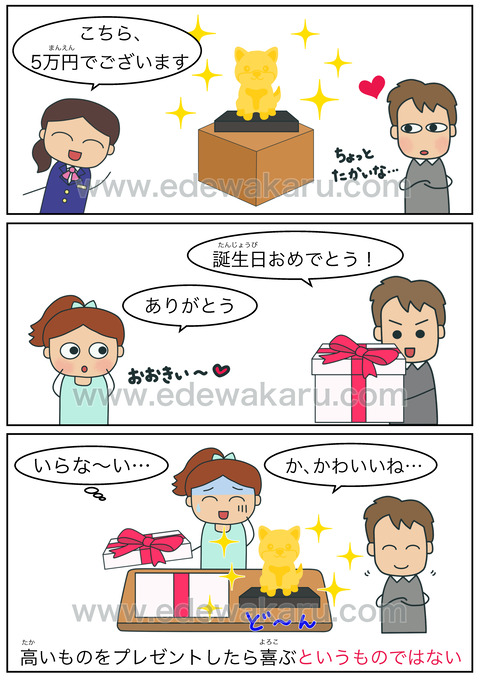
①高いものをプレゼントしたら喜ぶ
というものではない
→Many people are happy to receive an expensive present, but that isn’t always the case.
②何でも、安ければいい
というものではない
→It is wrong to think that everything is good as long as it is cheap.
③アメリカに住めば、自然に英語が話せるようになる
というものではない
→It is not true that living in America will naturally make you able to speak English.
④お金があれば幸せだ
というものではない
→Many people think that having money means being happy, but that isn’t always the case.
⑤謝ればいい
というものではないよ!
→It is wrong to think that apologizing is all you have to do!
There are many sentence patterns containing “もの” or “という,” so be sure to review them. 😊
[Related patterns]
In context 5 examples
高いものをプレゼントしたら喜ぶというものではない
Giving someone an expensive present doesn’t necessarily make them happy.
何でも、安ければいいというものではない
It’s not the case that everything is good as long as it’s cheap.
アメリカに住めば、自然に英語が話せるようになるというものではない
Living in America doesn’t necessarily mean you’ll naturally become able to speak English.
お金があれば幸せだというものではない
Having money doesn’t necessarily make you happy.
謝ればいいというものではないよ!
It’s not as if apologizing is all you have to do!
Read the original source text
Meaning
必ず〜だとは言えない
How to use it
動詞・形容詞・名詞[普通形]+というものではない
*な形容詞・名詞の現在肯定形の場合は「ーだ+というものではない」でもOK
Explanation
「Aというものではない」は「必ずAだとは言えない」「いつもAが正しいのではない」という意味の文型です。「普通に考えると、Aの場合が多いがAではない場合もある」というように[一部否定]として使われる場合と、「Aが100%正しいのではない」というように[婉曲否定(えんきょくひてい)]として使用される場合があります。
[例]
①高いものをプレゼントしたら喜ぶ
というものではない
→高いものをプレゼントしたら喜ぶ人が多いが、そうではない場合もある
②何でも、安ければいい
というものではない
→何でも安ければいいというのは間違えだ
③アメリカに住めば、自然に英語が話せるようになる
というものではない
→自然に英語が話せるようになるというのは正しくない
④お金があれば幸せだ
というものではない
→多くの人はお金があれば幸せだと思うが、そうでない場合もある
⑤謝ればいい
というものではないよ!
→謝ればいいと思っているのは間違いだよ!
「もの」や「という」がつく文型はたくさんありますので、復習をしておきましょう😊
【関連文型】
日本語文型辞典
Meaning
Explanation: Expresses that a certain claim or way of thinking cannot be said to be entirely valid. As in ② and ③, it may also be said as というものでもない, which softens the negation of that claim or way of thinking. Example sentences: ① It's not enough for food simply to be cheap. ② A car isn't necessarily good just because it's fast, either. ③ Just because you graduated from a famous university doesn't mean you'll be happy. ④ Just because people have freedom doesn't mean they can do anything they want.
Read the original source text
Meaning
基本情報説明ある主張や考え方について、それが全面的に妥当だとは言えないという意味を表す。②③のように「というものでもない」とも言い、その場合、その主張や考え方をやや婉曲に否定している。例文① 食べ物などは、安ければそれでいいというものではない。② 速ければそれだけでいい車だというものでもないだろう。③ 有名な大学を卒業したからといって、それで幸せになれるというものでもない。④ 人には自由があるからといって、何をしてもよいというものではない。
日本語文型辞典 英語版
Meaning
Means that an assertion or way of thinking does not necessarily apply in all cases. As in
(2)
and
(3)
, the expression というものでもない may also be used. In such cases, the effect is to refute the assertion or thinking in question in a slightly roundabout way.
In context 4 examples
食べ物などは、安ければそれでいいというものではない。
For things like food, it’s not a case of the cheaper, the better.
速ければそれだけでいい車だというものでもないだろう。
You don’t really think that a car is good if it’s just fast, do you?
有名な大学を卒業したからといってそれで幸せになれるというものでもない。
Just because someone graduates from a famous university doesn’t mean that she’ll be happy in life.
人には自由があるからといって何をしてもよいというものではない。
The fact that someone has freedom doesn’t mean they can do whatever they want.
くらべてわかる日本語表現文型辞典
Meaning
You might think that if X is the case, A must be true, but it cannot be said that this is always so.
How to use it
In context 4 examples
この仕事は資格をもっていれば、だれでも出来るというものではない。
It’s not the case that anyone can do this job just by having the qualifications.
金さえあれば、幸せというものでもない。
Having money alone doesn’t necessarily make you happy.
最近は痩せている女性のほうが人気があるが、ただ痩せていれば美しいというものでもない。
These days, slimmer women are more popular, but being thin alone doesn’t necessarily make you beautiful.
何だ!彼女のあの服は。高けりゃいいってものじゃないよ。
What is that outfit she’s wearing? Just because it’s expensive doesn’t mean it’s good.
Read the original source text
Meaning
XならAだと思われるかもしれないが、一概にそうとは言えない。
How to use it
日本語NET JLPT文法解説まとめ
Meaning
It's not always the case that ~.
Used with the same meaning as the partial negation 「〜わけではない」.
How to use it
Plain form + というものではない
Na・Nだ + というものではない
Explanation
"not necessarily / not always"
In context 5 examples
スポーツはただ練習すればできるようになるというものではない。
It's not as if you can learn to play a sport just by practicing.
外国語はただ文法を覚えれば話せるというものではない。
It's not as if you can speak a foreign language just by memorizing grammar.
何でもかんでも安ければいいというものではない。
It's not necessarily true that everything is good as long as it's cheap.
お金があれば、幸せだというものでもない。
Having money doesn't necessarily make you happy.
辞めれば済むってものじゃないよ。きちんと責任をとってほしい。
It's not as simple as just quitting. I want you to take proper responsibility.
Read the original source text
Meaning
いつも〜とは言えない。
部分否定の「〜わけではない」と同じ意味で使われる。
How to use it
普通形 + というものではない
Na・Nだ + というものではない
Explanation
"not necessarily / not always"
毎日のんびり日本語教師
How to use it
Sentence plain form + というものではない
Sentence plain form + というものでもない
Explanation
This sentence pattern states the speaker’s subjective opinion or way of thinking and rejects something categorically.
「~というものでもない」 is a somewhat indirect expression of negation. 「~というものではない」 is a direct expression of negation and therefore has a stronger tone.
「ただ」 can sometimes be used in the first part.
Colloquial forms are 「っていうもんじゃない」 and 「ってもんじゃない」.
When rejecting someone’s simplistic way of thinking, the pattern 「(ただ)~ばいいというものではない」 is often used.
Examples (1), (2), (3), and (7).
Notes
Related grammar: [N2 Grammar] ~というものだ/ってもんだ
In context 8 examples
個性は強ければいいというものでもない。
It’s not necessarily better to have a strong personality.
部下の失敗はただ叱れば良いというものではない。(部下的失败并不只是训斥就好。)
You can’t just scold a subordinate for making a mistake and think that’s enough. (Simply scolding a subordinate for a mistake isn’t enough.)
情報が多ければ判断が楽というものではない。(信息越多判断并不容易。)
Having more information doesn’t necessarily make it easier to make a decision. (The more information you have, the easier it isn’t necessarily to decide.)
すぐにできるというものではないので、気長に続けていくうちに身につけられたらいいです。
You can’t master it right away, so I hope you’ll keep at it patiently and gradually learn it.
健康のためにはただ食べればよいというものではなく、運動もしなければならない。
For your health, you can’t just eat; you also have to exercise.
教科書に書いていることが絶対的に正しいというものでもない。
What is written in textbooks is not necessarily absolutely correct.
サプリメントは何でもかんでも飲めばいいってもんじゃない。
You can’t just take any supplement indiscriminately.
休めるときには休んでおくべきで、無理をすればいいというものではない。
You should rest when you can; pushing yourself isn’t necessarily the answer.
Read the original source text
How to use it
文の普通形+というものではない
文の普通形+というものでもない
Explanation
話者の主観的な意見や考え方を述べ、ある物事について全面的に否定する文型です。
「~というものでもない」はやや婉曲的な否定表現です。「~というものではない」は直接的な否定表現のため語気が強いです。
前件には「ただ」が呼応することがあります。
口語形は「っていうもんじゃない」「ってもんじゃない」です。
相手の安直な考え方を否定する場合には「(ただ)~ばいいというものではない」の文型がよく用いられます。
例文(1)(2)(3)(7)。
Notes
関連文法:【N2文法】~というものだ/ってもんだ
どんなときどう使う 日本語表現文型辞典
Usage 1
Meaning
It can't be said that; it's not the case
How to use it
〔Plain form〕 + というものではない
Explanation
~とはいえない
1)「いつも必ず~とは言えない」と言いたいときの表現。ある主張や考えが正しいと言えないこともあると婉曲に、または部分的に否定する言い方。
2) ❷ ❸ のように「~ばいいというものでは(も)ない」という形でよく使う。
2)Often used in pattern ~ばいいというものでは(も)ない as in sentences ❷ and ❸ .
1)Something isn't always the case. Euphemistically states certain assertion or idea cannot be considered correct. Also used to partially negate something.
In context 4 examples
楽器は習っていれば自然にできるようになるというものではない。練習が必要だ。
It’s not as though you’ll naturally learn to play an instrument just by taking lessons. You need to practice.
会議では何を言うかが大切だ。ただ出席していればいいというものではない。
What matters in a meeting is what you say. It’s not enough just to attend.
鉄道は速ければいいというものでもありません。乗客の安全が第一です。
It’s not necessarily better for trains to be faster. Passenger safety comes first.
まじめな人だから仕事ができるというものでもない。
Being a serious person doesn’t necessarily mean you’re good at your job.
Read the original source text
Meaning
It can't be said that; it's not the case
How to use it
〔普通形〕+というものではない
Explanation
~とはいえない
1)「いつも必ず~とは言えない」と言いたいときの表現。ある主張や考えが正しいと言えないこともあると婉曲に、または部分的に否定する言い方。
2) ❷ ❸ のように「~ばいいというものでは(も)ない」という形でよく使う。
2)Often used in pattern ~ばいいというものでは(も)ない as in sentences ❷ and ❸ .
1)Something isn't always the case. Euphemistically states certain assertion or idea cannot be considered correct. Also used to partially negate something.
Usage 2
Meaning
It can't be said that; it's not the case
How to use it
〔Plain form〕 + というものではない
Explanation
というものではない
~とはいえない
1)「いつも必ず~とは言えない」と言いたいときの表現。ある主張や考えが正しいと言えないこともあると婉曲に、または部分的に否定する言い方。
2) ❷ ❸ のように「~ばいいというものでは(も)ない」という形でよく使う。
2)Often used in pattern ~ばいいというものでは(も)ない as in sentences ❷ and ❸ .というものではない
1)Something isn't always the case. Euphemistically states certain assertion or idea cannot be considered correct. Also used to partially negate something.
In context 4 examples
楽器は習っていれば自然にできるようになるというものではない。練習が必要だ。
It’s not as though you’ll naturally learn to play an instrument just by taking lessons. You need to practice.
会議では何を言うかが大切だ。ただ出席していればいいというものではない。
What matters in a meeting is what you say. It’s not enough just to attend.
鉄道は速ければいいというものでもありません。乗客の安全が第一です。
It’s not necessarily better for trains to be faster. Passenger safety comes first.
まじめな人だから仕事ができるというものでもない。
Being a serious person doesn’t necessarily mean you’re good at your job.
Read the original source text
Meaning
It can't be said that; it's not the case
How to use it
〔普通形〕+というものではない
Explanation
というものではない
~とはいえない
1)「いつも必ず~とは言えない」と言いたいときの表現。ある主張や考えが正しいと言えないこともあると婉曲に、または部分的に否定する言い方。
2) ❷ ❸ のように「~ばいいというものでは(も)ない」という形でよく使う。
2)Often used in pattern ~ばいいというものでは(も)ない as in sentences ❷ and ❸ .というものではない
1)Something isn't always the case. Euphemistically states certain assertion or idea cannot be considered correct. Also used to partially negate something.