DoJG 日本語文法辞典(全集)
Meaning
Only; just; alone
How to use it
(i) Noun | のみ(Particle) | |
| 学生のみ(が)来た | Only students came |
| 学生のみ(を)呼ぶ | Invite students only |
(ii) Noun | {Particle のみ/のみ Particle} | |
| 学生{にのみ/のみに}話す | Talk only to students/talk to students only |
(iii) Vinformal | のみだ | |
| {行く/行った}のみだ | Only go/went |
Explanation
A particle which expresses a limit imposed upon an action, event, or a state.
In context 8 examples
要点のみ(を)話して下さい。
Please tell me just the main point.
これは吉田先生にのみ話してあります。
I have told this only to Professor Yoshida.
勝てるかどうか分からないが、ベストを尽くすのみだ。
I don't know whether I can win or not, but I will just do my best.
この答えは私のみ(が)知っている。
Only I know the answer to this.
姓のみ記入のこと。
Write your surname only.
私はただ言われたことをするのみだ。
I will just do what I was told to do.
ただ実行あるのみ(だ)。
The only thing we have to do is to put it into practice.
外装が終わったのみでまだほかは何も手が着いていない。
We've just finished the exterior and haven't started anything else yet.
どんなときどう使う 日本語表現文型辞典
Meaning
the only thing that…
How to use it
ただ + N / 〔Plain form〕 (ナAである / Nである) + のみW
Explanation
ただ~のみ
ただ~だけ
「ただ~だけ」と限定するときの表現。硬い書き言葉。
Sets limits on something. Very formal written expression.ただ
In context 4 examples
マラソン当日の天気、選手にとってはただそれのみが心配だ。
For the runners, the only thing they worry about is the weather on the day of the marathon.
戦争直後、人々はただ生きるのみでせいいっぱいだった。
Immediately after the war, people had all they could do just to survive.
ただ厳しいのみではいい教育とは言えない。
Being strict alone does not make for a good education.
今はもう過去を振り返るな。ただ前進あるのみ。
Don't look back on the past anymore. All that's left is to move forward.
Read the original source text
Meaning
the only thing that…
How to use it
ただ+N/〔普通形〕(ナAである/Nである)+のみW
Explanation
ただ~のみ
ただ~だけ
「ただ~だけ」と限定するときの表現。硬い書き言葉。
Sets limits on something. Very formal written expression.ただ
絵でわかる日本語
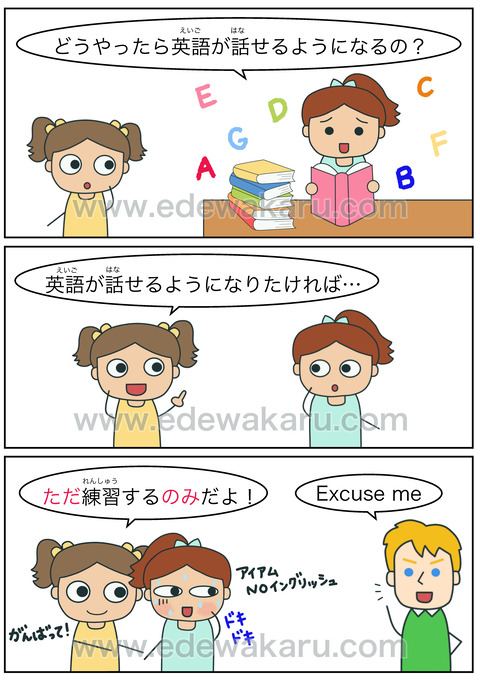
Meaning
Only...; nothing but...
There is no choice but to...
How to use it
ただ + verb, い-adjective, or noun [dictionary form] + のみ
ただ + な-adjective
Explanation
“ただ〜のみ” is a sentence pattern meaning “only...” or “there is no choice but to....” It is a formal way of saying “ただ〜だけだ,” and emphasizes that “there is no other option” or “there is only one thing that must be done.” “ただ” can be omitted. With a verb formed with する, both “〜するのみ” and “〜あるのみ” are used.
[Example]
If you want to get better at English, all you can do is practice.
= If you want to get better at English, there is nothing to do but practice.
“ただ〜のみ” is a formal expression, but those taking the N1 exam should remember it. 😊
In context 5 examples
英語が話せるようになりたければ、ただ練習するのみだよ!
→話せるようになりたければ、練習するしかないよ!If you want to be able to speak English, all you can do is practice!
A:明日の運動会、楽しみだね!B:うん。雨が降らないことをただ願うのみだよ〜→雨が降らないことをただ願うだけだよ〜
A: I’m looking forward to tomorrow’s sports day! B: Yeah. All I can do is hope it doesn’t rain. → All I can do is hope it doesn’t rain.
やれることはやった。あとはただ結果を待つのみだ
→あとはただ結果を待つだけだI’ve done what I can. All that’s left is to wait for the results. → All that’s left is just to wait for the results.
部長を怒らせたくなければ、ただ我慢するのみだ…
→ただ我慢するしかない…If you don’t want to make the department manager angry, all you can do is put up with it... → There’s nothing to do but put up with it...
A:彼女にふられたんだ…B:彼女のことなんて忘れて、ただ仕事に集中するのみだよ
→ただ仕事に集中するだけだよA: She dumped me... B: Just forget about her and focus on your work. → Just focus on your work.
Read the original source text
Meaning
ただ〜だけだ
〜するしかない
How to use it
ただ+動詞・い形容詞・名詞[辞書形]+のみ
ただ+な形容詞
Explanation
「ただ〜のみ」は「ただ〜だけ」「〜するしかない」という意味の文型です。これは「ただ〜だけだ」のかたい言い方で、「〜以外にない」「しなければいけないことは1つしかない」ということを強調します。「ただ」は省略することができます。[する動詞]を使う場合は「〜するのみ」 だけでなく「〜あるのみ」という形もあります。
[例]
英語が上手になりたいなら、
ただ
練習
するのみ
だ
=英語が上手になりたいなら、
ただ
練習
ある
のみ
だ
「ただ〜のみ」はかたい言い方ですが、N1を受ける人は覚えておきましょう😊
日本語文型辞典
Meaning
Expresses the meaning “only that much.” Used in formal, written-style expressions. In speech, 「だけ」 or 「ばかり」 is used.
Means “nothing but that.” It may indicate that something is just about to be done, as in ①, or that the action is done exclusively, as in ②. It can be paraphrased as 「…するばかりだ」.
Follows nouns such as 「前進」, 「努力」, and 「忍耐」 to mean “that is all that needs to be done.”
How to use it
Nのみ
V-るのみだ
Nあるのみだ
In context 7 examples
経験のみに頼っていては成功しない。
You won't succeed if you rely only on experience.
金持ちのみが得をする世の中だ。
It's a world where only the rich benefit.
洪水の後に残されたのは、石の土台のみだった。
The only thing left after the flood was the stone foundation.
準備は整った。あとはスイッチをいれるのみだ。
The preparations are complete. All that's left is to flip the switch.
早くしなければと焦るのみで、いっこうに仕事がはかどらない。
I'm just worrying that I have to hurry, but my work isn't progressing at all.
こうなったからは前進あるのみだ。
Now that things have come to this, all we can do is move forward.
成功するためには、ひたすら努力あるのみです。
To succeed, all you need is single-minded effort.
Read the original source text
Meaning
それだけと限る意味を表す。書きことば的なかたい表現に用いられる。話しことばでは「だけ」や「ばかり」が用いられる。
「それだけである」の意味。①のようにある動作が行われる直前の状態にあることを示す場合や、②のようにもっぱらその動作ばかりが行われることを表す場合がある。「…するばかりだ」に言いかえられる。
「前進」「努力」「忍耐」などの名詞を受けて、「すべきことはそれだけだ」という意味を表す。
How to use it
Nのみ
V-るのみだ
Nあるのみだ
日本語文型辞典 英語版
Meaning
Means to restrict something to just one thing. Used in formal language with the tone of written Japanese. In spoken Japanese, だけ and ばかり are used.
Means “only that.” Can indicate being in a state right before a certain action is carried out, as in
(1)
, or that a certain action is performed exclusively and repeatedly, as in
(2)
. Can be paraphrased as ...するばかりだ.
Placed after nouns like 前進 (progress/advance), 努力 (effort), and 忍耐 (patience) and means “that is the only thing one should do.”
How to use it
1. Nのみ
2. V-るのみだ
3. Nあるのみだ
In context 7 examples
経験のみに頼っていては成功しない。
You’ll never succeed if you depend only on experience.
金持ちのみが得をする世の中だ。
Only the rich gain advantages in this world.
洪水の後に残されたのは、石の土台のみだった。
It was only the stone foundation that was left after the flood.
準備は整った。あとはスイッチをいれるのみだ。
Everything is ready. All that’s left is to switch it on.
早くしなければと焦るのみで、いっこうに仕事がはかどらない。
All I do is rush to get things done quickly, and I don’t make any progress with my work at all.
こうなったからは前進あるのみだ。
Since things have ended up like this, there’s nothing we can do but move forward.
成功するためには、ひたすら努力あるのみです。
In order to succeed, all you have to do is devote yourself to hard work.
Read the original source text
Meaning
Means to restrict something to just one thing. Used in formal language with the tone of written Japanese. In spoken Japanese, だけ and ばかり are used.
Means “only that.” Can indicate being in a state right before a certain action is carried out, as in
(1)
, or that a certain action is performed exclusively and repeatedly, as in
(2)
. Can be paraphrased as ...するばかりだ.
Placed after nouns like 前進 (progress/advance), 努力 (effort), and 忍耐 (patience) and means “that is the only thing one should do.”
How to use it
1. Nのみ
2. V-るのみだ
3. Nあるのみだ
くらべてわかる日本語表現文型辞典
Meaning
Meaning 1: Emphasizes that there is nothing other than A to mention, and that A alone is B.
Meaning 2: An expression emphasizing the small number of A: only A is B.
How to use it
Tada A nomi B (tada A nomi da)
Tada [Verb - dictionary form] nomi
Tada [Noun - ∅] nomi
Explanation
【Contrast 1, 2】
“Tada A dake da”
“Tada A nomi da” is a somewhat old-fashioned expression and therefore sounds a little formal. “Tada A nomi da” strongly conveys the meaning of “the only one,” whereas “tada A dake da” can convey meanings such as limitation, so it has a broader range of meanings.
○となりの人とは、ただあいさつするだけです。 — I only exchange greetings with the person next door.
×となりの人とは、ただあいさつするのみです。 — I only exchange greetings with the person next door.
Notes
【Note 2】
・“Tada A nomi B” is more formal than “tatta A nomi B.”
・“Tada A nomi narazu B” is “A nomi narazu B” (p. 270).
In context 8 examples
子どもは3人いるが、今はただ末っ子のことのみが気がかりだ。
I have three children, but right now the youngest is the only one I’m worried about.
彼女は私が何を言ってもただうなずくのみで、何も言わない。
No matter what I say, she only nods and says nothing.
試験は1問も解けぬまま、ただ時間が虚しく過ぎるのみだった。
I couldn’t solve even one question on the exam; all I could do was watch time pass pointlessly.
留学したからにはどんな困難があってもただ前進あるのみだ。
Now that I have studied abroad, all I can do is keep moving forward, no matter what difficulties arise.
あの事故の生還者はただ一人のみだった。
There was only one survivor of that accident.
日本はオリンピックに大選手団を送り込んだが、金メダルがとれたのはただ(の)二人のみだった。
Japan sent a large team of athletes to the Olympics, but only two won gold medals.
締め切り日までただ1カ月を残すのみとなった。
There is now just one month left until the deadline.
その村で洪水の被害を免れたのは、ただ2軒のみだった。
Only two houses in that village escaped flood damage.
Read the original source text
Meaning
意味1:取り上げて述べることがA以外になく、AだけがBだと強調する。
意味2:Aの少ない数を強調する表現。たったAだけがBだ。
How to use it
ただAのみB(ただAのみだ)
ただ[動詞-る形]のみ
ただ[名詞-∅]のみ
Explanation
【対比1,2】
「ただAだけだ」
「ただAのみだ」はやや古い表現のため、少し堅い感じがある。「ただAのみだ」は唯一という意味合いが強いが、「ただAだけだ」には限定などの意味があり、意味範囲は「ただAだけだ」の方が広い。
○となりの人とは、ただあいさつするだけです。
×となりの人とは、ただあいさつするのみです。
Notes
【注意2】
・「ただAのみB」は「たったAのみB」より硬い表現。
・「ただAのみならずB」は「AのみならずB」(P.270)
Yokubi — The Common Grammar Guide (https://yoku.bi)
Explanation
だけ, のみ, and ばかり are variations of "just" or "only". しか is similar, but it can only be used in negative statements.
だけ means "just so", in terms of amount. It acts like a particle.
のみ is like a less colloquial だけ.
ばかり is yet another "only" word. It can also be pronounced ばっか or ばっかり. Xばかり focuses on everything falling within the definition of X as being true, whereas だけ and のみ focus on things that fall outside of the statement being false. Think of the difference in vibes between "There is only this" and "There is nothing else".
The structure \<verb\>てばかりいる is often used to convey a critical attitude towards someone stating they do just one thing over and over to the point where it's detrimental.
ばかり can also be used with temporal statements to convey how soon or early something happened.
しか is used with negative statements to convey the same meaning as だけ but with the focus on everything else that is not what is being marked.
The compound だけしか exists too. It works exactly the same as しか but has stronger emphasis.
In context 1 examples
味付けは塩コショウのみ。
There is only salt & pepper as flavoring
IMABI
The Particle のみ
Read this IMABI lesson ↗Explanation
The Particle のみ
The adverbial particle のみ1 shows up in literary-style language for the purpose of singling out one entity, translating neatly into English most of the time as “only.”
As opposed to the far more ubiquitous particle だけ, のみ is highly literary in tone. This is not to say, however, that it is “honorific” by nature.
i. 男性のみ
Male-only
ii. 補助金対象のみの見積書
Estimates for subsidy-eligible items only
iii. このアプリは、最初は、Androidのみの対応で、iPhoneは一足遅れて対応となった。
Initially, this app supported Android only, with support for iPhone following one step behind.
While it is largely synonymous with the particle だけ, のみ draws focus onto the individual thing that the predicate is being restricted to, as opposed to pertaining to “extent.”
The Adverbial Particle のみ
The primary function of the adverbial particle のみ is to denote restriction on a single entity, and that entity may be a thing or a state. The particle のみ appears most often after nominal phrases.
1. この村のみがミカンを生産している。
Only this village produces mandarin oranges.
2. 神のみぞ2知る。
Only God/the gods know(s).
3. 緊急の場合にのみ連絡せよ。
Contact only in case of an emergency.
4. 入場は招待者のみ可3
Admission by invitation only
5. 台風被害は深刻だったが、次第に整備され車の通れない箇所は一か所のみとなった。
Although the damage caused by the typhoon was severe, repairs were gradually carried out, and now only a single section (of road) remains impassable to vehicles.
6. 公認された博打のみが合法です。
Only authorized gambling is legal.
7. この村は、ミカンのみ(を)生産している。
This village produces only mandarin oranges.
8. 広島市は、日本に大使館のある国にのみ招待状を送っている。
Hiroshima City sends invitations only to countries that have an embassy in Japan.
9. 女性のみ(の)求人が可能です。
Job postings exclusively for women are permitted.
10. そのイタリア料理店は、イタリア郷土料理とイタリア産のワインのみを提供している。
That Italian restaurant serves only regional Italian cuisine and wines produced in Italy.
When the particle のみ appears after predicates, there is a strong sense of “all there is left to do is X” for verbal predicates. It is also often the case that the adverb ただ is added for emphasis at the start of the whole clause being restricted by のみ, but it is not required to show up in the sentence.
11. 水不足はいよいよ深刻だ。後はただ雨が降るのを待つのみだ。
The water shortage is all the more serious. The only thing to do is wait for it to rain.
12. 我々はただ忍耐にんたいがあるのみだ。
All we have is our perseverance.
13. 選手はその指示に従うのみだ。
All the players must do is follow their (coach’s) instructions.
14. 考えている暇なんてない、ただ動くのみだ。
There is no time to think; just act.
15. やれることはやったので、後はただ結果を待つのみだ。
I have done everything I can. So now, all that I can do is wait for the results.
When のみ follows a predicate, the copula usually concludes the sentence, but when the copula is not present, the sentence becomes more emphatic, with のみ truly cutting things off.
16. 老兵は死なずただ消え去るのみ。
Old soldiers never die, they just fade away.
It is also often the case to see a noun whose meaning relates to an action be followed by ある with のみ to produce ~あるのみ(だ), which can be viewed as a highly formalized alternative to ~するしかない.
17. 日々鍛錬あるのみ!
All there is to do is train—day in, day out!
18. 今はとにかく我慢あるのみ!
For now, all we can do is endure!
19. N1に合格するにはただ練習あるのみだ。
All there is to do to pass the N1 is to practice.
20. 過去のことは振り返らず、ただ前進あるのみだ。
Don’t look back at the past; simply move forward.
The particle のみ is exceedingly rare with adjectival predicates, and it cannot even attach to adjectival nouns without the intervention of である. For both adjectives and adjective nouns, のみ will usually be replaced with だけ. As is the case with verbal predicates, the adverb ただ usually accompanies のみ in this capacity.
21. ここの山河は、ただ美しいのみで、不産女
うまずめの風景といってもいい。
The mountains and rivers here are nothing but beautiful—one might even call it the landscape of barren women.
From 『宮本武蔵・水の巻』by 吉川英治.
22. ただ面白い{のみ △・だけ ◎}の映画には興味がない。
I have no interest in movies that are nothing but funny.
Note that in complete isolation for the sense of “X is just #,” のみ cannot be used with adjectival predicates at all.
23a. そのワインは高いのみだ。X
23b. そのワインは高いだけ(だ)。〇
Intended Meaning: That wine is just expensive.
のみ w/ Case Particles
When combined with the case particles が or を, のみ must come first, producing ~のみが and ~のみを. However, the dropping of が and を with のみ4 is quite common.
24. 遼平のみ(が)そのことに気づいていた。
Only Ryohei had noticed that.
25. 警察はその関係者のみ(を)逮捕した。
The police arrested only those individuals involved.
For many other case particles such as に, で, へ, と, and から, the particle のみ may come first or after the case particle. However, it is not always the case that both word orders are always correct, as the exact purpose does notably shift depending on its location to the preceding phrase. For all these case particle, のみ following after is the most common word order.
26. 初回は指定空港{のみから・からのみ}入国しなくてはいけない。
For your initial entry, you must enter through your designated airport only.
27.ランカウイ島{のみへ・へのみ}旅行予定の場合は、最低3日以上の滞在が必須となる。
If you are planning a trip exclusively to Langkawi Island, a minimum stay of at least three days is mandatory.
28. 中井は友人{にのみ ・のみに}伝えた。
Nakai told only his friends.
When のみ comes first, のみ becomes part of the definition of the nominal expression itself, then it is the predicate which determines what happens to this newly defined/restricted nominal. At times, this is grammatically necessary, which is true for the next three examples.
29. すぐに [WiFiのみ]に切り替えました。
I immediately switched to “Wi-Fi Only.”
30. [有害と認められる部分のみ]を、除きました。
(I) have removed only those parts deemed harmful.
If, however, のみ appears after a case particle, のみ affects the whole clause as an emphatic particle. In totality, this word order is preferred provided のみ is not an integral part of the nominal phrase at hand.
31. 人は思い出にのみ嫉妬する。
People are jealous only of memories.
While attention can be drawn to the fact that the agent is always/only jealous about X, we see that the function of のみ has subtly changed to emphasizing the intensity and continuous nature of the action (= the state of being jealous about X) while still retaining its literal definition of “only,” highlighting how the case information before のみ becomes just as important as the preceding noun. With emphasis now leaning more toward the predicate, the restriction at hand is at the agent’s detriment, whereby the flipside scenarios=state(s) of condition are not entertained at all due to the agent’s fixation on the sole condition at hand.
32a. 国内のみで販売されています。
It is being sold domestically only.
Implication: Emphasis is placed heavily on the location of where the sales are being made, as that is where the sales are being limited to.
32b. 国内でのみ販売されています。
It is being sold only domestically.
Implication: Sales are only being had domestically, implicitly conceding that other sales (international) are not being entertained.
With these implications in mind, consider the following grammaticality judgments.
33. このお菓子は地域限定で、九州{でのみ ◎・のみで 〇/△}販売されている。
This confection is a regional exclusive and is sold [only in Kyushu/in Kyushu only (△) ].
While highly fixating on 九州 as the be-all location is not inherently wrong to state, shifting the emphasis closer to the predicate tends to be the more natural choice.
Incidentally, there are situations in which のみ cannot be used after で , either because のみ marks the exclusivity of components (Ex. 34) or because で denotes the end of a dependent clause (Ex. 35).
34. 核家族とは、夫婦とその未婚の子{のみで 〇・でのみ X}構成される家族を指す。
The “nuclear family” consists solely of a married couple and their unmarried children.
35. その仕事を担当するのは{彼のみで 〇・でのみ X}問題ない。
It is perfectly fine for him alone to be in charge of the work.
When combined with the case particle の, のみ must always appear first.
37. 空欄のみの問題なので,なるべく効率の良い解法を目指しました。
Since they are fill-in-the blank questions, I aimed for the most efficient means of answering them.
38. ポピュリズム政治は、政治家のみの問題ではなく、民主主義そのもののもつ性質から必然的に生まれ、政治家が利用しているものである。
Populist politics is not merely an issue concerning politicians; rather, it emerges inevitably from the very nature of democracy itself—a characteristic that politicians subsequently exploit.
Historical Sidenote
When のみ first appeared in the written record, it notably always appeared first in combination with other case particles. This can largely be attributed to its etymology. However, for the majority of Japanese history, its role as an adverbial modifier prompted it to largely occur after case particles the about 90% of the time, which is why many speakers today view it as the “traditional” word order, despite it not being the “oldest” word order.
Nonetheless, shifting where のみ appears in relation to case particles does shift the balance of emphasis. If it appears before a case particle, then the argument can be made that the “limitation” set by のみ is largely on the noun itself, whereas if it is placed after a case particle, the “limitation” set by のみ affects the whole clause.
~のみならず
Translating into English as “not only,” the grammar pattern ~のみならず is a combination of the adverbial particle のみ and the classical copula verb なり in the negative, with the negative auxiliary ~ず being used in the 連用形. In more modern language, ~のみならず is fairly innocuously replaceable with ~だけでなく. This is because while のみ strongly holds onto its literal sense of “only,” on the basis of speech register, outside of stiffer, literary-stilted language, it inevitably gets replaced by だけ. First, let’s look at sentences utilizing ~のみならず after nouns.
39. 獺祭といえば、国内のみならず、海外でも人気の日本酒だ。
Speaking of Dassai, it is a sake that is not only popular domestically but abroad as well.
40. この水族館には、深海魚{のみならず・だけでなく}、熱帯魚もいます。
In this aquarium, there are not only deep-sea fish but also tropical fish.
Although in isolation, ~のみ is seldom encountered with adjectival predicates, they become more compatible with ~のみならず, although the adjective/adjectival noun in question will often be preceded by the adverb ただ.
41. 富士山はただ高いのみならず、美しいのです。
Mount Fuji is not just tall, but it is also beautiful.
42. デザインはひどいのみならず、内装もひどい。
Not only is the design terrible, but the interior is terrible as well.
~のみならず may also appear after verbal predicates. With stative predicates, X is not the only sole state qualifying the subject, and with dynamic predicates, X is not the sole action being taken by the agent.
43. 私たちは犯罪の原因を追及するのみならず、犯罪の機会をなくすることが重要ではないでしょうか。
Wouldn’t it be important for us not only to investigate the causes of crime but also to eliminate the opportunities for people to commit crimes?
44. 景観として優れているのみならず、他の地域では見られない動植物たちの貴重な生息地にもなっています。
Not only does it offer outstanding scenic beauty, but it also serves as a precious habitat for flora and fauna found nowhere else.
45. 環境負荷の少ない自然エネルギーは、地球温暖化防止に役立つのみならず、地震のような災害時でも利用が可能であり、新たな産業振興、地域振興にもつながるものである。
Natural energy resources, which impose minimal burden on the environment, not only contribute to preventing global warming but can also be utilized during disasters such as earthquakes; furthermore, they lead to the promotion of new industries and regional revitalization.
~のみか
Highly rare in Modern Japanese, the grammar pattern ~のみか bears the meaning of “not only (that),” and its best more modern equivalent is ~ばかりか5. As will be described in greater detail, the reason for why のみ has been supplanted by ばかり in the case can be attributed to how literal its exclusivity is interpreted.
Although that very exclusivity is shown to not be the case via the particle か and the clause that follows, there is a greater sense of surprise implied by the use of ばかり. It is also worth noting that neither pattern may be followed by clauses pertaining to commands, requests, or statements of volition.
46. 由紀子は感謝しない{のみか・ばかりか}逆に恨んでいる。
Far from being grateful, Yukiko actually harbors resentment.
There is also a palpable difference between ~のみか and ~ばかりか when it comes to “extent.”
47. テイラー君は漢字{ばかりか ・のみか }ひらがなさえ書けない。
Not only can Taylor-kun not write kanji, he can’t even write hiragana.
It is one thing for a learner of Japanese to not know how to write kanji, but for that inability to be extended to hiragana, now that takes the learner’s illiteracy to another level, thus ばかりか. Now, it is still possible for kanji to just be the problem or by no means the only problem, thus のみか serves as a more literal role of stating two situations that are occurring in the context of the first situation not being the sole situation and that the second situation is just as in need of being singled out in the same breath.
48. 由紀子は感謝しない{ばかりか ◎・のみか 〇}、恨んでさえいる。
Yukiko not only fails to show gratitude, but she also goes so far as to harbor resentment.
While Ex. 48 is only a marginally altered version of Ex. 46, it is now more parallel in structure ~のみか and ~ばかりか can be. Due to just how rare ~のみか is, ~ばかりか will always be the more natural choice. As for how “not being grateful” and “resenting” relate, it is far easier to juxtapose these states in the sense of “not only is the case that Yukiko is…, it is also the case that she is…,” which would lean toward ~のみか, but given how emotionally charged both scenarios are, ~ばかりか would be more likely chosen to highlight how the extent of Yukiko’s poor attitude covers more than one issue.
As is always the case with synonymous phrases, the fine lines are always there. Whether those fine lines really differ in any practical sense, now that is left to both speakers and listeners to squawk about.
~だけでなく vs ~のみならず vs ~ばかりか (のみか) , etc.
With ~のみならず, ~ばかりか, and ~のみか all translating into English as “not only,” it may be tempting to assume that the structures are wholly interchangeable. However, the statements that they are used in are quite different in nature.
As demonstrated in Exs. 38-43, statements made with ~だけでなく and ~のみならず are fairly generic in nature. The speaker is merely tacking on something else that is the case, with the difference between them being solely how formal the tone is.
49. ポケモンは、子供{だけでなく 〇・のみならず △}大人でも楽しめます。
Pokémon can be enjoyed not only by children but also by adults.
50. ポケモンというゲームソフトシリーズは、日本のみならず、世界でも有名である。
The Pokémon video game series is famous not only in Japan but throughout the world.
Meanwhile, ~ばかりか adds a level of surprise, making the situation being tacked on (Y) sound more serious than it otherwise would. Though “surprise” might not be quite the right word for describing how Y is interpreted with ~のみか, Y has the same heightened level of severity from X not solely being the case.
51. ラファエル君は、無断欠席が多い{ばかりか・のみか}、出勤しても真面目に働かず周りに迷惑をかけたりする。
Not only does Rafael-kun frequently miss work without permission, even when he does show up, he fails to work conscientiously and ends up causing issues for those around him.
Even more phrases in Japanese can translate as “not only” into English, but there is always a layer of nuancing that cannot be ignored. Take for instance, Xはもちろん(のこと)Y and XはもとよりY. To account for this nuancing, the English translations will steer away from “not only” so that you may see how more parallel things are worded than you would otherwise expect.
52. セスさんは、英語はもちろん(のこと)、カタルーニャ語も話せるそうです。
I hear that Seth speaks Catalan, in addition to English of course.
53. セスさんは、英語はもとより、カタルーニャ語も喋れますよ。
Seth speaks English, of course, but he also speaks Catalan.
In both cases, X is deemed only natural, with the spin added to もとより being that X is principally the case by default. At times, Y need not always be as likely to occur, but it is a welcomed attribute just as naturally as is X.
54. 会員{だけでなく・はもちろんのこと・はもとより}一般のお客さんも割引価格でご購入いただけます。
[Not just members/Members, of course, yes/Members by default, yes], but also customers from the general public are able to make purchases at discounted prices.
If the speaker wishes to state that an extent is not be limited to X, but that it will be extended to Y, then the grammar pattern ~に限らず may be employed. It must also be noted that X and Y are limited to nouns, meaning neither constitute predicates. As far as translating into English goes, “not limited to” is both literal and more than sufficient to understand how it works.
55. まずは政治の話に限らず、どんな話でもオープンに話せる親子になれたらいいですよね。
First and foremost, wouldn’t it wonderful to have the kind of parent-children relationship in which anything can be talked about openly? And I’m not just talking about politics.
56. 先生は、ピアノや音楽に限らず、様々なことを私に教えてくださいました。
My teacher taught me a great many things—by no means limiting themselves to the piano or music.
57. そもそも生成文法に限らず、言語学というのは言語が持つ様々な仕組みや性質を理解しよう、という試みなので、その記述や説明の妥当性と教育に使えるかどうかは原理的に関係無いはずだ。
Fundamentally—and this applies not only to generative grammar—linguistics is an endeavor to understand the various mechanisms and properties inherent in language; therefore, in principle, the validity of its descriptions and explanations should be entirely unrelated to whether or not they can be applied in an educational context.
If X and Y are within the same range/extent=ballpark, ~に限らず will become ungrammatical. In which cases, ~のみならず might be your next best bet.
58. 泥棒は、窃盗{のみならず ◎・に限らず X}、器物破損の罪で重い刑を受けた。
The thief received a severe sentence for not only theft but also property damage.
Reasoning: Both “theft” and “property damage” constitute crimes that a thief would generally commit.
59. メキシコ料理は、タコス{だけでなく 〇・のみならず X・に限らず X}、エンチラーダなども大好きだよ。
I love Mexican food—not just tacos, but things like enchiladas, you name it.
You may also find that ~にとどまらず translates to “not only.” This pattern is used when an extent/parameter is exceeded, with that extension to Y being unexpected. Interestingly, X must not be a finite range. There needs to be some substance to the range of X already that warrants mentioning that what is happening goes beyond said range. If one wishes to have the parameter limited to a finite entity anyway, then either だけ or のみ must intervene so that the range in question is elevated to a similar level of severity.
60. 平日にとどまらず、週末にも仕事をするようになってしまった。
I have reached the point where I am working not on weekdays but on weekends as well.
61. 津波の被害は海岸部{だけ・のみ}にとどまらず、内陸の広い地域にまで達した。
The damage caused by the tsunami was not limited to the coastal areas; it extended vastly into the interior as well.
Unlike ~に限らず, ~にとどまらず may appear after verbal predicates. As to the nature of the verbal predicates, they will always pertain to extent.
62. その発見は、日本中の注目を集めたにとどまらず、全米にも知られるようになった。
That discovery didn’t just capture the attention of all Japan, it also became known throughout the United States.
~をのみ
Mentioned as being archaic earlier, we will look at an example of ~をのみ from Classical Japanese which helps demonstrate how のみ functions an adverbial modifier.
63. 御心をのみ惑はして去りなむことの悲しく耐へがたく侍るなり。
I find it sad and unbearable that I have done nothing but cause you emotional turmoil and will soon leave.
From the『竹取物語』.
In this example, there is a clear and evident emphasis on the intensity and continuous nature of the emotional turmoil being caused. In this sentence, the speaker would have undoubtedly thought it strange to use ~のみを instead, as then 心 would somehow be fixated upon as opposed to the fact that the action=predicate continues to be nothing but what the agent is doing. In Modern Japanese, のみ alone would suffice without the intervention of を at all, but the inclusion of を afterward would still be fairly unnatural for the same reason.
のみ vs ばかり
Incidentally, both ~をのみ and ~にのみ beg the question of how does のみ truly differ from ばかり if both particles seemingly pertain to the intense fixation on one action. In older stages of Japanese, the overlap would have been more severe, as のみ appeared in the capacity of “limitation” well before ばかり did, yet even after のみ became eclipsed by ばかり in this capacity, so too were both ultimately largely supplanted by だけ—with the modern speaker differentiating all these particles through their subtleties.
In Modern Japanese, ばかり has retained all the meanings that it has accumulated, ranging from “approximation,” “extent/degree,” to “limitation,” but each function dangerously overlaps with other adverbial particles, making the particle notably difficult to learners and natives alike because of the inevitable nuance nitpicking that ensues. Both its meaning of “approximation” and “extent/degree” have largely been taken over by the particles ほど・くらい and its meaning of “limitation” has largely been taken over by the particle だけ.
64a. 十ばかりの子供 (Dated)
64b. 十歳くらいの子供
A child around age ten
Yet, when ばかり’s meaning pertains to intense repetition, we see that it has not been supplanted by these other adverbial particles, nor does it share or has it ever shared this function with のみ.
65. 泣いて{ばかり 〇・のみ X}いる。
All (they) do is cry.
66a. 誰も知らない物語を思うばかり 〇 (Intense Repetition)
66b. 誰も知らない物語を思うのみ ? (Only Course of Action (Left))
66a. All (I) do is dream of stories unknown to all
66b. [All there is left to do is/All I have going for me is to] dream of stories unknown to all (?)
Intended Meaning: All (I) do is dream of stories unknown to all
These examples show how syntactically diversified this function of ばかり has become, with both its placement after the ~て form and the 連体形 representing dynamic/active repetition on the part of the agent. We see that ~てのみ is entirely ungrammatical, and that 連体形+ばかり and 連体形+のみ do not result in the same meaning at all. Here, we see that のみ is both literal and static in its portrayal of verbal predicates, even though both particles can still be roughly translated as “only.”
Going back to the phrase ~にのみ嫉妬する mentioned earlier, the literal fixation implied by のみ does not inherently imply repeated action; rather, it merely highlights a generic statement that the agent does “nothing but” be jealous about X. Though the agent could be jealous about other things if they were not so fixated on X, that is not even being entertained. If, however, ばかり were used instead, that theory does, in fact, become viable. With this in mind, let’s compare this with ばかり thrown in the mix, which can appear in this same environment of “noun + に.”
67a. 人は、恵まれた人にのみ嫉妬するわけではないのだ。
67b. 人は、恵まれた人にばかり嫉妬するわけではないのだ。
67a. It is not the case that people envy those who are privileged solely.
67b. It is not the case that people envy only those who are privileged.
32a. 人は思い出にのみ嫉妬する
32b. 人は思い出にばかり嫉妬する
People are jealous only of memories.
People are jealous [only of memories/of nothing but memories].
On the grounds of translating these sentences into English, 32a’s translation could be used for 32b’s. Even so, the underlining meaning of extent which ばかり possesses, when applied to [恵まれた人], is what ushers in the notion of that extent being true on a constant basis (≠ continuous state). Even though the same wordings “nothing but/only” are used in English for both particles, we cannot rule out that the agent is not jealous about other things in the case of 32b. It is just that the agent is so prone to hating on the fortunate (that other objects of hate are not being focused on at the time of utterance). Meanwhile, Ex. 32a, while still a powerful statement on the reality (continuous state) of the agent=people’s innate jealousy, the fixation on the object of jealousy treats the act itself as, again, a constant state which people are all guilty of, as opposed to the agent (we humans) constantly going back to being jealous of nothing but [memories = the object], which is how ばかり would function. Yet again, we see that there is no escaping the literal limitation which のみ sets in motion.
What, then, if ばかり were placed directly after the noun? This is made possible when を is ellipsed, and even still, we see that there is a significant difference in nuance between ばかり and のみ.
68. 漁夫たちは、博打{ばかり ◎・のみ X}やって、あぶく銭を稼ぐ。
The fishermen do nothing but gamble, raking in easy bucks.
Here, we see that のみ is a horrible choice. While it is possible for an agent to “only partake in gambling,” this is immediately negated by the agent “making fast bucks,” another action which is undeniably enabling the constant act of gambling, which is so hard to ignore, in fact, that any other choice but ばかり among the pool of adverbial particles pertaining to limitation would be highly unnatural.
This brings us back to the notion of “limitation” in a literal sense. In Modern Japanese, you would be hard pressed to find situations in which the speaker truly implies that ばかり means “only” in such a literal, exclusive sense6. Even in Classical Japanese, the contexts in which the meaning of “only” did not pertain to constant repetition in this manner were limited to generic statements, singling out the one thing that makes the statement true.
69a. されど、なほ夕顔といふ名ばかりはをかし。
69b. だけれど、やはり、夕顔という名前{だけは ◎・ばかりは ?}素敵だ。
After all, though, only the name of the flower “yuugao = evening face” is (deserving of being called) charming.
From the 『源氏物語』.
In this context, ~ばかりは would be generally replaced by ~だけは in Modern Japanese (Ex. 69b), with のみ also being unnatural. While the encroachment of だけ onto both particles’ semantic domains is undeniable, ~のみは does not even exist despite its emphatic—albeit limited—role of emphasizing the intensity of a continuous state, which is incidentally not the same thing as emphasizing the limited extent to which a generic statement is oh-so true like in Ex. 69, nor is it the same thing as emphasizing the extent to which a statement always ends up being the case like in Ex. 67b.
While のみ is used in generic statements, such as the ubiquitous set phrase showcased in (Ex. 2), the very literal nature of “only X” that defines the particle causes it to sound more solemn and/or formal than emphatic. Even when case information is thrown into the definition of X, nothing else is even being entertained, with that overarching formality further keeping the attention directed only on X. If that formality is not warranted, だけ takes over.
2. 神のみぞ知る。
Only God/the gods know(s).
68. この問題は、エフェクトの表示に{のみ ◎・だけ 〇}影響を及ぼしている。
The issue affects only the display of effects.
69. 子供{だけ 〇・のみ X}入れるみたいだよ。
It looks like only children are allowed in.
さのみ
Written in kanji as 然のみ, さのみ is an archaic adverbial phrase with two distinct meanings. The first meaning directly translates to そのように{ばかり・だけ}, highlighting how the particles ばかり, and だけ took over のみ’s role of “limitation” throughout the lexicon.
70. よき人は、知りたることとて、さのみ知り顔にやは言ふ。
Would a wise person—simply because they possess a certain piece of knowledge—speak of it indiscriminately, with an air of self-satisfied erudition? No; surely, they would not.
From the 『徒然草』.
The second meaning of さのみ, however, seems a bit more bizarre, especially when its modern equivalent is thrown into the mix. Most often paired with negative predicates, さのみ could also mean “(not) particularly so.” As such, this phrase showcases のみ’s secondary meaning in Classical Japanese, which was to create a light comparison for the sake of emphasis. Of course, even in these light comparisons, it retains the sense of “particularly,” which is not a far cry whatsoever from its basal meaning of “only.”
71. 限りあれば、さのみもえとどめさせ給はず。
With there being protocols, (he) was unable to hold (her) there for as long as (he) would have desired.
From the 『源氏物語』.
72. 何事も、古き世のみぞしたはしき。
In all things, it is particularly periods from the past that arouse longing.
From the 『徒然草』.
While these examples are fascinating, given how のみ nowadays has largely been stuck with the very literal sense of “limitation” from whence it came, the phrase さのみ becomes even more uncanny for how it is often translated into Modern Japanese as それほど7. Though it is not surprising that a usage of のみ which dangerously encroaching on the notion of “extent”8 would be snatched up by another adverbial particle that precisely pertains to extent, it may strike you as odd that ばかり would not be viable here.
Rest assured, さばかり does also exist in the capacity of “that/very much.” Principally, ばかり’s meaning of “limitation” derives from its meaning of “extent,” whereas のみ’s secondary meaning of “particularly” derives from its meaning of “limitation.”
73. さばかり寒き夜もすがら、ここかしこに眠り居たるこそをかしけれ。
Given how it was one of those nights in which it was so cold one shouldn’t have been able to even sleep, it intrigues me that I saw so many dozing off here and there.
From the 『徒然草』.
【参照】
Classical Japanese: A Grammar by Haruo Shirane
副助詞「ノミ」の変容と副助詞研究の課題 by 山田昌裕
The particle のみ has existed since Old Japanese, and it is believed to derive from ~の身, making it literally mean “it/that itself.” ↩︎
While 神のみぞ知る is a set phrase, it utilizes the original syntax of the particle ぞ, which used to be a bound particle that appeared immediately before the predicate it emphasized, also dictating that same predicate be in the 連体形. ↩︎
可 is used in written shorthand to indicate feasibility, what is allowed, and/or what there is authorization for. ↩︎
In older-style language, ~をのみ could also be observed, but it is no longer viable in modern speech. ↩︎
The particle ばかり obtained the function of limitation in a similar vein to のみ prior to the rise of the particle だけ, which explains why ~ばかりか still retains this usage of the particle. ↩︎
The grammar pattern ~ばかりか comes to mind as the best example of ばかり retaining its meaning of “only” in the sense of limitation, though this meaning of “only” is by no means in isolation. Moreover, the exclusivity of ばかり’s complement is notably denied, hinging on the actual reality that its underlining meaning of “extent” covers another scenario that is defined in the following clause. ↩︎
そうとばかりも would also suffice as a translation which get us to a closer direct translation to the modern lexicon. ↩︎
While dangerously close to the notion of “extent,” similar nuance splicing can be found with how “not particularly” is interpreted depending on the context.
iv. Seth’s lessons are not particularly bad lessons. (Categorical)
v. Seth’s lessons are not particularly bad in the way Tae Kim’s are. (Degree from Comparison)
vii. Seth’s lessons are not particularly that bad. (Degree) ↩︎
In context 83 examples
この村のみがミカンを生産している。
Only this village produces mandarin oranges.
神のみぞ2知る。
Only God/the gods know(s).
緊急の場合にのみ連絡せよ。
Contact only in case of an emergency.
入場は招待者のみ可3
Admission by invitation only
台風被害は深刻だったが、次第に整備され車の通れない箇所は一か所のみとなった。
Although the damage caused by the typhoon was severe, repairs were gradually carried out, and now only a single section (of road) remains impassable to vehicles.
公認された博打のみが合法です。
Only authorized gambling is legal.
この村は、ミカンのみ(を)生産している。
This village produces only mandarin oranges.
広島市は、日本に大使館のある国にのみ招待状を送っている。
Hiroshima City sends invitations only to countries that have an embassy in Japan.
女性のみ(の)求人が可能です。
Job postings exclusively for women are permitted.
そのイタリア料理店は、イタリア郷土料理とイタリア産のワインのみを提供している。
That Italian restaurant serves only regional Italian cuisine and wines produced in Italy.
水不足はいよいよ深刻だ。後はただ雨が降るのを待つのみだ。
The water shortage is all the more serious. The only thing to do is wait for it to rain.
我々はただ忍耐にんたいがあるのみだ。
All we have is our perseverance.
選手はその指示に従うのみだ。
All the players must do is follow their (coach’s) instructions.
考えている暇なんてない、ただ動くのみだ。
There is no time to think; just act.
やれることはやったので、後はただ結果を待つのみだ。
I have done everything I can. So now, all that I can do is wait for the results.
老兵は死なずただ消え去るのみ。
Old soldiers never die, they just fade away.
日々鍛錬あるのみ!
All there is to do is train—day in, day out!
今はとにかく我慢あるのみ!
For now, all we can do is endure!
N1に合格するにはただ練習あるのみだ。
All there is to do to pass the N1 is to practice.
過去のことは振り返らず、ただ前進あるのみだ。
Don’t look back at the past; simply move forward.
ここの山河は、ただ美しいのみで、不産女
The mountains and rivers here are merely beautiful, and ...
ただ面白い{のみ △・だけ ◎}の映画には興味がない。
I have no interest in movies that are nothing but funny.
そのワインは高いのみだ。X
Intended Meaning: That wine is just expensive.
そのワインは高いだけ(だ)。〇
Intended Meaning: That wine is just expensive.
遼平のみ(が)そのことに気づいていた。
Only Ryohei had noticed that.
警察はその関係者のみ(を)逮捕した。
The police arrested only those individuals involved.
初回は指定空港{のみから・からのみ}入国しなくてはいけない。
For your initial entry, you must enter through your designated airport only.
ランカウイ島{のみへ・へのみ}旅行予定の場合は、最低3日以上の滞在が必須となる。
If you are planning a trip exclusively to Langkawi Island, a minimum stay of at least three days is mandatory.
中井は友人{にのみ ・のみに}伝えた。
Nakai told only his friends.
すぐに [WiFiのみ]に切り替えました。
I immediately switched to “Wi-Fi Only.”
[有害と認められる部分のみ]を、除きました。
(I) have removed only those parts deemed harmful.
人は思い出にのみ嫉妬する。
People are jealous only of memories.
国内のみで販売されています。
It is being sold domestically only.
国内でのみ販売されています。
It is being sold only domestically.
このお菓子は地域限定で、九州{でのみ ◎・のみで 〇/△}販売されている。
This confection is a regional exclusive and is sold [only in Kyushu/in Kyushu only (△) ].
核家族とは、夫婦とその未婚の子{のみで 〇・でのみ X}構成される家族を指す。
The “nuclear family” consists solely of a married couple and their unmarried children.
その仕事を担当するのは{彼のみで 〇・でのみ X}問題ない。
It is perfectly fine for him alone to be in charge of the work.
空欄のみの問題なので,なるべく効率の良い解法を目指しました。
Since they are fill-in-the blank questions, I aimed for the most efficient means of answering them.
ポピュリズム政治は、政治家のみの問題ではなく、民主主義そのもののもつ性質から必然的に生まれ、政治家が利用しているものである。
Populist politics is not merely an issue concerning politicians; rather, it emerges inevitably from the very nature of democracy itself—a characteristic that politicians subsequently exploit.
獺祭といえば、国内のみならず、海外でも人気の日本酒だ。
Speaking of Dassai, it is a sake that is not only popular domestically but abroad as well.
この水族館には、深海魚{のみならず・だけでなく}、熱帯魚もいます。
In this aquarium, there are not only deep-sea fish but also tropical fish.
富士山はただ高いのみならず、美しいのです。
Mount Fuji is not just tall, but it is also beautiful.
デザインはひどいのみならず、内装もひどい。
Not only is the design terrible, but the interior is terrible as well.
私たちは犯罪の原因を追及するのみならず、犯罪の機会をなくすることが重要ではないでしょうか。
Wouldn’t it be important for us not only to investigate the causes of crime but also to eliminate the opportunities for people to commit crimes?
景観として優れているのみならず、他の地域では見られない動植物たちの貴重な生息地にもなっています。
Not only does it offer outstanding scenic beauty, but it also serves as a precious habitat for flora and fauna found nowhere else.
環境負荷の少ない自然エネルギーは、地球温暖化防止に役立つのみならず、地震のような災害時でも利用が可能であり、新たな産業振興、地域振興にもつながるものである。
Natural energy resources, which impose minimal burden on the environment, not only contribute to preventing global warming but can also be utilized during disasters such as earthquakes; furthermore, they lead to the promotion of new industries and regional revitalization.
由紀子は感謝しない{のみか・ばかりか}逆に恨んでいる。
Far from being grateful, Yukiko actually harbors resentment.
テイラー君は漢字{ばかりか ・のみか }ひらがなさえ書けない。
Not only can Taylor-kun not write kanji, he can’t even write hiragana.
由紀子は感謝しない{ばかりか ◎・のみか 〇}、恨んでさえいる。
Yukiko not only fails to show gratitude, but she also goes so far as to harbor resentment.
ポケモンは、子供{だけでなく 〇・のみならず △}大人でも楽しめます。
Pokémon can be enjoyed not only by children but also by adults.
ポケモンというゲームソフトシリーズは、日本のみならず、世界でも有名である。
The Pokémon video game series is famous not only in Japan but throughout the world.
ラファエル君は、無断欠席が多い{ばかりか・のみか}、出勤しても真面目に働かず周りに迷惑をかけたりする。
Not only does Rafael-kun frequently miss work without permission, even when he does show up, he fails to work conscientiously and ends up causing issues for those around him.
セスさんは、英語はもちろん(のこと)、カタルーニャ語も話せるそうです。
I hear that Seth speaks Catalan, in addition to English of course.
セスさんは、英語はもとより、カタルーニャ語も喋れますよ。
Seth speaks English, of course, but he also speaks Catalan.
会員{だけでなく・はもちろんのこと・はもとより}一般のお客さんも割引価格でご購入いただけます。
[Not just members/Members, of course, yes/Members by default, yes], but also customers from the general public are able to make purchases at discounted prices.
まずは政治の話に限らず、どんな話でもオープンに話せる親子になれたらいいですよね。
First and foremost, wouldn’t it wonderful to have the kind of parent-children relationship in which anything can be talked about openly? And I’m not just talking about politics.
先生は、ピアノや音楽に限らず、様々なことを私に教えてくださいました。
My teacher taught me a great many things—by no means limiting themselves to the piano or music.
そもそも生成文法に限らず、言語学というのは言語が持つ様々な仕組みや性質を理解しよう、という試みなので、その記述や説明の妥当性と教育に使えるかどうかは原理的に関係無いはずだ。
Fundamentally—and this applies not only to generative grammar—linguistics is an endeavor to understand the various mechanisms and properties inherent in language; therefore, in principle, the validity of its descriptions and explanations should be entirely unrelated to whether or not they can be applied in an educational context.
泥棒は、窃盗{のみならず ◎・に限らず X}、器物破損の罪で重い刑を受けた。
The thief received a severe sentence for not only theft but also property damage.
メキシコ料理は、タコス{だけでなく 〇・のみならず X・に限らず X}、エンチラーダなども大好きだよ。
I love Mexican food—not just tacos, but things like enchiladas, you name it.
平日にとどまらず、週末にも仕事をするようになってしまった。
I have reached the point where I am working not on weekdays but on weekends as well.
津波の被害は海岸部{だけ・のみ}にとどまらず、内陸の広い地域にまで達した。
The damage caused by the tsunami was not limited to the coastal areas; it extended vastly into the interior as well.
その発見は、日本中の注目を集めたにとどまらず、全米にも知られるようになった。
That discovery didn’t just capture the attention of all Japan, it also became known throughout the United States.
御心をのみ惑はして去りなむことの悲しく耐へがたく侍るなり。
I find it sad and unbearable that I have done nothing but cause you emotional turmoil and will soon leave.
十ばかりの子供 (Dated)
A child around age ten
十歳くらいの子供
A child around age ten
泣いて{ばかり 〇・のみ X}いる。
All (they) do is cry.
誰も知らない物語を思うばかり 〇 (Intense Repetition)
66a. All (I) do is dream of stories unknown to all
誰も知らない物語を思うのみ ? (Only Course of Action (Left))
66a. All (I) do is dream of stories unknown to all
人は、恵まれた人にのみ嫉妬するわけではないのだ。
67a. It is not the case that people envy those who are privileged solely.
人は、恵まれた人にばかり嫉妬するわけではないのだ。
67a. It is not the case that people envy those who are privileged solely.
人は思い出にのみ嫉妬する
People are jealous only of memories.
人は思い出にばかり嫉妬する
People are jealous only of memories.
漁夫たちは、博打{ばかり ◎・のみ X}やって、あぶく銭を稼ぐ。
The fishermen do nothing but gamble, raking in easy bucks.
されど、なほ夕顔といふ名ばかりはをかし。
After all, though, only the name of the flower “yuugao = evening face” is (deserving of being called) charming.
だけれど、やはり、夕顔という名前{だけは ◎・ばかりは ?}素敵だ。
After all, though, only the name of the flower “yuugao = evening face” is (deserving of being called) charming.
神のみぞ知る。
Only God/the gods know(s).
この問題は、エフェクトの表示に{のみ ◎・だけ 〇}影響を及ぼしている。
The issue affects only the display of effects.
子供{だけ 〇・のみ X}入れるみたいだよ。
It looks like only children are allowed in.
よき人は、知りたることとて、さのみ知り顔にやは言ふ。
Would a wise person—simply because they possess a certain piece of knowledge—speak of it indiscriminately, with an air of self-satisfied erudition? No; surely, they would not.
限りあれば、さのみもえとどめさせ給はず。
With there being protocols, (he) was unable to hold (her) there for as long as (he) would have desired.
何事も、古き世のみぞしたはしき。
In all things, it is particularly periods from the past that arouse longing.
さばかり寒き夜もすがら、ここかしこに眠り居たるこそをかしけれ。
Given how it was one of those nights in which it was so cold one shouldn’t have been able to even sleep, it intrigues me that I saw so many dozing off here and there.
Read the original source text
Explanation
The Particle のみ
The adverbial particle のみ1 shows up in literary-style language for the purpose of singling out one entity, translating neatly into English most of the time as “only.”
As opposed to the far more ubiquitous particle だけ, のみ is highly literary in tone. This is not to say, however, that it is “honorific” by nature.
i. 男性のみ
Male-only
ii. 補助金対象のみの見積書
Estimates for subsidy-eligible items only
iii. このアプリは、最初は、Androidのみの対応で、iPhoneは一足遅れて対応となった。
Initially, this app supported Android only, with support for iPhone following one step behind.
While it is largely synonymous with the particle だけ, のみ draws focus onto the individual thing that the predicate is being restricted to, as opposed to pertaining to “extent.”
The Adverbial Particle のみ
The primary function of the adverbial particle のみ is to denote restriction on a single entity, and that entity may be a thing or a state. The particle のみ appears most often after nominal phrases.
1. この村のみがミカンを生産している。
Only this village produces mandarin oranges.
2. 神のみぞ2知る。
Only God/the gods know(s).
3. 緊急の場合にのみ連絡せよ。
Contact only in case of an emergency.
4. 入場は招待者のみ可3
Admission by invitation only
5. 台風被害は深刻だったが、次第に整備され車の通れない箇所は一か所のみとなった。
Although the damage caused by the typhoon was severe, repairs were gradually carried out, and now only a single section (of road) remains impassable to vehicles.
6. 公認された博打のみが合法です。
Only authorized gambling is legal.
7. この村は、ミカンのみ(を)生産している。
This village produces only mandarin oranges.
8. 広島市は、日本に大使館のある国にのみ招待状を送っている。
Hiroshima City sends invitations only to countries that have an embassy in Japan.
9. 女性のみ(の)求人が可能です。
Job postings exclusively for women are permitted.
10. そのイタリア料理店は、イタリア郷土料理とイタリア産のワインのみを提供している。
That Italian restaurant serves only regional Italian cuisine and wines produced in Italy.
When the particle のみ appears after predicates, there is a strong sense of “all there is left to do is X” for verbal predicates. It is also often the case that the adverb ただ is added for emphasis at the start of the whole clause being restricted by のみ, but it is not required to show up in the sentence.
11. 水不足はいよいよ深刻だ。後はただ雨が降るのを待つのみだ。
The water shortage is all the more serious. The only thing to do is wait for it to rain.
12. 我々はただ忍耐にんたいがあるのみだ。
All we have is our perseverance.
13. 選手はその指示に従うのみだ。
All the players must do is follow their (coach’s) instructions.
14. 考えている暇なんてない、ただ動くのみだ。
There is no time to think; just act.
15. やれることはやったので、後はただ結果を待つのみだ。
I have done everything I can. So now, all that I can do is wait for the results.
When のみ follows a predicate, the copula usually concludes the sentence, but when the copula is not present, the sentence becomes more emphatic, with のみ truly cutting things off.
16. 老兵は死なずただ消え去るのみ。
Old soldiers never die, they just fade away.
It is also often the case to see a noun whose meaning relates to an action be followed by ある with のみ to produce ~あるのみ(だ), which can be viewed as a highly formalized alternative to ~するしかない.
17. 日々鍛錬あるのみ!
All there is to do is train—day in, day out!
18. 今はとにかく我慢あるのみ!
For now, all we can do is endure!
19. N1に合格するにはただ練習あるのみだ。
All there is to do to pass the N1 is to practice.
20. 過去のことは振り返らず、ただ前進あるのみだ。
Don’t look back at the past; simply move forward.
The particle のみ is exceedingly rare with adjectival predicates, and it cannot even attach to adjectival nouns without the intervention of である. For both adjectives and adjective nouns, のみ will usually be replaced with だけ. As is the case with verbal predicates, the adverb ただ usually accompanies のみ in this capacity.
21. ここの山河は、ただ美しいのみで、不産女
うまずめの風景といってもいい。
The mountains and rivers here are nothing but beautiful—one might even call it the landscape of barren women.
From 『宮本武蔵・水の巻』by 吉川英治.
22. ただ面白い{のみ △・だけ ◎}の映画には興味がない。
I have no interest in movies that are nothing but funny.
Note that in complete isolation for the sense of “X is just #,” のみ cannot be used with adjectival predicates at all.
23a. そのワインは高いのみだ。X
23b. そのワインは高いだけ(だ)。〇
Intended Meaning: That wine is just expensive.
のみ w/ Case Particles
When combined with the case particles が or を, のみ must come first, producing ~のみが and ~のみを. However, the dropping of が and を with のみ4 is quite common.
24. 遼平のみ(が)そのことに気づいていた。
Only Ryohei had noticed that.
25. 警察はその関係者のみ(を)逮捕した。
The police arrested only those individuals involved.
For many other case particles such as に, で, へ, と, and から, the particle のみ may come first or after the case particle. However, it is not always the case that both word orders are always correct, as the exact purpose does notably shift depending on its location to the preceding phrase. For all these case particle, のみ following after is the most common word order.
26. 初回は指定空港{のみから・からのみ}入国しなくてはいけない。
For your initial entry, you must enter through your designated airport only.
27.ランカウイ島{のみへ・へのみ}旅行予定の場合は、最低3日以上の滞在が必須となる。
If you are planning a trip exclusively to Langkawi Island, a minimum stay of at least three days is mandatory.
28. 中井は友人{にのみ ・のみに}伝えた。
Nakai told only his friends.
When のみ comes first, のみ becomes part of the definition of the nominal expression itself, then it is the predicate which determines what happens to this newly defined/restricted nominal. At times, this is grammatically necessary, which is true for the next three examples.
29. すぐに [WiFiのみ]に切り替えました。
I immediately switched to “Wi-Fi Only.”
30. [有害と認められる部分のみ]を、除きました。
(I) have removed only those parts deemed harmful.
If, however, のみ appears after a case particle, のみ affects the whole clause as an emphatic particle. In totality, this word order is preferred provided のみ is not an integral part of the nominal phrase at hand.
31. 人は思い出にのみ嫉妬する。
People are jealous only of memories.
While attention can be drawn to the fact that the agent is always/only jealous about X, we see that the function of のみ has subtly changed to emphasizing the intensity and continuous nature of the action (= the state of being jealous about X) while still retaining its literal definition of “only,” highlighting how the case information before のみ becomes just as important as the preceding noun. With emphasis now leaning more toward the predicate, the restriction at hand is at the agent’s detriment, whereby the flipside scenarios=state(s) of condition are not entertained at all due to the agent’s fixation on the sole condition at hand.
32a. 国内のみで販売されています。
It is being sold domestically only.
Implication: Emphasis is placed heavily on the location of where the sales are being made, as that is where the sales are being limited to.
32b. 国内でのみ販売されています。
It is being sold only domestically.
Implication: Sales are only being had domestically, implicitly conceding that other sales (international) are not being entertained.
With these implications in mind, consider the following grammaticality judgments.
33. このお菓子は地域限定で、九州{でのみ ◎・のみで 〇/△}販売されている。
This confection is a regional exclusive and is sold [only in Kyushu/in Kyushu only (△) ].
While highly fixating on 九州 as the be-all location is not inherently wrong to state, shifting the emphasis closer to the predicate tends to be the more natural choice.
Incidentally, there are situations in which のみ cannot be used after で , either because のみ marks the exclusivity of components (Ex. 34) or because で denotes the end of a dependent clause (Ex. 35).
34. 核家族とは、夫婦とその未婚の子{のみで 〇・でのみ X}構成される家族を指す。
The “nuclear family” consists solely of a married couple and their unmarried children.
35. その仕事を担当するのは{彼のみで 〇・でのみ X}問題ない。
It is perfectly fine for him alone to be in charge of the work.
When combined with the case particle の, のみ must always appear first.
37. 空欄のみの問題なので,なるべく効率の良い解法を目指しました。
Since they are fill-in-the blank questions, I aimed for the most efficient means of answering them.
38. ポピュリズム政治は、政治家のみの問題ではなく、民主主義そのもののもつ性質から必然的に生まれ、政治家が利用しているものである。
Populist politics is not merely an issue concerning politicians; rather, it emerges inevitably from the very nature of democracy itself—a characteristic that politicians subsequently exploit.
Historical Sidenote
When のみ first appeared in the written record, it notably always appeared first in combination with other case particles. This can largely be attributed to its etymology. However, for the majority of Japanese history, its role as an adverbial modifier prompted it to largely occur after case particles the about 90% of the time, which is why many speakers today view it as the “traditional” word order, despite it not being the “oldest” word order.
Nonetheless, shifting where のみ appears in relation to case particles does shift the balance of emphasis. If it appears before a case particle, then the argument can be made that the “limitation” set by のみ is largely on the noun itself, whereas if it is placed after a case particle, the “limitation” set by のみ affects the whole clause.
~のみならず
Translating into English as “not only,” the grammar pattern ~のみならず is a combination of the adverbial particle のみ and the classical copula verb なり in the negative, with the negative auxiliary ~ず being used in the 連用形. In more modern language, ~のみならず is fairly innocuously replaceable with ~だけでなく. This is because while のみ strongly holds onto its literal sense of “only,” on the basis of speech register, outside of stiffer, literary-stilted language, it inevitably gets replaced by だけ. First, let’s look at sentences utilizing ~のみならず after nouns.
39. 獺祭といえば、国内のみならず、海外でも人気の日本酒だ。
Speaking of Dassai, it is a sake that is not only popular domestically but abroad as well.
40. この水族館には、深海魚{のみならず・だけでなく}、熱帯魚もいます。
In this aquarium, there are not only deep-sea fish but also tropical fish.
Although in isolation, ~のみ is seldom encountered with adjectival predicates, they become more compatible with ~のみならず, although the adjective/adjectival noun in question will often be preceded by the adverb ただ.
41. 富士山はただ高いのみならず、美しいのです。
Mount Fuji is not just tall, but it is also beautiful.
42. デザインはひどいのみならず、内装もひどい。
Not only is the design terrible, but the interior is terrible as well.
~のみならず may also appear after verbal predicates. With stative predicates, X is not the only sole state qualifying the subject, and with dynamic predicates, X is not the sole action being taken by the agent.
43. 私たちは犯罪の原因を追及するのみならず、犯罪の機会をなくすることが重要ではないでしょうか。
Wouldn’t it be important for us not only to investigate the causes of crime but also to eliminate the opportunities for people to commit crimes?
44. 景観として優れているのみならず、他の地域では見られない動植物たちの貴重な生息地にもなっています。
Not only does it offer outstanding scenic beauty, but it also serves as a precious habitat for flora and fauna found nowhere else.
45. 環境負荷の少ない自然エネルギーは、地球温暖化防止に役立つのみならず、地震のような災害時でも利用が可能であり、新たな産業振興、地域振興にもつながるものである。
Natural energy resources, which impose minimal burden on the environment, not only contribute to preventing global warming but can also be utilized during disasters such as earthquakes; furthermore, they lead to the promotion of new industries and regional revitalization.
~のみか
Highly rare in Modern Japanese, the grammar pattern ~のみか bears the meaning of “not only (that),” and its best more modern equivalent is ~ばかりか5. As will be described in greater detail, the reason for why のみ has been supplanted by ばかり in the case can be attributed to how literal its exclusivity is interpreted.
Although that very exclusivity is shown to not be the case via the particle か and the clause that follows, there is a greater sense of surprise implied by the use of ばかり. It is also worth noting that neither pattern may be followed by clauses pertaining to commands, requests, or statements of volition.
46. 由紀子は感謝しない{のみか・ばかりか}逆に恨んでいる。
Far from being grateful, Yukiko actually harbors resentment.
There is also a palpable difference between ~のみか and ~ばかりか when it comes to “extent.”
47. テイラー君は漢字{ばかりか ・のみか }ひらがなさえ書けない。
Not only can Taylor-kun not write kanji, he can’t even write hiragana.
It is one thing for a learner of Japanese to not know how to write kanji, but for that inability to be extended to hiragana, now that takes the learner’s illiteracy to another level, thus ばかりか. Now, it is still possible for kanji to just be the problem or by no means the only problem, thus のみか serves as a more literal role of stating two situations that are occurring in the context of the first situation not being the sole situation and that the second situation is just as in need of being singled out in the same breath.
48. 由紀子は感謝しない{ばかりか ◎・のみか 〇}、恨んでさえいる。
Yukiko not only fails to show gratitude, but she also goes so far as to harbor resentment.
While Ex. 48 is only a marginally altered version of Ex. 46, it is now more parallel in structure ~のみか and ~ばかりか can be. Due to just how rare ~のみか is, ~ばかりか will always be the more natural choice. As for how “not being grateful” and “resenting” relate, it is far easier to juxtapose these states in the sense of “not only is the case that Yukiko is…, it is also the case that she is…,” which would lean toward ~のみか, but given how emotionally charged both scenarios are, ~ばかりか would be more likely chosen to highlight how the extent of Yukiko’s poor attitude covers more than one issue.
As is always the case with synonymous phrases, the fine lines are always there. Whether those fine lines really differ in any practical sense, now that is left to both speakers and listeners to squawk about.
~だけでなく vs ~のみならず vs ~ばかりか (のみか) , etc.
With ~のみならず, ~ばかりか, and ~のみか all translating into English as “not only,” it may be tempting to assume that the structures are wholly interchangeable. However, the statements that they are used in are quite different in nature.
As demonstrated in Exs. 38-43, statements made with ~だけでなく and ~のみならず are fairly generic in nature. The speaker is merely tacking on something else that is the case, with the difference between them being solely how formal the tone is.
49. ポケモンは、子供{だけでなく 〇・のみならず △}大人でも楽しめます。
Pokémon can be enjoyed not only by children but also by adults.
50. ポケモンというゲームソフトシリーズは、日本のみならず、世界でも有名である。
The Pokémon video game series is famous not only in Japan but throughout the world.
Meanwhile, ~ばかりか adds a level of surprise, making the situation being tacked on (Y) sound more serious than it otherwise would. Though “surprise” might not be quite the right word for describing how Y is interpreted with ~のみか, Y has the same heightened level of severity from X not solely being the case.
51. ラファエル君は、無断欠席が多い{ばかりか・のみか}、出勤しても真面目に働かず周りに迷惑をかけたりする。
Not only does Rafael-kun frequently miss work without permission, even when he does show up, he fails to work conscientiously and ends up causing issues for those around him.
Even more phrases in Japanese can translate as “not only” into English, but there is always a layer of nuancing that cannot be ignored. Take for instance, Xはもちろん(のこと)Y and XはもとよりY. To account for this nuancing, the English translations will steer away from “not only” so that you may see how more parallel things are worded than you would otherwise expect.
52. セスさんは、英語はもちろん(のこと)、カタルーニャ語も話せるそうです。
I hear that Seth speaks Catalan, in addition to English of course.
53. セスさんは、英語はもとより、カタルーニャ語も喋れますよ。
Seth speaks English, of course, but he also speaks Catalan.
In both cases, X is deemed only natural, with the spin added to もとより being that X is principally the case by default. At times, Y need not always be as likely to occur, but it is a welcomed attribute just as naturally as is X.
54. 会員{だけでなく・はもちろんのこと・はもとより}一般のお客さんも割引価格でご購入いただけます。
[Not just members/Members, of course, yes/Members by default, yes], but also customers from the general public are able to make purchases at discounted prices.
If the speaker wishes to state that an extent is not be limited to X, but that it will be extended to Y, then the grammar pattern ~に限らず may be employed. It must also be noted that X and Y are limited to nouns, meaning neither constitute predicates. As far as translating into English goes, “not limited to” is both literal and more than sufficient to understand how it works.
55. まずは政治の話に限らず、どんな話でもオープンに話せる親子になれたらいいですよね。
First and foremost, wouldn’t it wonderful to have the kind of parent-children relationship in which anything can be talked about openly? And I’m not just talking about politics.
56. 先生は、ピアノや音楽に限らず、様々なことを私に教えてくださいました。
My teacher taught me a great many things—by no means limiting themselves to the piano or music.
57. そもそも生成文法に限らず、言語学というのは言語が持つ様々な仕組みや性質を理解しよう、という試みなので、その記述や説明の妥当性と教育に使えるかどうかは原理的に関係無いはずだ。
Fundamentally—and this applies not only to generative grammar—linguistics is an endeavor to understand the various mechanisms and properties inherent in language; therefore, in principle, the validity of its descriptions and explanations should be entirely unrelated to whether or not they can be applied in an educational context.
If X and Y are within the same range/extent=ballpark, ~に限らず will become ungrammatical. In which cases, ~のみならず might be your next best bet.
58. 泥棒は、窃盗{のみならず ◎・に限らず X}、器物破損の罪で重い刑を受けた。
The thief received a severe sentence for not only theft but also property damage.
Reasoning: Both “theft” and “property damage” constitute crimes that a thief would generally commit.
59. メキシコ料理は、タコス{だけでなく 〇・のみならず X・に限らず X}、エンチラーダなども大好きだよ。
I love Mexican food—not just tacos, but things like enchiladas, you name it.
You may also find that ~にとどまらず translates to “not only.” This pattern is used when an extent/parameter is exceeded, with that extension to Y being unexpected. Interestingly, X must not be a finite range. There needs to be some substance to the range of X already that warrants mentioning that what is happening goes beyond said range. If one wishes to have the parameter limited to a finite entity anyway, then either だけ or のみ must intervene so that the range in question is elevated to a similar level of severity.
60. 平日にとどまらず、週末にも仕事をするようになってしまった。
I have reached the point where I am working not on weekdays but on weekends as well.
61. 津波の被害は海岸部{だけ・のみ}にとどまらず、内陸の広い地域にまで達した。
The damage caused by the tsunami was not limited to the coastal areas; it extended vastly into the interior as well.
Unlike ~に限らず, ~にとどまらず may appear after verbal predicates. As to the nature of the verbal predicates, they will always pertain to extent.
62. その発見は、日本中の注目を集めたにとどまらず、全米にも知られるようになった。
That discovery didn’t just capture the attention of all Japan, it also became known throughout the United States.
~をのみ
Mentioned as being archaic earlier, we will look at an example of ~をのみ from Classical Japanese which helps demonstrate how のみ functions an adverbial modifier.
63. 御心をのみ惑はして去りなむことの悲しく耐へがたく侍るなり。
I find it sad and unbearable that I have done nothing but cause you emotional turmoil and will soon leave.
From the『竹取物語』.
In this example, there is a clear and evident emphasis on the intensity and continuous nature of the emotional turmoil being caused. In this sentence, the speaker would have undoubtedly thought it strange to use ~のみを instead, as then 心 would somehow be fixated upon as opposed to the fact that the action=predicate continues to be nothing but what the agent is doing. In Modern Japanese, のみ alone would suffice without the intervention of を at all, but the inclusion of を afterward would still be fairly unnatural for the same reason.
のみ vs ばかり
Incidentally, both ~をのみ and ~にのみ beg the question of how does のみ truly differ from ばかり if both particles seemingly pertain to the intense fixation on one action. In older stages of Japanese, the overlap would have been more severe, as のみ appeared in the capacity of “limitation” well before ばかり did, yet even after のみ became eclipsed by ばかり in this capacity, so too were both ultimately largely supplanted by だけ—with the modern speaker differentiating all these particles through their subtleties.
In Modern Japanese, ばかり has retained all the meanings that it has accumulated, ranging from “approximation,” “extent/degree,” to “limitation,” but each function dangerously overlaps with other adverbial particles, making the particle notably difficult to learners and natives alike because of the inevitable nuance nitpicking that ensues. Both its meaning of “approximation” and “extent/degree” have largely been taken over by the particles ほど・くらい and its meaning of “limitation” has largely been taken over by the particle だけ.
64a. 十ばかりの子供 (Dated)
64b. 十歳くらいの子供
A child around age ten
Yet, when ばかり’s meaning pertains to intense repetition, we see that it has not been supplanted by these other adverbial particles, nor does it share or has it ever shared this function with のみ.
65. 泣いて{ばかり 〇・のみ X}いる。
All (they) do is cry.
66a. 誰も知らない物語を思うばかり 〇 (Intense Repetition)
66b. 誰も知らない物語を思うのみ ? (Only Course of Action (Left))
66a. All (I) do is dream of stories unknown to all
66b. [All there is left to do is/All I have going for me is to] dream of stories unknown to all (?)
Intended Meaning: All (I) do is dream of stories unknown to all
These examples show how syntactically diversified this function of ばかり has become, with both its placement after the ~て form and the 連体形 representing dynamic/active repetition on the part of the agent. We see that ~てのみ is entirely ungrammatical, and that 連体形+ばかり and 連体形+のみ do not result in the same meaning at all. Here, we see that のみ is both literal and static in its portrayal of verbal predicates, even though both particles can still be roughly translated as “only.”
Going back to the phrase ~にのみ嫉妬する mentioned earlier, the literal fixation implied by のみ does not inherently imply repeated action; rather, it merely highlights a generic statement that the agent does “nothing but” be jealous about X. Though the agent could be jealous about other things if they were not so fixated on X, that is not even being entertained. If, however, ばかり were used instead, that theory does, in fact, become viable. With this in mind, let’s compare this with ばかり thrown in the mix, which can appear in this same environment of “noun + に.”
67a. 人は、恵まれた人にのみ嫉妬するわけではないのだ。
67b. 人は、恵まれた人にばかり嫉妬するわけではないのだ。
67a. It is not the case that people envy those who are privileged solely.
67b. It is not the case that people envy only those who are privileged.
32a. 人は思い出にのみ嫉妬する
32b. 人は思い出にばかり嫉妬する
People are jealous only of memories.
People are jealous [only of memories/of nothing but memories].
On the grounds of translating these sentences into English, 32a’s translation could be used for 32b’s. Even so, the underlining meaning of extent which ばかり possesses, when applied to [恵まれた人], is what ushers in the notion of that extent being true on a constant basis (≠ continuous state). Even though the same wordings “nothing but/only” are used in English for both particles, we cannot rule out that the agent is not jealous about other things in the case of 32b. It is just that the agent is so prone to hating on the fortunate (that other objects of hate are not being focused on at the time of utterance). Meanwhile, Ex. 32a, while still a powerful statement on the reality (continuous state) of the agent=people’s innate jealousy, the fixation on the object of jealousy treats the act itself as, again, a constant state which people are all guilty of, as opposed to the agent (we humans) constantly going back to being jealous of nothing but [memories = the object], which is how ばかり would function. Yet again, we see that there is no escaping the literal limitation which のみ sets in motion.
What, then, if ばかり were placed directly after the noun? This is made possible when を is ellipsed, and even still, we see that there is a significant difference in nuance between ばかり and のみ.
68. 漁夫たちは、博打{ばかり ◎・のみ X}やって、あぶく銭を稼ぐ。
The fishermen do nothing but gamble, raking in easy bucks.
Here, we see that のみ is a horrible choice. While it is possible for an agent to “only partake in gambling,” this is immediately negated by the agent “making fast bucks,” another action which is undeniably enabling the constant act of gambling, which is so hard to ignore, in fact, that any other choice but ばかり among the pool of adverbial particles pertaining to limitation would be highly unnatural.
This brings us back to the notion of “limitation” in a literal sense. In Modern Japanese, you would be hard pressed to find situations in which the speaker truly implies that ばかり means “only” in such a literal, exclusive sense6. Even in Classical Japanese, the contexts in which the meaning of “only” did not pertain to constant repetition in this manner were limited to generic statements, singling out the one thing that makes the statement true.
69a. されど、なほ夕顔といふ名ばかりはをかし。
69b. だけれど、やはり、夕顔という名前{だけは ◎・ばかりは ?}素敵だ。
After all, though, only the name of the flower “yuugao = evening face” is (deserving of being called) charming.
From the 『源氏物語』.
In this context, ~ばかりは would be generally replaced by ~だけは in Modern Japanese (Ex. 69b), with のみ also being unnatural. While the encroachment of だけ onto both particles’ semantic domains is undeniable, ~のみは does not even exist despite its emphatic—albeit limited—role of emphasizing the intensity of a continuous state, which is incidentally not the same thing as emphasizing the limited extent to which a generic statement is oh-so true like in Ex. 69, nor is it the same thing as emphasizing the extent to which a statement always ends up being the case like in Ex. 67b.
While のみ is used in generic statements, such as the ubiquitous set phrase showcased in (Ex. 2), the very literal nature of “only X” that defines the particle causes it to sound more solemn and/or formal than emphatic. Even when case information is thrown into the definition of X, nothing else is even being entertained, with that overarching formality further keeping the attention directed only on X. If that formality is not warranted, だけ takes over.
2. 神のみぞ知る。
Only God/the gods know(s).
68. この問題は、エフェクトの表示に{のみ ◎・だけ 〇}影響を及ぼしている。
The issue affects only the display of effects.
69. 子供{だけ 〇・のみ X}入れるみたいだよ。
It looks like only children are allowed in.
さのみ
Written in kanji as 然のみ, さのみ is an archaic adverbial phrase with two distinct meanings. The first meaning directly translates to そのように{ばかり・だけ}, highlighting how the particles ばかり, and だけ took over のみ’s role of “limitation” throughout the lexicon.
70. よき人は、知りたることとて、さのみ知り顔にやは言ふ。
Would a wise person—simply because they possess a certain piece of knowledge—speak of it indiscriminately, with an air of self-satisfied erudition? No; surely, they would not.
From the 『徒然草』.
The second meaning of さのみ, however, seems a bit more bizarre, especially when its modern equivalent is thrown into the mix. Most often paired with negative predicates, さのみ could also mean “(not) particularly so.” As such, this phrase showcases のみ’s secondary meaning in Classical Japanese, which was to create a light comparison for the sake of emphasis. Of course, even in these light comparisons, it retains the sense of “particularly,” which is not a far cry whatsoever from its basal meaning of “only.”
71. 限りあれば、さのみもえとどめさせ給はず。
With there being protocols, (he) was unable to hold (her) there for as long as (he) would have desired.
From the 『源氏物語』.
72. 何事も、古き世のみぞしたはしき。
In all things, it is particularly periods from the past that arouse longing.
From the 『徒然草』.
While these examples are fascinating, given how のみ nowadays has largely been stuck with the very literal sense of “limitation” from whence it came, the phrase さのみ becomes even more uncanny for how it is often translated into Modern Japanese as それほど7. Though it is not surprising that a usage of のみ which dangerously encroaching on the notion of “extent”8 would be snatched up by another adverbial particle that precisely pertains to extent, it may strike you as odd that ばかり would not be viable here.
Rest assured, さばかり does also exist in the capacity of “that/very much.” Principally, ばかり’s meaning of “limitation” derives from its meaning of “extent,” whereas のみ’s secondary meaning of “particularly” derives from its meaning of “limitation.”
73. さばかり寒き夜もすがら、ここかしこに眠り居たるこそをかしけれ。
Given how it was one of those nights in which it was so cold one shouldn’t have been able to even sleep, it intrigues me that I saw so many dozing off here and there.
From the 『徒然草』.
【参照】
Classical Japanese: A Grammar by Haruo Shirane
副助詞「ノミ」の変容と副助詞研究の課題 by 山田昌裕
The particle のみ has existed since Old Japanese, and it is believed to derive from ~の身, making it literally mean “it/that itself.” ↩︎
While 神のみぞ知る is a set phrase, it utilizes the original syntax of the particle ぞ, which used to be a bound particle that appeared immediately before the predicate it emphasized, also dictating that same predicate be in the 連体形. ↩︎
可 is used in written shorthand to indicate feasibility, what is allowed, and/or what there is authorization for. ↩︎
In older-style language, ~をのみ could also be observed, but it is no longer viable in modern speech. ↩︎
The particle ばかり obtained the function of limitation in a similar vein to のみ prior to the rise of the particle だけ, which explains why ~ばかりか still retains this usage of the particle. ↩︎
The grammar pattern ~ばかりか comes to mind as the best example of ばかり retaining its meaning of “only” in the sense of limitation, though this meaning of “only” is by no means in isolation. Moreover, the exclusivity of ばかり’s complement is notably denied, hinging on the actual reality that its underlining meaning of “extent” covers another scenario that is defined in the following clause. ↩︎
そうとばかりも would also suffice as a translation which get us to a closer direct translation to the modern lexicon. ↩︎
While dangerously close to the notion of “extent,” similar nuance splicing can be found with how “not particularly” is interpreted depending on the context.
iv. Seth’s lessons are not particularly bad lessons. (Categorical)
v. Seth’s lessons are not particularly bad in the way Tae Kim’s are. (Degree from Comparison)
vii. Seth’s lessons are not particularly that bad. (Degree) ↩︎
Adverbial Particles
Read this IMABI lesson ↗Explanation
第032課: Adverbial Particles
All of the particles that will be discussed in this lesson are those that you should already know from Modern Japanese. Essentially little has changed, which will hopefully make this an easy lesson. The particles that will be studied in this lesson are the following.
まで など し(も) ばかり
のみ だに すら さえ
The Particle まで
As you know, the particle まで created some sort of extent, and this is rather concrete, even when it is dealing with unexpected degree as opposed to other phrases like にかけて. As is the case in Modern Japanese, this particle may follow noun phrases and the 連体形. Just like in Modern Japanese it can be paired with either the particles から or より to create “from…to…”.
1. 明くるより暮るるまで、東の山ぎはを眺めて過ぐす。
From the time the sun came up till it went down, I passed the time by gazing at the edge of the eastern hills.
From the 更級日記.
2. 夜更くるまで酒飲み物語して、あるじの親王、酔ひて入りたまひなむとも。
The Prince of the household drank and talked until night and was completely drunk as he tried to enter (his bedroom).
From the 伊勢物語.
3. 武蔵の國まで惑ひ歩きけり。
He walked wandering as far as Musashi Province.
From the 伊勢物語.
4. わが宿は道もなきまで荒れにけり。
As for our house, it has been overrun to the point that the road has disappeared.
From the 古今和歌集.
5. 朝ぼらけ有明の月と見るまでに吉野の里に降れる白雪
It’s the white snow piled up in Yoshino village to the point that one mistakes it for the moon at dawn’s light shining across.
From the 古今和歌集.
The Particle など
The particle など first appeared in the 平安時代. Its primary function is to show example(s), implying similar items of such group are included as well. However, just as in Modern Japanese, it may just be used primarily to soften the sentence.
6. 雨など降るもをかし。
It is also charming when the rain and such falls.
From the 枕草子.
7. いみじううつくしきちごの、いちごなど食ひたる。
Extremely kids ate strawberries and such.
From the 枕草子.
8. いざ、いと心安き所にて、のどかに聞こえむなど語らひ給へば…
Since (Genji) said such things as “Well, let’s talk all relaxed somewhere very comfortable”,…
From the 源氏物語.
9. 閼伽棚に菊紅葉など折り散らしたる、さすがに住む人のあればなるべし。
The chrysanthemums and colored leaves bent and scattered on the water offering board is no doubt because people are living there.
From the 徒然草.
10. 大人、童、下衆なんど、かたちよし。
The adults, children, and low class people and such have beautiful appearances.
From the 宇津保物語.
11. 車の音すれば、若き者どもの覗きなどすべかめるに
It looked like the young (lady) attendants were looking for an opening of such when there was noise from a cart, but…
From the 源氏物語.
The Particle し(も)
Up until the 平安時代, the particle し was seen in all sorts of positions in a sentence, but it quickly became more commonly seen in combinations such as し…ば… or combined with bound particles. This is where the form しも comes to play, which is sometimes classified as a bound particle with there being も. The particle is quite emphatic and singles out a single item from a list of things, and thus, it is very limiting. Just like in Modern Japanese, this means it’s perfect for strengthening a negation.
12. 今し、かもめむれゐてあそぶ所あり。
Right now, there is a place where the seagulls are gathering and playing.
From the 土佐日記.
13. 折りしも雨風うしつづきて、心あわただしく散りすぎぬ。
The rain and wind unfortunately continued, and (the cherry blossoms) restlessly ended up scattering away.
From the 徒然草.
14. 飛鳥川の淵瀬常ならぬ世にしあれば
Since this is the world just like the rapids and abysses of the Asuka river ever changing
From the 徒然草.
15. 心には月見むとしも思はねどうきには空ぞながめられける。
Though in my heart, I didn’t have any thought of looking at the moon, in my sorrow I found myself gazing at the sky.
From the 後拾遺集.
The Particle ばかり
Just like in Modern Japanese, the primary usage of ばかり is to show approximation. This approximation deals with numbers, place, age, time, weight, etc. It can also show degree/extent. The use of “just”, which is also found in Modern Japanese, began in the 平安時代. This is pretty distinguishable from the other usage because it wouldn’t be used with a “counter/quantity noun”.
Now, the intense repetition usage found in things like 鳴いてばかりいる in Modern Japanese started out in the 鎌倉時代 as a final particle usage, but now it is the most important usage, with its use for “just” as a means of restriction being almost entirely given to だけ and its approximation usage fighting with くらい over minute semantics (Lesson 83).
Origin Note: The particle ばかり comes from the verb 計る. If you know that はかり・秤 means a “scale/weighing machine” even to this day, you can see the direct correlation it has with its fundamental meaning of showing approximation, which all of its other usages evolved from over time.
Sound Change Note: Starting in the 江戸時代, the particle underwent dialectical sound changes, of which some have survived into Modern Japanese as slang/colloquial variants. Those that are important include ばっかり, ばっかし, ばかし, and ばっか.
Base Note: ばかり goes after the 終止形 for approximation usages but after the 連体形 for limitation usages.
Examples
16. 廣瀬河袖衝許 淺乎也 心深目手 吾念有良武 (原文)
広瀬川袖つくばかり浅きをや 心深めて我が思へるらむ。
Just like the Hirose River being so shallow that my sleeves are wet,
I wonder why I’m taking it so deep to the heart.
From the 万葉集.
17. 如此許恋乍不有者高山之磐根四巻手死奈麻死物乎 (原文)
かくばかり恋ひつつあらずは高山の磐根し枕まきて死なましものを
Without yearning and suffering this much,
I want to end up dying upon the rocks as my pillow in that tall mountain.
From the 万葉集.
18. されど、なほ夕顔という名ばかりはをかし。
But after all, only the name of the evening face is charming.
From the 枕草子.
19. 頚もちぎるばかり引きたるに。
They pulled (his head) to the extent that his neck was almost torn off.
From the 徒然草.
20. 卯のときばかりにふねいだす。
We set out on the boat around the Hour of the Rabbit.
From the 土佐日記.
21. 人しれずおつる涙のつもりつつ數かくばかりなりにけるかな。
As my tears in secret piled up, I ended up at the point of writing down the number of tears in vain.
From the 拾遺和歌集.
22. 命あらば逢ふよもあらん世の中になど死ぬばかりおもふ心ぞ。
If I had life, I would probably have a time of being able to meet that person, but even so, why does my heart fret as if I’m going to die?
From the 金葉集.
Word Note: 世の中 in this passage has both the meaning of “male-female relationship” and “longevity”. This adds to the modern translation as referring to the speaker and the partner as well as the twist on “life”.
23. 吾屋前 芽子花咲有 見来益 今二日許 有者将落 (原文)
我が屋戸の萩が花咲けり見に来ませいま二日ばかりあらば散りなむ
The ogi flowers have bloomed at my yard. Come see them! Won’t they scatter away in two days?
From the 万葉集.
24. 有明のつれなく見えし別れより暁ほど憂きものはなし。
Nothing is better than the dawn from the day we parted as the dawn moonlight shined coldly above.
From the 古今和歌集.
25. かぞふれば年の残りもなかりけり老いぬるばかり悲しきはなし。
When you count, there is no remaining years. There is nothing more said that getting old.
From the 新古今和歌集.
26. 今来んと言ひしばかりに長月のありあけの月を待ちいでつるかな。
I wait for the moon of the dawn of the ninth month saying it will show now, but will it emerge?
From the 古今和歌集.
The Particle のみ
The particle のみ during the 奈良時代 was used far more frequently than ばかり, but ever since it has lost its steam, and even in Modern Japanese were it has survived to, it is used in a limited fashion in more literary/formal situations. Its use, just like today is to show “limitation” meaning “only”. Up until the 平安時代, it would be placed before particles like を and に, but the order switched to をのみ and にのみ respectively, as is the case to the present day.
27. ただ浪の白きのみぞ見ゆる。
The only thing that was visible was the white of the waves.
From the 土佐日記.
28. 秋の夜も名のみなりけり逢ふといへば事ぞともなく明けぬるものを。
The fall night was in name only. If I were to meet (my lover), I wish this night would end oh so soon.
From the 古今和歌集.
29. 筑波祢尓 可加奈久和之能 祢乃未乎可 奈伎和多里南牟 安布登波奈思尓 (原文)
筑波嶺に かか鳴く鷲の音のみをか 泣きわたりなむ 逢ふとはなしに。
Like the eagles crying at Tsukubane, I too shall cry for I can no longer see that child.
From the 万葉集.
30. 花は盛りに、月はくまなきをのみ見るものかは。
Should we look at the moon only when it is clear or at flowers only at their peak?
From the 徒然草.
The Particles だに, すら, & さえ
Except for some particle details, the original coverage of these particles almost completely applies here as well.
だに was used a lot in the 奈良時代 to primarily show minimal desire (せめて…でも), and then afterwards it began being used to show minimal example, eventually replacing すら. However, as we know, in Modern Japanese さえ took over all of them.
すら was used in the ancient period too, in which it showed minimal example. So, at least in the 奈良時代, the two particles weren’t really confused in function with each other. There wasn’t even any true consistency on how it was used with case particles. Combinations like をすら, すらを, すらに, にすら, etc. were all common. At one point it also appeared as そら, and managed to survive into Modern Japanese be being consistently used in writing.
さえ is slightly different in that it can mean “on top of that” and show minimal example. “Minimal example” in Modern Japanese can appear as でさえ(も) to distinguish the usages. It came from the verb “to add”, 添ふ. This shouldn’t be a surprise. It too was used in the ancient period. With the similar roles of だに, すら, and さえ, it’s not surprising that they’d be confused with each other and that one would become used more than the others as a result.
Examples
31. 今一度聲をだに聞かせ給へ。
Now let me hear your voice at least once.
From the 源氏物語.
32. かたみに打ちて、男をさへぞ打つめる。
They took turns hitting each other, and it appears that they even hit the men!
From the 枕草子.
33. 昇らんをだに見送り給へ。
At the very least, watch me ascend.
From the 竹取物語.
34. 言不問 木尚妹興兄 有云乎 直独子尓 有之苦者 (原文)
言問はぬ木すら妹いもと兄せありとふをただ独子ひとりごにあるが苦しさ。
They say that even the mute tree has sisters and brothers; oh how hard it must be as an only child!
From the 万葉集.
35. ひとつ子にさへありければ、いとかなしうし給ひけり。
In addition, since he was the only child, (the mother) was even more saddened.
From the 伊勢物語.
36. 星の光だに見えず暗きに。
It was dark and even the light of the stars wasn’t visible.
From the 更級日記.
37. 人所寝 味宿不寝 早敷八四 公目尚 欲嘆 (原文)
人の寝る 味眠は寝ずて愛はしきやし 君が目すらを欲りて嘆くも。
Having not had sweet sleep with someone, my dear, I sigh desiring at least a glimpse of you.
From the 万葉集.
In context 37 examples
明くるより暮るるまで、東の山ぎはを眺めて過ぐす。
From the time the sun came up till it went down, I passed the time by gazing at the edge of the eastern hills.
夜更くるまで酒飲み物語して、あるじの親王、酔ひて入りたまひなむとも。
The Prince of the household drank and talked until night and was completely drunk as he tried to enter (his bedroom).
武蔵の國まで惑ひ歩きけり。
He walked wandering as far as Musashi Province.
わが宿は道もなきまで荒れにけり。
As for our house, it has been overrun to the point that the road has disappeared.
朝ぼらけ有明の月と見るまでに吉野の里に降れる白雪
It’s the white snow piled up in Yoshino village to the point that one mistakes it for the moon at dawn’s light shining across.
雨など降るもをかし。
It is also charming when the rain and such falls.
いみじううつくしきちごの、いちごなど食ひたる。
Extremely kids ate strawberries and such.
いざ、いと心安き所にて、のどかに聞こえむなど語らひ給へば…
Since (Genji) said such things as “Well, let’s talk all relaxed somewhere very comfortable”,…
閼伽棚に菊紅葉など折り散らしたる、さすがに住む人のあればなるべし。
The chrysanthemums and colored leaves bent and scattered on the water offering board is no doubt because people are living there.
大人、童、下衆なんど、かたちよし。
The adults, children, and low class people and such have beautiful appearances.
車の音すれば、若き者どもの覗きなどすべかめるに
It looked like the young (lady) attendants were looking for an opening of such when there was noise from a cart, but…
今し、かもめむれゐてあそぶ所あり。
Right now, there is a place where the seagulls are gathering and playing.
折りしも雨風うしつづきて、心あわただしく散りすぎぬ。
The rain and wind unfortunately continued, and (the cherry blossoms) restlessly ended up scattering away.
飛鳥川の淵瀬常ならぬ世にしあれば
Since this is the world just like the rapids and abysses of the Asuka river ever changing
心には月見むとしも思はねどうきには空ぞながめられける。
Though in my heart, I didn’t have any thought of looking at the moon, in my sorrow I found myself gazing at the sky.
廣瀬河袖衝許 淺乎也 心深目手 吾念有良武 (原文)
廣瀬河袖衝許 淺乎也 心深目手 吾念有良武 (Original text)
如此許恋乍不有者高山之磐根四巻手死奈麻死物乎 (原文)
如此許恋乍不有者高山之磐根四巻手死奈麻死物乎 (Original text)
されど、なほ夕顔という名ばかりはをかし。
But after all, only the name of the evening face is charming.
頚もちぎるばかり引きたるに。
They pulled (his head) to the extent that his neck was almost torn off.
卯のときばかりにふねいだす。
We set out on the boat around the Hour of the Rabbit.
人しれずおつる涙のつもりつつ數かくばかりなりにけるかな。
As my tears in secret piled up, I ended up at the point of writing down the number of tears in vain.
命あらば逢ふよもあらん世の中になど死ぬばかりおもふ心ぞ。
If I had life, I would probably have a time of being able to meet that person, but even so, why does my heart fret as if I’m going to die?
吾屋前 芽子花咲有 見来益 今二日許 有者将落 (原文)
吾屋前 芽子花咲有 見来益 今二日許 有者将落 (Original text)
有明のつれなく見えし別れより暁ほど憂きものはなし。
Nothing is better than the dawn from the day we parted as the dawn moonlight shined coldly above.
かぞふれば年の残りもなかりけり老いぬるばかり悲しきはなし。
When you count, there is no remaining years. There is nothing more said that getting old.
今来んと言ひしばかりに長月のありあけの月を待ちいでつるかな。
I wait for the moon of the dawn of the ninth month saying it will show now, but will it emerge?
ただ浪の白きのみぞ見ゆる。
The only thing that was visible was the white of the waves.
秋の夜も名のみなりけり逢ふといへば事ぞともなく明けぬるものを。
The fall night was in name only. If I were to meet (my lover), I wish this night would end oh so soon.
筑波祢尓 可加奈久和之能 祢乃未乎可 奈伎和多里南牟 安布登波奈思尓 (原文)
筑波祢尓 可加奈久和之能 祢乃未乎可 奈伎和多里南牟 安布登波奈思尓 (Original text)
花は盛りに、月はくまなきをのみ見るものかは。
Should we look at the moon only when it is clear or at flowers only at their peak?
今一度聲をだに聞かせ給へ。
Now let me hear your voice at least once.
かたみに打ちて、男をさへぞ打つめる。
They took turns hitting each other, and it appears that they even hit the men!
昇らんをだに見送り給へ。
At the very least, watch me ascend.
言不問 木尚妹興兄 有云乎 直独子尓 有之苦者 (原文)
言不問 木尚妹興兄 有云乎 直独子尓 有之苦者 (Original text)
ひとつ子にさへありければ、いとかなしうし給ひけり。
In addition, since he was the only child, (the mother) was even more saddened.
星の光だに見えず暗きに。
It was dark and even the light of the stars wasn’t visible.
人所寝 味宿不寝 早敷八四 公目尚 欲嘆 (原文)
人所寝 味宿不寝 早敷八四 公目尚 欲嘆 (Original text)
Read the original source text
Explanation
第032課: Adverbial Particles
All of the particles that will be discussed in this lesson are those that you should already know from Modern Japanese. Essentially little has changed, which will hopefully make this an easy lesson. The particles that will be studied in this lesson are the following.
まで など し(も) ばかり
のみ だに すら さえ
The Particle まで
As you know, the particle まで created some sort of extent, and this is rather concrete, even when it is dealing with unexpected degree as opposed to other phrases like にかけて. As is the case in Modern Japanese, this particle may follow noun phrases and the 連体形. Just like in Modern Japanese it can be paired with either the particles から or より to create “from…to…”.
1. 明くるより暮るるまで、東の山ぎはを眺めて過ぐす。
From the time the sun came up till it went down, I passed the time by gazing at the edge of the eastern hills.
From the 更級日記.
2. 夜更くるまで酒飲み物語して、あるじの親王、酔ひて入りたまひなむとも。
The Prince of the household drank and talked until night and was completely drunk as he tried to enter (his bedroom).
From the 伊勢物語.
3. 武蔵の國まで惑ひ歩きけり。
He walked wandering as far as Musashi Province.
From the 伊勢物語.
4. わが宿は道もなきまで荒れにけり。
As for our house, it has been overrun to the point that the road has disappeared.
From the 古今和歌集.
5. 朝ぼらけ有明の月と見るまでに吉野の里に降れる白雪
It’s the white snow piled up in Yoshino village to the point that one mistakes it for the moon at dawn’s light shining across.
From the 古今和歌集.
The Particle など
The particle など first appeared in the 平安時代. Its primary function is to show example(s), implying similar items of such group are included as well. However, just as in Modern Japanese, it may just be used primarily to soften the sentence.
6. 雨など降るもをかし。
It is also charming when the rain and such falls.
From the 枕草子.
7. いみじううつくしきちごの、いちごなど食ひたる。
Extremely kids ate strawberries and such.
From the 枕草子.
8. いざ、いと心安き所にて、のどかに聞こえむなど語らひ給へば…
Since (Genji) said such things as “Well, let’s talk all relaxed somewhere very comfortable”,…
From the 源氏物語.
9. 閼伽棚に菊紅葉など折り散らしたる、さすがに住む人のあればなるべし。
The chrysanthemums and colored leaves bent and scattered on the water offering board is no doubt because people are living there.
From the 徒然草.
10. 大人、童、下衆なんど、かたちよし。
The adults, children, and low class people and such have beautiful appearances.
From the 宇津保物語.
11. 車の音すれば、若き者どもの覗きなどすべかめるに
It looked like the young (lady) attendants were looking for an opening of such when there was noise from a cart, but…
From the 源氏物語.
The Particle し(も)
Up until the 平安時代, the particle し was seen in all sorts of positions in a sentence, but it quickly became more commonly seen in combinations such as し…ば… or combined with bound particles. This is where the form しも comes to play, which is sometimes classified as a bound particle with there being も. The particle is quite emphatic and singles out a single item from a list of things, and thus, it is very limiting. Just like in Modern Japanese, this means it’s perfect for strengthening a negation.
12. 今し、かもめむれゐてあそぶ所あり。
Right now, there is a place where the seagulls are gathering and playing.
From the 土佐日記.
13. 折りしも雨風うしつづきて、心あわただしく散りすぎぬ。
The rain and wind unfortunately continued, and (the cherry blossoms) restlessly ended up scattering away.
From the 徒然草.
14. 飛鳥川の淵瀬常ならぬ世にしあれば
Since this is the world just like the rapids and abysses of the Asuka river ever changing
From the 徒然草.
15. 心には月見むとしも思はねどうきには空ぞながめられける。
Though in my heart, I didn’t have any thought of looking at the moon, in my sorrow I found myself gazing at the sky.
From the 後拾遺集.
The Particle ばかり
Just like in Modern Japanese, the primary usage of ばかり is to show approximation. This approximation deals with numbers, place, age, time, weight, etc. It can also show degree/extent. The use of “just”, which is also found in Modern Japanese, began in the 平安時代. This is pretty distinguishable from the other usage because it wouldn’t be used with a “counter/quantity noun”.
Now, the intense repetition usage found in things like 鳴いてばかりいる in Modern Japanese started out in the 鎌倉時代 as a final particle usage, but now it is the most important usage, with its use for “just” as a means of restriction being almost entirely given to だけ and its approximation usage fighting with くらい over minute semantics (Lesson 83).
Origin Note: The particle ばかり comes from the verb 計る. If you know that はかり・秤 means a “scale/weighing machine” even to this day, you can see the direct correlation it has with its fundamental meaning of showing approximation, which all of its other usages evolved from over time.
Sound Change Note: Starting in the 江戸時代, the particle underwent dialectical sound changes, of which some have survived into Modern Japanese as slang/colloquial variants. Those that are important include ばっかり, ばっかし, ばかし, and ばっか.
Base Note: ばかり goes after the 終止形 for approximation usages but after the 連体形 for limitation usages.
Examples
16. 廣瀬河袖衝許 淺乎也 心深目手 吾念有良武 (原文)
広瀬川袖つくばかり浅きをや 心深めて我が思へるらむ。
Just like the Hirose River being so shallow that my sleeves are wet,
I wonder why I’m taking it so deep to the heart.
From the 万葉集.
17. 如此許恋乍不有者高山之磐根四巻手死奈麻死物乎 (原文)
かくばかり恋ひつつあらずは高山の磐根し枕まきて死なましものを
Without yearning and suffering this much,
I want to end up dying upon the rocks as my pillow in that tall mountain.
From the 万葉集.
18. されど、なほ夕顔という名ばかりはをかし。
But after all, only the name of the evening face is charming.
From the 枕草子.
19. 頚もちぎるばかり引きたるに。
They pulled (his head) to the extent that his neck was almost torn off.
From the 徒然草.
20. 卯のときばかりにふねいだす。
We set out on the boat around the Hour of the Rabbit.
From the 土佐日記.
21. 人しれずおつる涙のつもりつつ數かくばかりなりにけるかな。
As my tears in secret piled up, I ended up at the point of writing down the number of tears in vain.
From the 拾遺和歌集.
22. 命あらば逢ふよもあらん世の中になど死ぬばかりおもふ心ぞ。
If I had life, I would probably have a time of being able to meet that person, but even so, why does my heart fret as if I’m going to die?
From the 金葉集.
Word Note: 世の中 in this passage has both the meaning of “male-female relationship” and “longevity”. This adds to the modern translation as referring to the speaker and the partner as well as the twist on “life”.
23. 吾屋前 芽子花咲有 見来益 今二日許 有者将落 (原文)
我が屋戸の萩が花咲けり見に来ませいま二日ばかりあらば散りなむ
The ogi flowers have bloomed at my yard. Come see them! Won’t they scatter away in two days?
From the 万葉集.
24. 有明のつれなく見えし別れより暁ほど憂きものはなし。
Nothing is better than the dawn from the day we parted as the dawn moonlight shined coldly above.
From the 古今和歌集.
25. かぞふれば年の残りもなかりけり老いぬるばかり悲しきはなし。
When you count, there is no remaining years. There is nothing more said that getting old.
From the 新古今和歌集.
26. 今来んと言ひしばかりに長月のありあけの月を待ちいでつるかな。
I wait for the moon of the dawn of the ninth month saying it will show now, but will it emerge?
From the 古今和歌集.
The Particle のみ
The particle のみ during the 奈良時代 was used far more frequently than ばかり, but ever since it has lost its steam, and even in Modern Japanese were it has survived to, it is used in a limited fashion in more literary/formal situations. Its use, just like today is to show “limitation” meaning “only”. Up until the 平安時代, it would be placed before particles like を and に, but the order switched to をのみ and にのみ respectively, as is the case to the present day.
27. ただ浪の白きのみぞ見ゆる。
The only thing that was visible was the white of the waves.
From the 土佐日記.
28. 秋の夜も名のみなりけり逢ふといへば事ぞともなく明けぬるものを。
The fall night was in name only. If I were to meet (my lover), I wish this night would end oh so soon.
From the 古今和歌集.
29. 筑波祢尓 可加奈久和之能 祢乃未乎可 奈伎和多里南牟 安布登波奈思尓 (原文)
筑波嶺に かか鳴く鷲の音のみをか 泣きわたりなむ 逢ふとはなしに。
Like the eagles crying at Tsukubane, I too shall cry for I can no longer see that child.
From the 万葉集.
30. 花は盛りに、月はくまなきをのみ見るものかは。
Should we look at the moon only when it is clear or at flowers only at their peak?
From the 徒然草.
The Particles だに, すら, & さえ
Except for some particle details, the original coverage of these particles almost completely applies here as well.
だに was used a lot in the 奈良時代 to primarily show minimal desire (せめて…でも), and then afterwards it began being used to show minimal example, eventually replacing すら. However, as we know, in Modern Japanese さえ took over all of them.
すら was used in the ancient period too, in which it showed minimal example. So, at least in the 奈良時代, the two particles weren’t really confused in function with each other. There wasn’t even any true consistency on how it was used with case particles. Combinations like をすら, すらを, すらに, にすら, etc. were all common. At one point it also appeared as そら, and managed to survive into Modern Japanese be being consistently used in writing.
さえ is slightly different in that it can mean “on top of that” and show minimal example. “Minimal example” in Modern Japanese can appear as でさえ(も) to distinguish the usages. It came from the verb “to add”, 添ふ. This shouldn’t be a surprise. It too was used in the ancient period. With the similar roles of だに, すら, and さえ, it’s not surprising that they’d be confused with each other and that one would become used more than the others as a result.
Examples
31. 今一度聲をだに聞かせ給へ。
Now let me hear your voice at least once.
From the 源氏物語.
32. かたみに打ちて、男をさへぞ打つめる。
They took turns hitting each other, and it appears that they even hit the men!
From the 枕草子.
33. 昇らんをだに見送り給へ。
At the very least, watch me ascend.
From the 竹取物語.
34. 言不問 木尚妹興兄 有云乎 直独子尓 有之苦者 (原文)
言問はぬ木すら妹いもと兄せありとふをただ独子ひとりごにあるが苦しさ。
They say that even the mute tree has sisters and brothers; oh how hard it must be as an only child!
From the 万葉集.
35. ひとつ子にさへありければ、いとかなしうし給ひけり。
In addition, since he was the only child, (the mother) was even more saddened.
From the 伊勢物語.
36. 星の光だに見えず暗きに。
It was dark and even the light of the stars wasn’t visible.
From the 更級日記.
37. 人所寝 味宿不寝 早敷八四 公目尚 欲嘆 (原文)
人の寝る 味眠は寝ずて愛はしきやし 君が目すらを欲りて嘆くも。
Having not had sweet sleep with someone, my dear, I sigh desiring at least a glimpse of you.
From the 万葉集.
文法
Meaning
Nothing but ~. An expression that limits something, saying that there is nothing beyond it.
How to use it
ただ + V (dictionary form) + のみ
ただ + い-adjective い + のみ
ただ + な-adjective である + のみ
ただ + N + のみ
※With する-verbs, in addition to 「〜するのみ」, the expression 「〜あるのみ」 is also used.
Notes
① A formal expression used in writing.
② 「ただ」 may be omitted.
In context 6 examples
今はただみんなの無事を祈るのみです。
All we can do now is pray that everyone is safe.
ただ今は無くなった方のご冥福を祈るのみです。
For now, all I can do is pray for the repose of the souls of those who have passed away.
昨日の失敗は一旦忘れて、ただ次の仕事に専念するのみだ。
Put yesterday’s failure aside for now and just focus on the next job.
明日は楽しみにしていた遠足なので、雨が降らないことを祈るのみです。
Tomorrow is the field trip I’ve been looking forward to, so all I can do is pray that it doesn’t rain.
やれることはやったので、後はただ結果を待つのみだ。
I’ve done all I can, so now all that’s left is to wait for the results.
過去のことは振り返らず、ただ前進あるのみだ。
Don’t dwell on the past; just keep moving forward.
Read the original source text
Meaning
ただ〜だけそれ以外にはないと限定して言う表現。
How to use it
ただ + V(辞書形) + のみ
ただ + イAい + のみ
ただ + ナである + のみ
ただ + N + のみ
※する動詞は「〜するのみ」の他に「〜あるのみ」という言い方もある。
Notes
①硬い表現で書き言葉
②「ただ」は省略可
Bunpro Grammar Reference
Meaning
Nothing but, Should, Have to, Only, All that remains,
How to use it
(ただ) + Verb[る]+ のみ + (だ(1))
(ただ) + [する]Verb + ある(2) + のみ + (だ(1))
(1) である
(2) する
(ただ) + Verb[る]+ のみ + (です(1))
(ただ) + [する]Verb + ある(2) + のみ + (です(1))
(1) であります
(2) する
Nuance
An expression used when there is merely just one action remaining.
Explanation
ただ~のみ is an expression that is commonly interpreted as ‘(A) is all that is required’, or ‘(A) is all that remains’. It is a combination of the neologism ただ ‘merely’, and the adverbial particle のみ ‘just’ or ‘only’. のみ itself has the same meanings and uses as both だけ and ばかり, but is slightly more formal.
Frequently, (A) will be a verb that indicates movement, continuation, or hope. This highlights that one has already done everything that is possible, and all that is left to do is hope for a good result, or that one is already doing all that is necessary, and all that remains is to continue.
私たちにはもう何もできない。ただ医者を信じて待つのみだ。
There is nothing we can do anymore. What we can do is nothing but trust the doctor and wait.
僕にできることはただ祈るのみです。
I can do nothing but pray.
将来日本の大手企業に勤めたいので、ただ勉強あるのみだ。
Since I want to work in a big Japanese company in the future, I have no choice but to study.
When する-Verbs are used with this expression, occasionally it will be replaced by ある. This puts more focus on the existence of the action, rather than the action itself. The replacement of する with ある is primarily literary.
In context 14 examples
- A(エー):「どうやれば作家になる夢を実現することができるのでしょう?」
B(ビー):「やっぱりなにごとも練習あるのみだな。」A: 'How can I achieve my dream of becoming a writer?' B: 'In the end, It all rests on practice.'
- 私たちにはもう何もできない。ただ医者を信じて待つのみだ。
There is nothing we can do anymore. What we can do is nothing but trust the doctor and wait.
- 僕にできることはただ祈るのみです。
I can do nothing but pray.
- 将来日本の大手企業に勤めたいので、ただ勉強あるのみだ。
Since I want to work in a big Japanese company in the future, I have no choice but to study.
- 「できるだけのことをした。あとは降伏するのみだ。」
'We have done all we can. All that remains is to surrender.'
- 人生には後悔する暇なんてありません。ただ前進あるのみです。
There is no time for something like regrets in life. We have only to move forward.
- テストを受けた後、ただ結果を待つのみだ。
'After taking the test, all that remains is to wait for the results.'
- 「このような状況ではただ前に進んで迎えに行くのみであります。」
'In a situation like this, there is no choice but to keep moving forward.'
- 今戦わなければ死あるのみだ!
Nothing but death remains for us if we don't fight now!
- 世界をより良くするためには行動あるのみだ。
To make the world a better place, we have no choice but to take action.
- 新聞記者:「アスリートはストレスの多い生活をしているでしょう?」
インタビューされたスポーツマン:「アスリートにとってはスポーツ競技の結果がすべてです。不安もありますが、やるべきことは練習あるのみです。」Newspaper reporter: 'Athletes live a very stressful life, don't they?' Interviewed sportsman: 'For athletes, everything depends on the results of the sports competition. There is anxiety too, but what we have to do we have no choice but to exercise.'
- 週末は仕事の事は考えずに走るのみだね。
On weekends I just run, without thinking about work.
- 癖を直すためには、我慢あるのみだ。
To cure bad habits, we have no choice but to endure.
- たとえ自分の進む道が難しくなることがあっても、我々は従うのみだ。
Even if it happens that our path will get harder, we have no choice but to follow it.
日本語NET JLPT文法解説まとめ
Meaning
"just ~ / nothing but ~"
An expression that limits something by saying there is nothing else.
How to use it
ただ + V(dictionary form) + のみ
ただ + イAい + のみ
ただ + ナである + のみ
ただ + N + のみ
※For suru verbs, 「〜あるのみ」 is also used in addition to 「〜するのみ」.
Explanation
"only"
An expression that limits by saying there is no other option.
① A formal expression used in written language.
② 「ただ」 may be omitted.
In context 6 examples
今はただみんなの無事を祈るのみです。
All we can do now is pray that everyone is safe.
今ただは無くなった方のご冥福を祈るのみです。
For now, all I can do is pray for the repose of the soul of the person who passed away.
昨日の失敗は一旦忘れて、ただ次の仕事に専念するのみだ。
Put yesterday’s failure aside for now and just focus on the next job.
明日は楽しみにしていた遠足なので、雨が降らないことを祈るのみです。
Tomorrow is the field trip I’ve been looking forward to, so all I can do is pray that it doesn’t rain.
やれることはやったので、後はただ結果を待つのみだ。
I’ve done all I can, so now all that’s left is to wait for the results.
過去のことは振り返らず、ただ前進あるのみだ。
Don’t dwell on the past; just keep moving forward.
Read the original source text
Meaning
"ただ〜だけ"
それ以外にはないと限定して言う表現。
How to use it
ただ + V(辞書形) + のみ
ただ + イAい + のみ
ただ + ナである + のみ
ただ + N + のみ
※する動詞は「〜するのみ」の他に「〜あるのみ」という言い方もある。
Explanation
"only"
An expression that limits by saying there is no other option.
①硬い表現で書き言葉
②「ただ」は省略可