絵でわかる日本語
Meaning
〜without it being a problem
〜become unnecessary
〜without needing to〜
How to use it
Verb [ない-form] + ないですむ
Verb [ない-form] + ずにすむ
Noun [dictionary form] + なしですむ
Explanation
“〜ないですむ,” “〜ずにすむ,” and “〜なしですむ” are sentence patterns meaning “〜without it being a problem,” “〜become unnecessary,” or “〜without needing to〜.”
In most cases, they are used when you want to say that you no longer have to do something bad, unpleasant, or troublesome. 😮
(Review: 〜くさい)
Remember that for verbs, there are two forms: “〜ないですむ” and “〜ずにすむ.”
😀
[Examples]
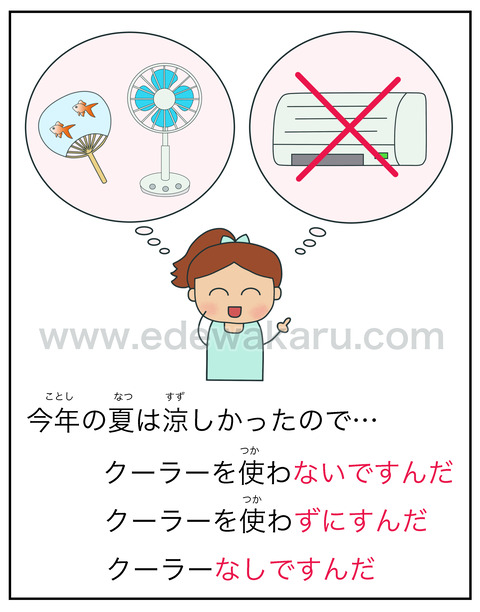
Because this summer was cool, I got by without using the air conditioner.
= Because this summer was cool, I got by without using the air conditioner.
Be careful: when used with a noun, the form is “〜なしですんだ.” 😨
[Examples]
❌ Because this summer was cool, I got by without an air conditioner.
⭕️ Because this summer was cool, I got by without an air conditioner.
Remember that when written in kanji, “〜ないですむ,” “〜ずにすむ,” and “〜なしですむ” are written
“〜ないで済む,” “〜ずに済む,” and “〜なしで済む.”
😀
In context 5 examples
今年の夏は涼しかったので、クーラーを使わないですんだ
→今年の夏は涼しかったので、クーラーを使わなくても問題はなかったBecause this summer was cool, I got by without using the air conditioner. → Because this summer was cool, not using the air conditioner wasn’t a problem.
今年の夏は涼しかったので、クーラーなしですんだ
→今年の夏は涼しかったので、クーラーがなくても問題はなかったBecause this summer was cool, I got by without an air conditioner. → Because this summer was cool, not having an air conditioner wasn’t a problem.
遅刻をしたが、怒られないですんだ
→遅刻をしたが、怒られなかったI was late, but I got away without being scolded. → I was late, but I wasn’t scolded.
すぐに電車が来たので、待たないですんだ
→すぐに電車が来たので、待たなくてもよかったThe train came right away, so I didn’t have to wait. → The train came right away, so I didn’t have to wait.
日本に友達がいるので、ホテルに泊まらないですんだ
→日本に友達がいるので、ホテルに泊まらなくてもOKだったI have a friend in Japan, so I got by without staying at a hotel. → I have a friend in Japan, so staying at a hotel wasn’t necessary.
Read the original source text
Meaning
〜なくても問題はない
〜なくてもよくなる
〜なくてもOKだ
How to use it
動詞[ない形]+ないですむ
動詞[ない形]+ずにすむ
名詞[辞書形]+なしですむ
Explanation
「〜ないですむ」「〜ずにすむ」「〜なしですむ」は「〜なくても問題はない」「〜なくてもよくなる」「〜なくてもOKだ」という意味を表す文型です。
ほとんどの場合、
よくないことや嫌なこと、面倒くさいことをしなくてもよくなったと言いたい時
に使われます😮
(復習:〜くさい)
動詞の場合は
「〜ないですむ」と「〜ずにすむ」
の2つの形があると覚えておきましょう😀
[例]
今年の夏は涼しかったので、クーラーを使わ
ないですんだ
=今年の夏は涼しかったので、クーラーを使わ
ずにすんだ
名詞に使う場合は、「〜なしですんだ」になりますので注意しましょう😨
[例]
❌今年の夏は涼しかったので、クーラー
ないですんだ
⭕️今年の夏は涼しかったので、クーラー
なしですんだ
「〜ないですむ」「〜ずにすむ」「〜なしですむ」は漢字で書くと
「〜ないで済む」「〜ずに済む」「〜なしで済む」
と書くと覚えておきましょう😀
日本語文型辞典
Meaning
Basic information: V-ずにすむ. Means “to no longer have to do something that was planned” or “to avoid something expected to happen.” Expresses avoiding an undesirable situation. Written style; in conversation, “...ないですむ” is used. Examples: ① I was thinking of buying a kanji dictionary, but a friend gave me an old one, so I didn’t have to buy one. ② They developed a good medicine, so I didn’t have to have surgery. ③ It would be nice if I could go through life without working, but that’s not possible. ④ If you take care of it properly now, you won’t have to regret it later. ⑤ The safety device activated, so it didn’t turn into a major accident.
Read the original source text
Meaning
基本情報V-ずにすむ説明「予定していたことをしなくてもよくなる」「予測されることが避けられる」という意味。好ましくない事態が避けられることを表す。書きことば的。話しことばでは「…ないですむ」となる。例文① 漢和辞典を買おうと思っていたら、友だちが古いのをくれたので買わずにすんだ。② いい薬ができたので手術せずにすんだ。③ 一生働かずにすんだらいいんだけれど、そういうわけにはいかない。④ いまちゃんとやっておけば、あとで後悔せずにすみますよ。⑤ 安全装置が作動したので大事故にならずにすんだ。
日本語文型辞典 英語版
Meaning
【ずにすむ】[V-ずにすむ]
Means “no longer have to do something that was previously planned” or “something that was anticipated can be avoided.” Expresses that an undesirable situation has been avoided. Has the tone of written language. In spoken language, ...ないですむ is used.
In context 5 examples
漢和辞典を買おうと思っていたら、友だちが古いのをくれたので買わずにすんだ。
I was thinking about buying a Japanese kanji dictionary, but a friend gave me her old one, so I didn’t have to buy one after all.
いい薬ができたので手術せずにすんだ。
Since there’s good medicine available now, it turned out that I didn’t have to have surgery.
一生働かずにすんだらいいんだけれど、そういうわけにはいかない。
It would be great if you could live your whole life without working, but that will never happen.
いまちゃんとやっておけば、あとで後悔せずにすみますよ。
If you do it properly now, you won’t have any regrets later on.
安全装置が作動したので大事故にならずにすんだ。
The fail-safe device was activated, so we were able to avoid a major accident.
毎日のんびり日本語教師
How to use it
Verb ない-form + ずに済む
Verb ない-form + ないで済む
Verb ない-form + なくて済む
Explanation
This expresses that a problem can be resolved without doing that. It is usually used when avoiding an undesirable situation.
In spoken language, 「ないで済む/なくて済む」 is often used.
Notes
The “済む” series
In context 8 examples
インフルは息子だけで、家族にうつらずに済んだ。
Only my son got the flu, and we managed to avoid it spreading to the rest of the family.
周りにバレずに済んだ。
I managed to avoid being found out by the people around me.
メモしておけば忘れずに済む。
If you make a note of it, you won't have to worry about forgetting.
ちゃんとしたら怒られずに済んだのではないか。
If I had done it properly, I might have avoided getting scolded.
amazonさえあれば外出なくて済む。(只要有amazon,不用外出就可以解决了。)
As long as I have Amazon, I can manage without going out. (As long as I have Amazon, I don't need to go out.)
階段から落ちたけど怪我しなくて済んでよかった。
I fell down the stairs, but luckily I didn't have to get hurt.
予約してたおかげで待ち時間が全くなくて済んだ。
Thanks to having a reservation, I didn't have to wait at all.
一時はどうなることかと思ったが何事もなくて済んだ。
For a while I wondered what would happen, but in the end everything turned out fine.
Read the original source text
How to use it
動ない形+ずに済む
動ない形+ないで済む
動ない形+なくて済む
Explanation
そうしなくても問題が解決できることを表します。通常は悪い事態を回避することに用います。
話し言葉では「ないで済む/なくて済む」をよく用います。
Notes
「済む」シリーズ
NINJAL 日本語文型データベース
Meaning
Means that something you had planned to do or were supposed to do is no longer necessary. It is often used when something undesirable for the speaker has been avoided.
How to use it
In context 6 examples
美容院は、事前に予約しておけば、待たずに済む。
If you make an appointment in advance at the hair salon, you can avoid waiting.
夫がピザを買って帰ってきたので、今日は夕飯を作らずに済んだ。
My husband came home with pizza, so I didn’t have to make dinner today.
パソコンの調子が悪かったが、修理できたので新しいのを買わずに済んだ。
My computer wasn’t working well, but I was able to get it repaired, so I didn’t have to buy a new one.
薬を飲んで一日休めば、病院に行かずに済むだろう。
If you take medicine and rest for a day, you probably won’t have to go to the hospital.
去年から会議資料を電子データで共有することになったので、紙の資料は用意せずに済むようになった。
Since last year, we’ve been sharing meeting materials as digital files, so we no longer have to prepare paper copies.
仕事で失敗してしまったが、森さんが助けてくれたので部長に怒られずにすみそうだ。
I made a mistake at work, but Mori helped me, so it looks like I’ll avoid getting scolded by the department head.
Read the original source text
Meaning
予定していたことや当然しなければならないことをしなくてもよくなるという意味です。話し手にとって好ましくないことが避けられた場合によく使います。