DoJG 日本語文法辞典(全集)
Meaning
~ whatever; ~ whoever; ~ whenever; ~ whichever
How to use it
Noun (particle) | でも, (Noun (particle) でも,) でも、Wh-word (particle) でも | |
| 小学生(に) でも、誰(に) でも | (to) an elementary pupil or (to) anybody |
| アフリカ(から) でも、どこ(から) でも | (from) Africa or (from) anywhere |
| 寿司でも、何でも | Sushi or whatever |
| 明日でも、いつでも | Tomorrow or whenever |
Explanation
~でも[Wh. word]でも A structure indicating that what is expressed in the main/subordinate clause is applicable to anyone, anything, any place or any time.
In context 6 examples
そんなことは子供でも誰でも知っているよ。
That sort of thing is known even to a child or to anybody.
私って漫画でも何でも読み出すと止まらないタイプなの。
I'm the type of person who cannot stop reading manga or whatever once I start.
Tシャツの大きさはMでもLでも、どちらでもかまいません。
It doesn't matter to me whether (the size of) the T-shirt is M or L (literally: or whichever).
欧米では、バスでも地下鉄でも、車椅子でどこへでも行ける。どうしても助けが必要な時は、誰かに頼めばたとえ日本人にでも誰にでも手を貸してくれる。
In Europe and America you can go anywhere in a wheelchair by bus or by subway. When you find you need help, just ask anyone. People there will lend a hand to anyone who asks, Japanese or otherwise.
最近のパーティーは留学生でも日本人でも誰でも参加自由で、来る人は飲み物、音楽、自分の作った料理を持ってくるというようにしています.
At our recent parties we've made it so all students, whether Japanese or from abroad, can freely participate and ask everyone to bring drinks, music or food they've made.
A:すみませんが、来週、検査の結果が出たら、もう一度来ていただけますか。B:分かりました。来週でもいつでも伺います。
A: Can you come back next week when we get the result of the examination? B: Yes, I can come next week or whenever.
日本語文型辞典
Usage 1
Meaning
Core information
Explanation
Used at the beginning of a sentence to show that what follows runs counter to what was said before it. It is more casual and somewhat more conversational than 「しかし」. It is not used in the middle of a sentence.
Example sentences
① My friends went swimming at the pool. But I couldn’t go because I had a part-time job.
② He has a nice new car. But he hardly ever drives it.
③ People say that Mr. Aoki is selfish. But I don’t think so.
④ My older sister married a poor artist. But she seems very happy.
Example (incorrect)
My friend quit the part-time job but I couldn’t quit.
Example (correct)
My friend quit the part-time job, but I couldn’t quit.
Read the original source text
Meaning
基本情報説明文頭に用いて、それより前に述べられたことと相反することが続くことを表す。「しかし」より、くだけた表現で、やや会話的。文中では使わない。例文① 友達はプールヘ泳ぎに行った。でも、わたしはアルバイトで行けなかった。② 彼は新しい、いい車をもっている。でもめったに乗らない。③ 青木さんは、自分勝手な人だと言われている。でも、わたしはそうは思わない。④ わたしの姉は貧乏な画家と結婚した。でも、とても幸せそうだ。例文(誤) 友達はアルバイトをやめたでも、わたしはやめられなかった。例文(正) 友達はアルバイトをやめたが、わたしはやめられなかった。
Usage 2
Meaning
In the form 「XでもY」, an extreme example X, which would not normally be expected to be Y, is given to express that if even X is Y, then other things are all the more so.
Used to give one example while implying that there are other options as well. Depending on the context, it often refers to the thing indirectly. For example, ① indicates “coffee or another drink,” while ② specifically refers to “looking at this magazine.” Examples ⑨–⑪ use 「でも」 to give examples in hypothetical expressions meaning “if, for instance, you did something like this.” However, what the speaker actually wants to say is often the sentence with 「でも」 removed, such as “if you went somewhere to escape the summer heat.” 「でも」 is often used in sentences that are indirect overall.
Attached to the continuative form of a verb, it means “if by any chance that happens.” It is often used to mention something undesirable, such as an accident or illness, in order to warn someone.
⇾てでも
⇾ても
⇾てもいい4
⇾てもかまわない3
⇾てもよろしい
How to use it
Nでも
N(+ particle)でも
R-でもしたら
V-てでも
N/Na でも
In context 18 examples
この機械は操作が簡単で、子供でも使えます。
This machine is easy to operate, so even children can use it.
この算数の問題は大人でもむずかしい。
Even adults find this arithmetic problem difficult.
この森は、夏でも涼しい。
This forest is cool even in summer.
コーヒーでも飲みませんか。
Would you like to have some coffee or something?
待っている間、この雑誌でも見ていてください。
While you’re waiting, please look through this magazine or something.
A:佐々木さん、いませんね。
B:ああ、昼食にでもでかけたんでしょう。A: Mr. Sasaki isn’t here. B: Oh, he probably went out for lunch or something.
山下さんにでも聞いてみたらどう?
Why don’t you try asking Mr. Yamashita or someone?
A:先生のお宅へ行くとき、何か持って行きましょうか。
B:そうですね。ワインでも買って行きましょう。A: Should we bring something when we go to the teacher’s house? B: Let’s buy some wine or something and take it.
この夏は、山にでも登ってみたい。
This summer, I’d like to try climbing a mountain or something.
病気にでもなったら困るから、日ごろ運動するようにしている。
I try to exercise regularly because it would be a problem if I got sick or something.
宿題のレポートは、図書館ででも調べてみることにした。
I decided to try researching the report for my homework at the library or somewhere.
避暑にでも行ったら元気になるかもしれない。
Maybe I’ll feel better if I go somewhere to escape the summer heat.
こんな忙しいときに客でも来たら大変なことになる。
It would be a disaster if a customer came at such a busy time.
寒いからなべものでもしたらどうでしょうか。
It’s cold, so how about making a hot pot or something?
放っておいて、病気が悪くなりでもしたら、どうするんですか。
What would you do if you just left it and the illness got worse or something?
そんな大金、落としでもしたら大変だから、銀行に入れた方がいいですよ。
It would be terrible if you dropped such a large sum of money, so you should put it in the bank.
そんなにいうならこのカメラ、貸してあげるけど、気をつけてよ、こわしでもしたら承知しないから。
If you insist that much, I’ll lend you this camera, but be careful. I won’t let you off if you break it or anything.
こどものころ、妹を泣かしでもしたら、いつも一番上の兄に怒られた。
When we were children, if I ever made my little sister cry or anything, my eldest brother always scolded me.
Read the original source text
Meaning
「XでもY」の形で普通Yだとは考えられない極端な例Xをあげて、それがYなのだから他のものはなおさらYだということを表す。
他にも選択肢があることを含みながら一例をあげるのに用いる。文脈によって、実際にはそのものを腕曲に指すことが多い。たとえば、①は、「コーヒーかほかの飲みもの」を示すが、②は具体的に指示しようとしているのは、「この雑誌を見ている」ことである。⑨から⑪は、「でも」を用いて、例を示し、「たとえば、こういうことをしたら」という意味の仮定表現。ただし、実際に話し手の言いたいことは、「避暑にいったら」など、それぞれの表現から「でも」をとった文であることが多い。全体に腕曲な表現をする文では、「でも」がよく使われる。
動詞の連用形に付いて、万一そうなったらという意味を表す。事故、病気など、万一起こると困るということをあげて、注意を促すような場合が多い。
⇾てでも
⇾ても
⇾てもいい4
⇾てもかまわない3
⇾てもよろしい
How to use it
Nでも
N(+助詞)でも
R-でもしたら
V-てでも
N/Na でも
絵でわかる日本語
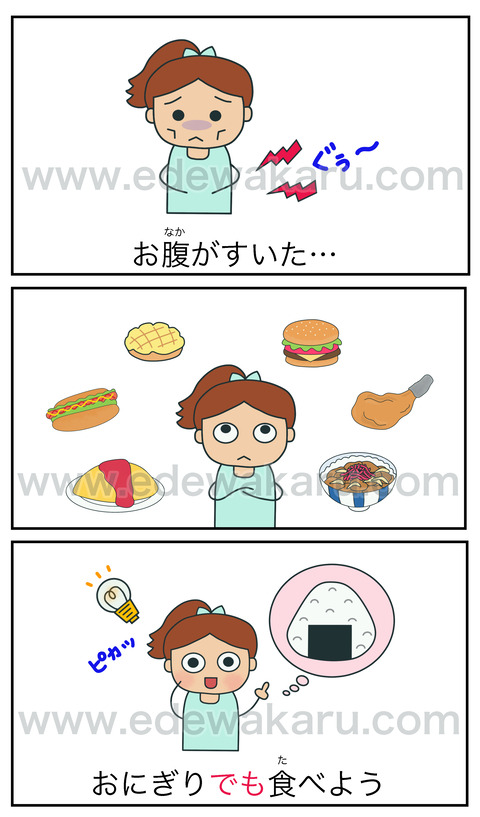
Meaning
Give examples.
How to use it
Noun [dictionary form] + でも
Explanation
“〜でも” is used when giving one example from among several options.
[Examples]
①おにぎり
でも
食べよう
→Let’s eat an onigiri or some other food (a hamburger, hot dog, bread, etc.).
②コーヒー
でも
飲もうかな
→Maybe I’ll drink coffee or some other beverage (juice, water, tea, etc.).
③お母さんに
でも
借りようかな
→Maybe I’ll borrow from my mother or someone else (my father, sibling, friend, boyfriend, etc.).
④映画
でも
見に行こうよ
→Let’s go see a movie or do something else (go shopping, go to an art museum, etc.).
[For advanced learners]
“〜でも” is most often used when giving an example from among several options, but when used in conversation it also avoids stating things directly and serves as an indirect expression. 😮 (Review: 〜において)
[Example]
A: Where do you want to go today?
B: Let’s go see a movie or something.
The conversation above can be used with two meanings:
① Give one example from among several options.
② Make an indirect suggestion.
① As explained above, “see a movie” is given as an example from among options such as “see a movie,” “go shopping,” or “go to an art museum.”
② Compared with “Let’s go see a movie,” saying “Let’s go see a movie or something” means something like “I want to go see a movie, but what do you think? Is that okay?” It is used when indirectly conveying to the other person that you want to see a movie. 😊
That got a little detailed. 😅 Japanese people often prefer to speak indirectly rather than say things directly, so I think it’s good to remember this. 😉
In context 4 examples
お腹がすいた…おにぎりでも食べよう(復習:「おにぎり」と「にぎり」)
→お腹がすいた…おにぎりか何かを食べようI’m hungry… Let’s eat an onigiri or something. (Review: “おにぎり” and “にぎり”) →I’m hungry… Let’s eat an onigiri or something.
コーヒーでも飲もうかな(復習:〜かな・〜かしら(文法))
→コーヒーか何かを飲もうかなMaybe I’ll have some coffee or something. (Review: 〜かな・〜かしら (grammar)) →Maybe I’ll have some coffee or something.
お金がない…お母さんにでも借りようかな
→お金がない…お母さんか誰かに借りようかなI’m out of money… Maybe I’ll borrow some from my mom or someone. →I’m out of money… Maybe I’ll borrow some from my mom or someone.
A:今日はどこに行きたい?B:映画でも見に行こうよ
→映画か何かを見に行こうよA: Where do you want to go today? B: Let’s go see a movie or something. →Let’s go see a movie or something.
Read the original source text
Meaning
例をあげて言う
How to use it
名詞[辞書形]+でも
Explanation
「〜でも」はいくつか選択肢がある中から、1つ例をあげて言う時に使われます。
[例]
①おにぎり
でも
食べよう
→おにぎりか他の食べ物(ハンバーガー、ホットドッグ、パンなど)を食べよう
②コーヒー
でも
飲もうかな
→コーヒーか他の飲み物(ジュース、水、お茶など)を飲もうかな
③お母さんに
でも
借りようかな
→お母さんか他の人(お父さん、兄弟、友達、彼氏など)に借りようかな
④映画
でも
見に行こうよ
→映画を見るか他のこと(買い物に行く、美術館に行くなど)をしようよ
【上級レベルの人へ】
「〜でも」は選択肢の中から例をあげて言う場合に使われるのがほとんどですが、会話において使用される場合は、物事をはっきり言わず、婉曲的表現(えんきょくてきひょうげん)として使われます
😮(復習:〜において)
[例]
A:今日はどこに行きたい?
B :映画
でも
見に行こうよ
上の会話は
①いくつかの選択肢から1つ例をあげる
②婉曲的に提案する
2つの意味で使うことができます😀
①は上でも説明したように、
「映画を見る」「買い物に行く」「美術館に行く」などの選択肢から「映画を見る」を例としてあげています。
②は「映画を見に行こうよ」に比べて、「映画でも見に行こうよ」と言った方が
「私は映画を見に行きたいけれど、あなたはどう?いい?」というような意味になります。「映画を見たい」という気持ちを婉曲的に相手に伝えている場面で使われます
😊
ちょっと細かい説明になってしまいました😅日本人ははっきりと言わず、遠回しに言ったりする言い方を好むことがよくありますので、覚えておくといいと思います😉
日本語文型辞典 英語版
Meaning
Placed at the beginning of a sentence to indicate that what follows will contradict what was stated previously. Less formal than しかし and more conversational in tone. Not used in the middle of a sentence.
(×)友達はアルバイトをやめたでも、わたしはやめられなかった。
My friend quit her part-time job, and but I couldn’t quit.
(○)友達はアルバイトをやめたが、わたしはやめられなかった。
My friend quit her part-time job, but I couldn’t quit.
The pattern XでもY gives X as an extreme example that would usually not be thought of as compatible with Y, in order to express the notion that because X is Y, other things are all the more Y.
B:ああ、昼食にでもでかけたんでしょう。
Ah, he’s probably out to lunch or something.
B:そうですね。ワインでも買って行きましょう。
Yes, let’s buy some wine or something to take along.
Used to give an example, with the implication that there are also other choices. Depending on the context, it is often used to indicate a specific thing in an indirect manner.
For example,
(1)
suggests “coffee or some other kind of drink,” but in
(2)
what is actually being referred to is the concrete action of “looking at this magazine.” In
(9)
-
(11)
, でも is used to give an example in a suppositional expression that means “for example, what if you (we) do such-and-such?” However, it should be noted that in usages like
(9)
, what the speaker actually wants to say is something like “Why don’t you get out of the heat?” which is an expression that doesn’t include でも. In general, でも is often used in indirect statements.
When でもしたら is attached to the stem of a verb, it expresses the notion of a worst-case scenario. Often used to caution someone by raising the possibility of an accident, illness, or something else that would cause problems in the event of its occurrence.
【ても】、
【てもいい】4、
【てもかまわない】3、
How to use it
1. Nでも
2. N(+ particle)でも
3. R-でもしたら
4. V-てでも→
5. N/Na でも→
In context 22 examples
友達はプールへ泳ぎに行った。でも、わたしはアルバイトで行けなかった。
My friends went swimming at the pool. But I couldn’t go because of my part-time job.
彼は新しい、いい車をもっている。でもめったに乗らない。
He has a fine new car. But he almost never drives it.
青木さんは、自分勝手な人だと言われている。でも、わたしはそうは思わない。
Many people say that Aoki-san is a self-centered person. But I don’t think so.
わたしの姉は貧乏な画家と結婚した。でも、とても幸せそうだ。
My older sister married a painter with no money. But she seems very happy.
この機械は操作が簡単で、子供でも使えます。
This machine is easy to operate, so even a child can use it.
この算数の問題は大人でもむずかしい。
This arithmetic problem is difficult even for an adult.
この森は、夏でも涼しい。
This forest is cool even in the summer.
コーヒーでも飲みませんか。
Would you like something to drink, like coffee, or...?
待っている間、この雑誌でも見ていてください。
While you’re waiting, please feel free to take a look at this magazine.
A:佐々木さん、いませんね。
Sasaki-san isn’t here, is he?
山下さんにでも聞いてみたらどう。
Why not ask, say, Yamashita-san about it?
A:先生のお宅へ行くとき、何か持って行きましょうか。
Shall we take something to our professor’s house when we visit?
この夏は、山にでも登ってみたい。
This summer I want to do something like mountain-climbing.
病気にでもなったら困るから、日ごろ運動するようにしている。
It would be a big problem if I got sick or something, so I make it a point to exercise daily.
宿題のレポートは、図書館ででも調べてみることにした。
For the report I got for homework, I decided to do some research in the library and wherever.
避暑にでも行ったら元気になるかもしれない。
You might get well if you go to a summer resort or someplace to get out of the heat.
こんな忙しいときに客でも来たら大変なことになる。
What with being this busy, if we get an unexpected guest or something it’ll be a real problem.
寒いからなべものでもしたらどうでしょうか。
Since it’s so cold, how about having nabe (hot pot) or something?
放っておいて、病気が悪くなりでもしたら、どうするんですか。
If you let it go and your illness gets worse, then what will you do?
そんな大金、落としでもしたら大変だから、銀行に入れた方がいいですよ。
With such a large sum of money, it would be terrible if you lost it or something, so you’d better put it in the bank.
そんなにいうならこのカメラ、貸してあげるけど、気をつけてよ、こわしでもしたら承知しないから。
If you’re going to insist, I’ll lend you this camera, but be careful— I’m not going to let you get away with it if you break it or something.
こどものころ、妹を泣かしでもしたら、いつも一番上の兄に怒られた。
When I was a child, if I ever did something like make my little sister cry, my oldest brother would always get mad at me.
Read the original source text
Meaning
Placed at the beginning of a sentence to indicate that what follows will contradict what was stated previously. Less formal than しかし and more conversational in tone. Not used in the middle of a sentence.
(×)友達はアルバイトをやめたでも、わたしはやめられなかった。
My friend quit her part-time job, and but I couldn’t quit.
(○)友達はアルバイトをやめたが、わたしはやめられなかった。
My friend quit her part-time job, but I couldn’t quit.
The pattern XでもY gives X as an extreme example that would usually not be thought of as compatible with Y, in order to express the notion that because X is Y, other things are all the more Y.
B:ああ、昼食にでもでかけたんでしょう。
Ah, he’s probably out to lunch or something.
B:そうですね。ワインでも買って行きましょう。
Yes, let’s buy some wine or something to take along.
Used to give an example, with the implication that there are also other choices. Depending on the context, it is often used to indicate a specific thing in an indirect manner.
For example,
(1)
suggests “coffee or some other kind of drink,” but in
(2)
what is actually being referred to is the concrete action of “looking at this magazine.” In
(9)
-
(11)
, でも is used to give an example in a suppositional expression that means “for example, what if you (we) do such-and-such?” However, it should be noted that in usages like
(9)
, what the speaker actually wants to say is something like “Why don’t you get out of the heat?” which is an expression that doesn’t include でも. In general, でも is often used in indirect statements.
When でもしたら is attached to the stem of a verb, it expresses the notion of a worst-case scenario. Often used to caution someone by raising the possibility of an accident, illness, or something else that would cause problems in the event of its occurrence.
【ても】、
【てもいい】4、
【てもかまわない】3、
How to use it
1. Nでも
2. N(+助詞)でも
3. R-でもしたら
4. V-てでも→
5. N/Na でも→
AIUEO JLPT Grammar
Usage 1
Meaning
「でも」is a conjunction used when the content of the first and second clauses contrast, or when providing a different opinion or additional information from the first clause. It is a casual expression and is commonly used in everyday conversation. Similar to "but” or "however” in English.
In context 5 examples
天気は悪いです。でも、出かけます。
The weather is bad. But, I will go out.
彼は親切です。でも、時々厳しいです。
He is kind. But, he is sometimes strict.
旅行に行きたい。でも、お金がない。
I want to travel. But, I don’t have money.
今日は休みです。でも、仕事があります。
Today is a day off. But, I have work.
彼女は綺麗です。でも、性格があまり良くないです。
She is beautiful. But, her personality is not very good.
Usage 2
Meaning
「でも」is a particle that is used to offer examples, make suggestions, or emphasize something among other possible options. It is often used when suggesting or offering options to others.
How to use it
Noun + でも
In context 5 examples
映画でも見に行きませんか。
How about going to see a movie?
会議の後でコーヒーでも飲みましょう。
Let’s have some coffee after the meeting.
授業が終わったら図書館でも行きましょうか。
Shall we go to the library after class?
運動の後でジュースでも飲みませんか。
How about having some juice after exercising?
週末にバーベキューでもしませんか。
How about having a barbecue this weekend?
Read the original source text
Meaning
「でも」is a particle that is used to offer examples, make suggestions, or emphasize something among other possible options. It is often used when suggesting or offering options to others.
How to use it
名詞+でも
Explanation · 日本語
「でも」は、例示や提案、強調の意味を持つ助詞で、他の選択肢もある中で特にその例を挙げる場合に使われます。相手に勧めたり、提案するときにもよく使われます。
文法
Meaning
~か, a way of speaking that gives one example from among several possible options.
How to use it
N + でも
In context 4 examples
ちょっとコーヒーでも、飲みませんか。
→ちょっとコーヒーか、何か飲みませんか。Would you like to have some coffee or something? →Would you like to have some coffee or something?
お腹空いたから、おにぎりでも食べよう。
→お腹空いたから、おにぎりか何か食べよう。I'm hungry, so let's have a rice ball or something. →I'm hungry, so let's have a rice ball or something.
A:明日、何する?
B:うーん、映画でも見る?
→映画か何か見る?A: What are you doing tomorrow? B: Hmm, want to watch a movie or something? →Want to watch a movie or something?
あー、暇だなぁ。ゲームでもするか。
→ゲームか何かするか。Ah, I'm bored. Maybe I'll play a game or something. →Maybe I'll play a game or something.
Read the original source text
Meaning
~か、何かいくつかある選択肢の中から、1つ例を取り上げていう言い方。
How to use it
N + でも
Bunpro Grammar Reference
Usage 1
Meaning
Or something, Any... (with question words), No matter (who)
How to use it
Noun + でも + Suggestion
だれでも - Anyone
なんでも - Anything
どこでも - Anywhere
いつでも - Anytime
Nuance
A word used for expressing undetermined possibilities or choices.
Explanation
でも is one of many adverbial particles in Japanese. These are particles that behave like a regular 助詞 (in that they appear after the words that they are referencing), but their role is a little bit more specific. でも itself has several uses, and the use that we will examine in this grammar point is called 例示. Basically this means 'presenting examples'.
In English, this results in a translation similar to 'even', or 'or something'. To use this structure, simply attach でも to the end of any noun, or pronoun.
お茶でも飲みましょうか。
Shall we drink some tea, or something?
大丈夫だよ、お前でも出来るよ。
It's okay, even someone like you can do it.
When grouped with a standard noun as above, でも is just showing that the noun is an example/suggestion, and that there are other choices/possibilities available. However, when the noun is a word like 誰, どこ, 何, or いつ, the translation becomes much closer to English words like 'anyone', 'anywhere', 'anything', or 'anytime'.
この簡単な漢字は誰でも分かるよ。
Everyone knows this easy kanji.
「明日はどこに行きたい?」「どこでもいいよ。」
'Where do you want to go tomorrow?' 'Anywhere is fine.'
お前は本当に何でも食べるね。
You really do eat anything.
いつでも電話してね。
Please, call me anytime.
Fun Fact
There is debate among Japanese native speakers about whether でも should be considered its own word, or if it is actually just a combination of the particles で and も (or て and も in the case of verbs, but we will cover that later). As で and も together could be translated as 'even with (A)', it would also be correct to consider it this way.
スプーンでも缶詰が開く。
A can will open, even with a spoon.
Caution
When grouped with 何, the pronunciation will almost always change to なん. This is purely to make なんでも easier to say.
In context 19 examples
- どこでもいいよ。
Anywhere is good.
- 大丈夫だよ、お前でも出来るよ。
It's okay, even someone like you can do it.
- お茶でも飲みましょうか。
Shall we drink some tea, or something?
- 「明日はどこに行きたい?」「どこでもいいよ。」
'Where do you want to go tomorrow?' 'Anywhere is fine.'
- いつでも電話してね。
Please, call me anytime.
- お前は本当に何でも食べるね。
You really do eat anything.
- この簡単な漢字は誰でも分かるよ。
Everyone knows this easy kanji.
- いつでも家に来てください。
Please come to my house anytime.
- いつでも電話に出るから。
I will answer the phone anytime, so... (please don't hesitate to call me)
- いつでも洗濯できますよ。
I can do laundry anytime.
- お茶でもどう?
How about tea or something?
- 今日のパーティーでは、いつでもダンスをしていいんだよ。
At today's party, you can dance anytime you like.
- 明日の朝、一緒に散歩でもしませんか。
Won't you go on a walk with me or something tomorrow morning?
- どこでもいいんです。
Anywhere is fine.
- 今週末は映画でも見に行きませんか。
Why don't we go watch a movie or something this weekend?
- ごめん、お茶がなかった。水でも大丈夫?
Sorry, I didn't have any tea. Is water or something alright?
- コーヒーに砂糖でも、入れませんか。
Won't you put sugar or something in your coffee?
- 誰でも彼の名前を知っています。
Everyone knows his name.
- スプーンでも缶詰が開く。
A can will open, even with a spoon.
Usage 2
Meaning
Whether ~ or, Neither ~ or
How to use it
[い]Adjective[て] + も + [い]Adjective[て] + も
[な]Adjective + でも + [な]Adjective + でも
Noun (A) + でも + Noun (B) + でも
[い]Adjective[て] + も + [い]Adjective[て] + も + Phrase[ない]
[な]Adjective + でも + [な]Adjective + でも + Phrase[ない]
Noun (A) + でも + Noun (B) + でも + Phrase[ない]
Nuance
A casual phrase which indicates that even if it is (A), or even if it is (B), the result is still the same.
Explanation
When the adverbial particle でも is used more than once in a sequence, it is an extension of one of its regular meanings, analogical reasoning. However, several 'analogies' are being presented.
This use of でも is regularly translated as 'whether it is (A), or (B)', or 'neither (A) nor (B)', depending on whether the rest of the phrase is positive, or negative.
サッカーでもバスケットボールでもいいからスポーツをやりたい。
Regardless of whether it is soccer or basketball, I want to play sports.
ケーキでもクッキーでも苺が入っていたらどちらも食べない。
Even if it is a cake or a cookie, I will not eat it if it has strawberries in it.
Literally, the translation of 〜でも〜でも is closer to the following:
Even if it's (A), even if it's (B), (C) is the result. (In a positive sentence)
Even if it's (A), even if it's (B), (C) is not the result. (In a negative sentence)
In context 14 examples
- これでも、それでも、何でもいいです!
Whether this, or that, whatever (is fine)!
- サッカーでもバスケットボールでもいいからスポーツをやりたい。
Regardless of whether it is soccer or basketball, I want to play sports.
- ケーキでもクッキーでも苺が入っていたらどちらも食べない。
Even if it is a cake or a cookie, I will not eat it if it has strawberries in it.
- サッカーでも、卓球でも、彼ならスポーツは何でもできる。
Whether it's soccer or table tennis, he can play any sport.
- 電車でも、バスでも行ける場所なので、便利です。
You can get there whether by train or bus, so it's convenient.
- 彼がMacでもWindowsでも使えるって。
(He said) that whether it's Mac or Windows, he can use them.
- じゃんけんでも、サイコロでも何でもいいから、早く決めてよ。
Whether it is with rock, paper, scissors or with dice, or whatever, hurry up and decide.
- 教科書でも、ネットでも日本語を学ぶことが出来るから習ってみたらどう?
Whether it is with a textbook or online, you can learn Japanese so why not give it a shot?
- 60点でも、100点でも、合格したらいいんだよ。
It doesn't matter whether you get a 60 or a 100, as long as you pass.
- 電車でも、バスでも、飛行機でも、タクシーでも使える。
You can use either a train or a bus or a plane or a taxi.
- ジュースでもコーラでも何でもいいから、早く飲みましょう。
It doesn't matter whether it is juice or cola, let's hurry up and drink!
- 喉が渇いたので、水でも、お茶でも飲みたいな。
I am thirsty, so whether it is water or tea I want to drink it.
- 英語でも、日本語でも、中国語でも喋れる彼が凄いと思う。
Whether it is English or Japanese or even Chinese, he (who can speak those languages) is amazing.
- 円でも、ドルでも商品を買えるからこのコンビニが便利だ!
Whether it is with yen or dollars, you can buy products at this convenience store so it is convenient!
Yokubi — The Common Grammar Guide (https://yoku.bi)
Usage 1
Explanation
Besides marking questions, か can also be used to turn question words into generic nouns.
| | |
|------------|---------------|
| なに | what |
| なに**か** | **some**thing |
| | |
|------------|-------------|
| だれ | who |
| だれ**か** | **some**one |
| | |
|------------|---------------|
| どこ | where |
| どこ**か** | **some**where |
| | |
|------------|---------------------------|
| いつ | when |
| いつ**か** | **some**time ("somewhen") |
Often なにか is slurred as なんか:
Make sure to not confuse the following two usages:
Note how with question words + か it is common to drop the が particle after them (何かが -> 何か), possibly because it is easier to pronounce.
In a similar manner, we can also use も to turn question words into "inclusive/exclusive" nouns. Think about words like "anything" or "nothing" in English.
| | |
|--------|--------------------------|
| なにも | anything/nothing |
| だれも | everyone/anyone/no one |
| どれも | any of them/none of them |
| いつも | anytime/never/always |
Note: In case of 誰も used as subject in a non-negative statement, the が cannot be dropped so it becomes 誰もが
There's a logical distinction between "every particular thing" and "any one particular thing". By attaching でも to some of these words, you can give them the "any" sense of "any one particular thing".
In context 2 examples
あんたは誰でも助けるの?
Would you (really) save anyone (no matter who)?
場所はどこでもいい。
Anywhere (no matter where) is fine
Usage 2
Explanation
Unrelated to the **subject marker** が, the **conjunction** が states that, even though the former statement is true, the latter statement is also true. With が, both statements are independent clauses. Often, but not always, the second statement is in contrast with the first statement. This is commonly translated as "but" or "although", but there are cases where it's simply just an "and" and there is no contrast at all.
が attaches after a complete sentence, meaning after nouns and な adjectives it **requires** だ (or です). ですが is common in speech and everyday polite language, but だが sounds too stiff and it's almost exclusively left to written or very formal language.
Same as が, there is also the conjunction けど. Their usage and meaning can be considered pretty much the same. Just like with が, both ですけど and だけど exist and are very common in conversational tone in real life too. けど comes across as less formal than が.
けど and が both cover a formality/politeness space that can feel very nuanced, so here's a few rules of thumb. These aren't actual rules, just general advice:
- If the entire sentence is in plain form, use (だ)けど
- If it's conversational language, don't use (だ)が
- If the entire sentence is in polite form, use ですが
- Ending a statement with polite form but using けど in the middle is common, but can come across as unnatural if the politeness level isn't appropriate
A very common usage of が/けど is to introduce something as a topic in an indirect manner. In this usage it does not have a nuance of adversative ("but"). It is simply introducing something before talking about it. It is common to see this usage with the explanatory の particle like なんだけど or なんですが:
This usage is very common when easing the listener into a request or question you have for them:
This type of phrase is so common that in many situations the speaker doesn't even need to provide an explanation after the んですが/んだけど, to the point where the second half of the sentence can be completely dropped.
けど can also show up as けれど and けれども. They are *mostly* the same, but the longer it is, the more formal it sounds.
しかし is an interjection. It sounds formal. English speakers tend to overuse this because it resembles how we use "but" at the beginning of sentences in our language but in Japanese it is not that common.
ても is a combination of the て form and も. It works as a conjunction stating that the statement after it is true *despite* the statement before it. This is like an adversative, but it's not always one.
There is also でも that can be used to add an adversative "but" meaning at the beginning of a new sentence.
In context 1 examples
でも、あなたは分かっているでしょ?
But you get that, don't you?
NINJAL 日本語文型データベース
Meaning
[1] Used when you want to say that if a hypothetical condition of 「〜」 were met, a certain outcome should naturally follow, but contrary to expectations it does not.
This is the affirmative form for na-adjectives and nouns.
When 「〜」 contains an interrogative such as 「何・どこ・誰」, or when adjectives or nouns with similar or opposing meanings are repeated as 「〜でも〜でも」, it expresses that the same result holds under any condition.
Also, 「いくら~でも・どんなに〜でも」 expresses that the same result is unaffected even when 「~」 is high in degree or frequency.
[2] Used when you want to say that if a condition of 「〜」 were met, a certain outcome should naturally follow, but contrary to expectations it does not.
This is the affirmative form for na-adjectives and nouns.
When 「〜」 contains an interrogative such as 「何・どこ・誰」, or when adjectives or nouns with similar or opposing meanings are repeated as 「〜でも〜でも」, it expresses that the same result holds under any condition.
Also, 「いくら~でも・どんなに〜でも」 expresses that the same result is unaffected even when 「~」 is high in degree or frequency.
How to use it
na-A でも
N でも
N でも
Notes
[1] 「~」 is followed by a clause expressing a hypothetical situation that has not actually occurred. After 「~でも」 comes a clause describing a situation different from what is expected.
[2] 「~」 is followed by a clause expressing a fact. After 「~でも」 comes a clause describing a situation different from what is expected.
In context 26 examples
もしも今回このプロジェクトの実現が無理でも、いつか必ず実現させたい。
Even if it's impossible to carry out this project now, I want to make it happen someday, no matter what.
この先状況がどんなに困難でも、彼には立ち向かう勇気があると私は信じています。
I believe he has the courage to face whatever difficulties lie ahead.
一人暮らしをするなら、たとえどんなに大変でも、自分のことは自分でやらなければいけないのだ。
If you're going to live on your own, you have to take care of yourself, no matter how hard it is.
いくら報酬が魅力的でも、あまり興味の持てない仕事だったら断るつもりだ。
No matter how attractive the pay is, I intend to turn down a job if I'm not very interested in it.
手作りアクセサリーのオンラインショップ。はじめは収入がわずかでも、ぜひ始めてみたい。
An online shop for handmade accessories. Even if I earn very little at first, I definitely want to give it a try.
明日の手術の結果が良好でも、術後の検査などがありますから、退院まで最低3週間はかかります。
Even if tomorrow's surgery goes well, there will be postoperative tests and so on, so it will take at least three weeks before you're discharged.
周りが静かでもにぎやかでも、私はカフェでは勉強に集中できない。
Whether the people around me are quiet or lively, I can't concentrate on studying in a café.
簡単な漢字でも、慌てると書き間違えることがあるかもしれないから、気をつけてね。
Even with simple kanji, you might write them incorrectly if you rush, so be careful.
「来週の運動会は、雨でも行われますか」「いえ、雨なら、中止になります」
“Will next week's sports day be held even if it rains?” “No, if it rains, it will be canceled.”
冬の登山は、どんなに安全な状況でも油断はできないと考えてください。
Remember that in winter mountain climbing, you can't let your guard down, no matter how safe the conditions are.
失業中なので、たとえどんな小さな仕事でも引き受けようと思っている。
I'm unemployed, so I intend to take any job, no matter how small.
推理小説を読んでいる。今のところ、登場人物のだれが犯人でもおかしくない状況だ。
I'm reading a mystery novel. So far, the situation is such that any of the characters could be the culprit.
一生の中で、1人でも2人でも、親友と呼べる人に出会えたらいいと思う。
I hope to meet one or two people in my life whom I can call close friends.
平日でも休日でも、私は同じ時間に起きます。
I get up at the same time on weekdays and holidays.
いくら肉が好きでも、こう毎日では飽きてしまう。
No matter how much I like meat, eating it every day like this gets tiresome.
歌は下手なんですが、下手でも、友達とカラオケに行けば楽しいです。
I'm not good at singing, but even so, I enjoy going to karaoke with my friends.
どんなに生活が不便でも、この島の人々は充実した日々を過ごしている。
No matter how inconvenient life is, the people on this island lead fulfilling lives.
家庭と仕事の両立がいくら大変でも、教師はやりがいのある仕事なので辞めたくないです。
No matter how hard it is to balance family and work, I don't want to quit teaching because it's rewarding.
今の収入が十分でも、毎月の支出がどのぐらいか把握していないのは問題だ。
Even if your current income is sufficient, it's a problem if you don't know how much you spend each month.
サイズがぴったりでも、デザインが好みじゃないから、別の靴を探すことにしよう。
Even if the size fits perfectly, I don't like the design, so I'll look for another pair of shoes.
いくら高級品でも、使わない物は処分したほうがいい。
No matter how luxurious something is, it's better to get rid of things you don't use.
「来週は3連休ですね」「3連休でも仕事があるんで休めないんですよ」
“There's a three-day weekend next week.” “Even with a three-day weekend, I have work, so I can't take time off.”
昨日と同じ気温でも、今日は湿度が高いので、暑く感じる。
Even though the temperature is the same as yesterday, it feels hot today because the humidity is high.
兄弟でも、話せないことはたくさんあるよ。
Even between siblings, there are lots of things you can't talk about.
「また一人で海外旅行ですか。怖くないですか」「一人でも平気ですよ。一人のほうが気楽だし」
“Traveling abroad alone again? Aren't you scared?” “I'm fine on my own. It's more relaxing that way.”
私は高い服でも安い服でも、気に入った物を大事に着ている。
Whether my clothes are expensive or cheap, I take good care of the ones I like and wear them often.
Read the original source text
Meaning
[1] ~という仮定の条件が成立した場合には当然ある事態が成立するはずだが、予想に反してそうならないと言いたいときに使います。
「〜」がナ形容詞の肯定、名詞の肯定の場合の形です。
「~」に疑問詞(「何・どこ・誰」など)があるときや、似ている意味や対立する意味の形容詞や名詞を「〜でも〜でも」と繰り返すときは、どのような条件の場合にも同じ結果になることを表します。
また、「いくら~でも・どんなに〜でも」は、「~」の程度や頻度が高い場合にも、それに影響されないで、同じ結果になることを表します。
[2] ~という条件が成立した場合には当然ある事態が成立するはずだが、予想に反してそうならないと言いたいときに使います。
「〜」がナ形容詞の肯定、名詞の肯定の場合の形です。
「~」に疑問詞(「何・どこ・誰」など)があるときや、似ている意味や対立する意味の形容詞や名詞を「〜でも〜でも」と繰り返すときは、どのような条件の場合にも同じ結果になることを表します。
また、「いくら~でも・どんなに〜でも」は、「~」の程度や頻度が高い場合にも、それに影響されないで、同じ結果になることを表します。
How to use it
na-Aでも
Nでも
Nでも
Notes
[1] 「~」には現実には起こっていない仮定のことを表す文がきます。「~でも」の後には、予想されることとは異なる事態を表す文がきます。
[2] 「~」には事実を表す文がきます。「~でも」の後には、予想されることとは異なる事態を表す文がきます。
IMABI
The Particle でも
Read this IMABI lesson ↗Explanation
The Particle でも
でも、でも、もう。。。
The Adverbial Particle でも
でも is like “even” and often lessens the tone of a sentence. In the latter case, it is seen in contexts where the speaker is often trying to make some sort of suggestion or offer to someone. Options are implied given the literal interpretation of “even”. This is meant to be less direct so one doesn’t sound pushy.
でも is simply the て形 of the copula with も. So, ~ても is very similar but with adjectives and verbs to mean “even though”. The negative form of this is ~なくても or ~ないでも, although the latter is uncommon and rather literary.
Part of Speech Pattern Meaning
名詞 でも ~Even
形容詞 ~ても ~(Even) though
形容動詞 ~(であっ)ても ~(Even) though
動詞 ~ても・でも ~(Even) though
Although there are situations where translation may change, the general purpose of these modals is to make a 逆接関係, which is Japanese terminology for a contradictory relationship. This should make sense in light of the translations above.
Particle Note: It is not used with particles such as が, を, and は, but it can be seen after other particles such as に, と, から, and まで. However, in slightly older Japanese, you can see combinations such as ~をでも. It is not advisable to use this as it is, again, not used anymore.
Origin Note: でも comes from the て form of だ + も.
Examples
1. 先生でも分からないな。(Masculine)
Even the teacher doesn’t understand it.
2. お茶ちゃでも飲みますか。
Literally: Do you want to drink even (if it’s) tea?
Shall we drink tea or something?
3. ここでも、あそこでも、子供が遊んでいます。
There are children playing here and even over there.
4. あの人のいうことは、満更嘘まんざらうそでもない。
What that person says isn’t all a lie.
5. 彼はまたしても「お願ねがいします」と来た。
He came again saying, “Please.”
6a. 彼が言わないでも、分かるでしょう。 (Usually don’t use)
6b. 彼が言わなくても、分かるでしょう。(More natural)
Even if he doesn’t say, you’ll probably understand.
7. どうでもいい。
I don’t care.
Literally: Whatever it is, it’s OK.
8. コーヒーでもどう?おごるよ。
How about a coffee on me?
9. どんなことがあっても、絶対ぜったいに行くんだ。(Assertive)
No matter what, I’m definitely going to go!
10. 雨が降ふっていても、ゲームは楽しかった。
Even though it had been raining, I enjoyed the game.
11. いずれにしても飲酒運転は絶対にしません。
In any case, I absolutely do not drink and drive.
12. 私でも分かります。
Even I understand.
13. そんな例はいくつでも見つかる。
You can find ever so many such examples.
14. 彼は貧まずしくても幸しあわせだ。
He is happy even though he is poor.
15. メキシコでは、冬になっても、雪が降ふらない。
It doesn’t snow in Mexico even in the winter.
16. 居ても立ってもいられなかった。
I couldn’t sit still.
Set Phrase Note: This last phrase literally means that one couldn’t even be sitting or standing. 居る originally meant “to sit”, and it is used in its original sense in this phrase.
何と言っても: Undeniably (lit. = no matter what they say)
17. 何といってもこの曲が一番だよね。
No matter what you say, this song is the best.
18. 何といっても命いのちだけは大事だいじだ。
Life is no doubt but the only important thing.
でいい is like “it’s all right/OK to”, でかまわない is like “I don’t care/mind if you”, and でさしつかえない is like “it won’t interfere if you”. All three generally represent the same thing, and their purpose is to show permission. でも can be used instead of で, and the inclusion of も makes the phrases less direct. でも may appear as ても as these are also て form speech modals.
19. 新しくなくてもいいですか。
Is it OK if it’s not new?
20. 中古車ちゅうこしゃでもかまいませんか。
Do you mind if it’s a used vehicle?
21. 参加さんかしなくてもいいでしょうか。
Is it all right for me not to participate?
22. 心配しんぱいしなくていいから。
It’s all right not to worry.
23. トイレを使つかっていいですか。
May I use the bathroom?
Classroom Note: The above sentence is an essential classroom phrase.
24. 家いえは古くてもさしつかえませんか。
Is it all right if the house is old?
25. 十一階じゅういっかいのシングルルームでよろしいですか。
Is a single room on the eleventh floor all right?
26. どれでもけっこうですよ。
Anything will do.
27. 何をやっても一日と続かない。
No matter what you do, it won’t continue for another day.
~てでも
This pattern is used to show that no matter what you do with whatever means necessary, you carry it out. The verb phrase that follows should be one that shows intention. This phrase is typically translated as “no matter if”, but let this not detract from the fact that what follows is a statement of what is/should be carried out rather than showing despair.
28. 若い時の苦労くろうは買ってでもせよ。(Proverb)
By all means do so no matter if you buy hardships in youth.
Proverb Note: This proverb says that hardships when you’re young become great experiences for the future, so it is best to seek them out.
29. 金で買ってでも、苦労した方がいいのは、若いうちだけだ。
No matter if you buy with money, it’s only best to have hardships when one is young.
In context 30 examples
先生でも分からないな。(Masculine)
Even the teacher doesn’t understand it.
お茶ちゃでも飲みますか。
Literally: Do you want to drink even (if it’s) tea?
ここでも、あそこでも、子供が遊んでいます。
There are children playing here and even over there.
あの人のいうことは、満更嘘まんざらうそでもない。
What that person says isn’t all a lie.
彼はまたしても「お願ねがいします」と来た。
He came again saying, “Please.”
彼が言わないでも、分かるでしょう。 (Usually don’t use)
Even if he doesn’t say, you’ll probably understand.
彼が言わなくても、分かるでしょう。(More natural)
Even if he doesn’t say, you’ll probably understand.
どうでもいい。
I don’t care.
コーヒーでもどう?おごるよ。
How about a coffee on me?
どんなことがあっても、絶対ぜったいに行くんだ。(Assertive)
No matter what, I’m definitely going to go!
雨が降ふっていても、ゲームは楽しかった。
Even though it had been raining, I enjoyed the game.
いずれにしても飲酒運転は絶対にしません。
In any case, I absolutely do not drink and drive.
私でも分かります。
Even I understand.
そんな例はいくつでも見つかる。
You can find ever so many such examples.
彼は貧まずしくても幸しあわせだ。
He is happy even though he is poor.
メキシコでは、冬になっても、雪が降ふらない。
It doesn’t snow in Mexico even in the winter.
居ても立ってもいられなかった。
I couldn’t sit still.
何といってもこの曲が一番だよね。
No matter what you say, this song is the best.
何といっても命いのちだけは大事だいじだ。
Life is no doubt but the only important thing.
新しくなくてもいいですか。
Is it OK if it’s not new?
中古車ちゅうこしゃでもかまいませんか。
Do you mind if it’s a used vehicle?
参加さんかしなくてもいいでしょうか。
Is it all right for me not to participate?
心配しんぱいしなくていいから。
It’s all right not to worry.
トイレを使つかっていいですか。
May I use the bathroom?
家いえは古くてもさしつかえませんか。
Is it all right if the house is old?
十一階じゅういっかいのシングルルームでよろしいですか。
Is a single room on the eleventh floor all right?
どれでもけっこうですよ。
Anything will do.
何をやっても一日と続かない。
No matter what you do, it won’t continue for another day.
若い時の苦労くろうは買ってでもせよ。(Proverb)
By all means do so no matter if you buy hardships in youth.
金で買ってでも、苦労した方がいいのは、若いうちだけだ。
No matter if you buy with money, it’s only best to have hardships when one is young.
Interrogatives III: With Particles
Read this IMABI lesson ↗Explanation
Interrogatives III: With Particles
In this lesson, we will investigate how the meaning of the basic interrogatives of Japanese change when used in conjunction with certain particles, most notably with か, も, and でも.
Interrogative + か/も
The chart below illustrates how the basic interrogatives in Japanese are interpreted when the adverbial particles か・も are attached. Note that, for も, the English translation will differ depending on whether the sentence is in the affirmative or negative.
+ か + も
誰・どなたSomeoneAffirmative: Either/Everyone
Negative: Neither/Nobody
なにSomethingAffirmative: Everything
Negative: Nothing1
なぜSomehowX
どうしてXBy any means
いつSometimeAlways
どこ・どちらSomewhereAffirmative: Everywhere
Negative: Nowhere
どれEvery (one/thing)Affirmative: Anything
Negative: None
どうSomehow or anotherMuch
These expressions, just like their base interrogatives, behave grammatically as adverbial nouns. Meaning, depending on the surrounding grammatical context they may either behave as a noun or as an adverb.
1. 仕事も何もかも忘れて、休暇きゅうかを楽たのしんだ。
I forgot about work and everything, and I enjoyed a vacation.
2. 誰かがおいしいクッキーを全部食べた。
Somebody ate all of the delicious cookies!
3. いつも何を考えているのですか。
What are you always thinking about?
4. 彼は本当にいつも親切しんせつです。
He is really always kind.
5. あいつはいつも愚痴ぐちを零こぼしてる。
That guy is always complaining.
6. 犯人はんにんをどこかで見たか。
Did you see the criminal somewhere?
7. いつか日本の大学に留学りゅうがくしたいと思っています。
I want to some day study abroad at a Japanese university.
8. 誰もが彼の商才しょうさいを認みとめている。
Everyone recognizes his business ability.
9. 私の英語の講座こうざはどれも文法ぶんぽうを扱あつかった。
Every one of my English courses dealt with grammar.
10. あなたのコンピューターはどこも悪くありません。
There’s nothing wrong anywhere with your computer.
11. 食べ物が何もない。
I have nothing to eat.
12. 彼女は何も答こたえませんでした。
She answered nothing.
13. アクセルに何かおかしいところがあります。
There’s something wrong with the accelerator.
14. 今日の彼はどうかしている。
He’s not himself today.
15. 色々いろいろどうもありがとうございます。
Thank you very much for everything.
16. 昨日きのうはどうも。
Thanks for yesterday.
17. 今日は魚がどうも食くわない。
The fish won’t bite for some reason today.
18. 何かの拍子ひょうしでケイタイを落としたんです。
By some chance, I dropped my cellphone.
19. 何か趣味しゅみはありますか。
Do you have any hobbies?
20. 彼らはワープロにいつも手を焼やいている。
They’re always having trouble with their processor.
While particles such as が・の・で・に clearly follow after [interrogative + か], the relationship between particles and [interrogative + も] appears somewhat more complicated. Consider the following:
21. 誰の車でもない。
That isn’t even anybody’s car.
22. 誰の車も盗んでいません。
I have not stolen anyone’s car.
23. 現時点では何の証拠もない。
At this point in time, there is no proof of (it) whatsoever.
24. 誰にも車を使わせていません。
I have not been letting anyone use my car.
25. 健康に日常生活を送るということは誰もの願いです。
It’s everyone’s desire to live out every day life in good health.
Interrogative + でも
When an interrogative is followed by でも, it creates an “any” indefinite pronoun. These phrases are only used as adverbs. So, you cannot follow them with particles like が.
なん+ でもAnything
誰・どなた+ でもAnybody/anyone
いつ+ でもAnytime
どこ・どちら+ でもAnywhere
どれ+ でもAnything (out of many)
26. いつでもいい。
Anytime is OK.
27. この棚たなの商品しょうひんはどれでも千円です。
Whichever item on this shelf is 1,000 yen.
28. どこでも好きなところへ行く。
I will go anywhere I like.
29. 論評ろんぴょうの結果けっかはいつでも悪いことだ。
The effect of criticism is always a bad thing.
30. 彼は何なんでも高価こうかな物ものを好このむ。
He favors anything expensive.
Interrogative + V1 ~ても
When an interrogative is used in conjugation with ~ても, you get “no matter…”
31. 阿蘇山あそさんはいつ見てもきれいですね。
Mt. Aso is beautiful no matter when you see it, huh.
32. 僕は何を食べても、太らない。
No matter what I eat, I don’t get fat.
33. どこに行っても僕は君の側そばにいるよ。
No matter where you go, I will be by your side.
34. 誰の鍵かぎがドアを開けても、僕がいるから君はこの部屋に安全あんぜんだよ。
No matter whose key opens the door, you are safe in this room because I’m here.
35. 何度見ても面白いです。
No matter how many times I see it, it’s funny.
何も may be used in the affirmative to mean “anything and everything” in the phrases 何もかも and 何も全すべて. The か in かも is written in Kanji as 彼, which means it is, in fact, etymologically related to the word 彼 with a literal meaning of “that.” ↩︎
In context 35 examples
仕事も何もかも忘れて、休暇きゅうかを楽たのしんだ。
I forgot about work and everything, and I enjoyed a vacation.
誰かがおいしいクッキーを全部食べた。
Somebody ate all of the delicious cookies!
いつも何を考えているのですか。
What are you always thinking about?
彼は本当にいつも親切しんせつです。
He is really always kind.
あいつはいつも愚痴ぐちを零こぼしてる。
That guy is always complaining.
犯人はんにんをどこかで見たか。
Did you see the criminal somewhere?
いつか日本の大学に留学りゅうがくしたいと思っています。
I want to some day study abroad at a Japanese university.
誰もが彼の商才しょうさいを認みとめている。
Everyone recognizes his business ability.
私の英語の講座こうざはどれも文法ぶんぽうを扱あつかった。
Every one of my English courses dealt with grammar.
あなたのコンピューターはどこも悪くありません。
There’s nothing wrong anywhere with your computer.
食べ物が何もない。
I have nothing to eat.
彼女は何も答こたえませんでした。
She answered nothing.
アクセルに何かおかしいところがあります。
There’s something wrong with the accelerator.
今日の彼はどうかしている。
He’s not himself today.
色々いろいろどうもありがとうございます。
Thank you very much for everything.
昨日きのうはどうも。
Thanks for yesterday.
今日は魚がどうも食くわない。
The fish won’t bite for some reason today.
何かの拍子ひょうしでケイタイを落としたんです。
By some chance, I dropped my cellphone.
何か趣味しゅみはありますか。
Do you have any hobbies?
彼らはワープロにいつも手を焼やいている。
They’re always having trouble with their processor.
誰の車でもない。
That isn’t even anybody’s car.
誰の車も盗んでいません。
I have not stolen anyone’s car.
現時点では何の証拠もない。
At this point in time, there is no proof of (it) whatsoever.
誰にも車を使わせていません。
I have not been letting anyone use my car.
健康に日常生活を送るということは誰もの願いです。
It’s everyone’s desire to live out every day life in good health.
いつでもいい。
Anytime is OK.
この棚たなの商品しょうひんはどれでも千円です。
Whichever item on this shelf is 1,000 yen.
どこでも好きなところへ行く。
I will go anywhere I like.
論評ろんぴょうの結果けっかはいつでも悪いことだ。
The effect of criticism is always a bad thing.
彼は何なんでも高価こうかな物ものを好このむ。
He favors anything expensive.
阿蘇山あそさんはいつ見てもきれいですね。
Mt. Aso is beautiful no matter when you see it, huh.
僕は何を食べても、太らない。
No matter what I eat, I don’t get fat.
どこに行っても僕は君の側そばにいるよ。
No matter where you go, I will be by your side.
誰の鍵かぎがドアを開けても、僕がいるから君はこの部屋に安全あんぜんだよ。
No matter whose key opens the door, you are safe in this room because I’m here.
何度見ても面白いです。
No matter how many times I see it, it’s funny.