日本語文型辞典
Meaning
Basic information: Na(なこと)きわまりない; A-いこときわまりない. Explanation: Means “to the point that there could be nothing more” or “extremely.” There is also the form “無作法/丁重/不愉快きわまる,” which has the same meaning but attaches only to the stem of a na-adjective. A formal, literary expression. Also said as “…ことこのうえない.” Examples: ① That expedition could be called extremely dangerous. ② The way the other person ended the phone call was extremely unpleasant. ③ Such behavior is considered extremely rude in this society. ④ I am deeply honored to have received such an exceptionally courteous greeting. ⑤ The scenery was indescribably beautiful.
Read the original source text
Meaning
基本情報Na(なこと)きわまりないA-いこときわまりない説明それ以上はないようなどころまで達している、という意味。また「無作法/丁重/不愉快きわまる」という形もあり、おなじ意味だが、ナ形容詞の語幹にしか付かない。あらたまった、書きことば的表現。「…ことこのうえない」とも言う。例文① その探検旅行は危険きわまりないものと言えた。② その相手の電話の切り方は不愉快きわまりないものだった。③ そのような行動は、この社会では無作法(なこと)きわまりないものとされている。④ 丁重きわまりないごあいさつをいただき、まことに恐縮です。⑤ そのけしきは美しいこときわまりないものだった。
日本語文型辞典 英語版
Meaning
【きわまりない】[Na(なこと)きわまりない][A-いこときわまりない]
Expresses that something reaches its ultimate limit. Also takes the form きわまる, which has the same meaning, but this form can only be combined with na-adjectives, as in 無作法/丁重/不愉快きわまる. A formal expression used in written language. ことこのうえない may also be used.
In context 5 examples
その探検旅行は危険きわまりないものと言えた。
They say that the exploration of that region is highly dangerous.
その相手の電話の切り方は不愉快きわまりないものだった。
The other party’s way of hanging up was really unpleasant.
そのような行動は、この社会では無作法(なこと)きわまりないものとされている。
That sort of action is regarded as very rude in this society.
丁重きわまりないごあいさつをいただき、まことに恐縮です。
I wish to thank you sincerely for your very courteous greeting.
そのけしきは美しいこときわまりないものだった。
The view was stupendously beautiful.
くらべてわかる日本語表現文型辞典
Meaning
An expression that emphasizes A by saying it is as A as can possibly be.
How to use it
Explanation
【Comparison 1】
“Aのきわみ” (Meaning 1, p. 270)
“Aのきわみ” refers to the peak reached when the degree of A has increased to its highest point. “Aきわまりない” means that something is very A. They can sometimes be substituted for each other, but the nuance differs.
○自家用セスナ機を持っているなんて、贅沢のきわみだ。(この上なく贅沢だ) — 自家用セスナ機を持っているなんて、贅沢のきわみだ。(It is the height of luxury.)
○自家用セスナ機を持っているなんて、贅沢きわまりない。(贅沢で不愉快だ) — 自家用セスナ機を持っているなんて、贅沢きわまりない。(It is extremely luxurious and unpleasant.)
Also, “Aのきわみ” cannot be used for something that does not express degree.
○今回の人事異動は不本意きわまりない。
×今回の人事異動は不本意のきわみだ。
Notes
【Note 1】
・“きわまりない” and “きわまる” have the same meaning.
○彼のとった行動は、冷酷きわまる。/冷酷きわまりない。
・A is often used with set Sino-Japanese words having negative meanings, such as “cruel,” “immoral,” “incomprehensible,” “unreasonable,” “rude,” “unkind,” “ordinary,” and “ridiculous.”
×彼はケチきわまりない。
×彼女は幸福きわまりない。
・Some set expressions use only “きわまる.”
○ローマ法王を見て、感きわまって涙を流す人もいた。
In context 4 examples
いきなり商品を売り付けようとするとは失礼きわまりない。
Trying to force a product on someone out of the blue is extremely rude.
あの深夜番組は、不健全きわまりない。
That late-night program is extremely unhealthy.
この数式は、複雑なこときわまる。
This formula is extremely complicated.
あの評論家の意見はいつも痛快きわまる。
That critic’s opinions are always extremely refreshing.
Read the original source text
Meaning
これ以上ないくらいAだと、Aを強調する表現。
How to use it
Explanation
【対比1】
「Aのきわみ」(意味1 P.270)
「Aのきわみ」はAの程度が高まった頂点である。「Aきわまりない」はとてもAだという表現である。置き換えられるものもあるがニュアンスは異なる。
○自家用セスナ機を持っているなんて、贅沢のきわみだ。(この上なく贅沢だ)
○自家用セスナ機を持っているなんて、贅沢きわまりない。(贅沢で不愉快だ)
また、「Aのきわみ」は程度を表さないものには使えない。
○今回の人事異動は不本意きわまりない。
×今回の人事異動は不本意のきわみだ。
Notes
【注意1】
・「きわまりない」も「きわまる」も意味は同じ。
○彼のとった行動は、冷酷きわまる。/冷酷きわまりない。
・Aは「残酷・不道徳・不可解・非常識・無礼・不親切・平凡・滑稽」など決まったマイナスの意味の漢語に使うことが多い。
×彼はケチきわまりない。
×彼女は幸福きわまりない。
・慣用的表現として「きわまる」しか使わないものもある。
○ローマ法王を見て、感きわまって涙を流す人もいた。
絵でわかる日本語
Usage 1
Read this source entry ↗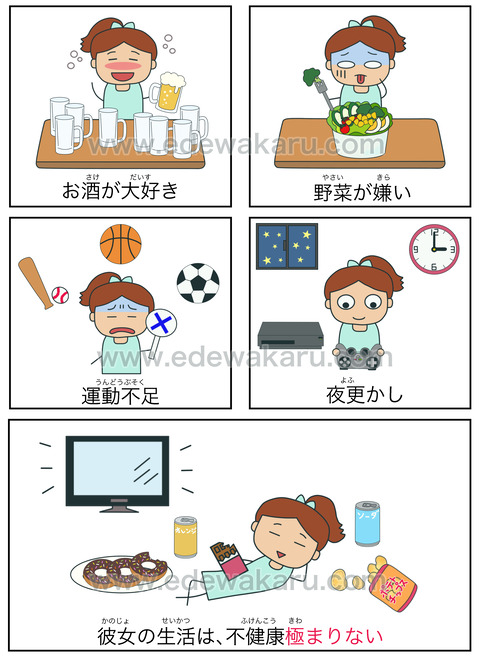
Meaning
Extremely 〜
Very 〜
How to use it
な-adjective [〜な] + 極まる
な-adjective [〜な] + 極まりない
な-adjective [〜な] + こと + 極まりない
い-adjective [〜い] + こと + 極まりない
Explanation
「〜極まりない」 is a sentence pattern meaning “extremely 〜” or “very 〜.” It is used when you want to say “to an unsurpassable degree.” 😊 「〜極まりない」 is used with [な-adjectives] and [い-adjectives], and it has several connection patterns, so learn them. 😉
[How 「〜極まりない」 connects]
[な-adjectives]
・な-adjective [〜な] + 極まりない
・な-adjective [〜な] + こと + 極まりない
[い-adjectives]
い-adjective [〜い] + こと + 極まりない
There is also the form 「〜極まる」, which has the same meaning as 「〜極まりない」, so learn it too. 😀
「〜極まる」 is only used with [な-adjectives], so be careful. 😨
[Example]
Her lifestyle is extremely unhealthy.
= Her lifestyle is extremely unhealthy.
= Her lifestyle is extremely unhealthy.
「〜極まりない」 and 「〜極まる」 are very formal expressions, so they aren’t often used in conversation. 😅 People taking N1 should learn them thoroughly for the test.
In context 5 examples
彼女の生活は、不健康極まりない
→彼女の生活は、とても不健康だHer lifestyle is extremely unhealthy. → Her lifestyle is very unhealthy.
N1に満点で合格した!感激極まりない
→N1に満点で合格した!すごく感激だI passed N1 with a perfect score! I’m extremely thrilled. → I passed N1 with a perfect score! I’m so thrilled.
1点足りなくて不合格だった…残念極まりない
→1点足りなくて不合格だった…とても残念だI failed by one point… It’s extremely disappointing. → I failed by one point… It’s very disappointing.
飲酒運転(いんしゅうんてん)は危険極まりないことだ
→飲酒運転は非常に危険なことだDrunk driving is extremely dangerous. → Drunk driving is very dangerous.
富士山から見る景色は美しいこと極まりない
→富士山から見る景色は非常に美しいThe view from Mount Fuji is as beautiful as it could possibly be. → The view from Mount Fuji is extremely beautiful.
Read the original source text
Meaning
とても〜だ
非常に〜だ
How to use it
な形容詞[ーな]+極まる
な形容詞[ーな]+極まりない
な形容詞[ーな]+こと+極まりない
い形容詞[ーい]+こと+極まりない
Explanation
「〜極まりない」は「とても〜だ」「非常に〜だ」という意味を表す文型です。
「それ以上ない程度だ」
と言いたい時に使われます😊「〜極まりない」は【な形容詞】【い形容詞】に使われ、いくつか接続方法がありますので覚えておきましょう😉
[「〜極まりない」の接続]
【な形容詞】
・な形容詞[ーな]+極まりない
・な形容詞[ーな]+こと+極まりない
【い形容詞】
い形容詞[ーい]+こと+極まりない
「〜極まりない」と同じ意味で「〜極まる」という形もありますので一緒に覚えておきましょう
😀
「〜極まる」は【な形容詞】にしか使われません
ので気をつけましょう😨
[例]
彼女の生活は、不健康
極まりない
=彼女の生活は、不健康な
こと極まりない
=彼女の生活は、不健康
極まる
「〜極まりない」「〜極まる」はとてもかたい言い方ですので、会話ではあまり使われません😅N1を受ける人は、テストのためにしっかりと覚えておきましょう。
Usage 2
Read this source entry ↗Meaning
Extremely 〜
Very 〜
How to use it
な-adjective [〜な] + 極まる
な-adjective [〜な] + 極まりない
な-adjective [〜な] + こと + 極まりない
い-adjective [〜い] + こと + 極まりない
Explanation
「〜極まりない」 is a sentence pattern meaning “extremely 〜” or “very 〜.” It is used when you want to say “to an unsurpassable degree.” 😊 「〜極まりない」 is used with [な-adjectives] and [い-adjectives], and it has several connection patterns, so learn them. 😉
[How 「〜極まりない」 connects]
[な-adjectives]
・な-adjective [〜な] + 極まりない
・な-adjective [〜な] + こと + 極まりない
[い-adjectives]
い-adjective [〜い] + こと + 極まりない
There is also the form 「〜極まる」, which has the same meaning as 「〜極まりない」, so learn it too. 😀
「〜極まる」 is only used with [な-adjectives], so be careful. 😨
[Example]
Her lifestyle is extremely unhealthy.
= Her lifestyle is extremely unhealthy.
= Her lifestyle is extremely unhealthy.
「〜極まりない」 and 「〜極まる」 are very formal expressions, so they aren’t often used in conversation. 😅 People taking N1 should learn them thoroughly for the test.
In context 5 examples
彼女の生活は、不健康極まりない
→彼女の生活は、とても不健康だHer lifestyle is extremely unhealthy. → Her lifestyle is very unhealthy.
N1に満点で合格した!感激極まりない
→N1に満点で合格した!すごく感激だI passed N1 with a perfect score! I’m extremely thrilled. → I passed N1 with a perfect score! I’m so thrilled.
1点足りなくて不合格だった…残念極まりない
→1点足りなくて不合格だった…とても残念だI failed by one point… It’s extremely disappointing. → I failed by one point… It’s very disappointing.
飲酒運転(いんしゅうんてん)は危険極まりないことだ
→飲酒運転は非常に危険なことだDrunk driving is extremely dangerous. → Drunk driving is very dangerous.
富士山から見る景色は美しいこと極まりない
→富士山から見る景色は非常に美しいThe view from Mount Fuji is as beautiful as it could possibly be. → The view from Mount Fuji is extremely beautiful.
Read the original source text
Meaning
とても〜だ
非常に〜だ
How to use it
な形容詞[ーな]+極まる
な形容詞[ーな]+極まりない
な形容詞[ーな]+こと+極まりない
い形容詞[ーい]+こと+極まりない
Explanation
「〜極まりない」は「とても〜だ」「非常に〜だ」という意味を表す文型です。
「それ以上ない程度だ」
と言いたい時に使われます😊「〜極まりない」は【な形容詞】【い形容詞】に使われ、いくつか接続方法がありますので覚えておきましょう😉
[「〜極まりない」の接続]
【な形容詞】
・な形容詞[ーな]+極まりない
・な形容詞[ーな]+こと+極まりない
【い形容詞】
い形容詞[ーい]+こと+極まりない
「〜極まりない」と同じ意味で「〜極まる」という形もありますので一緒に覚えておきましょう
😀
「〜極まる」は【な形容詞】にしか使われません
ので気をつけましょう😨
[例]
彼女の生活は、不健康
極まりない
=彼女の生活は、不健康な
こと極まりない
=彼女の生活は、不健康
極まる
「〜極まりない」「〜極まる」はとてもかたい言い方ですので、会話ではあまり使われません😅N1を受ける人は、テストのためにしっかりと覚えておきましょう。
NINJAL 日本語文型データベース
Usage 1
Meaning
This expresses that something is at an extreme level. It has a meaning close to “extremely ~.”
How to use it
na-A極まりない
Notes
“~” is a Sino-Japanese na-adjective (such as “退屈” or “危険”), and is often a word with a negative connotation.
The polite form “極まりありません” is not used.
In context 7 examples
こんな狭い道に車を止めるとは、本当に迷惑極まりない!
Parking a car on such a narrow road is utterly inconsiderate!
あの音楽の先生の授業は退屈極まりなかった。
That music teacher’s classes were extremely boring.
単独での冬山登山は危険極まりないので、行うべきではない。
Climbing a winter mountain alone is extremely dangerous, so you should not do it.
上司の不愉快極まりないセクシャル・ハラスメントにはもう我慢ならない。
I can no longer put up with my boss’s utterly unpleasant sexual harassment.
祖父はよく女は勝手極まりない生き物だと言っていたが、祖母も同様に、男は勝手極まりない生き物だと言っていた。
My grandfather often said that women are utterly selfish creatures, but my grandmother likewise said that men are utterly selfish creatures.
そのピアニストの流麗極まりない演奏に、聴衆は魅了された。
The audience was captivated by the pianist’s exceptionally graceful performance.
スカイダイビングは爽快極まりなく、実にエキサイティングなスポーツです。
Skydiving is utterly exhilarating and is a truly exciting sport.
Read the original source text
Meaning
物事の状態が極限のレベルまで~だということを表します。「非常に~だ」に近い意味です。
How to use it
na-A極まりない
Notes
「〜」は漢語のナ形容詞(「退屈・危険」など)で、マイナスイメージの言葉がくることが多いです。
丁寧体「極まりありません」の形は使いません。
Usage 2
Meaning
Expresses that the state of something is ~ to an extreme degree. It is close in meaning to “非常に~だ” (extremely ~).
“感極まる” is an idiomatic expression.
How to use it
na-A極まる
N極まる
Notes
“~” is a Sino-Japanese na-adjective (such as “退屈” or “危険”), and is often a word with a negative connotation.
It is often used to describe a noun.
It is not often used in the polite style.
It is also not used in the past or negative forms.
In context 7 examples
あの男の態度は実に失礼極まる。
That man’s attitude is truly extremely rude.
無責任極まる上司の態度に幻滅した。自分の責任を部下に押しつけるとは許せない。
I was disillusioned by my utterly irresponsible boss’s attitude. I can’t forgive him for pushing his own responsibilities onto his subordinates.
同居していた夫の母から冷淡極まる待遇を受け、別居することを決意した。
After receiving utterly cold treatment from my husband’s mother, who lived with us, I decided to live separately.
他の車の運転を妨害するいわゆる「あおり運転」は、危険極まる行為であり、法の下で罰せられなければならない。
So-called “road rage driving,” which obstructs other cars, is an extremely dangerous act and must be punished under the law.
Aチームは大胆極まる戦術で、予選を勝ち抜いてきた。
Team A has made it through the preliminaries with an extremely bold strategy.
その宮殿の内部には贅沢極まる装飾がほどこされているという。
They say that the inside of the palace is decorated with exceptionally lavish ornamentation.
昨日、テニス大会で優勝した。優勝カップをもらった瞬間、感極まって涙が出そうになった。
Yesterday, I won the tennis tournament. The moment I received the winner’s cup, I was so overcome with emotion that I nearly cried.
Read the original source text
Meaning
物事の状態が極限のレベルまで~だということを表します。「非常に~だ」に近い意味です。
「感極まる」は慣用的な言い方です。
How to use it
na-A極まる
N極まる
Notes
「〜」は漢語のナ形容詞(「退屈・危険」など)で、マイナスイメージの言葉がくることが多いです。
名詞を説明する形で使うことが多いです。
丁寧体で使うことはあまりありません。
また、過去形や否定形にはしません。
どんなときどう使う 日本語表現文型辞典
Meaning
utterly; inexcusably
How to use it
ナA+極まる (extremely; utterly)
Explanation
この上なく~だ
1)「~極まる・~極まりない」の形で、「この上なく~だ・非常に~だ」という意味。
2)話す人が感情的な言い方をするときに使われることが多い。古い言い方。
1)In forms ~極まる, ~極まりない, means nothing is more…than…, or extremely….
2)Often used in emotional speech. Old-fashioned expression.
In context 3 examples
電車の中などで見る最近の若い者の態度の悪いこと、まったく不愉快極まる。
The bad behavior of young people these days, as seen on trains and such, is utterly unpleasant.
あのレストランのウエーターの態度は不作法極まる。もう2度と行くものか。
The waiter at that restaurant was utterly ill-mannered. I'll never go there again.
目が合ってもあいさつもしないとは、となりの息子は失礼極まりない。
Even when our eyes meet, he doesn't even greet me. The boy next door is extremely rude.
Read the original source text
Meaning
utterly; inexcusably
How to use it
ナA+極まる
Explanation
この上なく~だ
1)「~極まる・~極まりない」の形で、「この上なく~だ・非常に~だ」という意味。
2)話す人が感情的な言い方をするときに使われることが多い。古い言い方。
1)In forms ~極まる, ~極まりない, means nothing is more…than…, or extremely….
2)Often used in emotional speech. Old-fashioned expression.
毎日のんびり日本語教師
How to use it
な-adjective stem + (なこと) + 極まりない/極まる
な-adjective stem + (であること) + 極まりない/極まる
い-adjective + こと + 極まりない/極まる
Explanation
Indicates an extreme degree.
Although “極まる” and “極まりない” formally appear to contrast as affirmative and negative, in this expression that contrast disappears, and both have the same meaning. If anything, “極まりない” is used somewhat more frequently.
Used in written language.
“感極まる” is an idiomatic expression meaning to be deeply moved.
Notes
Nothing in particular.
In context 15 examples
一日何時間もゲームをするのは不健全なこと極まりない。
Playing games for hours every day is the height of unhealthiness.
彼の失礼極まりない態度に我慢できなかった。
I couldn’t put up with his utterly rude attitude.
法定速度を守らないのは危険極まる行動だ。(不遵守法定速度是极其危险的行为。)
Not obeying the speed limit is an extremely dangerous act.
初対面なのにあの態度は失礼極まりない。
That attitude, despite this being our first meeting, is utterly rude.
迷惑極まりない路上駐車を早く取り締まってほしい。
I want them to crack down quickly on this utterly troublesome illegal parking on the street.
あの人、ずっと下ネタ言ってて不愉快極まりない。
That person keeps making dirty jokes, and it’s utterly unpleasant.
高層ビルなのにエレベーターが故障していて不便極まりない。
The elevator is broken even though it’s a high-rise building; it couldn’t be more inconvenient.
ドーナツにチョコレート、そしてコーラ。不健康極まりないけど不健康なものほど美味しい。
Chocolate donuts, and then cola. It’s the height of unhealthiness, but unhealthy things taste the best.
社会とは理不尽極まりないものだ。
Society is utterly unreasonable.
部員のうちたった一人が感染しただけでチーム全体が棄権しなければならないなんて残念極まりない。
It’s utterly disappointing that the whole team has to withdraw just because a single team member got infected.
恥ずかしいこと極まりない。穴があったら入りたい。
I’m utterly embarrassed. I wish I could crawl into a hole.
彼の主張を一通り確認したが、幼稚なこと極まりないものだった。
I reviewed all of his arguments, but they were utterly childish.
遅刻の理由を聞いたら、彼は「自転車に乗り遅れたので遅刻しました」などと意味不明で異常極まりない言い訳をしてきた。
When I asked him why he was late, he gave me an utterly bizarre and incomprehensible excuse, saying things like, “I was late because I missed my bicycle.”
本質を知ろうとせずに表面的に批判する行為は愚かであること極まりない。
Criticizing superficially without trying to understand the essence is utterly foolish.
無能極まりない上司の下では部下は育たない。
Subordinates cannot grow under a utterly incompetent boss.
Read the original source text
How to use it
ナ形語幹+(なこと)+極まりない/極まる
ナ形語幹+(であること)+極まりない/極まる
イ形容詞+こと+極まりない/極まる
Explanation
極限の程度を表します。
「極まる」「極まりない」は形式上肯否の対立が見られますが、この言い方の時はその対立が解消され、いずれも同じ意味となります。どちらかというと「極まりない」のほうが使用頻度が高めです。
書き言葉として用います。
「
感極まる」は非常に感動することを表す慣用表現です。
Notes
特になし