日本語文型辞典
Usage 1
Meaning
Means “at the same time as …” or “as soon as ….” An old-fashioned expression. Written style.
Expresses that one action is immediately followed by the next. Means “within a short time of doing …” or “as soon as ….” Written style.
How to use it
V-るや
V-るやいなや
In context 5 examples
「どうして俺なんか生んだんだ」という兄のことばを聞くや、母は顔を真っ赤にしておこりだした。
As soon as his mother heard her son say, “Why did you give birth to someone like me?” she turned bright red with anger.
「父死す」の電報を受け取るや、すぐさま彼は汽車に飛び乗った。
As soon as he received the telegram saying “Father has died,” he immediately jumped on a train.
彼はそれを聞くやいなや、ものも言わずに立ち去った。
As soon as he heard that, he left without saying a word.
その薬を飲むやいなや、急に眠気がおそってきた。
As soon as I took that medicine, I suddenly felt sleepy.
開店のドアが開くや否や、客はなだれのように押しよせた。
As soon as the store’s doors opened, customers surged in like an avalanche.
Read the original source text
Meaning
「…と同時に」「…とすぐに」の意味。古い言い方。書きことば。
ひとつの動作に続いてすぐに次のことが行われる様子を表す。「…するかしないかの短い間に」「…するとすぐに」の意味。書きことば。
How to use it
V-るや
V-るやいなや
Usage 2
Meaning
Used to list things. When one says 「XとY」, only X and Y are meant, but 「XやY」 implies that there are other things as well.
Gives an approximate number and indicates that it is not a large amount. Usually followed by expressions such as 「大丈夫だ」, 「かまわない」, and 「たいしたことはない」. Most often, numbers such as 1, 2 (for example, one or two people) are used.
How to use it
NやN
数量詞+や+数量詞
In context 10 examples
机の上には皿や紙コップなどが置いてあった。
There were plates, paper cups, and other things on the table.
バスは中学生や高校生ですぐにいっぱいになった。
The bus quickly filled up with middle school and high school students.
その村には米や野菜はあるが、肉はなかなか手に入らない。
That village has rice and vegetables, but meat is hard to come by.
うちの息子は一度外国に出かけると1ケ月や2ヶ月はなんの連絡もありません。
Whenever my son goes abroad, I hear nothing from him for a month or two.
善人だと言われている人でも、悪いことの一つや二つはしているだろう。
Even people said to be good must have done one or two bad things.
彼女ももうすぐ二十歳なんだから、ボーイフレンドが一人や二人いてもおかしくない。
She's almost twenty, so it wouldn't be unusual for her to have one or two boyfriends.
彼は気前がいいから、5万や10万なら理由を聞かずに貸してくれる。
He's generous, so he'll lend you 50,000 or 100,000 yen without asking why.
狭い部屋ですが、一晩や二晩ならがまんできるでしょう。
It's a small room, but you can put up with it for a night or two.
給料は安いが、子供の一人や二人は育てられる。
The salary is low, but I can raise one or two children.
国際化の時代なのに外国語の一つや二つできないようでは困ります。
It's a problem if you can't speak one or two foreign languages in this age of globalization.
Read the original source text
Meaning
ものをならべたてるのに用いる。「XとY」と言った場合はXYの二つだけだが、「XやY」はそれ以外にもなにかあるという含みがある。
おおよその数をあげて、それがたいした数ではないことを表す。「大丈夫だ」「かまわない」「たいしたことはない」という表現が続く。普通は1、2(一人や二人など)が使われることが多い。
How to use it
NやN
数量詞+や+数量詞
IMABI
The Parallel Particle や
Read this IMABI lesson ↗Explanation
The Parallel Particle や
Back in Lesson 27, we learned about the parallel particle と, which is used to conjoin noun phrases to create a finite list that is contained within the elements linked. In other words, if one wishes to say “N1 and N2,” one may say:
i. N1とN2
Consequently, however, i inherently implies that there is no N3.
Similarly, the parallel particle や also links nouns in much the same way, but with a catch. Instead of there not being a N3, the presumption is that there might be a N3—avoiding the exclusivity inherent with と.
ii. N1やN2(など)
Oftentimes, the final element of an incomplete list created by や is concluded with the adverbial particle など, which serves the function of “etc.”
Terminology Note: “N1,” “N2,” etc. stand for “Noun 1,” “Noun 2,” and so on.
Incomplete Lists with や
The primary function of the parallel particle や is to list things incompletely, and most importantly, in situations where speakers wish to refrain from imposing the strict exclusivity that the parallel particle と would. The implication of this wording will become more important as we move forward in this discussion, but for now, let’s look at simple sentences with や in action. Note that, when translating it into English, the word “and” is still often employed out of necessity.
1. ピクニックには、お菓子かしや飲み物ものを持もってまいりました。
We brought candies, drinks, etc. to the picnic.
2. うちの家は電車でんしゃやバス停に近くて、とても便利べんりなところに位置しています。
My home is close to the stations, bus, train, etc., located in a very convenient place.
3. 牛や馬が、向こうの青々とした草むら1で草を食はんで2いる。
Cows and horses are grazing in the lush green meadow over there.
4. 東京や韓国かんこくへ行く時は、飛行機ひこうきで行きます。
Whenever I go to Tokyo, Korea, etc., I go by plane.
5. 何やか3や言っては両親にお金をせびる。
To say this and that to get money out of one’s parents.
Sometimes, や is more akin to “or,” which is evident in the following:
6. 火事や地震が起こったら、避難してください。
Please evacuate if a fire or earthquake occurs.
It would be fairly odd for someone to be told to only evacuate in the cases of just fire and earthquake. Whether there is just a fire, just an earthquake, or both a fire and an earthquake at hand, Ex. 6 remains valid. Even so, や may also correspond to the “or” in “one or the other” relationships.
7. 私の結婚相手の条件は東大や京大を出ていることですわ!
My (one) condition I have for the person I’m going to marry is that they be a graduate of the University of Tokyo or Kyoto University!
What makes や an incomplete enumerator even in this context is that [東大] and [京大] are both prestigious schools, so if a guy from another unenumerated school wishes to court the speaker, he may still have a shot. The real question that ought to be posed, however, is whether the speaker necessarily considered other schools when they made this statement.
Before diving into how “incomplete” lists made with や are,
8. 遼平は毎日、ラーメンやうどんを食べた。
Ryohei ate (things like) ramen and udon every day.
Ryohei ate ramen or udon (or the like) every day.
9. 遼平は毎日、牛乳やヨーグルトを飲んだ。
Ryohei had (things like) milk and yogurt every day.
Ryohei had milk or yogurt (or the like) every day.
It is both plausible that Ryohei ate ramen and udon (and things of that vein) daily or that he alternated between those things, and the same goes for whether he had milk and yogurt daily or switched between the two or also went for similar dairy products. It is worth noting that this level of ambiguity is also possible in English.
Not So Incomplete Lists with や?
It turns out that many errors made by learners when distinguishing between と and や is not due to misunderstanding the basic functions of these particles but the implications behind choosing one over the other. First, consider the following example.
10a. 日本には神社とお寺がたくさんあるが、そういうところは結婚式や葬式のための施設でしかないと考える人が意外と多いようだ。X
Intended: Japan has a lot of shrines and temples, but it seems that there are quite a few people who view those places as nothing more than venues for weddings and/or funerals.
10b. 日本には神社やお寺がたくさんあるが、そういうところは結婚式や葬式のための施設でしかないと考える人が意外と多いようだ。◎
Japan has a lot of shrines and temples, but it seems that there are quite a few people who view those places as nothing more than venues for weddings and/or funerals.
From the English alone, as a learner yourself, you may wonder what is so wrong with Ex. 10a. The speaker is specifically talking about temples and shrines, and it is those places that Japanese people view in peculiar ways. Even so, we see that even the learner is naturally hesitant to limit these institutions to [結婚式と葬式], thus the use of [結婚式や葬式], but why [神社やお寺]?
In the Japanese wording for “those places,” we see that そういうところ is employed, but unlike its English counterpart, this Japanese phrasing is naturally vague and would be better translated as “those sort of places.” This phrasing coupled with the use of や in [神社やお寺] demonstrates a strong tendency of avoiding absolutes as well as the general observation that if そういうところ is not absolute in nature, its referents ought not be absolutes either.
While そういうところ strongly flags [神社とお寺] as being ungrammatical in the context of the overall sentence, what if we were only looking at 日本には神社やお寺がたくさんあるが]? Even still, the use of や would prevail, even if both 神社=N1 and お寺=N2 were the sole things on the speaker’s mind. This is an instance of the not-so-incomplete や, and to get to the bottom of how it functions (or if it is even warranted to distinguish it from や’s basic understanding), there are several factors that we will need to explore:
The qualities that N1 and N2 possess—[N1やN2].
How the list relates to the predicate, especially verbal predicates.
The emotional state of the speaker.
The nature of the information being given via the list: “old” vs “new” information.
The qualities that N1 and N2 possess—[N1やN2]
First, let’s look at a healthy number of pairings made via や in isolation.
iii. 人権や自由
Human rights and freedoms
iv. 法律や宗教
The law and religion
v. 茶道や華道、剣道や弓道
The Way of Tea and The Way of Floral Art; The Way of the Sword and The Way of the Bow
vi. 電車やバス (and so on)
Trains and buses
vii. カナダやメキシコ
Canada and Mexico (and so on)
Something that these pairings all demonstrate is that N1 and N2 are of the same vein. They may be particular instances of whatever overarching theme being discussed, but the relationship between the two words ought to be obvious and in line with common sense.
In contrast, N1-N2 pairings conjoined by と maintain a high level of independence for the nouns involved, making と perfect for juxtaposing finite, distinct entities. As such, と is heavily used, for instance, in the titles of books and movies, but in the phrasing “in the titles of books and movies,” one would expect や to appear.
vix. 罪と罰
Crime and Punishment
ix. 父と子
Father and child
x. 火と汐
Fire & Tide
xi. 美女と野獣
Beauty and the Beast
xii. 日本語の文法とその指導
Japanese Grammar and Its Instruction
xiii. 本や映画(など)のタイトル
Titles of books, movies, etc.
Although it is not to say that や cannot exist in certain pairings, once it is used instead of と, the “independence (独立性)” of each entity is significantly lowered. This also helps us explain how や can also be interpreted as “or,” as we saw earlier.
11. 罪や罰は償う事が出来る。
Sins and punishments can be atoned for.
12. 三位一体の表現に「父」や「子」を使わないところってあるの?
Are there any contexts in which the terms “Father” and “Son” are not used to express the Trinity?
13.「美女」や「野獣」のような一般的な語句や、単純にそれを組み合わせた語句は登録できません。
Common terms—such as “Beauty” or “Beast”—or simple combinations thereof cannot be registered.
To further verify the succinctness of と and the lack thereof of や, consider the following:
14a. きのう行ったのは、浅草と秋葉原です。〇
14b. きのう行ったのは、浅草や秋葉原です。??
14c. きのう行ったのは、浅草や秋葉原であって、日本橋ではない。〇
14a. The places I went to yesterday were Asakusa and Akihabara.
14b. As for where I went to yesterday, I went to Asakusa and Akihabara. (Intended)
14c. As for the places I went to yesterday, that would be Asakusa and Akihabara, not Nihombashi.
Given how weak the independence of N1 and N2 are with や conjoining them, we see that in Ex. 14c that the focus of the sentence is not so much on what や conjoins than it is on the comment that occurs afterward.
How the List Relates to the Predicate
If by using [N1やN2] the focus is not so much placed on the conjoined complements but whatever statement that follows, one might expect not-so-incomplete instances of や used to open up conversation on a given topic but direct the listener’s attention to what they have to say which would naturally follow.
15. 初詣は新年に行う重要な伝統行事で、[全国の神社や寺院]に、多くの人々が足を運びます。
Hatsumōde is a significant traditional custom observed at the start of the New Year, during which large numbers of people visit [shrines and temples across the country].
16. 将来の紛争については、36%のミレニアル世代が、人間に制御されていない自律型の[ドローンやロボット]が[戦争や武力紛争]で「民間人の犠牲者を増やす」と回答しています。
Regarding future conflicts, 36% of millennials believe that autonomous [drones and robots]—operating without human control—will “increase civilian casualties” in [wars and armed conflicts].
17. 夜遅くまで開いている店や24時間営業のコンビニエンスストア等4は、[ヨーロッパやアメリカの先進国]ではなかなか見られない光景だ。
Shops that remain open late into the night, as well as 24-hour convenience stores, are a sight rarely encountered in [developed nations in Europe and the United States].
In this same vein, we find that や is often followed by ~のような. Although incomplete lists are certainly possible, what with ~のような meaning “like,” when N1 and N2 are not so incomplete, the use of や and ~のような can bring about a euphemistic tone.
18. 剣道や弓道のような武道では首や胸元、腕から見える刺青やモヒカンのような奇抜な髪型はどのような扱いですか?
In martial arts such as Kendo and Kyudo, how are visible tattoos—specifically those on the neck, chest, or arms—and unconventional hairstyles, such as mohawks, generally treated?
19. 僕もラファエル君やローサ姉さんのように頑張りたいと思う!
I, too, want to work just as hard as Raphael and Rosa!
20. ロシア連邦政府が伝統的価値観とみなし、人権や自由のような普遍的価値観とどこで乖離しているのか、その輪郭は先の文章で見ることができる。
The preceding text clearly outlines the contours of what the Russian Federation government regards as “traditional values,” and reveals precisely where these diverge from universal values such as human rights and individual freedoms.
We also see that its euphemistic tone also makes it fit well with allowing complements of a negative predicate to not sound so blunt and jarring.
21. 中国や韓国は論外だ。
China and South Korea are out of the question.
22. マスコミや専門家はあてにならないので、私なりに考えてみる。
Since the media and experts cannot be relied upon, I try to think for myself.
Speaking of the nature of the predicate, let’s now consider what these predicates, largely verbal, have in common. We find that in many cases, predicates which follow や tend to be far more wide-reaching in scope as opposed to be localized/finite, fitting the overall theme of や.
23. 彼は彼自身の背中や尻尾や腹に、ついに苔が生えてしまったと信じた。
It came to believe that the moss had finally grown onto its own back, tail, and belly.
From 『山椒魚』.
24. 山椒魚は、杉苔や銭苔を眺めることを好まなかった。
The salamander did not care for gazing at the cedar moss or liverwort.
25. 電車やバスを乗り継いで訪れた。
I traveled there by taking connecting trains and buses.
In Ex. 23 the event of the moss growing seemingly everywhere fits more in line with the use of や. We can get a much stronger sense of how widespread the event is taking place and that it is not localized to the spots mentioned in the list marked by や. In Ex. 24, the act of [眺める] encompasses the various mosses that dominate the salamander’s world. If と were to be used instead of や, that world which the salamander is not so fond of becomes limited and weakens the overall message substantially. In Ex. 25, while it is more perceivable, if not a given, that the agent visited by making connections on trains and busses—refraining from mentioning “by car” —the verb 乗り継ぐ itself hints at the various shifts in transportation made, so whether other forms of transportation are truly part of the “list” or not, や facilitates a more natural tone to highlight the transitions made.
The Emotional State of the Speaker
One thing that seems to be ever clearer as we investigate what is really meant by や is that the speaker feels inclined to avoid speaking in absolutes even when the entities enumerated by it are, for all intended purposes, the only things being discussed. Moreover, if the speaker wanted to clearly state that any given list made with や is unequivocally incomplete, they can employ など to taper things off.
26a. セス先生の机の上に、ペンやノートがある。
26b. セス先生の机の上に、ペンやノートなどがある。
26a. There are pens and notebooks on Seth-sensei’s desk.
26b. There are pens, notebooks, and the like on Seth-sensei’s desk.
27a. 彼氏は間違った歯磨き粉やブラシを買って普通に使っていた。
27b. 彼氏は間違った歯磨き粉やブラシなどを買って普通に使っていた。
27a. My boyfriend had bought the wrong toothpaste and toothbrush and has been using them on the regular.
27b. My boyfriend had bought the wrong toothpaste, toothbrush, and you name it, and has been using those things on the regular.
In both Ex. 26 and Ex. 27, N1 and N2 go hand-in-hand, and while it is not as realistic for [ペンやノート] to be the only things on someone’s desk, [歯磨き粉やブラシ] clearly go together, yet the speaker refrains from using と to conjoin them in Ex. 27a. By not speaking in absolute terms, the focus of the sentence can fall on the predicate that follows, as we have seen, which is how the agent has been using the “wrong things” as if nothing was wrong5. Even if the “wrong things” were, in fact, limited to just those two entities, や allows for the focus of the sentence to not be trapped to those two entities individually. Incidentally, Ex. 27b., while not ungrammatical, oddly begs the question as to what other things the speaker’s boyfriend buys by mistake and uses anyway as if nothing were wrong.
“New” vs “Old” Information
It must not be forgotten that the parallel particle と derives from a case particle, a case particle which introduces participants as its primary function. When used as a parallel particle, と introduces a pairing not just in a finite manner, but in doing so, it keenly shows up when “introducing” those complements for the first time as “new information.” To contrast this with how や functions, consider the following.
28. 岩屋の天井には、杉苔と銭苔が密生している。
The ceiling of the rocky cavern was densely overgrown with cedar moss and liverwort.
24. 山椒魚は、杉苔や銭苔を眺めることを好まなかった。
The salamander did not care for gazing at the cedar moss or liverwort.
29. 岩や天井の凹みには、一群ずつの黴さえも生えた。
Even clusters of mold had sprouted within the crevices of the rocks and ceiling.
It turns out that within the overall passage of 『山椒魚』, the mosses introduced prior to Ex. 24 are conjoined as [杉苔と銭苔], with と instead of や. When the mosses appear a second time, we see that や is used, which in addition to the information now being “old,” や fits with the overall mood set by the negative predicate of the main clause as well as the wide-ranging implication of its immediate verbal head [眺める]. Later on in the passage, we even see [岩屋の天井] broken up as [岩や天井の凹み] to emphasize the wide-ranging extent of the underlining predicate [黴が生えた]. As such, while it is not always the case that や pertains to “old” information exclusively, we see that many of the implications borne in the contexts in which it appears are made possible by established context, bringing us full circle to the first point about nouns linked with や being of the same vein.
【参照】
並立助詞「と」と「や」に関する一考察 by 市川保子.
草むら may also be spelled in kanji as 叢. ↩︎
The verb 食む is a seldom encountered word meaning “to eat,” largely in the context of livestock eating grasses. Of course, in more colloquial conversation, it may be replaced by 食べる. ↩︎
The か in this expression is an indefinite pronoun meaning “that,” and it is etymologically related to the word 彼, which was used to mean “that” before being repurposed as the third-person pronoun for “he.” ↩︎
Whether it is read as とう or など, the use of “and the sort” when the statement is clearly about convenience stores that are open 24/7 is consistent with the use of the particle や thereafter in [ヨーロッパやアメリカの先進国] to ease one’s way into the substance of the main clause, which is that such stores are pretty uncommon in developed countries. ↩︎
Of course, there is still always the open-ended conclusion to consider, in which “the things one may use to maintain one’s oral hygiene need not be limited to 歯磨き粉・ブラシ as some intrinsic pair. ↩︎
In context 34 examples
ピクニックには、お菓子かしや飲み物ものを持もってまいりました。
We brought candies, drinks, etc. to the picnic.
うちの家は電車でんしゃやバス停に近くて、とても便利べんりなところに位置しています。
My home is close to the stations, bus, train, etc., located in a very convenient place.
牛や馬が、向こうの青々とした草むら1で草を食はんで2いる。
Cows and horses are grazing in the lush green meadow over there.
東京や韓国かんこくへ行く時は、飛行機ひこうきで行きます。
Whenever I go to Tokyo, Korea, etc., I go by plane.
何やか3や言っては両親にお金をせびる。
To say this and that to get money out of one’s parents.
火事や地震が起こったら、避難してください。
Please evacuate if a fire or earthquake occurs.
私の結婚相手の条件は東大や京大を出ていることですわ!
My (one) condition I have for the person I’m going to marry is that they be a graduate of the University of Tokyo or Kyoto University!
遼平は毎日、ラーメンやうどんを食べた。
Ryohei ate (things like) ramen and udon every day.
遼平は毎日、牛乳やヨーグルトを飲んだ。
Ryohei had (things like) milk and yogurt every day.
日本には神社とお寺がたくさんあるが、そういうところは結婚式や葬式のための施設でしかないと考える人が意外と多いようだ。X
Intended: Japan has a lot of shrines and temples, but it seems that there are quite a few people who view those places as nothing more than venues for weddings and/or funerals.
日本には神社やお寺がたくさんあるが、そういうところは結婚式や葬式のための施設でしかないと考える人が意外と多いようだ。◎
Japan has a lot of shrines and temples, but it seems that there are quite a few people who view those places as nothing more than venues for weddings and/or funerals.
罪や罰は償う事が出来る。
Sins and punishments can be atoned for.
三位一体の表現に「父」や「子」を使わないところってあるの?
Are there any contexts in which the terms “Father” and “Son” are not used to express the Trinity?
「美女」や「野獣」のような一般的な語句や、単純にそれを組み合わせた語句は登録できません。
Common terms—such as “Beauty” or “Beast”—or simple combinations thereof cannot be registered.
きのう行ったのは、浅草と秋葉原です。〇
14a. The places I went to yesterday were Asakusa and Akihabara.
きのう行ったのは、浅草や秋葉原です。??
14a. The places I went to yesterday were Asakusa and Akihabara.
きのう行ったのは、浅草や秋葉原であって、日本橋ではない。〇
14a. The places I went to yesterday were Asakusa and Akihabara.
初詣は新年に行う重要な伝統行事で、[全国の神社や寺院]に、多くの人々が足を運びます。
Hatsumōde is a significant traditional custom observed at the start of the New Year, during which large numbers of people visit [shrines and temples across the country].
将来の紛争については、36%のミレニアル世代が、人間に制御されていない自律型の[ドローンやロボット]が[戦争や武力紛争]で「民間人の犠牲者を増やす」と回答しています。
Regarding future conflicts, 36% of millennials believe that autonomous [drones and robots]—operating without human control—will “increase civilian casualties” in [wars and armed conflicts].
夜遅くまで開いている店や24時間営業のコンビニエンスストア等4は、[ヨーロッパやアメリカの先進国]ではなかなか見られない光景だ。
Shops that remain open late into the night, as well as 24-hour convenience stores, are a sight rarely encountered in [developed nations in Europe and the United States].
剣道や弓道のような武道では首や胸元、腕から見える刺青やモヒカンのような奇抜な髪型はどのような扱いですか?
In martial arts such as Kendo and Kyudo, how are visible tattoos—specifically those on the neck, chest, or arms—and unconventional hairstyles, such as mohawks, generally treated?
僕もラファエル君やローサ姉さんのように頑張りたいと思う!
I, too, want to work just as hard as Raphael and Rosa!
ロシア連邦政府が伝統的価値観とみなし、人権や自由のような普遍的価値観とどこで乖離しているのか、その輪郭は先の文章で見ることができる。
The preceding text clearly outlines the contours of what the Russian Federation government regards as “traditional values,” and reveals precisely where these diverge from universal values such as human rights and individual freedoms.
中国や韓国は論外だ。
China and South Korea are out of the question.
マスコミや専門家はあてにならないので、私なりに考えてみる。
Since the media and experts cannot be relied upon, I try to think for myself.
彼は彼自身の背中や尻尾や腹に、ついに苔が生えてしまったと信じた。
It came to believe that the moss had finally grown onto its own back, tail, and belly.
山椒魚は、杉苔や銭苔を眺めることを好まなかった。
The salamander did not care for gazing at the cedar moss or liverwort.
電車やバスを乗り継いで訪れた。
I traveled there by taking connecting trains and buses.
セス先生の机の上に、ペンやノートがある。
26a. There are pens and notebooks on Seth-sensei’s desk.
セス先生の机の上に、ペンやノートなどがある。
26a. There are pens and notebooks on Seth-sensei’s desk.
彼氏は間違った歯磨き粉やブラシを買って普通に使っていた。
27a. My boyfriend had bought the wrong toothpaste and toothbrush and has been using them on the regular.
彼氏は間違った歯磨き粉やブラシなどを買って普通に使っていた。
27a. My boyfriend had bought the wrong toothpaste and toothbrush and has been using them on the regular.
岩屋の天井には、杉苔と銭苔が密生している。
The ceiling of the rocky cavern was densely overgrown with cedar moss and liverwort.
岩や天井の凹みには、一群ずつの黴さえも生えた。
Even clusters of mold had sprouted within the crevices of the rocks and ceiling.
As soon as
Read this IMABI lesson ↗Explanation
As soon as: ~や(いなや), ~なり, ~途端(に), ~かと思うと, & ~次第
Though “as” itself is hard enough in Japanese, Japanese also has a lot of expressions that mean “as soon as”. This lesson will investigate how to use these expressions. Take close attention to what defines them as there are differences!
~や否や & ~や
Placed after the 終止形しゅうしけい of a verb in ~や or ~や否いなや, it means “as soon as”. With 否や, it is like the second action takes place before the first action can even be confirmed or done. The most used is や否や. In fact, や否や will be used 90% of the time.
1. 地震じしんが発生はっせいするやいなや、気象庁きしょうちょうは直ただちに津波警報つなみけいほうを出しました。
As soon as the earthquake happened, the Meteorological Agency issued a tsunami warning.
2. 姉の顔を見るやいなや、泣き出した。
I began weeping as soon as I saw my sister’s face.
3a. その選手はチャンスと見るや、一気に{攻め込んだ・攻撃をしかけた}。
3b. その選手はチャンスと見るやいなや、一気に{攻め込んだ・攻撃をしかけた}。 (あまり使わない言い方)
The player felt a chance open and attacked in one burst.
4. 出発しゅっぱつするやいなや雨が降ふり出した。
It started to rain as soon as I departed.
~やいなや cannot be used to show the speaker’s wants or intentions. Also, don’t use the past tense before ~やいなや. The action can be something that you can expect. It’s important to understand that the events of the second clause are actions/movements.
5. うちの猫は魚が大好きで、あげるやいなや、一気に全部食べてしまう。
My cat loves fish, and the instant you give it to it, it’s gone in an instant.
The Conjunctive Particle なり
After the 連体形 of a verb, ~なり shows that something is done as soon as something else is done. So right when someone does something, they do something next in sequence to the first action. The subject is normally third person, and the subject is the same in both clauses.
6a. 宿題を済ませるなり、彼らはインターネットを使った。
6b. 宿題を済ませるとすぐに、彼らはインターネットを使った。(More natural)
They used the Internet as soon as they finished their homework.
7. 彼は帰るなり、トイレに行った。
He went to the bathroom as soon as he got home.
8. 社長は入ってくるなり、大声で怒鳴りました。
As soon as the company president came in, he shouted in a big voice.
The word comes from the なり in words like 身なり (appearance). The event in the second clause is often one that describes an action/condition not wanted. Although it is used some in the spoken language, it is usually reserved to writing.
After the past tense, it shows a situation that is still in play as another action begins. It is unnatural when you move in any way to a different action.
9. 彼は靴を履いたなり、畳に上がってしまった。 △
彼は靴を履いたまま、畳に上がってしまった。 〇
He accidentally stepped onto the tatami mat with his shoes still.
10. 彼女は公園でベンチに座り込んだ{なり・まま}、眠ってしまった。
She fell asleep while sitting on a park bench.
~途端(に)
When students learn of 途端に, they immediately think of ~ときに, especially when they learn that this phrase is used after the past tense. Understandable, ~たとき(に)and ~たとたん(に) vaguely resemble each other, especially when not written in 漢字.
~た途端とたん(に) is, again, only used with the past tense. It marks the instant after one does something. This “something” that happens afterward is something that is unexpected and much of a surprise.
11. 彼がドアを開けた途端、車が爆発した。
The car exploded just as he opened the door.
12. 窓まどを開けた途端に、犬が飛び出していった。
As soon as I opened the window, the dog jumped out.
13. 立ち去さった途端に、その建物たてものが爆発ばくはつしたよ!
As soon as he left, the building exploded!
14. 動画どうがを観みた途端に、眠ねむくなってしまった。
I accidentally fell asleep as soon as I saw the video.
15. 余所見をした途端、転んだ。
I fell down as soon as I turned away.
16. 酒を飲むと、(その)途端に人が変わる。
Once a person drinks, that person changes instantly.
Grammar Note: 途端 may also be used in the sense of instantly and can be seen with such statements.
As seen in the example sentences, though, ~た途端(に)can’t be used when something volitional occurs. So, although a situation may be unexpected, you would need to use a phrase like ~たら、すぐに if you are using a verb of volition.
17. ベルが鳴ったら、すぐに外に出てください。
When the bell rings, immediately go outside.
~かと思うと
Perhaps because it is rarely treated separately in grammar discussions, students have a hard time knowing how to use this phrase. This describes something happening that causes a sense of surprise, similar to ~た途端(に), which follows after an event described in the first clause. Transitivity, though, is clearly different as ~た途端(に)is used with transitive expressions, but this phrase does not have that requirement.
You cannot use this phrase for yourself. At times it may be best to use ~かと思ったら instead. Sentences of command, negation, or will appear afterwards. For some people, when the event is not of the future or going back and forth in a way that means the first action may happen again in the “future”, then the use of ~かと思うと is somewhat unnatural and should be replaced with ~かと思ったら. So, for the sentences below regarding weather, you can paraphrase with the latter and have no problem.
Examples
18. 雨が降ってきたかと{思うと ?/〇・思ったら 〇}、もう止んだ。
Just when I thought it had started to rain, it stopped.
19. 空が曇ってきたと{思うと ?/〇・思ったら 〇}、突然大雨になった。
Just when I thought it got cloudy, it started to rain heavily.
20. 彼女はA君のことを好きだと言っていたかと思うと、次はB君が好きだと言い出し、何を考えているのかよく分からない。
Just as I had thought she said she liked A-kun, she then stated that she liked B-kun, and so I don’t know what she’s thinking.
22. うちの子供は帰ってきたかと{思うと ?/〇・思ったら 〇}、もう外に遊びに行った。
The kids had already gone to play outside just when I thought they had come home.
~次第
As a regular noun, 次第 means “course of events”. It is seen after nouns a lot, especially Sino-Japanese words, but also after the 連用形 of verbs.
When it attaches to other nouns, it often means “depending on”. As such, when after the 連用形 of a verb, it may show that something is dependent on an action in question.
23. 請求せいきゅうがあり次第だ。
It’s on demand.
24. 物事は状況次第。
Circumstances alter cases.
25. こういう次第だ。
This is how it stands.
26. 万事は君の(この)取り扱い方次第だ。
It depends on the way you handle it.
27. 天気の様子次第で行くかどうか決めるんだ。
I’m going to decide on whether to go or not depending on the weather condition.
28. 大統領が決心するかどうかはそれ次第だ。
The president’s resolution depends on this.
29. 豊作になるかどうかは天気次第です。
An abundant harvest is dependent on the weather.
30. 結果は君次第だ。
The results depend on you.
31. 昇進できるかどうかは能力次第だ。
Promotion is dependent on one’s ability.
連用形 + 次第
It may also be used with the 連用形 of a verb to show what happens “as soon as…”. This is in the sense that right after something realizes, one does the next action. Thus, the second clause following must be a verb of volition in regards to the speaker. This separates it quite well from the other “as soon as” phrases in this lesson.
32. 着き次第、被災地に援助します。
As soon as we arrive, we will aid in the disaster area.
33. 手当たり次第に食べ物を買い占しめる。
To buy up food as it is made available.
34. 満員になり次第締め切ろう。
Let’s close up as soon as we become a full house.
35. 我々は雪がやみ次第、作業を再び始めるつもりです。
We plan to resume operations as soon as it stops snowing.
Adverbial 次第に
Lastly, 次第に is an adverb meaning “gradually”, “finally”, or “in order”.
36. 機械は{次第にだんだんと}廃すたれていくだろう。
Machines will gradually go out of date.
37. 騒音そうおんが次第に消えてゆく。
Noise will gradually fade away.
In context 38 examples
地震じしんが発生はっせいするやいなや、気象庁きしょうちょうは直ただちに津波警報つなみけいほうを出しました。
As soon as the earthquake happened, the Meteorological Agency issued a tsunami warning.
姉の顔を見るやいなや、泣き出した。
I began weeping as soon as I saw my sister’s face.
その選手はチャンスと見るや、一気に{攻め込んだ・攻撃をしかけた}。
The player felt a chance open and attacked in one burst.
その選手はチャンスと見るやいなや、一気に{攻め込んだ・攻撃をしかけた}。 (あまり使わない言い方)
The player felt a chance open and attacked in one burst.
出発しゅっぱつするやいなや雨が降ふり出した。
It started to rain as soon as I departed.
うちの猫は魚が大好きで、あげるやいなや、一気に全部食べてしまう。
My cat loves fish, and the instant you give it to it, it’s gone in an instant.
宿題を済ませるなり、彼らはインターネットを使った。
They used the Internet as soon as they finished their homework.
宿題を済ませるとすぐに、彼らはインターネットを使った。(More natural)
They used the Internet as soon as they finished their homework.
彼は帰るなり、トイレに行った。
He went to the bathroom as soon as he got home.
社長は入ってくるなり、大声で怒鳴りました。
As soon as the company president came in, he shouted in a big voice.
彼は靴を履いたなり、畳に上がってしまった。 △
He went up onto the tatami with his shoes still on. △
彼女は公園でベンチに座り込んだ{なり・まま}、眠ってしまった。
She fell asleep while sitting on a park bench.
彼がドアを開けた途端、車が爆発した。
The car exploded just as he opened the door.
窓まどを開けた途端に、犬が飛び出していった。
As soon as I opened the window, the dog jumped out.
立ち去さった途端に、その建物たてものが爆発ばくはつしたよ!
As soon as he left, the building exploded!
動画どうがを観みた途端に、眠ねむくなってしまった。
I accidentally fell asleep as soon as I saw the video.
余所見をした途端、転んだ。
I fell down as soon as I turned away.
酒を飲むと、(その)途端に人が変わる。
Once a person drinks, that person changes instantly.
ベルが鳴ったら、すぐに外に出てください。
When the bell rings, immediately go outside.
雨が降ってきたかと{思うと ?/〇・思ったら 〇}、もう止んだ。
Just when I thought it had started to rain, it stopped.
空が曇ってきたと{思うと ?/〇・思ったら 〇}、突然大雨になった。
Just when I thought it got cloudy, it started to rain heavily.
彼女はA君のことを好きだと言っていたかと思うと、次はB君が好きだと言い出し、何を考えているのかよく分からない。
Just as I had thought she said she liked A-kun, she then stated that she liked B-kun, and so I don’t know what she’s thinking.
うちの子供は帰ってきたかと{思うと ?/〇・思ったら 〇}、もう外に遊びに行った。
The kids had already gone to play outside just when I thought they had come home.
請求せいきゅうがあり次第だ。
It’s on demand.
物事は状況次第。
Circumstances alter cases.
こういう次第だ。
This is how it stands.
万事は君の(この)取り扱い方次第だ。
It depends on the way you handle it.
天気の様子次第で行くかどうか決めるんだ。
I’m going to decide on whether to go or not depending on the weather condition.
大統領が決心するかどうかはそれ次第だ。
The president’s resolution depends on this.
豊作になるかどうかは天気次第です。
An abundant harvest is dependent on the weather.
結果は君次第だ。
The results depend on you.
昇進できるかどうかは能力次第だ。
Promotion is dependent on one’s ability.
着き次第、被災地に援助します。
As soon as we arrive, we will aid in the disaster area.
手当たり次第に食べ物を買い占しめる。
To buy up food as it is made available.
満員になり次第締め切ろう。
Let’s close up as soon as we become a full house.
我々は雪がやみ次第、作業を再び始めるつもりです。
We plan to resume operations as soon as it stops snowing.
機械は{次第にだんだんと}廃すたれていくだろう。
Machines will gradually go out of date.
騒音そうおんが次第に消えてゆく。
Noise will gradually fade away.
Read the original source text
Explanation
As soon as: ~や(いなや), ~なり, ~途端(に), ~かと思うと, & ~次第
Though “as” itself is hard enough in Japanese, Japanese also has a lot of expressions that mean “as soon as”. This lesson will investigate how to use these expressions. Take close attention to what defines them as there are differences!
~や否や & ~や
Placed after the 終止形しゅうしけい of a verb in ~や or ~や否いなや, it means “as soon as”. With 否や, it is like the second action takes place before the first action can even be confirmed or done. The most used is や否や. In fact, や否や will be used 90% of the time.
1. 地震じしんが発生はっせいするやいなや、気象庁きしょうちょうは直ただちに津波警報つなみけいほうを出しました。
As soon as the earthquake happened, the Meteorological Agency issued a tsunami warning.
2. 姉の顔を見るやいなや、泣き出した。
I began weeping as soon as I saw my sister’s face.
3a. その選手はチャンスと見るや、一気に{攻め込んだ・攻撃をしかけた}。
3b. その選手はチャンスと見るやいなや、一気に{攻め込んだ・攻撃をしかけた}。 (あまり使わない言い方)
The player felt a chance open and attacked in one burst.
4. 出発しゅっぱつするやいなや雨が降ふり出した。
It started to rain as soon as I departed.
~やいなや cannot be used to show the speaker’s wants or intentions. Also, don’t use the past tense before ~やいなや. The action can be something that you can expect. It’s important to understand that the events of the second clause are actions/movements.
5. うちの猫は魚が大好きで、あげるやいなや、一気に全部食べてしまう。
My cat loves fish, and the instant you give it to it, it’s gone in an instant.
The Conjunctive Particle なり
After the 連体形 of a verb, ~なり shows that something is done as soon as something else is done. So right when someone does something, they do something next in sequence to the first action. The subject is normally third person, and the subject is the same in both clauses.
6a. 宿題を済ませるなり、彼らはインターネットを使った。
6b. 宿題を済ませるとすぐに、彼らはインターネットを使った。(More natural)
They used the Internet as soon as they finished their homework.
7. 彼は帰るなり、トイレに行った。
He went to the bathroom as soon as he got home.
8. 社長は入ってくるなり、大声で怒鳴りました。
As soon as the company president came in, he shouted in a big voice.
The word comes from the なり in words like 身なり (appearance). The event in the second clause is often one that describes an action/condition not wanted. Although it is used some in the spoken language, it is usually reserved to writing.
After the past tense, it shows a situation that is still in play as another action begins. It is unnatural when you move in any way to a different action.
9. 彼は靴を履いたなり、畳に上がってしまった。 △
彼は靴を履いたまま、畳に上がってしまった。 〇
He accidentally stepped onto the tatami mat with his shoes still.
10. 彼女は公園でベンチに座り込んだ{なり・まま}、眠ってしまった。
She fell asleep while sitting on a park bench.
~途端(に)
When students learn of 途端に, they immediately think of ~ときに, especially when they learn that this phrase is used after the past tense. Understandable, ~たとき(に)and ~たとたん(に) vaguely resemble each other, especially when not written in 漢字.
~た途端とたん(に) is, again, only used with the past tense. It marks the instant after one does something. This “something” that happens afterward is something that is unexpected and much of a surprise.
11. 彼がドアを開けた途端、車が爆発した。
The car exploded just as he opened the door.
12. 窓まどを開けた途端に、犬が飛び出していった。
As soon as I opened the window, the dog jumped out.
13. 立ち去さった途端に、その建物たてものが爆発ばくはつしたよ!
As soon as he left, the building exploded!
14. 動画どうがを観みた途端に、眠ねむくなってしまった。
I accidentally fell asleep as soon as I saw the video.
15. 余所見をした途端、転んだ。
I fell down as soon as I turned away.
16. 酒を飲むと、(その)途端に人が変わる。
Once a person drinks, that person changes instantly.
Grammar Note: 途端 may also be used in the sense of instantly and can be seen with such statements.
As seen in the example sentences, though, ~た途端(に)can’t be used when something volitional occurs. So, although a situation may be unexpected, you would need to use a phrase like ~たら、すぐに if you are using a verb of volition.
17. ベルが鳴ったら、すぐに外に出てください。
When the bell rings, immediately go outside.
~かと思うと
Perhaps because it is rarely treated separately in grammar discussions, students have a hard time knowing how to use this phrase. This describes something happening that causes a sense of surprise, similar to ~た途端(に), which follows after an event described in the first clause. Transitivity, though, is clearly different as ~た途端(に)is used with transitive expressions, but this phrase does not have that requirement.
You cannot use this phrase for yourself. At times it may be best to use ~かと思ったら instead. Sentences of command, negation, or will appear afterwards. For some people, when the event is not of the future or going back and forth in a way that means the first action may happen again in the “future”, then the use of ~かと思うと is somewhat unnatural and should be replaced with ~かと思ったら. So, for the sentences below regarding weather, you can paraphrase with the latter and have no problem.
Examples
18. 雨が降ってきたかと{思うと ?/〇・思ったら 〇}、もう止んだ。
Just when I thought it had started to rain, it stopped.
19. 空が曇ってきたと{思うと ?/〇・思ったら 〇}、突然大雨になった。
Just when I thought it got cloudy, it started to rain heavily.
20. 彼女はA君のことを好きだと言っていたかと思うと、次はB君が好きだと言い出し、何を考えているのかよく分からない。
Just as I had thought she said she liked A-kun, she then stated that she liked B-kun, and so I don’t know what she’s thinking.
22. うちの子供は帰ってきたかと{思うと ?/〇・思ったら 〇}、もう外に遊びに行った。
The kids had already gone to play outside just when I thought they had come home.
~次第
As a regular noun, 次第 means “course of events”. It is seen after nouns a lot, especially Sino-Japanese words, but also after the 連用形 of verbs.
When it attaches to other nouns, it often means “depending on”. As such, when after the 連用形 of a verb, it may show that something is dependent on an action in question.
23. 請求せいきゅうがあり次第だ。
It’s on demand.
24. 物事は状況次第。
Circumstances alter cases.
25. こういう次第だ。
This is how it stands.
26. 万事は君の(この)取り扱い方次第だ。
It depends on the way you handle it.
27. 天気の様子次第で行くかどうか決めるんだ。
I’m going to decide on whether to go or not depending on the weather condition.
28. 大統領が決心するかどうかはそれ次第だ。
The president’s resolution depends on this.
29. 豊作になるかどうかは天気次第です。
An abundant harvest is dependent on the weather.
30. 結果は君次第だ。
The results depend on you.
31. 昇進できるかどうかは能力次第だ。
Promotion is dependent on one’s ability.
連用形 + 次第
It may also be used with the 連用形 of a verb to show what happens “as soon as…”. This is in the sense that right after something realizes, one does the next action. Thus, the second clause following must be a verb of volition in regards to the speaker. This separates it quite well from the other “as soon as” phrases in this lesson.
32. 着き次第、被災地に援助します。
As soon as we arrive, we will aid in the disaster area.
33. 手当たり次第に食べ物を買い占しめる。
To buy up food as it is made available.
34. 満員になり次第締め切ろう。
Let’s close up as soon as we become a full house.
35. 我々は雪がやみ次第、作業を再び始めるつもりです。
We plan to resume operations as soon as it stops snowing.
Adverbial 次第に
Lastly, 次第に is an adverb meaning “gradually”, “finally”, or “in order”.
36. 機械は{次第にだんだんと}廃すたれていくだろう。
Machines will gradually go out of date.
37. 騒音そうおんが次第に消えてゆく。
Noise will gradually fade away.
Bound Particles
Read this IMABI lesson ↗Explanation
第031課: Bound Particles
Bound particles (係助詞) might as well be called emphatic particles. Most of them have become adverbial and or final particles. Their functions range from emphatic to interrogative usages, and this is often determined by careful attention to context.
Bound particles require that the final verb phrase in their clause to be in a particular form. Most require the final verb phrase to be in the 連体形 because, as we’ve seen, that can make verbs function as nominalized phrases in Classical Japanese.
Though the particles discussed in this lesson may not be exhaustive in accounting for all such particles in Classical Japanese, it will enable you to have a decent understanding of the some times very complex grammar rules that go with them.
The particles to be discussed are the following:
Particle The Fixed Base Function(s) Final Usages?
は 終止形 Topic Marker Yes
も 終止形 Parallel listing Yes
や(は) 連体形 Doubt/question Yes
か(は) 連体形 Doubt/question Yes
ぞ 連体形 Emphasis Yes
なむ・なん 連体形 Emphasis Yes
こそ 已然形 Strong emphasis Yes
Grammar Note: These particles have such a strong role in binding sentences in a certain form that even in their absence, when other elements that would be used in concert with them are showing doubt or a rhetorical question, as is an important usage for particles like ぞ, なむ, や, and か, the sentence may still be seen bound in the 連体形. No wonder the 終止形 and 連体形 merged.
は
The particle は is as you should certainly know is extremely important in Modern Japanese. However, there was a point in time where it was not used, and it has taken centuries for the がVSは rivalry to get to its present form. In fact, the thing that rivaled は, which shows known information, was も, which could present new information. Where did this particle come from? It likely has origin with the particle ば, but it is certain that by the 平安時代 its usages had become greatly varied and increasingly more complex.
So, we know that it marks the topic. This topic is emphasized and often made distinct from other things, which is why we still often translate it into English with “as for”. This topic is what the explanation/predicate is going to be about. It can be used with parallel items to show comparison and or contrast. Of course, it still has the role of highlighting the negative.
As you saw from above, it can also be used with other bound particles, and it can also be used as a final particle. That’s right. Although modern orthography changes doesn’t make this obvious, the adverbial は and final particle わ of Modern Japanese are from the same thing. When it comes at the end, the verb has to go to the 連体形,which is the common trait for bound particles.
Grammar Note: Remember from previous lessons that は can attach to an adjective 連用形 or -ず to create a hypothetical situation, and ず+は often makes ず(ん)ば. Also remember that を+は = をば.
Examples
1. 古京はすでに荒れて、新都はいまだ成らず。
The old capital has already been ravaged, and the new capital has still not been materialized.
From the 方丈記.
2. 人妻尓 言者誰事 酢衣乃 此紐解跡 言者孰言 (原文)
人妻に言ふは誰たが言ことさ衣のこの紐解けと言ふは誰が言
Who calls for me, a married woman? Who says I untie the cords of my cloth and sleep together?
From the 万葉集.
3. 其願空しかるべくは、道にて死ぬべし。
If such a request proves hopeless, I shall die en route!
From the 平家物語.
4. なにもなにも小さきものはみなうつくし。
Of everything small things are particularly adorable.
From the 枕草子.
5. まろ格子上かうしげずば道なくてげにえ入いり来ざらまし。
If I hadn’t raised the lattice, there would’ve been no path and I would have not been able to come.
From the 源氏物語.
6. 法師ばかり羨ましからぬものはあらじ。
There is probably no less enviable than a monk.
From the 徒然草.
7. 火に焼かむに焼けずはこそ真まことならめ
When we try to burn it by fire and it cannot burn, it’s definitely the real thing.
From the 竹取物語.
8. かの花は失せにけるは。
That flower has ended up disappearing!
From the 枕草子.
9. とまらしなよもの時雨のふるさとゝなりにしならの霜のくちはゝ (原文)
とまらじな四方の時雨の古郷となりにしならの霜の朽ち葉は
It won’t stop. In Nara the showers pour every which way, and the oak leaves fall and rot in the dew.
From the 院百首.
Word Note: [降る里 and 古里] and [奈良 and 楢] are overlapped together respectively.
10. 古里となりにし奈良の都にも色はかはらず花は咲きけり。
Even in the old capital Nara, without change in color, the flowers had bloomed.
From the 古今和歌集.
11. 悪所に落ちては死にたからず。
We don’t want to die falling into a bad spot.
From the 平家物語.
12. 居明而 君乎者将待 奴婆珠能吾黒髪尓 霜者零騰文 (原文)
居明かして君をば待たむ烏珠ぬばたまの吾が黒髪に霜は降るとも
I will wait as is till dawn, no matter if the dew falls into my black hair.
From the 万葉集.
Base Note: Although we say that it is paired with the 終止形, there are sentences with it that are in the 命令形, where it is cut off in the 連用形, or ends in a nominal (体言止め). This is all still the case in Modern Japanese.
も
The particle も is like “too/also” and can show listing of things that are new information. Or, it shows that what it follows is not limited in the situation to it alone. In being such, も can be seen in adverbial phrases showing an outer limit or minimal desire, which it still does today.
13. 山川 水陰生 山草 不止妹 所念鴨 (原文)
山河の水陰みかげに生ふる山菅やますげの止やまずも妹がおもほゆるかも
Like the mountain sedge growing on the waterside in the mountain, I think of you nonstop.
From the 万葉集.
14. 限りなく遠くも来にけるかな。
How far we have come endlessly!
From the 伊勢物語.
15. 熟田津尓 船乗世武登 月待者 潮毛可奈比沼 今者許藝乞菜 (原文)
熟田津に船乗りせむと月待てば潮もかなひぬ、今は漕ぎ出でな
The tide too has improved while I waited for the moon while boarding in Nikita Harbor. I now sail!
From the 万葉集.
16. 長き御世にもあらなん
May (she) have long life!
From the 源氏物語.
17. 月だにも雲のいづくに夏の夜のやみはあやなし曙の空。
Even the moon somewhere in the clouds colors the darkness of the summer night–daybreak.
From 順徳院.
18. 京極の屋の南むきに、今も二本侍るめり。
There are apparently two trees still on the south side of the Kyogoku residence.
From the 徒然草.
19. 花ちれる水のまにまにとめくれば山には春もなくなりにけり。
When the flowers scattered afloat the river, spring ended went away in the mountains.
From the 古今和歌集.
も can be very emotive, and it was used as a final particle in the 奈良時代.
20. 冨等登藝須 奈保毛奈賀那牟 母等都比等 可氣都々母等奈 安乎祢之奈久母 (原文)
霍公鳥 なほも鳴かなむ 本つ人 かけつつもとな 吾を音し泣くも
Oh cuckoo cry still; I think of the person passed away and in that vestige I cry and weep.
From the 万葉集.
21. 樂浪乃 國都美神乃 浦佐備而 荒有京 見者悲毛 (原文)
楽浪の 国つ御神の うらさびて 荒れたる都 見れば悲しも
The heart of the kami of Sasanami has withered, and the ravaged capital ruins are sad to behold.
From the 万葉集.
When in もぞ and もこそ, it can show that something can’t be–するといけない.
22. 烏などもこそ、見つくれ。
It must not be that something like a crow would find it.
From the 源氏物語.
23. 玉の緒よ 絶えなば絶えね ながらへば 忍ぶることの 弱りもぞする。
If this life shall cease, may it cease. If I live on like this, my secret love will be known to all.
From the 新古今和歌集.
や(は)
や(は) can show doubt and (rhetorical) question. When in the middle of a sentence it no doubts binds the final verb in the 連体形. However, as will be evident in the examples, the 終止形 can indeed be used when や is in the final position of a clause.
24. 龍田河もみぢみだれて流るめり渡らば錦なかや絶えなむ
The Tatsuda River seems to flow with colored leaves. If I cross, the brocade may be severed in half.
From the 古今和歌集.
25. 忘哉 語 意遣 雖過不過 猶戀
忘るやと物語りして心遣り過ぐせど過ぎずなほ恋ひにけり
Wondering if I would forget, I avert my mind with gossip, but I still can’t go by my love (for you).
From the 万葉集.
26. 冬ながら空より花の散りくるは雲のあなたは春にやあるらむ。
As for flowers falling from the sky while it’s winter, does that mean spring is beyond the clouds?
From the 古今和歌集.
27. 宵のまに身を投げはつる夏虫は燃えてや人に逢ふと聞きけむ。
I wonder if the summer bugs that burned in the night heard they could meet their loved ones by throwing themselves into the flames?
From the 伊勢物語.
28. 秋の田の穂の上を照らす稲妻の光の間にも我や忘るる。
I will not forget you even when lightning brightens the tops of the ears of rice in the autumn field.
From the 古今和歌集.
29. さくら花春くははれる年だにも人の心に飽かれやはせぬ。
Cherry blossom, even in years when spring is long, would you scatter without having satisfied man? Bloom to your heart’s desire!
From the 古今和歌集.
Grammar Note: やは…~ぬ = Why don’t you… (showing want of the speaker as well)
30. 光やあると見るに、蛍ばかりの光だになし。
When she looked wondering if there were light, there wasn’t even the light of a firefly.
From the 竹取物語.
31. 古 人尓和礼有哉 樂浪乃 故京乎 見者悲寸 (原文)
古の 人に我れあれや 楽浪の 古き都を 見れば悲しき
Aren’t I not a person of the old; when I look at the old capital of Sasanami, I’m sad without reason.
From the 万葉集.
Grammar Note: や can also be after 已然形 to show a rhetorical question directed at oneself.
32. うちはへて春はさばかりのどけきを花の心や何いそぐらむ
Although spring is calm like this every day, why do the hearts of the flowers hurry and try to scatter?
From the 後撰和歌集.
Word Note: うちはえて comes from a verb with the meaning of stringing along a rope and is used here adverbially to express continuing to be so.
33. 多知之奈布 伎美我須我多乎 和須礼受波 与能可藝里尓夜 故非和多里奈無 (原文)
立ちしなふ君が姿を忘れずは世の限りにや恋い渡りなむ。
Without forgetting your great appearance will certainly go on loving you all my life.
From the 万葉集.
Grammar Note: This なむ is the 未然形 of the auxiliary ~ぬ + the volitional auxiliary ~む.
34. 保等登藝須 許々尓知可久乎 伎奈伎弖余 須疑奈<无>能知尓 之流志安良米夜母 (原文)
霍公鳥 ここに近くを 来鳴きてよ 過ぎなむ後に 験あらめやも
Cuckoo come cry closer. Now that after you pass by, is this not an omen?
From the 万葉集.
Grammar Note: ~めやも is a combination of the auxiliary ~む, which shows conjecture in this pattern, and the bound particles や and も. The pattern is used to rhetorically bring up conjecture or well with an added sense of exclamation and is equivalent to ~だろうか、いや、そんなことはないなあ.
Variant Note: This can be seen as やも in the 奈良時代.
35. 士也母 空応有 萬代尓 語続可 名者不立之而 (原文)
士やも 空しかるべき 万代に 語り継ぐべき 名は立てずして
Should a man end in vain? Without his name passed down for generations?
From the 万葉集.
Warning Note: Do not confuse this with the interjectory particle や.
か(は)
The bound particle か(は) may also show doubt and (rhetorical) question. かは was also originally かも in the 奈良時代. When in the middle or at the end of a sentence, it requires that the final verb be in the 連体形.
36. 幾世へてのちか忘れむ散りぬべき野辺の秋萩みがく月夜を
Will you forget years later? (Show) the moonlit night upon the autumn clover covered field.
From the 後撰和歌集.
37. いづれの山か天に近き。
Which mountain is closest to the heavens?
From the 竹取物語.
38. 何をか奉らむ。
What shall I give you?
From the 更級日記.
39. 安之我良乃 夜敝也麻故要弖 伊麻之奈波 多礼乎可伎美等 弥都々志努波牟 (原文)
足柄の 八重山越えて いましなば 誰れをか君と 見つつ偲はむ
When you pass over the eight folds of mountains in Ashigara, who will we look at to remember you?
From the 万葉集.
40. くひなのたたくなど、心細からぬかは。
At such times when the marsh hen knocks, are people free of uncertainty?
From the 徒然草.
41. 何事ぞや。童べと、腹だち給へるか。
What happened? Did you quarrel with the children?
From the 源氏物語.
ぞ
The particle ぞ is quite emphatic as it is in Modern Japanese and originally started out as そ. It often shows anxiety and when it is at the end of a sentence, depending on the context, it can either show a strong declaration or a strong question. It is often at the end of a sentence preceded by the citation particle と with a verb such as 言ふ implying that the said verb is there in the 連体形 as it would otherwise stipulate given that it is a bound particle.
Particle Note: ぞ frequently follows case, adverbial, and conjunctive particles to emphasize their roles.
Examples
42. 人はいさ心もしらずふるさとは花ぞ昔の香ににほひける
You know not the feelings of others, but at home, the flowers smell the same as in the past.
From the 古今和歌集.
43. みな鎧の袖をぞぬらしける。
Everyone wet the sleeves of their armor!
From the 平家物語.
44. なく雁のねをのみぞ聞くをぐら山霧たちはるる時しなければ
All I hear are the cries of geese! That’s because the mist never clears at Mount Ogura.
From the 新古今和歌集.
45. 吉野なる夏実の川の川淀に鴨ぞ鳴くなる山影にして
In the pool of the Natsumi River in Yoshino, the ducks are singing hidden in the mountain’s shadow.
From the 万葉集.
46. 門よくさしてよ。雨もぞ降る。
Close the gate well! It might rain!
From the 徒然草.
47. 見る人もなき山里の桜花ほかの散りなむのちぞ咲かまし。
Cherry blossoms, in the mountain village with no one to see you, if you could bloom after all else has, that would be good…
From the 古今和歌集.
48. 人所見 表結 人不見 裏紐開 戀日太 (原文)
人に見ゆる上は結びて人に見えぬ下紐したひも開けて恋こふる日ぞ多き
Doing the cord of the coat that people can see but opening the cord of the underclothes that people can’t see, the days that I long are many!
From the 万葉集.
49. あれは、何ものぞ。
Who is that?
From the 平家物語.
50. 川霧のふもとをこめて立ちぬれば空にぞ秋の山は見えける。
Since the river midst has shrouded the base, the mountain of autumn appeared to float in the sky.
From 宇治拾遺物語.
51. 飼ひける犬の、暗けれど主を知りて飛び付きたりけるとぞ。
They say that the dog that he had raised, though it was dark, knew his master jumped on him.
From the 徒然草.
52. 恋しとはたが名づけけむことならむ死ぬとぞただに言ふべかりける。
“Longing” is surely a word someone named. “To ie”, though, should have never been coined.
From the 古今和歌集.
Historical Note: ぞ actually started out as a final particle but acquired bound particle usages in becoming more emphatic.
なむ・なん
The particle なむ・なん shows emphasis and like ぞ it can be after the citation と with a verb in the 連体形 abbreviated such as 言ふ. The particle first started out in the form なも. It quickly became associated with casual speech and was frequently used in dialogues and stories.
53. 橋を八つわたせるによりてなむ八橋といひける。
It is exactly because they laid eight bridges that they call it Eight Bridges.
From the 伊勢物語.
54. 物なん心ぼそくおぼゆる。
Everything seems so depressing.
From the 竹取物語.
55. もののあはれも知らずなりゆくなん、浅ましき。
Sure enough, one becomes no longer aware of the pathos of things. How base!
From the 徒然草.
56. ただ今なむ、聞きつけ侍る。
I heard about it just now!
From the 源氏物語.
Particle Note: Although the bound particle なむ is rarely seen at the end of a sentence, when it is, it should not be confused with the desiderative final particle なむ, which means “I wish that…” and attaches to the 未然形. Perhaps it is this exact confusion that resulted in it rarely being at the end. When no verb is at the end of a sentence, though, it appears. After all, the source of confusion, connecting to a verb, is deleted.
57. 舞人を宿せる仮屋より出で来たりけるとなん。
Sure enough, it’s said that (the fire) came from the temporary dwelling housing the dancers.
From the 方丈記.
こそ
こそ creates strong emphasis and when in the middle of the sentence it binds the end into the 已然形. It’s often at the end of a sentence, but it is normally not directly preceded by a verb, so the form that is preceded by it is determined from the rest of the sentence. This can get tricky, which is the lovely trait that bound particles have when they’re not in the middle of a sentence.
Like the others, it can be at the end of a sentence where the final verb is dropped, leaving it to imply the verb that is dropped. It can also show hailing after a person’s name. This is just an application of its overall use of showing strong emphasis. This, strong emphasis, though, may at times show a concession. This can be determined when the two clauses, the one with こそ and the one that follows, seem to be counter to each other. You wouldn’t, then, interpret the particle as meaning “certainly” but “although”. Even still, the same degree of emphasis is maintained.
Exercises
58. 大かた、萬のしわざは止めて、暇あるこそ、めやすく、あらまほしけれ。
It is generally desirable and seemly to quit one’s myriad of doings and have leisure.
From the 徒然草.
59. さらにこそ信ぜられね。
I absolutely cannot believe it!
From the 大鏡.
60. みつ潮のながれひる間を逢ひがたみみるめの浦に夜をこそ待て。
Since meeting is hard until the tide dries, I will wait through the night to meet you at Mirume Bay.
From the 古今和歌集.
61. 敵にあふてこそ死にたけれ。悪所に落ちては死にたからず。
We want to die facing the enemy! We don’t want to die falling in a bad spot.
From the 平家物語.
62. これは龍のしわざにこそありけれ。
This was definitely the doing of a dragon.
From the 竹取物語.
In context 62 examples
古京はすでに荒れて、新都はいまだ成らず。
The old capital has already been ravaged, and the new capital has still not been materialized.
人妻尓 言者誰事 酢衣乃 此紐解跡 言者孰言 (原文)
人妻尓 言者誰事 酢衣乃 此紐解跡 言者孰言 (Original text)
其願空しかるべくは、道にて死ぬべし。
If such a request proves hopeless, I shall die en route!
なにもなにも小さきものはみなうつくし。
Of everything small things are particularly adorable.
まろ格子上かうしげずば道なくてげにえ入いり来ざらまし。
If I hadn’t raised the lattice, there would’ve been no path and I would have not been able to come.
法師ばかり羨ましからぬものはあらじ。
There is probably no less enviable than a monk.
火に焼かむに焼けずはこそ真まことならめ
When we try to burn it by fire and it cannot burn, it’s definitely the real thing.
かの花は失せにけるは。
That flower has ended up disappearing!
とまらしなよもの時雨のふるさとゝなりにしならの霜のくちはゝ (原文)
とまらしなよもの時雨のふるさとゝなりにしならの霜のくちはゝ (Original text)
古里となりにし奈良の都にも色はかはらず花は咲きけり。
Even in the old capital Nara, without change in color, the flowers had bloomed.
悪所に落ちては死にたからず。
We don’t want to die falling into a bad spot.
居明而 君乎者将待 奴婆珠能吾黒髪尓 霜者零騰文 (原文)
居明而 君乎者将待 奴婆珠能吾黒髪尓 霜者零騰文 (Original text)
山川 水陰生 山草 不止妹 所念鴨 (原文)
山川 水陰生 山草 不止妹 所念鴨 (Original text)
限りなく遠くも来にけるかな。
How far we have come endlessly!
熟田津尓 船乗世武登 月待者 潮毛可奈比沼 今者許藝乞菜 (原文)
熟田津尓 船乗世武登 月待者 潮毛可奈比沼 今者許藝乞菜 (Original text)
長き御世にもあらなん
May (she) have long life!
月だにも雲のいづくに夏の夜のやみはあやなし曙の空。
Even the moon somewhere in the clouds colors the darkness of the summer night–daybreak.
京極の屋の南むきに、今も二本侍るめり。
There are apparently two trees still on the south side of the Kyogoku residence.
花ちれる水のまにまにとめくれば山には春もなくなりにけり。
When the flowers scattered afloat the river, spring ended went away in the mountains.
冨等登藝須 奈保毛奈賀那牟 母等都比等 可氣都々母等奈 安乎祢之奈久母 (原文)
冨等登藝須 奈保毛奈賀那牟 母等都比等 可氣都々母等奈 安乎祢之奈久母 (Original text)
樂浪乃 國都美神乃 浦佐備而 荒有京 見者悲毛 (原文)
樂浪乃 國都美神乃 浦佐備而 荒有京 見者悲毛 (Original text)
烏などもこそ、見つくれ。
It must not be that something like a crow would find it.
玉の緒よ 絶えなば絶えね ながらへば 忍ぶることの 弱りもぞする。
If this life shall cease, may it cease. If I live on like this, my secret love will be known to all.
龍田河もみぢみだれて流るめり渡らば錦なかや絶えなむ
The Tatsuda River seems to flow with colored leaves. If I cross, the brocade may be severed in half.
忘哉 語 意遣 雖過不過 猶戀
忘哉 語 意遣 雖過不過 猶戀
冬ながら空より花の散りくるは雲のあなたは春にやあるらむ。
As for flowers falling from the sky while it’s winter, does that mean spring is beyond the clouds?
宵のまに身を投げはつる夏虫は燃えてや人に逢ふと聞きけむ。
I wonder if the summer bugs that burned in the night heard they could meet their loved ones by throwing themselves into the flames?
秋の田の穂の上を照らす稲妻の光の間にも我や忘るる。
I will not forget you even when lightning brightens the tops of the ears of rice in the autumn field.
さくら花春くははれる年だにも人の心に飽かれやはせぬ。
Cherry blossom, even in years when spring is long, would you scatter without having satisfied man? Bloom to your heart’s desire!
光やあると見るに、蛍ばかりの光だになし。
When she looked wondering if there were light, there wasn’t even the light of a firefly.
古 人尓和礼有哉 樂浪乃 故京乎 見者悲寸 (原文)
古 人尓和礼有哉 樂浪乃 故京乎 見者悲寸 (Original text)
うちはへて春はさばかりのどけきを花の心や何いそぐらむ
Although spring is calm like this every day, why do the hearts of the flowers hurry and try to scatter?
多知之奈布 伎美我須我多乎 和須礼受波 与能可藝里尓夜 故非和多里奈無 (原文)
多知之奈布 伎美我須我多乎 和須礼受波 与能可藝里尓夜 故非和多里奈無 (Original text)
保等登藝須 許々尓知可久乎 伎奈伎弖余 須疑奈<无>能知尓 之流志安良米夜母 (原文)
保等登藝須 許々尓知可久乎 伎奈伎弖余 須疑奈<无>能知尓 之流志安良米夜母 (Original text)
士也母 空応有 萬代尓 語続可 名者不立之而 (原文)
士也母 空応有 萬代尓 語続可 名者不立之而 (Original text)
幾世へてのちか忘れむ散りぬべき野辺の秋萩みがく月夜を
Will you forget years later? (Show) the moonlit night upon the autumn clover covered field.
いづれの山か天に近き。
Which mountain is closest to the heavens?
何をか奉らむ。
What shall I give you?
安之我良乃 夜敝也麻故要弖 伊麻之奈波 多礼乎可伎美等 弥都々志努波牟 (原文)
安之我良乃 夜敝也麻故要弖 伊麻之奈波 多礼乎可伎美等 弥都々志努波牟 (Original text)
くひなのたたくなど、心細からぬかは。
At such times when the marsh hen knocks, are people free of uncertainty?
何事ぞや。童べと、腹だち給へるか。
What happened? Did you quarrel with the children?
人はいさ心もしらずふるさとは花ぞ昔の香ににほひける
You know not the feelings of others, but at home, the flowers smell the same as in the past.
みな鎧の袖をぞぬらしける。
Everyone wet the sleeves of their armor!
なく雁のねをのみぞ聞くをぐら山霧たちはるる時しなければ
All I hear are the cries of geese! That’s because the mist never clears at Mount Ogura.
吉野なる夏実の川の川淀に鴨ぞ鳴くなる山影にして
In the pool of the Natsumi River in Yoshino, the ducks are singing hidden in the mountain’s shadow.
門よくさしてよ。雨もぞ降る。
Close the gate well! It might rain!
見る人もなき山里の桜花ほかの散りなむのちぞ咲かまし。
Cherry blossoms, in the mountain village with no one to see you, if you could bloom after all else has, that would be good…
人所見 表結 人不見 裏紐開 戀日太 (原文)
人所見 表結 人不見 裏紐開 戀日太 (Original text)
あれは、何ものぞ。
Who is that?
川霧のふもとをこめて立ちぬれば空にぞ秋の山は見えける。
Since the river midst has shrouded the base, the mountain of autumn appeared to float in the sky.
飼ひける犬の、暗けれど主を知りて飛び付きたりけるとぞ。
They say that the dog that he had raised, though it was dark, knew his master jumped on him.
恋しとはたが名づけけむことならむ死ぬとぞただに言ふべかりける。
“Longing” is surely a word someone named. “To ie”, though, should have never been coined.
橋を八つわたせるによりてなむ八橋といひける。
It is exactly because they laid eight bridges that they call it Eight Bridges.
物なん心ぼそくおぼゆる。
Everything seems so depressing.
もののあはれも知らずなりゆくなん、浅ましき。
Sure enough, one becomes no longer aware of the pathos of things. How base!
ただ今なむ、聞きつけ侍る。
I heard about it just now!
舞人を宿せる仮屋より出で来たりけるとなん。
Sure enough, it’s said that (the fire) came from the temporary dwelling housing the dancers.
大かた、萬のしわざは止めて、暇あるこそ、めやすく、あらまほしけれ。
It is generally desirable and seemly to quit one’s myriad of doings and have leisure.
さらにこそ信ぜられね。
I absolutely cannot believe it!
みつ潮のながれひる間を逢ひがたみみるめの浦に夜をこそ待て。
Since meeting is hard until the tide dries, I will wait through the night to meet you at Mirume Bay.
敵にあふてこそ死にたけれ。悪所に落ちては死にたからず。
We want to die facing the enemy! We don’t want to die falling in a bad spot.
これは龍のしわざにこそありけれ。
This was definitely the doing of a dragon.
Read the original source text
Explanation
第031課: Bound Particles
Bound particles (係助詞) might as well be called emphatic particles. Most of them have become adverbial and or final particles. Their functions range from emphatic to interrogative usages, and this is often determined by careful attention to context.
Bound particles require that the final verb phrase in their clause to be in a particular form. Most require the final verb phrase to be in the 連体形 because, as we’ve seen, that can make verbs function as nominalized phrases in Classical Japanese.
Though the particles discussed in this lesson may not be exhaustive in accounting for all such particles in Classical Japanese, it will enable you to have a decent understanding of the some times very complex grammar rules that go with them.
The particles to be discussed are the following:
Particle The Fixed Base Function(s) Final Usages?
は 終止形 Topic Marker Yes
も 終止形 Parallel listing Yes
や(は) 連体形 Doubt/question Yes
か(は) 連体形 Doubt/question Yes
ぞ 連体形 Emphasis Yes
なむ・なん 連体形 Emphasis Yes
こそ 已然形 Strong emphasis Yes
Grammar Note: These particles have such a strong role in binding sentences in a certain form that even in their absence, when other elements that would be used in concert with them are showing doubt or a rhetorical question, as is an important usage for particles like ぞ, なむ, や, and か, the sentence may still be seen bound in the 連体形. No wonder the 終止形 and 連体形 merged.
は
The particle は is as you should certainly know is extremely important in Modern Japanese. However, there was a point in time where it was not used, and it has taken centuries for the がVSは rivalry to get to its present form. In fact, the thing that rivaled は, which shows known information, was も, which could present new information. Where did this particle come from? It likely has origin with the particle ば, but it is certain that by the 平安時代 its usages had become greatly varied and increasingly more complex.
So, we know that it marks the topic. This topic is emphasized and often made distinct from other things, which is why we still often translate it into English with “as for”. This topic is what the explanation/predicate is going to be about. It can be used with parallel items to show comparison and or contrast. Of course, it still has the role of highlighting the negative.
As you saw from above, it can also be used with other bound particles, and it can also be used as a final particle. That’s right. Although modern orthography changes doesn’t make this obvious, the adverbial は and final particle わ of Modern Japanese are from the same thing. When it comes at the end, the verb has to go to the 連体形,which is the common trait for bound particles.
Grammar Note: Remember from previous lessons that は can attach to an adjective 連用形 or -ず to create a hypothetical situation, and ず+は often makes ず(ん)ば. Also remember that を+は = をば.
Examples
1. 古京はすでに荒れて、新都はいまだ成らず。
The old capital has already been ravaged, and the new capital has still not been materialized.
From the 方丈記.
2. 人妻尓 言者誰事 酢衣乃 此紐解跡 言者孰言 (原文)
人妻に言ふは誰たが言ことさ衣のこの紐解けと言ふは誰が言
Who calls for me, a married woman? Who says I untie the cords of my cloth and sleep together?
From the 万葉集.
3. 其願空しかるべくは、道にて死ぬべし。
If such a request proves hopeless, I shall die en route!
From the 平家物語.
4. なにもなにも小さきものはみなうつくし。
Of everything small things are particularly adorable.
From the 枕草子.
5. まろ格子上かうしげずば道なくてげにえ入いり来ざらまし。
If I hadn’t raised the lattice, there would’ve been no path and I would have not been able to come.
From the 源氏物語.
6. 法師ばかり羨ましからぬものはあらじ。
There is probably no less enviable than a monk.
From the 徒然草.
7. 火に焼かむに焼けずはこそ真まことならめ
When we try to burn it by fire and it cannot burn, it’s definitely the real thing.
From the 竹取物語.
8. かの花は失せにけるは。
That flower has ended up disappearing!
From the 枕草子.
9. とまらしなよもの時雨のふるさとゝなりにしならの霜のくちはゝ (原文)
とまらじな四方の時雨の古郷となりにしならの霜の朽ち葉は
It won’t stop. In Nara the showers pour every which way, and the oak leaves fall and rot in the dew.
From the 院百首.
Word Note: [降る里 and 古里] and [奈良 and 楢] are overlapped together respectively.
10. 古里となりにし奈良の都にも色はかはらず花は咲きけり。
Even in the old capital Nara, without change in color, the flowers had bloomed.
From the 古今和歌集.
11. 悪所に落ちては死にたからず。
We don’t want to die falling into a bad spot.
From the 平家物語.
12. 居明而 君乎者将待 奴婆珠能吾黒髪尓 霜者零騰文 (原文)
居明かして君をば待たむ烏珠ぬばたまの吾が黒髪に霜は降るとも
I will wait as is till dawn, no matter if the dew falls into my black hair.
From the 万葉集.
Base Note: Although we say that it is paired with the 終止形, there are sentences with it that are in the 命令形, where it is cut off in the 連用形, or ends in a nominal (体言止め). This is all still the case in Modern Japanese.
も
The particle も is like “too/also” and can show listing of things that are new information. Or, it shows that what it follows is not limited in the situation to it alone. In being such, も can be seen in adverbial phrases showing an outer limit or minimal desire, which it still does today.
13. 山川 水陰生 山草 不止妹 所念鴨 (原文)
山河の水陰みかげに生ふる山菅やますげの止やまずも妹がおもほゆるかも
Like the mountain sedge growing on the waterside in the mountain, I think of you nonstop.
From the 万葉集.
14. 限りなく遠くも来にけるかな。
How far we have come endlessly!
From the 伊勢物語.
15. 熟田津尓 船乗世武登 月待者 潮毛可奈比沼 今者許藝乞菜 (原文)
熟田津に船乗りせむと月待てば潮もかなひぬ、今は漕ぎ出でな
The tide too has improved while I waited for the moon while boarding in Nikita Harbor. I now sail!
From the 万葉集.
16. 長き御世にもあらなん
May (she) have long life!
From the 源氏物語.
17. 月だにも雲のいづくに夏の夜のやみはあやなし曙の空。
Even the moon somewhere in the clouds colors the darkness of the summer night–daybreak.
From 順徳院.
18. 京極の屋の南むきに、今も二本侍るめり。
There are apparently two trees still on the south side of the Kyogoku residence.
From the 徒然草.
19. 花ちれる水のまにまにとめくれば山には春もなくなりにけり。
When the flowers scattered afloat the river, spring ended went away in the mountains.
From the 古今和歌集.
も can be very emotive, and it was used as a final particle in the 奈良時代.
20. 冨等登藝須 奈保毛奈賀那牟 母等都比等 可氣都々母等奈 安乎祢之奈久母 (原文)
霍公鳥 なほも鳴かなむ 本つ人 かけつつもとな 吾を音し泣くも
Oh cuckoo cry still; I think of the person passed away and in that vestige I cry and weep.
From the 万葉集.
21. 樂浪乃 國都美神乃 浦佐備而 荒有京 見者悲毛 (原文)
楽浪の 国つ御神の うらさびて 荒れたる都 見れば悲しも
The heart of the kami of Sasanami has withered, and the ravaged capital ruins are sad to behold.
From the 万葉集.
When in もぞ and もこそ, it can show that something can’t be–するといけない.
22. 烏などもこそ、見つくれ。
It must not be that something like a crow would find it.
From the 源氏物語.
23. 玉の緒よ 絶えなば絶えね ながらへば 忍ぶることの 弱りもぞする。
If this life shall cease, may it cease. If I live on like this, my secret love will be known to all.
From the 新古今和歌集.
や(は)
や(は) can show doubt and (rhetorical) question. When in the middle of a sentence it no doubts binds the final verb in the 連体形. However, as will be evident in the examples, the 終止形 can indeed be used when や is in the final position of a clause.
24. 龍田河もみぢみだれて流るめり渡らば錦なかや絶えなむ
The Tatsuda River seems to flow with colored leaves. If I cross, the brocade may be severed in half.
From the 古今和歌集.
25. 忘哉 語 意遣 雖過不過 猶戀
忘るやと物語りして心遣り過ぐせど過ぎずなほ恋ひにけり
Wondering if I would forget, I avert my mind with gossip, but I still can’t go by my love (for you).
From the 万葉集.
26. 冬ながら空より花の散りくるは雲のあなたは春にやあるらむ。
As for flowers falling from the sky while it’s winter, does that mean spring is beyond the clouds?
From the 古今和歌集.
27. 宵のまに身を投げはつる夏虫は燃えてや人に逢ふと聞きけむ。
I wonder if the summer bugs that burned in the night heard they could meet their loved ones by throwing themselves into the flames?
From the 伊勢物語.
28. 秋の田の穂の上を照らす稲妻の光の間にも我や忘るる。
I will not forget you even when lightning brightens the tops of the ears of rice in the autumn field.
From the 古今和歌集.
29. さくら花春くははれる年だにも人の心に飽かれやはせぬ。
Cherry blossom, even in years when spring is long, would you scatter without having satisfied man? Bloom to your heart’s desire!
From the 古今和歌集.
Grammar Note: やは…~ぬ = Why don’t you… (showing want of the speaker as well)
30. 光やあると見るに、蛍ばかりの光だになし。
When she looked wondering if there were light, there wasn’t even the light of a firefly.
From the 竹取物語.
31. 古 人尓和礼有哉 樂浪乃 故京乎 見者悲寸 (原文)
古の 人に我れあれや 楽浪の 古き都を 見れば悲しき
Aren’t I not a person of the old; when I look at the old capital of Sasanami, I’m sad without reason.
From the 万葉集.
Grammar Note: や can also be after 已然形 to show a rhetorical question directed at oneself.
32. うちはへて春はさばかりのどけきを花の心や何いそぐらむ
Although spring is calm like this every day, why do the hearts of the flowers hurry and try to scatter?
From the 後撰和歌集.
Word Note: うちはえて comes from a verb with the meaning of stringing along a rope and is used here adverbially to express continuing to be so.
33. 多知之奈布 伎美我須我多乎 和須礼受波 与能可藝里尓夜 故非和多里奈無 (原文)
立ちしなふ君が姿を忘れずは世の限りにや恋い渡りなむ。
Without forgetting your great appearance will certainly go on loving you all my life.
From the 万葉集.
Grammar Note: This なむ is the 未然形 of the auxiliary ~ぬ + the volitional auxiliary ~む.
34. 保等登藝須 許々尓知可久乎 伎奈伎弖余 須疑奈<无>能知尓 之流志安良米夜母 (原文)
霍公鳥 ここに近くを 来鳴きてよ 過ぎなむ後に 験あらめやも
Cuckoo come cry closer. Now that after you pass by, is this not an omen?
From the 万葉集.
Grammar Note: ~めやも is a combination of the auxiliary ~む, which shows conjecture in this pattern, and the bound particles や and も. The pattern is used to rhetorically bring up conjecture or well with an added sense of exclamation and is equivalent to ~だろうか、いや、そんなことはないなあ.
Variant Note: This can be seen as やも in the 奈良時代.
35. 士也母 空応有 萬代尓 語続可 名者不立之而 (原文)
士やも 空しかるべき 万代に 語り継ぐべき 名は立てずして
Should a man end in vain? Without his name passed down for generations?
From the 万葉集.
Warning Note: Do not confuse this with the interjectory particle や.
か(は)
The bound particle か(は) may also show doubt and (rhetorical) question. かは was also originally かも in the 奈良時代. When in the middle or at the end of a sentence, it requires that the final verb be in the 連体形.
36. 幾世へてのちか忘れむ散りぬべき野辺の秋萩みがく月夜を
Will you forget years later? (Show) the moonlit night upon the autumn clover covered field.
From the 後撰和歌集.
37. いづれの山か天に近き。
Which mountain is closest to the heavens?
From the 竹取物語.
38. 何をか奉らむ。
What shall I give you?
From the 更級日記.
39. 安之我良乃 夜敝也麻故要弖 伊麻之奈波 多礼乎可伎美等 弥都々志努波牟 (原文)
足柄の 八重山越えて いましなば 誰れをか君と 見つつ偲はむ
When you pass over the eight folds of mountains in Ashigara, who will we look at to remember you?
From the 万葉集.
40. くひなのたたくなど、心細からぬかは。
At such times when the marsh hen knocks, are people free of uncertainty?
From the 徒然草.
41. 何事ぞや。童べと、腹だち給へるか。
What happened? Did you quarrel with the children?
From the 源氏物語.
ぞ
The particle ぞ is quite emphatic as it is in Modern Japanese and originally started out as そ. It often shows anxiety and when it is at the end of a sentence, depending on the context, it can either show a strong declaration or a strong question. It is often at the end of a sentence preceded by the citation particle と with a verb such as 言ふ implying that the said verb is there in the 連体形 as it would otherwise stipulate given that it is a bound particle.
Particle Note: ぞ frequently follows case, adverbial, and conjunctive particles to emphasize their roles.
Examples
42. 人はいさ心もしらずふるさとは花ぞ昔の香ににほひける
You know not the feelings of others, but at home, the flowers smell the same as in the past.
From the 古今和歌集.
43. みな鎧の袖をぞぬらしける。
Everyone wet the sleeves of their armor!
From the 平家物語.
44. なく雁のねをのみぞ聞くをぐら山霧たちはるる時しなければ
All I hear are the cries of geese! That’s because the mist never clears at Mount Ogura.
From the 新古今和歌集.
45. 吉野なる夏実の川の川淀に鴨ぞ鳴くなる山影にして
In the pool of the Natsumi River in Yoshino, the ducks are singing hidden in the mountain’s shadow.
From the 万葉集.
46. 門よくさしてよ。雨もぞ降る。
Close the gate well! It might rain!
From the 徒然草.
47. 見る人もなき山里の桜花ほかの散りなむのちぞ咲かまし。
Cherry blossoms, in the mountain village with no one to see you, if you could bloom after all else has, that would be good…
From the 古今和歌集.
48. 人所見 表結 人不見 裏紐開 戀日太 (原文)
人に見ゆる上は結びて人に見えぬ下紐したひも開けて恋こふる日ぞ多き
Doing the cord of the coat that people can see but opening the cord of the underclothes that people can’t see, the days that I long are many!
From the 万葉集.
49. あれは、何ものぞ。
Who is that?
From the 平家物語.
50. 川霧のふもとをこめて立ちぬれば空にぞ秋の山は見えける。
Since the river midst has shrouded the base, the mountain of autumn appeared to float in the sky.
From 宇治拾遺物語.
51. 飼ひける犬の、暗けれど主を知りて飛び付きたりけるとぞ。
They say that the dog that he had raised, though it was dark, knew his master jumped on him.
From the 徒然草.
52. 恋しとはたが名づけけむことならむ死ぬとぞただに言ふべかりける。
“Longing” is surely a word someone named. “To ie”, though, should have never been coined.
From the 古今和歌集.
Historical Note: ぞ actually started out as a final particle but acquired bound particle usages in becoming more emphatic.
なむ・なん
The particle なむ・なん shows emphasis and like ぞ it can be after the citation と with a verb in the 連体形 abbreviated such as 言ふ. The particle first started out in the form なも. It quickly became associated with casual speech and was frequently used in dialogues and stories.
53. 橋を八つわたせるによりてなむ八橋といひける。
It is exactly because they laid eight bridges that they call it Eight Bridges.
From the 伊勢物語.
54. 物なん心ぼそくおぼゆる。
Everything seems so depressing.
From the 竹取物語.
55. もののあはれも知らずなりゆくなん、浅ましき。
Sure enough, one becomes no longer aware of the pathos of things. How base!
From the 徒然草.
56. ただ今なむ、聞きつけ侍る。
I heard about it just now!
From the 源氏物語.
Particle Note: Although the bound particle なむ is rarely seen at the end of a sentence, when it is, it should not be confused with the desiderative final particle なむ, which means “I wish that…” and attaches to the 未然形. Perhaps it is this exact confusion that resulted in it rarely being at the end. When no verb is at the end of a sentence, though, it appears. After all, the source of confusion, connecting to a verb, is deleted.
57. 舞人を宿せる仮屋より出で来たりけるとなん。
Sure enough, it’s said that (the fire) came from the temporary dwelling housing the dancers.
From the 方丈記.
こそ
こそ creates strong emphasis and when in the middle of the sentence it binds the end into the 已然形. It’s often at the end of a sentence, but it is normally not directly preceded by a verb, so the form that is preceded by it is determined from the rest of the sentence. This can get tricky, which is the lovely trait that bound particles have when they’re not in the middle of a sentence.
Like the others, it can be at the end of a sentence where the final verb is dropped, leaving it to imply the verb that is dropped. It can also show hailing after a person’s name. This is just an application of its overall use of showing strong emphasis. This, strong emphasis, though, may at times show a concession. This can be determined when the two clauses, the one with こそ and the one that follows, seem to be counter to each other. You wouldn’t, then, interpret the particle as meaning “certainly” but “although”. Even still, the same degree of emphasis is maintained.
Exercises
58. 大かた、萬のしわざは止めて、暇あるこそ、めやすく、あらまほしけれ。
It is generally desirable and seemly to quit one’s myriad of doings and have leisure.
From the 徒然草.
59. さらにこそ信ぜられね。
I absolutely cannot believe it!
From the 大鏡.
60. みつ潮のながれひる間を逢ひがたみみるめの浦に夜をこそ待て。
Since meeting is hard until the tide dries, I will wait through the night to meet you at Mirume Bay.
From the 古今和歌集.
61. 敵にあふてこそ死にたけれ。悪所に落ちては死にたからず。
We want to die facing the enemy! We don’t want to die falling in a bad spot.
From the 平家物語.
62. これは龍のしわざにこそありけれ。
This was definitely the doing of a dragon.
From the 竹取物語.
The Interjectory/Final/Adverbial Particle や
Read this IMABI lesson ↗Explanation
The Interjectory/Final/Adverbial/Bound/Conjunctive Particle や
In this lesson, we will learn about how the particle や can be used in various other capacities: as an interjectory, final1, adverbial, conjunctive, or even a conjunctive particle.
The Interjectory Particle や
The interjectory particle や shows up in various environments to heighten the emotional flare of a sentence, with there being three distinct usages:
Following a name, や summons a person over much like how “you there!” does in English, although not with as harsh of a tone.
Marking exclamation much like starting a sentence with “My!” would in English.
Seen as an intensifier after a handful of adverbs―今や (now at last), またもや (yet again), ましてや (much less), etc.
1. またもや失敗(しっぱい)しました。
I lost yet again.
2. 今や遅(おそ)しと勝利(しょうり)を待ち侘(わ)びていた。
(He) was just impatiently tired of waiting for victory.
3. 彼の言葉に、祥子はまたもや目頭を熱くした。
His words made Sachiko yet again move to tears.
From 『冷たい誘惑』 by 乃南アサ.
4. お祖父じいさんや、今日はあなたの誕生日たんじょうびですよ。
Why, grandfather! Today is your birthday!
5. 恐おそろしいや。
My, that is scary!
6. くそ暑いなあ。ましてや風がないとなると、なおさら暑っ!
Ugh, it’s so damn hot. And with absolutely no breeze, it’s hotter than ever!
Another fascinating utilization of the interjectory particle や which heavily appears in seventeen-syllable haiku (known as hokku 発句), it functions as a “cutting word 切れ字” to create overtones.
7. 高砂や、この浦舟に帆をあげて、この浦舟に帆をあげて、月もろともに出潮の、波の淡路の島影や、遠く鳴尾の沖過ぎて、はや住江に着きにけり、はや住江に着きにけり。
Oh, Takasago, having lifted my sale, oh having lifted my sail, leaving her shore along with the moon, riding the high tides of Awaji as she too draws far, I have ventured far past the waters of Naruo and have quickly arrived at Suminoe.
From the 謡曲 entitled 『高砂2』.
8. 夏草や兵どもが夢の跡
Ah, the summer grasses! The traces of dreams of warriors!
By 『芭蕉』.
や’s utilization as a “cutting word” derives from its ability to attach to uninflected parts of speech, namely nouns (体言), or even adnominal modifiers, to lend a nuance of mild emphasis while also adjusting the rhythm of the discourse. This usage is notably even more archaic, as is evident by its ability to be wedged onto an adnominal modifier.
9. 石見のや高角山の木の間より我が振る袖を妹見つらむか
From amidst the trees of Mt. Takatsuno in Iwami, I wonder if my wife is watching, even now, as I wave my sleeve?
From the 『万葉集・Poem 132』.
10. 「わが心なぐさめかねつ更級(さらしな)や姨捨山(をばすてやま)に照る月を見て」と詠みてなむ、また行きて迎へ来にける。
“I simply cannot console myself as I gaze at the moon shining upon Ubasuteyama3 in Sarashina,” the man recited, as he then went once more (to the mountain) to fetch (her) to bring (her) back with (him).
From the 『更級日記』.
It is also worth noting that the interjectory particle や derives from the interjection や(あ) seen in sentence-initial position, which has been used since antiquity into the modern day as a mild exclamation similar to “wow” or even “why, hello there!”
やあ、いらっしゃい!
Hey there; welcome!
The Final Particle や
Following the 終止形 or 命令形 of predicates, there are three distinct usages of the final particle や:
Following the 命令形4 or even the 意志形 (volitional form with the auxiliary ~(よ)う), the speaker urges someone with the same or lower social status as oneself in lighthearted fashion to do something. Depending on the speaker’s dialect, the severity of tone may fluctuate.
After the 終止形 of predicates, it expresses a sense of lightly disregarding something. This “lighthearted” almost “flippant” approach may, again, fluctuate in the precise severity of tone depending on the speaker’s dialect.
Though dated in modern speech, it may also appear in ~ましょうや to indicate a rhetorical question5.
Overall, the use of the final particle や is indicative of a male speaker for its first usage with commands, but it is largely gender neutral albeit dialectal in nature for its second usage. As for its third usage, because it is rather dated, most speakers would not readily attribute it to either gender.
11. まあ、座れや。(Dialectical)
Well, sit down.
12. そういやおれ、あの人のこと良く知らないや。
Come to think of it, I don’t really know all that much about the man.
13. こりゃええや。(Dialectical)
This is fine(; no need to sweat).
14. そうしときましょうや。(Dialectical)
Let’s go ahead and do that.
15. この結末はどうなりましょうや。(Dated)
What of this conclusion, hm?
16. どうして私に言えましょうや。(Dated)
What makes (you) think that you can say that to me?
17. 何故使いなぞ出す必要がございましょうや。(Dated)
Why, pray tell, would there be any need to send out a messenger?
18. 人体に影響ないのなら全国の農林水産省関係の食堂で使ってもらいましょうや。(Dialectical)
If it truly poses no risk to human health, then let’s have it used in all the cafeterias affiliated with the Ministry of Agriculture, Forestry and Fisheries nationwide.
19. わかんないや。
Honestly, dunno.
20. でもここにいたら退屈しないや。
But, things never get borin’ here!
21. 恨めしや6!
Curse you!
Literal Meaning: Oh, how I’m vengeful toward you!
The Combination やい
A combination of the final particles や and い, や’s tone of light disregard is shifted to a far more curt tone. や may also be interpreted in its interjectory sense, in which case やい would be used to more brusquely call out for someone. In Standard Japanese, this combination sounds quite dated and/or dialectal.
22. 意気地なしやい!
Why, you freakin’ coward!
23. 俺じゃねーやい!
It ain’t me!
24. 高田君やい!
Yo, Takada-kun!
The Adverbial/Bound Particle や
Deriving from the bound particle や, the adverbial particle や appears in Modern Japanese in the grammar point ~やもしれない, which is synonymous with ~かもしれない meaning “might,” as in casting light doubt as to whether something is to happen or not.
The bound particle や was heavily used in Classical Japanese to mark rhetorical questions. In Modern Japanese, however, this usage has largely been taken over by the particle か, which also began as a bound particle before becoming a final particle. In addition to ~やもしれない, you may also encounter its more archaic renderings ~やもしれぬ・やもしれず7.
25. 賛否両論あるやもしれぬ。
There might be mixed reception.
26. 午後は氷雨やもしれず。
There might be sleet in the afternoon.
The adverbial/bound particle is also preserved in various rhetorical adverbial phrases such as いつぞや (some time ago in the literal sense of “oh, when was it?”) and 何ぞや (what is with?/why~how is it?).
27. おお、いつぞや、お世話になった山口さんではないか!
Why, if it isn’t Yamaguchi-san! Oh, when was it! I know you helped me out back in the day!
28. 『いまび』とは何ぞや?
What is with this “IMABI”?
29. 巣を出でてねぐらも知らぬ雛鳥も何ぞや暮れゆくひよと鳴くらむ。
Now, why is it that fledglings, which have left the nest and can no longer find its way back to it, cry out as dusk falls?
From the 『宇津保物語』.
Below are a few more examples from Classical Japanese showcasing や’s former bound particle functionality to indicate rhetorical questions and/or general doubt.
30. 近き火などに逃ぐる人は「しばし」とや言ふ。
Would people escaping from a nearby fire ever say “hold on”? (No, they wouldn’t.)
From the 『徒然草』.
31. などや苦しき目を見るらむ。
Why is it that I go through such tough situations?
From the 『更科日記』.
32. あないみじや。いとあやしきさまを人や見つらむとて、簾下ろしつ。
Oh, how dreadful! I hope no one saw us look so unsightly!” she murmured, as she promptly lowered her bamboo blinds.
From the 『源氏物語』.
33. 子曰く、学びて時に之を習う、亦説(よろこ)ばしからず乎8。
As Confucius has said, how truly delightful it is to review what one has learned at every opportunity!
From 『論語』by 孔子.
や否や
Way back, we learned how the grammar pattern ~やいなや is used to mean “no sooner than/as soon as.” For a more literal breakdown, “the event/action that follows (Y) occurs no sooner than event/action X occurs.
34. 帰宅するやいなや、旦那の買ってくれていた弁当を食べ、満足するとそのまま昼寝しちゃいました。
No sooner had I arrived home than I ate the bento my husband had bought me; once satisfied, I immediately drifted off into a nap.
35. 少年を担当した外科医は、顔を見るやいなや叫びました。「これは、私の息子です!」
The surgeon, who handles young boys, cried out the moment he saw (the boy’s) face: “This is my son!”
The first や in isolation with the clause that follows, [顔を見るや], can be viewed as literally deriving from its interjectory functionality, creating a sense of slight exclamation about X unfolding, then in the same breath, いなや (literally, or no?) follows, not so much to negate X but to highlight the sense of surprise that Y is now occurring no sooner than X does. The second や still appears to retain a rather exclamatory tone, fitting of an interjectory particle. It is precisely for this reason that the structure ~やいなや can be viewed as a bridging context between や’s interjectory and bound particle functionalities.
Incidentally, いなや can be omitted, which renders や as a conjunctive particle for all intended purposes.
36. 目当ての乗換駅に到着するや、さっさと降りてしまう。
I promptly get off no sooner than we arrive at the station where I intended to switch trains.
In older and/or dialectal grammar, ~やいなや may also be seen rendered as ~がいなや or even ~といなや.
37. 博士は死ぬのを見合せて町へ出ると、一人の娘を見るがいなや即座に魂を奪はれました。
The doctor, having put his death on hold, ventured into the town; the moment his eyes fell upon a certain young woman, his soul was instantly stolen away.
From 『フアウスト』by 牧野信一.
38. 朝飯過ぎるといなや
No sooner was I done with breakfast, than…
From 『世間胸算用』 by 井原西鶴.
39. 月の水にかげをうつすは、いかにもすみやかなる物也。はる〲高き天にあ
れども、雲がのくといなや、はや水にかげがさす也。
The moon’s projection onto the water is, indeed, speedy. Although the moon is high above in the heavens, no sooner do the clouds recede, than its shadow is cast onto the water.
From the 『兵法家伝書』.
If, however, both や retain its bound particle “rhetorical question” functionality, the interpretation of ~やいなや switches to “will X occur? (Probably not).”
40. 頼みの雨は降るや否や。
Now, will the rain we’re counting on come (or not? It probably won’t.)
41. 単純なる経済問題と見るべきや否や。
Now, should this be viewed as a simple economic problem (or not? No, it should not).
The difference between “interjectory” and “final particles” is largely insignificant, with “interjectory particle” being designated to largely emphatic roles seen in sentence-medial position, which necessarily give rise to said functions expanding to sentence-final position, thus the term “final particles.” “Final particles” are also viewed as being more essential to the meaning of a sentence than their “interjectory particle” predecessors. ↩︎
“Takasago” is a traditional Noh play, considered to be a very auspicious story involving a loving, long-married couple. ↩︎
Legend has it that on Ubasuteyama/Obasuteyama, people would carry their elderly relatives up the mountain and leave them there to die. ↩︎
The use of や after negative imperatives is possible but far more dialectal. ↩︎
In Classical Japanese, the particle や could function as a bound particle—a particle type which dictates that its predicate be in a particular base—and in this capacity it denoted a rhetorical question, either sentence-medial or in sentence-final position. In sentence-medial position, it would be bound at the end by the 連体形, but in sentence-final position, it would appear after the 終止形. This transition between appearing in sentence-medial position to sentence-final position is attributed to the ellipsis of the presumed main clause that would refute the rhetorical question. ↩︎
Stereotypically associated with ghosts and the like when cursing people out of hatred/spite. ↩︎
As for when to use ~ず over ~ぬ, this relies on how linguistically pure the speaker wishes to be. Using the 連体形 – ぬ – over the 終止形 – ず – has been true not just for this auxiliary but for all inflectional words for centuries. Furthermore, as is still technically the case in Modern Japanese, sentence endings (語尾) may choose one base over the other, in which only one form would be grammatical. Suffice to say, there is no distinguishable difference between the two iterations in sentence-final position. ↩︎
Here, 乎 is seen as the kanji rendering of や. ↩︎
In context 41 examples
またもや失敗(しっぱい)しました。
I lost yet again.
今や遅(おそ)しと勝利(しょうり)を待ち侘(わ)びていた。
(He) was just impatiently tired of waiting for victory.
彼の言葉に、祥子はまたもや目頭を熱くした。
His words made Sachiko yet again move to tears.
お祖父じいさんや、今日はあなたの誕生日たんじょうびですよ。
Why, grandfather! Today is your birthday!
恐おそろしいや。
My, that is scary!
くそ暑いなあ。ましてや風がないとなると、なおさら暑っ!
Ugh, it’s so damn hot. And with absolutely no breeze, it’s hotter than ever!
高砂や、この浦舟に帆をあげて、この浦舟に帆をあげて、月もろともに出潮の、波の淡路の島影や、遠く鳴尾の沖過ぎて、はや住江に着きにけり、はや住江に着きにけり。
Oh, Takasago, having lifted my sale, oh having lifted my sail, leaving her shore along with the moon, riding the high tides of Awaji as she too draws far, I have ventured far past the waters of Naruo and have quickly arrived at Suminoe.
夏草や兵どもが夢の跡
Ah, the summer grasses! The traces of dreams of warriors!
石見のや高角山の木の間より我が振る袖を妹見つらむか
From amidst the trees of Mt. Takatsuno in Iwami, I wonder if my wife is watching, even now, as I wave my sleeve?
「わが心なぐさめかねつ更級(さらしな)や姨捨山(をばすてやま)に照る月を見て」と詠みてなむ、また行きて迎へ来にける。
“I simply cannot console myself as I gaze at the moon shining upon Ubasuteyama3 in Sarashina,” the man recited, as he then went once more (to the mountain) to fetch (her) to bring (her) back with (him).
まあ、座れや。(Dialectical)
Well, sit down.
そういやおれ、あの人のこと良く知らないや。
Come to think of it, I don’t really know all that much about the man.
こりゃええや。(Dialectical)
This is fine(; no need to sweat).
そうしときましょうや。(Dialectical)
Let’s go ahead and do that.
この結末はどうなりましょうや。(Dated)
What of this conclusion, hm?
どうして私に言えましょうや。(Dated)
What makes (you) think that you can say that to me?
何故使いなぞ出す必要がございましょうや。(Dated)
Why, pray tell, would there be any need to send out a messenger?
人体に影響ないのなら全国の農林水産省関係の食堂で使ってもらいましょうや。(Dialectical)
If it truly poses no risk to human health, then let’s have it used in all the cafeterias affiliated with the Ministry of Agriculture, Forestry and Fisheries nationwide.
わかんないや。
Honestly, dunno.
でもここにいたら退屈しないや。
But, things never get borin’ here!
恨めしや6!
Curse you!
意気地なしやい!
Why, you freakin’ coward!
俺じゃねーやい!
It ain’t me!
高田君やい!
Yo, Takada-kun!
賛否両論あるやもしれぬ。
There might be mixed reception.
午後は氷雨やもしれず。
There might be sleet in the afternoon.
おお、いつぞや、お世話になった山口さんではないか!
Why, if it isn’t Yamaguchi-san! Oh, when was it! I know you helped me out back in the day!
『いまび』とは何ぞや?
What is with this “IMABI”?
巣を出でてねぐらも知らぬ雛鳥も何ぞや暮れゆくひよと鳴くらむ。
Now, why is it that fledglings, which have left the nest and can no longer find its way back to it, cry out as dusk falls?
近き火などに逃ぐる人は「しばし」とや言ふ。
Would people escaping from a nearby fire ever say “hold on”? (No, they wouldn’t.)
などや苦しき目を見るらむ。
Why is it that I go through such tough situations?
あないみじや。いとあやしきさまを人や見つらむとて、簾下ろしつ。
Oh, how dreadful! I hope no one saw us look so unsightly!” she murmured, as she promptly lowered her bamboo blinds.
子曰く、学びて時に之を習う、亦説(よろこ)ばしからず乎8。
As Confucius has said, how truly delightful it is to review what one has learned at every opportunity!
帰宅するやいなや、旦那の買ってくれていた弁当を食べ、満足するとそのまま昼寝しちゃいました。
No sooner had I arrived home than I ate the bento my husband had bought me; once satisfied, I immediately drifted off into a nap.
少年を担当した外科医は、顔を見るやいなや叫びました。「これは、私の息子です!」
The surgeon, who handles young boys, cried out the moment he saw (the boy’s) face: “This is my son!”
目当ての乗換駅に到着するや、さっさと降りてしまう。
I promptly get off no sooner than we arrive at the station where I intended to switch trains.
博士は死ぬのを見合せて町へ出ると、一人の娘を見るがいなや即座に魂を奪はれました。
The doctor, having put his death on hold, ventured into the town; the moment his eyes fell upon a certain young woman, his soul was instantly stolen away.
朝飯過ぎるといなや
No sooner was I done with breakfast, than…
月の水にかげをうつすは、いかにもすみやかなる物也。はる〲高き天にあ
To reflect the moon in the water is truly a wondrous thing. High in the distant heavens, there...
頼みの雨は降るや否や。
Now, will the rain we’re counting on come (or not? It probably won’t.)
単純なる経済問題と見るべきや否や。
Now, should this be viewed as a simple economic problem (or not? No, it should not).
Read the original source text
Explanation
The Interjectory/Final/Adverbial/Bound/Conjunctive Particle や
In this lesson, we will learn about how the particle や can be used in various other capacities: as an interjectory, final1, adverbial, conjunctive, or even a conjunctive particle.
The Interjectory Particle や
The interjectory particle や shows up in various environments to heighten the emotional flare of a sentence, with there being three distinct usages:
Following a name, や summons a person over much like how “you there!” does in English, although not with as harsh of a tone.
Marking exclamation much like starting a sentence with “My!” would in English.
Seen as an intensifier after a handful of adverbs―今や (now at last), またもや (yet again), ましてや (much less), etc.
1. またもや失敗(しっぱい)しました。
I lost yet again.
2. 今や遅(おそ)しと勝利(しょうり)を待ち侘(わ)びていた。
(He) was just impatiently tired of waiting for victory.
3. 彼の言葉に、祥子はまたもや目頭を熱くした。
His words made Sachiko yet again move to tears.
From 『冷たい誘惑』 by 乃南アサ.
4. お祖父じいさんや、今日はあなたの誕生日たんじょうびですよ。
Why, grandfather! Today is your birthday!
5. 恐おそろしいや。
My, that is scary!
6. くそ暑いなあ。ましてや風がないとなると、なおさら暑っ!
Ugh, it’s so damn hot. And with absolutely no breeze, it’s hotter than ever!
Another fascinating utilization of the interjectory particle や which heavily appears in seventeen-syllable haiku (known as hokku 発句), it functions as a “cutting word 切れ字” to create overtones.
7. 高砂や、この浦舟に帆をあげて、この浦舟に帆をあげて、月もろともに出潮の、波の淡路の島影や、遠く鳴尾の沖過ぎて、はや住江に着きにけり、はや住江に着きにけり。
Oh, Takasago, having lifted my sale, oh having lifted my sail, leaving her shore along with the moon, riding the high tides of Awaji as she too draws far, I have ventured far past the waters of Naruo and have quickly arrived at Suminoe.
From the 謡曲 entitled 『高砂2』.
8. 夏草や兵どもが夢の跡
Ah, the summer grasses! The traces of dreams of warriors!
By 『芭蕉』.
や’s utilization as a “cutting word” derives from its ability to attach to uninflected parts of speech, namely nouns (体言), or even adnominal modifiers, to lend a nuance of mild emphasis while also adjusting the rhythm of the discourse. This usage is notably even more archaic, as is evident by its ability to be wedged onto an adnominal modifier.
9. 石見のや高角山の木の間より我が振る袖を妹見つらむか
From amidst the trees of Mt. Takatsuno in Iwami, I wonder if my wife is watching, even now, as I wave my sleeve?
From the 『万葉集・Poem 132』.
10. 「わが心なぐさめかねつ更級(さらしな)や姨捨山(をばすてやま)に照る月を見て」と詠みてなむ、また行きて迎へ来にける。
“I simply cannot console myself as I gaze at the moon shining upon Ubasuteyama3 in Sarashina,” the man recited, as he then went once more (to the mountain) to fetch (her) to bring (her) back with (him).
From the 『更級日記』.
It is also worth noting that the interjectory particle や derives from the interjection や(あ) seen in sentence-initial position, which has been used since antiquity into the modern day as a mild exclamation similar to “wow” or even “why, hello there!”
やあ、いらっしゃい!
Hey there; welcome!
The Final Particle や
Following the 終止形 or 命令形 of predicates, there are three distinct usages of the final particle や:
Following the 命令形4 or even the 意志形 (volitional form with the auxiliary ~(よ)う), the speaker urges someone with the same or lower social status as oneself in lighthearted fashion to do something. Depending on the speaker’s dialect, the severity of tone may fluctuate.
After the 終止形 of predicates, it expresses a sense of lightly disregarding something. This “lighthearted” almost “flippant” approach may, again, fluctuate in the precise severity of tone depending on the speaker’s dialect.
Though dated in modern speech, it may also appear in ~ましょうや to indicate a rhetorical question5.
Overall, the use of the final particle や is indicative of a male speaker for its first usage with commands, but it is largely gender neutral albeit dialectal in nature for its second usage. As for its third usage, because it is rather dated, most speakers would not readily attribute it to either gender.
11. まあ、座れや。(Dialectical)
Well, sit down.
12. そういやおれ、あの人のこと良く知らないや。
Come to think of it, I don’t really know all that much about the man.
13. こりゃええや。(Dialectical)
This is fine(; no need to sweat).
14. そうしときましょうや。(Dialectical)
Let’s go ahead and do that.
15. この結末はどうなりましょうや。(Dated)
What of this conclusion, hm?
16. どうして私に言えましょうや。(Dated)
What makes (you) think that you can say that to me?
17. 何故使いなぞ出す必要がございましょうや。(Dated)
Why, pray tell, would there be any need to send out a messenger?
18. 人体に影響ないのなら全国の農林水産省関係の食堂で使ってもらいましょうや。(Dialectical)
If it truly poses no risk to human health, then let’s have it used in all the cafeterias affiliated with the Ministry of Agriculture, Forestry and Fisheries nationwide.
19. わかんないや。
Honestly, dunno.
20. でもここにいたら退屈しないや。
But, things never get borin’ here!
21. 恨めしや6!
Curse you!
Literal Meaning: Oh, how I’m vengeful toward you!
The Combination やい
A combination of the final particles や and い, や’s tone of light disregard is shifted to a far more curt tone. や may also be interpreted in its interjectory sense, in which case やい would be used to more brusquely call out for someone. In Standard Japanese, this combination sounds quite dated and/or dialectal.
22. 意気地なしやい!
Why, you freakin’ coward!
23. 俺じゃねーやい!
It ain’t me!
24. 高田君やい!
Yo, Takada-kun!
The Adverbial/Bound Particle や
Deriving from the bound particle や, the adverbial particle や appears in Modern Japanese in the grammar point ~やもしれない, which is synonymous with ~かもしれない meaning “might,” as in casting light doubt as to whether something is to happen or not.
The bound particle や was heavily used in Classical Japanese to mark rhetorical questions. In Modern Japanese, however, this usage has largely been taken over by the particle か, which also began as a bound particle before becoming a final particle. In addition to ~やもしれない, you may also encounter its more archaic renderings ~やもしれぬ・やもしれず7.
25. 賛否両論あるやもしれぬ。
There might be mixed reception.
26. 午後は氷雨やもしれず。
There might be sleet in the afternoon.
The adverbial/bound particle is also preserved in various rhetorical adverbial phrases such as いつぞや (some time ago in the literal sense of “oh, when was it?”) and 何ぞや (what is with?/why~how is it?).
27. おお、いつぞや、お世話になった山口さんではないか!
Why, if it isn’t Yamaguchi-san! Oh, when was it! I know you helped me out back in the day!
28. 『いまび』とは何ぞや?
What is with this “IMABI”?
29. 巣を出でてねぐらも知らぬ雛鳥も何ぞや暮れゆくひよと鳴くらむ。
Now, why is it that fledglings, which have left the nest and can no longer find its way back to it, cry out as dusk falls?
From the 『宇津保物語』.
Below are a few more examples from Classical Japanese showcasing や’s former bound particle functionality to indicate rhetorical questions and/or general doubt.
30. 近き火などに逃ぐる人は「しばし」とや言ふ。
Would people escaping from a nearby fire ever say “hold on”? (No, they wouldn’t.)
From the 『徒然草』.
31. などや苦しき目を見るらむ。
Why is it that I go through such tough situations?
From the 『更科日記』.
32. あないみじや。いとあやしきさまを人や見つらむとて、簾下ろしつ。
Oh, how dreadful! I hope no one saw us look so unsightly!” she murmured, as she promptly lowered her bamboo blinds.
From the 『源氏物語』.
33. 子曰く、学びて時に之を習う、亦説(よろこ)ばしからず乎8。
As Confucius has said, how truly delightful it is to review what one has learned at every opportunity!
From 『論語』by 孔子.
や否や
Way back, we learned how the grammar pattern ~やいなや is used to mean “no sooner than/as soon as.” For a more literal breakdown, “the event/action that follows (Y) occurs no sooner than event/action X occurs.
34. 帰宅するやいなや、旦那の買ってくれていた弁当を食べ、満足するとそのまま昼寝しちゃいました。
No sooner had I arrived home than I ate the bento my husband had bought me; once satisfied, I immediately drifted off into a nap.
35. 少年を担当した外科医は、顔を見るやいなや叫びました。「これは、私の息子です!」
The surgeon, who handles young boys, cried out the moment he saw (the boy’s) face: “This is my son!”
The first や in isolation with the clause that follows, [顔を見るや], can be viewed as literally deriving from its interjectory functionality, creating a sense of slight exclamation about X unfolding, then in the same breath, いなや (literally, or no?) follows, not so much to negate X but to highlight the sense of surprise that Y is now occurring no sooner than X does. The second や still appears to retain a rather exclamatory tone, fitting of an interjectory particle. It is precisely for this reason that the structure ~やいなや can be viewed as a bridging context between や’s interjectory and bound particle functionalities.
Incidentally, いなや can be omitted, which renders や as a conjunctive particle for all intended purposes.
36. 目当ての乗換駅に到着するや、さっさと降りてしまう。
I promptly get off no sooner than we arrive at the station where I intended to switch trains.
In older and/or dialectal grammar, ~やいなや may also be seen rendered as ~がいなや or even ~といなや.
37. 博士は死ぬのを見合せて町へ出ると、一人の娘を見るがいなや即座に魂を奪はれました。
The doctor, having put his death on hold, ventured into the town; the moment his eyes fell upon a certain young woman, his soul was instantly stolen away.
From 『フアウスト』by 牧野信一.
38. 朝飯過ぎるといなや
No sooner was I done with breakfast, than…
From 『世間胸算用』 by 井原西鶴.
39. 月の水にかげをうつすは、いかにもすみやかなる物也。はる〲高き天にあ
れども、雲がのくといなや、はや水にかげがさす也。
The moon’s projection onto the water is, indeed, speedy. Although the moon is high above in the heavens, no sooner do the clouds recede, than its shadow is cast onto the water.
From the 『兵法家伝書』.
If, however, both や retain its bound particle “rhetorical question” functionality, the interpretation of ~やいなや switches to “will X occur? (Probably not).”
40. 頼みの雨は降るや否や。
Now, will the rain we’re counting on come (or not? It probably won’t.)
41. 単純なる経済問題と見るべきや否や。
Now, should this be viewed as a simple economic problem (or not? No, it should not).
The difference between “interjectory” and “final particles” is largely insignificant, with “interjectory particle” being designated to largely emphatic roles seen in sentence-medial position, which necessarily give rise to said functions expanding to sentence-final position, thus the term “final particles.” “Final particles” are also viewed as being more essential to the meaning of a sentence than their “interjectory particle” predecessors. ↩︎
“Takasago” is a traditional Noh play, considered to be a very auspicious story involving a loving, long-married couple. ↩︎
Legend has it that on Ubasuteyama/Obasuteyama, people would carry their elderly relatives up the mountain and leave them there to die. ↩︎
The use of や after negative imperatives is possible but far more dialectal. ↩︎
In Classical Japanese, the particle や could function as a bound particle—a particle type which dictates that its predicate be in a particular base—and in this capacity it denoted a rhetorical question, either sentence-medial or in sentence-final position. In sentence-medial position, it would be bound at the end by the 連体形, but in sentence-final position, it would appear after the 終止形. This transition between appearing in sentence-medial position to sentence-final position is attributed to the ellipsis of the presumed main clause that would refute the rhetorical question. ↩︎
Stereotypically associated with ghosts and the like when cursing people out of hatred/spite. ↩︎
As for when to use ~ず over ~ぬ, this relies on how linguistically pure the speaker wishes to be. Using the 連体形 – ぬ – over the 終止形 – ず – has been true not just for this auxiliary but for all inflectional words for centuries. Furthermore, as is still technically the case in Modern Japanese, sentence endings (語尾) may choose one base over the other, in which only one form would be grammatical. Suffice to say, there is no distinguishable difference between the two iterations in sentence-final position. ↩︎
Here, 乎 is seen as the kanji rendering of や. ↩︎
Bunpro Grammar Reference
Usage 1
Meaning
To be, Am, Are, Is
How to use it
[な]Adjective + や
Noun + や
Nuance
The Kansai version of a casual determiner of what something is.
Explanation
One of the most basic changes that takes place in 関西弁 is that of the auxiliary verb だ. だ is replaced directly byや, with や keeping exactly the same meaning (asserting that something is true).
As や is a replacement for だ, it will follow all of the same conjugation rules. This means that it will mostly be seen after な-Adjectives, or nouns. It should not be attached to verbs or い-Adjectives, unless as part of a set expression.
や will regularly be seen in many of the same conjugation patterns as だ, meaning that it conjugates in the same way. A few examples of this are やろ(だろ), やったら(だったら), and やけど(だけど).
Caution
As with standard Japanese, particles are regularly dropped in 関西弁. This means that many sentences may appear almost exactly the same as they would in standard Japanese, purely due to omission of the particles that would be different.
Notes
Kansai dialect
In context 15 examples
- ここかそこだ。
ここかそこや。It is here or there.
- この靴可愛いやろ。
Don't you think these shoes are cute?
- やっぱりあの人は綺麗や。
Afterall, that person is beautiful. (Whenever I see that person, I am reminded of their beauty)
- あ、黒猫や!
Look, it's a black cat!
- 私が好きなパンはこれや。
This is the bread that I like.
- 明日やったら行けるよ。
If it's tomorrow, I can go.
- あんたの事が好きや。
I like you.
- 本当は仕事休みたいんやけど 、人手が足りないから全然休めない。
To be honest, I want a day off, but since we are shorthanded, I can't.
- これはあなたの本だ。
これはあなたの本や。This is your book.
- ここがいいだろう?
ここがいいやろう?Here is good, right? / Probably, here is good.
- 私は9時にバナナを食べるんだ。
私は9時にバナナを食べるんや。I eat a banana at 9 o'clock.
- いいえ、結構だ。
いいえ、結構や。No, thank you. (I'm good thank you)
- この中で一番好きな 食べ物は何だ?
この中で一番好きな 食べ物は何や?Out of these (options), what is your favorite food?
- 今日はいい天気だ。
今日はいい天気や。It is such a nice day today.
- 明日はテストだけど、勉強をせずに寝るん。
明日はテストやけど、勉強をせずに寝るんや。There will be a test tomorrow, but I am going to sleep without studying.
Read the original source text
Meaning
To be, Am, Are, Is
How to use it
[な]Adjective + や
Noun + や
Nuance
The Kansai version of a casual determiner of what something is.
Explanation
One of the most basic changes that takes place in 関西弁 is that of the auxiliary verb だ. だ is replaced directly byや, with や keeping exactly the same meaning (asserting that something is true).
As や is a replacement for だ, it will follow all of the same conjugation rules. This means that it will mostly be seen after な-Adjectives, or nouns. It should not be attached to verbs or い-Adjectives, unless as part of a set expression.
や will regularly be seen in many of the same conjugation patterns as だ, meaning that it conjugates in the same way. A few examples of this are やろ(だろ), やったら(だったら), and やけど(だけど).
Caution
As with standard Japanese, particles are regularly dropped in 関西弁. This means that many sentences may appear almost exactly the same as they would in standard Japanese, purely due to omission of the particles that would be different.
Notes
関西弁
Nuance · 日本語
関西でカジュアルに何かが何かであることを断定する際に使われる助動詞。
Usage 2
Meaning
Things like, And the like
How to use it
Noun + や + Noun
Nuance
A particle that expresses non-exhaustive lists.
Explanation
や is a particle that has several different roles in Japanese, with the most common being as an adverbial particle. や is used similarly to と as 'and', but rather than listing specific things in a group, it lists 'things like (A)'.
や is always used to group nouns, and simply comes directly after them.
このスーパーには果物や弁当がある。
This super market has things like fruit and bentos.
飛行機や船は大きいです。
Things like planes and ships are big.
To compare how と and や are different, imagine that there is a bowl of fruit. In this bowl there are apples, oranges, and peaches. If と is used to list the apples and oranges, it would give the listener the impression that there are no peaches. This is called an 'exhaustive' list, meaning that all possibilities should be listed. However, if や is used, the listener would know that there are other things in the bowl apart from the apples and oranges. In this way, や is a better choice when you want to say 'and', but don't want to limit the group that you are listing.
昨日の飲み会でビールとワインを飲んだ。
Last night at the party, I drank beer and wine. (Only beer and wine)
昨日の飲み会でビールやワインを飲んだ。
Last night at the party, I drank things like beer and wine. (There were other things, but it was mainly beer and wine)
Caution
や cannot be used after verb phrases. This is done with たり, or とか.
In context 16 examples
- コンビニでお水やおかしを買った。
I bought things like water and snacks at the convenience store.
- 昨日の飲み会でビールとワインを飲んだ。
Last night at the party, I drank beer and wine. (Only beer and wine)
- このスーパーには果物や弁当がある。
This super market has things like fruit and bentos.
- 飛行機や船は大きいです。
Things like planes and ships are big.
- 昨日の飲み会でビールやワインを飲んだ。
Last night at the party, I drank things like beer and wine. (There were other things, but it was mainly beer and wine)
- ひらがなやカタカナや漢字があります。
There are things like Hiragana and Katakana and Kanji.
- 京都や東京や大阪に行きました。
I went to places like Kyoto and Tokyo and Osaka.
- サッカーやテニスをするのが好き。
I like playing sports like soccer and tennis.
- 果物や野菜を食べてください。
Please eat things like fruits and vegetables.
- 新幹線で、東京や大阪にも行った。
I also went to places like Tokyo and Osaka by bullet train.
- あのカフェに猫や犬がいる。
There are things like cats and dogs in that Cafe over there.
- コーヒーやジュースを買ってください。
Please buy things like coffee and juice.
- この絵は緑色や赤色が多い。
There are a lot of colors like greens and reds in this painting.
- 火曜日や金曜日も、スポーツをします。
I will play sports on days like Tuesday and Friday.
- 冷蔵庫に肉や魚があります。
There are things like meat and fish in the refrigerator.
- バスや電車で行く。
To go by things like buses and trains.
Read the original source text
Meaning
Things like, And the like
How to use it
Noun + や + Noun
Nuance
A particle that expresses non-exhaustive lists.
Explanation
や is a particle that has several different roles in Japanese, with the most common being as an adverbial particle. や is used similarly to と as 'and', but rather than listing specific things in a group, it lists 'things like (A)'.
や is always used to group nouns, and simply comes directly after them.
このスーパーには果物や弁当がある。
This super market has things like fruit and bentos.
飛行機や船は大きいです。
Things like planes and ships are big.
To compare how と and や are different, imagine that there is a bowl of fruit. In this bowl there are apples, oranges, and peaches. If と is used to list the apples and oranges, it would give the listener the impression that there are no peaches. This is called an 'exhaustive' list, meaning that all possibilities should be listed. However, if や is used, the listener would know that there are other things in the bowl apart from the apples and oranges. In this way, や is a better choice when you want to say 'and', but don't want to limit the group that you are listing.
昨日の飲み会でビールとワインを飲んだ。
Last night at the party, I drank beer and wine. (Only beer and wine)
昨日の飲み会でビールやワインを飲んだ。
Last night at the party, I drank things like beer and wine. (There were other things, but it was mainly beer and wine)
Caution
や cannot be used after verb phrases. This is done with たり, or とか.
Nuance · 日本語
リスト内の情報が包括的ではないということを表す助詞。
AIUEO JLPT Grammar
Meaning
「〜や」is a particle used to list multiple nouns and is used to present items exemplarily. This sentence pattern indicates that the nouns listed are not a complete list but a selection of examples. Adding「など」emphasizes that there are more examples. Similar to "… and ... etc.” in English.
How to use it
Noun 1 や + Noun 2 (+ など)
In context 5 examples
りんごや梨などの果物が好きです。
I like fruits such as apples and pears.
犬や猫がいます。
There are dogs and cats.
日本や中国などに行きたいです。
I want to go to Japan, China, etc.
映画や音楽が好きです。
I like movies and music.
コンピュータやスマートフォンを使います。
I use computers and smartphones.
Read the original source text
Meaning
「〜や」is a particle used to list multiple nouns and is used to present items exemplarily. This sentence pattern indicates that the nouns listed are not a complete list but a selection of examples. Adding「など」emphasizes that there are more examples. Similar to "… and ... etc.” in English.
How to use it
名詞1や+名詞2 (+など)
Explanation · 日本語
「〜や」は、複数の名詞を並べるときに使われ、例示的に項目を挙げるための助詞です。この文型は、列挙した名詞が完全なリストではなく、一部の例であることを示します。「など」を加えることで、さらに他の例があることを強調することができます。
DoJG 日本語文法辞典(全集)
Meaning
And
Explanation
A coordinate conjunction that is used to list two or more items (nouns or noun phrases) in an inexhaustive fashion.
In context 4 examples
山田さんや小川さんが来た・来ました。
Mr. Yamada and Mr. Ogawa (and others) came.
山本さんやスミスさんがテニスをしている。
Mr. Yamamoto, Mr. Smith and others are playing tennis.
僕はビールやワインを飲んだ。
I drank beer, wine and other things like that.
土田さんは大川さんや鈴木さんに手紙を書いた。
Mr. Tsuchida wrote a letter to Mr. Okawa and Mr. Suzuki (and others).
絵でわかる日本語
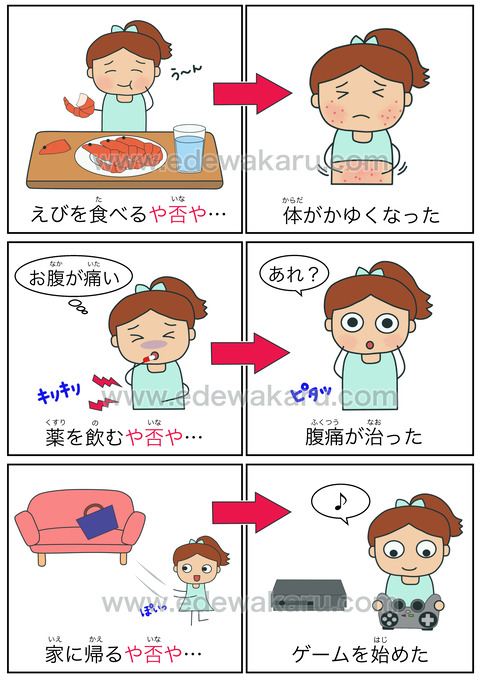
Meaning
as soon as ~
How to use it
Verb [dictionary form] + や否や
Verb [dictionary form] + や
Explanation
「Aや否やB」 is a sentence pattern meaning “B happened immediately after A.” It is used when you want to say that “the action B takes place immediately following action A.”
It is used in writing, so it is hardly ever used in conversation. 😅 Also, since this pattern is used for something that has already happened, it is most often used in the form 「〜や否や〜た」. 「〜や否や」 can be changed to 「〜や」. 😮
(Review: 〜として)
[Examples]
① As soon as I ate shrimp, my body started itching.
→ As soon as I ate shrimp, my body started itching.
② As soon as I took the medicine, my stomachache went away.
→ As soon as I took the medicine, my stomachache went away.
③ As soon as she got home, she started playing a game.
→ As soon as she got home, she started playing a game.
There are many patterns meaning “as soon as 〜 happens,” so learn to distinguish them. 😀
[Related patterns]
In context 5 examples
えびを食べるや否や、体がかゆくなった
→えびを食べるとすぐに、体がかゆくなったAs soon as I ate shrimp, my body started itching. → My body started itching as soon as I ate shrimp.
薬を飲むや否や、腹痛が治った
→薬を飲むとすぐに、腹痛が治ったAs soon as I took the medicine, my stomachache went away. → My stomachache went away as soon as I took the medicine.
彼女は、家に帰るや否やゲームを始めた
→彼女は、家に帰るとすぐにゲームを始めたAs soon as she got home, she started playing a game. → She started playing a game as soon as she got home.
彼はそのニュースを聞くや否や、泣き出した
→彼はそのニュースを聞くとすぐに、泣き出したAs soon as he heard the news, he burst into tears. → He burst into tears as soon as he heard the news.
山田くんは授業が始まるや否や眠ってしまった
→山田くんは授業が始まるとすぐに眠ってしまった(復習:〜てしまう(残念・後悔))Yamada-kun fell asleep as soon as class began. → Yamada-kun fell asleep as soon as class began. (Review: 〜てしまう (regret or disappointment))
Read the original source text
Meaning
〜するとすぐに
How to use it
動詞[辞書形]+や否や
動詞[辞書形]+や
Explanation
「Aや否やB」は「AするとすぐにBをした」という意味の文型です。「Aの動作に続いて、Bの動作がすぐに行われる」と言いたい時に使います。
書き言葉として使われます
ので、会話で使用されることはほとんどありません😅また、この文型はすでに発生したことに使用しますので、
「〜や否や〜た」
という形で使われることがほとんどです。「〜や否や」は「〜や」にチェンジすることができます😮
(復習:〜として)
[例]
①えびを食べる
や否や、体がかゆくなった
→えびを食べる
や、体がかゆくなった
②薬を飲む
や否や、腹痛が治った
→薬を飲む
や、腹痛が治った
③彼女は、家に帰る
や否や
ゲームを始めた
→彼女は、家に帰る
や
ゲームを始めた
「〜すると、すぐに」という意味の文型はたくさんありますので、区別して覚えておきましょう😀
【関連文型】
日本語文型辞典 英語版
Meaning
Used to list things. In cases where XとY is used, there are only X and Y. In cases where XやY is used, it implies that there are also things other than those two.
Gives an approximate amount and expresses that it is not a considerable amount. Used with expressions such as 大丈夫だ, かまわない, and たいしたことはない. It is often used to say “one or two” (e.g. one or two people).
Means “at the same time as...” or “immediately on ...ing.” An old, written expression.
Expresses a state in which, as a result of one action, the next thing occurs immediately. Means “in the split second when something is or is not done” or “immediately after....” Written language.
How to use it
1. N and N; N or N
2. approximately [quantity] or [quantity]
1. just as V-る; as soon as V-る
2. as soon as V-る
In context 15 examples
机の上には皿や紙コップなどが置いてあった。
Things like plates and paper cups had been placed on the table.
バスは中学生や高校生ですぐにいっぱいになった。
The bus was soon full of junior and senior high school students as well as others.
その村には米や野菜はあるが、肉はなかなか手に入らない。
In that village they have food such as rice and vegetables, but it is not easy to lay your hands on meat.
うちの息子は一度外国に出かけると1ヶ月や2ヶ月はなんの連絡もありません。
Once our son has gone abroad we hear nothing from him for a month or two.
善人だと言われている人でも、悪いことの一つや二つはしているだろう。
Even those who are said to be good people probably do one or two bad things.
彼女ももうすぐ二十歳なんだから、ボーイフレンドが一人や二人いてもおかしくない。
She will soon be twenty and so it isn’t unusual for her to have a boyfriend or two.
彼は気前がいいから、5万や10 万なら理由を聞かずに貸してくれる。
He is generous and so he will lend me 50,000 or 100,000 yen without asking the reason.
狭い部屋ですが、一晩や二晩ならがまんできるでしょう。
It’s a small room, but I hope you can put up with it for a night or two.
給料は安いが、子供の一人や二人は育てられる。
My salary is low but we can raise a child or two on it.
国際化の時代なのに外国語の一つや二つできないようでは困ります。
It’s the age of internationalization, so not being able to speak a foreign language or two is a problem.
「どうして俺なんか生んだんだ」という兄のことばを聞くや、母は顔を真っ赤にしておこりだした。
Hearing my older brother ask why he had been born, my mother’s face turned bright red and she flew into a rage.
「父死す」の電報を受け取るや、すぐさま彼は汽車に飛び乗った。
When he received the telegram saying “Father has passed away” he immediately jumped on a train for home.
彼はそれを聞くやいなや、ものも言わずに立ち去った。
As soon as he heard that, he took his leave without saying a word.
その薬を飲むやいなや、急に眠気がおそってきた。
As soon as I took that medicine, I was overcome with drowsiness.
開店のドアが開くや否や、客はなだれのように押しよせた。
No sooner had the store’s doors opened than an avalanche of customers pushed their way in.
Read the original source text
Meaning
Used to list things. In cases where XとY is used, there are only X and Y. In cases where XやY is used, it implies that there are also things other than those two.
Gives an approximate amount and expresses that it is not a considerable amount. Used with expressions such as 大丈夫だ, かまわない, and たいしたことはない. It is often used to say “one or two” (e.g. one or two people).
Means “at the same time as...” or “immediately on ...ing.” An old, written expression.
Expresses a state in which, as a result of one action, the next thing occurs immediately. Means “in the split second when something is or is not done” or “immediately after....” Written language.
How to use it
1. NやN
2. 数量詞+や+数量詞
1. V-るや
2. V-るやいなや
NINJAL 日本語文型データベース
Meaning
Used when you want to say that the next event occurs almost at the same time as ~. It can describe both a one-time event in the past and an event that happens repeatedly as a habit.
How to use it
Vるや
Notes
A verb expressing an instantaneous action or event comes in “〜”. After “〜や”, a sentence expressing the speaker’s wishes or intentions, or a sentence urging the other person to do something, cannot follow.
In context 5 examples
その男は相手が金持ちと見るや、とたんに態度を変えた。
As soon as the man saw that the other person was rich, he immediately changed his attitude.
部長は、もはや計画の失敗は避けられないと知るや、責任を部下に押し付けはじめた。
As soon as the department head realized that failure of the plan was now unavoidable, he began shifting the blame onto his subordinates.
大統領がパーティー会場に到着するや、たちまち大きな歓声があがった。
As soon as the president arrived at the party venue, a loud cheer went up.
演奏が終わるや、観衆は立ち上がり、盛大な拍手を送った。
As soon as the performance ended, the audience stood up and gave a thunderous round of applause.
日付が変わり新年を迎えるや、「あけましておめでとう」のメッセージがSNS上にもたくさん投稿される。
As soon as the date changed and the New Year began, lots of “Happy New Year” messages were posted on social media too.
Read the original source text
Meaning
〜とほぼ同時に、次の出来事が起こると言いたいときに使います。過去の一度だけの出来事も、習慣的に繰り返し起こる出来事も表すことができます。
How to use it
Vるや
Notes
「〜」には、瞬間的な動作や出来事を表す動詞がきます。「〜や」の後には、話し手の希望・意向を表す文や相手への働きかけの文はきません。
Yokubi — The Common Grammar Guide (https://yoku.bi)
Explanation
List of items in Japanese are made by tagging each item with a specific "listing" particle that defines the nature of the list. There can be both exhaustive and non-exhaustive lists. An exhaustive list is just a list that states explicitly every element it is comprised of. A non-exhaustive list is a list that provides a few examples or a description of the nature of its elements, while leaving space for ambiguity and indirectness.
"I went to the mall with Paul and Frank" is an exhaustive list, while "I went to the mall with Paul, Frank, and the rest of the crew" on the other hand is a non-exhaustive list.
Depending on the nature of the list, the final element often has its listing particle dropped and replaced with the case particle that applies to the entire list.
や makes a **non-exhaustive** list providing a few examples of elements that correlate to a general common idea of them.
と was covered as a side-note before, but here we'll cover it explicitly and compare it to や. と makes a "generic" **exhaustive** list. It counts every element in the list.
As already mentioned, the last と is optional and usually dropped.
か can be used to provide alternatives. It is closer to "or" than "and" although the distinction is sometimes blurry.
とか makes a "vague" list. It's vague, and therefore **non-exhaustive**, but each item is its own. The items aren't necessarily considered to share a common property.
It can also be used to make things vague with just one element:
To the surprise of no one, とか is basically like と + か. It can also be used to list verbs, often to provide alternative choices. This is a distinctive feature that doesn't exist for the other listing particles in this lesson.
If the list is too long (more than 2-3 elements), it's common to use commas to separate the elements in the middle without using particles.
など is not technically a listing particle, but rather some filler particle that sounds like using "etc" or "and such" in English. It implies the notion of a list of elements open to more similar stuff. Its meaning is similar to using a single や or とか to state that more examples are implied but not directly stated.
These listing particles are also commonly used together, especially with など. The pattern Xや、Y、Zなど is incredibly common, like in the following sentence:
There is another listing particle that is sometimes overlooked: に. This particle is used to list things that come together in a set, or that the speaker is listing one-by-one as some form of chain of thought or active recollection.
In context 2 examples
スプーンやフォークで食べること
To eat with spoons and forks (and stuff like that)
剣や斧、槍、弓など、様々な武器が置かれている。
Swords, axes, spears, bows, and such a multitude of weapons were on display.