絵でわかる日本語
Usage 1
Read this source entry ↗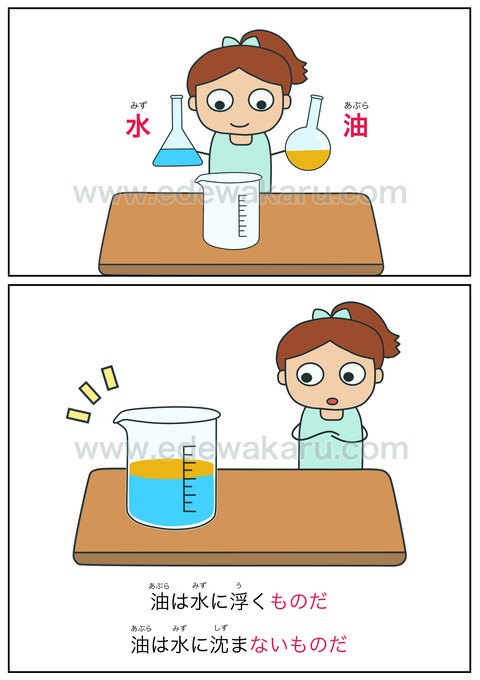
Meaning
An inherent property
An unchanging fact
How to use it
Verb [dictionary form] + ものだ
Verb [ない-form] + ものだ
Explanation
“〜ものだ・〜ないものだ” is a sentence pattern that expresses [inherent properties] and [unchanging facts]. Its negative form is “〜ないものだ.”
“〜ものだ・〜ないものだ” is also used to express [general ways of thinking]. There are many sentence patterns with “もの,” so be sure to distinguish and remember them.
In context 5 examples
油は水に浮くものだ
→油は、水に浮くという性質だOil floats on water. →It is a property of oil that it floats on water.
油は水に沈まないものだ
→油は、水には沈まない性質だOil does not sink in water. →It is a property of oil that it does not sink in water.
太陽は東から昇って、西に沈むものだ
→太陽は東から昇って、西に沈むのは変えることのできない事実だThe sun rises in the east and sets in the west. →The fact that the sun rises in the east and sets in the west is unchangeable.
水は高いところから低いところに流れるものだ
→水は高いところから低いところに流れるという性質だWater flows from high places to low places. →It is a property of water that it flows from high places to low places.
油は水にとけないものだ
→油は水にとけない性質だOil does not dissolve in water. →It is a property of oil that it does not dissolve in water.
Read the original source text
Meaning
本来の性質
変わらない事実
How to use it
動詞[原形]+ものだ
動詞[ない形]+ものだ
Explanation
「〜ものだ・〜ないものだ」は【本来の性質】【変わらない事実】を表す文型です。否定形は「〜ないものだ」となります。
「〜ものだ・〜ないものだ」には、【一般的考え方】を表す用法もあります。また、「もの」がつく文型はたくさんありますので、しっかりと区別をして覚えておきましょう。
Usage 2
Read this source entry ↗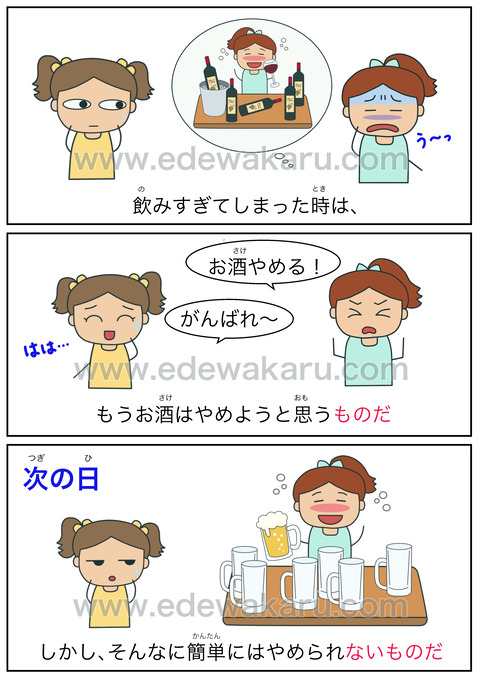
Meaning
~ is normal
Many people think that ~
How to use it
Verb [dictionary form] + ものだ
Verb [ない-form] + ものだ
Explanation
“〜ものだ・〜ないものだ” is a sentence pattern expressing [general ways of thinking], and means “~ is normal” or “normally, ~ is ~.” It is used to state things that are generally said or what many people think. In most cases, the negative form is “〜ないものだ” 😦
[For advanced learners] (A rather detailed explanation 😅)
Most reference books do not give a detailed explanation of the negative forms “〜ないものだ” and “〜ものではない” of “〜ものだ.” In general, “〜ないものだ” is used for the negative of [general views, inherent qualities, unchanging facts], while “〜ものではない” is used for the negative of “〜ものだ” expressing [what is expected or required].
[Examples]
①One does not use casual speech with one’s boss
→Generally speaking, it’s normal not to use casual speech with one’s boss
②One should not use casual speech with one’s boss
→One should not use casual speech with one’s boss
[Explanation]
① states a general principle (common sense),
whereas
② in many cases has a meaning close to prohibition 😀
There are many sentence patterns that include “もの,” and they are quite complex. Those taking the Japanese Language Proficiency Test should review them thoroughly and learn to distinguish them 😊
In context 7 examples
飲みすぎてしまった時は、もうお酒はやめようと思うものだ
→飲みすぎてしまった時は、もうお酒をよめようと多くの人は思うWhen you’ve drunk too much, you think you’ll stop drinking for good. →When you’ve drunk too much, many people think they’ll stop drinking for good.
しかし、そんなに簡単にはやめられないものだ
→しかし、普通はそんなに簡単にやめられないBut it’s not so easy to quit. →But normally, it’s not so easy to quit.
赤ちゃんは泣くものだよ
→赤ちゃんが泣くのは普通のことだよBabies cry; that’s normal. →It’s normal for babies to cry.
人の気持ちは、なかなかわからないものだ
→多くの人は、人の気持ちはなかなかわからないと思っているPeople’s feelings are hard to understand, aren’t they. →Many people think people’s feelings are hard to understand.
面接の時は、誰でも緊張するものだ
→面接の時は、普通誰でも緊張するAnyone gets nervous in an interview. →Normally, anyone gets nervous in an interview.
アイスを食べすぎると、お腹を壊すものだ
→アイスを食べすぎると、お腹を壊すのは普通のことだIf you eat too much ice cream, you get an upset stomach; that’s normal. →It’s normal to get an upset stomach if you eat too much ice cream.
年をとるにつれて、オールできなくなってくるものだ
→年をとるにつれて、オールができなくなってくるのは普通のことだAs you get older, you naturally become unable to stay up all night. →It’s normal to gradually become unable to stay up all night as you get older.
Read the original source text
Meaning
〜は普通のことだ
多くの人は〜だと思っている
How to use it
動詞[原形]+ものだ
動詞[ない形]+ものだ
Explanation
「〜ものだ・〜ないものだ」は[一般的な考え方]を表す文型で、「〜は普通のことだ」「普通、〜は〜だ」という意味で使われます。一般的に言われていることや、多くの人の考え方を言う場合に使用される文型です。否定形はほとんどの場合
「〜ないものだ」
となります😦
【上級レベルの人へ】(かなり細かい説明です😅)
ほとんどの参考書では「〜ものだ」の否定形「〜ないものだ」「〜ものではない」の細かい説明はのっていません。一般的に、[一般的考え方・本来の性質・変わらない事実]の否定形は「〜ないものだ」が使われ、[当然・義務]を表す「〜ものだ」の否定形は「〜ものではない」が使われます。
[例]
①上司には友達言葉を
使わないものだ
→一般的に考えて、友達言葉を
使わないのが普通だ
②上司には友達言葉を
使うものではない
→上司には友達言葉を
使うべきではない
[説明]
①は一般論(常識)を述べている
のに対し、
②は多くの場合禁止に近い意味を表します
😀
「もの」がつく文型はたくさんあり、とても複雑です。日本語能力試験を受ける人は、しっかりと復習をして区別して覚えておきましょう😊