日本語文型辞典
Meaning
Basic information: V-てみせる. Expresses demonstrating something by actually performing the action, in order to introduce it or help someone understand. Examples: ① First, he demonstrated the judo form to teach it. ② I hear you sing very well. Please sing something for us sometime. ③ I still don’t understand how to use the fax machine, so could you show me once? ④ If you showed me how to operate a tractor once, I think I could handle it on my own afterward.
Read the original source text
Meaning
基本情報V-てみせる説明紹介をしたり、理解をうながしたりするのに、実際の動作で示すことを表す。例文① かれは柔道の型を教えるためにまずやってみせた。② 歌がおじょうずだそうですね。一度歌ってみせてください。③ ファックスの使い方がまだわからないので、一度やって見せてくれませんか。④ トラクターぐらいなら、一度やってみせてもらったら、後は一人で扱えると思います。
絵でわかる日本語
Usage 1
Read this source entry ↗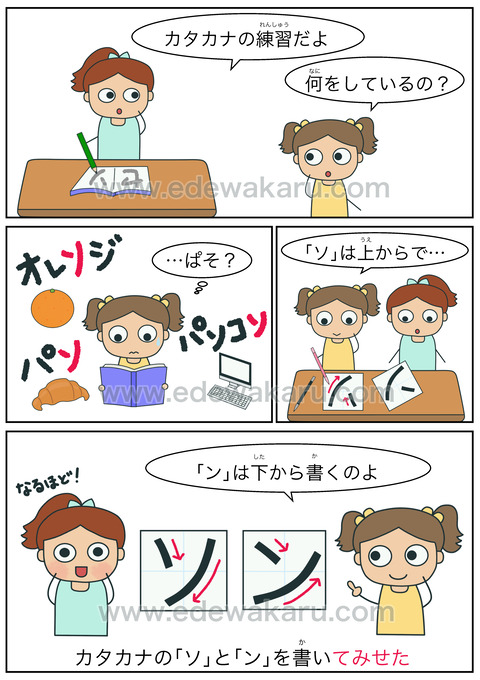
Meaning
Actually show an action so the other person can understand.
How to use it
Verb [て-form] + てみせる
Explanation
「〜てみせる」 is a sentence pattern used when you teach by actually demonstrating an action yourself so that the other person can understand. It is often used when explaining by showing an action is easier to understand than explaining verbally 😊
[Examples]
① I wrote the katakana characters 「ソ」 and 「ン」 to show them.
→ I wrote 「ソ」 and 「ン」 myself and taught the other person how to write them.
② Mom will cut it to show you, so cut it the same way.
→ The mother actually cut the vegetables and taught her daughter how to cut them.
③ I’ll do it to show you, so you don’t make a mistake.
→ I actually did it myself to explain how it is done.
④ Sorry, I don’t understand how to use it, so could you show me once?
→ I asked the other person to do it so that I could understand how to use it.
When written in kanji, 「〜てみせる」 is 「〜て見せる」. It may help to remember it as “show someone and teach them” by demonstrating your own action 😊 Review 「見る・見せる」 at the same time 😉
(Review: 見る・見せる)
(Review: 〜ておく)
In context 4 examples
カタカナの「ソ」と「ン」を書いてみせた
I wrote the katakana characters 「ソ」 and 「ン」 to show them.
娘:お母さん、野菜はどれくらいの大きさに切ればいいの?母:じゃ、お母さんが切ってみせるから同じように切ってね(復習:〜ちゃ・〜じゃ)
Daughter: Mom, how big should I cut the vegetables? Mother: Here, I’ll cut them to show you, so cut them the same way. (Review: 〜ちゃ・〜じゃ)
失敗しないように、私がやってみせますね(復習:〜ように(目的))
I’ll do it to show you, so you don’t make a mistake. (Review: 〜ように (purpose))
すみませんが、使い方がわからないので、一度やってみせてください
Sorry, I don’t understand how to use it, so could you show me once?
Read the original source text
Meaning
相手がわかるように、実際に動作を見せる
How to use it
動詞[て形]+てみせる
Explanation
「〜てみせる」は相手がわかるように、実際に自分の動作を見せて教える場合に使われる文型です。口で説明するより、動作を見せて説明した方がわかりやすい場合によく使われます😊
[例]
①カタカナの「ソ」と「ン」を書い
てみせた
→自分が「ソ」と「ン」を書いて、相手に書き方を教えた
②お母さんが切っ
てみせる
から同じように切ってね
→お母さんが実際に野菜を切って、娘に切り方を教えた
③失敗しないように、私がやっ
てみせます
ね
→自分が実際にやって、どうやるのかを説明した
④すみませんが、使い方がわからないので、一度やっ
てみせてください
→使い方を理解するために、相手にやってもらった
「〜てみせる」は、漢字で書くと「〜て見せる」です。相手に自分の動作を「見せて教える」と覚えてくといいと思います😊一緒に「見る・見せる」の復習もしておきましょう😉
(復習:見る・見せる)
(復習:〜ておく)
Usage 2
Read this source entry ↗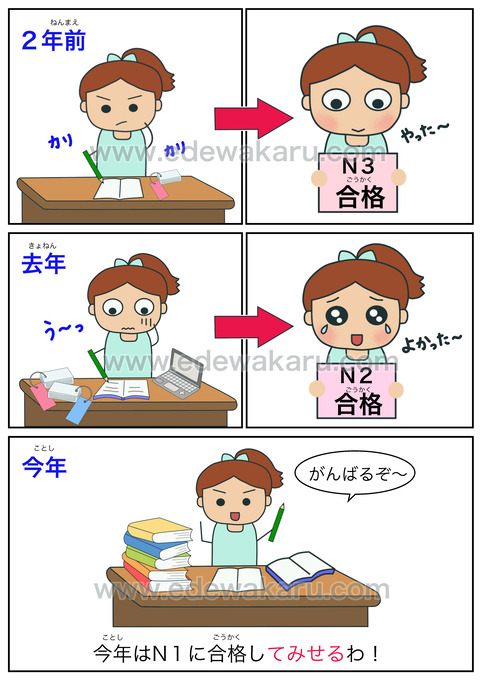
Meaning
I will definitely 〜
How to use it
Verb [て-form] + てみせる
Explanation
「〜てみせる」 means “I will definitely 〜” and expresses the speaker’s strong determination or will. Since it expresses one’s determination or will, remember to use it with [volitional verbs]. 😉
[Words often used with 「〜てみせる」]
・必ず (definitely) 〜てみせる
・絶対 (absolutely) 〜てみせる
・きっと (surely) 〜てみせる
・必ずや (by all means) 〜てみせる, etc.
「〜てみせる」 also means “to demonstrate an action so that the other person can understand.” I think it’s good to learn that meaning as well. 😉
(Review: )
In context 4 examples
今年はN1に合格してみせるわ!
I’ll pass N1 this year, just you watch!
次の試合は必ず勝ってみせるぞ
I’ll definitely win the next match!
将来は絶対に社長になってみせる!
I’ll absolutely become company president someday!
今度こそ、実験を成功させてみせる(復習:〜こそ)
This time for sure, I’ll make the experiment a success. (Review: 〜こそ)
Read the original source text
Meaning
絶対に〜する
How to use it
動詞[て形]+てみせる
Explanation
「〜てみせる」は「絶対に〜する」という意味で、話者の強い決意や意志を表す文型です。自分の決意や意志を表す文型ですので
【意志動詞】
に使うと覚えておきましょう😉
[「〜てみせる」とよく一緒に使われる言葉]
・
必ず
〜てみせる
・
絶対
〜てみせる
・
きっと
〜てみせる
・
必ずや
〜てみせる など
「〜てみせる」には「相手にわかるように、実際に動作を見せて教える」という意味もあります、ので、一緒に覚えておくといいと思います😉
(復習:)
どんなときどう使う 日本語表現文型辞典
Meaning
determined to accomplish
How to use it
Vて + みせる
Explanation
がんばって~するつもりだ
がんばって達成しよう、達成できる、という話者の強い気持ちを他に示す表現。他人に示すことで自分自身を励ましたいときの言い方。 ❹ のようにほかの人の前で実際の動作で何かを紹介するという意味でも使われる。
Speaker's strong resolve to indicate working work hard to accomplish something or conviction that speaker can succeed. Used to encourage speaker by telling someone speaker's intentions. Sometimes used to show something through actions, as in sentence ❹ .
In context 4 examples
ぼくはあしたの柔道の試合で必ず勝ってみせる。がんばるぞ。
I’ll make sure to win tomorrow’s judo match. I’m going to give it my all.
こんな不況に負けるものか。必ず会社を立て直してみせる。
As if I’d let a recession like this beat me! I’ll turn the company around, just you watch.
こんな簡単な仕事、わたしなら1日でかたづけてみせますよ。
A job this simple? I can get it done in a day, just watch.
彼はみんなの前で見事な手品をやってみせた。
He performed an amazing magic trick in front of everyone.
Read the original source text
Meaning
determined to accomplish
How to use it
Vて+みせる
Explanation
がんばって~するつもりだ
がんばって達成しよう、達成できる、という話者の強い気持ちを他に示す表現。他人に示すことで自分自身を励ましたいときの言い方。 ❹ のようにほかの人の前で実際の動作で何かを紹介するという意味でも使われる。
Speaker's strong resolve to indicate working work hard to accomplish something or conviction that speaker can succeed. Used to encourage speaker by telling someone speaker's intentions. Sometimes used to show something through actions, as in sentence ❹ .
日本語NET JLPT文法解説まとめ
Meaning
I intend to work hard and do ~ / I really intend to do ~
① An expression showing the speaker's strong determination and resolve.
② An expression that specifies a concrete action so the other person can understand.
How to use it
V(て-form) + みせる
Explanation
"intend to work hard to ~ / really intend to ~"
① An expression indicating the speaker's strong determination or resolve.
② An expression that demonstrates a specific action to make it clear to the listener.
In context 5 examples
今度こそ、絶対にJLPT N1に合格してみせる。
This time for sure, I'll pass the JLPT N1!
将来は自分の会社を作って成功してみせる。
In the future, I'll start my own company and make it succeed.
今年のクリスマスまでに絶対、彼女を作ってみせる。
I'll definitely get a girlfriend by Christmas this year.
「今ここで涙を流せる?」というリクエスに応え、子役俳優は上手に泣いてみせた。
In response to the request, “Can you cry right here and now?”, the child actor demonstrated crying skillfully.
コーチは「こうやってやるんだ」と、手本をやってみせた。
The coach said, “This is how you do it,” and demonstrated it.
Read the original source text
Meaning
がんばって〜するつもりだ / 本当に〜するつもりだ
①話し手の強い決意や覚悟を示す表現。
②相手にわかるように何か具体的な行為を示す表現
How to use it
V(テ形) + みせる
Explanation
"intend to work hard to ~ / really intend to ~"
① An expression indicating the speaker's strong determination or resolve.
② An expression that demonstrates a specific action to make it clear to the listener.
毎日のんびり日本語教師
How to use it
Verb て-form + 見せる
Explanation
Expresses demonstrating a model so that another person can understand.
This usage is at the N3 level.
Notes
Nothing in particular.
In context 8 examples
やり方が分からないので、一度やってみせてくれませんか?
I don’t understand how to do it, so could you show me once?
この実験は危険ですので、まずは私が皆さんにやってみせましょう。
This experiment is dangerous, so I’ll demonstrate it for everyone first.
何でもいいので好きな絵を描いてください。私はあなたが何を描いたか当ててみせましょう。
Draw any picture you like. I’ll show you that I can guess what you drew.
平凡な教師は言って聞かせる。よい教師はする。優秀な教師はやってみせる。しかし最高の教師 は子どもの心に火をつける。
An ordinary teacher tells and explains. A good teacher does. An excellent teacher demonstrates. But the greatest teacher lights a fire in a child’s heart.
人を描くときは筋肉の構造を知らなければいけません。私がまず全身を描いてみせますね。
When drawing people, you need to understand how muscles are structured. I’ll draw the whole body for you first.
私がやってみせますから見ていてください。
I’ll show you how to do it, so watch.
私、ムーンウォークできます! やって見せましょうか。
I can moonwalk! Shall I show you?
まず私が皆さんに踊って見せます。できる限りマネしてみてください。用法② 実現への強い決意
First I’ll demonstrate the dance for everyone. Try to imitate me as best you can. Usage ② A strong determination to make something happen
Read the original source text
How to use it
動て形+見せる
Explanation
他の人に理解してもらうためにお手本を示すことを表します。
この用法はN3レベルです。
Notes
特になし
日本語文型辞典 英語版
Meaning
【てみせる】[V-てみせる]
Expresses the actual demonstration of an action in order to introduce or promote better understanding of something.
In context 4 examples
かれは柔道の型を教えるためにまずやってみせた。
To teach the juudoo form, he first showed how it’s done.
歌がおじょうずだそうですね。一度歌ってみせてください。
I hear you’re good at singing. Please sing for us once.
ファックスの使い方がまだわからないので、一度やって見せてくれませんか。
I don’t know how to use this fax machine yet, so could you please show me once?
トラクターぐらいなら、一度やってみせてもらったら、後は一人で扱えると思います。
I think I could operate a tractor on my own, if someone showed me how to do it once.
AIUEO JLPT Grammar
Meaning
This sentence pattern is used to show the speaker’s strong determination to carry out an action and demonstrate the result. It implies a firm resolve and a desire to prove or accomplish something.
How to use it
Verb te-form + みせる
In context 5 examples
絶対に成功してみせる!
I will definitely succeed!
彼を説得してみせる。
I will convince him, just watch.
この問題を解決してみせましょう。
Let’s solve this problem.
どんなに難しくても、やり遂げてみせます。
No matter how difficult it is, I will see it through.
次の発表会ではもっと上手に歌ってみせる。
I will definitely sing better at the next concert.
Read the original source text
Meaning
This sentence pattern is used to show the speaker’s strong determination to carry out an action and demonstrate the result. It implies a firm resolve and a desire to prove or accomplish something.
How to use it
動詞て形+みせる
Explanation · 日本語
この文型は、話者が意志的に何かを実行し、その結果を相手に示すことを表す表現で、強い決意を持って何かを成し遂げるという意味を含み、何かを証明したい、やり遂げたいという気持ちが込められています。
文法
Meaning
I intend to work hard and do ~ / I will really do ~
① An expression that shows the speaker’s strong resolve or determination.
② An expression that names a specific action so the other person can understand.
How to use it
V(て-form) + みせる
In context 5 examples
今度こそ、全体にJLPT N1に合格してみせる。
This time, I’ll definitely pass the JLPT N1.
将来は自分の会社を作って成功してみせる。
In the future, I'll start my own company and make it succeed.
今度の試合、絶対勝ってみせるから、応援してくれないか。
I’ll definitely win this next match, so will you cheer me on?
「今ここで涙を流せる?」というリクエスに応え、子役俳優は上手に泣いてみせた。
In response to the request, “Can you cry right here and now?”, the child actor demonstrated crying skillfully.
コーチは「こうやってやるんだ」と、手本をやってみせた。
The coach said, “This is how you do it,” and demonstrated it.
Read the original source text
Meaning
がんばって〜するつもりだ / 本当に〜するつもりだ
①話し手の強い決意や覚悟を示す表現。
②相手にわかるように何か具体的な行為を示す表現。
How to use it
V(テ形) + みせる
IMABI
Trying
Read this IMABI lesson ↗Explanation
Try I: ~てみる・みたい・みせる
The word “try” has a lot of different meanings. When it is translated into Japanese, there are many phrases to consider. The phrases themselves are not difficult to use or understand, but because they all have the same English translation, it may become troublesome to differentiate between them. So, in the next two lessons, we will go through each applicable phrase in great detail so that you properly learn how to express the many “try” phrases of Japanese.
~てみる/~てみたい
As you know already, 見る means “to see.” When it is after the particle て, it means “to try to…” in the sense of doing something for the sake of seeing what happens. There isn’t any negative consequences necessarily implied by using it.
1. 新しいコートを着てみる。
I’ll try a new coat on.
2. よく考えてみる(よ)。
I’ll think it over.
3. カレーライスを食べてみる。
To try to eat curry rice.4. みんなに聞いてみたけど。
I’ve tried asking everyone, but…
5. 一か八かやってみる。
To take a chance/sink or swim.
Reading Note: 八 is read as ばち in the phrase above. Other readings of the entire phrase other than いちかばちか is wrong.
6. たまった宿題を一遍いっぺんに片付けてみよう。
I’m going to try to finish up this piled homework at once.
Grammar Note: In this sentence, ~よう is used to emphasize one’s volition to finish the homework.
~てみたい
~てみたい means “to want to try to…” Again, this “try” is the same “try” as in “trial and error” (試行錯誤). These patterns are not intended to describe “trials” that last longer than an occurrence.
7. 本当に(お)すしを食べてみたいです。
I really want to try sushi.
漢字 Note: Sushi may also be spelled as 寿司, 鮨, or rarely as 鮓.
8. やってみたい。
I want to try.
9. 月見バーガーを食べてみたい。
I want to try a tsukimi burger.
Word Note: It might as well be called egg burger.
10. 誰か一度会ってみたい 人がいますか。
Is there someone you would like to meet once?
11. みんなを笑いの渦うずに巻き込んでみたい。 (Idiomatic)
I want to put a smile on everyone’s faces.
Orthography Note: In Modern Japanese spelling, helper verbs like みる in ~てみる are written as such in ひらがな. Writing the verbs in 漢字 would not be wrong, but the verb may be interpreted literally.
Colloquialism Note: In casual speech, you can tell someone to try to do something by using ~てみい.
~てごらん
This is used to entice someone to try to do something. ごらん is from the honorific form of みる, ご覧になる. This pattern comes from the abbreviation of the command form of this expression, ご覧なさい.
12. おいしいから食べてごらん。
Try it. It’s delicious.
13. そのサボテンを跳とび越こえてごらん!
Try jumping over the cactus!
漢字 Note: The 漢字 for サボテン is 仙人掌. You don’t need to remember this.
Honorifics Note: Some speakers do not like ~てご覧なさい and feel that it lacks etiquette. However, as is found in dictionaries and is the case for most speakers, it is completely fine and the correct way of making ~てみる honorific.
14. 来てごらんなさい。
Please come [forth].
15. 耳を澄すませてご覧なさい。
Please try to listen carefully.
16. 目を閉じてご覧なさい。
Try closing your eyes.
However, those who feel ~てご覧なさい lacks respect replace it with ~てみてください with an already honorific verb. So, the difference lies in where the honorific element of the verb phrase is.
17a. 訂正されてみてください。△
17b. 訂正なさってみてください。〇
Please try to revise/edit it.
This shows that lowering honorific standards causes problems. The first sentence may make someone sound uneducated. The second sentence comes from fears of being too pushy, which ~なさい in other contexts gives.
To complicate things more, ~てご覧なさい may not always be appropriate. However, ~てみる is typically not used in other conjugations in honorific fashion as mentioning superiors trying things is not formal. Rather, things like ~ていただく “receiving the act of…(by/from….)” would be used. So, “I received the boss eating X” rather than “X tried eating X”.
試す
This verb means “to try out” and is used a lot with ~てみる.
18. 自分の力を試してみる。
To try one’s strength.
19. もう一度試してみて。
Have another try.
試す VS 試みる
試す is used to mean “to test” in the sense of investigating means.
試みる is used to mean “to test” in the sense of ascertaining an end result. In other words, you’re taking a go at it.
The best way to see how these two verbs differ, it’s important to see what sorts of phrases they are used in. Trying to escape from jail? 試みる will be your best choice. Simply trying to test your Japanese skills? 試す will be what you want.
20. 脱走だっそうを試みる。
To test/have a got at an escape.
21. 能力を試す。
To test ability.
22. 日本語能力試験をして実力を試してみたらどうですか。
How about testing your true skills by taking the Japanese Proficiency Test?
23. 新車の乗り心地ごこちを試す。
To test the feel of a new car.
24. 別の方法を試みる。
To try another method.
Other Miscellaneous “Try” Verbs
There are plenty of other phrases in Japanese that are translated into English as “try”. However, they all correspond to specific usages. Meanings like in “trying one’s utmost” or “test new products” are all expressed differently in Japanese.
25. 彼は全力を尽くした。
He tried his hardest.
26. ラーメンを試食ししょくする。
To taste-test ramen.
27. 新製品を試用する。
To test new products.
28. あらゆる努力どりょくをする。
To make every effort.
29. 誰がこの事件を{裁さばく・審理しんりする}のでしょうか。
Who is going to try this case?
30. 彼は脱税だつぜい容疑ようぎで裁判を受けた。
He was tried for tax evasion.
~てみせる
見せる means “to show”. After the particle て, it usually isn’t written in 漢字. In this sense, it shows the showing of an action to someone.
31. 手品てじなをしてみせましょう。
I will show you a trick!
32. 微笑んでみせる。
To show a smile.
33. 何としても勝ってみせるぞ。
No matter what it takes, I’ll show you that I’ll win.
34. 彼はグラフをコンピュータ画面に{表示して・出して}みせた。
He displayed the graph on the computer screen.
35. 彼は素晴らしい勇敢さを見せた。
He showed great courage.
36. 私の名前を漢字で書いてみせた。
I showed them how to write my name in Kanji.
37. 将来必ず日本語の通訳つうやくになってみせるよ。
As for the future, I will certainly show that I will become a Japanese interpreter.
In context 37 examples
新しいコートを着てみる。
I’ll try a new coat on.
よく考えてみる(よ)。
I’ll think it over.
カレーライスを食べてみる。
Try eating curry rice.
一か八かやってみる。
To take a chance/sink or swim.
たまった宿題を一遍いっぺんに片付けてみよう。
I’m going to try to finish up this piled homework at once.
本当に(お)すしを食べてみたいです。
I really want to try sushi.
やってみたい。
I want to try.
月見バーガーを食べてみたい。
I want to try a tsukimi burger.
誰か一度会ってみたい 人がいますか。
Is there someone you would like to meet once?
みんなを笑いの渦うずに巻き込んでみたい。 (Idiomatic)
I want to put a smile on everyone’s faces.
おいしいから食べてごらん。
Try it. It’s delicious.
そのサボテンを跳とび越こえてごらん!
Try jumping over the cactus!
来てごらんなさい。
Please come [forth].
耳を澄すませてご覧なさい。
Please try to listen carefully.
目を閉じてご覧なさい。
Try closing your eyes.
訂正されてみてください。△
Please try to revise/edit it.
訂正なさってみてください。〇
Please try to revise/edit it.
自分の力を試してみる。
To try one’s strength.
もう一度試してみて。
Have another try.
脱走だっそうを試みる。
To test/have a got at an escape.
能力を試す。
To test ability.
日本語能力試験をして実力を試してみたらどうですか。
How about testing your true skills by taking the Japanese Proficiency Test?
新車の乗り心地ごこちを試す。
To test the feel of a new car.
別の方法を試みる。
To try another method.
彼は全力を尽くした。
He tried his hardest.
ラーメンを試食ししょくする。
To taste-test ramen.
新製品を試用する。
To test new products.
あらゆる努力どりょくをする。
To make every effort.
誰がこの事件を{裁さばく・審理しんりする}のでしょうか。
Who is going to try this case?
彼は脱税だつぜい容疑ようぎで裁判を受けた。
He was tried for tax evasion.
手品てじなをしてみせましょう。
I will show you a trick!
微笑んでみせる。
To show a smile.
何としても勝ってみせるぞ。
No matter what it takes, I’ll show you that I’ll win.
彼はグラフをコンピュータ画面に{表示して・出して}みせた。
He displayed the graph on the computer screen.
彼は素晴らしい勇敢さを見せた。
He showed great courage.
私の名前を漢字で書いてみせた。
I showed them how to write my name in Kanji.
将来必ず日本語の通訳つうやくになってみせるよ。
As for the future, I will certainly show that I will become a Japanese interpreter.
Read the original source text
Explanation
Try I: ~てみる・みたい・みせる
The word “try” has a lot of different meanings. When it is translated into Japanese, there are many phrases to consider. The phrases themselves are not difficult to use or understand, but because they all have the same English translation, it may become troublesome to differentiate between them. So, in the next two lessons, we will go through each applicable phrase in great detail so that you properly learn how to express the many “try” phrases of Japanese.
~てみる/~てみたい
As you know already, 見る means “to see.” When it is after the particle て, it means “to try to…” in the sense of doing something for the sake of seeing what happens. There isn’t any negative consequences necessarily implied by using it.
1. 新しいコートを着てみる。
I’ll try a new coat on.
2. よく考えてみる(よ)。
I’ll think it over.
3. カレーライスを食べてみる。
To try to eat curry rice.4. みんなに聞いてみたけど。
I’ve tried asking everyone, but…
5. 一か八かやってみる。
To take a chance/sink or swim.
Reading Note: 八 is read as ばち in the phrase above. Other readings of the entire phrase other than いちかばちか is wrong.
6. たまった宿題を一遍いっぺんに片付けてみよう。
I’m going to try to finish up this piled homework at once.
Grammar Note: In this sentence, ~よう is used to emphasize one’s volition to finish the homework.
~てみたい
~てみたい means “to want to try to…” Again, this “try” is the same “try” as in “trial and error” (試行錯誤). These patterns are not intended to describe “trials” that last longer than an occurrence.
7. 本当に(お)すしを食べてみたいです。
I really want to try sushi.
漢字 Note: Sushi may also be spelled as 寿司, 鮨, or rarely as 鮓.
8. やってみたい。
I want to try.
9. 月見バーガーを食べてみたい。
I want to try a tsukimi burger.
Word Note: It might as well be called egg burger.
10. 誰か一度会ってみたい 人がいますか。
Is there someone you would like to meet once?
11. みんなを笑いの渦うずに巻き込んでみたい。 (Idiomatic)
I want to put a smile on everyone’s faces.
Orthography Note: In Modern Japanese spelling, helper verbs like みる in ~てみる are written as such in ひらがな. Writing the verbs in 漢字 would not be wrong, but the verb may be interpreted literally.
Colloquialism Note: In casual speech, you can tell someone to try to do something by using ~てみい.
~てごらん
This is used to entice someone to try to do something. ごらん is from the honorific form of みる, ご覧になる. This pattern comes from the abbreviation of the command form of this expression, ご覧なさい.
12. おいしいから食べてごらん。
Try it. It’s delicious.
13. そのサボテンを跳とび越こえてごらん!
Try jumping over the cactus!
漢字 Note: The 漢字 for サボテン is 仙人掌. You don’t need to remember this.
Honorifics Note: Some speakers do not like ~てご覧なさい and feel that it lacks etiquette. However, as is found in dictionaries and is the case for most speakers, it is completely fine and the correct way of making ~てみる honorific.
14. 来てごらんなさい。
Please come [forth].
15. 耳を澄すませてご覧なさい。
Please try to listen carefully.
16. 目を閉じてご覧なさい。
Try closing your eyes.
However, those who feel ~てご覧なさい lacks respect replace it with ~てみてください with an already honorific verb. So, the difference lies in where the honorific element of the verb phrase is.
17a. 訂正されてみてください。△
17b. 訂正なさってみてください。〇
Please try to revise/edit it.
This shows that lowering honorific standards causes problems. The first sentence may make someone sound uneducated. The second sentence comes from fears of being too pushy, which ~なさい in other contexts gives.
To complicate things more, ~てご覧なさい may not always be appropriate. However, ~てみる is typically not used in other conjugations in honorific fashion as mentioning superiors trying things is not formal. Rather, things like ~ていただく “receiving the act of…(by/from….)” would be used. So, “I received the boss eating X” rather than “X tried eating X”.
試す
This verb means “to try out” and is used a lot with ~てみる.
18. 自分の力を試してみる。
To try one’s strength.
19. もう一度試してみて。
Have another try.
試す VS 試みる
試す is used to mean “to test” in the sense of investigating means.
試みる is used to mean “to test” in the sense of ascertaining an end result. In other words, you’re taking a go at it.
The best way to see how these two verbs differ, it’s important to see what sorts of phrases they are used in. Trying to escape from jail? 試みる will be your best choice. Simply trying to test your Japanese skills? 試す will be what you want.
20. 脱走だっそうを試みる。
To test/have a got at an escape.
21. 能力を試す。
To test ability.
22. 日本語能力試験をして実力を試してみたらどうですか。
How about testing your true skills by taking the Japanese Proficiency Test?
23. 新車の乗り心地ごこちを試す。
To test the feel of a new car.
24. 別の方法を試みる。
To try another method.
Other Miscellaneous “Try” Verbs
There are plenty of other phrases in Japanese that are translated into English as “try”. However, they all correspond to specific usages. Meanings like in “trying one’s utmost” or “test new products” are all expressed differently in Japanese.
25. 彼は全力を尽くした。
He tried his hardest.
26. ラーメンを試食ししょくする。
To taste-test ramen.
27. 新製品を試用する。
To test new products.
28. あらゆる努力どりょくをする。
To make every effort.
29. 誰がこの事件を{裁さばく・審理しんりする}のでしょうか。
Who is going to try this case?
30. 彼は脱税だつぜい容疑ようぎで裁判を受けた。
He was tried for tax evasion.
~てみせる
見せる means “to show”. After the particle て, it usually isn’t written in 漢字. In this sense, it shows the showing of an action to someone.
31. 手品てじなをしてみせましょう。
I will show you a trick!
32. 微笑んでみせる。
To show a smile.
33. 何としても勝ってみせるぞ。
No matter what it takes, I’ll show you that I’ll win.
34. 彼はグラフをコンピュータ画面に{表示して・出して}みせた。
He displayed the graph on the computer screen.
35. 彼は素晴らしい勇敢さを見せた。
He showed great courage.
36. 私の名前を漢字で書いてみせた。
I showed them how to write my name in Kanji.
37. 将来必ず日本語の通訳つうやくになってみせるよ。
As for the future, I will certainly show that I will become a Japanese interpreter.
Bunpro Grammar Reference
Meaning
I will definitely, I will certainly, Just watch, Whatever it takes, I swear, for sure
How to use it
Verb[て]+ みせる
Verb[て]+ みせます
Nuance
A strong expression, emphasizing the speaker's intent to do (A). I will show that (A) can be done.
Explanation
て見せる, primarily written in hiragana, is an emphatic structure that indicates that the speaker is going to do (A) in a way that it is clear to the listener. This can be translated as 'I will definitely (A)', or 'I swear I will (A)', but the literal translation of 'I will show you that I'll do (A)' also makes the point clear.
To use てみせる, simply alter the verb preceding it into its て-form.
お前のために、次の試合では勝ってみせる!
I will definitely win the next competition for you!
来週のテストで合格してみせる!
I will definitely pass the test next week!
足が痛いけど、完走してみせる!
My legs hurt, but I am definitely going to finish the race!
Due to みせる requiring a target for who the speaker is showing, this grammar pattern will only be used when there is either directly someone that will be shown (A), or when the speaker is talking about showing someone (A) that does not happen to be there at the moment either physically or temporally. It will not be used when simply strongly stating that you will do (A), unless who sees that (A) is important. In a sentence like this, where the person being shown is not obvious, it will come across as 'I'll show everyone'.
As て見せる literally just means to 'show (A)', it will often be used without any special emphasis. Whether it is being used emphatically or not will usually be obvious from the overall context of the sentence.
In context 15 examples
- 「何があっても、必ずファンの期待に応えて見せます!」
'No matter what happens, I will definitely live up to my fans' expectations!'
- お前のために、次の試合では勝ってみせる!
I will definitely win the next competition for you!
- 来週のテストで合格してみせる!
I will definitely pass the test next week!
- 足が痛いけど、完走してみせる!
My legs hurt, but I am definitely going to finish the race!
- ピアニスト:「この曲を明日までに弾きこなしてみせる!」
Pianist: ‘I will definitely be able to play this song well by tomorrow!’
- 「今年こそ、必ず運転免許を取って見せるよ。」
'I will definitely get a drivers license this year!'
- 「どんな手を使ってでも、絶対、成功して見せる!」
'I will definitely win, no matter what it takes!'
- 妻を喜ばせるような美味しい料理を作ってみせる!
I will make delicious food that my wife will be thankful for, just watch!
- 日本語を完璧にマスターして、日本人の友達をビックリさせて見せる!
I will perfectly master Japanese and surprise my Japanese friends for sure!
- 面接で良い印象を与えて、必ずこの仕事をゲットして見せる!
I will give a good impression in the meeting and get this job whatever it takes!
- 猫カフェに行ったら、おもちゃで沢山の猫を操ってみせる!
When I go to a cat café, I will play with lots of cats with a toy for sure!
- 子供:「将来は有名な俳優になって、ママとパパに良い生活をさせてみせる!」
Child: ‘In the future, I swear that I will become a famous actor and give my mom and dad a good life!’
- 小説:「必ずこの手で魔王を倒して見せるという勇者エミリアの言葉に、わたしたちは賭けることにした。」
Novel: 'We decided to bet on Emilia the hero's words, that she would definitely defeat the demon king with her very own hands.'
- 負けた後、相手を挑発する:「次こそ、必ず勝って見せるぞ!あなたには負けない!」
相手:「よし、かかってこい!」After losing, challenging the opponent: 'I will definitely win next time! I won't lose!' Opponent: 'OK! Bring it on!'
- アニメ、 友達1:「先輩に私の気持ちを絶対気づかせて見せるわ!」
頼れる友達2:「がんばれ!」An anime, Friend 1: 'I will definitely make senpai realize my feelings!' Supportive friend 2: 'Go for it!'
Read the original source text
Meaning
I will definitely, I will certainly, Just watch, Whatever it takes, I swear, for sure
How to use it
Verb[て]+ みせる
Verb[て]+ みせます
Nuance
A strong expression, emphasizing the speaker's intent to do (A). I will show that (A) can be done.
Explanation
て見せる, primarily written in hiragana, is an emphatic structure that indicates that the speaker is going to do (A) in a way that it is clear to the listener. This can be translated as 'I will definitely (A)', or 'I swear I will (A)', but the literal translation of 'I will show you that I'll do (A)' also makes the point clear.
To use てみせる, simply alter the verb preceding it into its て-form.
お前のために、次の試合では勝ってみせる!
I will definitely win the next competition for you!
来週のテストで合格してみせる!
I will definitely pass the test next week!
足が痛いけど、完走してみせる!
My legs hurt, but I am definitely going to finish the race!
Due to みせる requiring a target for who the speaker is showing, this grammar pattern will only be used when there is either directly someone that will be shown (A), or when the speaker is talking about showing someone (A) that does not happen to be there at the moment either physically or temporally. It will not be used when simply strongly stating that you will do (A), unless who sees that (A) is important. In a sentence like this, where the person being shown is not obvious, it will come across as 'I'll show everyone'.
As て見せる literally just means to 'show (A)', it will often be used without any special emphasis. Whether it is being used emphatically or not will usually be obvious from the overall context of the sentence.
Nuance · 日本語
話し手が(A)をするという意思を強調するために使われる表現。(A)ができると証明するつもりだ。
Explanation · 日本語
「て見せる」は、話し手が (A) をすることを聞き手にはっきりと示すときに使われる強調構文です。主にひらがなで表記されます。この表現は、通常「私は絶対に (A) をする」や「私は (A) をすることを誓う」といった意味で使われます。
「てみせる」を使うときは、前の動詞をテ形に変えましょう。
お前のために、次の試合では勝ってみせる!
I will definitely win the next competition for you!
来週のテストで合格してみせる!
I will definitely pass the test next week!
足が痛いけど、完走してみせる!
My legs hurt, but I am definitely going to finish the race!
この表現は、(A) を「見せる」相手がいるときや、話し手が今その場にいない人に (A) を見せると話しているときに使われます。誰に見せるかを意識せず、ただ「(A) をする!」と強く言うときには使われません。また、見せる相手がはっきりとわからない場合は「みんなに見せる」と言っているように聞こえます。
「て見せる」は、強調表現としてではなく、単に「(A) を実際にして、それを見せる」という文字通りの意味で使われることもあります。強調の用法かどうかは、文全体の文脈から判断しましょう。