AIUEO JLPT Grammar
Meaning
This sentence pattern is used to indicate that something replaces a specific person or thing.
How to use it
Noun に + かわって; noun に + かわり
In context 5 examples
忙しい父にかわって、私が買い物に行きます。
I will go shopping in place of my busy father.
私にかわって、彼がスピーチをしてくれました。
He gave a speech on my behalf.
本日は社長に代わりまして、私がご挨拶差し上げます。
Today, I will be delivering the greetings on behalf of our president.
現金にかわり、クレジットカードが広く使われています。
Credit cards are widely used instead of cash.
環境への配慮により、プラスチック製品にかわり、紙製品が増えています。
Due to environmental concerns, paper products are increasing in place of plastic ones.
Read the original source text
Meaning
This sentence pattern is used to indicate that something replaces a specific person or thing.
How to use it
名詞に+かわって名詞に+かわり
Explanation · 日本語
この文型は、名詞に接続して使われ、何かが特定の人物や物事に代替することを示す表現です。
どんなときどう使う 日本語表現文型辞典
Meaning
instead of, in place of
How to use it
N + に代わって
Explanation
~の代理として/~ではなく
1)「いつものN、通常のNではなく」と言いたいときに使う。やや硬い言い方。
2)「の代わりに(代理)」で言い換えることができる。
2)Interchangeable with の代わりに (substitute).
1)Not the usual N. Somewhat formal.
In context 3 examples
木村先生は急用で学校へいらっしゃれません。それで今日は、木村先生に代わってわたしが授業をします。
Professor Kimura can’t come to school because of urgent business. So today I will teach the class in Professor Kimura’s place.
本日は社長に代わり、私、中川がごあいさつを申し上げます。
Today, on behalf of the president, I, Nakagawa, would like to offer a greeting.
普通の電話に代わって、各家庭でテレビ電話が使われるようになる日もそう遠くないだろう。
The day when video phones are used in every home in place of ordinary phones probably isn’t far off.
Read the original source text
Meaning
instead of, in place of
How to use it
N+に代わって
Explanation
~の代理として/~ではなく
1)「いつものN、通常のNではなく」と言いたいときに使う。やや硬い言い方。
2)「の代わりに(代理)」で言い換えることができる。
2)Interchangeable with の代わりに (substitute).
1)Not the usual N. Somewhat formal.
絵でわかる日本語
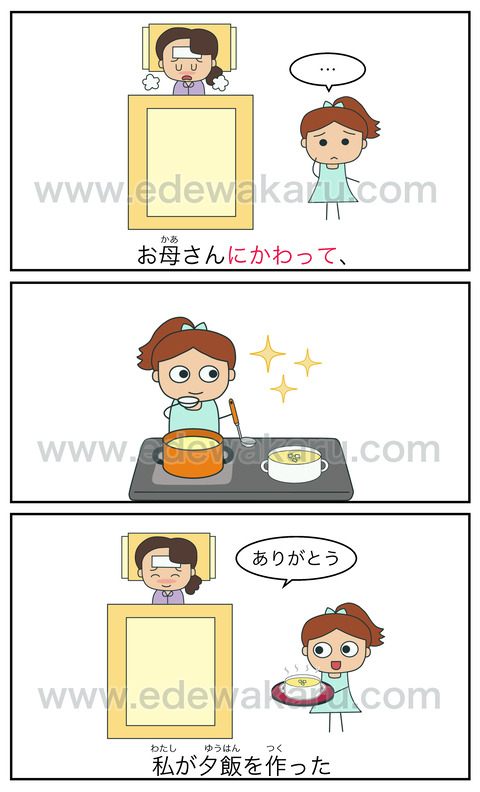
Meaning
In place of …
As …’s substitute
How to use it
Noun[dictionary form]+にかわって
Noun[dictionary form]+にかわり
Noun[dictionary form]+にかわる+noun
Explanation
“〜にかわって” is a sentence pattern meaning “in place of …” or “as a substitute for ….” It is used to say that someone else does something that would normally be done by someone else. 😊
[Examples]
①お母さん
にかわって、私が夕食を作った
→Usually “Mom” makes dinner, but she got sick, so “I” made it.
②社長
にかわって、部長があいさつをした
→The president was supposed to do it, but was absent, so the department manager did it.
③忙しい父
にかわって
結婚式に出席した
→My father was supposed to attend the wedding, but he was busy, so I attended in his place.
When followed by a noun, the form is “〜にかわる+noun.” 😀
[Example]
山田さん
にかわる
すばらしい社員はいない
There is no outstanding employee who can take Yamada’s place.
Also, “〜にかわり” has the same meaning and usage as “〜にかわって,” but “〜にかわり” is more formal. 😮
[Example]
社長
にかわって、部長があいさつをした
=社長
にかわり、部長があいさつをした
There are several similar sentence patterns, so be sure to distinguish and learn them properly. 😊
In context 3 examples
お母さんにかわって、私が夕食を作った
→お母さんと交代して、私が夕食を作ったI made dinner in place of my mother. →I took over from my mother and made dinner.
社長にかわって、部長があいさつをした
→社長の代理として、部長があいさつをしたThe department manager gave the greeting in place of the company president. →The department manager gave the greeting as the company president’s representative.
忙しい父にかわって、結婚式に出席した
→忙しい父の代理として、結婚式に出席したI attended the wedding on behalf of my busy father. →I attended the wedding as a substitute for my busy father.
Read the original source text
Meaning
〜と交代して
〜の代理として
How to use it
名詞[辞書形]+にかわって
名詞[辞書形]+にかわり
名詞[辞書形]+にかわる+名詞
Explanation
「〜にかわって」は「〜と交代して」「〜の代理として」という意味を表す文型です。「本当は〜がするはずのことを他の人がする」と言いたい時に使います😊
[例]
①お母さん
にかわって、私が夕食を作った
→いつもは「お母さん」が夕食を作るが、病気になったので「私」が作った
②社長
にかわって、部長があいさつをした
→「社長」がするはずだったが、社長がいなかったので「部長」がした
③忙しい父
にかわって
結婚式に出席した
→本当は「父」が結婚式に出席するはずだったが、忙しいので「私」が出席した
後ろに名詞がくる場合は「〜にかわる+名詞」になります
😀
[例]
山田さん
にかわる
すばらしい社員はいない
また、
「〜にかわり」は「〜にかわって」と意味も使い方も同じですが、「〜にかわり」の方が、かたい言い方です
😮
[例]
社長
にかわって、部長があいさつをした
=社長
にかわり、部長があいさつをした
似ている文型がいくつかありますので、きちんと区別をして覚えておきましょう😊
日本語文型辞典
Meaning
N にかわって
It means that one thing does what another thing is supposed to do. When modifying a noun, it takes the form 「NにかわるN」, as in ⑤. 「…のかわりに」 is also used.
Examples:
1. I will give the greeting in my mother’s place.
2. My father attended in place of my mother, who had suddenly fallen ill.
3. On behalf of Mr. Yamada, who was unable to attend today, we will ask a member of his family to receive the certificate and runner-up prize.
4. In the 21st century, Asian countries may come to lead the world in place of the developed countries that have done so until now.
5. If Ms. Yamada withdraws her candidacy, we will have to put forward another capable person in her place.
Read the original source text
Meaning
基本情報Nにかわって説明あるものがするはずのことを他のものがするという意味を表す。名詞を修飾する時は⑤のように「NにかわるN」となる。「…のかわりに」とも言う。例文① 母にかわって、私があいさつします。② 急病の母にかわって、父が出席した。③ 本日ご出席いただけなかった山田さんに代わって、ご家族の方に賞状と副賞を受け取っていただきます。④ 21世紀には、これまでの先進諸国に代わって、アジア諸国が世界をリードするようになるのではないだろうか。⑤ 山田さんが立候補を辞退するとなると、彼女に代わる実力者を立てなければならない。
日本語文型辞典 英語版
Meaning
【にかわって】[Nにかわって]
Expresses the meaning that someone takes action on behalf of the person who was to have done so. When it modifies a noun, becomes NにかわるN. Can be rephrased as ...のかわりに.
In context 5 examples
母にかわって、私があいさつします。
I’ll make a greeting on behalf of my mother.
急病の母にかわって、父が出席した。
My father went in place of my mother, who was stricken with a sudden sickness.
本日ご出席いただけなかった山田さんに代わって、ご家族の方に賞状と副賞を受け取っていただきます。
On behalf of Yamada-san, who could not be here today, I would like a member of her family to receive a certificate of accomplishment and a supplementary prize.
21世紀には、これまでの先進諸国に代わって、アジア諸国が世界をリードするようになるのではないだろうか。
Isn’t it the case that in the 21st century, Asian countries will take the lead in the world instead of those advanced countries that have led until now?
山田さんが立候補を辞退するとなると、彼女に代わる実力者を立てなければならない。
If Yamada-san withdraws as a candidate, we have to recommend another capable person in her place.
NINJAL 日本語文型データベース
Usage 1
Meaning
Used to say that something other than ~ performs the role that ~ would normally be expected to perform.
How to use it
N にかわって
Notes
After “~にかわって,” a word denoting something that can achieve the same purpose as “~” comes.
In context 5 examples
「出張中の田中にかわって、私、林がご挨拶させていただきます」
“On behalf of Tanaka, who is away on a business trip, I, Hayashi, would like to offer my greetings.”
近年では、オフィスでの勤務にかわって自宅でのテレワークが主流になっている職種もある。
In recent years, there are some types of work where teleworking from home has become the norm in place of working at the office.
現在、国際電話にかわって、通話もできるチャットアプリが広く利用されている。
Chat apps that also allow voice calls are now widely used in place of international phone calls.
時代の流れや社会的ニーズに合わせ、従来の古い経営方式にかわって、新しい経営方式が導入されるようになってきた。
In response to changing times and social needs, new management systems have come to be introduced in place of the old, conventional ones.
人や荷物を乗せて運ぶものとして、馬車に代わって登場したのが、ガソリン自動車である。
The gasoline-powered automobile appeared in place of the horse-drawn carriage as a means of transporting people and goods.
Read the original source text
Meaning
〜がするはずの役割を、〜ではなく別のものが果たすと言いたいときに使います。
How to use it
Nにかわって
Notes
「〜にかわって」の後には、「〜」と同じ目的を達成できるものを表す言葉がきます。
Usage 2
Meaning
Used to say that something other than ~ performs the role that ~ would normally be expected to perform.
This form modifies a noun, using “~にかわって” or “~にかわり.”
How to use it
N1 にかわる N2
Notes
N is a noun denoting something that can achieve the same purpose as “~.”
In context 5 examples
昔、米や塩はお金にかわる大切なものだった。
In the past, rice and salt were important things that could serve in place of money.
石油にかわるエネルギ―源としては太陽光、風力、水力などが挙げられる。
Solar, wind, and hydropower are among the energy sources that can replace oil.
このプロジェクトを任せられる人物は渡辺部長だけだ。彼にかわる人材は他にいないだろう。
Watanabe, the department manager, is the only person who can be entrusted with this project. There probably isn’t anyone else who can replace him.
持ち運びに便利なタブレットは、ノートパソコンにかわる売れ筋商品です。
Tablets, which are convenient to carry, are a popular product that can replace notebook computers.
田中先生は来年の3月から産休に入るので、学校では田中先生に代わる音楽の教師を探している。
Since Ms. Tanaka will go on maternity leave starting next March, the school is looking for a music teacher to replace her.
Read the original source text
Meaning
〜がするはずの役割を、〜ではなく別のものが果たすと言いたいときに使います。
「〜にかわって・〜にかわり」の名詞を説明する形です。
How to use it
N1にかわるN2
Notes
Nには「〜」と同じ目的を達成できるものを表す名詞がきます。
DoJG 日本語文法辞典(全集)
Meaning
In place of; replacing; on behalf of
How to use it
Noun | に代わって | |
| 母に代わって | In place of my mother |
Explanation
A compound particle to express replacement or substitution of a regular person/thing by someone/something.
In context 6 examples
病気の山田先生に代わって、鈴木先生が教えて下さった。
In place of Professor Yamada, who is ill, Professor Suzuki taught us.
戦後ガラスに代わってプラスチックが出てきた。
After the war plastics became available replacing glass.
レコードに代わってCDが出て、音質がとてもよくなった。
In place of records, CDs have become available, and the sound quality has improved a great deal.
私が父に代わって、空港までお客さんを迎えに行った。
In place of my father, I went to the airport to pick up our guest.
御出席の皆様に代わりまして、一言ご挨拶を述べさせていただきます。
On behalf of everyone present here, let me say a word of greeting.
申し訳ございませんが、社長は今日都合が悪いので、私が社長に代わって参りました。
I am very sorry that the president was unable to attend, but I have come in his place.
毎日のんびり日本語教師
How to use it
Noun + に代わって
Noun + に代わり
Explanation
Expresses doing something on someone else’s behalf.
It is usually attached to a noun referring to a person.
Notes
Related grammar: 「【N3文法】~代わりに(かわりに)」
In context 5 examples
課長に代わって私が会議に出席します。
I will attend the meeting on behalf of the section manager.
後輩に代わって尻拭いをするはめになった。
I ended up having to clean up after my junior colleague.
この仕事について、彼に代わる人はいない。
There is no one who can take his place in this job.
亡くなった母に代わり、私が弟の面倒を見る。
I will take care of my younger brother in place of my late mother.
「月に代わっておしおきよ」(我要代表月亮消灭你。)
“In the name of the moon, I’ll punish you!”
Read the original source text
How to use it
名詞+に代わって
名詞+に代わり
Explanation
誰かの代わりに何かをすることを表します。
通常は人物を表す名詞に接続されます。
Notes
関連文法「【N3文法】~代わりに(かわりに)」