DoJG 日本語文法辞典(全集)
Usage 1
Meaning
As much as; as ~ as possible; as much as one wants
How to use it
(i) Noun | だけ {が/を} | |
| 先生だけ{が/を} | The teacher alone {subject/direct object} |
(ii) N {Prt だけ/Prt だけ} | (where Prt=particles other than が, を and は) | |
| 先生 {だけに/にだけ} | Only to the teacher/to the teacher alone |
(iii) {V/Adjective い} informal | だけ {だ/です} | |
| {話す/話した} だけ {だ/です} | Someone talks/talked, that's all |
| {高い/ 高かった} だけ {だ/です} | Something is/was expensive, that's all |
(iv) Adjective な stem | {な/だった} だけ {だ/です} | |
| {静かな/静かだった} だけ {だ/です} | Something is/was quiet, that's all |
Explanation
A particle meaning "to the extent that someone (can/wants to) do something or something can happen".
In context 15 examples
若いうちに本を読めるだけ読んでおいた方がよい。
You'd better read as many books as you can while you are young.
食べるだけ食べると、礼も言わずに帰ってしまった。
After he had eaten as much as he wanted, he went home without even thanking me.
食べたいだけ食べるのが僕の主義です。
My principle is to eat as much as I want to.
うちの子は背が伸びるだけ伸びた感じです。
It looks like my child has grown as much as he is going to.
修士論文の内容についてできるだけ詳しく話して下さい。
Tell me about your MA thesis in as much detail as possible.
昨日は寿司屋で寿司を食べられるだけ食べた。
Yesterday I ate as much sushi as I could at a sushi restaurant.
学生のうちに海外に行けるだけ行ってみたいと思います。
I think I want to go abroad as often as I can while I'm a student.
運転手さん、飛行機に遅れてしまうので、飛ばせるだけ飛ばして下さい。
Driver, I may miss my plane, so please go as fast as you can.
前から抱いていた不服を言うだけ言ったらすうっとした。
When I freely gave vent to my longstanding complaints (literally: as much as I wanted to) it felt so good.
お金は使うだけ使っても故障の少ない車が買いたい。
I'd like to buy a trouble-free car no matter how much it costs.
昨日は寝たいだけ寝たので、心も体もすっきりした。
Yesterday I slept as much as I wanted, so my mind and body are refreshed.
痛風になった時、私の足の親指は腫れるだけ腫れてしまいました。
When I got gout my big toe really swelled up (literally: as much as it could swell).
今まで都会の真ん中でとてもうるさかったので、今度はできるだけ静かなところに住みたいです。
Until now, we have lived in the midst of a big, noisy town, so now we would like to live in as quiet a place as possible.
この会社に入りたい理由、また入社したらやりたいことは何ですか。できるだけ具体的にお書き下さい。
Why do you want to join this company and what do you want to do once you join the company? Please write down your answers in as much detail as possible.
その学会にはできるだけ出席するようにします。
I will do my best to attend the academic conference.
Usage 2
Meaning
Only; just; alone; merely; that’s all
How to use it
(i) Noun | だけ {が/を} | |
| 先生だけ{が/を} | The teacher alone {subject/direct object} |
(ii) N {Prt だけ/Prt だけ} | (where Prt=particles other than が, を and は) | |
| 先生 {だけに/にだけ} | Only to the teacher/to the teacher alone |
(iii) {V/Adjective い} informal | だけ {だ/です} | |
| {話す/話した} だけ {だ/です} | Someone talks/talked, that's all |
| {高い/ 高かった} だけ {だ/です} | Something is/was expensive, that's all |
(iv) Adjective な stem | {な/だった} だけ {だ/です} | |
| {静かな/静かだった} だけ {だ/です} | Something is/was quiet, that's all |
Explanation
A particle which expresses a limit imposed upon something that is growing and expanding.
In context 15 examples
スミスさんだけ(が)来た・来ました。
Only Mr. Smith came.
私は日本へ一度だけ行った・行きました。
I went to Japan only once.
雪子さんとはデートしただけだ・です。
I just dated Yukiko, that's all.
この家は大きいだけだ・です。
This house is big, that's all.
このお菓子は色が奇麗なだけだ・です。
This cake has pretty colours, that's all.
佐藤さんだけ(が)会議に出ました。
Only Mr. Sato attended the conference.
小さい和英辞典だけ(を)買いました。
I bought only a small Japanese-English dictionary.
僕にだけ・だけに話して下さい。
Please tell it only to me/to me alone.
この車はアルコールでだけ・だけで動きます。
This car runs only on alcohol (and nothing else)/on alcohol alone (so it needs nothing else).
あの先生には一度だけ会いました。
I met that professor only once.
朝はコーヒーを一杯飲むだけです。
In the morning I just drink a cup of coffee, that’s all.
この本は高いだけで面白くない。
This book is just expensive and is not interesting.
テニスは好きなだけで上手じゃない。
I just like tennis, and I’m not good at it.
それは学生だけのパーティーだった。
It was a party for students only.
出来るだけゆっくり話して下さい。
Please speak slowly as possible.
日本語文型辞典
Usage 1
Meaning
Basic information: N(+particle+)だけN/Na なだけA/V だけ. Expresses limitation.
a. …だけ
Indicates a limitation meaning “there is nothing other than that.” When attached to a clause, it follows the plain form. It connects with 「が」 and 「を」 as in 「Nだけが」 and 「Nだけを」. These particles may also be omitted, as in ②. With particles such as 「に」 and 「から」, there are two possible ways to connect: 「Nだけに」 and 「Nにだけ」. However, there may be cases where the distinction below applies.
b. …といってもせいぜい…だけだ
Used to emphasize that the amount is small.
c. …たところで…だけだ
Means that even if one does something, the result will only be rather unsatisfactory.
d. ただ…だけ
Means “just doing that alone.” It is followed by an expression of negative evaluation.
e. …だけで
Used after verbs such as “think,” “hear,” “feel,” and “imagine” to mean that one can experience the feeling without actually experiencing the thing.
An emphatic way to say 「…だけだ」. To emphasize that the amount is small, use 「だけだ」 or 「(だけ)しかない」, not 「だけある」.
「だけ」 cannot be used in the following cases.
Means “both” or “each of the two.” In spoken language, also said as 「…だけじゃなく…も」.
Means that there is no other way, or that something is not a big deal.
Means “for that one reason alone.”
The same verb is often repeated. As in 「言いたいこと」 in ③, it may also form a noun phrase that contains the repeated verb. Means “not doing anything else that ought to be done besides that.”
How to use it
…だけだ
…だけしか…ない
…だけでなく…も
…だけのことだ
…というだけ(の理由)で
V-るだけV-て
In context 47 examples
今度の事件に関係がないのは彼だけだ。
He’s the only one who isn’t involved in this incident.
品物なんかいりません。お気持ちだけいただきます。
I don’t need things like that. I’ll just accept your kind thoughts.
コピーをとるだけの簡単な仕事です。
It’s a simple job that only involves making copies.
ちょっとだけお借りします。
I’ll borrow it just for a moment.
あの人だけが私を理解してくれる。
He’s the only person who understands me.
ここは便利なだけで環境はあまりよくない。
This place is convenient, but the environment isn’t very good.
たいした怪我ではありません。ちょっと指を切っただけです。
It’s not a serious injury. I just cut my finger a little.
その話を聞いて泣いたのはわたしだけではない。
I wasn’t the only one who cried when I heard that story.
あなただけにお知らせします。
I’ll let you know, and you alone.
あの人にだけは負けたくない。
I don’t want to lose to that person in particular.
(例) 身分は保険証でだけ証明できる。(他の手段ではできない)
身分は保険証だけで証明できる。(保険証以外のものは要らない)(Example) Identity can be proven only with an insurance card. (No other means will do.) Identity can be proven with only an insurance card. (Nothing besides the insurance card is needed.)
ボーナスといってもせいぜい一ケ月分出るだけだ。
Even if you call it a bonus, it’ll be only one month’s pay at most.
夏祭りといってもせいぜい屋台が三、四軒出るだけです。
Even if you call it a summer festival, there’ll only be three or four food stalls at most.
旅行といってもせいぜい2泊するだけです。
Even if you call it a trip, it’ll only be two nights at most.
はやっているといってもせいぜい週末に混むだけだ。け月分出夏祭屋台三四軒出旅行泊週末混
Even if you say it’s popular, it only gets crowded on weekends.け月分出夏祭屋台三四軒出旅行泊週末混
急いで計算したところで間違いが多くなるだけだ。
Even if you calculate in a hurry, you’ll only make more mistakes.
親に話したところで誤解されるだけだ。
Even if you tell your parents, they’ll only misunderstand you.
早く帰ったところでねこが待っているだけだ。
Even if you go home early, the only one waiting for you is the cat.
スポーツはただ見るだけでは面白くない。
Sports aren’t interesting if you only watch them.
外国へ行ってただ景色を見るだけではつまらない。そこの土地の人たちとちょっとでも触れ合う旅にしたい。
It’s boring to go abroad and just look at the scenery. I want to make it a trip where I have at least some contact with the local people.
ただ話しただけではあの人のほんとう本当のよさはわからない。
You can’t understand how wonderful that person really is just by talking to them.
明日からまた仕事だと思うと、考えるだけでいやになる。
Just thinking that I have to go back to work tomorrow makes me feel miserable.
地震は経験した人の話を聞くだけでこわい。
Just hearing people who have experienced an earthquake talk about it is frightening.
イルカのダンスなんて考えただけで楽しくなる。
Just thinking about dolphins dancing makes me happy.
今月、残ったお金はこれだけしかありません。
This is all the money I have left this month.
頼りになるのはもうあなただけしかいない。
You’re the only person I can rely on now.
こんなことは、あなたにだけしか頼めません。
You’re the only person I can ask for something like this.
いまのところひとりだけしかレポートを出していない。
So far, only one person has submitted a report.
(例) A:お金がいくらありますか。
B:(誤)千円だけあります。
B:(正)千円だけです/千円しかありません。(Example) A: How much money do you have? B: (Incorrect) I have only 1,000 yen. B: (Correct) I have only 1,000 yen. / I have no more than 1,000 yen.
(例) A:この花いくらでしたか。
B:(誤)二百円だけです。
B:(正)二百円しかしませんでした/たったの二百円でした。
A:いま何時ですか。
B:(誤)1時だけです。
B:(正)まだ1時です。(Example) A: How much was this flower? B: (Incorrect) It’s only 200 yen. B: (Correct) It was only 200 yen. / It cost just 200 yen. A: What time is it now? B: (Incorrect) It’s only one o’clock. B: (Correct) It’s only one o’clock so far.
肉だけでなく、野菜も食べなければいけない。
You have to eat vegetables as well as meat.
英語だけでなくて、アラビア語もうまい。
He’s good at Arabic as well as English.
彼は歌が上手なだけでなく自分で曲も作る。
He not only sings well, he also composes his own songs.
今度の台風で、村は田畑だけでなく家屋も大きな被害を受けた。
The village suffered extensive damage to its homes as well as its fields in this typhoon.
授賞式にかれは招待を受けただけではなく、スピーチも頼まれた。
He was not only invited to the awards ceremony, but was also asked to give a speech.
だれも行かないのなら私が行くだけのことだ。
If no one else will go, I’ll just have to go.
入園テストといっても何もむずかしいことはないんです。先生に名前を呼ばれたら「はい」と返事をするだけのことです。
There’s nothing difficult about the kindergarten entrance test. All you have to do is answer “Yes” when the teacher calls your name.
いやなら無理をすることはない。断わるだけのことだ。
If you don’t want to, you don’t have to force yourself. Just say no.
その野菜はめずらしいというだけでよく売れている。
That vegetable sells well just because it’s unusual.
若いというだけで皆にもてはやされる。
Everyone makes much of them just because they’re young.
その晩に現場近くにいたというだけで彼は逮捕された。
He was arrested simply because he was near the scene that night.
子どもが多いというだけの理由でアパートの入居を断わられた。
They refused to rent us an apartment just because we have a lot of children.
名前の書いてない自転車に乗っているというだけの理由で警官に職務質問を受けた。
The police stopped me for questioning simply because I was riding a bicycle without a name written on it.
彼女は文句を言うだけ言ってなにも手伝ってくれない。
She complains as much as she likes, but doesn’t help with anything.
彼は飲むだけ飲んで会費を払わずに帰ってしまった。
He drank as much as he could, then went home without paying his share.
言いたいことだけ言ってさっさと出ていった。
He said everything he wanted to say, then quickly left.
いまどうしているか様子がわからないから、手紙を出すだけ出して返事を待とう。
Since I don’t know how things are going now, I’ll send a letter anyway and wait for a reply.
Read the original source text
Meaning
基本情報N(+助詞+)だけN/Na なだけA/V だけ説明限定を表す。
a. …だけ
それ以外のものはないという限定を表す。節に付く場合は普遍体に続く。「が」「を」には「Nだけが」「Nだけを」のように接続する。②のように「が」「を」を省略することもある。「に」「から」などは「Nだけに」「Nにだけ」のように2通りの接続のしかたがある。ただし、次のような使い分けがある場合もある。
b. …といってもせいぜい…だけだ
少ないことを強調するのに用いる。
c. …たところで…だけだ
なにかをしてもあまり良くない結末にしかならないという意味。
d. ただ…だけ
それをするだけではという意味。後ろにはマイナス評価の表現が続く。
e. …だけで
「考える、聞く、思う、想像する」などの動詞に続けて使い、実際には体験しなくても感じられるという意味を表すのに使う。
「…だけだ」を強調して言う表現。少ないことを強調するときは「だけある」ではなく「だけだ」「(だけ)しかない」の表現を使う。
次のような場合は「だけ」は使えない。
両方とも、どちらもという意味。話しことばでは「…だけじゃなく…も」とも言う。
それ以外に方法はない、あるいはそれはたいしたことはないという意味。
ただひとつの理由でという意味。
同じ動詞を繰り返して使うことが多い。③の「言いたいこと」のように繰り返す動詞を含んだ名詞になることもある。「そのこと以外の、他のするべきことをしない」という意味。
How to use it
…だけだ
…だけしか…ない
…だけでなく…も
…だけのことだ
…というだけ(の理由)で
V-るだけV-て
Usage 2
Meaning
Basic information: Expresses a degree.
Repeating verbs such as 「頑張る」 (try hard) and 「持つ」 (hold) expresses “do as much as one can.”
Repeating a verb expresses “to the extent that one’s desire is satisfied.”
Means “do as much as this.” Often followed by an expression that indicates that no more than that is expected or demanded.
Means “do something to a corresponding degree.”
Means “enough to do ….” Attached to nouns such as 「生活力」「金」「勇気」「語学力」「根性」「やさしさ」 to indicate a degree.
Means that when something happens, something else occurs to a corresponding degree. Can be rephrased as 「V-ばV-るほど」. 「V-ばV-るほど」 is more widely used.
Uses 「これ」「それ」「あれ」「どれ」. Often followed by 「…のだから」「…ば」「…のに」 or 「…ても」 and means “this much” or “to this extent.”
Expresses that the situation is not very good, but it is fortunate that it did not become even worse and stayed at this level.
How to use it
V-れるだけV
V-たいだけV
V一るだけはV
V-る/V-ただけのことはする
V-るだけのN
V-ぱV-るだけ
これだけ…のだから
…だけましだ
Na なだけましだ
A/V だけましだ
In context 29 examples
がんばれるだけがんばってみます。
I’ll try as hard as I can.
そこのリンゴ、持てるだけ持って行っていいよ。
You can take as many of those apples as you can carry.
彼は銀行から金を借りられるだけ借りて家を買った。
He borrowed as much money as he could from the bank and bought a house.
待てるだけ待ったが彼は、待ち合わせの場所に現れなかった。
I waited as long as I could, but he never showed up at the meeting place.
ここが気に入ったのなら、いたいだけいていいですよ。
If you like it here, you can stay as long as you want.
遠慮しないで食べたいだけ食べなさい。
Don’t hold back—eat as much as you want.
遊びたいだけ遊んで納得した。あすからいっしょうけんめい勉強しよう。
I played as much as I wanted and felt satisfied. Starting tomorrow, I’ll study as hard as I can.
彼女は泣きたいだけ泣いて気が済んだのか夕食の支度を始めた。
Perhaps she had cried to her heart’s content and felt better, because she began preparing dinner.
やるだけはやったのだから、静かに結果を待とう。
I’ve done all I can, so let’s quietly wait for the results.
息子の言い分を聞くだけは聞いてやってくれませんか。
Would you please at least listen to what my son has to say?
このことは両親にも話すだけは話しておいた方がいい。
It would be better to at least talk this over with your parents.
お金をいただいただけのことはしますが、それ以上のことは出来かねます。
I’ll do what I can for the money you’ve given me, but I can’t do anything beyond that.
調査期間はわずか1カ月でしたが、やれるだけのことはやったつもりです。
The investigation period was only one month, but I believe I did everything I could.
出来るだけのことはしますが、今月中に仕上げるのはむずかしいと思います。
I’ll do what I can, but I think it will be difficult to finish this month.
どんなところでも生きていけるだけの生活力が彼にはある。
He has the resourcefulness to survive anywhere.
その日彼の財布にはコーヒーを一杯飲むだけの金もなかった。
That day, he didn’t even have enough money in his wallet for a cup of coffee.
妻に本当のことを打ち明けるだけの勇気もなかった。
I didn’t even have the courage to tell my wife the truth.
その学生には異国で暮らすだけの語学カが不足している。
That student lacks the language skills needed to live in a foreign country.
交渉は時間をかければかけるだけ余計にもつれていった。
The more time they spent negotiating, the more tangled things became.
動物は世話をすればするだけなついてきます。
The more you care for animals, the more attached they become to you.
ピアノは練習すればするだけよく指が動くようになる。
The more you practice piano, the more dexterous your fingers become.
これだけ努力したんだからいつかは報われるだろう。
I’ve worked this hard, so I’ll be rewarded someday.
よくがんばったね。それだけがんばれば誰にも文句は言われないよ。
You worked really hard. If you work that hard, no one will complain.
あれだけ頼んでおいたのに彼はやってくれなかった。
Even though I’d asked him so many times, he didn’t do it for me.
あれだけ練習してもうまくならないのは、彼に才能がないのだろう。
If he still hasn’t improved after practicing that much, he probably has no talent.
どれだけ言えば、あの人にわかってもらえるのだろうか。
How many times will I have to tell that person before they understand?
風邪でのどが痛いが、熱が出ないだけましだ。
My throat hurts from a cold, but at least I don’t have a fever.
さいふをとられたが、パスポートが無事だっただけまだましだ。
My wallet was stolen, but at least my passport was safe.
私の住んでいるところは駅からも遠いし工場があってうるさい。このへんは不便だが、静かなだけましだ。
Where I live is far from the station, and there’s a factory, so it’s noisy. This area is inconvenient, but at least it’s quiet.
Read the original source text
Meaning
基本情報説明程度を表す。
「頑張る」「持つ」などの動詞を繰り返して、「できる限りする」という意味を表す。
動詞を繰り返して、欲求が満たされる程度までという意味を表す。
この程度のことまではするという意味。それ以上のことは期待しない、要求しないという表現が続くことが多い。
それに見合う程度にするという意味。
「…するのに充分な」の意味。「生活力、金、勇気、語学力、根性、やさしさ」な どの名詞に付いて程度を表す。
あることをすればその程度にあわせて次のことが起こるという意味。「V-ばV-るほど」と言いかえることができる。「V-ばV-るほど」の方が広く用いられる。
「これ」「それ」「あれ」「どれ」が用いられる。後ろには「…のだから」「…ば」「…のに」「…ても」などを伴って、「こんなにたくさん、この程度まで」の意味を表す。
あまり良くない状況だが、もっとひどいことにならなくて、この程度でよかったという意味を表す。
How to use it
V-れるだけV
V-たいだけV
V一るだけはV
V-る/V-ただけのことはする
V-るだけのN
V-ぱV-るだけ
これだけ…のだから
…だけましだ
Na なだけましだ
A/V だけましだ
Usage 3
Meaning
Basic information
N / A / V だけに
Na なだけに
Indicates the general nature of a fact and states something that can naturally be inferred from it.
An expression indicating that the later situation follows naturally from what was mentioned before.
a. …だけになおさら
Means “because …, naturally, all the more so.” なおのこと in sense ② is used in the same way.
Means “even though one would normally expect a good result, the opposite happened.” Used when the result is bad, contrary to what was expected.
b. N が N だけに
⇾ が 13
Means that something is worthy of one’s effort, position, or experience. Used to express an evaluation that there are results, abilities, special qualities, etc. commensurate with it.
How to use it
…だけに
a …だけに
c …だけにかえって
…だけのことはある
In context 16 examples
お茶の先生だけに言葉遣いが上品だ。
As you’d expect from a tea instructor, her choice of words is refined.
彼は現職の教師だけに受験についてはくわしい。
As he is a teacher currently in the profession, he knows a lot about entrance examinations.
かれらは若いだけに徹夜をしても平気なようだ。
Since they’re young, they seem able to stay up all night without any trouble.
今回の事故は一歩まちがえば大惨事につながるだけに、原因の究明が急がれる。
Since one wrong step in this accident could lead to a major disaster, it is urgent to determine the cause.
横綱の意地があるだけになおさら大関には負けられないでしょう。
Precisely because he has the pride of a yokozuna, he surely cannot afford to lose to an ōzeki.
彼女は若かっただけになおのことその早すぎた死が惜しまれる。
Because she was so young, her death at such an early age is all the more lamentable.
苦労しただけになおさら今回の優勝はうれしいでしょうね。
You must be all the happier about winning this time after all the hardships you went through.
現地は暑さに加えて、飲み水も不足しているだけになおさら救援が待たれる。
On top of the heat, drinking water is also scarce in the area, making relief efforts all the more eagerly awaited.
若くて体力があるだけにかえって無理をして体をこわしてしまった。
Precisely because he was young and strong, he overexerted himself and damaged his health.
今まで順調だっただけにかえって今度の事業の失敗は彼に致命的な打撃となった。
Because things had gone smoothly until now, the failure of this venture dealt him an even more devastating blow.
祖父は今年90歳で元気だが、歳が歳だけに昼間もウトウトしていることが多くなってきた。
My grandfather is 90 this year and in good health, but given his age, he has increasingly been dozing during the day.
この商品は今までの物よりもずっと性能がいいのですが、値段が値段だけにそうたくさんは売れないでしょう。
This product performs much better than previous ones, but given its price, it probably won’t sell in very large quantities.
うまい魚だ。とれたてを送ってもらっただけのことはある。
What delicious fish. It’s certainly worth having it sent freshly caught.
A:このナイフ、いつまでもよく切れるね。
B:買った時は高いと思ったけど、それだけのことはあるね。A: This knife keeps cutting really well, doesn’t it? B: I thought it was expensive when I bought it, but it was worth it.
A:杉島さんの英語の発音、とってもきれいね。
B:そうね、さすがにイギリスに留学していただけのことはあるわね。A: Mr. Sugishima’s English pronunciation is so beautiful. B: Yes, as you’d expect from someone who studied in Britain.
彼女は学校の先生をしていただけのことはあって、今も人前で話すのがうまい。
As you’d expect from someone who used to be a schoolteacher, she is still good at speaking in front of people.
Read the original source text
Meaning
基本情報N/A/V だけにNaなだけに説明あることがらの一般的な性質を示し、そこから当然推測できることを述べる。
前のことがらの当然のなりゆきとして後の状況が出て来るということを表す表現。
a. …だけになおさら
「…なので当然ではあるが、よりいっそう」の意味。②の「なおのこと」も同じように使う。
ふつうは良い結果が得られるはずなのにそれとは反対に、という意味。期待されるのとは反対の悪い結果をもたらした場合に使う。
b. NがNだけに
⇾が13
努力や地位や経験に値するという意味。それに見合う結果、能力、特長などがあることを評価して表す。
How to use it
…だけに
a…だけに
c…だけにかえって
…だけのことはある
絵でわかる日本語
Usage 1
Read this source entry ↗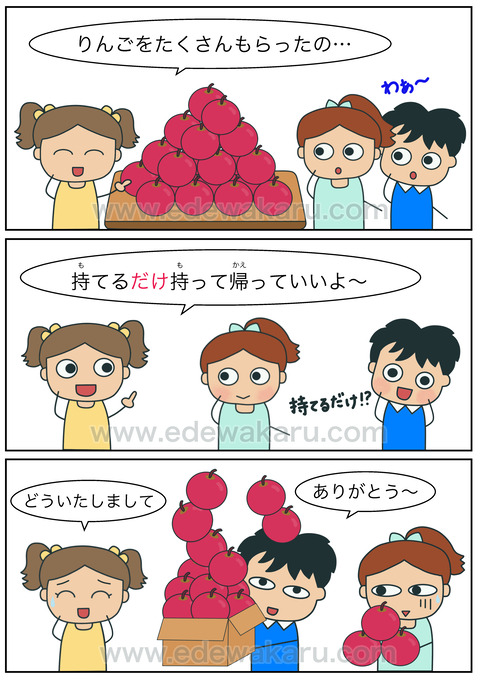
Meaning
Do something up to the limit of what you can do
How to use it
Verb [potential form / potential expression] + だけ
Explanation
“AれるだけA” is a sentence pattern meaning “do A up to the limit of what you can do.” In many cases, the same verb is used for both instances of “A.”
[Examples]
① I got a lot of apples, so you can take as many as you can carry home.
→ You can take home as many as you can carry.
② Yeah… But I did everything I could, so I have no regrets.
→ I did everything up to the limit of what I could do, so I have no regrets.
③ Please, eat as much as you can before you go.
→ Please eat up to the limit of what you can eat before you go.
⑤ You have to play as much as you can while you’re still a student!
→ You have to play up to the limit of what you can while you’re still a student!
* Meaning: “I have to play a lot while I still can.”
Also, “できるだけ” means “as much as possible within the limits of one’s ability or circumstances,” so remember it as it is 😀
In context 5 examples
A:りんごをたくさんもらったから、持てるだけ持って帰っていいよB:わぁ、ありがとう〜
A: I got a lot of apples, so you can take as many as you can carry home. B: Wow, thanks!
A:試験はどうだった?難しかった?B:うん…でも、やれるだけのことはやったから後悔はないわ
A: How was the exam? Was it hard? B: Yeah… But I did everything I could, so I have no regrets.
どうぞ、食べられるだけ食べていってくださいね(復習:〜ていく(継起))
Please, eat as much as you can before you go. (Review: 〜ていく (sequence))
学生のうちに遊べるだけ遊んでおかなきゃ!(復習:〜うちに①(状態継続時))(復習:〜なきゃ)
You have to play as much as you can while you’re still a student! (Review: 〜うちに① (while a state continues)) (Review: 〜なきゃ)
明日はできるだけ早く学校に来るようにしてください(復習:〜ようにしてください)
Please make sure to come to school as early as you can tomorrow. (Review: 〜ようにしてください)
Read the original source text
Meaning
〜できる限界まで〜
How to use it
動詞[可能形・可能表現]+だけ
Explanation
「AれるだけA」は「Aできる限界の範囲までAする」という意味を表す文型です。多くの場合「A」には同じ動詞が入ります。
[例]
①りんごをたくさんもらったから、
持てるだけ持って
帰っていいよ
→
持てる限界まで
持って帰っていいよ
②うん…でも、
やれる
だけ
のことは
やった
から後悔はないわ
→できる限界までのことはやったから後悔はないわ
③どうぞ、
食べられるだけ食べていって
くださいね
→
食べられる限界まで
食べていってくださいね
⑤学生のうちに
遊べるだけ遊んで
おかなきゃ!
→
遊べる限界まで
遊んでおかなきゃ
*「たくさん遊んでおかなきゃ」という意味
また
「できるだけ」は「能力や状況の範囲で一番〜」という意味
ですので、そのまま覚えておきましょう😀
Usage 2
Read this source entry ↗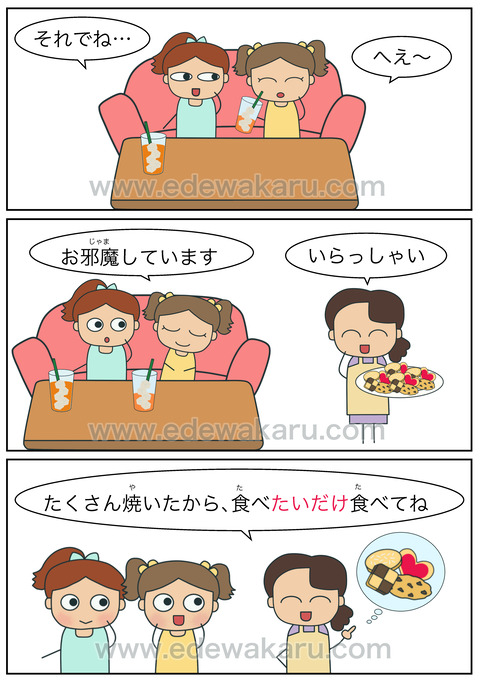
Meaning
Do as much as you want to do.
Do everything you want to do.
How to use it
Verb [ーたい] + だけ
Explanation
“AたいだけA” is a sentence pattern meaning “do A up to the limit of how much you want to do A” or “do all the A you want to do.” In most cases, the same verb is used for both instances of “A.”
(Review: 入る・入れる)
[Examples]
① A: Those cookies look delicious!
B: I baked a lot, so eat as many as you want.
→ Eat up to as much as you feel like eating.
② A: I had a fight with my mom, so I don’t want to go home.
B: I see… You can stay at our place for as long as you want.
→ You can stay for as long as you want to.
(Review: 〜間 (time period))
③ When you feel like crying, you can cry as much as you want.
→ You can cry up to the limit of how much you feel like crying.
④ I played as much as I wanted over the three-day weekend, so I think I’ll be able to work hard again starting tomorrow.
→ I played up to the limit of how much I wanted to, so I think I’ll be able to work hard again.
⑤ Yamada-kun said all the complaints he wanted to and then left.
→ He said everything he wanted to say and then left.
There is also the sentence pattern “VれるだけV” with “〜だけ,” so remember to learn that one too 😀
In context 5 examples
A:おいしそうなクッキー!B:たくさん焼いたから、食べたいだけ食べてねA:ありがとうございます
A: Those cookies look delicious! B: I baked a lot, so eat as many as you want. A: Thank you.
A:お母さんとケンカしたから、家に帰りたくないのB:そっか…うちにいたいだけいていいよ
A: I had a fight with my mom, so I don’t want to go home. B: I see… You can stay at our place for as long as you want.
泣きたい時は、泣きたいだけ泣けばいいんだよ
When you feel like crying, you can cry as much as you want.
3連休は遊びたいだけ遊んだから、明日からまた仕事をがんばれそうだ(復習:〜そうだ(可能性))
I played as much as I wanted over the three-day weekend, so I think I’ll be able to work hard again starting tomorrow. (Review: 〜そうだ (possibility))
山田くんは、文句を言いたいだけ言って帰ってしまった(復習:〜てしまう(完了・状態))
Yamada-kun said all the complaints he wanted to and then left. (Review: 〜てしまう (completion/state))
Read the original source text
Meaning
〜したい限界まで〜する
〜したいと思う全部〜
How to use it
動詞[ーたい]+だけ
Explanation
「AたいだけA」は「Aたい限界までAする」「Aたい全部〜する」という意味を表す文型です。ほとんどの場合「A」には同じ動詞が入ります。
(復習:入る・入れる)
[例]
①A:おいしそうなクッキー!!
B:たくさん焼いたから、
食べたいだけ食べて
ね
→食べたいと思うげ限界まで食べてね
②A:お母さんとケンカしたから、家に帰りたくないの
B:そっか…うちに
いたいだけいて
いいよ
→いたい間はずっといていいよ
(復習:〜間(時間))
③泣きたい時は、
泣きたいだけ泣けば
いいんだよ
→泣きたいと思う限界まで泣けばいいんだよ
④3連休は
遊びたいだけ遊んだ
から、明日からまた仕事をがんばれそうだ
→遊びたいと思う限界まで遊んだから、また頑張れそうだ
⑤山田くんは、文句を
言いたいだけ言って
帰ってしまった
→言いたいことを全部言って帰ってしまった
「〜だけ」には
「VれるだけV」
という文型もありますので、一緒に覚えておきましょう😀
どんなときどう使う 日本語表現文型辞典
Meaning
as much as
How to use it
〔Plain form〕affirmative form(na-adjective な)+だけ(no examples with nouns)
Explanation
~の範囲は全部
1)「もうこれ以上はないという限度まで…する」と言いたいときに使う。 ❸ のように「できるだけ」の形で慣用的に使うこともある。
2)動詞のほかに「ほしいだけ・Vたいだけ・好きなだけ」などの例がある。
1)Do something to its limit. Also used in idioms, in form of できるだけ, as in sentence ❸ .
2)Besides appending to verbs, can be seen in patterns such as ほしいだけ, Vたいだけ, 好きなだけ, etc.
In context 4 examples
テーブルの上のものは食べたいだけ食べてもかまわないんですよ。
You can eat as much as you want of what’s on the table.
ここにあるお菓子をどうぞ好きなだけお取りください。
Please help yourself to as many of the sweets here as you like.
あしたはできるだけ早く来てください。
Please come as early as you can tomorrow.
わかっているだけのことはもう全部話しました。
I’ve already told you everything I know.
Read the original source text
Meaning
as much as
How to use it
〔普通形〕の肯定形(ナAな)+だけ(Nにつく例はない)
Explanation
~の範囲は全部
1)「もうこれ以上はないという限度まで…する」と言いたいときに使う。 ❸ のように「できるだけ」の形で慣用的に使うこともある。
2)動詞のほかに「ほしいだけ・Vたいだけ・好きなだけ」などの例がある。
1)Do something to its limit. Also used in idioms, in form of できるだけ, as in sentence ❸ .
2)Besides appending to verbs, can be seen in patterns such as ほしいだけ, Vたいだけ, 好きなだけ, etc.
日本語NET JLPT文法解説まとめ
Usage 1
Read this source entry ↗Meaning
Expresses limitation.
How to use it
N + だけ
Number + counter + だけ
Explanation
"only"
Expresses a limitation.
Note that in English, only comes before the noun, as in “only N,” whereas in Japanese the noun comes first, as in “Nだけ.”
In context 10 examples
私の休みは日曜日だけです。土曜日は仕事があります。
My only day off is Sunday. I work on Saturdays.
昨日30分だけ勉強しました。
I studied for only 30 minutes yesterday.
このクラスでフランス人は僕だけです。
I'm the only French person in this class.
今、財布の中には200円だけあります。
I have only 200 yen in my wallet right now.
さっき、1時間だけ寝ました。
I slept for only an hour just now.
ジェシカさんだけ、その問題に答えられなかった。
Jessica was the only one who couldn't answer that question.
朝は何も食べません。牛乳だけ飲みます。
I don't eat anything in the morning. I only drink milk.
私はベジダリアンですから、肉は食べません。野菜だけ食べます。
I'm a vegetarian, so I don't eat meat. I only eat vegetables.
トムさんだけが、私の気持ちをわかってくれる。
Only Tom understands how I feel.
君だけに、僕の秘密を教えてあげる。
I'll tell my secret only to you.
Read the original source text
Meaning
限定を表す
How to use it
N + だけ
数字 + 助数詞 + だけ
Explanation
"only"
Expresses a limitation.
英語の場合、onlyが名詞より先に来て「only N」と表現するが、日本語の場合は名詞が先に来て「Nだけ」となる点に注意。
Usage 2
Read this source entry ↗Meaning
The entire range of ~
Used when you want to say “do ~ to the limit of one’s ability.”
How to use it
Plain form (affirmative) + だけ
※Not used with N.
Explanation
as much as
In context 4 examples
できるだけ水を飲むようにしてください。
Please try to drink as much water as you can.
どうぞ、好きなだけ食べてくださいね。
Please eat as much as you like.
やれるだけのことはやったので、もう後悔はありません。
I did everything I could, so I have no regrets now.
泣きたいときは、我慢せず泣きたいだけ泣けばいいんですよ。
When you feel like crying, you can cry as much as you want without holding back.
Read the original source text
Meaning
~の範囲は全部て
「~の範囲の限界まで~する」と言いたいときに使う。
How to use it
普通形(肯定形)+ だけ
※Nにはつかない。
Explanation
as much as
毎日のんびり日本語教師
Usage 1
Read this source entry ↗Meaning
To the extent of; in proportion to that amount
How to use it
Noun + (の) 分
Noun + だけ
Noun + の分だけ
な-adjective stem + な分
な-adjective stem + だけ
な-adjective stem + な分だけ
い-adjective plain form + 分
い-adjective plain form + だけ
い-adjective plain form + 分だけ
Verb plain form + 分
Verb plain form + だけ
Verb plain form + 分だけ
Explanation
Expresses an amount or degree.
The following clause describes an event that occurs to a degree corresponding to that in the preceding clause, or a change in quantity commensurate with that degree.
When it attaches to words expressing a quantity, such as “number” or “amount,” 分 may be omitted.
Notes
Nothing in particular.
In context 8 examples
「ありがとう」の言葉の数だけ人と人の距離が縮まる。
The more times we say “thank you,” the closer people become to one another.
ご飯は自分が食べる分だけ作るようにしている。残るともったいないから。
I try to make only as much rice as I can eat myself, because leftovers would be a waste.
涙の分だけ強くなれる。
You can become stronger in proportion to your tears.
悩んだ分だけ成長できる。
You can grow as much as you struggle.
歳の分だけ老獪になる。(只会变老。)
You only grow more cunning with age.
ダイエットしてるから食べた量だけ運動して消費したい。
Since I'm dieting, I want to exercise enough to burn off exactly the amount I've eaten.
頑張った分だけ評価されるとは限らない。結局は結果を出さなければならない。
You aren't necessarily appreciated in proportion to how hard you work. In the end, you have to produce results.
給料分以上は働きたくない。(我不想做工资份额以外的工作。)
I don't want to work beyond what I'm paid for.
Read the original source text
Meaning
按其程度
How to use it
名詞+(の)分
名詞+だけ
名詞+の分だけ
な形容詞語幹+な分
な形容詞語幹+だけ
な形容詞語幹+な分だけ
い形容詞普通形+分
い形容詞普通形+だけ
い形容詞普通形+分だけ
動詞普通形+分
動詞普通形+だけ
動詞普通形+分だけ
Explanation
程度量を表します。
前件の程度に相当する事態が発生したり、その程度に相応しい量の変化がもたらされることを後件で述べます。
「数」「量」などの数量を表す語につくときは「分」が省略可能になります。
Notes
特になし
Usage 2
Read this source entry ↗How to use it
Verb dictionary form + だけ + verb て-form
Explanation
The same verb is used twice in the construction.
It carries the nuance that one does only that action and doesn't do the other things one ought to do.
Notes
The 「だけ」series
In context 8 examples
平日は仕事するだけして、休日は家で死んだように寝ている。
On weekdays, I do nothing but work, and on my days off I sleep at home as if I were dead.
彼は食べるだけ食べてお金も払わず帰って行った。
He ate his fill and left without paying.
女性と遊ぶだけ遊んで捨てるなんて最低な男だ。
He's the worst kind of man, playing around with women to his heart's content and then dumping them.
いつでも調理できるように、野菜は切るだけ切って保存しておこうと思う。
I think I'll cut up the vegetables and store them, so they'll be ready to cook whenever I need them.
彼は文句を言うだけ言って何もしない。
He does nothing but complain and never does anything.
政府は国民から税金を取るだけ取って、何も保障をしてくれない。
The government takes as much tax as it can from the public, but gives them no support at all.
悩み事あれば聞くだけ聞いてあげるよ。
If you have something on your mind, I'll at least hear you out.
告白するだけして、彼は私の返事も聞かずに立ち去った。
He confessed his feelings and then walked away without even hearing my reply.
Read the original source text
How to use it
動辞形+だけ+動て形
Explanation
同じ動詞を2回用いて接続します。
その動作だけ行い、それ以外のやるべきことはやらないというニュアンスを持っています。
Notes
「だけ」シリーズ
Usage 3
Read this source entry ↗How to use it
Noun + (particle)+ だけ
な-adjective + な + だけ
い-adjective plain form + だけ
Verb plain form + だけ
Explanation
Expresses limitation.
It is used mainly in objective expressions. Therefore, there is hardly any nuance of the speaker’s dissatisfaction with a small quantity in terms of time, degree, range, or the like. To express subjective dissatisfaction with a small quantity, it is better to use “~しか~ない.”
Notes
Related grammar: 【N3 grammar】~しか~ない
The “だけ” series
In context 8 examples
参加したい人だけ当日来てください。
Only those who want to participate should come on the day.
一つだけ質問してもいいですか。
May I ask just one question?
サングラスをかけてたから目の周りだけ日焼けしなかった。
Because I was wearing sunglasses, only the area around my eyes didn’t get sunburned.
今日だけ全品半額です。(仅今天全部是半价。)
Everything is half price today only.
寝る前に1時間だけゲームしたい。
I want to play games for just one hour before bed.
若者が減少しているのは、鳥取県だけではない。(年轻人减少的不仅仅是鸟取县。)
Tottori Prefecture isn’t the only place where the number of young people is declining.
クラスの中で彼一人だけが異彩を放っていた。
He alone stood out in the class.
本屋さんに行くとトイレに行きたくなるのは私だけですか?
Am I the only one who feels like using the bathroom when I go to a bookstore?
Read the original source text
How to use it
名詞+(助詞)+だけ
な形容詞+な+だけ
い形容詞普通形+だけ
動詞普通形+だけ
Explanation
限定を表します。
主に客観的な表現に用いられます。そのため、時間や程度、範囲などの数量が少ないことに対する話者の不満のニュアンスはほとんどありません。主観的かつ数量が少ないことに対する不満を表すには「~しか~ない」を用いた方がいいです。
Notes
関連文法「【N3文法】~しか~ない」
「だけ」シリーズ
Usage 4
Read this source entry ↗How to use it
Verb dictionary form + だけ + verb
できるだけ(のことは)する (do whatever one can)
やれるだけ(のことは)やる (do all one can)
Explanation
The same verb is used twice in the construction, expressing that the action is performed to the degree the speaker considers sufficient.
A similar grammar pattern is 「【N1文法】~(ら)れるだけ~」, but it differs in expressing the greatest possible degree or amount.
Notes
The 「だけ」series
In context 5 examples
やるだけやった。あとは結果を待つだけだ。
I've done all I can. Now all that's left is to wait for the result.
ウイルスに感染しないようにできるだけのことはしてるけどやっぱり怖い。
I'm doing everything I can to avoid catching the virus, but I'm still scared.
試食品を食べるだけ食べて、商品を買っていかないお客もいる。
Some customers eat all the samples they want but don't buy any of the products.
相談したいことがあるんだけど、聞くだけ聞いてもらえる?
There's something I want to ask you about. Could you at least hear me out?
子供作るだけ作って、育児は祖母に任せる。
They have as many children as they can, then leave raising them to the grandmother.
Read the original source text
How to use it
動辞形+だけ+動詞
できるだけ(のことは)する
やれるだけ(のことは)やる
Explanation
同じ動詞を2回用いて接続し、その動作を話者が十分だと思う程度量行うことを表します。
似ている文法に「【N1文法】~(ら)れるだけ~」がありますが、こちらは可能な限りの最大の程度量を表す点で異なります。
Notes
「だけ」シリーズ
日本語文型辞典 英語版
Meaning
【だけ1】[N(+助詞+)だけ][N/Na なだけ][A/V だけ]Expresses limitation.
Expresses restriction or limitation, with the meaning “there is nothing else.” Follows a plain form when attached to a clause. When combined with が and を, it takes the forms Nだけが and Nだけを. が and を are sometimes dropped, as seen in
(2)
. There are two patterns of linking with particles like に and から, as in Nだけに and Nにだけ. However, in some cases these two patterns have different meanings, as in the examples below.
(例)身分は保険証でだけ証明できる。(他の手段ではできない)
You can prove your identity only with your health insurance certificate. (You can’t use any other method.)
(例)身分は保険証だけで証明できる。(保険証以外のものは要らない)
You can prove your identity with just your health insurance certificate. (You don’t need anything else but the insurance certificate.)
b. ...といってもせいぜい...だけだ
Used to emphasize that there is not much of something.
c. ...たところで...だけだ
Means “even if you do something, it will only result in a less-than-satisfactory outcome.”
d. ただ...だけでは
Means “just by doing such-and-such.” Followed by expressions of negative evaluation.
e. ...だけで
Used after verbs such as 考える (think), 聞く (hear, listen to), 思う(think) or 想像する(imagine) to express that you can feel something without actually experiencing it.
Used to emphasize ...だけだ (only/just...). To emphasize the small quantity of something,だけだ or (だけ)しかない is used, not だけある.
(例)A:お金がいくらありますか。
How much money do you have?
B:(×)千円だけあります。
There is only a thousand yen.
B:(○)千円だけです/千円しかありません。
Only a thousand yen./All I have is a thousand yen.
だけ cannot be used in the following cases.
(例)A:この花いくらでしたか。
How much was this flower?
B:(×)二百円だけです。
It’s only two hundred yen.
B:(○)二百円しかしませんでした/たったの二百円でした。
It only cost two hundred yen./It was just two hundred yen.
(例)A:いま何時ですか。
What time is it now?
B:(×)1時だけです。
It’s merely one o’clock.
B:(○)まだ1時です。
It’s still just one o’clock.
Means “both; not only...but also....” In spoken language, ...だけじゃなく...もis also used.
Means that there is no other way, or that something is not anything special.
Means for only one single reason.
In this pattern, the same verb is repeated. In some cases, as in 言いたいこと in
(3)
, a noun phrase that contains a verb is repeated. Means “someone is doing one thing, but not another thing that s/he should be doing.”
【だけ2】Expresses a degree/extent.
Verbs such as がんばる(work hard) and 持つ(hold) are repeated to express the meaning “do something as much as possible.”
Repeats the verb and means “up to the point at which one’s desire is satisfied.”
Means that someone does something to a certain extent. Followed by an expression indicating that nothing is expected or demanded beyond that extent.
Means “do X to a degree that complies with Y.”
Means “sufficient in order to....” Expresses a degree and attaches to nouns such as 生活力 (vitality, earning power), 金 (money), 勇気 (courage), 語学力 (language ability), 根性 (willpower) and やさしさ (kindness).
Means that if you do one thing, another thing will happen along with it to the same extent. Can be replaced by the pattern V-ば V-るほど, which is more commonly used.
これ, それ, あれ and どれ can all be used. (こ)れだけ is followed by ...のだから, ...ば, ...のに, or ...ても and means “this much, to this extent.”
Means that the current situation isn’t very good, but it’s fortunate that it isn’t any worse or that it’s only to this extent.
【だけ3】[N/A/V だけに][Na なだけに]Indicates a general characteristic of a person or thing, which is then used to describe what can naturally be inferred from that characteristic.
This expression means that the latter situation arises as a natural result of the former.
b. ...だけになおさら
Means “because of such-and-such, it is natural that...is all the more....” なおのことin
(2)
is used in the same way.
c. ...だけにかえって
Means that although something should normally have a good result, the opposite has happened.
d. NがNだけに
→
3
B:買った時は高いと思ったけど、それだけのことはあるね。
I thought it was a little expensive when I bought it, but it’s been worth the price.
B:そうね、さすがにイギリスに留学していただけのことはあるわね。
Yes, her study abroad in England has certainly paid off, hasn’t it.
Means that something is worth the effort, position, experience, etc. Expresses a positive judgment that the thing in question has a proportional result, ability, or merit.
How to use it
1. ...だけだa. ...だけ
2. ...だけしか...ない
3. ...だけでなく...も
4. ...だけのことだ
5. ...というだけ(の理由)で
6. V-るだけV-て
1. V-れるだけV
2. V-たいだけV
3. V-るだけはV
4. V-る/V-た だけのことはする
5. V-るだけのN
6. V-ば V-るだけ
7. これだけ...のだから
8. ...だけましだ[Na なだけましだ][A/V だけましだ]
1. ...だけにa. ...だけに
2. ...だけのことはある
In context 89 examples
今度の事件に関係がないのは彼だけだ。
He’s the only one not connected with the current incident.
品物なんかいりません。お気持ちだけいただきます。
I don’t need things. Your kindness alone is enough.
コピーをとるだけの簡単な仕事です。
It’s an easy job of just making photocopies.
ちょっとだけお借りします。
I’ll borrow it for just a little while.
あの人だけが私を理解してくれる。
Only he understands me.
ここは便利なだけで環境はあまりよくない。
This place is convenient, but that’s all—the surroundings are not very good.
たいした怪我ではありません。ちょっと指を切っただけです。
It isn’t a serious injury. I cut my finger a little, that’s all.
その話を聞いて泣いたのはわたしだけではない。
I wasn’t the only one who cried after hearing that story.
あなただけにお知らせします。
I’ll notify you, and only you.
あの人にだけは負けたくない。
She’s the one person I don’t want to lose to.
ボーナスといってもせいぜい一ヶ月分出るだけだ。
A bonus it may be, but it’s only about a month’s salary, at the very most.
夏祭りといってもせいぜい屋台が三、四軒出るだけです。
A summer festival it may be, but there are only three or four booths at the most.
旅行といってもせいぜい2泊するだけです。
I say it’s a trip, but it’s only two nights’ stay, if that.
はやっているといってもせいぜい週末に混むだけだ。
You may think it’s popular, but it just gets crowded on the weekends, that’s all.
急いで計算したところで間違いが多くなるだけだ。
If you calculate in a hurry, you’ll only make more mistakes.
親に話したところで誤解されるだけだ。
If I tell my parents, it’ll only cause misunderstanding.
早く帰ったところでねこが待っているだけだ。
If I go home early, all I have is a cat waiting for me.
スポーツはただ見るだけでは面白くない。
Sports are not interesting if all you do is watch.
外国へ行ってただ景色を見るだけではつまらない。そこの土地の人たちとちょっとでも触れ合う旅にしたい。
It’s boring to travel abroad and just look at the scenery. I want my trip to be one that includes at least a little contact with the local people.
ただ話しただけではあの人の本当のよさはわからない。
You won’t see that person’s true merits simply by talking to him.
明日からまた仕事だと思うと、考えるだけでいやになる。
Just thinking about the fact that work starts again tomorrow makes me feel like I can’t stand it.
地震は経験した人の話を聞くだけでこわい。
It’s scary just listening to the stories of people who have experienced earthquakes.
イルカのダンスなんて考えただけで楽しくなる。
Just thinking about dolphins dancing makes you feel happy.
今月、残ったお金はこれだけしかありません。
This is all the money I have left this month.
頼りになるのはもうあなただけしかいない。
The only one I have left to rely on is you.
こんなことは、あなたにだけしか頼めません。
You’re the only one I can ask to do this.
いまのところひとりだけしかレポートを出していない。
So far only one person has submitted a paper.
肉だけでなく、野菜も食べなければいけない。
You have to eat not just meat but vegetables, too.
英語だけでなくて、アラビア語もうまい。
She’s good at not only English but also Arabic.
彼は歌が上手なだけでなく自分で曲も作る。
He’s not only good at singing, he also composes songs himself.
今度の台風で、村は田畑だけでなく家屋も大きな被害を受けた。
As a result of the latest typhoon, not only the cultivated fields but also the houses in the village were badly damaged.
授賞式にかれは招待を受けただけではなく、スピーチも頼まれた。
He was not only invited to the awards ceremony, he was also asked to give a speech.
だれも行かないのなら私が行くだけのことだ。
If no one else is going, I’ll go by myself.
入園テストといっても何もむずかしいことはないんです。先生に名前を呼ばれたら「はい」と返事をするだけのことです。
We say “kindergarten entrance test,” but it’s not hard. All they need to do is answer “yes” when the teacher calls their names.
いやなら無理をすることはない。断わるだけのことだ。
If you don’t want to, you don’t have to. All you need to do is say no.
その野菜はめずらしいというだけでよく売れている。
That vegetable is selling well just because it’s unusual.
若いというだけで皆にもてはやされる。
Everyone makes a fuss over him just because he’s young.
その晩に現場近くにいたというだけで彼は逮捕された。
He was arrested only because he happened to be near the scene that night.
子どもが多いというだけの理由でアパートの入居を断わられた。
I was refused an apartment, just for the reason that I have a lot of children.
名前の書いてない自転車に乗っているというだけの理由で警官に職務質問を受けた。
I was questioned by the police simply because I was riding a bike with no name written on it.
彼女は文句を言うだけ言ってなにも手伝ってくれない。
All she does is complain, and she doesn’t help with anything.
彼は飲むだけ飲んで会費を払わずに帰ってしまった。
He drank all he wanted to and left without paying his share.
言いたいことだけ言ってさっさと出ていった。
He said what he wanted to say and left in a hurry.
いまどうしているか様子がわからないから、手紙を出すだけ出して返事を待とう。
I don’t know how he’s doing these days, so let’s just send a letter and wait for a reply.
がんばれるだけがんばってみます。
I’ll try as hard as I can.
そこのリンゴ、持てるだけ持って行っていいよ。
You may take as many of those apples as you can carry.
彼は銀行から金を借りられるだけ借りて家を買った。
He borrowed as much money as he could from the bank and bought a house.
待てるだけ待ったが、彼は待ち合わせの場所に現れなかった。
I waited for as long as I could, but he didn’t show up at the appointed place.
ここが気に入ったのなら、いたいだけいていいですよ。
If you like it here, please feel free to stay as long as you like.
遠慮しないで食べたいだけ食べなさい。
Don’t hesitate–eat as much as you like.
遊びたいだけ遊んで納得した。あすからいっしょうけんめい勉強しよう。
I’m satisfied to have played as much as I wanted to. I’ll study hard starting tomorrow.
彼女は泣きたいだけ泣いて気が済んだのか夕食の支度を始めた。
It might have been that she felt better after having a good cry, but then she started to prepare supper.
やるだけはやったのだから、静かに結果を待とう。
We’ve done all we can, so let’s wait quietly for the result.
息子の言い分を聞くだけは聞いてやってくれませんか。
Won’t you please at least listen to what my son has to say?
このことは両親にも話すだけは話しておいた方がいい。
It would be better to at least talk to your parents about this, too.
お金をいただいただけのことはしますが、それ以上のことは出来かねます。
I’ll do what I’m paid to do, but I can’t do anything beyond that.
調査期間はわずか1ヶ月でしたが、やれるだけのことはやったつもりです。
The period of investigation was only one month, but I feel I’ve done all I can.
出来るだけのことはしますが、今月中に仕上げるのはむずかしいと思います。
I’ll do my best, but I don’t think it’s possible to finish it this month.
どんなところでも生きていけるだけの生活力が彼にはある。
He has enough of an appetite for life that he could live anywhere.
その日彼の財布にはコーヒーを一杯飲むだけの金もなかった。
That day he didn’t even have enough money in his wallet to buy a cup of coffee.
妻に本当のことを打ち明けるだけの勇気もなかった。
I didn’t have enough courage to confess the truth to my wife.
その学生には異国で暮らすだけの語学力が不足している。
That student lacks sufficient foreign language ability to live abroad.
交渉は時間をかければかけるだけ余計にもつれていった。
The more time it took, the more complicated the negotiations became.
動物は世話をすればするだけなついてきます。
The more you look after an animal, the more attached to you it gets.
ピアノは練習すればするだけよく指が動くようになる。
The more you practice the piano, the better your fingers move.
これだけ努力したんだからいつかは報われるだろう。
I’ve put in so much effort, so someday it is sure to pay off.
よくがんばったね。それだけがんばれば誰にも文句は言われないよ。
You really worked hard. If you work that hard, no one can criticize you.
あれだけ頼んでおいたのに彼はやってくれなかった。
In spite of all my requests, he still didn’t do it for me.
あれだけ練習してもうまくならないのは、彼に才能がないのだろう。
The fact that he hasn’t improved even after all that practice probably means he doesn’t have any talent.
どれだけ言えば、あの人にわかってもらえるのだろうか。
How much do I have to say to make that person understand?
風邪でのどが痛いが、熱が出ないだけましだ。
I have a sore throat due to a cold, but at least I don’t have a fever.
さいふをとられたが、パスポートが無事だっただけまだましだ。
I had my wallet stolen, but at least my passport was safe.
私の住んでいるところは駅からも遠いし工場があってうるさい。このへんは不便だが、静かなだけましだ。
The place I live is far from the station and there’s a factory close by, so it’s noisy. Still, this area may be inconvenient, but at least it’s quiet.
お茶の先生だけに言葉遣いが上品だ。
Her use of language is elegant, as you’d expect from a teacher of tea ceremony.
彼は現職の教師だけに受験についてはくわしい。
Being a working teacher, he knows a lot about taking examinations.
かれらは若いだけに徹夜をしても平気なようだ。
Because they’re young, staying up all night doesn’t seem to affect them.
今回の事故は一歩まちがえば大惨事につながるだけに、原因の究明が急がれる。
Because the current accident could easily have led to a disaster, we need to determine the cause quickly.
横綱の意地があるだけになおさら大関には負けられないでしょう。
He has the pride of a yokozuna (the highest rank of sumoo), so he’s probably all the more determined not to lose against an oozeki (the second highest rank of sumoo).
彼女は若かっただけになおのことその早すぎた死が惜しまれる。
Since she was so young, her premature death is even more regrettable.
苦労しただけになおさら今回の優勝はうれしいでしょうね。
Especially after the hardships you’ve had, this victory must be all the more gratifying.
現地は暑さに加えて、飲み水も不足しているだけになおさら救援が待たれる。
Along with the heat in the area, a lack of drinking water has made the need for aid all the more urgent.
若くて体力があるだけにかえって無理をして体をこわしてしまった。
It was because I was young and had a lot of stamina that I ended up working too hard and ruining my health.
今まで順調だっただけにかえって今度の事業の失敗は彼に致命的な打撃となった。
It was precisely because things had been going so well up till now that the failure of this enterprise dealt him a fatal blow.
祖父は今年 90 歳で元気だが、歳が歳だけに昼間もウトウトしていることが多くなってきた。
My grandfather is ninety this year and doing very well, but given his age, he dozes off more and more during the day.
この商品は今までの物よりもずっと性能がいいのですが、値段が値段だけにそうたくさんは売れないでしょう。
This product has much better performance than any in the past, but given the price, we probably won’t be able to sell very many.
うまい魚だ。とれたてを送ってもらっただけのことはある。
This fish is delicious. There’s nothing like having freshly caught fish sent to you.
A:このナイフ、いつまでもよく切れるね。
This knife just keeps on cutting really well, doesn’t it?
A:杉島さんの英語の発音、とってもきれいね。
Sugishima-san’s English pronunciation is really good.
彼女は学校の先生をしていただけのことはあって、今も人前で話すのがうまい。
Because she was a school teacher, she’s good at public speaking even today.
Read the original source text
Meaning
【だけ1】[N(+助詞+)だけ][N/Na なだけ][A/V だけ]Expresses limitation.
Expresses restriction or limitation, with the meaning “there is nothing else.” Follows a plain form when attached to a clause. When combined with が and を, it takes the forms Nだけが and Nだけを. が and を are sometimes dropped, as seen in
(2)
. There are two patterns of linking with particles like に and から, as in Nだけに and Nにだけ. However, in some cases these two patterns have different meanings, as in the examples below.
(例)身分は保険証でだけ証明できる。(他の手段ではできない)
You can prove your identity only with your health insurance certificate. (You can’t use any other method.)
(例)身分は保険証だけで証明できる。(保険証以外のものは要らない)
You can prove your identity with just your health insurance certificate. (You don’t need anything else but the insurance certificate.)
b. ...といってもせいぜい...だけだ
Used to emphasize that there is not much of something.
c. ...たところで...だけだ
Means “even if you do something, it will only result in a less-than-satisfactory outcome.”
d. ただ...だけでは
Means “just by doing such-and-such.” Followed by expressions of negative evaluation.
e. ...だけで
Used after verbs such as 考える (think), 聞く (hear, listen to), 思う(think) or 想像する(imagine) to express that you can feel something without actually experiencing it.
Used to emphasize ...だけだ (only/just...). To emphasize the small quantity of something,だけだ or (だけ)しかない is used, not だけある.
(例)A:お金がいくらありますか。
How much money do you have?
B:(×)千円だけあります。
There is only a thousand yen.
B:(○)千円だけです/千円しかありません。
Only a thousand yen./All I have is a thousand yen.
だけ cannot be used in the following cases.
(例)A:この花いくらでしたか。
How much was this flower?
B:(×)二百円だけです。
It’s only two hundred yen.
B:(○)二百円しかしませんでした/たったの二百円でした。
It only cost two hundred yen./It was just two hundred yen.
(例)A:いま何時ですか。
What time is it now?
B:(×)1時だけです。
It’s merely one o’clock.
B:(○)まだ1時です。
It’s still just one o’clock.
Means “both; not only...but also....” In spoken language, ...だけじゃなく...もis also used.
Means that there is no other way, or that something is not anything special.
Means for only one single reason.
In this pattern, the same verb is repeated. In some cases, as in 言いたいこと in
(3)
, a noun phrase that contains a verb is repeated. Means “someone is doing one thing, but not another thing that s/he should be doing.”
【だけ2】Expresses a degree/extent.
Verbs such as がんばる(work hard) and 持つ(hold) are repeated to express the meaning “do something as much as possible.”
Repeats the verb and means “up to the point at which one’s desire is satisfied.”
Means that someone does something to a certain extent. Followed by an expression indicating that nothing is expected or demanded beyond that extent.
Means “do X to a degree that complies with Y.”
Means “sufficient in order to....” Expresses a degree and attaches to nouns such as 生活力 (vitality, earning power), 金 (money), 勇気 (courage), 語学力 (language ability), 根性 (willpower) and やさしさ (kindness).
Means that if you do one thing, another thing will happen along with it to the same extent. Can be replaced by the pattern V-ば V-るほど, which is more commonly used.
これ, それ, あれ and どれ can all be used. (こ)れだけ is followed by ...のだから, ...ば, ...のに, or ...ても and means “this much, to this extent.”
Means that the current situation isn’t very good, but it’s fortunate that it isn’t any worse or that it’s only to this extent.
【だけ3】[N/A/V だけに][Na なだけに]Indicates a general characteristic of a person or thing, which is then used to describe what can naturally be inferred from that characteristic.
This expression means that the latter situation arises as a natural result of the former.
b. ...だけになおさら
Means “because of such-and-such, it is natural that...is all the more....” なおのことin
(2)
is used in the same way.
c. ...だけにかえって
Means that although something should normally have a good result, the opposite has happened.
d. NがNだけに
→
3
B:買った時は高いと思ったけど、それだけのことはあるね。
I thought it was a little expensive when I bought it, but it’s been worth the price.
B:そうね、さすがにイギリスに留学していただけのことはあるわね。
Yes, her study abroad in England has certainly paid off, hasn’t it.
Means that something is worth the effort, position, experience, etc. Expresses a positive judgment that the thing in question has a proportional result, ability, or merit.
How to use it
1. ...だけだa. ...だけ
2. ...だけしか...ない
3. ...だけでなく...も
4. ...だけのことだ
5. ...というだけ(の理由)で
6. V-るだけV-て
1. V-れるだけV
2. V-たいだけV
3. V-るだけはV
4. V-る/V-た だけのことはする
5. V-るだけのN
6. V-ば V-るだけ
7. これだけ...のだから
8. ...だけましだ[Na なだけましだ][A/V だけましだ]
1. ...だけにa. ...だけに
2. ...だけのことはある
文法
Usage 1
Meaning
Expresses limitation.
How to use it
N + だけ
Number + counter + だけ
Notes
Note that in English, only comes before the noun, as in “only N,” whereas in Japanese the noun comes first, as in “Nだけ.”
In context 10 examples
私の休みは日曜日だけです。土曜日は仕事があります。
My only day off is Sunday. I work on Saturdays.
昨日30分だけ勉強しました。
I studied for only 30 minutes yesterday.
このクラスでフランス人は僕だけです。
I'm the only French person in this class.
今、財布の中には200円だけあります。
I have only 200 yen in my wallet right now.
さっき、1時間だけ寝ました。
I slept for only an hour just now.
ジェシカさんだけ、その問題に答えられなかった。
Jessica was the only one who couldn't answer that question.
朝は何も食べません。牛乳だけ飲みます。
I don't eat anything in the morning. I only drink milk.
私はベジダリアンですから、肉は食べません。野菜だけ食べます。
I'm a vegetarian, so I don't eat meat. I only eat vegetables.
トムさんだけが、私の気持ちをわかってくれる。
Only Tom understands how I feel.
君だけに、僕の秘密を教えてあげる。
I'll tell my secret only to you.
Read the original source text
Meaning
限定を表す
How to use it
N + だけ
数字 + 助数詞 + だけ
Notes
英語の場合、onlyが名詞より先に来て「only N」と表現するが、日本語の場合は名詞が先に来て「Nだけ」となる点に注意。
Usage 2
Meaning
The entire range of ~
Used when you want to say “do ~ to the limit of one’s ability.”
How to use it
Plain form (affirmative) + だけ
※Not used with N.
In context 4 examples
できるだけ水を飲むようにしてください。
Please try to drink as much water as you can.
どうぞ、好きなだけ食べてくださいね。
Please eat as much as you like.
やれるだけのことはやったので、もう後悔はありません。
I did everything I could, so I have no regrets now.
泣きたいときは、我慢せず泣きたいだけ泣けばいいんですよ。
When you feel like crying, you can cry as much as you want without holding back.
Read the original source text
Meaning
~の範囲は全部て
「~の範囲の限界まで~する」と言いたいときに使う。
How to use it
普通形(肯定形)+ だけ
※Nにはつかない。
Bunpro Grammar Reference
Meaning
Only, Just
How to use it
Verb + だけ
[い]Adjective + だけ
[な]Adjective + な + だけ
Noun + だけ
Nuance
A word that takes one thing from a group of possibilities, and presents it as a single thing.
Explanation
だけ is used in Japanese in a similar way to 'only' or 'just' in English. The basic meaning of this word is that 'while there are/were several possibilities, only (A) is true/was chosen'. だけ is used by attaching it to the base (dictionary) form of any word, except for な-Adjectives, which require な when being used adjectivally.
今夜は食べるだけ、何も飲まない。
Tonight I'm only going to eat, I won't drink anything.
私はブロッコリーだけがきらい。
I only dislike broccoli.
あの人は有名なだけ。
That person is just famous. (Fame is all they have)
このスープは辛いだけ。
This soup is just spicy.
Due to な-Adjectives being able to be used as either a noun or an adjective, the meaning of a sentence will be different depending on whether だけ is used with the noun form, or the adjective form.
私の彼女は綺麗なだけです。
My girlfriend is just beautiful. (There are no other distinguishing features)
富士山は綺麗だけじゃない。
As for Mt. Fuji, beauty is not all there is. (There are other distinguishing features)
Basically this difference just highlights whether something is being discussed in a measurable way (an adjective), or an immeasurable way (a noun).
In context 18 examples
- 一人だけです。
Only one person.
- 私はブロッコリーだけがきらい。
I only dislike broccoli.
- 今夜は食べるだけ、何も飲まない。
Tonight I'm only going to eat, I won't drink anything.
- 私の彼女は綺麗なだけです。
My girlfriend is just beautiful. (There are no other distinguishing features)
- 富士山は綺麗だけじゃない。
As for Mt. Fuji, beauty is not all there is. (There are other distinguishing features)
- あの人は有名なだけ。
That person is just famous. (Fame is all they have)
- このスープは辛いだけ。
This soup is just spicy.
- それだけです。
Only that.
- サッカーだけが好き。
I only like soccer.
- 私だけ行きます。
Only I am going.
- その映画は長いだけ。
That movie is just long.
- 彼女は綺麗なだけ。
She is just beautiful.
- 汚いだけだった。
It was only dirty.
- 友達だけ来ます。
Only friends will come.
- 私だけ本を読むのが好き。
Only I like reading books.
- バスだけで行く。
To go only by bus.
- 妹はパンだけ食べます。
My little sister eats only bread.
- 日本語を勉強するのは、月曜日だけです。
I study Japanese only on Mondays.
Yokubi — The Common Grammar Guide (https://yoku.bi)
Explanation
だけ, のみ, and ばかり are variations of "just" or "only". しか is similar, but it can only be used in negative statements.
だけ means "just so", in terms of amount. It acts like a particle.
のみ is like a less colloquial だけ.
ばかり is yet another "only" word. It can also be pronounced ばっか or ばっかり. Xばかり focuses on everything falling within the definition of X as being true, whereas だけ and のみ focus on things that fall outside of the statement being false. Think of the difference in vibes between "There is only this" and "There is nothing else".
The structure \<verb\>てばかりいる is often used to convey a critical attitude towards someone stating they do just one thing over and over to the point where it's detrimental.
ばかり can also be used with temporal statements to convey how soon or early something happened.
しか is used with negative statements to convey the same meaning as だけ but with the focus on everything else that is not what is being marked.
The compound だけしか exists too. It works exactly the same as しか but has stronger emphasis.
In context 2 examples
俺だけ行く
Only I will go
俺だけじゃないよ
It's not only me.
IMABI
The Particle だけ
Read this IMABI lesson ↗Explanation
The Particle だけ
In a nutshell, the adverbial particle だけ shows limitation meaning “just/only.” This lesson will teach you how it is used to mean just this.
The Adverbial Particle だけ
だけ means “just/only” and shows the extent/limit of something. だけ can also be after verbs, adjectives, etc. that are in the れんたいけい. So, いやなだけ not いやだけ. This is because it’s actually from the noun 丈(たけ), which means “length”.
Noun + だけ 形容詞 + だけ 形容動詞 + だけ Verb + だけ
手 + だけ → 手だけ ほしい + だけ → ほしいだけ 好き + だけ → 好きなだけ 話す+ だけ → 話すだけ
Particle Note: が and を are optional after だけ. Don’t put them before it.
1. テストのことを思うだけで不安ふあんになった。
I became uneasy just at the thought of the test.
2. 赤いリンゴだけ五つください。
Please give me five red apples only.
3. 君だけを愛している。
I only love you.
4. 私は英語えいごだけ(を)勉強します。
I only study English.
5. 人は外見がいけんだけでは分かりません。
You can’t tell a person just by looks.
6. 今回こんかいだけは見逃みのがしてください。
Please overlook just this one time.
7. 一人ひとりだけ{です・います}。
There is only 1 person.
8. ほしいだけ持もつ。
To carry just what one wants.
9. 彼は、この前の週末しゅうまつに洗濯せんたくだけしたのよ。(Feminine)
He only did the laundry last weekend!
10. 彼女は、この前の週末に掃除そうじだけしたんだよ。(Masculine)
She only did cleaning last weekend!
だけで(は)なく
だけで{(は)・じゃ}なく means “not only”.
11. 猫ねこがいるだけでなく、犬もいます。
Not only are there cats, but there are also dogs.
12a. あの部屋へやは広いだけでなく、とても明るくて美しいです。(ちょっと不自然)
12b. あの部屋は広くて明るいです。(もっと自然)
That room is not only spacious, but it’s also very bright and beautiful.
だけ(のこと)だ
だけ(のこと)だ states that there is nothing more than something. So, it can be translated as “…is no more than”. With the inclusion of のこと, the statement is more forceful.
13. 風邪かぜを引ひいただけだよ。
I only caught a cold.
14. 会社かいしゃが破産はさんしただけのことだ。
It’s just that the company went bankrupt.
15. 見ているだけです。
I’m just looking.
16. 膝ひざを擦すり剥むいただけ。
I only grazed my knee.
Speech Level Note: The deletion of だ makes だけ a final particle. It makes the sentence less blunt. だけです is perfectly fine for polite speech.
With こそあど
With これ, それ, あれ, and どれ, だけ translates as “much.”
18. 便利べんりなサイトはこれだけです。
These are the only useful sites.
19. これだけの切符きっぷを集あつめていた。
I’ve collected this many tickets.
20. それだけなの?(A little feminine)
Is that all?
21. その入門書にゅうもんしょは本当に高いが、それだけの価値かちがある。
The beginner’s book is really expensive, but it has the worth.
22. どれだけ苦くるしくても僕は離はなしはしない。
No matter how hard it is, I won’t let go.
Verb+だけ+Verb
だけ shows a limit, and in this expression you make it even more clear that you are not expecting, wanting, or doing any more.
23. このことは両親にも話すだけは話しておいた方がいい。
As for this, it’s best that you at the most talk to your parents.
24. やるだけはやったんだから、静かに結果を待ちましょう。
I’ll wait quietly for the results since I did what I had to do.
25. 言うだけ言ったらすっきりした。
I feel good now that I’ve said (what I had to say).
26. まあ聞くだけ聞いてくれ。
Come on, at least listen to what I have to say.
———————————————————————————–
Potential + だけ
With the potential form of the verb, it can be translated in this way as “as much as…”
27. できるだけして。
Do as much as possible.
28. 私は走れるだけ走りました。
I ran as much as I could.
なるべく VS できるだけ
Both mean “if possible/as (much) as possible”. なるべく is (somewhat) formal. できるだけ can be followed by の. To use it with なるべく , you have to use the rare なるたけ/なるだけ.
29. なるべくタバコをすうな。
As much as possible/if possible, do not smoke.
Grammar Note: な in the above sentence creates the negative imperative.
30. なるべく午後ごごに来てほしいです。
I would like you to come during the afternoon if possible.
31. できるだけ多くの金が必要ひつよう!
I need as much money as possible!
32. できるだけ早く帰ってください。
Please come home as soon as possible.
ただ
As an adverb, ただ means “just what you’re doing”. For example, “you’re just hoping that you get a good grade in Japanese class”. Other synonyms include 専もっぱら and ひたすら. Or, it may stress that there’s “nothing else” or that there is “merely” something. Other words for this include たった and わずかに.
ただ…だけ means “mere(ly)”, but だけ isn’t necessary. 専ら ≒ “entirely”, so there is no need for だけ. Neither is there a need for it with ひたすら. ほんの僅か…だけ = “just a few”. たった comes from ただ to mean “mere” and is frequently used with だけ.
Examples
33. たった一つ
Just one
34. たった今消えたんだよ。
It disappeared just now!
35. ただいま
I’m home!
Culture Note: Whenever you come home, you say ただいま. People there will response with お帰り(なさい) “welcome home.” The added part makes it polite.
37. もっぱらの噂うわさだよ。
It’s widely rumored.
38. ただの理由りゆうで
With just a mere excuse
39. それは単たんに程度ていどの問題もんだいじゃないか?
Isn’t that just a problem of degree?
Word Note: 単に means “purely/simply/merely” and is also often used with だけ.
40. 単に私見しけんを述のべただけだよ。
I merely stated my own opinion.
Nuance Note: Simply as in “easily” can be 単純たんじゅんに, 簡単に, 単に, etc. with just slight differences. The first shows a heavy emphasis on simplifying a process down. The second shows more so the easy, and the latter emphasizes on the extent of the matter.
41. 東京までたった10キロです。
It’s just 10 kilometers to Tokyo.
42. あられがほんのわずか降ふっただけだ。(Somewhat written style)
There was only a light amount of hail that fell.
43. ほんの一度だけ
Just one time
Word Note: ほんの is an attributive phrase that means “mere”. ほんの少し means “just a little.” The word gives the sense that there really is nothing else beyond it. It can also be written as 本の.
44. ただの風邪かぜでしょう。
It’s probably just a cold.
Word Note: 風邪 means “cold” but comes from and is pronounced just like 風 (wind).
45 [徒・只]より高いものはない。
Nothing costs more than what is given to us.
46. 道はただひとつ。
There is but one way to live.
47. 美びはただ皮一枚かわいちまい。
Beauty is but skin-deep.
ただでは in a negative sentence means that something serious is to happen.
48. ただではおかないぞ!
You’ll pay for this!
In context 46 examples
テストのことを思うだけで不安ふあんになった。
I became uneasy just at the thought of the test.
赤いリンゴだけ五つください。
Please give me five red apples only.
君だけを愛している。
I only love you.
私は英語えいごだけ(を)勉強します。
I only study English.
人は外見がいけんだけでは分かりません。
You can’t tell a person just by looks.
今回こんかいだけは見逃みのがしてください。
Please overlook just this one time.
一人ひとりだけ{です・います}。
There is only 1 person.
ほしいだけ持もつ。
To carry just what one wants.
彼は、この前の週末しゅうまつに洗濯せんたくだけしたのよ。(Feminine)
He only did the laundry last weekend!
彼女は、この前の週末に掃除そうじだけしたんだよ。(Masculine)
She only did cleaning last weekend!
猫ねこがいるだけでなく、犬もいます。
Not only are there cats, but there are also dogs.
あの部屋へやは広いだけでなく、とても明るくて美しいです。(ちょっと不自然)
That room is not only spacious, but it’s also very bright and beautiful.
あの部屋は広くて明るいです。(もっと自然)
That room is not only spacious, but it’s also very bright and beautiful.
風邪かぜを引ひいただけだよ。
I only caught a cold.
会社かいしゃが破産はさんしただけのことだ。
It’s just that the company went bankrupt.
見ているだけです。
I’m just looking.
膝ひざを擦すり剥むいただけ。
I only grazed my knee.
便利べんりなサイトはこれだけです。
These are the only useful sites.
これだけの切符きっぷを集あつめていた。
I’ve collected this many tickets.
それだけなの?(A little feminine)
Is that all?
その入門書にゅうもんしょは本当に高いが、それだけの価値かちがある。
The beginner’s book is really expensive, but it has the worth.
どれだけ苦くるしくても僕は離はなしはしない。
No matter how hard it is, I won’t let go.
このことは両親にも話すだけは話しておいた方がいい。
As for this, it’s best that you at the most talk to your parents.
やるだけはやったんだから、静かに結果を待ちましょう。
I’ll wait quietly for the results since I did what I had to do.
言うだけ言ったらすっきりした。
I feel good now that I’ve said (what I had to say).
まあ聞くだけ聞いてくれ。
Come on, at least listen to what I have to say.
できるだけして。
Do as much as possible.
私は走れるだけ走りました。
I ran as much as I could.
なるべくタバコをすうな。
As much as possible/if possible, do not smoke.
なるべく午後ごごに来てほしいです。
I would like you to come during the afternoon if possible.
できるだけ多くの金が必要ひつよう!
I need as much money as possible!
できるだけ早く帰ってください。
Please come home as soon as possible.
たった一つ
Just one
たった今消えたんだよ。
It disappeared just now!
ただいま
I’m home!
もっぱらの噂うわさだよ。
It’s widely rumored.
ただの理由りゆうで
With just a mere excuse
それは単たんに程度ていどの問題もんだいじゃないか?
Isn’t that just a problem of degree?
単に私見しけんを述のべただけだよ。
I merely stated my own opinion.
東京までたった10キロです。
It’s just 10 kilometers to Tokyo.
あられがほんのわずか降ふっただけだ。(Somewhat written style)
There was only a light amount of hail that fell.
ほんの一度だけ
Just one time
ただの風邪かぜでしょう。
It’s probably just a cold.
道はただひとつ。
There is but one way to live.
美びはただ皮一枚かわいちまい。
Beauty is but skin-deep.
ただではおかないぞ!
You’ll pay for this!