絵でわかる日本語
Meaning
If you have to choose one, ~ would be better.
How to use it
Verb [dictionary form, た-form, or ない-form] + ほうがましだ
い-adjective [remove い] + ほうがましだ
な-adjective [remove な] + ほうがましだ
Noun + のほうがましだ
Explanation
“〜ほうがましだ” is a sentence pattern that means “if you have to choose one of the two, ~ would be better.” It is used when the speaker wants to say, “I dislike both, but if I have to choose one, ~ would be better.” Learn the patterns it commonly appears with.
[Commonly used patterns]
・〜より
〜ほうがましだ
・〜くらいなら
〜ほうがましだ
“〜ほうがましだ” is also often used in conversation, so learn it.
[Related grammar patterns]
In context 5 examples
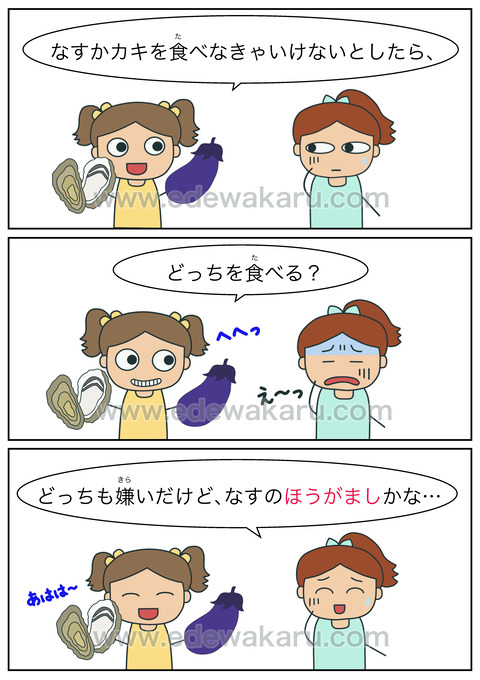
A:なすかカキを食べなきゃいけないとしたらどっち?B:う〜ん…どっちも嫌いだけど、なすのほうがましかな…
→どちらも嫌いだけど、なすのほうがいいかなA: If you had to eat either eggplant or oysters, which would you choose? B: Hmm… I don’t like either, but I guess eggplant would be better… →I don’t like either, but I guess eggplant would be better.
あの人と結婚するくらいなら、ずっと独身でいるほうがましだわ!
→どちらも嫌だが、あの人結婚するならずっと独身のほうがいいI’d rather stay single forever than marry that person! →I dislike both options, but if I were to marry that person, staying single forever would be better.
A:あの店のラーメンはまずいよね…B:うん。あのラーメンを食べるより、家でカップラーメンを食べるほうがましだね
→あの店のラーメンを食べるより、家でカップラーメンを食べるほうがいいA: The ramen at that shop is bad, isn’t it… B: Yeah. I’d rather eat instant ramen at home than eat that ramen. →I’d rather eat instant ramen at home than eat the ramen at that shop.
ストレスで病気になるくらいなら、会社を辞めたほうがましだ
→どちらも嫌だが、病気になるより、会社を辞めたほうがいいI’d rather quit my job than get sick from stress. →I dislike both options, but I’d rather quit my job than get sick.
休日出勤(きゅうじつしゅっきん)するなら、残業したほうがましだ
→どちらも嫌だが、休日出勤より残業のほうがいいIf I have to work on a day off, I’d rather work overtime. →I dislike both options, but working overtime is better than working on a day off.
Read the original source text
Meaning
どちらか選ばなければいけないなら、〜のほうがいい
How to use it
動詞[辞書形・た形・ない形]+ほうがましだ
い形容詞[ーい]+ほうがましだ
な形容詞[ーな]+ほうがましだ
名詞+のほうがましだ
Explanation
「〜ほうがましだ」は「どちらかを選ばなければいけないなら、〜のほうがいい」という意味を表す文型です。これは、話者が「どちらも嫌だが、どちらかを選ばなければいけないなら〜のほうがいい」と言いたい時に使われます。よく一緒に使われる文型を覚えておきましょう。
[よく使われる文型]
・
〜より
〜ほうがましだ
・
〜くらいなら
〜ほうがましだ
「〜ほうがましだ」は、会話でもよく使われますので覚えておきましょう。
【関連文型】
毎日のんびり日本語教師
How to use it
Verb past form + ほうがまし
Verb negative form + ほうがまし
Noun + の + ほうがまし
い-adjective base form + ほうがまし
な-adjective + な + ほうがまし
(Verb dictionary form + ほうがまし)
Explanation
This grammar is used when clearly ranking two opposing choices and choosing the one considered relatively better. The choice reflects the speaker’s subjective judgment. It may also carry the speaker’s strong dissatisfaction or defiant feelings.
Although it can rarely connect to the verb dictionary form (8), verbs generally connect in the past form or negative form.
It often occurs with comparative expressions such as 「~より」 and 「~くらいなら」 before it.
「まし」 is originally a な-adjective. It is also sometimes written in katakana as 「マシ」.
Notes
Similar grammar: 「~ほうがいい」
Similar grammar: 「~ほうがよかった」
In context 8 examples
何もしないで後悔するくらいなら行動して後悔したほうがましだ。
Rather than regret doing nothing, it’s better to take action and regret it.
あんなやつと友達になるくらいなら死んだ方がましだ。
I’d rather die than become friends with a guy like that.
心から謝るつもりがないのなら謝らないほうがましだ。
If you have no intention of apologizing sincerely, you’d be better off not apologizing.
忘年会がだるすぎる。一人のほうがまし。
The year-end party is such a drag. I’d rather be alone.
途中で諦めて放置するくらいなら、最初からやらないほうがマシ。
Rather than give up partway through and leave it unfinished, it’s better not to start in the first place.
嘘をつかれ続けるよりも、本当のことを教えてくれたほうがまだましです。
Rather than keep being lied to, it’s still better if you tell me the truth.
性格の悪さから見れば、あいつよりも俺のほうがまだましだ。
When it comes to having a bad personality, I’m still better than that guy.
同じ時間拘束されるなら、授業よりもアルバイトするほうがましだ。
If I have to be tied up for the same amount of time, I’d rather work part-time than attend class.
Read the original source text
How to use it
動た形+ほうがまし
動ない形+ほうがまし
名詞+の+ほうがまし
い形容詞原形+ほうがまし
な形容詞+な+ほうがまし
(動辞形+ほうがまし)
Explanation
2つの対立する選択肢にはっきりとした優劣をつけ、そのうち比較的まだ良いと思われるものを選ぶときに使う文法です。話者の主観による選択です。話者の強い不満や反発的な感情が含まれることもあります。
稀に動辞形にも接続することもありますが(8)、動詞の場合は基本的に動た形あるいは動ない形に接続されます。
前にはよく比較の「~より」や「~くらいなら」が呼応します。
「まし」はもともとナ形容詞です。カタカナで「マシ」と表記されることもあります。
Notes
似ている文法「~ほうがいい」
似ている文法「~ほうがよかった」