AIUEO JLPT Grammar
Meaning
This sentence pattern expresses a strong demonstration of something through attitude or behavior, as if it were being conveyed in words, despite no actual verbal communication. It is used when the speaker infers the intention or feelings of the other person and feels that their behavior strongly indicates something.
How to use it
Plain sentence + とばかりに
In context 5 examples
彼は「待っていられない」とばかりに、会場を飛び出していった。
He rushed out of the venue as if to say, “I can’t wait any longer.”
彼女は「そんなこと信じられない」とばかりに、首を振った。
She shook her head as if to say, “I can’t believe that.”
犬は「遊んでくれ」とばかりに、私に向かって走ってきた。
The dog ran toward me as if to say, “Play with me!”
彼は「早くしろ」とばかりに、時計をちらちら見ていた。
He kept glancing at his watch as if to say, “Hurry up.”
彼らは「我々に勝てるわけがない」とばかりに、試合前に自信を見せていた。
They showed confidence before the match as if to say, “There’s no way you can beat us.”
Read the original source text
Meaning
This sentence pattern expresses a strong demonstration of something through attitude or behavior, as if it were being conveyed in words, despite no actual verbal communication. It is used when the speaker infers the intention or feelings of the other person and feels that their behavior strongly indicates something.
How to use it
普通文と+ばかりに
Explanation · 日本語
この文型は、実際には何も言わないが、あたかもそのように言っているかのように、態度や行動で強く何かを示していることを表す表現です。話者が相手の意図や感情を推測し、その態度や行動が、まるで何かを言葉で示しているように感じるときに使われます。
DoJG 日本語文法辞典(全集)
Meaning
As if; as if to say that; as if ~ were convinced that; as if ~ believed that; as if ~ decided that
How to use it
(i) Direct Quotation | とばかりに | |
| 「それ!」とばかりに | As if to say, "there you go!" |
(ii) Indirect Quotation | とばかりに | |
| そうはさせないとばかりに | As if so to say that someone wouldn’t let someone do that |
(iii) Noun | とばかりに | |
| チャンスとばかりに | As if someone had decided that this were someone’s great opportunity |
Explanation
A phrase that indicates that someone does something in order to convey something or in such a way that someone is convinced that something is the case.
In context 10 examples
悟は「黙ってついてこい」とばかりに先に立って歩き出した。
Satoru started off (literally: began to walk ahead) as if to say: ""Don't say anything and follow me.""
課長は余計な質問はするなとばかりに私をにらみつけた。
My section chief glared at me as if to tell me not to ask any unnecessary questions.
霧が晴れたので、私は今がチャンスとばかりに写真を撮りまくった。
The fog had cleared, so I took pictures furiously, as if it were my only chance.
竹本はこの時とばかりに日頃の不満を吐き出した。
Takemoto vented his long-held complaints as if he were convinced this was the time (to do so).
彼女は「えい!」とばかりに侵入者を投げ飛ばした。
She threw off (literally: flung) the intruder with a yell (literally: as if yelling, ""Ei.!"").
庭園の花たちは早く撮ってとばかりに美しく咲いていました。
The flowers in the garden were blooming beautifully, as if they wanted us to take their pictures.
思い立ったが吉日とばかりにエアロビクスを始めました。
I began aerobics believing that the day you think of something is an auspicious day to start it.
新鮮な魚を食べられるのは今日が最後とばかりに、刺身を食べられるだけ食べた。
I ate as much sashimi as I could, as if I were convinced it was the last day I could eat fresh fish.
守は心の洗濯とばかりに一週間の旅行に出かけた。
Mamoru left for a one-week trip, seemingly convinced that it would refresh his mind.
彼らはここぞとばかりに自分たちの給料の安さを訴えた。
Seeming to have decided that this was a great opportunity, they protested that their wages were low.
絵でわかる日本語
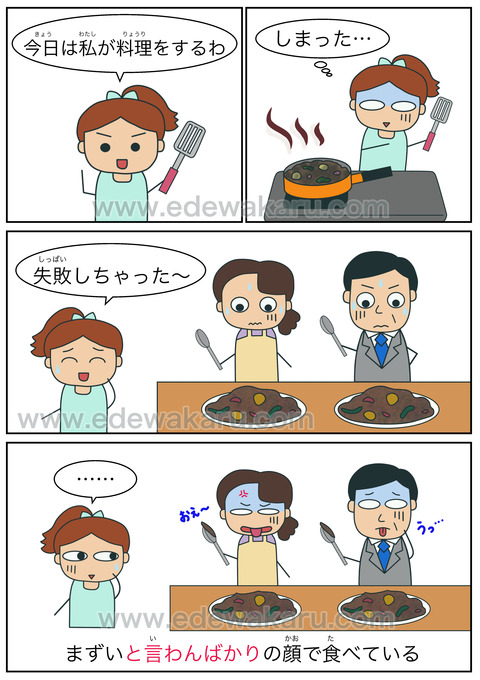
Meaning
Without actually saying 〜, with a face that seems to say 〜
Without actually saying 〜, in a manner that seems to say 〜
Without actually saying 〜, with an attitude that seems to say 〜
How to use it
Verb/adjective/noun [plain form] + と言わんばかりに
Explanation
「〜と言わんばかり」 is a sentence pattern meaning “Without actually saying 〜, with a face, manner, or attitude that seems to say 〜.” As in Example ①, when a noun follows, the form is 「〜と言わんばかりの + noun」. 😀 Also, 「〜とばかりに」 is an abbreviated form of 「〜と言わんばかりに」, so they can be used interchangeably. 😮
[Examples]
They’re making a face as if to say it tastes bad.
= They’re making a face as if to say it tastes bad.
When I get home, my dog runs up to me as if to say “Welcome home.”
= It runs up to me as if to say “Welcome home.”
「〜と言わんばかり・〜とばかり」 are formal expressions, so they are used mostly in writing. People taking N1 should learn 「〜んばかり」 together with them. 😉
In context 5 examples
まずいと言わんばかりの顔をして食べている
→実際に「まずい」とは言っていないが、「まずい」と言いそうな顔をして食べているThey’re eating with a face as if to say, “This tastes bad.” → They aren’t actually saying “This tastes bad,” but they’re eating with a face that seems to say it.
うちの犬は、私が帰ると「おかえり」と言わんばかりに走ってくる
→実際に「おかえり」と言っていないが、「おかえり」と言いそうな様子で走ってくるWhen I get home, my dog runs up to me as if to say, “Welcome home.” → It doesn’t actually say “Welcome home,” but runs up to me in a manner that seems to say it.
遅刻をしたら、出て行けと言わんばかりににらまれた
→実際に「出て行け」と言っていないが、「出て行け」と言いそうな態度でにらまれたWhen I was late, I was glared at as if to say, “Get out.” → They didn’t actually say “Get out,” but glared at me with an attitude that seemed to say it.
失敗したのは彼女のせいだと言わんばかりの表情で、みんなが彼女を見ている
→みんなは「彼女のせいだ」と言っていないが、「彼女のせいだ」と言いそうな顔で彼女を見ているEveryone is looking at her with an expression as if to say that the failure was her fault. → They aren’t saying “It was her fault,” but they’re looking at her with a face that seems to say it.
彼は、こんな問題は簡単だと言わんばかりに、どんどん問題を解いていく
→実際に「簡単だ」と言っていないが、「簡単だ」と言いそうな様子でどんどん問題を解いていくHe keeps solving problem after problem as if to say, “A problem like this is easy.” → He isn’t actually saying “It’s easy,” but he keeps solving problem after problem in a manner that seems to say it.
Read the original source text
Meaning
実際には〜と言っていないが、〜と言いそうな顔で〜
実際には〜と言っていないが、〜と言いそうな様子で〜
実際には〜と言っていないが、〜と言いそうな態度で〜
How to use it
動詞・形容詞・名詞[普通形]+と言わんばかりに
Explanation
「〜と言わんばかり」は「実際は〜と言っていないが、〜と言いそうな顔・様子・態度で〜」という意味を表す文型です。例文①のように、後ろに名詞がくる場合は
「〜と言わんばかりの+名詞」
になります😀また「〜とばかりに」は「〜と言わんばかりに」の省略形(しょうりゃくけい)ですので、チェンジすることができます😮
[例]
まずい
と言わんばかり
の顔をしている
=まずい
とばかり
の顔をしている
うちの犬は、私が帰ると「おかえり」
と言わんばかり
に走ってくる
=「おかえり」
とばかり
に走ってくる
「〜と言わんばかり・〜とばかり」はかたい言い方ですので、ほとんど
書き言葉
として使われます。N1を受ける人は「〜んばかり」も一緒に覚えておくといいと思います😉
くらべてわかる日本語表現文型辞典
Meaning
Meaning 1: A feeling or thought, A, comes through in B’s gestures. B as if to say A.
Meaning 2: A indicates the cry or the degree of exertion when performing B.
How to use it
AとばかりにB
Connection 1:
[Noun—∅] とばかりに
[Sentence] とばかりに
Connection 2:
[Exclamation] とばかりに
Explanation
[Comparison 1]
“AんばかりにB” (Meanings 1 and 2, p. 348)
Notes
[Note 1]
・“AとばかりにB” is an abbreviated form of “Aと言わんばかりにB” and means “in a manner as if saying A.”
[Note 2]
・This cry may sometimes be actually uttered, but it is mainly used to describe how something is done. It is a set expression and combines only with certain fixed cries.
In context 8 examples
行くなとばかりに、立ちはだかった。
He blocked the way as if to say, “Don’t go.”
そんな話は聞きたくないとばかりに、耳をふさいだ。
She covered her ears as if to say, “I don’t want to hear any more about that.”
妻は早く起きろとばかりに、掃除機をかけはじめた。
As if to say, “Get up already,” his wife started vacuuming.
先生が部屋を出ると、学生たちはチャンスとばかりに騒ぎはじめた。
As soon as the teacher left the room, the students started making noise as if they’d been given their chance.
「えいっ」とばかりに、切りつけた。
He slashed at them with a cry of “Hiyah!”
それっとばかりに、飛びかかった。
He pounced as if to say, “Now!”
やあっ!とばかりに、投げつけた。
He hurled it as if to shout, “Yah!”
ここぞとばかりに、自己PRをした。
She promoted herself as if to say, “This is my moment.”
Read the original source text
Meaning
意味1:Aという感情、思っていることがBの身振りに出る。AというようにB。
意味2:Bを行うときの掛け声や力の入り具合をAで示す。
How to use it
AとばかりにB
接続1:
[名詞-∅]とばかりに
[文]とばかりに
接続2:
[掛け声]とばかりに
Explanation
【対比1】
「AんばかりにB」(意味1,2 P.348)
Notes
【注意1】
・「AとばかりにB」は「Aと言わんばかりにB」の略であり、Aと言うような様子でという意味である。
【注意2】
・この掛け声は実際に発話される場合もあるが、主に様子を表したい場合に用いる。慣用的な表現で決まった掛け声としか結びつかない。
毎日のんびり日本語教師
How to use it
Quoted phrase + とばかりに
Quoted phrase + と言わんばかりに
Explanation
This attaches to a quoted phrase and expresses that the following action is carried out to such an extent that it is as if the phrase were being said.
Depending on the quoted phrase, it can also mean doing something as though thinking, “Now's my chance.” A representative idiomatic expression is 「ここぞとばかりに」.
Notes
Similar grammar: 「~如き/如く/如し(ごとき/ごとく/ごとし)」
The 「ばかり」 series
In context 8 examples
彼の登場で、待ってましたとばかりに大きな拍手が起こった。
When he appeared, there was a loud round of applause, as if to say, “We've been waiting for you!”
あの人に恋人が居ないことを知り、ここぞとばかりに告白した。
When I found out that person didn't have a partner, I confessed my feelings as if seizing the perfect opportunity.
早く来いと言わんばかりにこちらに向かって大きく手を振っている。
They're waving their hand broadly toward me as if to say, “Hurry up and come here!”
お前が悪いとばかりに指を指され怒られた。
He pointed at me and scolded me as if to say, “You're the one at fault.”
ここだとばかりにスマッシュを放った。
I smashed the ball as if to say, “This is the spot!”
今がチャンスだとばかりに攻めかかる。
They launch an attack as if thinking, “Now's our chance!”
もう話したくもないとばかりの形相で立ち去っていった。
He walked away with an expression that practically said, “I don't even want to talk anymore.”
カッコいいだろうとばかりに腕時計を自慢してくる。
He keeps bragging about his wristwatch as if to say, “Pretty cool, right?”
Read the original source text
How to use it
発話文+とばかりに
発話文+と言わんばかりに
Explanation
発話文に接続して、そう言うくらいの程度で後項の動作が行われることを表します。
接続する発話文によっては、「今がチャンスだと思い~する」という意味に変わったりもします。その代表的な慣用表現に「ここぞとばかりに」があります。
Notes
似ている文法「~如き/如く/如し(ごとき/ごとく/ごとし)」
「ばかり」シリーズ