AIUEO JLPT Grammar
Meaning
「〜てちょうだい」is a casual request or plea, typically used by women or children, often in informal conversations with family, close friends, or peers. Similar to "give me …” in English.
How to use it
Verb て-form + ちょうだい
In context 5 examples
お皿を洗ってちょうだい。
Please wash the dishes.
薬を飲んでちょうだい。
Please take your medicine.
写真を撮ってちょうだい。
Please take a picture.
鼻をかんでちょうだい。
Please blow your nose.
ゴミを捨ててちょうだい。
Please take out the trash.
Read the original source text
Meaning
「〜てちょうだい」is a casual request or plea, typically used by women or children, often in informal conversations with family, close friends, or peers. Similar to "give me …” in English.
How to use it
動詞て形+ちょうだい
Explanation · 日本語
「〜てちょうだい」は、カジュアルな依頼やお願いを表す表現で、主に女性や子供が使います。親しい人や家族、友人などとの会話で使用されます。
絵でわかる日本語
Meaning
Please ~.
Could you ~?
How to use it
Verb [て-form] + ちょうだい
Explanation
“〜てちょうだい” is one of the expressions used to make requests, and it is a pattern used by women. 😊 It is used with almost the same meaning as “〜てください,” which you studied at the beginner level, so using it with someone of higher status is very rude. 😨 In most cases, it is used between people such as “mother → child,” “boss → subordinate,” or “senior → junior.”
I think you’ll have many chances to hear it in dramas and anime, so it may be good to learn it. 😉
In context 4 examples
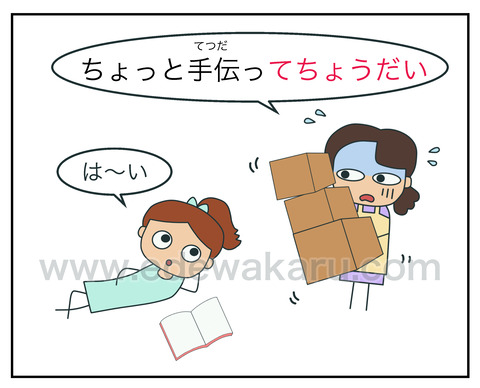
母:ちょっと手伝ってちょうだい→ちょっと手伝っててくれる?娘:は〜い
Mother: Help me for a moment, please. →Could you help me for a moment? Daughter: Okaaay.
母:買い物に行ってくるから妹を見ていてちょうだいね→妹を見ていてね息子:100円くれたら見ていてあげるよ〜
Mother: I’m going shopping, so please keep an eye on your little sister. →Keep an eye on your little sister, okay? Son: If you give me ¥100, I’ll watch her for you~
上司:これ、コピーしてきてちょうだい
→コピーしてきてくれる?部下:はいBoss: Make copies of this and bring them back, please. →Could you make copies and bring them back? Subordinate: Yes.
妻:帰りに牛乳を買ってきてちょうだい
→牛乳を買ってきて夫:OKWife: Please buy some milk on your way home. →Buy some milk on your way home. Husband: OK.
Read the original source text
Meaning
〜てください
〜てくれますか?
How to use it
動詞[て形]+ちょうだい
Explanation
「〜てちょうだい」は依頼表現の1つで、女性が使う文型です
😊これは、初級で勉強した「〜てください」とほとんど同じ意味で使われますので、
目上の人に使うととても失礼になります
😨ほとんどの場合は「母→子供」「上司→部下」「先輩→後輩」などの間で使われます。
ドラマやアニメで聞く機会がたくさんあると思いますので、覚えておくといいと思いますよ😉
日本語文型辞典
Meaning
Basic information: V-てちょうだい. Used to ask someone to do something. It is usually said by women or children to someone close and familiar. It is not a rough expression, but it is not used in formal situations. Examples: ① Nobuko, come over here for a moment. ② She said, “Kazuo, come and take a look,” and led me over to the window. ③ My mother said to me, “Please, stop riding around on your motorcycle.”
Read the original source text
Meaning
基本情報V-てちょうだい説明相手に何かするように依頼するのに用いる。女性、子供が身近な、現しい相手に言うのが普通。ぞんざいな表現ではないが、フォーマルな場面では使わない。例文① 伸子さん、ちょっとここへ来てちょうだい。② 彼女は「和雄さん、ちょっと見てちょうだい」と言って、わたしを窓のところへ連れて行った。③ 「お願いだから、オートバイを乗り回すのはやめてちょうだい」と母に言われた。
日本語文型辞典 英語版
Meaning
【てちょうだい】[V-てちょうだい]
Used to make a request of someone. Usually used by women or children to people with whom they have a close relationship. Although it is not a rough or impolite expression, it is not used in formal situations.
In context 3 examples
伸子さん、ちょっとここへ来てちょうだい。
Nobuko-san, come here for a minute, OK?
彼女は「和雄さん、ちょっと見てちょうだい」と言って、わたしを窓のところへ連れて行った。
She said, “Kazuo-san, please just take a look,” and led me over to the window.
「お願いだから、オートバイを乗り回すのはやめてちょうだい」と母に言われた。
My mother told me, “I just want you to stop riding around on your motorcycle.”
NINJAL 日本語文型データベース
Meaning
Used when asking or instructing someone to do something. It can express greater familiarity than “〜てください.”
How to use it
Vてちょうだい
Notes
It is used mainly by someone in a higher position when speaking to someone in a lower position. Women use it more often than men. It is especially common in everyday conversation among people who are close, such as family members.
In context 5 examples
親「ちょっと静かにしてちょうだい。電話の声が聞こえないから」
Parent: “Please be quiet for a moment. I can’t hear the person on the phone.”
親「お母さんちょっとトイレに行ってくるから、ここで待っててちょうだい。ね、わかった?」
Parent: “Mom’s just going to the bathroom, so wait here for me, okay? You understand?”
親「私たち親の前では本当のことを話してちょうだい。何があってもあなたの味方だから」
Parent: “Tell us the truth, your parents. No matter what happens, we’re on your side.”
母「ねえ、荷物を車に乗せるから、ちょっと手伝ってちょうだい」娘「今テレビ見てるから、あとで」
Mother: “Hey, I’m going to put the luggage in the car, so give me a hand for a moment.” Daughter: “I’m watching TV now. Later.”
社長「今から取引先に行かないといけないから、すぐに車を用意してちょうだい」
President: “I have to go to a client’s office now, so get a car ready right away.”
Read the original source text
Meaning
相手に何かするように、頼んだり、指示するときに使います。「〜てください」より親しさを表すことができます。
How to use it
Vてちょうだい
Notes
主に、立場が上の人が下の人に対して使います。男性より女性のほうがよく使います。特に身内などの親しい間柄の場合は、日常的によく使います。