絵でわかる日本語
Usage 1
Read this source entry ↗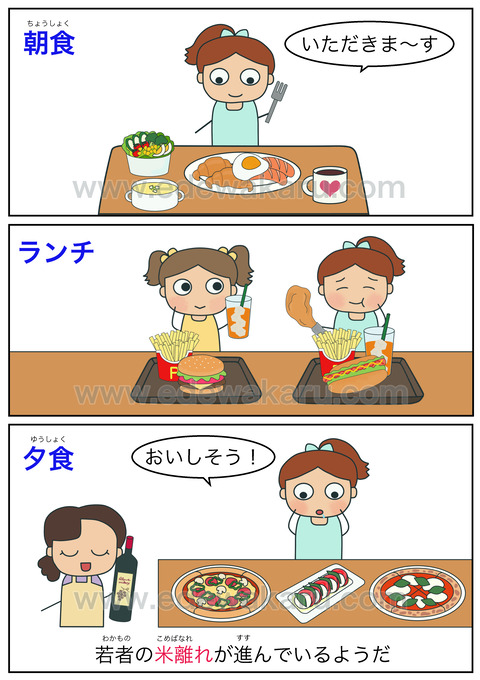
Meaning
To stop doing …
To stop using …
How to use it
Noun[dictionary form]+離れ
Explanation
“〜離れ” is a sentence pattern that expresses losing interest or concern, and is used to mean “to stop doing …” or “to stop using ….” It is used when something that many people used to do or use is no longer done or used. Be careful: when using it as a verb, the form is “〇〇離れする,” not “〇〇離れる.”
[Commonly used “〜離れ” expressions]
・
テレビ
離れ
・
米
離れ(
お米
離れ・
ごはん
離れ)
・
車
離れ
・
活字
離れ
・
映画
離れ
・
政治
離れ
・
選挙
離れ
・
新聞
離れ
・
旅行
離れ(overseas travel disengagement)
・
お酒
離れ(beer disengagement), etc.
Learn some commonly used “〜離れ” expressions. 😊
【Related sentence patterns】
In context 4 examples
若者の米離れが進んでいるようだ
→若者がお米を食べなくなってきているようだIt seems young people are increasingly eating less rice. →It seems young people are starting to eat less rice.
妻:なんでも、最近の子はテレビを見ないそうよ夫:そうだ…テレビ離れが進む一方だな
→テレビを見なくなる人が多くなる一方だなWife: I hear that kids these days don’t watch TV. Husband: That’s right… More and more people are turning away from TV. →More and more people are stopping watching TV.
お金がかかるからか、車離れする人が増えている
→車に乗らなくなる人が増えているPerhaps because it costs money, more people are giving up cars. →More people are stopping driving cars.
若い人の選挙離れは深刻だそうだ
→若い人が選挙に行かなくなったことは深刻な問題だApparently, young people’s disengagement from elections is a serious problem. →It is a serious problem that young people have stopped voting.
Read the original source text
Meaning
〜しなくなる
〜を使わなくなる
How to use it
名詞[辞書形]+離れ
Explanation
「〜離れ」は興味や関心がなくなってしまうことを表す文型で、「〜しなくなる」「〜を使わなくなる」という意味で使われます。今まではたくさんの人がやったり使ったりしていたものが使われなくなったりする場合に使用されます。動詞として使う場合は「〇〇離れる」ではなく、「〇〇離れする」になりますので気をつけましょう。
[よく使われる「〜離れ」]
・
テレビ
離れ
・
米
離れ(
お米
離れ・
ごはん
離れ)
・
車
離れ
・
活字
離れ
・
映画
離れ
・
政治
離れ
・
選挙
離れ
・
新聞
離れ
・
旅行
離れ(海外旅行離れ)
・
お酒
離れ(ビール離れ) など
よく使われる「〜離れ」をいくつか覚えておきましょう😊
【関連文型】
Usage 2
Read this source entry ↗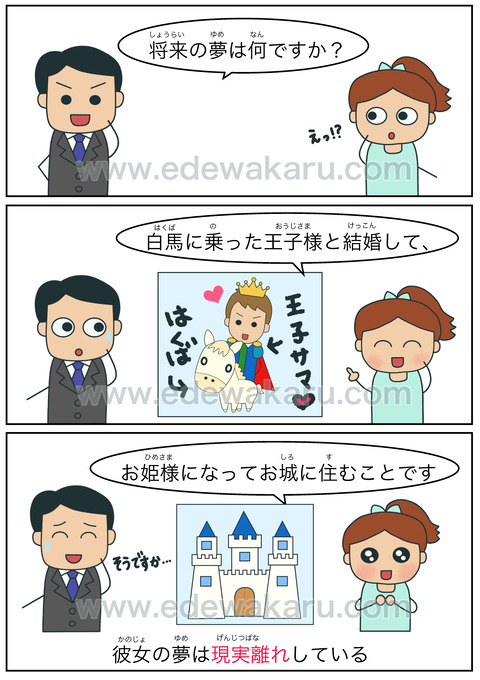
Meaning
Very different from …
Far removed from …
How to use it
Noun[dictionary form]+離れ
Explanation
“A離れ” is a sentence pattern meaning “very different from the typical A” or “far removed from A.” It is read “〜ばなれ.” It is used when you want to say that something is completely different in degree from “A.”
It is used in the forms “〜離れしている” and “〜離れした+noun.” The words used with it are mostly fixed, so learn some of them.
[Commonly used words]
・
現実
離れ
・
人間
離れ
・
日本人
離れ
・
新人
離れ
・
素人
離れ
・
世間
離れ
・
浮世
離れ, etc.
“〜離れ” has other usages as well, so review them. 😊
【Related sentence patterns】
In context 5 examples
彼女の夢は現実離れしている
→現実からかけ離れている(現実的ではない)Her dream is far removed from reality. →It is far removed from reality (unrealistic).
あの歌手は新人離れした歌唱力(かしょうりょく)で、みんなを感動させた
→普通の新人とは全然違うすばらしい歌唱力で感動させたThat singer moved everyone with a singing ability that was beyond that of a typical newcomer. →They moved everyone with an outstanding singing ability completely unlike that of an ordinary newcomer.
彼が持つ技術は人間離れしている
→彼は普通の人にはできない、すばらしい技術を持っているHis skills are superhuman. →He has amazing skills that ordinary people could not manage.
彼女は日本人離れしたスタイルで、モデルとして活躍している
→一般的な日本人とは違うスタイルで、活躍しているShe is thriving as a model with a figure unlike that of a typical Japanese person. →She is thriving with a figure that differs from that of a typical Japanese person.
社長の世間離れした金銭感覚(きんせんかんかく)は理解できない…
→一般人とは全然違う金銭感覚は理解できないI can’t understand the president’s out-of-touch sense of money… →I can’t understand his sense of money, which is completely different from that of ordinary people.
Read the original source text
Meaning
〜とすごく違う
〜からかけ離れている
How to use it
名詞[辞書形]+離れ
Explanation
「A離れ」は「一般的なAとすごく違う」「Aからかけ離れている」という意味の文型です。読み方は「〜ばなれ」です。「A」 の程度と全然違うと言いたい時に使われます。
「〜離れしている」「〜離れした+名詞」
の形で使われます。使われる単語はほとんど決まっていますので、いくつか覚えておきましょう。
[よく使われる単語]
・
現実
離れ
・
人間
離れ
・
日本人
離れ
・
新人
離れ
・
素人
離れ
・
世間
離れ
・
浮世
離れ など
「〜離れ」には他にも用法がありますので、復習をしておきましょう😊
【関連文型】
Usage 3
Read this source entry ↗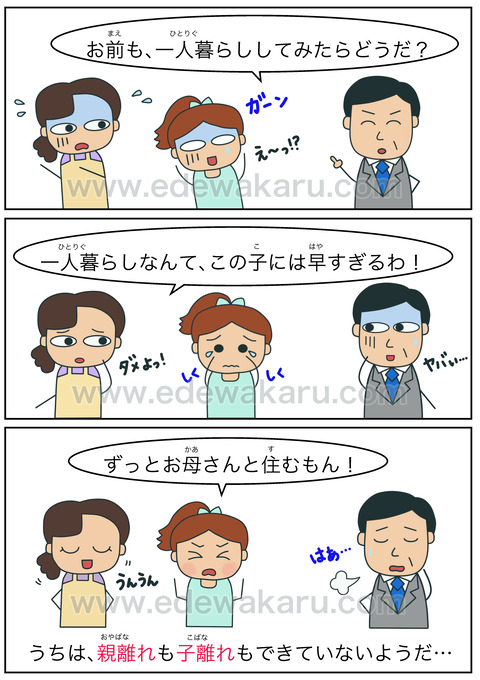
Meaning
To become independent by moving away from …
How to use it
Noun[dictionary form]+離れ
Explanation
“〜離れ” is a sentence pattern meaning “to become independent by moving away from ~” or “to become independent without relying on ~.” The words it is used with are fixed, so I think it’s best to memorize each as a single word. It is read as “〜banare,” and when used as a verb, it becomes “〜離れする.”
[Words it is used with]
・親離れ (becoming independent from one’s parents)
・子離れ (letting one’s child become independent)
・乳離れ (weaning; becoming independent)
・巣離れ (leaving the nest; becoming independent)
[Meanings]
親離れ
→A child moving away from their parents and becoming independent
子離れ
→Supporting a child as they become independent
乳離れ
→①A baby growing up and stopping breastfeeding
②A child moving away from their parents and becoming independent
巣離れ
→①A baby bird growing up and leaving the nest
②A child growing up, moving away from their parents, and becoming independent
“〜離れ” has other uses too, so let’s review them 😊
[Related grammar patterns]
Read the original source text
Meaning
〜から離れて独立する
How to use it
名詞[辞書形]+離れ
Explanation
「〜離れ」は「〜から離れて自立する」「〜に依存しないで、独立する」という意味の文型です。使われる単語は決まっていますので、1つの単語として覚えておくといいと思います。また読み方は「〜ばなれ」で、動詞として使う場合は「〜離れする」になります。
[使われる単語]
・
親離れ
・
子離れ
・
乳離れ
・
巣離れ
[意味]
親離れ
→子供が親から離れて自立すること
子離れ
→子供が自立することを応援すること
乳離れ
→①赤ちゃんが成長して母乳を飲まなくなること
②子供が親から離れて自立すること
巣離れ
→①ひな鳥が成長して、巣から出ていくこと
②子供が成長して、親から離れて自立すること
「〜離れ」には他にも用法がありますので復習をしておきましょう😊
【関連文型】
毎日のんびり日本語教師
How to use it
Noun + 離れ(ばなれ)
Noun denoting a person + の + noun + 離れ
Explanation
It has three meanings.
① Losing interest or concern
It describes how people have lost interest in or concern for something they used to do or be familiar with, and have stopped doing it. The noun that connects with 「離れ」 has a case relationship marked by the particle 「から」 or 「が」. See sentences (1)–(7).
「から」-case relationship
車離れ, テレビ離れ, 政治離れ, 映画離れ(映画館離れ), ビール離れ, 選挙離れ, 活字離れ, 消費離れ…
「が」-case relationship
客離れ, ファン離れ, 支持者離れ, 消費者離れ…
② Exceeding the norm
Being beyond the usual degree. In this meaning, it takes the forms 「~している」 and 「~した+noun」. See sentences (8)–(12).
人間離れしている, 浮世離れしている, 世間離れしている, 日本人離れしている, 現実離れしている, 常人離れしている, 新人離れしている…
③ Becoming independent
No longer needing to depend on someone, and separating to become independent. See sentences (13) and (14).
子離れ, 親離れ, 乳離れ(ちばなれ)/おっぱい離れ…
The original reading is 「離れ(はなれ)」, but rendaku changes it to 「ばなれ」.
「肉離れ」 (“muscle strain”) is a fixed expression unrelated to the three uses above.
Notes
Nothing in particular.
In context 14 examples
維持費も高く、税金も安くないせいで若者の車離れが進んでいる。
Because maintenance costs are high and taxes aren’t low either, young people are increasingly turning away from cars.
youtube等の動画共有サイトの隆盛により、若者のテレビ離れがより進んでいる。(由于Youtube等共享网站的兴起,导致年轻人对电视失去了兴趣。)
With the rise of video-sharing sites such as YouTube, young people are turning away from television even more. (The growth of sharing sites such as YouTube has led young people to lose interest in television.)
若年層の投票率が低く、若者の政治離れが深刻化している。
Turnout among young people is low, and their disengagement from politics is becoming more serious.
NetflixやHulu等の動画配信サービスが普及してから、人々の映画館離れが進んでいる。(Netflix和Hulu等视频上传功能普及以来,人们对电影院渐渐失去了兴趣。)
Since video streaming services such as Netflix and Hulu became widespread, people have increasingly been turning away from movie theaters. (Since video upload services such as Netflix and Hulu became widespread, people have gradually lost interest in movie theaters.)
私の周囲でもビールを飲まない、いわゆる「ビール離れ」した友達が多い。
Many of my friends, too, don’t drink beer; they’re what you might call part of the “beer exodus.”
日本では芸能人などが政治的なメッセージを発信しない傾向があるため、それが若者の選挙離れの一因になっているとも言われている。
In Japan, entertainers and others tend not to express political messages, and this is said to be one reason young people are turning away from voting.
近年、若者の活字離れが叫ばれ、文章が上手くかけない大人が急増しているらしい。
In recent years, people have been sounding the alarm about young people turning away from printed text, and apparently the number of adults who cannot write well is rapidly increasing.
彼女の美しさは人間離れしている。(她的美貌超凡脱俗。)
Her beauty is otherworldly. (Her beauty is beyond the ordinary.)
数千万円もする車を何台も買ったり、彼の金銭感覚は世間離れしている。
He buys several cars costing tens of millions of yen each; his sense of money is completely out of touch with the world.
彼女は新人離れした演技力で一躍芸能界の表舞台に躍り出た。(她作为新人却以超凡的演技在演艺界舞台上大显身手。)
With acting ability far beyond what one would expect of a newcomer, she burst onto center stage in the entertainment world. (As a newcomer, she made a splash on the entertainment scene with extraordinary acting.)
A選手の特徴は、何と言っても日本人離れしたその体格だ。
What sets Athlete A apart more than anything is that physique, which is unlike that of an ordinary Japanese person.
彼らの主張は現実離れしている。
Their claims are detached from reality.
子どももいつか親離れしなければいけないが、親も子離れしなければならない。
Children will eventually have to become independent of their parents, but parents must also learn to let go of their children.
長男は3歳近くまで乳離れ出来なかった。
My eldest son couldn’t be weaned until he was nearly three.
Read the original source text
How to use it
名詞+離れ(ばなれ)
人物を表す名詞+の+名詞+離れ
Explanation
意味は3つあります。
①興味・関心を失う
以前は多くの人がやっていたことや親しんでいたことが、今日では興味や関心が薄くなり、やらなくなってしまったことを表します。接続される名詞と「離れ」の間には、助詞「から」や「が」を用いた格関係があります。例文(1)~(7)。
カラ格の格関係
車離れ、テレビ離れ、政治離れ、映画離れ(映画館離れ)、ビール離れ、選挙離れ、活字離れ、消費離れ…
ガ格の格関係
客離れ、ファン離れ、支持者離れ、消費者離れ…
②程度の逸脱
その一般的な程度を逸脱していること。この意味の時は、「~している」「~した+名詞」の形を取ります。例文(8)~(12)。
人間離れしている、浮世離れしている、世間離れしている、日本人離れしている、現実離れしている、常人離れしている、新人離れしている…
③独立
依存する必要がなくなり、離れて独立すること。例文(13)(14)。
子離れ、親離れ、乳離れ(ちばなれ)/おっぱい離れ…
本来は「離れ(はなれ)」ですが、連濁を起こして「ばなれ」となります。
「肉離れ(肌肉拉伤)」は上記3つの用法とは関係のない固定表現です。
Notes
特になし
AIUEO JLPT Grammar
Meaning
「〜離れ」 expresses distancing from or losing interest in something. It emphasizes detachment or the decline of certain habits or trends.
How to use it
Noun + 離れ
In context 5 examples
若者の車離れが進んでいる。
Young people are increasingly moving away from owning cars.
テレビ離れが加速している。
The shift away from television is accelerating.
学生のスポーツ離れが問題になっている。
The distancing of students from sports has become a problem.
自然離れした生活はストレスを増やすことがある。
A life distanced from nature can sometimes increase stress.
最近の若者は現金離れが進んで、キャッシュレス決済を好んでいる。
Recently, young people are moving away from using cash and prefer cashless payments.
Read the original source text
Meaning
「〜離れ」 expresses distancing from or losing interest in something. It emphasizes detachment or the decline of certain habits or trends.
How to use it
名詞+離れ
Explanation · 日本語
「〜離れ」は、物事から距離を置くことや、関心が薄れることを表す表現です。特に、何かから離れることや、その習慣、傾向が衰退することを強調するときに使われます。