文法
Meaning
Without …, … cannot happen; used when you want to say that unless the preceding condition is met, it is difficult for the following clause to hold.
How to use it
V (dictionary form) + こと + なくしては
N + なくしては
Notes
The は in 「なくしては」 may be omitted.
In context 8 examples
努力なくして、成功などあり得ない。
Without effort, success is impossible.
この問題の解決なくして、我が社の未来はない。
Without solving this problem, our company has no future.
私の親はとても厳しく、親の了承なくして結婚することは許されない。
My parents are very strict, and I am not allowed to marry without their approval.
私は彼なくしては生きていけない。
I can't live without him.
親の愛なくしては、子は十分に育たない。
Without parental love, a child cannot grow up properly.
パスポートなくしては、海外へは行けません。
Without a passport, you can't travel abroad.
別れた夫の援助なくしては、一人で子供育てることなんてできない。
Without support from my ex-husband, I can't raise the children on my own.
私は辞書なくしては、日本語の新聞が読めません。
Without a dictionary, I can't read Japanese newspapers.
Read the original source text
Meaning
〜がなければ・・・ない前件が成立しなければ、後件が成立しにくいと言いたい時に使う。
How to use it
V(辞書形)こと + なくしては
N + なくしては
Notes
「なくしては」の「は」は省略可能
DoJG 日本語文法辞典(全集)
Meaning
Without; if it were not for ~
How to use it
Noun | なくして(は) | |
| 協力なくして(は) | Without cooperation |
Explanation
なくして(は)A compound particle meaning "without something".
In context 9 examples
努力なくして(は)この事業はできない。
Without effort we won't be able to finish this undertaking.
山川教授なくしては今の私は存在しなかったであろう。
Without Professor Yamakawa, I wouldn't be what I am now.
コンピュータなくして現在の生活は不可能だ。
Without computers, our current lifestyle would be impossible.
ITの活用なくして企業の成長は望めません。
If we don't make good use of IT, we can't expect our business to grow.
日本の平和と繁栄は、世界の平和と安定なくしてはあり得ない。
Peace and prosperity in Japan is not possible without peace and stability throughout the world.
あらゆる生物は水なくして生きていけない。
No creature can live without water.
コミュニケーションなくしては、人間が関与する一切の活動は成立し得ない。
Without communication, no human activity could occur.
関係者の密接な共同作業なくしてはこの計画の実現は不可能であったろう。
If it had not been for the close cooperation of the people involved in this project, it would have been impossible to make it a reality.
沿道の人たちの声援なくしては、このマラソンは完走できなかったでしょう。
Without encouragement from the roadside people, I couldn't have finished running this marathon.
絵でわかる日本語
Meaning
Without 〜, 〜 cannot happen.
Without 〜, 〜 cannot be done.
How to use it
Verb [dictionary form] + ことなくしては
Noun [dictionary form] + なくしては
Explanation
“AなくしてはBない” is a pattern meaning “without A, B cannot happen” or “without A, B cannot be done.” It is used to say that “if A were absent, B would not be possible,” emphasizing that A is very important. The “は” in “〜なくしては” can sometimes be omitted. When a verb is used as “A,” the form is:
“V dictionary form + ことなくしては〜ない.”
[Example]
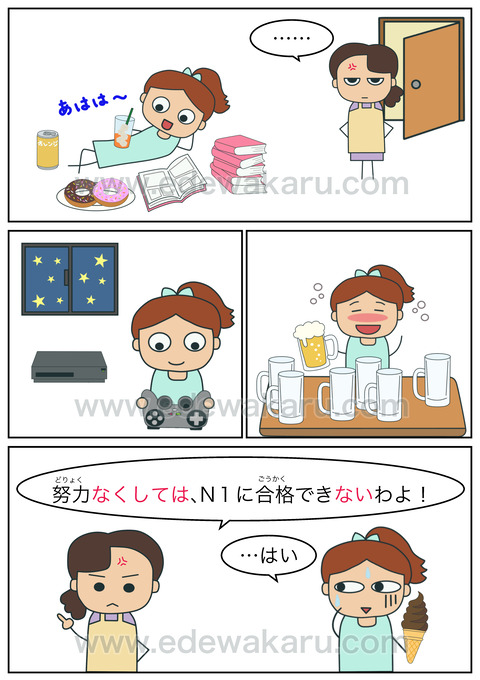
Without making an effort, you won’t pass N1.
“〜なくしては〜ない” is a more formal expression than “〜なしでは〜ない・〜なしには〜ない.” Let’s review “〜なしでは〜ない・〜なしには〜ない” 😊
In context 5 examples
努力なくしては、N1には合格できないわよ
→努力がなければ、N1には合格できないわよWithout hard work, you won’t pass N1. →If you don’t work hard, you won’t pass N1.
みんなの協力なくしては、成功できなかっただろう
→みんなの協力がなければ、成功はできなかっただろうWe probably couldn’t have succeeded without everyone’s cooperation. →We probably wouldn’t have succeeded without everyone’s cooperation.
親の援助なくしては大学には行けない
→親の援助がなければ大学には行けないWithout my parents’ support, I can’t go to university. →I can’t go to university without my parents’ support.
話し合いなくしては、問題は解決しないと思います
→話し合いがなければ、問題は解決しないと思いますI don’t think the problem can be solved without discussion. →I don’t think the problem can be solved without discussion.
彼なくしては、今回の試合には勝てなかっただろう
→彼がいなければ、今回の試合には勝てなかっただろうWe probably couldn’t have won this match without him. →We probably wouldn’t have won this match without him.
Read the original source text
Meaning
〜がなければ〜ない
〜がなければ〜できない
How to use it
動詞[辞書形]+ことなくしては
名詞[辞書形]+なくしては
Explanation
「AなくしてはBない」は「AがなければBない」「AがなければBできない」という意味の文型です。これは「Aがなかったら、Bは成立しない」と言いたい時に使う文型で、「A」がとても重要だということを強調します。「〜なくしては」の「は」は、省略されることもあります。「A」に動詞が入る場合は
「V辞+ことなくしては〜ない」
になります。
[例]
努力する
ことなくしては、N1に合格できないわよ
「〜なくしては〜ない」は「〜なしでは〜ない・〜なしには〜ない」よりかたい言い方です。「〜なしでは〜ない・〜なしには〜ない」の復習をしておきましょう😊
日本語文型辞典
Meaning
Basic information
Nなくしては
Attached to a noun, this means “if something were not there.” It is used to say that doing something would be difficult without it. Depending on the context, 「は」 may be omitted. ⑤ is a set expression meaning “If there were no love, what meaning would life have?” This is a written expression; 「Nがなかったら」 is used in spoken language.
Examples
① Without my parents’ support, it would be very difficult to live on my own.
② Without unconditional love, raising children is nothing but painful.
③ Without her many years of effort, she probably could not have won a place as a representative at the national tournament.
④ Without frank exchanges of opinions between the parties involved, we have no choice but to say that the road to resolving the problem is long.
⑤ What is life without love?
Read the original source text
Meaning
基本情報Nなくしては説明名詞に付いて、「あるものがなかったら」という意味を表す。それがなかったら何かすることは難しいだろうということを述べるのに使う。文脈によって「は」は省略できる。⑤は慣用句的表現で「愛がなかったら人生に何の意味があるというのか」という意味。書きことば的表現で、話しことばでは「Nがなかったら」を使う。例文① 親の援助なくしては、とても一人で生活できない。② 無償の愛情なくしては、子育ては苦痛でしかない。③ 彼女のこの長年の努力なくしては、全国大会の代表の座を勝ち取ることはできなかっただろう。④ 当事者同士の率直な意見交換なくしては、問題解決への道のりは遠いと言わざるを得ない。⑤ 愛なくして何の人生か。
日本語文型辞典 英語版
Meaning
【なくしては】[Nなくしては]
Means “if N did not exist.” Expresses that, without N, something is difficult to do. Depending on the context, the particle は may be omitted.
(5)
is an idiomatic expression that means “if there is no love, then what is the meaning of life?” なくしては is a formal, written expression, and in spoken Japanese Nがなかったら is used instead.
In context 5 examples
親の援助なくしてはとても一人で生活できない。
It’s impossible to live on my own without my parents’ support.
無償の愛情なくしては子育ては苦痛でしかない。
Without unconditional love, raising children is nothing but pain.
彼女のこの長年の努力なくしては全国大会の代表の座を勝ち取ることはできなかっただろう。
If it had not been for her many years of effort, she wouldn’t have been able to win the position of national conference representative.
当事者同士の率直な意見交換なくしては問題解決への道のりは遠いと言わざるを得ない。
I have to say that the problem is far from being solved if the parties concerned will not honestly exchange views with each other.
愛なくして何の人生か。
What is life without love?
日本語NET JLPT文法解説まとめ
Meaning
“Without ... there is no ...”
Used when you want to say that unless the preceding clause is fulfilled, the following clause is unlikely to be fulfilled.
How to use it
V (dictionary form) + こと + なくしては
N + なくしては
Explanation
“Without 〜, there is no ...”
The は in “なくしては” may be omitted.
In context 8 examples
努力なくして、成功などあり得ない。
Without effort, success is impossible.
この問題の解決なくして、我が社の未来はない。
Without solving this problem, our company has no future.
私の親はとても厳しく、親の了承なくして結婚することは許されない。
My parents are very strict, and I am not allowed to marry without their approval.
私は彼なくしては生きていけない。
I can't live without him.
親の愛なくしては、子は十分に育たない。
Without parental love, a child cannot grow up properly.
パスポートなくしては、海外へは行けません。
Without a passport, you can't travel abroad.
別れた夫の援助なくしては、一人で子供育てることなんてできない。
Without support from my ex-husband, I can't raise the children on my own.
私は辞書なくしては、日本語の新聞が読めません。
Without a dictionary, I can't read Japanese newspapers.
Read the original source text
Meaning
"〜がなければ・・・ない"
前件が成立しなければ、後件が成立しにくいと言いたい時に使う。
How to use it
V(辞書形)こと + なくしては
N + なくしては
Explanation
"Without 〜, there is no ..."
「なくしては」の「は」は省略可能
NINJAL 日本語文型データベース
Meaning
Used to emphasize that something cannot be achieved without “~.” It means that “~” is absolutely necessary for something to be achieved.
How to use it
Nなくしては
Notes
“~” often takes an abstract noun expressing something desirable, such as 「愛・努力・援助」 (love, effort, support). What follows 「〜なくしては」 is often a negative sentence or one expressing difficulty.
In context 5 examples
政治理念なくしては有能な政治家にはなれないのではないだろうか。
Without political ideals, one cannot become a capable politician, can one?
パンなくしては生きられないと人は言うが、人はパンだけで生きているわけではない。
People say that we cannot live without bread, but people do not live by bread alone.
国際間の相互理解なくしては、真のグローバリゼーションは不可能だろう。
Without mutual understanding between nations, true globalization would be impossible.
失敗なくしては成功も難しい。失敗から学んでこそ成功するのだ。
Without failure, success is difficult too. It is by learning from failure that we succeed.
今後、安定的な労働力を確保することなくしては経済成長は望めないだろう。
Going forward, economic growth cannot be expected without securing a stable workforce.
Read the original source text
Meaning
~がなければ、あることは実現不可能だと強調して言いたいときに使います。あることの実現のためには~が絶対必要だという意味で使います。
How to use it
Nなくしては
Notes
「~」には、「愛・努力・援助」など望ましいことを表す抽象名詞をよく使います。「〜なくしては」の後には、否定の文や困難を表す文がくることが多いです。
IMABI
Negative Patterns
Read this IMABI lesson ↗Explanation
More Negative Patterns: ~ないことには, ~なし・なき, ~なしで(は), ~なしに(は), ~なくして(は), ~ことなく, & 甲斐もなく
This lesson will introduce you to more patterns that utilize ~ない or derivations of it.
~ないことには(~ない)
AないことにはB means “if…don’t/in not…; unless”. So, if you don’t do A, you get stuck with B. B could be positive or negative depending on the outcome that you wish to express. It can be used with verbs, adjectives, or the copula, but don’t forget how to properly use ない! This pattern must be only used in declarative sentences.
品詞 接続 例
名詞 N+でないことには 人でないことには
形容詞 Adj → く-連用形 + ないことには 高くないことには
形容動詞 Adj + でないことには 精密でないことには
動詞 Adj → 未然形 + ないことには しないことには
1. 泳がないことには、海岸に行けなくなった。
In not swimming, I became unable to go to the beach.
2. 急がないことには、間に合わなくなる。
In not hurrying, you won’t make it in time.
3. 勝たないことには、試合しあいに負ける。
If you don’t win, you lose in the tournament.
4. がんばらないことには、今度の韓国語の試験に合格できないよ。
Unless you try hard, you won’t pass this next Korean exam.
Grammar Note: Do not confuse this with …ないことには where は is simply emphatic. The phrase discussed in this section is conjunctive in nature, whereas this is not.
5. 自分に関わりのないことには口を出すなよ。
Don’t interfere in things that don’t concern you!
~なし
無なし means “without” and is after nominal phrases. If なし for some reason is placed before a noun, it becomes 無き. There is more behind this form of ない. The problem lies with how to use ~なしに(は), ~なしで(は), and ~なくして(は). These phrases show that if something were not to happen, a certain event won’t be. These phrases show necessity, and there is a negative phrase in the next clause.
6. コーヒーなしに過ごせない。
I can’t go on without coffee.
7. 涙なしに語ることができない。(書き言葉的)
I can’t tell it without tears coming.
8. 国民の理解と協力なしには実行できない。(書き言葉)
We can’t act forth without the understanding and cooperation of the citizens.
9. 政府開発援助なしではこの革新的な医学研究は続けることができない。
Without government development aid, this groundbreaking medical research can’t continue.
10. しっかりと準備することなくしては成功できぬ。 (硬い書き言葉)
Without properly preparing, you can’t succeed.
11. 先生方のご指導なくして私の大学合格は有り得ませんでした。(とても丁寧; Useful expression)
Without the guidance of my teachers, my college success wouldn’t have been possible.
12. 政治家せいじかはテレプロンプター(原稿)なしで話せない。
Politicians can’t talk without a teleprompter.
13.百害ひゃくがいあって一利いちりなし。(Set phrase/proverb)
To do no good but a lot of harm.
14. 「憲法を改正することなくして、軍事大国になれない」と考える人が増えているそうだ。
It sounds that the number of people who think that without revising the constitution, [Japan] won’t be able to become a military power is growing.
Grammar Note: Also seen as ~ずして(は), ~なくして(は) is a more old-fashioned/archaic equivalent of ~なしに(は), but it can be used in plus and or negative situations.
~なしで(は) VS ~なしに(は)
Although both present a premise X, which makes Y possible, they are slightly different.
1. ~なしで(は) is used with a noun that shows a general condition, and the listener is told that there must be X. Thus, the speaker can use this when pointing out a ban or the need for evasion.
2. ~なしに(は) can’t be used directly towards the listener to get that person working. When these expressions are interchangeable, the former shows an individual cause whereas the latter shows a more obvious situation that is deemed to be evident and necessary. Thus, it is more suited for the written language.
15. スペイン語?無理いうなや。辞書なし{で・に}は、分からんわ。(ちょっと関西弁っぽい)
Spanish? Don’t be unreasonable. I can’t understand it without a dictionary.
16. 客商売だから、ネクタイなし{〇 で・X に}は、困るんだけども。(話し言葉)
Since it’s business (client-oriented), it’d be troubling without a tie.
17. 届け出なし{〇 に・△ で}外泊するのは、キャンプの規則に違反することになります。
Sleeping outdoors is now a violation of camp rules without notification.
18. ノックなしに(は)、ドアを開けないでください。
Don’t open the door without knocking.
Grammar Note: は in the last situation would make it fit well, but the message was probably written on the door rather than spoken. Had the sentence been spoken, with ノックしないで being more common, ~なしに would exemplary demonstrate consideration to the listener.
~ないことには~ない VS ~ことなしに(は)~ない VS ~ことなく
XないことにはYない shows that for the realization of Y, X is necessary. X can be a positive or negative situation. However, ~ことなしに(は)~ない and ~ことなく can only be used with verbs whereas the former pattern is also seen with nouns and adjectives. Furthermore, these latter expressions show that “for Y to realize, X is unavoidable”. So, it’s not positive.
19a. 努力どりょく{することなしには・しないことには}、成功はできない。
19b. 成功するためには、努力を避さけていることはできない。
You cannot succeed unless you put in effort.
20. 「憲法を変え{・ることなしには・ないことには}、軍事大国になれないと考える人が増えている」といわれますが、本当かどうかよく分かりませんね。
It’s said that the number of people that think that without changing the constitution, [Japan] won’t be able to come a military power is growing, but I don’t really know if that’s true.
21. 優しい人でないことには、お金があっても、結婚できませんよ。
You can’t get married even if you have money if you’re not a nice person.
Other things to keep in mind is that both ~ことなしに(は)~ない and ~ことなく are more likely to appear in the written language; however, the former is even more 硬かたい because it has the old なし in it. You do still see ~こと(も)なく in the spoken language, though, in which it has interchangeability with 連用形+もしないで.
22a. 多少のリスクを負わないことには、ビジネスなんかできないよ。とうてい避けられないもんだから。〇
22b. 多少のリスクを負う{ことなく・ことなしに}、ビジネスなんかできないよ。とうてい避けられないもんだから。X
Without taking some risk, you can’t do business. That’s because you can’t avoid it no matter what.23. 石に躓つまづいて転ころんだ子供が{泣くこともなく・泣きもしないで}、笑顔えがおで立ち上がったなんてびっくりしたよ。
I was surprised that the kid who tripped and fell on the rocks got up with a smile without even crying.
24. しょうことなく、メザキさんと並んで、いくら行っても太くもならないし細くもならない道を、長く歩いた。
With it not being helped, I went along with Mr. Mezaki, and we walked a long ways down the road, which no matter how much you go neither widens nor thins.
From 溺レる by 川上弘美.
Phrase Note: しょうことなく = しょうことなしに = やむを得ず.
25. ためらうことなく、消防士は燃えている家に入った。
The firefighters went into the burning house without hesitation.
26. 福田社長はしょうことなしに謝罪をした。
Company President Fukuda apologized with little choice.
27. 試験に合格することなしに、この会社には入れません。
It is not possible to get into this company without passing the exam.
甲斐(かい)もなく
甲斐かい means “avail” and 甲斐かいもなく, thus, means “to no avail/in vain”. Just as in English, it is not really casual.
28. 私たちは練習れんしゅうした甲斐かいもなく負けてしまった。
We lost despite practicing.
29. わざわざフランスから出かけてきた甲斐がありました。
It was worth our while to have come all the way from France.
30. 勉強した甲斐もなく落ちてしまいました。
I ended up failing to no avail of studying.
31. 働はたらき甲斐がい
Just the value of working
32. 年甲斐としがいもなく
Unbecoming to one’s age
In context 35 examples
泳がないことには、海岸に行けなくなった。
In not swimming, I became unable to go to the beach.
急がないことには、間に合わなくなる。
In not hurrying, you won’t make it in time.
勝たないことには、試合しあいに負ける。
If you don’t win, you lose in the tournament.
がんばらないことには、今度の韓国語の試験に合格できないよ。
Unless you try hard, you won’t pass this next Korean exam.
自分に関わりのないことには口を出すなよ。
Don’t interfere in things that don’t concern you!
コーヒーなしに過ごせない。
I can’t go on without coffee.
涙なしに語ることができない。(書き言葉的)
I can’t tell it without tears coming.
国民の理解と協力なしには実行できない。(書き言葉)
We can’t act forth without the understanding and cooperation of the citizens.
政府開発援助なしではこの革新的な医学研究は続けることができない。
Without government development aid, this groundbreaking medical research can’t continue.
しっかりと準備することなくしては成功できぬ。 (硬い書き言葉)
Without properly preparing, you can’t succeed.
先生方のご指導なくして私の大学合格は有り得ませんでした。(とても丁寧; Useful expression)
Without the guidance of my teachers, my college success wouldn’t have been possible.
政治家せいじかはテレプロンプター(原稿)なしで話せない。
Politicians can’t talk without a teleprompter.
百害ひゃくがいあって一利いちりなし。(Set phrase/proverb)
To do no good but a lot of harm.
「憲法を改正することなくして、軍事大国になれない」と考える人が増えているそうだ。
It sounds that the number of people who think that without revising the constitution, [Japan] won’t be able to become a military power is growing.
~なしで(は) is used with a noun that shows a general condition, and the listener is told that there must be X. Thus, the speaker can use this when pointing out a ban or the need for evasion.
Spanish? Don’t be unreasonable. I can’t understand it without a dictionary.
~なしに(は) can’t be used directly towards the listener to get that person working. When these expressions are interchangeable, the former shows an individual cause whereas the latter shows a more obvious situation that is deemed to be evident and necessary. Thus, it is more suited for the written language.
Spanish? Don’t be unreasonable. I can’t understand it without a dictionary.
スペイン語?無理いうなや。辞書なし{で・に}は、分からんわ。(ちょっと関西弁っぽい)
Spanish? Don’t be unreasonable. I can’t understand it without a dictionary.
客商売だから、ネクタイなし{〇 で・X に}は、困るんだけども。(話し言葉)
Since it’s business (client-oriented), it’d be troubling without a tie.
届け出なし{〇 に・△ で}外泊するのは、キャンプの規則に違反することになります。
Sleeping outdoors is now a violation of camp rules without notification.
ノックなしに(は)、ドアを開けないでください。
Don’t open the door without knocking.
努力どりょく{することなしには・しないことには}、成功はできない。
You cannot succeed unless you put in effort.
成功するためには、努力を避さけていることはできない。
You cannot succeed unless you put in effort.
「憲法を変え{・ることなしには・ないことには}、軍事大国になれないと考える人が増えている」といわれますが、本当かどうかよく分かりませんね。
It’s said that the number of people that think that without changing the constitution, [Japan] won’t be able to come a military power is growing, but I don’t really know if that’s true.
優しい人でないことには、お金があっても、結婚できませんよ。
You can’t get married even if you have money if you’re not a nice person.
多少のリスクを負わないことには、ビジネスなんかできないよ。とうてい避けられないもんだから。〇
Unless you take on some risk, you can’t do business. It’s something you simply can’t avoid. 〇
多少のリスクを負う{ことなく・ことなしに}、ビジネスなんかできないよ。とうてい避けられないもんだから。X
You can’t do business without taking on some risk. It’s something you simply can’t avoid. X
しょうことなく、メザキさんと並んで、いくら行っても太くもならないし細くもならない道を、長く歩いた。
With it not being helped, I went along with Mr. Mezaki, and we walked a long ways down the road, which no matter how much you go neither widens nor thins.
ためらうことなく、消防士は燃えている家に入った。
The firefighters went into the burning house without hesitation.
福田社長はしょうことなしに謝罪をした。
Company President Fukuda apologized with little choice.
試験に合格することなしに、この会社には入れません。
It is not possible to get into this company without passing the exam.
私たちは練習れんしゅうした甲斐かいもなく負けてしまった。
We lost despite practicing.
わざわざフランスから出かけてきた甲斐がありました。
It was worth our while to have come all the way from France.
勉強した甲斐もなく落ちてしまいました。
I ended up failing to no avail of studying.
働はたらき甲斐がい
Just the value of working
年甲斐としがいもなく
Unbecoming to one’s age
Read the original source text
Explanation
More Negative Patterns: ~ないことには, ~なし・なき, ~なしで(は), ~なしに(は), ~なくして(は), ~ことなく, & 甲斐もなく
This lesson will introduce you to more patterns that utilize ~ない or derivations of it.
~ないことには(~ない)
AないことにはB means “if…don’t/in not…; unless”. So, if you don’t do A, you get stuck with B. B could be positive or negative depending on the outcome that you wish to express. It can be used with verbs, adjectives, or the copula, but don’t forget how to properly use ない! This pattern must be only used in declarative sentences.
品詞 接続 例
名詞 N+でないことには 人でないことには
形容詞 Adj → く-連用形 + ないことには 高くないことには
形容動詞 Adj + でないことには 精密でないことには
動詞 Adj → 未然形 + ないことには しないことには
1. 泳がないことには、海岸に行けなくなった。
In not swimming, I became unable to go to the beach.
2. 急がないことには、間に合わなくなる。
In not hurrying, you won’t make it in time.
3. 勝たないことには、試合しあいに負ける。
If you don’t win, you lose in the tournament.
4. がんばらないことには、今度の韓国語の試験に合格できないよ。
Unless you try hard, you won’t pass this next Korean exam.
Grammar Note: Do not confuse this with …ないことには where は is simply emphatic. The phrase discussed in this section is conjunctive in nature, whereas this is not.
5. 自分に関わりのないことには口を出すなよ。
Don’t interfere in things that don’t concern you!
~なし
無なし means “without” and is after nominal phrases. If なし for some reason is placed before a noun, it becomes 無き. There is more behind this form of ない. The problem lies with how to use ~なしに(は), ~なしで(は), and ~なくして(は). These phrases show that if something were not to happen, a certain event won’t be. These phrases show necessity, and there is a negative phrase in the next clause.
6. コーヒーなしに過ごせない。
I can’t go on without coffee.
7. 涙なしに語ることができない。(書き言葉的)
I can’t tell it without tears coming.
8. 国民の理解と協力なしには実行できない。(書き言葉)
We can’t act forth without the understanding and cooperation of the citizens.
9. 政府開発援助なしではこの革新的な医学研究は続けることができない。
Without government development aid, this groundbreaking medical research can’t continue.
10. しっかりと準備することなくしては成功できぬ。 (硬い書き言葉)
Without properly preparing, you can’t succeed.
11. 先生方のご指導なくして私の大学合格は有り得ませんでした。(とても丁寧; Useful expression)
Without the guidance of my teachers, my college success wouldn’t have been possible.
12. 政治家せいじかはテレプロンプター(原稿)なしで話せない。
Politicians can’t talk without a teleprompter.
13.百害ひゃくがいあって一利いちりなし。(Set phrase/proverb)
To do no good but a lot of harm.
14. 「憲法を改正することなくして、軍事大国になれない」と考える人が増えているそうだ。
It sounds that the number of people who think that without revising the constitution, [Japan] won’t be able to become a military power is growing.
Grammar Note: Also seen as ~ずして(は), ~なくして(は) is a more old-fashioned/archaic equivalent of ~なしに(は), but it can be used in plus and or negative situations.
~なしで(は) VS ~なしに(は)
Although both present a premise X, which makes Y possible, they are slightly different.
1. ~なしで(は) is used with a noun that shows a general condition, and the listener is told that there must be X. Thus, the speaker can use this when pointing out a ban or the need for evasion.
2. ~なしに(は) can’t be used directly towards the listener to get that person working. When these expressions are interchangeable, the former shows an individual cause whereas the latter shows a more obvious situation that is deemed to be evident and necessary. Thus, it is more suited for the written language.
15. スペイン語?無理いうなや。辞書なし{で・に}は、分からんわ。(ちょっと関西弁っぽい)
Spanish? Don’t be unreasonable. I can’t understand it without a dictionary.
16. 客商売だから、ネクタイなし{〇 で・X に}は、困るんだけども。(話し言葉)
Since it’s business (client-oriented), it’d be troubling without a tie.
17. 届け出なし{〇 に・△ で}外泊するのは、キャンプの規則に違反することになります。
Sleeping outdoors is now a violation of camp rules without notification.
18. ノックなしに(は)、ドアを開けないでください。
Don’t open the door without knocking.
Grammar Note: は in the last situation would make it fit well, but the message was probably written on the door rather than spoken. Had the sentence been spoken, with ノックしないで being more common, ~なしに would exemplary demonstrate consideration to the listener.
~ないことには~ない VS ~ことなしに(は)~ない VS ~ことなく
XないことにはYない shows that for the realization of Y, X is necessary. X can be a positive or negative situation. However, ~ことなしに(は)~ない and ~ことなく can only be used with verbs whereas the former pattern is also seen with nouns and adjectives. Furthermore, these latter expressions show that “for Y to realize, X is unavoidable”. So, it’s not positive.
19a. 努力どりょく{することなしには・しないことには}、成功はできない。
19b. 成功するためには、努力を避さけていることはできない。
You cannot succeed unless you put in effort.
20. 「憲法を変え{・ることなしには・ないことには}、軍事大国になれないと考える人が増えている」といわれますが、本当かどうかよく分かりませんね。
It’s said that the number of people that think that without changing the constitution, [Japan] won’t be able to come a military power is growing, but I don’t really know if that’s true.
21. 優しい人でないことには、お金があっても、結婚できませんよ。
You can’t get married even if you have money if you’re not a nice person.
Other things to keep in mind is that both ~ことなしに(は)~ない and ~ことなく are more likely to appear in the written language; however, the former is even more 硬かたい because it has the old なし in it. You do still see ~こと(も)なく in the spoken language, though, in which it has interchangeability with 連用形+もしないで.
22a. 多少のリスクを負わないことには、ビジネスなんかできないよ。とうてい避けられないもんだから。〇
22b. 多少のリスクを負う{ことなく・ことなしに}、ビジネスなんかできないよ。とうてい避けられないもんだから。X
Without taking some risk, you can’t do business. That’s because you can’t avoid it no matter what.23. 石に躓つまづいて転ころんだ子供が{泣くこともなく・泣きもしないで}、笑顔えがおで立ち上がったなんてびっくりしたよ。
I was surprised that the kid who tripped and fell on the rocks got up with a smile without even crying.
24. しょうことなく、メザキさんと並んで、いくら行っても太くもならないし細くもならない道を、長く歩いた。
With it not being helped, I went along with Mr. Mezaki, and we walked a long ways down the road, which no matter how much you go neither widens nor thins.
From 溺レる by 川上弘美.
Phrase Note: しょうことなく = しょうことなしに = やむを得ず.
25. ためらうことなく、消防士は燃えている家に入った。
The firefighters went into the burning house without hesitation.
26. 福田社長はしょうことなしに謝罪をした。
Company President Fukuda apologized with little choice.
27. 試験に合格することなしに、この会社には入れません。
It is not possible to get into this company without passing the exam.
甲斐(かい)もなく
甲斐かい means “avail” and 甲斐かいもなく, thus, means “to no avail/in vain”. Just as in English, it is not really casual.
28. 私たちは練習れんしゅうした甲斐かいもなく負けてしまった。
We lost despite practicing.
29. わざわざフランスから出かけてきた甲斐がありました。
It was worth our while to have come all the way from France.
30. 勉強した甲斐もなく落ちてしまいました。
I ended up failing to no avail of studying.
31. 働はたらき甲斐がい
Just the value of working
32. 年甲斐としがいもなく
Unbecoming to one’s age