文法
Meaning
Extremely 〜.
Indicates that the degree exceeds the standard.
How to use it
V (ます-form) ます + すぎる
いA い + すぎる
なA + すぎる
Notes
It is often used with a negative meaning.
In context 15 examples
昨日は飲みすぎて、何度も吐いちゃった。
I drank too much yesterday and threw up several times.
最近、遊びすぎて金欠なんです。
I’ve been going out too much lately, so I’m broke.
疲れすぎて、もう何もできません。
I’m so tired that I can’t do anything anymore.
テレビの見すぎで、目が悪くなったかも。
I may have damaged my eyesight from watching too much TV.
塩を入れすぎて、辛くなってしまいました。
I added too much salt, so it ended up too spicy.
もう食べすぎて、お腹がいっぱいです。
I’ve eaten too much already, so I’m full.
注文しすぎて、全部食べられなかった。
I ordered too much and couldn’t eat it all.
歌いすぎて、もう声が出ない。
I’ve sung too much, and I can’t sing anymore.
お土産を買いすぎました。
I bought too many souvenirs.
田中課長は怖すぎて、近づきがたい。
Section Chief Tanaka is so scary that it’s hard to approach him.
このレストランの料理は量が少ないのに、高すぎる。
The portions at this restaurant are small, but the food is too expensive.
ベトナムのコーヒーは甘すぎるので、あまり好きじゃない。
Vietnamese coffee is too sweet, so I don’t really like it.
東京の路線図は複雑すぎて、よく乗らなければいけない電車を間違えます。
Tokyo’s train map is so complicated that I often get on the wrong train.
山本さんは静かすぎて、コミュニケーションが難しいです。
Yamamoto is so quiet that it’s difficult to communicate with him.
この仕事は大変すぎて、私にはもうできません。
This job is too difficult; I can’t do it anymore.
Read the original source text
Meaning
非常に〜だ。
程度が水準を超えていることを表す。
How to use it
V(ます形)ます + すぎる
イAい + すぎる
ナA + すぎる
Notes
ネガディブな意味で使われることが多い。
Bunpro Grammar Reference
Meaning
Too much, Very
How to use it
Verb[stem]+ すぎる
[い]Adjective[い̶]+ すぎる
[な]Adjective + すぎる
Negative:
Verb[な̶い̶]+ な(1) + すぎる
[い]Adjective[く][な̶い̶] + なさ + すぎる
[な]Adjective + では(2)な̶い̶ + なさ + すぎる
(1) なさ
(2) じゃ
Verb[stem]+ すぎます
[い]Adjective[い̶]+ すぎます
[な]Adjective + すぎます
Negative:
Verb[な̶い̶]+ な(1) + すぎます
[い]Adjective [く][な̶い̶] + なさ + すぎます
[な]Adjective + では(2)な̶い̶ + なさ + すぎます
(1) なさ
(2) じゃ
Nuance
A word that often expresses when something has been exceeded or passed.
Explanation
すぎる is a verb that is used in Japanese to mean 'to exceed', or 'to go past'. It keeps this meaning when it is attached to other words, and creates the Japanese equivalent of saying that something is 'too much'. すぎる can be joined to the ます stem of verbs, the stem form of い-Adjectives (simply remove the い), or the stem form of な-Adjectives (simply remove the な).
頑張りすぎるのは身体に良くない。
Working too hard is not good for your health.
これは熱すぎるよ。
This is way too hot.
俺には田舎は静かすぎる。
For me, the countryside is way too quiet.
With すぎる, the る is regularly omitted, with すぎ being used by itself. This is a casual language pattern, and something you will hear all the time. This variation may be used with any word that すぎる would usually be used with.
この犬、可愛すぎ!
This dog is too cute!
There are a few rules that you will need to be careful about when using すぎる. The first of these unique rules is using すぎる with ない. When linked to ない, the い-Adjective, the い changes to さ, creating the structure なさすぎる. This means 'too much not (A)', or more naturally in English 'not enough (A)'. However, when the auxiliary verb version of ない follows verbs, the さ is not used, resulting in なすぎる. Despite this, さ may sometimes be included following verbs in slangy Japanese.
As with regular ない forms, では or じゃ will be required when used after な-Adjectives.
あの人は私のタイプじゃなさすぎる。
That person is DEFINITELY not my type. (Literally 'they are too much not my type')
私はお金がなさすぎる。
I don't have enough money. (Literally 'I have too much of no money')
この店は商品がなすぎる。
This store does not have enough goods. (Unnatural Japanese)
In the third example here, we can see that the さ has been omitted. This is not correct Japanese, as the さ will always be required when ない is functioning as an い-Adjective.
The second unique rule is when using すぎる with いい to mean 'too good'. Because すぎる is used with the stem form of い-Adjectives, you will need to remember that the stem form of いい is not actually い, but よ. This means that よすぎる would be correct, while いすぎる is not.
この歌は良すぎる。
This song is too good.
Caution
Because すぎる itself is a verb, it can also appear in the negative form, this confuses a lot of learners, and is something that needs to be practiced. Let's have a look at all of the ways that すぎる could possibly appear with ない.
学校に行かなさすぎるから成績が落ちた。
Because I don't go to school enough, my grades are going down. (Literally, I don't go too much)
彼はトイレに行かなさすぎない。
He doesn't not go to the toilet enough. (A double negative that becomes positive)
ゲームセンターには行きすぎないでね。
Don't go to the arcade too often. (The negative focus is on 'too much', and sounds more like a request)
Because the meaning is different in each one of these sentences, depending on where the ない is, and how many ない's there are, you may need to be careful while reading these, until it starts to feel natural.
In context 24 examples
- ここはゴミが多すぎる。
There is too much garbage here.
- 俺には田舎は静かすぎる。
For me, the countryside is way too quiet.
- 私はお金がなさすぎる。
I don't have enough money. (Literally 'I have too much of no money')
- この歌は良すぎる。
This song is too good.
- これは熱すぎるよ。
This is way too hot.
- この犬、可愛すぎ!
This dog is too cute!
- あの人は私のタイプじゃなさすぎる。
That person is DEFINITELY not my type. (Literally 'they are too much not my type')
- この店は商品がなすぎる。
This store does not have enough goods. (Unnatural Japanese)
- 頑張りすぎるのは身体に良くない。
Working too hard is not good for your health.
- この寿司は美味しすぎる。
This sushi is too delicious.
- その冗談は面白くなさすぎた。
That joke was not funny at all. (Literally - Was too much not funny)
- いつも週末に寝すぎます。
I always sleep too much on the weekends.
- 漢字を書きすぎたから、手が痛い。
Because I wrote too much kanji, my hand hurts.
- その絵は綺麗すぎる。
That picture is very/too beautiful.
- 寝なさすぎたから、疲れた。
I didn't sleep at all, so I am tired. (Literally - I did too much of not sleeping)
- これは重すぎるでしょう。
This is too heavy, right?
- 今日の授業は長すぎました。
Today's class was too long.
- お菓子を食べすぎないでください。
Please don't eat too much candy.
- 友達が私の服を借りすぎたので、今服がない。
My friend borrowed too many of my clothes, so now I don't have any clothes.
- 買い物をしすぎたから、お金がない。
Because I did too much shopping, I don't have any money.
- アイスクリームを食べすぎたからお腹が痛い。
Because I ate too much ice cream, my stomach hurts.
- 学校に行かなさすぎるから成績が落ちた。
Because I don't go to school enough, my grades are going down. (Literally, I don't go too much)
- 彼はトイレに行かなさすぎない。
He doesn't not go to the toilet enough. (A double negative that becomes positive)
- ゲームセンターには行きすぎないでね。
Don't go to the arcade too often. (The negative focus is on 'too much', and sounds more like a request)
どんなときどう使う 日本語表現文型辞典
Meaning
too
How to use it
Vます/i-adjective い/na-adjective+すぎる. Exception: ない→なさすぎる
Explanation
程度がちょうどいい線を超えていると言いたいときに使う。マイナスの評価。
Negative evaluation indicating a degree crosses a line that was perfect.
In context 4 examples
このケーキはちょっと甘すぎます。
This cake is a little too sweet.
わあ、このスーツ10万円ですか。高すぎますよ。
Wow, this suit costs 100,000 yen? That’s too expensive!
食べすぎておなかがいっぱいです。
I ate too much and I’m full.
あの人はまじめだけれど、ユーモアがなさすぎる。
That person is serious, but has far too little sense of humor.
Read the original source text
Meaning
too
How to use it
Vます/イAい/ナA+すぎる 例外 ない→なさすぎる
Explanation
程度がちょうどいい線を超えていると言いたいときに使う。マイナスの評価。
Negative evaluation indicating a degree crosses a line that was perfect.
絵でわかる日本語
Meaning
Very ~
Extremely ~
How to use it
Verb [ます-form] + すぎる
い-adjective [remove ーい] + すぎる
な-adjective [remove ーな] + すぎる
Explanation
“〜すぎる” is a sentence pattern meaning “to a degree greater than usual, very〜” or “to a degree greater than usual, extremely〜.”
Use it when you want to say, “It is extremely〜, more than usual.”
The form “〜すぎて〜” is also often used, so remember it 😀
[Examples]
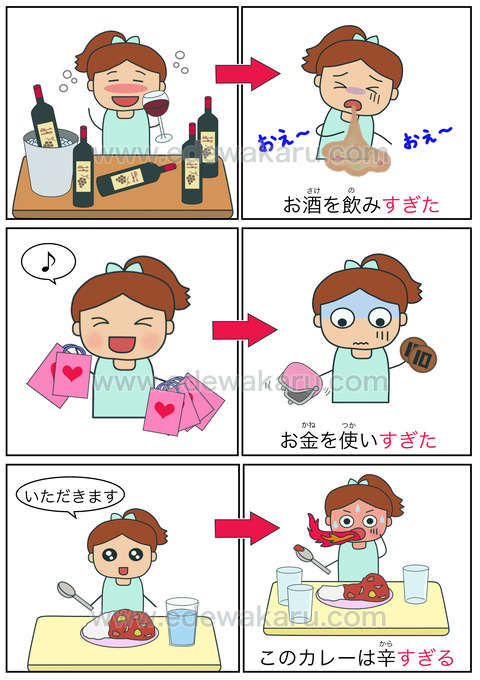
① I drank too much alcohol yesterday and felt sick.
→I felt sick because I drank a great deal of alcohol yesterday.
② This curry is too spicy.
→I can’t eat this curry because it is very spicy.
In most cases, using “〜すぎる” adds a [negative meaning] 😮
[Examples]
① This problem is too easy.
→It’s boring because it’s so easy.
② He’s too energetic.
→He’s a little noisy because he’s so energetic.
[For advanced learners]
As in the examples above, even when “〜すぎる” is used with words that have a positive meaning, such as “easy” or “energetic,” it usually adds a negative meaning. However, in modern usage there are also expressions with “〜すぎる” that do not have a negative meaning. You may hear them in everyday conversation or on TV programs, so remember them 😊
(Review: 〜てしまう (regret / remorse))
(Review: 〜において・〜におけるN)
(Review: 〜ておく)
[Examples]
① That person is way too handsome!!
② This cake is too delicious!
③ That singer is just too cute, don’t you think!
(Review: 〜でしょ・〜だろ)
④ That movie is way too interesting!
Beginner-level patterns are often used in conversation and are very important. Learn them well and work on using them skillfully 😊
In context 5 examples
お酒を飲みすぎた
→お酒をすごくたくさん飲んでしまったI drank way too much alcohol. →I ended up drinking a great deal of alcohol.
お金を使いすぎた
→お金をすごくたくさん使ってしまったI spent way too much money. →I ended up spending a great deal of money.
このカレーは辛すぎる
→このカレーはとても辛いThis curry is too spicy. →This curry is very spicy.
このバッグは高すぎる
→このバッグはとても高いThis bag is too expensive. →This bag is very expensive.
私の給料は少なすぎる
→私の給料は普通よりもすごく少ないMy salary is way too low. →My salary is much lower than usual.
Read the original source text
Meaning
とても〜
すごく〜
How to use it
動詞[ます形]+すぎる
い形容詞[ーい]+すぎる
な形容詞[ーな]+すぎる
Explanation
「〜すぎる」は「程度が普通よりも、とても〜」「程度が普通よりも、すごく〜」という意味の文型です。
「程度が普通よりも、すごく〜だ」
と言いたい時に使用されます。
「〜すぎて〜」
という形もよく使われますので、覚えておきましょう😀
[例]
①昨日はお酒を飲み
すぎて、気持ちが悪くなった
→昨日はお酒をとてもたくさん飲んだので、気持ちが悪くなった
②このカレーは辛
→このカレーはとても辛いので、食べられない
「〜すぎる」を使うと、ほとんどの場合【マイナスの意味】が入ります😮
[例]
①この問題は簡単
すぎる
→とても簡単なのでつまらない
②彼は元気
すぎる
→すごく元気なので、ちょっとうるさい
【上級レベルの人へ】
「〜すぎる」は上の例のように「簡単」「元気」など、プラスの意味の単語に使っても、マイナスの意味が入ってしまうことがほとんどです。しかし、現代においてはマイナスの意味を含まない「〜すぎる」という表現もあります。日常会話(にちじょうかいわ)やテレビ番組などで聞くことがあると思いますので、覚えておきましょう😊
(復習:〜てしまう(残念・後悔))
(復習:〜において・〜におけるN)
(復習:〜ておく)
[例]
①あの人、かっこよ
すぎる!!
②このケーキ、おいし
すぎる!
③あの歌手はかわい
すぎる
でしょ!
(復習:〜でしょ・〜だろ)
④あの映画、おもしろ
すぎる!
初級の文型は、会話でもよく使いとても重要です。しっかりと覚えて、上手に使えるようにがんばってくださいね😊
日本語文型辞典 英語版
Meaning
【すぎる】[N/Na すぎる][A-すぎる][R-すぎる]
Indicates a state of excess or immoderation.
Indicates a state of excess. Used as a noun.
Means “even if you do something, it can’t be said to be sufficient.”
(1)
means “the more careful you are, the better” and
(2)
means “the sooner the better.”
How to use it
1. ...すぎる
2. ...すぎ[R-すぎだ][R-すぎのN]
3. ...ても...すぎることはない
In context 15 examples
この役は思春期の役だから 10 歳では子供すぎて話にならない。
This is a role for an adolescent, so someone only ten years old is too much of a child to even consider for it.
下宿のおばさんは親切すぎてときどき迷惑なこともあります。
The landlady of my boardinghouse is too kind, to the degree that it’s sometimes even annoying.
彼はまじめすぎて、面白味に欠ける。
He is too serious and lacking in appeal.
このあたりの家は高すぎて、とても買えません。
The houses in this neighborhood are too expensive—there’s no way I can buy one.
銭湯の湯は私にはあつすぎます。
The hot water in the public bath is too hot for me.
子供の目が悪くなったのはテレビを見すぎたせいだと思います。
I think the reason the children’s eyesight has become worse is because of watching too much TV.
ゆうべ飲み過ぎて頭が痛い。
Last night I drank too much, so I have a headache.
太郎、遊びすぎですよ。もうちょっと勉強しなさい。
Taro, you play too much. You should study a little more.
働きすぎのお父さん、もっと子供と遊ぶ時間を作ってください。
Overworked fathers, please make more time to play with your children.
飲み過ぎにはこの薬がいいそうだ。
This medicine is supposed to be good for when you’ve had too much to drink.
テレビの見すぎで成績が下がってしまった。
My school grades dropped because I watched too much TV.
肥料は適度に与えてください。やりすぎはかえってよくありません。
Give it a moderate amount of fertilizer. Overdoing it will have a reverse effect.
冬山登山は注意しても、し過ぎることはない。
When mountain-climbing in winter, one cannot be overly careful.
手紙の返事はどんなに早くても、早すぎることはない。
It is never too soon to reply to a letter.
親にはどんなに感謝してもしすぎることはないと思っています。
I think that no matter how much I thank my parents, it will never be too much.
Read the original source text
Meaning
【すぎる】[N/Na すぎる][A-すぎる][R-すぎる]
Indicates a state of excess or immoderation.
Indicates a state of excess. Used as a noun.
Means “even if you do something, it can’t be said to be sufficient.”
(1)
means “the more careful you are, the better” and
(2)
means “the sooner the better.”
How to use it
1. ...すぎる
2. ...すぎ[R-すぎだ][R-すぎのN]
3. ...ても...すぎることはない
日本語NET JLPT文法解説まとめ
Meaning
Extremely 〜.
Indicates that the degree exceeds the standard.
How to use it
V (ます-form) ます + すぎる
いA い + すぎる
なA + すぎる
Explanation
"too much"
Indicates that the degree exceeds the level.
It is often used with a negative meaning.
In context 22 examples
昨日は飲みすぎて、何度も吐いちゃった。
I drank too much yesterday and threw up several times.
最近、遊びすぎて金欠なんです。
I’ve been going out too much lately, so I’m broke.
疲れすぎて、もう何もできません。
I’m so tired that I can’t do anything anymore.
テレビの見すぎで、目が悪くなったかも。
I may have damaged my eyesight from watching too much TV.
塩を入れすぎて、辛くなってしまいました。
I added too much salt, so it ended up too spicy.
もう食べすぎて、お腹がいっぱいです。
I’ve eaten too much already, so I’m full.
注文しすぎて、全部食べられなかった。
I ordered too much and couldn’t eat it all.
歌いすぎて、もう声が出ない。
I’ve sung too much, and I can’t sing anymore.
お土産を買いすぎました。
I bought too many souvenirs.
田中課長は怖すぎて、近づきがたい。
Section Chief Tanaka is so scary that it’s hard to approach him.
このレストランの料理は量が少ないのに、高すぎる。
The portions at this restaurant are small, but the food is too expensive.
ベトナムのコーヒーは甘すぎるので、あまり好きじゃない。
Vietnamese coffee is too sweet, so I don’t really like it.
勉強しなきゃいけないのに、アニメはおもしろすぎて、ついつい見ています。
I have to study, but anime is so interesting that I keep watching it without meaning to.
お酒が美味しすぎて、何杯も飲んじゃった。
The alcohol was so delicious that I ended up drinking several glasses.
仕事が辛すぎて、病気になってしまった。
My job was so hard that I ended up getting sick.
この話は悲しすぎます。
This story is too sad.
彼のジョークはくだらなすぎて、反応に困る。
His jokes are so stupid that I don’t know how to react.
隣の部屋がうるさすぎて、眠れません。
The next room is so noisy that I can’t sleep.
東京の路線図は複雑すぎて、よく乗らなければいけない電車を間違えます。
Tokyo’s train map is so complicated that I often get on the wrong train.
山本さんは静かすぎて、コミュニケーションが難しいです。
Yamamoto is so quiet that it’s difficult to communicate with him.
この仕事は大変すぎて、私にはもうできません。
This job is too difficult; I can’t do it anymore.
今日は暇すぎる。
I’m so bored today.
Read the original source text
Meaning
非常に〜だ。
程度が水準を超えていることを表す。
How to use it
V(ます形)ます + すぎる
イAい + すぎる
ナA + すぎる
Explanation
"too much"
Indicates that the degree exceeds the level.
ネガディブな意味で使われることが多い。
NINJAL 日本語文型データベース
Meaning
Expresses becoming or being in a state that exceeds the usual degree or frequency and causes an undesirable result.
How to use it
Notes
It conjugates in the same way as a verb.
In context 17 examples
気分が悪い。昨日は飲みすぎた。
I feel sick. I drank too much yesterday.
晩ご飯を食べすぎました。おなかが痛いです。
I ate too much dinner. My stomach hurts.
バーゲンで服を買いすぎたので、後悔しています。
I regret buying too many clothes at the sale.
昨日、夜遅くまでゲームをしすぎて、今朝は起きられませんでした。
I played video games too late last night, so I couldn’t get up this morning.
パーティーのとき、料理を作りすぎて、たくさん余らせてしまいました。
I made too much food for the party and ended up with a lot left over.
ストレスをためないようにするには、小さいことは気にしすぎないほうがいい。
To avoid building up stress, it’s better not to worry too much about small things.
花に水をやり過ぎちゃったかな。弱ってきたみたい。
Maybe I watered the flowers too much. They seem to be wilting.
このスーツケースは1泊2日の旅行には大きすぎる。もう少し小さいのを買おうかな。
This suitcase is too big for a two-day, one-night trip. Maybe I’ll buy a smaller one.
「調子が良すぎる人って、信用できないよね」
“You can’t trust people who are too smooth, can you?”
「このケーキ、ちょっと甘すぎない?」「そう? 私にはちょうどいいけど……」
“Isn’t this cake a little too sweet?” “Really? It’s just right for me, though…”
友達に紹介された問題集をやってみたけど、私には難し過ぎた。
I tried the workbook a friend recommended, but it was too difficult for me.
学生のときに買ったスカートは、短すぎてもう履けません。
The skirt I bought when I was a student is too short, so I can’t wear it anymore.
雷雨のときに海でサーフィンをするなんて危険すぎる。
Surfing in the sea during a thunderstorm is far too dangerous.
親が偉大すぎると、子どもにかかるプレッシャーは大きいようだ。
When parents are too great, it seems the pressure on their children is considerable.
図書館で勉強する人もいるが、私は静かすぎる場所では、落ち着いて勉強できない。
Some people study in the library, but I can’t study calmly in a place that’s too quiet.
山本君はまじめ過ぎて、付き合いにくい。
Yamamoto is too serious, so he’s hard to get along with.
今日の午後は仕事が暇すぎて、居眠りしてしまった。
Work was so slow this afternoon that I dozed off.
Read the original source text
Meaning
通常の程度や頻度を超えて、不都合が生じる状態になることや、不都合が生じる状態であることを表します。
How to use it
Notes
動詞と同じ形に変化します。
Yokubi — The Common Grammar Guide (https://yoku.bi)
Explanation
ころ is a noun that roughly means "approximate time". You run into Xのころに a lot. This can either be a conjunction "around the time of X", or a noun like "the general time when X" with the に particle attached. In some situations ころ can attach directly to nouns as the suffix ごろ.
くらい takes a measure or amount (including time) and makes it approximate. It is completely interchangeable with ぐらい and it is entirely up to speaker's preference.
It can also be used to mean "to the point where" or "to the level where" and not an inch beyond that.
When paired with the は particle it gives a nuance of "at least".
まで essentially means "up to" or "until". The limit or boundary marked by まで is included in the set.
まで is often paired with から as 〜から〜まで (from 〜 until 〜).
までに changes the meaning of まで to mean "by" (as in "do something by next Friday")
ほど essentially means "as" in terms of a comparison. Deep down the core meaning of ほど is "to the extent of".
In positive statements where ほど attaches to an "amount", it's an approximation.
すぎる is a verb and means "to exceed" or "to surpass". As an auxiliary verb, it means "too much" or indicates an excess of activity. It attaches to the ます stem.
IMABI
Too: ~すぎる
Read this IMABI lesson ↗Explanation
Too: ~すぎる
A very important verb that takes on a more grammatical function in compound expressions is the intransitive verb 過ぎる meaning “to pass/exceed.” From these meanings, the sense of “being too…” developed inside compounds. First, we will examine its definitions as an independent verb, then return our focus onto how it behaves in compounds upon having properly understood its core meaning.
The Meanings of 過ぎる
The core meaning of the intransitive verb 過ぎる is describing going from one place/position, which is treated as a standard reference point, onto somewhere further out.
In the physical sense of a person or thing “passing through/by,” you will find the verb used in the pattern X (agent) が Y (location = medium) を過ぎる. Now, this particle を is the transitional marker を and should not be confused with its direct object marking function.
1. 列車が今、新宿駅を過ぎたところだ。
The train has just now passed Shinjuku Station.
2. 台風が島を過ぎてから2日経ってもまだ片づけに追われている人がいる。
Even after two days since the typhoon passed through the island, there are people still pressed with clean-up efforts.
3. 太郎は病院の前を過ぎて一つ目の角を左折した。
Taro passed the front of the hospital and took a left turn at the first corner.
Building on this notion, the location=medium may also be temporal as in a point time chosen as that standard reference point. The consequence of this passing of time may either indicate that a certain time period has expired, that time has elapsed (to some outpoint), and this difference must be discerned by whether the time point being referenced describes an instance or has duration to it. This small difference will greatly affect particle usage, especially when to use が・を. Compare and contrast the following.
4. テイラー君は13時を過ぎても起きないので、私が電話で起こしました。
I woke Taylor-kun up over the phone since he wouldn’t wake up past 1 PM.
5. 私たちのフライトはほぼ1時間遅れ、真夜中を過ぎました。
Our flight was late about an hour, going past midnight.
6. 蒲田に引っ越してから5年が過ぎました。
Five years have passed since moving to Kamata.
7. 時の1過ぎるのは早いものだ。
Time sure flies by.
8. マンションは、耐用年数を過ぎると、もう住めないのですか?
When your apartment building has passed its maintenance lifespan, are you no longer able to live in it?
9. うちのマンションは、いよいよ80年の耐用年数が過ぎました。
My apartment building has at last passed its maintenance lifespan of 80 years.
Whereas in Ex. 8 耐用年数 is treated as a deadline that has been surpassed, in Ex. 9, 耐用年数 is described as the time period which has elapsed/concluded. So, while it seems as though が・を are interchangeable here, the grammatical implication is not the same between them.
Whenever the height/peak of something has passed and the thing in question begins to fall in decline, how that transitional period is perceived determines whether that reference point is marked by が or を. By choosing が, the speaker merely states the elapsing of said time period, whereas by choosing を, the speaker emphasizes how that point in time was a deadline that has since passed.
10. 食材は旬が過ぎると、手に入りにくくなってしまうので、楽しむなら、今のうちですよ。
When a food item has gone out of season, it becomes harder to get a hold of, so if you’re going to enjoy it, now’s the chance.
11. クレソンは旬を過ぎると、硬くなることが特徴です。
When watercress goes out of season, it characteristically hardens up.
Aside from temporal reference points, it is also possible that it is an amount, degree, or standard that is being “passed.”
12. 納豆菌は熱に弱いので、40度を過ぎると死滅する。
The bacteria in natto is weak to heat, they die off when the temperature exceeds 40℃.
13. あの老人は100歳を過ぎてもバスで通勤していました。
That old man was commuting by bus even past the age of 100.
When it is a “limit” that is surpassed (goes too far), a negative effect is implied. Because 過ぎる is indicating that something has gone too far, it is paired with the particle が in this scenario.
14. 冗談にしては度が過ぎるよ。
Even for a joke, that goes too far.
15. 私の友達の旦那さんも冗談が過ぎる人ですよ。
My friend’s husband is also someone who takes jokes too far.
16. ちょっと口が過ぎますよ。
You’re going a bit too overboard.
~すぎる
It is the this last extension of 過ぎる’s semantic domain that brings us to the true focus of this lesson: how ~すぎる(~過ぎる)indicates a state/action that is “too” much, having surpassed a reasonable limit. In doing so, it may follow the 連用形 of verbs, the stem of adjectives/adjectival nouns, or even attach to nouns.
Part of Speech基本形~すぎる
Verb食べる
To eat食べすぎる
To eat too much
Adjective小さい
To be small小さすぎる
To be too small
Adjectival Noun便利だ
To be convenient便利すぎる
To be too convenient
Noun金持ち
Rich person金持ちすぎる
Too rich of a person
It is most common to see 過ぎる written in Hiragana when used in such compounds, but it is also not uncommon to see it still written in Kanji.
17. お酒を飲みすぎて、二日酔ふつかよいしている。
I drank too much sake, and I have a hangover.
18. これって小さすぎますけど、もうちょっと大きいのはありますか?
This is too small. Do you have a bigger one?
19. 彼氏の実家がお金持ちすぎることで悩んでいます。
I’m struggling with how my boyfriend’s family are too rich.
20. 暑すぎて窓ガラスが突然割れた。
It was too hot, and the window glass suddenly cracked.
21. 寝室が寒すぎる。
The bedroom is too cold.
22. そのカメラは高すぎるね。
Isn’t that camera too expensive?
23. 明日では遅おそすぎるでしょう。
Tomorrow will probably be too late.
24. 道路の横断おうだんにはいくら注意ちゅういしても、しすぎることはない。
You can never be too careful when crossing the street.
25 いくら好きでも、食べすぎると、体に悪いです。
No matter how much you like it, eating too much is bad for your health.
26. すこし早く眼が覚めすぎた。
I woke up a little too early.
27. この物理学の問題は難しすぎて、理解するのは無理です。
This physics problem is too difficult, and understanding it is useless.
28. コンピューターの画面に近すぎないことが大切だ。
It’s important to not be too close to the computer screen.
29. 考え事をしながら歩いていたら、自分の家の前を通り過ぎてしまった。
Lost in thought, I walked past my house.
Semantic Quirks behind ~すぎる
Though ~すぎる appears to function as a supplementary verb ending in this capacity, the nature as to how a state or action is being “too” much may be qualified in context, especially with adverbs, indicating a level of autonomy from the first element itself. Consider how 入りすぎる is interpreted in the following.
30. 砂糖がたくさん入りすぎたかな。
I guess it had too much sugar in it.
31. 今回の旅行はちょっと高いお店に入りすぎたかもしれない。
I might’ve gone into somewhat pricey stores too much on this trip.
32. 風呂に長く入りすぎたな、一旦寝よう。
I’ve been in the bath longer (than I should’ve), so I’ll be off to bed for now.
33a. 横綱は土俵にゆっくり入りすぎた。
The yokozuna stepped into the wrestling ring too slowly.
These four sentences prove that one must look at the sentence level to properly understand ~すぎる. Although supplementary verb endings like ~ている may have more than one function permitted the verb’s semantics allows it, in which case further context clues would specify the correct meaning, ~すぎる has its own meaning at play – indicating excessive amount in Ex. 30, excessive frequency in Ex. 31, and in the case of Exs. 32-33, indicating the manner marked by the adverb is too excessive. In the latter cases, it is arguable that this is how ~すぎる may in fact still affect adverbs provided there is an intervening predicate to establish a manner’s context. In all four examples, ~すぎる’s meaning is clear and directly related to its independent verb functionality.
Let’s throw in another factor. What if it is clear enough from ~すぎる that the action in question is excessive in some way, but when the adverb is taken out of the sentence, does the sentence still stand? For Exs. 34-35, the answer is: yes. Drop that adverb, and the excessive nature of the action is still understood. However, exactly how would be left to interpretation.
34. 友達をあまり長く弁護し過ぎたかもしれない。
I might’ve been defending my friend for far too long.
35. 自己防衛もあまり強く働き過ぎると感情を悪化させる原因になります。
When you take self-defense way too intensely, it becomes a worsening factor for your emotions.
Ironically, though, if the degree and/or manner to which the action is too excessive cannot be ascertained at all, we find that with verbs – especially in which how they play out like 入る are dependent on context – that the use of ~すぎる may result in an ungrammatical sentence.
33b. 横綱は土俵に入りすぎた。X
The yokozuna went too far into the wrestling ring. ?
Sumo wrestlers must enter the 土俵, and so 入る cannot be portrayed as an excessive action, nor is there anything intrinsic about 横綱は土俵に入る that could be construed as being unwanted.
With adjectives and adjectival nouns, on the contrary, which are all about how things are, we find that so long as excessiveness can be substantiated and viewed a a bad thing, ~すぎる could be paired with any qualification which exhibits gradation. Consequently, ~すぎる itself does not have the same range of interpretations as it does with verbs – being limited to “excessive degree.”
When an adjective describes a positive situation, such as is the case with 綺麗だ or 好きだ, there is a new tendency in which the negative implication is weakened, causing ~すぎる to function similarly to how an exaggerated “so” might work in English. The lack of a negative implication is frowned upon by most natives and Japanese educators alike, and it is unclear whether this innovation will stick around for the long haul.
36. マジ彼氏のことが好きすぎる!△
I seriously like my boyfriend too much! △
Now, as may have been obvious from the sheer lack of examples earlier, the affinity between nouns and ~すぎる is incredibly low, so much so that it can be said that attaching it to generic nouns in the broadest sense is not even grammatical. For a “Noun + ~すぎる” combination to be grammatical, the noun itself must have a quality that intrinsically possesses a gradation. Quite like some verbs but almost to the point of being a prerequisite, modification of the noun to make that gradation evident is commonplace.
37. いい人すぎる!
(You)’re too nice of a person!
38. 珍品過ぎるわ。
It’s far too rare.
39. ついさっき見た光景すぎる。
The scene is far too much like what I just saw.
The Placement of ~ない
While ~すぎる itself conjugates no differently than any other verbal expression, it is both logical for excessiveness to be described as “not being so” or for the negative to be described as being excessive.
39. 食べ過ぎないでくださいね。
Please don’t overeat.
40. 食べなすぎると、逆に体重は減らなくなる。
If you eat too little, you’ll conversely not lose weight.
Oddly enough, whenever ~すぎる attaches to 無い, whether as a standalone adjective or as an auxiliary adjective – ~ない – to create the negative form of adjectives, an epenthetic さ is inserted between it and the base of 無い, producing 無さすぎる.
41. 本当に語彙力が無さすぎる・・・
I really lack too much in vocab…
42. 自分の顔がかわいくなさすぎるのをなんとかしたい。
I want to do something about my own face being too so not cute.
It is also possible to see さ inserted for the auxiliary adjective ~ない. Though this is considered highly colloquial2, it is a testament to how native speakers view the adjective ない and the auxiliary adjective as the same morpheme.
43. 彼は何もできなすぎる。 △3
He can’t do anything (way too much). ?
Morphological Oddities
Putting aside the epenthetic さ found with 無い, there are a few other morphological oddities that can be observed with ~すぎる.
~すぎ
It is also possible to create nouns from compounds made with ~すぎる by reducing it to its 連用形. This can be observed in Exs. 44-45.
44. 飲みすぎで吐いた可能性がもっとも高いと思います。
I think the highest possibility is that (you) threw up from overdrinking.
45. 食べ過ぎで胃が痛い。
My stomach hurts from overeating.
However, it is also possible to see ~すぎ used as the predicate, in which case it is followed by the copula. This is a feature of colloquial conversation, and when employed in polite speech, and provides a very familial tone.
46. ちょっと誤字多すぎじゃない?
Aren’t there are bit too many typos?
47. いつも食べ過ぎだよ。
You always eat too much!
48a. 暑すぎですね。
48b. 暑すぎますね。
It’s too hot, huh.
~に過ぎる
Though not indicative of typical speech, it is possible to see ~過ぎる after the に-連用形 of adjectival nouns in the written language, with only a minor effect of providing a more formal tone. This rendition is often seen with adjectival nouns created with the suffix ~的.
49. 先生は今から思えばいささか楽観的にすぎるかもしれない。
Now that I look back now, Sensei might just be a little too optimistic.
50. 与党の解釈は一方的にすぎると言えなくはない。
You can’t not say that the ruling party’s explanation is too one-sided.
Note that this should not be confused with Noun +~に過ぎる, which was overlooked previously. In this scenario, the case particle に is used as a standard marker, and together, the verb 過ぎる better translates as “to outrival/surpass.” This usage, along with its negative rendition ~に過ぎない (merely/no more than), are treated as higher level grammar points, when what is really at play is the difference between using に over を4.
51. 私としては、これに過ぎる喜びはありません。
As for me, there is no joy greater than this.
52. 投票率は6%に過ぎなかった。
Voter turnout wasn’t even more than 6%.
~でありすぎる
What is less likely to occur than even the に‐連用形 of adjectival nouns being paired with 過ぎる is the 連用形 of である – であり – being used instead. This is not so much so formal in tone than being how ~すぎる is paired with the copula. The effect of which draws attention to being stuck in said condition.
53. 彼女の不幸は、皮肉にも、彼女があまりにも魅力的でありすぎたことなのであった。
Her misfortune, ironically, might have been that she was far too attractive.
54. 一年昔のあなたは、幸福過ぎて、思いのままでありすぎて、僕なんかには眩しいようでした。
You, a year ago, were far too joyous and did as you pleased that you were blinding to me.
From 『火のついた踵』by 宮本百合子.
It must be noted that が・の are largely interchangeable within subordinate clauses modifying a noun. ↩︎
Epenthetic さ is believed to follow the root of the adjective ない /na-/, which also occurs with the auxiliary ~そうだ. Epenthetic さ only occurs with the adjectives よい and ない, and while epenthetic さ is not present for よい with すぎる, the phenomenon is thought to be triggered by the roots of both adjectives being monosyllabic. This “monosyllabic” status has been used to refute the grammaticality of epenthetic さ for the auxiliary iteration ~ない, as the “root” of the phrase would no longer be monosyllabic. However, this ignores the morpheme boundaries at play. It is fairer to say that epenthetic さ merely began with ない as a standalone adjective, as this meaning predates its auxiliary form by centuries. It is only natural for the morphology of its newer auxiliary form to match that of the original. ↩︎
The unnaturalness of Ex. 43 does not pertain to the presence of an epenthetic さ or not, but rather, it is because of how redundant it is. Though the connotation of ~すぎる is still negative, its meaning is downplayed to that of an emphatic marker given how the speaker has already indicated the person in question is capable of nothing. With that already being as extreme as one can underperform, ~すぎる’s literal role becomes meaningless. ↩︎
While the particle を as a direct object marker is limited to transitive verbs, the concept of what defines an “object,” of course, is not limited to direct objects. The ways in which に also acts an object marker are both varied and different from how を does so, and in this construct, に marks what it follows as the object of comparison with that noun being what sets the standard that is immediately surpassed by the other entity thanks to 過ぎる. ↩︎
In context 56 examples
列車が今、新宿駅を過ぎたところだ。
The train has just now passed Shinjuku Station.
台風が島を過ぎてから2日経ってもまだ片づけに追われている人がいる。
Even after two days since the typhoon passed through the island, there are people still pressed with clean-up efforts.
太郎は病院の前を過ぎて一つ目の角を左折した。
Taro passed the front of the hospital and took a left turn at the first corner.
テイラー君は13時を過ぎても起きないので、私が電話で起こしました。
I woke Taylor-kun up over the phone since he wouldn’t wake up past 1 PM.
私たちのフライトはほぼ1時間遅れ、真夜中を過ぎました。
Our flight was late about an hour, going past midnight.
蒲田に引っ越してから5年が過ぎました。
Five years have passed since moving to Kamata.
時の1過ぎるのは早いものだ。
Time sure flies by.
マンションは、耐用年数を過ぎると、もう住めないのですか?
When your apartment building has passed its maintenance lifespan, are you no longer able to live in it?
うちのマンションは、いよいよ80年の耐用年数が過ぎました。
My apartment building has at last passed its maintenance lifespan of 80 years.
食材は旬が過ぎると、手に入りにくくなってしまうので、楽しむなら、今のうちですよ。
When a food item has gone out of season, it becomes harder to get a hold of, so if you’re going to enjoy it, now’s the chance.
クレソンは旬を過ぎると、硬くなることが特徴です。
When watercress goes out of season, it characteristically hardens up.
納豆菌は熱に弱いので、40度を過ぎると死滅する。
The bacteria in natto is weak to heat, they die off when the temperature exceeds 40℃.
あの老人は100歳を過ぎてもバスで通勤していました。
That old man was commuting by bus even past the age of 100.
冗談にしては度が過ぎるよ。
Even for a joke, that goes too far.
私の友達の旦那さんも冗談が過ぎる人ですよ。
My friend’s husband is also someone who takes jokes too far.
ちょっと口が過ぎますよ。
You’re going a bit too overboard.
お酒を飲みすぎて、二日酔ふつかよいしている。
I drank too much sake, and I have a hangover.
これって小さすぎますけど、もうちょっと大きいのはありますか?
This is too small. Do you have a bigger one?
彼氏の実家がお金持ちすぎることで悩んでいます。
I’m struggling with how my boyfriend’s family are too rich.
暑すぎて窓ガラスが突然割れた。
It was too hot, and the window glass suddenly cracked.
寝室が寒すぎる。
The bedroom is too cold.
そのカメラは高すぎるね。
Isn’t that camera too expensive?
明日では遅おそすぎるでしょう。
Tomorrow will probably be too late.
道路の横断おうだんにはいくら注意ちゅういしても、しすぎることはない。
You can never be too careful when crossing the street.
すこし早く眼が覚めすぎた。
I woke up a little too early.
この物理学の問題は難しすぎて、理解するのは無理です。
This physics problem is too difficult, and understanding it is useless.
コンピューターの画面に近すぎないことが大切だ。
It’s important to not be too close to the computer screen.
考え事をしながら歩いていたら、自分の家の前を通り過ぎてしまった。
Lost in thought, I walked past my house.
砂糖がたくさん入りすぎたかな。
I guess it had too much sugar in it.
今回の旅行はちょっと高いお店に入りすぎたかもしれない。
I might’ve gone into somewhat pricey stores too much on this trip.
風呂に長く入りすぎたな、一旦寝よう。
I’ve been in the bath longer (than I should’ve), so I’ll be off to bed for now.
横綱は土俵にゆっくり入りすぎた。
The yokozuna stepped into the wrestling ring too slowly.
友達をあまり長く弁護し過ぎたかもしれない。
I might’ve been defending my friend for far too long.
自己防衛もあまり強く働き過ぎると感情を悪化させる原因になります。
When you take self-defense way too intensely, it becomes a worsening factor for your emotions.
横綱は土俵に入りすぎた。X
The yokozuna went too far into the wrestling ring. ?
マジ彼氏のことが好きすぎる!△
I seriously like my boyfriend too much! △
いい人すぎる!
(You)’re too nice of a person!
珍品過ぎるわ。
It’s far too rare.
ついさっき見た光景すぎる。
The scene is far too much like what I just saw.
食べ過ぎないでくださいね。
Please don’t overeat.
食べなすぎると、逆に体重は減らなくなる。
If you eat too little, you’ll conversely not lose weight.
本当に語彙力が無さすぎる・・・
I really lack too much in vocab…
自分の顔がかわいくなさすぎるのをなんとかしたい。
I want to do something about my own face being too so not cute.
彼は何もできなすぎる。 △3
He can’t do anything (way too much). ?
飲みすぎで吐いた可能性がもっとも高いと思います。
I think the highest possibility is that (you) threw up from overdrinking.
食べ過ぎで胃が痛い。
My stomach hurts from overeating.
ちょっと誤字多すぎじゃない?
Aren’t there are bit too many typos?
いつも食べ過ぎだよ。
You always eat too much!
暑すぎですね。
It’s too hot, huh.
暑すぎますね。
It’s too hot, huh.
先生は今から思えばいささか楽観的にすぎるかもしれない。
Now that I look back now, Sensei might just be a little too optimistic.
与党の解釈は一方的にすぎると言えなくはない。
You can’t not say that the ruling party’s explanation is too one-sided.
私としては、これに過ぎる喜びはありません。
As for me, there is no joy greater than this.
投票率は6%に過ぎなかった。
Voter turnout wasn’t even more than 6%.
彼女の不幸は、皮肉にも、彼女があまりにも魅力的でありすぎたことなのであった。
Her misfortune, ironically, might have been that she was far too attractive.
一年昔のあなたは、幸福過ぎて、思いのままでありすぎて、僕なんかには眩しいようでした。
You, a year ago, were far too joyous and did as you pleased that you were blinding to me.
日本語文型辞典
Meaning
Basic information
N / Na すぎる; A-すぎる; R-すぎる
Expresses an excessive state.
Expresses an excessive state. Used as a noun.
Means “even if you do something, it cannot be said to be enough.” ① means “the more careful you are, the better”; ② means “the sooner, the better.”
How to use it
…すぎる
…すぎ
R-すぎだ
R-すぎのN
…ても…すぎることはない
In context 15 examples
この役は思春期の役だから10歳では子供すぎて話にならない。
This is a role of an adolescent, so a ten-year-old is too much of a child to be suitable.
下宿のおばさんは親切すぎてときどき迷惑なこともあります。
The landlady at my boarding house is too kind, which is sometimes a nuisance.
彼はまじめすぎて、面白味に欠ける。
He is too serious and lacks a sense of humor.
このあたりの家は高すぎて、とても買えません。
The houses around here are too expensive; I can’t possibly buy one.
銭湯の湯は私にはあつすぎます。
The bathhouse water is too hot for me.
子供の目が悪くなったのはテレビを見すぎたせいだと思います。
I think my child’s eyesight got worse because they watched too much television.
ゆうべ飲み過ぎて頭が痛い。
I drank too much last night, and my head hurts.
太郎、遊びすぎですよ。もうちょっと勉強しなさい。
Taro, you’re playing too much. Study a little more.
働きすぎのお父さん、もっと子供と遊ぶ時間を作ってください。
You work too much, Dad. Please make more time to play with the children.
飲み過ぎにはこの薬がいいそうだ。
I hear this medicine is good for drinking too much.
テレビの見すぎで成績が下がつてしまった。
My grades dropped because I watched too much TV.
肥料は適度に与えてください。やりすぎはかえってよくありません。
Please apply fertilizer in moderation. Too much can actually be harmful.
冬山登山は注意しても、し過ぎることはない。
You can never be too careful when climbing in the winter mountains.
手紙の返事はどんなに早くても、早すぎることはない。
No reply to a letter can ever be too quick.
親にはどんなに感謝してもしすぎることはないと思っています。
I think you can never be too grateful to your parents.
Read the original source text
Meaning
基本情報N/Na すぎるA-すぎるR-すぎる
過度の状態を表す。
過度の状態を表す。名詞として用いられる。
「何かをしても、それで充分だとはいえない」という意味。①は「注意すればするほどいい」、②は「早いほどいい」の意味。
How to use it
…すぎる
…すぎ
R-すぎだ
R-すぎのN
…ても…すぎることはない
毎日のんびり日本語教師
Meaning
Extremely ~
Excessively ~
How to use it
Verb ます-stem + 過ぎる
い-adjective stem + 過ぎる
な-adjective stem + 過ぎる
Noun + (が)過ぎる
Explanation
Attaches to the ます-stem of a verb, an い-adjective stem, or a な-adjective stem, and expresses that the action or state exceeds the ordinary degree or level.
Although it is not mentioned in reference books and the like, the phrasing “Noun + 過ぎる” has come into use, especially among young people. (Examples 5, 6, and 7)
The form “Noun + が過ぎる” is also used, as in “いたずらが過ぎる,” “わがままが過ぎる,” and “保身が過ぎる,” but the nouns that can be used with “~が過ぎる” are limited.
Notes
Nothing in particular.
In context 10 examples
夜景が美しすぎて見とれてしまった。
The night view was so beautiful that I couldn’t help but stare.
もう若くないからか、食べ過ぎるとすぐ胃もたれする。
Maybe because I’m not young anymore, if I eat too much, I get indigestion right away.
毛虫の見た目が気持ち悪すぎて見るだけで鳥肌が立つ。
Caterpillars look so disgusting that I get goosebumps just looking at them.
あの子可愛すぎてつい見ちゃう。
That kid is so cute that I can’t help watching them.
あの子の天使すぎる笑顔にいつも癒やされている。
I’m always comforted by that child’s angelic smile.
彼の謎過ぎる行動には頭を抱えるしかない。
I can only clutch my head over his utterly baffling behavior.
先輩はいつも優しくて良い人すぎる。(前辈一直是温柔的老好人。)
My senior is always kind and far too nice.
筋肉痛が痛すぎて階段を下りるのすらできない。
My muscle soreness hurts so much that I can’t even go down the stairs.
今の会社は残業が多すぎる。
There’s far too much overtime at my current company.
しんしんと降っている雪が好きすぎて、いつも写真で撮ってしまう。
I love the snow falling steadily so much that I always end up taking pictures of it.
Read the original source text
Meaning
非常に~
甚だしく~
How to use it
動ます形+過ぎる
い形容詞語幹+過ぎる
な形容詞語幹+過ぎる
名詞+(が)過ぎる
Explanation
動ます形、い形語幹、な形語幹に接続して、その動作や状態が普通の程度・水準を超えていることを表します。
参考書等には記載されていませんが、「名詞+過ぎる」という言い方が若い人を中心に使われてきています。(5)(6)(7)
また、いたずらが過ぎる、わがままが過ぎる、保身が過ぎるのように「名詞+が過ぎる」の形も取ることがありますが、「~が過ぎる」に接続できる名詞は限定的です。
Notes
特になし