絵でわかる日本語
Usage 1
Read this source entry ↗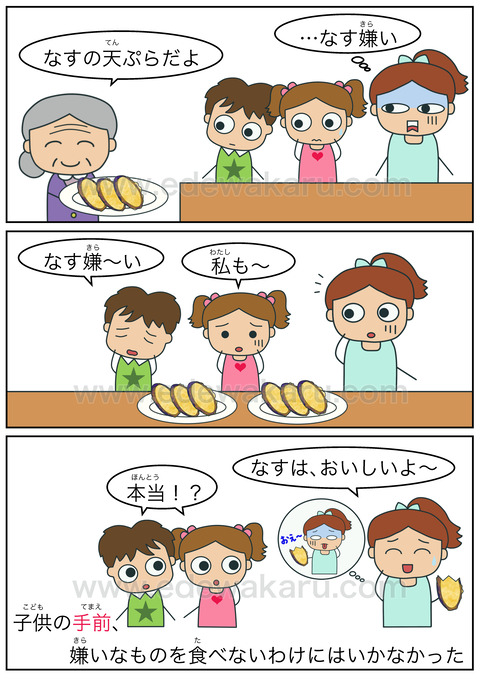
Meaning
Because it is in front of ~
How to use it
Noun [dictionary form] + の手前
Explanation
「〜手前」 in the form 「Nの手前」 means “because it is in front of N.” N is a noun referring to a person. It is used to say, “Because N is watching, I can’t ~” or “Because I’m in front of N, I can’t ~.”
「〜手前」 also has the meaning “because I’ve already done ~, I can’t ~,” so learn that usage too 😉
In context 5 examples
子供の手前、嫌いなものを食べないわけにはいかなかった
→子供の前なので、嫌いなものを食べないわけにはいかなかったBecause my child was watching, I couldn’t refuse to eat the food I dislike. → Because my child was watching, I couldn’t refuse to eat the food I dislike.
残業している上司の手前、仕事が終わっても帰りづらい
→残業している上司の前なので、帰りづらいIt’s hard to leave work once I’m done, with my boss still working overtime in front of me. → Because my boss is still working overtime in front of me, it’s hard to leave.
彼女の手前、この試合に負けるわけにはいかない!
→彼女が見ているので、この試合に負けるわけにはいかない!With my girlfriend watching, I can’t afford to lose this match! → Since my girlfriend is watching, I can’t afford to lose this match!
部下の手前、かっこ悪いところを見せられない
→部下の前なので、かっこ悪いところをみせられないWith my subordinates watching, I can’t let them see me look uncool. → Because I’m in front of my subordinates, I can’t let them see me look uncool.
学生の手前、「もうら」を漢字でどう書くかわからないなんて言えない
→学生の前で、「もうら」を漢字でどう書くかわからないなんて言えない*「もうら」は漢字で「網羅」です😊In front of my students, I can’t say that I don’t know how to write “mōra” in kanji. → In front of my students, I can’t say that I don’t know how to write “mōra” in kanji. *「もうら」 is written in kanji as 「網羅」 😊
Read the original source text
Meaning
〜の前なので
How to use it
名詞[辞書形]+の手前
Explanation
「〜手前」は「Nの手前」の形で、「Nの前なので」という意味を表します。「N」には人を表す名詞が入り、「Nの前なので、〜できない」「Nが見ているので、〜ことができない」と言いたい時に使われます。
「〜手前」には「〜してしまったから、〜できない」 という意味もありますので、一緒に覚えておきましょう😉
Usage 2
Read this source entry ↗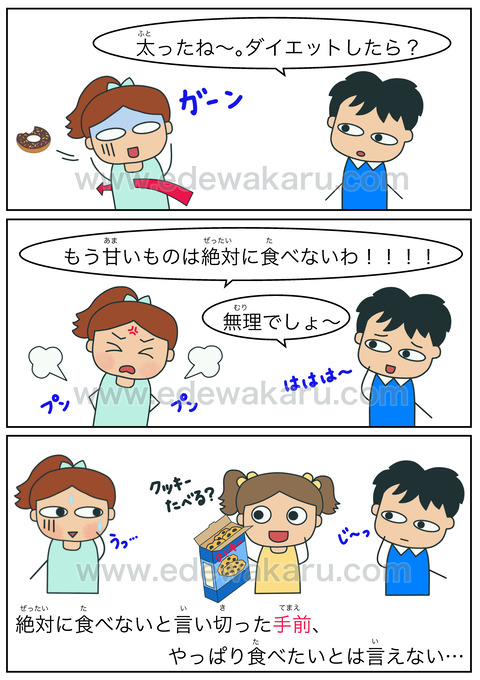
Meaning
Because one has already done ~
Given the situation ~
How to use it
Verb [dictionary form, た-form, or ている form] + 手前
Explanation
「〜手前」 is a sentence pattern meaning “because one has already done ~” or “given the situation ~.” It is used to say, “Since I’ve done ~, I can’t ~,” or “Given the situation, I have to ~.” There are several patterns that are often used together with it, so learn them.
[Patterns often used together]
・〜手前 +
〜なければならない
・〜手前 +
〜わけにはいかない
・〜手前 +
〜ないわけにはいかない
・〜手前 +
〜よりほかない
・〜手前 +
〜しかない
and so on
「〜手前」 also has a usage meaning “because one is in front of ~,” so learn that usage too 😉
In context 6 examples
もう甘いものは絶対に食べないと言いきった手前、やっぱり食べたいとは言えない
→もう甘いものは絶対に食べないと言いきったので、やっぱり食べたいとは言えないSince I insisted that I absolutely wouldn’t eat sweets anymore, I can’t say that I want some after all. → Since I insisted that I absolutely wouldn’t eat sweets anymore, I can’t say that I want some after all.
一人でできると言った手前、手伝ってほしいとは言いづらい…
→一人でできると言ってしまったので、手伝ってほしいとは言いづらいSince I said I could do it alone, it’s hard to say I want help... → Since I went and said I could do it alone, it’s hard to say I want help.
モデルをしている手前、太るわけにはいかない
→モデルをしているので、太るわけにはいかないSince I’m a model, I can’t afford to gain weight. → Since I’m a model, I can’t afford to gain weight.
ちゃんとやると言った手前、最後までやらざるを得ない
→ちゃんとやると言ったので、最後までやらざるを得ないSince I said I’d do it properly, I have no choice but to see it through to the end. → Since I said I’d do it properly, I have no choice but to see it through to the end.
パーティーには必ず参加すると言った手前、いまさら行けなくなったとは言いにくい
→必ず参加すると言ったので、行けなくなったとは言いにくいSince I said I would definitely attend the party, it’s hard to say now that I can’t go. → Since I said I would definitely attend, it’s hard to say I can’t go.
親に授業料(じゅぎょうりょう)を払ってもらっている手前、しっかり勉強しなければいけない
→授業料を払ってもらっているので、しっかり勉強しなければいけないSince my parents are paying my tuition, I have to study hard. → Since they are paying my tuition, I have to study hard.
Read the original source text
Meaning
〜してしまったから
〜という状況なので
How to use it
動詞[辞書形・た形・ている]+手前
Explanation
「〜手前」は「〜してしまったから」「〜という状況なので」という意味の文型です。「〜してしまったので、〜できない」「〜という状況なので、〜しなければいけない」と言いたい時に使われます。よく一緒に使われる文型がいくつかありますので、覚えておきましょう。
[よく一緒に使われる文型]
・〜手前+
〜なければならない
・〜手前+
〜わけにはいかない
・〜手前+
〜ないわけにはいかない
・〜手前+
〜よりほかない
・〜手前+
〜しかない
など
「〜手前」には「〜の前なので」という意味の用法もありますので、一緒に覚えておきましょう😉
日本語NET JLPT文法解説まとめ
Meaning
① Given one’s position or situation, (one has no choice but to ...)
② Because ~ is in front of us,
・Used when one wants to say, “Given this situation or position, there is no choice but to ...”
・An expression that takes into account the speaker’s attitude toward a third party. The latter clause is often subjective.
How to use it
V (dictionary form / た-form / ている-form) + てまえ
N の + てまえ
N is a word referring to a person.
Explanation
① Given the position/situation of ~, (one has no choice but to ...)
② Because ~ is in front of us / Given the presence of ~,
・Used when you want to express that 'given the situation or position of ~, there is no choice but to ...'.
・It is used with an awareness of the speaker's attitude toward a third party. The latter part of the sentence often contains a subjective statement.
In context 8 examples
熱があるから学校を休むと言ってしまった手前、外に出て誰かに見られてはまずい。
Since I’ve already said I’d stay home from school because I have a fever, it would be bad if I went out and someone saw me.
おまかせしますと言った手前、友達の買ってきた弁当が嫌とは言えなかった。
Since I said, “I’ll leave it up to you,” I couldn’t say that I didn’t like the boxed lunch my friend had bought.
自分から誘ってしまった手前、今さらやっぱりやめておこうとは言えない。
Since I was the one who invited them, I can’t say, “Actually, let’s not,” at this point.
実習生が見ている手前、あたふたした姿を見せることはできない。しっかり授業に備えて教案を準備しておこう。
Since the trainee teacher is watching, I can’t let them see me flustered. I’ll prepare a lesson plan properly and get ready for class.
彼女の手前、試合で無様な姿を見せることはできない。
With her watching, I can’t show an unsightly performance in the match.
夫がCanonに勤めている手前、他社のカメラが欲しいなんて言えない。
Since my husband works at Canon, I can’t say that I want a camera made by another company.
アパレルの会社で働いている手前、常にファッションには気をつかっている。
Since I work for an apparel company, I always pay attention to fashion.
参加すると言ってしまった手前、今さら飲み会をキャンセルなんてできない。
Since I already said I’d participate, I can’t cancel the drinking party at this point.
Read the original source text
Meaning
①〜という立場・状況なので、(・・・するしかない)
②〜の前なので、
・「〜という状況や立場からなので、・・・するほか選択肢がない」と言いたい時に使う。
・話し手の第三者に対する態度を意識した表現。後件には主観的な文が来ることが多い。
How to use it
V(辞書形 / タ形 / テイル形) てまえ
Nの + てまえ
Nは人に関する単語が来る
Explanation
① Given the position/situation of ~, (one has no choice but to ...)
② Because ~ is in front of us / Given the presence of ~,
・Used when you want to express that 'given the situation or position of ~, there is no choice but to ...'.
・It is used with an awareness of the speaker's attitude toward a third party. The latter part of the sentence often contains a subjective statement.
毎日のんびり日本語教師
Meaning
Because of that, I have no choice but to do it (even though I don't want to).
How to use it
Noun + の手前
Verb dictionary form + 手前
Verb ta-form + 手前
Verb te-iru form + 手前
Explanation
手前 can mean appearances or face, and expresses the speaker's reluctant feelings.
The first part gives the reason, while the second part states something the speaker really does not want to do but must do, taking their position and social evaluation into account.
This is because if they do not do it, their standing will decline or they will lose face.
Therefore, the second part is accompanied by expressions that restrict one's actions, such as “~するしかない” (“have no choice but to do”), “~なければならない” (“must do”), and “~すべき” (“should do”).
Notes
Nothing in particular.
In context 5 examples
約束した手前、寝る時間を割いてでもやるべきだと思う。
Since I promised, I think I should do it even if I have to sacrifice sleep.
毎度助けてもらっている手前、何かお礼をしなければ。
Since you've helped me so many times, I have to do something to thank you.
自分から誘った手前、今さらやっぱり止めようとは言いにくい。
Since I was the one who invited them, it's hard to say now, “Actually, let's not.”
「別れよう」と私が言い出した手前、やっぱりやり直そうとは言えない。
Since I was the one who brought up breaking up, I can't now say, “Actually, let's get back together.”
子供の手前、酔っぱらった姿で帰宅するのは恥ずかしい。(在孩子面前喝得酩酊大醉回家是很丢脸的事情)
In front of my children, it would be embarrassing to come home drunk. (It's embarrassing to come home completely drunk in front of the children.)
Read the original source text
Meaning
~だから、(したくないが)~するしかない。
How to use it
名詞+の手前
動詞辞書形+手前
動た形+手前
動ている形+手前
Explanation
「手前」には体裁や面子という意味があり、話者の
不本意な感情
を表します。
前項には理由を、後項には立場や社会的評価を考慮した上で本当はしたくはないがしなければならないことを述べます。
それをしないと評価が下がったり、面目が立たなくなるためです。
したがって後項には行動を制限する「~するしかない」「~なければならない」「~すべき」等が呼応します。
Notes
特になし
AIUEO JLPT Grammar
Meaning
「〜手前」 is used to explain actions taken out of consideration for others’ views or one’s sense of responsibility. It is commonly used to describe actions taken to maintain appearances or protect one’s pride, particularly in front of others.
How to use it
Verb dictionary form + 手前; verb ta-form + 手前; verb て-form + いる + 手前; noun の + 手前
In context 5 examples
みんなの手前、弱音を吐くわけにはいかない。
I can’t complain in front of everyone.
自分が言い出した手前、途中で諦めるわけにはいかない。
Since I was the one who brought it up, I can’t give up halfway.
先生の前で発表する手前、ちゃんと準備しておかなければならない。
Before giving a presentation in front of the teacher, you need to be well prepared.
子供たちの手前、悪い言葉を使うわけにはいかない。
I can’t use bad language in front of the children.
彼に嘘をついた手前、今さら真実を話すことはできない。
Since I lied to him, I can’t tell the truth now.
Read the original source text
Meaning
「〜手前」 is used to explain actions taken out of consideration for others’ views or one’s sense of responsibility. It is commonly used to describe actions taken to maintain appearances or protect one’s pride, particularly in front of others.
How to use it
動詞辞書形+手前動詞た形+手前動詞て形+いる+手前名詞の+手前
Explanation · 日本語
「〜手前」は、他者の視線や立場に配慮して、あるいは自分の責任感から、ある行動を取らざるを得ない状況を説明するときに使われます。特に、他人に対して見栄を張ったり、面子を守ったりするために行動する場合に用いられることが多いです。
Bunpro Grammar Reference
Meaning
Before, In front of, From one's standpoint or side
How to use it
Verb + 手前
Noun + の + 手前
Nuance
An expression that highlights something as being in the forward facing viewpoint of (A), regardless of whether it is physical or mental.
Explanation
The noun 手前 'in front of' has several different meanings in Japanese depending on whether it is being used with a verb in its standard form, or with a noun.
Regarding verbs, it expresses 'going forward from (A), (B)'. This is usually in relation to something that has happened either accidentally or completely, and may represent what will be done as a result of being in that situation.
崖から落ちる手前で父親に腕を引っ張られた。
My father pulled me by my arm before I fell off the cliff.
勢いで手を上げてしまった手前、答えずに手を下げるわけにはいかない。
From the standpoint of me raising my hand in the heat of the moment, there is no way of me backing out without answering the question.
先輩にはいつもお世話になっている手前、彼女の頼みを断るわけにはいかない。
Since my senpai always takes good care of me, there is no way that I can turn down her request.
This can also be interpreted as 'now that (A), (B)', and simply highlights that nothing can be done except to move on or 'forward' given the current circumstances.
When 手前 appears with nouns followed by the case marking particle の, it often expresses that what is 'in front' of (A) is the reason for (B), or simply is 'in front of (A)'.
娘の手前、運動音痴な姿を見せるわけにはいかない。
I can't show my unathletic self in front of my daughter.
彼女の両親の手前、発言には気を付けなければいけない。
I have to be careful of what I say when I am in front of my girlfriend's parents.
Despite the many translations, 手前 always shows something that is 'facing' the noun or verb that appears with it. Due to this, thinking of this structure as similar to 'faced with (A), (B)' may be helpful, as English also expresses lack of option and finality in this way.
In context 17 examples
- あなたの手前にあるものを見てください。
Please look at the thing that is in front of you.
- 娘の手前、運動音痴な姿を見せるわけにはいかない。
I can't show my unathletic self in front of my daughter.
- 崖から落ちる手前で父親に腕を引っ張られた。
My father pulled me by my arm before I fell off the cliff.
- 勢いで手を上げてしまった手前、答えずに手を下げるわけにはいかない。
From the standpoint of me raising my hand in the heat of the moment, there is no way of me backing out without answering the question.
- 先輩にはいつもお世話になっている手前、彼女の頼みを断るわけにはいかない。
Since my senpai always takes good care of me, there is no way that I can turn down her request.
- 彼女の両親の手前、発言には気を付けなければいけない。
I have to be careful of what I say when I am in front of my girlfriend's parents.
- オルガンをもっと手前に配置してください。
Please position the organ even more in front.
- 死んでしまう一歩手前で助かった。
I was helped just before I would have died. (on the brink)
- 私の手前の人が、私の友達です。
The person in front of me is my friend.
- 火山の被害がうちの手前まで及んだ。
The damage from the volcano extended to right in front of my house.
- こちらに過失があった手前、強いことは言えません。
Our side made the mistake here, so we cannot complain. (we・this side)
- 空っぽになる手前でガソリンを入れることができた。
I was able to get gas before it became completely empty.
- 手前の看板を撤去してください。
Please remove the sign in front.
- 境界線の手前で待っていてください。
Please wait in front of the boundary line.
- これまでよりも手前で曲がるカーブを投げられるようになった。
I became able to throw a curveball that curves even more in front.
- 手前で警備している彼を交代させてください。
Please let me change places with the guy who is in front on defense.
- 改札の手前でスイカを忘れてきたことに気づいて良かった。
I am glad that, in front of the ticket gates, I noticed that I had forgotten my Suica (card).
Read the original source text
Meaning
Before, In front of, From one's standpoint or side
How to use it
Verb + 手前
Noun + の + 手前
Nuance
An expression that highlights something as being in the forward facing viewpoint of (A), regardless of whether it is physical or mental.
Explanation
The noun 手前 'in front of' has several different meanings in Japanese depending on whether it is being used with a verb in its standard form, or with a noun.
Regarding verbs, it expresses 'going forward from (A), (B)'. This is usually in relation to something that has happened either accidentally or completely, and may represent what will be done as a result of being in that situation.
崖から落ちる手前で父親に腕を引っ張られた。
My father pulled me by my arm before I fell off the cliff.
勢いで手を上げてしまった手前、答えずに手を下げるわけにはいかない。
From the standpoint of me raising my hand in the heat of the moment, there is no way of me backing out without answering the question.
先輩にはいつもお世話になっている手前、彼女の頼みを断るわけにはいかない。
Since my senpai always takes good care of me, there is no way that I can turn down her request.
This can also be interpreted as 'now that (A), (B)', and simply highlights that nothing can be done except to move on or 'forward' given the current circumstances.
When 手前 appears with nouns followed by the case marking particle の, it often expresses that what is 'in front' of (A) is the reason for (B), or simply is 'in front of (A)'.
娘の手前、運動音痴な姿を見せるわけにはいかない。
I can't show my unathletic self in front of my daughter.
彼女の両親の手前、発言には気を付けなければいけない。
I have to be careful of what I say when I am in front of my girlfriend's parents.
Despite the many translations, 手前 always shows something that is 'facing' the noun or verb that appears with it. Due to this, thinking of this structure as similar to 'faced with (A), (B)' may be helpful, as English also expresses lack of option and finality in this way.
Nuance · 日本語
物理的・精神的なものを問わず、(A)の前向きの視点であることを強調する表現。
Explanation · 日本語
名詞の「手前」にはいくつか意味がありますが、動詞の普通形と一緒に使われるか、名詞と一緒に使われるかによって、その意味が変わります。
動詞と一緒に使われる場合、「(A) という状況なので (B)」のような意味になります。これは、何かが起こった後、その状況に応じた行動を取ることを表します。この「何か」は、偶然に起こることもあれば、そうでないこともあります。
崖から落ちる手前で父親に腕を引っ張られた。
My father pulled me by my arm before I fell off the cliff.
勢いで手を上げてしまった手前、答えずに手を下げるわけにはいかない。
From the standpoint of me raising my hand in the heat of the moment, there is no way of me backing out without answering the question.
先輩にはいつもお世話になっている手前、彼女の頼みを断るわけにはいかない。
Since my senpai always takes good care of me, there is no way that I can turn down her request.
これは「(A) した以上 (B)」と言い換えることもできます。いずれにしても、今の状況では (B) をする以外に方法がないことが強調されています。
名詞と一緒に使われる場合、格助詞「の」を伴って「(A) が前にあるので (B)」や、ただ単に「(A) の前」という意味になります。
娘の手前、運動音痴な姿を見せるわけにはいかない。
I can't show my unathletic self in front of my daughter.
彼女の両親の手前、発言には気を付けなければいけない。
I have to be careful of what I say when I am in front of my girlfriend's parents.
「手前」は、常に一緒に使われている動詞や名詞と何かが「向き合っている」ことを示します。そのため、「手前」は、ある状況や人を目の前にしているため、もう逃げられない、つまりほかに選択肢がない状況に置かれていることを表す、とイメージするといいでしょう。
文法
Meaning
① Given one’s position or situation, (one has no choice but to ...)
② Because ~ is in front of us,
・Used when one wants to say, “Given this situation or position, there is no choice but to ...”
・An expression that takes into account the speaker’s attitude toward a third party. The latter clause is often subjective.
How to use it
V (dictionary form / ta-form / te-iru form) てまえ
Nの + てまえ N is usually a word referring to a person.
In context 8 examples
熱があるから学校を休むと言ってしまった手前、外に出て誰かに見られてはまずい。
Since I’ve already said I’d stay home from school because I have a fever, it would be bad if I went out and someone saw me.
おまかせしますと言った手前、友達の買ってきた弁当が嫌とは言えなかった。
Since I said, “I’ll leave it up to you,” I couldn’t say that I didn’t like the boxed lunch my friend had bought.
自分から誘ってしまった手前、今さらやっぱりやめておこうとは言えない。
Since I was the one who invited them, I can’t say, “Actually, let’s not,” at this point.
実習生が見ている手前、あたふたした姿を見せることはできない。しっかり授業に備えて教案を準備しておこう。
Since the trainee teacher is watching, I can’t let them see me flustered. I’ll prepare a lesson plan properly and get ready for class.
彼女の手前、試合で無様な姿を見せることはできない。
With her watching, I can’t show an unsightly performance in the match.
夫がCanonに勤めている手前、他社のカメラが欲しいなんて言えない。
Since my husband works at Canon, I can’t say that I want a camera made by another company.
アパレルの会社で働いている手前、常にファッションには気をつかっている。
Since I work for an apparel company, I always pay attention to fashion.
参加すると言ってしまった手前、今さら飲み会をキャンセルなんてできない。
Since I already said I’d participate, I can’t cancel the drinking party at this point.
Read the original source text
Meaning
①〜という立場・状況なので、(・・・するしかない)
②〜の前なので、
・「〜という状況や立場からなので、・・・するほか選択肢がない」と言いたい時に使う。
・話し手の第三者に対する態度を意識した表現。後件には主観的な文が来ることが多い。
How to use it
V(辞書形 / タ形 / テイル形) てまえ
Nの + てまえNは人に関する単語が来る
NINJAL 日本語文型データベース
Meaning
It is used when you want to say that, considering your position as “〜,” you must act in a way that preserves your honor.
How to use it
Vる手前/Vた手前
Nである手前/Nだった手前・Nであった手前
Notes
After 「〜手前」 comes a sentence expressing the feeling that you must do something, even if it is difficult. Expressions such as 「〜なければならない・〜せざるをえない・〜できない・〜わけにはいかない」 are often used.
In context 9 examples
謝金をもらう手前、いい加減な仕事をするわけにはいきません。
Since I’m being paid for this work, I can’t do a half-hearted job.
佐藤さんにはいつもお世話になっている手前、手伝ってほしいと言われたら断れません。
Since Mr. Sato has always been so good to me, I can’t turn him down if he asks me to help.
いよいよ演劇祭の本番だ。みんなに見られている手前、下手な演技はできない。
It’s finally opening night of the theater festival. With everyone watching, I can’t give a poor performance.
誕生日には早く帰ると子どもに約束した手前、今日はどんなに忙しくても仕事を切り上げざるをえない。
Since I promised my child I’d come home early on their birthday, I have no choice but to wrap up work today, no matter how busy I am.
作業が遅れているが、必ず期日に間に合わせると言った手前、何とかしなければ。
The work is behind schedule, but since I said I’d definitely meet the deadline, I have to find some way to make it happen.
仕事の都合とはいえ、自分から友達を海外旅行に誘った手前、直前になってやっぱりやめるとは言いにくかった。
Even though it was for work-related reasons, since I was the one who invited my friend on an overseas trip, I found it hard to say at the last minute that I’d changed my mind.
本当は私も野菜があまり好きではないが、子どもたちを指導する教師である手前、子どもたちの前では何でも食べられるような顔をしている。
I don’t actually like vegetables very much either, but since I’m a teacher who guides children, I act as if I can eat anything in front of them.
私のほうが美樹より先輩である手前、しっかりしなければと初めは思っていたが、最近はどちらが先輩かよくわからなくなっている。
Since I’m senior to Miki, I initially thought I had to be the responsible one, but lately I can’t tell which of us is senior anymore.
父はかつて世に知られた政治家だった手前、恥ずかしい言動はできないとよく言っている。
My father used to be a well-known politician, so he often says he cannot afford to say or do anything shameful.
Read the original source text
Meaning
〜という自分の立場を考えると、面目が保てるようにしなければならないと言いたいときに使います。
How to use it
Vる手前/Vた手前
Nである手前/Nだった手前・Nであった手前
Notes
「~手前」の後には、難しくてもしなければならないという心情を表す文がきます。「〜なければならない・〜せざるをえない・〜できない・〜わけにはいかない」などをよく使います。