絵でわかる日本語
日本語文型辞典
Meaning
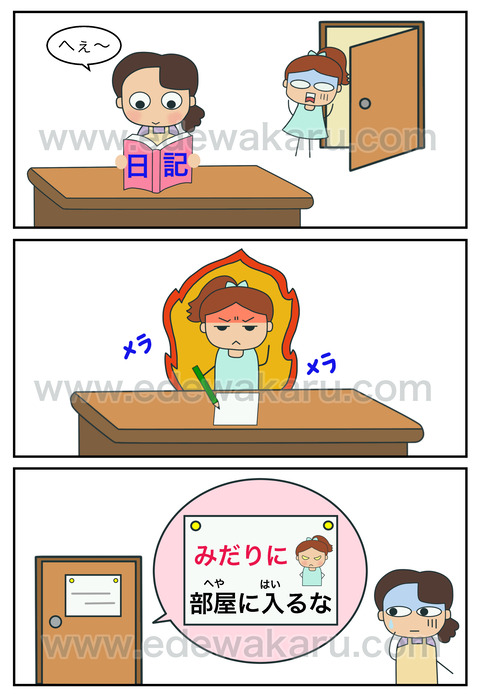
Basic information: Means “without any need,” “without permission,” or “arbitrarily.” It is a formal written expression, and is followed by expressions prohibiting someone’s actions, such as みだりに…するな/してはいけない (“Do not… carelessly/without permission”). In everyday spoken language, 膠手に…しないでください is often used.
Example sentences:
① Please do not feed the animals.
② You should not enter other people’s rooms without permission.
③ Even newspapers are not permitted to disclose individuals’ private information indiscriminately.
Read the original source text
Meaning
基本情報説明「必要もないのに」「許可なく」「勝手に」の意味。「みだりに…するな/してはいけない」など、後には人の行動を禁止する表現が続く。日常の話しことばでは、「膠手に…しないでください」がよく使われる。書きことば的なかたい表現。例文① みだりに動物にえさを与えないでください。② みだりに他人の部屋に立ち入るべきではない。③ 新聞と言えども、個人のプライバシーをみだりに公表することは許さない。
日本語文型辞典 英語版
Meaning
Means “without necessity,” “without permission,” or “capriciously.” Expressions forbidding certain actions or behavior, such as みだりに...するな/してはいけない, come after this. In everyday conversation 勝手に...しないでください is often used. It is a formal written expression.
In context 3 examples
みだりに動物にえさを与えないでください。
Please do not feed the animals (without permission).
みだりに他人の部屋に立ち入るべきではない。
You should not enter another person’s room without permission.
新聞と言えども、個人のプライバシーをみだりに公表することはゆるされない。
Although it’s a newspaper, it doesn’t have the right to infringe upon people’s privacy.