AIUEO JLPT Grammar
Meaning
This sentence pattern expresses that one cannot avoid doing something, meaning one is compelled to act in a certain way due to a strong feeling or impulse. It is used when emphasizing uncontrollable feelings or habitual actions.
How to use it
Verb (ない-form) + ずには + いられない
In context 5 examples
この映画を見ると、泣かないではいられない。
I can’t stop myself from crying when I watch this movie.
彼女のことを考えると、会いに行かずにはいられない。
When I think about her, I can’t help but go see her.
その光景を見て、驚かずにはいられなかった。
I couldn’t help but be surprised when I saw that scene.
そのニュースを聞いて、彼に連絡せずにはいられなかった。
I couldn’t help but contact him after hearing that news.
あまりにも美しい風景で、写真を撮らないではいられませんでした。
The scenery was so beautiful that I couldn’t help but take a picture.
Read the original source text
Meaning
This sentence pattern expresses that one cannot avoid doing something, meaning one is compelled to act in a certain way due to a strong feeling or impulse. It is used when emphasizing uncontrollable feelings or habitual actions.
How to use it
動詞ない形+ずには+いられない
Explanation · 日本語
この文型は、何かをしないでいることができない、つまり、自然にある行動を取ってしまうという強い感情や衝動を表す表現です。抑えられない気持ちや習慣的な行動を強調するときに使われます。
文法
Meaning
Cannot help but ~ / cannot keep from ~
Used when, whether due to a physical inability to hold back or after observing a situation or circumstances, the speaker feels a desire to do something that cannot be suppressed by willpower.
How to use it
Vない + ずにはいられない (*しない → せずにはいられない)
In context 10 examples
この店のカレーはとても辛い。ちょっと食べたら、水を飲まずにはいられない。
The curry at this restaurant is very spicy. After eating just a little, I can't help drinking water.
この映画を見ると、誰でも感動せずにはいられないだろう。
Anyone who watches this movie will probably be unable to help being moved.
さっき蚊に刺されたところが痒くて、かかずにはいられない。
The spot where a mosquito bit me just now is itchy, and I can't help scratching it.
友達がいじめられているところを見たので、何か言わずにはいられなかった。
I saw my friend being bullied, so I couldn't help saying something.
あまりに暑くて、ジャケットを脱がずにはいられなかった。
It was so hot that I couldn't help taking off my jacket.
彼の困った顔がおかしくて、笑わずにはいられなかった。
His troubled expression was so funny that I couldn't help laughing.
たばこをやめたいんですが、見ると、吸わずにはいられないんです。
I want to quit smoking, but whenever I see cigarettes, I can't help smoking.
おもしろそうなアニメを見つけると、見ずにはいられないんです。
Whenever I find an anime that looks interesting, I can't help watching it.
私はわからないことがあると、辞書やインターネットですぐに調べずにはいられない性格だ。
Whenever there's something I don't understand, I'm the type who can't help looking it up right away in a dictionary or on the internet.
ストレスがたまっていて、もう酒を飲まずにはいられない。
I've been so stressed that I can't help drinking now.
Read the original source text
Meaning
どうしても〜しないでいることはできない。/ どうしても〜してしまう。身体的に我慢できない場合や、ものごとの様子や事情を見て、話し手の心の中で「〜したい」という気持ちが起こり、意志の力で抑えられない時に使う。
How to use it
Vない + ずにはいられない(*しない→せずにはいられない)
Bunpro Grammar Reference
Meaning
Cannot help doing something, Cannot resist doing something
How to use it
Verb[な̶い̶]+ ずにはいられない
Verb[な̶い̶]+ ずにはいられません
Nuance
A somewhat old-fashioned way to show that not doing (A) cannot be lived with, or is unbearable.
Explanation
As mentioned in our ずに lesson, ず is an auxiliary verb that is not commonly used in modern Japanese, except for in set expressions. It has the equivalent role of ない, in expressing that something 'has not', or 'will not' happen. The case marking particle に is then combined with the adverbial particle は, and the negative-potential form of いる, いられない. ずにはいられない may be translated as 'cannot help doing (A)', or 'cannot resist doing (A)'.
ずにはいられない will be attached to the indeterminate form of verbs. This is the same stem form as ない uses.
美味しそうなステーキが目の前にあったら、食べずにはいられない。
If there is a delicious looking steak in front of me, there is no way I can resist eating it.
この映画を見ると誰でも泣かずにはいられない。
No matter who you are, if you watch this movie, there is no way you can not cry.
Although ずにはいられない is often translated as 'cannot resist (A)', the literal meaning is simply 'cannot be without (A)'.
Caution
As the modern indeterminate form of する has several different forms, care will need to be taken when conjugating する verbs. While ない joins with し to create しない, ず will join with せ to create せず.
この10年間色々とお世話になったから、先輩には感謝をせずにはいられない。
This past 10 years, I have been helped a lot by my senpai, so there is no way I can go on without showing them some appreciation.
私は猫アレルギーなのでくしゃみをせずにはいられない。
I am allergic to cats so I can't not sneeze.
In context 16 examples
- 子供が生まれて泣かずには居られない。
You can't help but cry when your child is born.
- 美味しそうなステーキが目の前にあったら、食べずにはいられない。
If there is a delicious looking steak in front of me, there is no way I can resist eating it.
- この映画を見ると誰でも泣かずにはいられない。
No matter who you are, if you watch this movie, there is no way you can not cry.
- 彼はよく嘘をつくから、疑わずには居られない。
I can't help but be suspicious because he always tells lies.
- 事故を目撃したら、助けずには居られない。
When you witness an accident, you can't help but help out.
- それを思い出すたびに恥ずかしくならずには居られない。
Everytime I recall that I can't help but get embarrassed.
- 彼の変顔は面白すぎて、笑わずには居られません。
His strange faces are just too funny, I can't help but laugh.
- 食べずには居られない。このチョコ美味しすぎるよ。
This chocolate is just too good. I can't stop myself from eating it.
- 新しいラーメン屋を見つけたら、入らずには居られません。
If I find a new ramen shop, I can't stop myself from going in.
- 風邪をひいたから、くしゃみをせずには居られないんです。
I can't stop myself from sneezing because I have a cold.
- 「気にしないで」と言われても、気にせずには居られない。
Even if I am told 'don't worry about it,' I can't help but worry.
- 審判が不公平すぎて、文句を言わずには居られない。
I can't help but complain. The trial was just too unfair.
- 彼の生い立ちを聞いたら、同情せずには居られない。
Hearing his story, I can't help but feel sympathy for him.
- 一部だけ読んだ小説の結末に興味を持つようになって、読まずには居られない。
Since I am so curious about the ending of a book I read only part of, I can't stop myself from reading it.
- この10年間色々とお世話になったから、先輩には感謝をせずにはいられない。
This past 10 years, I have been helped a lot by my senpai, so there is no way I can go on without showing them some appreciation.
- 私は猫アレルギーなのでくしゃみをせずにはいられない。
I am allergic to cats so I can't not sneeze.
Read the original source text
Meaning
Cannot help doing something, Cannot resist doing something
How to use it
Verb[な̶い̶]+ ずにはいられない
Verb[な̶い̶]+ ずにはいられません
Nuance
A somewhat old-fashioned way to show that not doing (A) cannot be lived with, or is unbearable.
Explanation
As mentioned in our ずに lesson, ず is an auxiliary verb that is not commonly used in modern Japanese, except for in set expressions. It has the equivalent role of ない, in expressing that something 'has not', or 'will not' happen. The case marking particle に is then combined with the adverbial particle は, and the negative-potential form of いる, いられない. ずにはいられない may be translated as 'cannot help doing (A)', or 'cannot resist doing (A)'.
ずにはいられない will be attached to the indeterminate form of verbs. This is the same stem form as ない uses.
美味しそうなステーキが目の前にあったら、食べずにはいられない。
If there is a delicious looking steak in front of me, there is no way I can resist eating it.
この映画を見ると誰でも泣かずにはいられない。
No matter who you are, if you watch this movie, there is no way you can not cry.
Although ずにはいられない is often translated as 'cannot resist (A)', the literal meaning is simply 'cannot be without (A)'.
Caution
As the modern indeterminate form of する has several different forms, care will need to be taken when conjugating する verbs. While ない joins with し to create しない, ず will join with せ to create せず.
この10年間色々とお世話になったから、先輩には感謝をせずにはいられない。
This past 10 years, I have been helped a lot by my senpai, so there is no way I can go on without showing them some appreciation.
私は猫アレルギーなのでくしゃみをせずにはいられない。
I am allergic to cats so I can't not sneeze.
Nuance · 日本語
少し古い言い方で、(A)をやらないでは生きていられない、又はやらないことは考えられないということを表す表現。
Explanation · 日本語
文法「ずに」の中でも触れましたが、「ず」は現代では主に決まった表現の中だけで使われる助動詞です。この助動詞は「ない」と同じように動詞を否定する働きを持っています。これに格助詞の「に」、副助詞の「は」、そして動詞「いる」の可能形を否定形にした「いられない」が付くと、「ずにはいられない」という文法になります。これは「どうしても (A) してしまう」や「(A) をしないでいることができない」といった意味で使われます。
「ずにはいられない」は、動詞の未然形に使われます。動詞の未然形は「ない」を使うときと同じ形です。
美味しそうなステーキが目の前にあったら、食べずにはいられない。
If there is a delicious looking steak in front of me, there is no way I can resist eating it.
この映画を見ると誰でも泣かずにはいられない。
No matter who you are, if you watch this movie, there is no way you can not cry.
「ずにはいられない」は、「(A) をしたいという気持ちがとても強くて、その結果、自然と (A) してしまう」というニュアンスでよく使われます。
注意点
スル動詞の場合は少し注意が必要です。「ない」のときは「し」を使って「しない」になりますが、「ず」のときは「せ」を使って「せず」になります。
この10年間色々とお世話になったから、先輩には感謝をせずにはいられない。
This past 10 years, I have been helped a lot by my senpai, so there is no way I can go on without showing them some appreciation.
私は猫アレルギーなのでくしゃみをせずにはいられない。
I am allergic to cats so I can't not sneeze.
どんなときどう使う 日本語表現文型辞典
Usage 1
Meaning
just had to
How to use it
Vない+ずにはいられない. Exception: しない→せずにはいられない
Explanation
どうしても~しないでいることはできない
1)身体的にがまんできないことを言うとき、または様子や事情を見て、話者の心の中に非常に~したいという気持ちが起こり、抑えられない、と言いたいときに使う。
2)話者の気持ちや体感などを表す言葉であるから3人称に使うときは文末に ❹ のように「ようだ・らしい・のだ」をつける必要がある。
3)「ないではいられない」と意味が同じ。
2)As expresses speaker's emotions or physical sensations, necessary to append suffixes ようだ, らしい, or のだ when using the third person, as in ❹ .
3)Same meaning as ないではいられない.
1)To physically not be able to bear something. Expresses that when speaker sees a situation, cannot suppress strong feeling of wanting to do something about it.
In context 4 examples
おなかが痛くて声を出さずにはいられなかった。
My stomach hurt so much that I couldn’t help crying out.
(本の広告から)おもしろい! 読み始めたら、終わりまで読まずにはいられない。
(From a book advertisement) Exciting! Once you start reading, you won’t be able to stop until you reach the end.
地震の被災者のことを思うと、早く復興が進むようにと願わずにはいられません。
When I think of the people affected by the earthquake, I can’t help wishing for reconstruction to progress quickly.
林さんは「なぜ?」と思うと人に聞かずにはいられないようだ。何でも質問する。
When Hayashi wonders “Why?”, it seems he can’t help asking people. He asks about everything.
Read the original source text
Meaning
just had to
How to use it
Vない+ずにはいられない 例外 しない→せずにはいられない
Explanation
どうしても~しないでいることはできない
1)身体的にがまんできないことを言うとき、または様子や事情を見て、話者の心の中に非常に~したいという気持ちが起こり、抑えられない、と言いたいときに使う。
2)話者の気持ちや体感などを表す言葉であるから3人称に使うときは文末に ❹ のように「ようだ・らしい・のだ」をつける必要がある。
3)「ないではいられない」と意味が同じ。
2)As expresses speaker's emotions or physical sensations, necessary to append suffixes ようだ, らしい, or のだ when using the third person, as in ❹ .
3)Same meaning as ないではいられない.
1)To physically not be able to bear something. Expresses that when speaker sees a situation, cannot suppress strong feeling of wanting to do something about it.
Usage 2
Meaning
just had to
How to use it
Vない+ずにはいられない. Exception: しない→せずにはいられない
Explanation
ずにはいられない
どうしても~しないでいることはできない
1)身体的にがまんできないことを言うとき、または様子や事情を見て、話者の心の中に非常に~したいという気持ちが起こり、抑えられない、と言いたいときに使う。
2)話者の気持ちや体感などを表す言葉であるから3人称に使うときは文末に ❹ のように「ようだ・らしい・のだ」をつける必要がある。
3)「ないではいられない」と意味が同じ。
2)As expresses speaker's emotions or physical sensations, necessary to append suffixes ようだ, らしい, or のだ when using the third person, as in ❹ .
3)Same meaning as ないではいられない.ずにはいられない
1)To physically not be able to bear something. Expresses that when speaker sees a situation, cannot suppress strong feeling of wanting to do something about it.
In context 4 examples
おなかが痛くて声を出さずにはいられなかった。
My stomach hurt so much that I couldn’t help crying out.
(本の広告から)おもしろい! 読み始めたら、終わりまで読まずにはいられない。
(From a book advertisement) Exciting! Once you start reading, you won’t be able to stop until you reach the end.
地震の被災者のことを思うと、早く復興が進むようにと願わずにはいられません。
When I think of the people affected by the earthquake, I can’t help wishing for reconstruction to progress quickly.
林さんは「なぜ?」と思うと人に聞かずにはいられないようだ。何でも質問する。
When Hayashi wonders “Why?”, it seems he can’t help asking people. He asks about everything.
Read the original source text
Meaning
just had to
How to use it
Vない+ずにはいられない 例外 しない→せずにはいられない
Explanation
ずにはいられない
どうしても~しないでいることはできない
1)身体的にがまんできないことを言うとき、または様子や事情を見て、話者の心の中に非常に~したいという気持ちが起こり、抑えられない、と言いたいときに使う。
2)話者の気持ちや体感などを表す言葉であるから3人称に使うときは文末に ❹ のように「ようだ・らしい・のだ」をつける必要がある。
3)「ないではいられない」と意味が同じ。
2)As expresses speaker's emotions or physical sensations, necessary to append suffixes ようだ, らしい, or のだ when using the third person, as in ❹ .
3)Same meaning as ないではいられない.ずにはいられない
1)To physically not be able to bear something. Expresses that when speaker sees a situation, cannot suppress strong feeling of wanting to do something about it.
絵でわかる日本語
Usage 1
Read this source entry ↗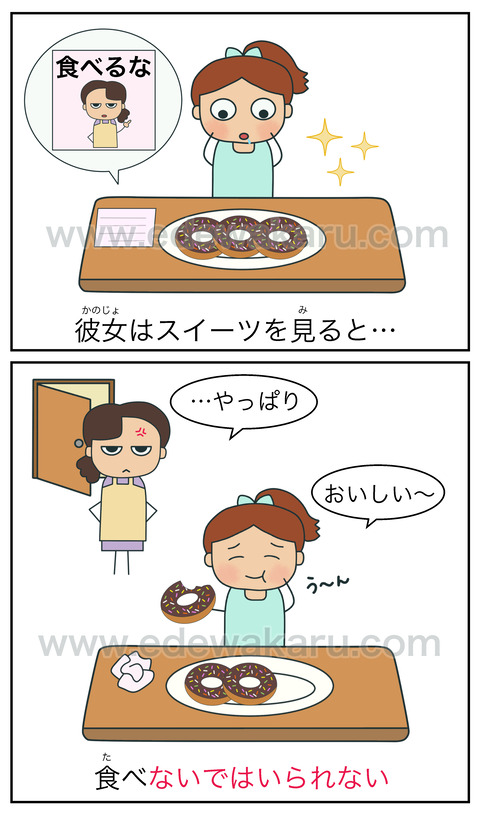
Meaning
Unable to hold back, naturally end up 〜ing
Unable to hold back, end up doing 〜
Cannot remain without doing 〜
How to use it
Verb [ない-form] + ないではいられない
Verb [ない-form] + ずにはいられない
Explanation
「〜ないではいられない」 is a sentence pattern meaning “unable to hold back, end up doing 〜” or “cannot remain without doing 〜.” It is used when you want to say that you cannot suppress the feeling of wanting to do something by your own effort, and so you naturally end up doing it. 😊 The person who is the subject “can’t hold back and ends up doing 〜,” so it is used with something that has feelings. In most cases, the subject is a person. 😮
[Examples]
① When she sees sweets, she can’t help eating them.
[Subject]
She
② It was hot today, so I couldn’t help turning on the air conditioner.
[Subject]
I
③ His story was so funny that I couldn’t help laughing.
[Subject]
I
④ Our dog seems unable to help barking when someone comes over.
[Subject]
Our dog
* This can be used for dogs too, since they have feelings. 😊
(Review: 〜ために・〜ためか)
Also, the more literary form of 「〜ないではいられない」 is 「〜ずにはいられない」.
[Example]
When she sees sweets, she can’t help eating them.
= When she sees sweets, she can’t help eating them.
Learn 「〜ないではいられない」 and 「〜ずにはいられない」 together. 😉
In context 5 examples
彼女はスイーツを見ると、食べないではいられない
→彼女はスイーツを見ると、我慢できず食べてしまう(復習:「スイーツ」と「デザート」)When she sees sweets, she can’t help eating them. → When she sees sweets, she can’t hold back and ends up eating them. (Review: “sweets” and “dessert”)
今日は暑かったので、エアコンをつけないではいられなかった
→今日は暑かったので、我慢できずにエアコンをつけてしまった(復習:エアコン)It was hot today, so I couldn’t help turning on the air conditioner. → It was hot today, so I couldn’t hold back and ended up turning on the air conditioner. (Review: air conditioner)
彼の話はおもしろくて、笑わないではいられなかったよ
→彼の話はおもしろくて、我慢できずに笑ってしまったよHis story was so funny that I couldn’t help laughing. → His story was so funny that I couldn’t hold back from laughing.
あの本を読んだら、泣かないではいられない
→あの本を読んだら、泣かないでいることはできないAfter reading that book, you can’t help crying. → After reading that book, you can’t remain without crying.
「口が軽い人」とは、何でも人に話さないではいられない人のことです
→「口が軽い人」とは、我慢できずに何でも人に話してしまう人のことです(復習:〜とは(定義・説明))(復習:口が軽い)A “loose-lipped person” is someone who can’t help telling others everything. → A “loose-lipped person” is someone who can’t hold back and ends up telling others everything. (Review: 〜とは (definition/explanation); 口が軽い)
Read the original source text
Meaning
我慢できず、自然に〜になってしまう
我慢できなくて、〜してしまう
〜しないでいることはできない
How to use it
動詞[ない形]+ないではいられない
動詞[ない形]+ずにはいられない
Explanation
「〜ないではいられない」は「我慢できずに〜してしまう」「〜しないでいることはできない」という意味を表す文型です。
「〜したい」という気持ちを自分の力では抑えることができなくて、自然に〜してしまう
と言いたい時に使います😊 主語になる人が「我慢できずに〜してしまう」という意味ですので、感情を持つものが使われます。
ほとんどの場合、主語には「人」がきます😮
[例]
①彼女はスイーツを見ると、食べ
ないではいられない
【主語】
彼女
②今日は暑かったので、エアコンをつけ
ないではいられなかった
【主語】
私
③彼の話はおもしろくて、笑わ
ないではいられなかった
よ
【主語】
私
④うちの犬は、人が来ると吠え
ないではいられない
ようだ
【主語】
うちの犬
*犬にも感情があるため、使うことができます😊
(復習:〜ために・〜ためか)
また
「〜ないではいられない」の書き言葉的な言い方は「〜ずにはいられない」です。
[例]
彼女はスイーツを見ると、食べ
ないではいられない
=彼女はスイーツを見ると、食べ
ずにはいられない
「〜ないではいられない」「〜ずにはいられない」は一緒に覚えておきましょう😉
Usage 2
Read this source entry ↗Meaning
Unable to hold back, naturally end up 〜ing
Unable to hold back, end up doing 〜
Cannot remain without doing 〜
How to use it
Verb [ない-form] + ないではいられない
Verb [ない-form] + ずにはいられない
Explanation
「〜ないではいられない」 is a sentence pattern meaning “unable to hold back, end up doing 〜” or “cannot remain without doing 〜.” It is used when you want to say that you cannot suppress the feeling of wanting to do something by your own effort, and so you naturally end up doing it. 😊 The person who is the subject “can’t hold back and ends up doing 〜,” so it is used with something that has feelings. In most cases, the subject is a person. 😮
[Examples]
① When she sees sweets, she can’t help eating them.
[Subject]
She
② It was hot today, so I couldn’t help turning on the air conditioner.
[Subject]
I
③ His story was so funny that I couldn’t help laughing.
[Subject]
I
④ Our dog seems unable to help barking when someone comes over.
[Subject]
Our dog
* This can be used for dogs too, since they have feelings. 😊
(Review: 〜ために・〜ためか)
Also, the more literary form of 「〜ないではいられない」 is 「〜ずにはいられない」.
[Example]
When she sees sweets, she can’t help eating them.
= When she sees sweets, she can’t help eating them.
Learn 「〜ないではいられない」 and 「〜ずにはいられない」 together. 😉
In context 5 examples
彼女はスイーツを見ると、食べないではいられない
→彼女はスイーツを見ると、我慢できず食べてしまう(復習:「スイーツ」と「デザート」)When she sees sweets, she can’t help eating them. → When she sees sweets, she can’t hold back and ends up eating them. (Review: “sweets” and “dessert”)
今日は暑かったので、エアコンをつけないではいられなかった
→今日は暑かったので、我慢できずにエアコンをつけてしまった(復習:エアコン)It was hot today, so I couldn’t help turning on the air conditioner. → It was hot today, so I couldn’t hold back and ended up turning on the air conditioner. (Review: air conditioner)
彼の話はおもしろくて、笑わないではいられなかったよ
→彼の話はおもしろくて、我慢できずに笑ってしまったよHis story was so funny that I couldn’t help laughing. → His story was so funny that I couldn’t hold back from laughing.
あの本を読んだら、泣かないではいられない
→あの本を読んだら、泣かないでいることはできないAfter reading that book, you can’t help crying. → After reading that book, you can’t remain without crying.
「口が軽い人」とは、何でも人に話さないではいられない人のことです
→「口が軽い人」とは、我慢できずに何でも人に話してしまう人のことです(復習:〜とは(定義・説明))(復習:口が軽い)A “loose-lipped person” is someone who can’t help telling others everything. → A “loose-lipped person” is someone who can’t hold back and ends up telling others everything. (Review: 〜とは (definition/explanation); 口が軽い)
Read the original source text
Meaning
我慢できず、自然に〜になってしまう
我慢できなくて、〜してしまう
〜しないでいることはできない
How to use it
動詞[ない形]+ないではいられない
動詞[ない形]+ずにはいられない
Explanation
「〜ないではいられない」は「我慢できずに〜してしまう」「〜しないでいることはできない」という意味を表す文型です。
「〜したい」という気持ちを自分の力では抑えることができなくて、自然に〜してしまう
と言いたい時に使います😊 主語になる人が「我慢できずに〜してしまう」という意味ですので、感情を持つものが使われます。
ほとんどの場合、主語には「人」がきます😮
[例]
①彼女はスイーツを見ると、食べ
ないではいられない
【主語】
彼女
②今日は暑かったので、エアコンをつけ
ないではいられなかった
【主語】
私
③彼の話はおもしろくて、笑わ
ないではいられなかった
よ
【主語】
私
④うちの犬は、人が来ると吠え
ないではいられない
ようだ
【主語】
うちの犬
*犬にも感情があるため、使うことができます😊
(復習:〜ために・〜ためか)
また
「〜ないではいられない」の書き言葉的な言い方は「〜ずにはいられない」です。
[例]
彼女はスイーツを見ると、食べ
ないではいられない
=彼女はスイーツを見ると、食べ
ずにはいられない
「〜ないではいられない」「〜ずにはいられない」は一緒に覚えておきましょう😉
日本語文型辞典
Meaning
Basic information: V-ずにはいられない. Means that one cannot restrain oneself by willpower and does it naturally. Written style; in conversation, “...ないではいられない” is used. Examples: ① Anyone who reads this book will surely be unable to help being moved. ② When I think of how she feels, I can’t help regretting what I did. ③ Everyone was captivated by her beauty. ④ I can’t help drinking alcohol to relieve the stress at work. ⑤ Even the most serious person would be unable to help laughing at that joke.
Read the original source text
Meaning
基本情報V-ずにはいられない説明意志の力では押さえられずに自然にそうしてしまうという意味を表す。書きことば的。話しことばでは「…ないではいられない」となる。例文① この本を読むと、誰でも感動せずにはいられないだろう。② 彼女の気持ちを思うと、自分のしたことを悔やまずにはいられない。③ 彼女の美しさには誰でも魅了されずにはいられなかった。④ 会社でのストレスを解消するために洒を飲まずにはいられない。⑤ その冗談にはどんなまじめな人も笑わずにはいられないだろう。
日本語文型辞典 英語版
Meaning
【ずにはいられない】[V-ずにはいられない]
Means that someone does something in spite of him/herself, or in spite of his/her determination to suppress it. Tends to be used in written language. In spoken language, it takes the form ...ないではいられない.
In context 5 examples
この本を読むと、誰でも感動せずにはいられないだろう。
Anyone who reads this book will surely be moved by it, I think.
彼女の気持ちを思うと、自分のしたことを悔やまずにはいられない。
When I consider her feelings, I can’t help but feel regret for what I did.
彼女の美しさには誰でも魅了されずにはいられなかった。
No one could help but be captivated by her beauty.
会社でのストレスを解消するために酒を飲まずにはいられない。
To relieve the stress at my workplace, I can’t do without alcohol.
その冗談にはどんなまじめな人も笑わずにはいられないだろう。
I don’t think anyone, no matter how serious, could help but laugh at that joke.
日本語NET JLPT文法解説まとめ
Meaning
Cannot help but ~ / can’t help ~ing.
Used when one cannot physically hold back, or when, seeing the state or circumstances of something, the speaker feels an urge to do something that cannot be suppressed by willpower.
How to use it
Vない + ずにはいられない(*しない→せずにはいられない)
Explanation
"cannot help doing / cannot help but do"
These expression indicate that a certain feeling could not be contained, or that a feeling naturally resulted from a certain condition.
In context 10 examples
この店のカレーはとても辛い。ちょっと食べたら、水を飲まずにはいられない。
The curry at this restaurant is very spicy. After eating just a little, I can't help drinking water.
この映画を見ると、誰でも感動せずにはいられないだろう。
Anyone who watches this movie will probably be unable to help being moved.
さっき蚊に刺されたところが痒くて、かかずにはいられない。
The spot where a mosquito bit me just now is itchy, and I can't help scratching it.
友達がいじめられているところを見たので、何か言わずにはいられなかった。
I saw my friend being bullied, so I couldn't help saying something.
あまりに暑くて、ジャケットを脱がずにはいられなかった。
It was so hot that I couldn't help taking off my jacket.
彼の困った顔がおかしくて、笑わずにはいられなかった。
His troubled expression was so funny that I couldn't help laughing.
たばこをやめたいんですが、見ると、吸わずにはいられないんです。
I want to quit smoking, but whenever I see cigarettes, I can't help smoking.
おもしろそうなアニメを見つけると、見ずにはいられないんです。
Whenever I find an anime that looks interesting, I can't help watching it.
私はわからないことがあると、辞書やインターネットですぐに調べずにはいられない性格だ。
Whenever there's something I don't understand, I'm the type who can't help looking it up right away in a dictionary or on the internet.
ストレスがたまっていて、もう酒を飲まずにはいられない。
I've been so stressed that I can't help drinking now.
Read the original source text
Meaning
どうしても〜しないでいることはできない。/ どうしても〜してしまう。
身体的に我慢できない場合や、ものごとの様子や事情を見て、話し手の心の中で「〜したい」とう気持ちが起こり、意志の力で抑えられない時に使う。
How to use it
Vない + ずにはいられない(*しない→せずにはいられない)
Explanation
"cannot help doing / cannot help but do"
These expression indicate that a certain feeling could not be contained, or that a feeling naturally resulted from a certain condition.
毎日のんびり日本語教師
How to use it
Verbない-form + ずにはいられない
Verbない-form + ないではいられない
Explanation
Expresses that an action is naturally brought about, regardless of one's will.
Notes
Similar and easily confused grammar patterns
In context 8 examples
純真無垢な主人公の恋を応援せずにはいられない。(不能不支持纯真无邪的主人公的恋爱。)
I can't help rooting for the pure and innocent protagonist's romance.
家に花置くのが好きで、花を見ると買わないではいられない。
I like keeping flowers at home, and whenever I see flowers, I can't help buying them.
期待すると恋は失敗する。しかし人間はやはり期待せずにはいられない生き物だ。
Expectations make love fail. But humans are creatures who can't help having expectations.
賢者は、話すべきことがあるから口を開く。愚者は、話さずにはいられないから口を開く。
A wise person opens their mouth because they have something to say. A fool opens their mouth because they can't help talking.
彼女のあの引き締まった細い足は見ずにはいられない。
I can't help looking at her slender, toned legs.
様々なことを知る中で、知らなければよかったと思わずにはいられない真実もあるはずだ。
As we learn about various things, there must be truths that we can't help thinking we would have been better off not knowing.
A党の政策には文句を言わずにはいられない。
I can't help complaining about Party A's policies.
ストロベリーもチーズケーキも大好物なので、ストロベリーチーズケーキ、この組み合わせは食べずにはいられない。
Strawberries and cheesecake are both among my favorite foods, so I can't resist this combination: strawberry cheesecake.
Read the original source text
How to use it
動ない形+ずにはいられない
動ない形+ないではいられない
Explanation
自分の意志とは関係なく、自然に動作が引き起こされることを表します。
Notes
似ていて紛らわしい文法