DoJG 日本語文法辞典(全集)
Meaning
Also; too; (not) either; (not) even
How to use it
(i) Vます | もする/もしない | |
| 読みもする | Also read |
| 読みもしない | Do not read, either; do not even read |
(ii) Adjective い stem | くもある/くもない | |
| 安くもある | Something is also cheap |
| 安くもない | Something is not cheap, either; something is not even cheap |
(iii) {Adjective な stem/Noun} | でもある/でもない | |
| 便利でもある | Something is also convenient |
| 便利でもない | Something is not convenient, either; something is not even convenient |
| 先生でもある | Someone is also a teacher |
| 先生でもない | Someone is not a teacher, either; someone is not even a teacher |
Explanation
A particle which implies that something else is also (not) the case.
In context 11 examples
吉岡さんは今年七十歳だが、毎日一キロ走る。時々泳ぎもする。
Although Mr. Yoshioka is seventy this year, he runs one kilometre every day. He occasionally swims, too.
この本は有益で、その上、面白くもある。
This book is beneficial and, on top of that, it is also interesting.
この映画は面白くないし、特に教育的でもない。
This movie is not interesting and not particularly educational, either.
奥田氏は弁護士であり、作家でもある。
Mr. Okuda is a lawyer and also a novelist.
由利子は最近廊下ですれ違っても見向きもしない。
Recently Yuriko does not (even) look at me even if we pass each other in the hall.
猿だっておかしければ笑いもするでしょう。
Apes also laugh if something is funny, right?
健一は新婚早々三日も家を空けたが、和代は泣かなかった。そして、怒りもしなかった。
Ken'ichi didn't go home for three days right after their marriage, but Kazuyo didn't cry. She didn't get mad, either.
あのアパートはあまり便利ではないし安くもない。
That apartment is not convenient and not inexpensive, either.
周遊券は便利な上、経済的でもある。
Excursion tickets are convenient; on top of that, they are also economical.
田口さんなんて友達でもないのに、どうしてそんなにしてあげるの。
Mr. Taguchi is not even a friend. How come you do so much for him?
安くもないのに、そうしてそんなものを買うんですか。
Why are you going to buy a thing like that which is not even cheap?
日本語文型辞典
Meaning
a. Nも
Used to add another item of the same kind. It presupposes that there are other similar things, though in some cases, such as ③, their existence is only implied. It can attach directly to a noun, or, as in ②, to a noun plus a particle.
b. NもNも
Used to list things of the same kind. It can attach directly to a noun or, as in ③ and ④, to a noun plus a particle.
a. …も…も…ない
Used with paired words such as “cold/hot” or “hands/feet” to mean neither of them. Many are set expressions; a more fixed expression is にっちもさっちもいかない (“to be at a complete impasse; to be unable to make any progress”).
b. V-るもV-ないもない
Repeats the same verb to mean “the situation is such that whether one does it or not is beside the point.” It is used to repeat part of what the other person said in order to strongly deny it or firmly admonish them that they should not say such a thing.
c. …もなにもない
Used to strengthen a negation. In ① and ②, it attaches to a noun and means that not only that thing but also anything else is absent, emphasizing that there is nothing. In ③–⑤, it repeats part of what the other person said to strongly deny it or firmly admonish them not to say such a thing. This usage is the same as V-るもV-ないもない.
d. …も…も
Uses paired words such as “go/not go” or “win/lose,” followed by expressions such as …しだいだ or …にかかっている, to mean “which one is chosen depends on…” or “which outcome occurs is determined by….”
An extreme example is given to imply that something less extreme is naturally true as well. For example, ① implies that since the person cannot even write the easiest hiragana, they naturally cannot write the more difficult katakana or kanji. Meaning can also be emphasized with さえ or まで, as in ⑧ and ⑨.
a. Quantity word+も
Used to emphasize a large quantity or high degree.
b. Quantity word+も…ない
Used to emphasize a small quantity or low degree and strengthen a negative statement. Take care not to confuse it with usage も-4a, which emphasizes a high degree.
c. Minimum quantity+も…ない
Words containing 1 that indicate a minimum quantity, such as ひとりも, ひとつも, and 一回も, or すこし are used with a negative expression to mean “not at all” or “not even a little.”
d. Quantity word+も …ば/…たら
Expresses that this quantity is enough for something to be realized. たら and と can be used as well as ば. The sentence often ends with an expression of the speaker’s conjecture, such as だろう, でしょう, or と思う.
e. Quantity word+も…か
Used with forms such as あったでしょうか or あろうか to express an approximate quantity based on the speaker’s subjective judgment.
a. Question word+(particle)+も
Used with words such as だれ, なに, どれ, どこ, and いつ to express that something applies in every case. When used in affirmative sentences, as in ①–④, it expresses complete affirmation; when used in negative sentences, as in ⑤–⑨, it expresses complete negation. However, いくらもある means “there is plenty,” while いくらもない means “there is almost none.”
b. なん+counter+も
Expresses a large quantity or a high number of times.
c. なん+counter+も…ない
Expresses a small quantity or a low number of times. Note, however, that as in Example 2 below, it can also express a large quantity.
Used, as in ①–③, when the speaker speaks with emotion about something that changes with the passage of time, such as seasonal changes or the beginning or end of something; or, as in ④–⑥, when softening an expression by implying that there are other similar cases as well.
Used to repeat the same noun to emphasize that the degree is out of the ordinary.
In forms such as XもXならYもYだ, expresses criticism that there is something wrong with both sides.
In the form XもありYもある, expresses that something is both X and Y.
Lists variations of something to express that there are various cases. Often lists contrasting things.
Used to emphasize a negative meaning. Often used when the speaker is surprised or exasperated because someone has not done something they would normally be expected to do.
A formal written way to say …もしないで.
⇾も11
Repeats the same verb to mean that the person cannot even do something they would normally be able to do. There are also set expressions such as the following.
How to use it
Nも【Addition】
…も …も【Paired】
NもNも…ない
NaもNaもない
A-くもA-くもない
R-もR-もしない
V-るも V-る/V-ない も
Extreme example+も
N(+particle)も
V-るのも
Quantity word+も
Question word+も
Nも【Topic】
NもN 【Emphasis】
NもNなら
NもNだが
…もあり…もある
NでもありNでもある
NaでもありNaでもある
A-くもありA-くもある
10 …もあれば…もある
NもあればNもある
VこともあればVこともある
…もV-ない
NもV-ない
R-もしない
…もV-ずに
…もの/…ことも
V-ない V-る もの/こと もV-ない
In context 127 examples
A:なんだか、すごく疲れました。
B:ええ、私もです。A: I’m awfully tired for some reason. B: Yes, me too.
東京へ行くので、帰りに静岡にも寄って来る。
I’m going to Tokyo, so I’ll stop by Shizuoka on the way back too.
今日も雨だ。
It’s raining again today.
私のアパートは日当りが悪い。そのうえ、風通しも良くない。
My apartment doesn’t get much sunlight. On top of that, it isn’t well ventilated either.
今日は風が強いし、雨も降りだしそうだ。
The wind is strong today, and it looks like it’s going to rain too.
セルソさんもイサベラさんもペルーの人です。
Both Celso and Isabella are from Peru.
山下さんも田中さんも、英語はあまり得意じゃないでしょう。
Neither Mr. Yamashita nor Mr. Tanaka is probably very good at English.
空港までは電車でもバスでも行ける。
You can get to the airport by either train or bus.
田中さんにも山下さんにも連終しておきました。
I contacted both Mr. Tanaka and Mr. Yamashita.
A:田中さんか森本さんを呼んできてくれない?
B:田中さんも森本さんもまだ出社していないんですけれど。A: Could you go get either Mr. Tanaka or Mr. Morimoto? B: Neither Mr. Tanaka nor Mr. Morimoto has come to work yet.
雨も降ってきたし、風も強くなってきました。
It has started raining, and the wind has gotten stronger too.
金もないし、暇もない。
I have neither money nor free time.
猫が好きな人もいるし、嫌いな人もいる。
Some people like cats, and some people dislike them.
寒くも暑くもなく、ちょうどいい気候だ。
It’s neither cold nor hot; the weather is just right.
成績は上がりも下がりもしない。現状維持だ。
The grades neither rise nor fall. They’re staying the same.
趣味で音楽をやるのに上手も下手もない。
When playing music as a hobby, there’s no such thing as being good or bad.
今はな、長男も次男もない時代だな。
We live in an age when it no longer matters whether you’re the eldest or second son.
最近は男も女もない時代だ。
These days, gender doesn’t matter.
あまりの強さに手も足もでない(=どうしようもない)。
They’re so strong that I can’t do a thing about it.
根も葉もない(=根拠のない)噂をたてられる。
Someone has started a completely baseless rumor.
私は逃げも隠れもしない。文句があったら、いつでも来なさい。
I’m neither running away nor hiding. If you have a complaint, come see me anytime.
(例) 今回の事件はにっちもさっちもいかない状態だ。
(Example) This incident is at a complete impasse; there’s no way forward.
A:すみません。十日までにはできそうもありません。
B:何を言ってるんだ。いまさら、できるもできないもないだろう。やってもらわないと困るよ。A: I'm sorry. It doesn't look like I'll be able to finish by the tenth. B: What are you talking about? At this point, there is no question of whether you can do it or not. We'll be in trouble if you don't do it.
A:すみませんでした。許してください。
B:許すも許さないもない。君の責任じゃないんだから。A: I'm sorry. Please forgive me. B: There's no question of forgiving you or not. It wasn't your responsibility.
A:ご主人、単身赴任なさるんですって?賛成なさったんですか。
B:賛成するもしないもないんですよ。全部一人で決めてしまってから、言うんですから。A: I hear your husband is going to take a job transfer alone. Did you agree to it? B: There was no question of agreeing or not. He told me only after he'd decided everything by himself.
A:反対なさるんじゃないかと心配しているんですが。:反対するもしないもない。喜んで応援するよ。
A: I'm worried you might oppose it. B: There's no question of opposing it. I'll be glad to support you.
愛もなにもない乾いた心に潤いが戻ってきた。
Life returned to a dry heart with no love or anything of the sort.
政治倫理も何もない政界には、何を言っても無駄だ。
There's no point in saying anything in a political world with no ethics or anything of the sort.
母:テレビを消して、手伝ってちょうだい。子供:だってえ、今いいところなんだもん。母:だってもなにもありません。すぐ来なさい。
Mother: Turn off the TV and come help me. Child: But this is the best part! Mother: No excuses. Come here right now.
A:被害状況をよく調べましてから、救助隊を派遣するかどうか決定したいと考えております。
B:何を言っているんだ。調べるも何もないだろう。これだけけが人が出ているんだから。A: We would like to investigate the extent of the damage thoroughly before deciding whether to dispatch a rescue team. B: What are you talking about? There's no question of investigating or anything. There are this many injured people.
A:反対なさるんじゃないかと心配しているんですが。
B:反対するもなにもない。喜んで応援するよ。A: I'm worried you might oppose it. B: There's no question of opposing it. I'll be glad to support you.
行くも止まるも君の心一つです。
Whether you go or stay is entirely up to you.
行くも行かないもあなたしだいです。
Whether you go or not is up to you.
成功するもしないも努力しだいだ。
Whether you succeed or not depends on your efforts.
勝つも負けるも時の運だ。
Winning or losing is a matter of luck.
日本語をはじめて1年になりますが、まだひらがなも書けません。
I've been studying Japanese for a year, but I still can't even write hiragana.
スミスさんは、かなり難しい漢字も読めます。
Mr. Smith can even read fairly difficult kanji.
こんな簡単な仕事は子供にもできる。
Even a child can do such a simple job.
恐ろしくて、声もでませんでした。
I was so terrified I couldn't even speak.
立っていることもできないほど疲れました。
I was so tired I couldn't even stand.
あんな奴は顔を見るのも殊だ。
That guy is so unpleasant that even looking at his face is unbearable.
最悪の場合も考えておいたほうがよい。
You should prepare for even the worst case.
頭が痛いときには、小さな音でさえもがまんできない。
When I have a headache, I can't stand even a quiet sound.
人類は月にまでも行くことができるようになった。
Humankind has become able to travel as far as the moon.
雨はもう三日も降っています。
It has been raining for as long as three days now.
大根一本が300円もするなんて…。
I can't believe a single daikon costs as much as 300 yen...
反戦デモには十万人もの人が参加した。
As many as 100,000 people took part in the antiwar demonstration.
いっペんにビールを20本も飲むなんて、あいつはどうかしているよ。
Drinking as many as 20 beers at once—there's something wrong with that guy.
ほしいけれど、10万円もするなら、買えない。
I'd like one, but if it costs as much as 100,000 yen, I can't buy it.
新しい車を買おうと思って貯金を始めたが、目標までまだ50万円も足りない。
I started saving because I want to buy a new car, but I'm still short of my goal by as much as 500,000 yen.
泳ぐのは苦手で、ほんの5mも泳げない。
I'm not good at swimming and can't even swim a mere five meters.
ここからあそこまで10mもないだろう。
It can't be as much as ten meters from here to there, can it?
財布の中には、500円も残っていない。
There isn't even 500 yen left in my wallet.
ベッドに入って10分もたたないうちに寝てしまった。
I fell asleep less than ten minutes after getting into bed.
(例) こんな豪勢な暮らしをしていて、わずか10万円も支払えないのか。(程度小)
学生の身分で月々10万円も支払えるはずがない。(程度大)(Example) Living in such luxury, you can't even pay a mere 100,000 yen? (small amount) There's no way a student could pay as much as 100,000 yen every month. (large amount)
客はひとりも来なかった。
Not a single customer came.
彼女のことは一目も忘れたことはない。
I have never forgotten her for even a moment.
外国へは一回も行ったことがない。
I've never been abroad even once.
失敗は彼が原因だったが、彼を責めようとする人はひとりもいなかった。
He was responsible for the failure, but there wasn't a single person who tried to blame him.
この料理は少しもおいしくない。
This dish isn't tasty at all.
この仕事なら、三日もあれば充分だ。
Three days would be more than enough for this job.
A:テープレコーダーつて、いくらぐらいするものですか。
B:そうですねえ、安いものなら、五千円もあれば買えますよ。A: About how much does a tape recorder cost? B: Well, you can buy one for as little as 5,000 yen.
もうしばらく待ってください。10分もしたら、先生は戻っていらっしゃると思います。
Please wait a little longer. I think the teacher will be back in about ten minutes.
雨はだんだん小降りになってきた。あと10分もすればきれいに晴れ上がるだろう。
The rain has gradually let up. In as little as ten minutes, the sky will probably clear completely.
このあたりは、自然が豊かだが、もう10年もたてば、開発されてしまうだろう。
Nature is abundant around here, but in as little as ten years, it will probably all be developed.
事故にあってから、救出されるまで1時間もあったでしょうか、夢中だったのでよくわかりません。
Was it as long as an hour from the accident until I was rescued? I was in such a daze that I don't really know.
A:その魚はどれくらいの大きさでしたか。
B:そうですねえ。50cmもあったかなあ。A: How big was that fish? B: Let's see... Was it as much as 50 centimeters?
昔、家の庭に大きな木があった。高さは4、5mもあっただろうか。杉か何かだったと思う。
There used to be a big tree in the garden at my house. I wonder if it was as tall as four or five meters. I think it was a cedar or something.
直径3センチもあろうかという氷の固まりが降ってきた。
Hailstones that looked to be as much as three centimeters in diameter came down.
山田さんはいつも本を読んでいる。
Mr. Yamada is always reading books.
だれもが知っている。
Everyone knows.
どれもみんなすばらしい。
Every one of them is wonderful.
どちらも正しい。
Both are correct.
誰も知らない。
Nobody knows.
このことは誰にも話さないでください。
Please don't tell anyone about this.
何も買えない。
I can't buy anything.
この辞書はどれも役にたたない。
None of these dictionaries is any use.
どちらも正しくない。
Neither one is correct.
(例) そんな話はいくらもある。
財布の中には、いくらも入っていない。(Example) There are any number of stories like that. There isn't much money in my wallet.
タイには何人も友だちがいる。
I have many friends in Thailand.
何回も海外旅行をしたことがある。
I've traveled abroad many times.
何度もノックしたが、返事がない。
I knocked many times, but there was no answer.
雨は何日も降り続いた。
It kept raining for many days.
何か月も留守にしたので、庭は荒れ放題だ。
I was away for months, so the garden is completely overgrown.
この問題が解ける人は何人もいないでしょう。
There probably aren't many people who can solve this problem.
私の国では、雨が降る日は一年に何日もない。
In my country, there aren't many days in a year when it rains.
すぐに終わります。何分もかかりません。
It'll be over soon. It won't take many minutes.
こんなチャンスは、人生に何度もない。
You don't get many chances like this in life.
(例) 1。試験まで後何日もない。(=短い間)
2。彼は何カ月も姿を見せなかった。(=長い間)(Example) 1. There aren't many days left until the exam. (= a short time) 2. He didn't show himself for many months. (= a long time)
秋も深まって、紅葉が美しい。
Autumn has deepened, and the autumn leaves are beautiful.
夜もふけた。
Night has grown late.
長かった夏休みも終わって、あしたからまた学校が始まります。
The long summer vacation is over, and school starts again tomorrow.
彼にも困ったものだ。
He's really something, that man.
さっきまであんなに泣いていた赤ん坊もようやく寝ました。
Even the baby, who had been crying so much just moments ago, has finally fallen asleep.
彼のきげんも直って、平和な空気が戻った。
His mood improved too, and a peaceful atmosphere returned.
あいつは、うそつきもうそつき、大うそつきだ。
That guy is a liar through and through—a big liar.
彼の両親の家は、山奥も山奥、一番近い駅から車で3時問もかかるところにある。
His parents' house is way out in the mountains; it takes a full three hours by car from the nearest station.
A:佐藤さん、酒飲みなんですって?
B:酒飲みも酒飲み、ものすごい酒飲みだ。A: I hear Mr. Sato is a drinker? B: A drinker? He's a tremendous drinker.
親も親なら子も子だね。
If the parents are like that, the children are just the same.
兄さんも兄さんだが、姉さんだってひどいよ。
My older brother is bad enough, but my older sister is terrible too.
わいろをもらう政治家も政治家だが、それを贈る企業も企業だ。
The politicians who take bribes are bad enough, but the companies that offer them are just as bad.
彼はこの会社の創始者でもあり、今の社長でもある。
He is both the founder of this company and its current president.
藤田さんは私の義兄でもあり師でもある。
Mr. Fujita is both my brother-in-law and my mentor.
彼の言ったことは、心外でもあり不愉快でもある。
What he said was both shocking and unpleasant.
娘の結婚は、宿しくもありさみしくもある。
My daughter's marriage is both a joy and a sadness.
起きる時間は決まっていない。早く起きることもあれば遅く起きることもある。
There is no set time when I get up. Sometimes I get up early, and sometimes I get up late.
人生、楽もあれば苦もある。
Life has its joys and its hardships.
株価の変動は誰にも分からない。上がることもあれば、下がることもある。
No one can predict stock price fluctuations. Sometimes they go up, and sometimes they go down.
車に乗っていると、便利な時もあれば、不便な時もある。
When you're in a car, there are times when it's convenient and times when it's inconvenient.
温泉といってもいろいろだ。硫黄が含まれているものもあれば、炭酸が含まれているものもある。
Hot springs come in all kinds. Some contain sulfur, while others contain carbon dioxide.
あいつは本当に失礼な奴だ。道であっても、挨拶もしない。
That guy is really rude. Even when we meet on the street, he doesn't even say hello.
息子は体のぐあいでも悪いのか、夕食に手もつけない。
Perhaps my son isn't feeling well; he hasn't even touched his dinner.
あの手は、ほんとうに強情だ。あんなにひどく叱られても、泣きもしない。
That woman is really stubborn. Even after being scolded so harshly, she doesn't even cry.
前から気がついていたのか、母は父が会社をやめたと聞いても驚きもしなかった。
Perhaps she had already noticed, because Mother didn't even look surprised when she heard that Father had quit his job.
うちの猫は魚がきらいで、さしみをやっても見向きもしない。
Our cat hates fish and doesn't even look at sashimi when I give it some.
さわりもしないのに、ガラスのコップが割れてしまった。
The glass cup broke even though nobody had even touched it.
夕方になっても、電気もつけないで、本に熱中していた。
Even after it got dark, I was engrossed in my book without even turning on the light.
山田さんは怒ったのか、さよならも言わないで帰ってしまった。
Perhaps Mr. Yamada was angry; he went home without even saying goodbye.
この寒いのに、子供たちは、上着も着ないで、走り回っている。
Even in this cold weather, the children are running around without even putting on their coats.
わたしは深く考えもせず、失礼なことを言ってしまった。
Without even thinking it through, I said something rude.
彼女は食事もとらずに、けが人の看病をしている。
She is caring for the injured without even eating.
彼女は、若い女性が興味を持ちそうなことにはいっさい目もくれず、研究に没頭していた。
She was absorbed in her research, paying no attention at all to anything that might interest a young woman.
寝坊したので、食べるものも食べないであわてて会社へ行った。
I overslept, so I rushed off to work without even eating what I should have eaten.
急に雨が降り出したので、買うものも買わないで帰ってきてしまった。
It suddenly started raining, so I came home without even buying what I meant to buy.
時間が足りなかったので、吉いたいことも十分には言えなかった。
I didn't have enough time, so I couldn't even say all the things I wanted to say.
こんな無能な医者では助かる命も助からない。
With such an incompetent doctor, even a life that could be saved won't be saved.
(例) 叔父が急に亡くなったというので、取るものも取りあえず(=大急ぎで)駆けつけた。
(Example) When I heard that my uncle had suddenly died, I rushed over without stopping to gather my things (= in great haste).
Read the original source text
Meaning
a. Nも
同類のものごとをさらにつけ加えるのに用いる。他に同じ様なものごとのあることが前提とされているが、その存在が単に暗示されているだけの③のような場合もある。名詞に直接付くだけでなく、②のように「名詞+助詞」に付くこともある。
b. NもNも
同車のものごとをならべて取り上げるのに用いる。名詞に直接付くだけでなく、③④のように「名詞+助詞」に付くこともある。
a. …も…も…ない
「寒い・暑い」「手・足」など一対になった言葉を取り上げて、それらのどちらでもないとい意味を表す。慣用的な表現が多く、さらに固定化したものに「にっちもさっちもいかない(ニビうにもならない)」がある。
b. V-るもV-ないもない
同じ動詞を繰り返し用いて「する、しないを問題にしていられる状況ではない」という意味を表す。相手のことばの山部を繰り返して、それを強く否定したり、そんなことを言っては困ると強くたしなめたりするのに使う。
c. …もなにもない
否定を強めるのに用いる。①②は、名詞に付いて、それだけでなくその他のものもないという意味を表し、ないことを強調している。③~⑤は、相手の言葉の一部を繰り返して、それを強く否定したり、そんなことを言っては困ると強くたしなめたりするのに使う。「V-るもV-ないもない」と同じ用法。
d. …も…も
「行く・行かない」「勝つ・負ける」など一対になった言葉を用い、後に「…しだいだ」「…にかかっている」などの表現を伴って、「どちらにするかは…にかかっている」「どちらになるかは…で決まる」という意味を表す。
極端な事例をあげて、それよりも程度の小さいことがらについては当然そうであることを暗示する。たとえば、①では一番やさしいひらがなも書けないのだから、「それよりも難しいカタカナや漢字は当然書けない」という含みがある。また、⑧~⑨のように「さえ」「まで」などを伴って意味を強調することもある。
a. 数量詞+も
数量の多さや程度の高さを強調するのに用いる。
b. 数量詞+も…ない
数量の少なさや程度の低いことを強調して否定の意を強めるのに用いる。程度の高いことを強調する「も-4a」の用法と紛らわしいので注意を要する。
c. 最小限の数量+も…ない
「ひとりも」「ひとつも」「一回も」など最小限の量を表す「1」の付く言葉や「すこし」を打ち消しの表現とともに使って、「まったく/ぜんぜん-ない」という意味を表す。
d. 数量詞+も …ば/…たら
あることがらが成立するのにこの程度の数量があれば十分だということを表す。「ば」のほかに、「たら」や「と」も用いられる。また、文末には「だろう」「でしょう」「と思う」など話し手の推量であることを表す表現がくることが多い。
e. 数量詞+も…か
「あったでしょうか」「あろうか」などといつしょに使われて、話し手の主観的な判断によるおおよその量を表す。
a. 疑問詞+(助詞)+も
「だれ・なに・どれ・どこ・いつ」などといっしょに使われて、どの場合にも当てはまることを表す。①~④のように肯定文に用いられる場合には全面肯定、⑤~⑨のように否定文に用いられる場合には全面否定を表す。ただし、次の「いくらもある」は、たくさんあること、「いくらもない」は、ほとんどないことを表す。
b. なん+助数詞+も
数量や回数などが多い様子を表す。
c. なん+助数詞+も…ない
数量や回数などが少ない様子を表す。ただし、次の(例2)のように数量が多いことを表す場合もあるので注意を要する。
①~③のように、季節の変化や、ものごとの始まりやおわりなど、時間が過ぎていくのにともなって変化するようなことがらを、話し手が感慨をこめてとりあげたり、④~⑥のように、他にも同じようなことがあることを暗示することで、表現をやわらげて提示したりする場合に用いる。
同じ名詞を繰り返して、その程度が普通でないことを強調するのに用いる。
「XもXならYもYだ」などの形で、どちらにも問題があることを非難する気持ちを表す。
「XもありYもある」の形で、XとYの両方であることを表す。
あることがらについてのバリエーションを並べて、いろいろな場合があることを表す。対照的なことがらを並べることが多い。
否定の意を強調するのに用いる。普通なら当然するはずのことをしないので、話し手が驚いたり、あきれたりしている場合に使うことが多い。
「…もしないで」の書きことば的な言い方。
⇾も11
同じ動詞を繰り返して、「普通なら当然できることもできない」という意味を表す。また、次のような慣用表現もある。
How to use it
Nも【累加】
…も …も【対句的】
NもNも…ない
NaもNaもない
A-くもA-くもない
R-もR-もしない
V-るも V-る/V-ない も
極端な事例+も
N(+助詞)も
V-るのも
数量詞+も
疑問詞+も
Nも【提題】
NもN 【強調】
NもNなら
NもNだが
…もあり…もある
NでもありNでもある
NaでもありNaでもある
A-くもありA-くもある
10 …もあれば…もある
NもあればNもある
VこともあればVこともある
…もV-ない
NもV-ない
R-もしない
…もV-ずに
…もの/…ことも
V-ない V-る もの/こと もV-ない
絵でわかる日本語
Usage 1
Read this source entry ↗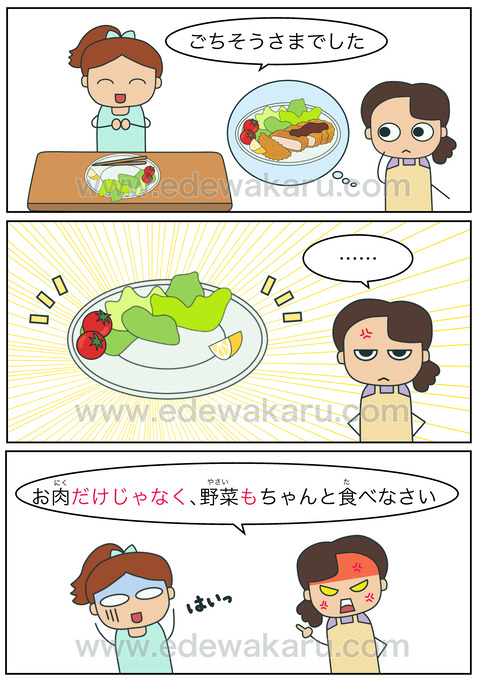
Meaning
both A and B
A as well as B
How to use it
Verb, adjective, or noun [plain form] + だけでなく〜も
Explanation
“AだけでなくBも” is a grammar pattern meaning “both A and B” or “A as well as B.” It is also used to say “B is ... in addition to A” or “B is ... besides A.” The expressions 〜も and 〜まで often follow 〜だけでなく.
[Patterns often used with 〜だけでなく]
・〜だけでなく + 〜も
・〜だけでなく + 〜まで
In conversation, 〜だけでなく is also often expressed as 〜だけじゃなく.
[Example]
Eat your vegetables properly, not just meat.
= Eat your vegetables properly, not just meat.
Let’s review the patterns similar to 〜だけでなく〜も 😊
[Related patterns]
In context 6 examples
母:お肉だけでなく、野菜もちゃんと食べなさい!!娘:は〜い
→お肉も野菜も、どちらもちゃんと食べなさいMother: Eat your vegetables properly too, not just meat!! Daughter: Okaaay. →Eat both the meat and the vegetables properly.
彼女は英語だけでなく、中国語も話せる
→英語も中国語も、どちらも話せるShe can speak Chinese as well as English. →She can speak both English and Chinese.
雨だけでなく、風まで強くなってきた
→雨も風も、どちらも強くなってきたNot only the rain, but even the wind is getting stronger. →Both the rain and the wind are getting stronger.
彼は頭がいいだけでなく、スポーツもできる
→彼は勉強もスポーツもどちらもできるHe’s not only smart, he’s good at sports too. →He’s good at both academics and sports.
彼女は遅刻してきただけでなく、宿題もしてこなかった
→遅刻もしたし、宿題もしてこなかったShe was not only late, she also didn’t do her homework. →She was late, and she also didn’t do her homework.
このアニメは日本だけでなく、海外でも人気だ
→日本でも海外でも、人気だThis anime is popular overseas as well as in Japan. →It’s popular both in Japan and overseas.
Read the original source text
Meaning
〜も〜も、どちらも〜
〜も〜も、両方〜
How to use it
動詞・形容詞・名詞[普通形]+だけでなく〜も
Explanation
「AだけでなくBも」は「AもBも、どちらも」「AもBも、両方〜」という意味の文型です。「A以外にBも〜だ」「Aの他にBも〜」と言いたい時にも使われます。「〜だけでなく」の後ろには「〜も」「〜まで」などがよく使用されます。
[「〜だけでなく」とよく使われる文型]
・〜だけでなく+〜も
・〜だけでなく+〜まで
また「
〜だけでなく」を会話で使う場合は「〜だけじゃなく」もよく使われます。
[例]
お肉
だけでなく、野菜もちゃんと食べなさい
=お肉
だけじゃなく、野菜もちゃんと食べなさい
「〜だけでなく〜も」に似ている文型を復習しておきましょう😊
【関連文型】
Usage 2
Read this source entry ↗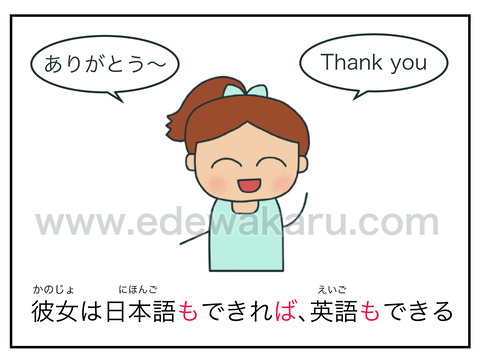
Meaning
Both … and …
How to use it
Noun [dictionary form] + も + verb・adjective [ば-form] + noun [dictionary form] + も
Explanation
「〜も〜ば〜も〜」is used with the same meaning as「〜も〜し〜も〜」. The most basic use is to list 「good thing + good thing」or「bad thing + bad thing」as in examples ①② 😊 As in examples ③④, when using the negative form, it becomes 「〜も〜なければ〜も〜ない」. Also, as in example ⑤, it can be used to list contrasting things, such as 「好き」and「嫌い」, so remember that 😀
【Summary of usage】
・「good thing + good thing」or「bad thing + bad thing」(examples ①②)
・Negative form: 「〜も〜なければ〜も〜ない」(examples ③④)
・Can also be used for contrasting things (such as “like/dislike,” “difficult/easy,” “good/bad”) (example ⑤)
Many people find the ば-form difficult and may feel this pattern is hard to use, but in conversation 「〜も〜し〜も〜」is more commonly used 😉
In context 5 examples
彼女は日本語もできれば、英語もできる【いいこと+いいこと】
→彼女は日本語もできるし、英語もできるShe can speak Japanese, and she can speak English too. 【good thing + good thing】 →She can speak Japanese, and she can speak English too.
このレストランは値段も高ければ、サービスも悪い【悪いこと+悪いこと】
→このレストランは値段も高いし、サービスも悪いThis restaurant is expensive, and the service is bad too. 【bad thing + bad thing】 →This restaurant is expensive, and the service is bad too.
旅行に行きたいが、お金もなければ時間もない【否定形+否定形】
→旅行に行きたいが、お金もないし、時間もないI want to travel, but I have no money and no time. 【negative + negative】 →I want to travel, but I have no money and no time.
彼はお酒も飲まなければ、たばこも吸わない 【否定形+否定形】
→彼はお酒も飲まないし、たばこも吸わないHe neither drinks alcohol nor smokes. 【negative + negative】 →He neither drinks alcohol nor smokes.
犬が好きな人もいれば、嫌いな人もいる【対照的なこと(好き・嫌い)】
→犬が好きな人もいるし、嫌いな人もいるSome people like dogs, while others dislike them. 【contrasting things (like/dislike)】 →Some people like dogs, while others dislike them.
Read the original source text
Meaning
〜も〜し、〜も〜
How to use it
名詞[辞書形]+も+動詞・形容詞[ば形]+名詞[辞書形]+も
Explanation
「〜も〜ば〜も〜」は「〜も〜し〜も〜」と同じ意味で使用されます。1番基本的な使い方は①②のように
「いいこと+いいこと」「悪いこと+悪いこと」を並べて使う
ものですね😊例文③④のように、
否定形を使う場合は「〜も〜なければ〜も〜ない」
となります。また、例文⑤の
「好き」と「嫌い」のように対照的(たいしょうてき)なことを並べて使用する場合
もありますので覚えておきましょう😀
【使い方まとめ】
・
「いいこと+いいこと」「悪いこと+悪いこと」
(例文①②)
・否定形は
「〜も〜なければ〜も〜ない」
(例文③④)
・
対照的なことにも使う
(「好き・嫌い」「難しい・簡単」「いい・悪い」など)(例文⑤)
「ば形」は苦手な人も多く、使いにくく感じるかもしれませんが、会話では「〜も〜し〜も〜」の方がよく使われます😉
Usage 3
Read this source entry ↗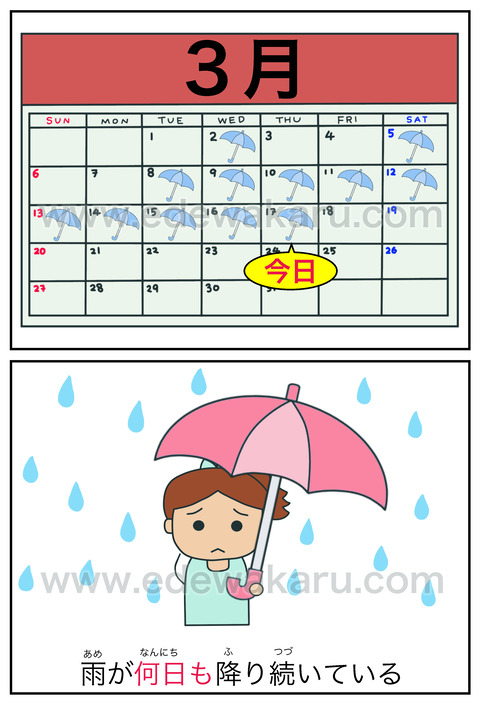
Meaning
Expresses a large quantity
How to use it
なん + counter + も
Explanation
“なん + counter + も” is a sentence pattern expressing a large quantity or number of times.
Remember that “何” is read as “なん,” not “なに” 😊
[For intermediate to advanced learners]
If you have time, learn it together with
“なん + counter + となく.”
(Review: なん〜となく (なん + counter + となく))
[Examples]
① It has continued raining for many days.
= It has continued raining for days on end.
② I have been to Hokkaido many times.
= I have been to Hokkaido countless times.
“なん + counter + も” is often used in conversation, so be sure to learn it well 😉
In context 3 examples
雨が何日も降り続いている
→雨が降り続いている日が長いIt has continued raining for many days. →It has been raining for a long time.
留学していたので、アメリカに何人も友達がいます
→留学していたので、アメリカにたくさん友達がいる(復習:「何人」の読み方は?)I have many friends in the United States because I studied abroad there. →I have a lot of friends in the United States because I studied abroad there (Review: How is “何人” read?).
デパートで、何年も会っていなかった友達に会った
→デパートで、長い間会っていなかった友達に会ったI ran into a friend I hadn’t seen in years at the department store. →I ran into a friend I hadn’t seen in a long time at the department store.
Read the original source text
Meaning
数量が多いことを表す
How to use it
なん+助数詞+も
Explanation
「なん+助数詞+も」は数量や回数が多いことを表す文型です。
「何」は「なに」ではなく「なん」と読む
と覚えておきましょう😊
【中級〜上級レベルの人へ】
余裕がある人は
「なん+助数詞+となく」
と一緒に覚えておきましょう。
(復習:なん〜となく(なん+助数詞+となく))
[例]
①雨が
何日も
降り続いている
=雨が
何日となく
降り続いている
②
何回も
北海道へ行ったことがある
=
何回となく
北海道へ行ったことがある
「なん+助数詞+も」は会話でもよく使いますので、しっかりと覚えておきましょう😉
Usage 4
Read this source entry ↗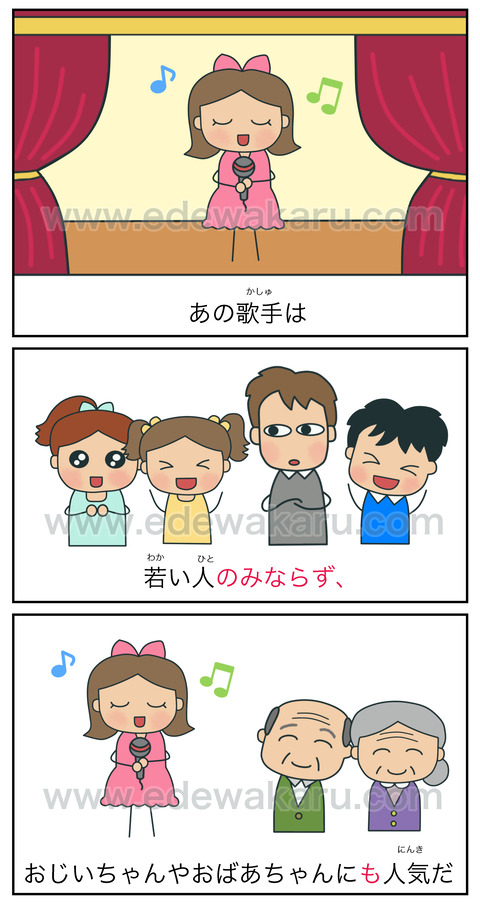
Meaning
not only 〜 but also 〜
not only 〜, but other things as well
How to use it
Verb, adjective, or noun [plain form] + のみならず〜も
Explanation
“〜のみならず〜も” is a sentence pattern meaning “not only 〜 but also 〜” or “not only 〜, but other things as well.”
It can also be used at the beginning of a sentence, as in “のみならず〜.” 😮
[Example]
She is fluent in English.
Moreover,
she is also fluent in Chinese.
This is a formal-sounding form of the N3 pattern “〜だけでなく〜も,” so it is not often used in everyday conversation, but you may hear it in the news and so on, so remember it. 😉
In context 3 examples
あの歌手は若い人のみならず、おじいちゃん、おばあちゃんにも人気がある
→あの歌手は若い人だけでなく、おじいちゃん、おばあちゃんにも人気があるThat singer is popular not only with young people, but also with grandpas and grandmas. → That singer is popular not only with young people, but also with grandpas and grandmas.
彼女は英語のみならず、中国語もペラペラなんだって
→彼女は英語だけでなく、中国語もペラペラなんだって(復習:〜って(伝聞))I hear she’s fluent not only in English, but also in Chinese. → I hear she’s fluent not only in English, but also in Chinese. (Review: 〜って (hearsay))
ポケモンは日本のみならず、海外でも有名だ
→ポケモンは日本だけでなく、海外でも有名だPokemon is famous not only in Japan, but overseas as well. → Pokemon is famous not only in Japan, but overseas as well.
Read the original source text
Meaning
〜だけでなく〜も
〜だけでなく、それ以外にも
How to use it
動詞・形容詞・名詞[普通形]+のみならず〜も
Explanation
「〜のみならず〜も」は「〜だけでなく〜も」「〜だけでなく、それ以外にも」という意味を表す文型です。
また「のみならず〜」というように、文の始めに使うこともできます😮
[例]
彼女は英語がペラペラだ。
のみならず、
中国語もペラペラだ
N3の文型「〜だけでなく〜も」のかたい言い方ですので、
日常会話(にちじょうかいわ)で使われることはあまりありません
が、ニュースなどでは聞く機会があると思いますので覚えておきましょう😉
Usage 5
Read this source entry ↗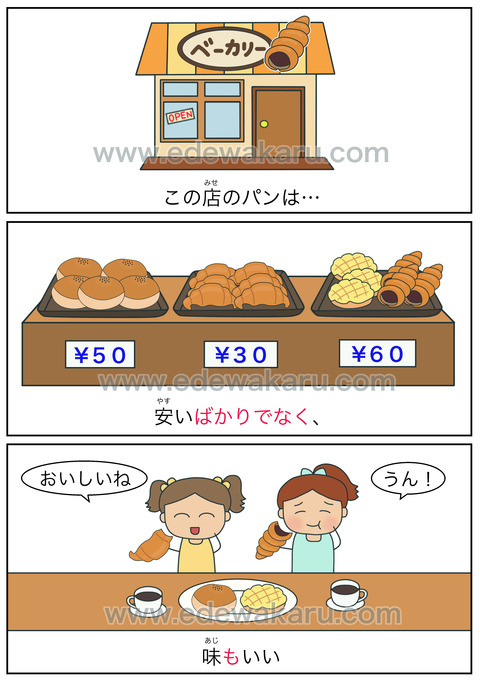
Meaning
Not only ~, but also ~
~ as well as ~
How to use it
Verb・adjective・noun [plain form]+ばかりでなく〜も
Explanation
「Aばかりでなく、Bも〜」 is a sentence pattern meaning “not only A, but also B.” In most cases, A is something expected or common, or something to a lesser degree than B. It is used to say “not only A, but also B,” or “not only A, but on top of that, B” 😮
[Examples]
① The bread at this shop is cheap, and the taste is good too.
[A] It is cheap.
[B] It tastes good.
→ There are often shops that are cheap, but this one is not only cheap; its food tastes good too.
② She can speak not only English, but also Chinese.
[A] She can speak English.
[B] She can speak Chinese.
→ There are many people who can speak English, but she can speak not only English, but Chinese as well.
③ It’s not only raining today; the wind is strong too…
[A] Heavy rain is falling.
[B] The wind is strong.
→ Heavy rain is common, but today the wind is strong as well.
There are many sentence patterns formed with 「ばかり」, so it’s good to learn them together 😊
[The 「ばかり」 series]
〜たばかり
〜てばかりいる・〜てばかりだ
〜てばかりはいられない・〜てばかりもいられない
〜と言わんばかりに・〜とばかりに
〜とばかり思っていた
〜とばかりは言えない
〜ばかり (quantity word+ばかり)
〜ばかりだ
〜ばかりだ (all prepared)
〜ばかりで
〜ばかりでなく〜も
〜ばかりに
〜ばかりの (figurative)
〜ばかりは
〜んばかり
In context 5 examples
この店のパンは安いばかりでなく、味もいい
→この店のパンは安いだけでなく、味もいい(復習:「味」と「におい」)The bread at this shop is not only cheap, but tastes good too. → The bread at this shop is not only cheap, but tastes good too. (Review: 「味」 and 「におい」)
山田くんは遅刻したばかりでなく、宿題も忘れたそうよ
→山田くんは遅刻しただけでなく、宿題も忘れたそうよ(復習:〜そうだ(伝聞))I heard Yamada was not only late, but also forgot his homework. → I heard Yamada was not only late, but also forgot his homework. (Review: 〜そうだ (hearsay))
彼女は英語ばかりでなく、中国語も話せる
→彼女は英語だけでなく、中国語も話せるShe can speak not only English, but also Chinese. → She can speak not only English, but also Chinese.
A:今日は雨ばかりでなく、風も強いね…B:台風が来るんじゃない?(復習:〜んじゃない・〜じゃない)
→今日は雨だけでなく、風も強いね…A: It’s not only raining today; the wind is strong too… B: Maybe a typhoon is coming? (Review: 〜んじゃない・〜じゃない) → It’s not only raining today; the wind is strong too…
彼女はかわいいばかりでなく、性格もいい
→彼女はかわいいだけでなく、性格もいいShe is not only cute, but has a good personality too. → She is not only cute, but has a good personality too.
Read the original source text
Meaning
〜だけでなく〜も
〜はもちろん〜も
How to use it
動詞・形容詞・名詞[普通形]+ばかりでなく〜も
Explanation
「Aばかりでなく、Bも〜」は「AだけでなくBも〜」という意味を表す文型です。ほとんどの場合、「A」には当然のことやよくあること、Bより程度が低いことなどが入り、
「Aだけでなく、さらにB」「Aだけでなく、その上B」
と言いたい時に使われます😮
[例]
①この店のパンは安い
ばかりでなく、味
も
いい
【A】安い
【B】味がいい
→安い店はよくあるが、安い
だけでなくさらに
味
も
いい
②彼女は英語
ばかりでなく、中国語
も
話せる
【A】英語が話せる
【B】中国語が話せる
→英語が話せる人はよくいるが、彼女は英語
だけではなく、さらに
中国語
も
話せる
③今日は雨
ばかりでなく、風
も
強いね…
【A】強い雨が降る
【B】風が強い
→強い雨が降ることはよくあるが、今日は
さらに
風も強い
「ばかり」がつくる文型はたくさんありますので、一緒に覚えておくといいと思います😊
【「ばかり」シリーズ】
〜たばかり
〜てばかりいる・〜てばかりだ
〜てばかりはいられない・〜てばかりもいられない
〜と言わんばかりに・〜とばかりに
〜とばかり思っていた
〜とばかりは言えない
〜ばかり(数量詞+ばかり)
〜ばかりだ
〜ばかりだ(準備完了)
〜ばかりで
〜ばかりでなく〜も
〜ばかりに
〜ばかりの(比喩)
〜ばかりは
〜んばかり
Usage 6
Read this source entry ↗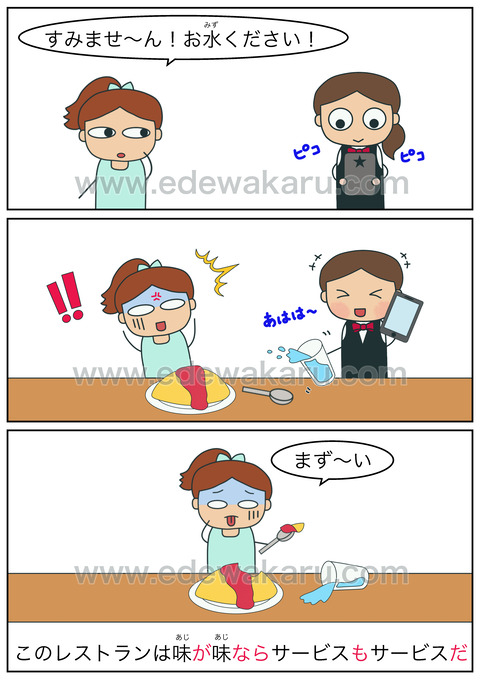
Meaning
Both ~ and ~ are bad
How to use it
Noun [dictionary form] + が + Noun [dictionary form] + なら + Noun [dictionary form] + も + Noun [dictionary form] + だ
Explanation
「AがAならBもBだ」 is a sentence pattern meaning “Both A and B are bad.”
A and B refer to people or things with a close relationship, such as a parent and child or a husband and wife. It is often used to criticize both A and B. 「AがAならBもBだ」 can also be changed to 「AもAならBもBだ」.
[Example]
If the food is bad,
then the service is bad, too.
→
The food is bad,
and the service is bad, too.
「〜が〜なら〜も〜だ」 is a commonly used pattern, so advanced learners should learn it 😉
In context 4 examples
このレストランは味が味ならサービスもサービスだ
→味もサービスも、どちらも最悪だAt this restaurant, the food is bad, and the service is bad, too. → Both the food and the service are terrible.
A:毎日遅刻して、先生に怒られないの?B:怒られないよ〜。先生も毎日遅れてくるしA:…。学生が学生なら、先生も先生ね…
→学生も先生も、どちらもよくないね…A: You’re late every day. Doesn’t the teacher get mad at you? B: No. The teacher is late every day, too. A: ... If the students are like that, and the teacher is like that, too... → Both the students and the teacher are bad...
A:お隣の奥さんは、何かにつけ文句を言ってくるの…B:聞いたところによると、旦那さんもそうらしいわよA:…。妻が妻なら、夫も夫だね
→妻も夫もどちらもよくないねA: The woman next door complains about everything... B: From what I hear, her husband is like that, too. A: ... If the wife is like that, and the husband is like that, too. → Both the wife and the husband are bad.
A:あの家の子は、すごく乱暴よね…B:うん。でも注意すると、母親がキレるんだってA:そうなんだ…親が親なら、子も子だね
→親も子供も、どちらもよくないんだねA: That family’s child is so rough... B: Yeah. But apparently, when someone tells them off, the mother loses her temper. A: I see... Like parent, like child. → Both the parent and the child are bad.
Read the original source text
Meaning
〜も〜も、どちらもよくない
How to use it
名詞[辞書形]+が+名詞[辞書形]なら+名詞[辞書形]+も+名詞[辞書形]だ
Explanation
「AがAならBもBだ」は「AもBもどちらもよくない」という意味の文型です。
「A」と「B」には、[親・子][夫・妻]など、関係が深い人やものが入ります。「A」と「B」の両方を批判する場合によく使われます。「AがAならBもBだ」は「AもAならBもBだ」にチェンジすることもできます。
[例]
味
が
味
なら
サービス
も
サービス
だ
→味
も
味
なら
サービス
も
サービス
だ
「〜が〜なら〜も〜だ」はよく使われる文型ですので、上級レベルの人は覚えておきましょう😉
Usage 7
Read this source entry ↗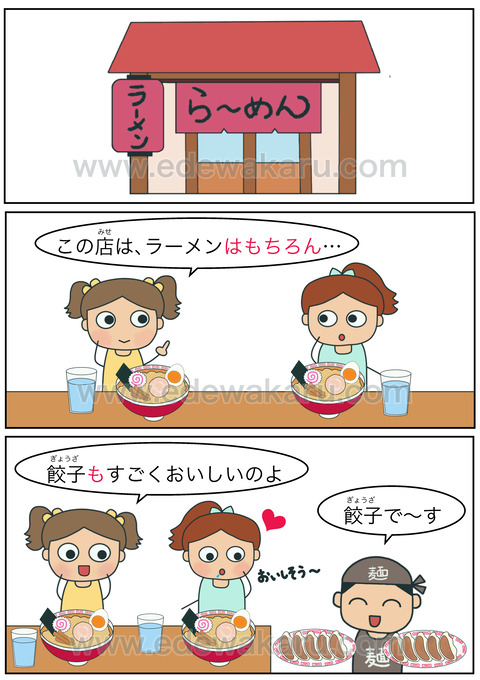
Meaning
A is of course, and B too
Not only A, but also B
How to use it
Noun [dictionary form] + はもちろん
Explanation
“AはもちろんBも” is a sentence pattern meaning “A goes without saying, and B too” or “A is a given, and the same is true of B.” “A” is something so obvious it need not be stated, and is used as a representative example when you want to say that “B” is true as well. “〜はもちろん” can be changed to “〜はもちろんのこと.”
[Example]
She can speak not only English, of course, but Chinese too.
= She can speak not only English, of course, but Chinese too.
The more formal form of “〜はもちろん” is “〜はもとより,” so be sure to learn them together 😊
[Related articles]
In context 6 examples
この店は、ラーメンはもちろん餃子もすごくおいしいのよ
→ラーメンは当然、さらに餃子もすごくおいしいのよAt this restaurant, not only the ramen but also the gyoza are really delicious. → The gyoza, as well as the ramen, are really delicious.
彼女は、英語はもちろん中国語も話すことができる
→英語は当然、さらに中国語も話すことができるShe can speak not only English, of course, but Chinese too. → She can speak Chinese as well as English, of course.
彼は勉強はもちろんスポーツもできるからモテるんだね
→勉強は当然として、さらにスポーツもできるからモテるんだねHe’s popular because he can do sports as well as study, of course.
あのカフェは、土日はもちろん平日もお客さんがいっぱいいる
→土日は当然、平日もお客さんがいっぱいいるThat café is full of customers on weekdays as well as weekends, of course.
このアニメは、日本ではもちろん海外でも人気がある
→日本では当然として、海外でも人気があるThis anime is popular overseas as well as in Japan, of course.
先生:今日の授業の復習はもちろん、明日の授業の予習もするように学生:はい
→今日の復習は当然として、予習もするようにTeacher: Be sure to review today’s lesson, and of course prepare for tomorrow’s lesson too. Student: Yes. → Make sure to review today’s lesson, and prepare for tomorrow’s as well.
Read the original source text
Meaning
〜は当然、さらに〜も
How to use it
名詞[辞書形]+はもちろん
Explanation
「AはもちろんBも」は「Aは当然として、さらにBも」「Aは当然〜で、Bも同じだ」という意味の文型です。 「A」には言わなくても当然なことが代表例(だいひょうれい)として入り、さらに「B」も同じだと言いたい時に使われます。「〜はもちろん」は「〜はもちろんのこと」にチェンジすることができます。
[例]
彼女は、英語
はもちろん
中国語も話すことができる
=彼女は、英語
はもちろんのこと
中国語も話すことができる
「〜はもちろん」のかたい言い方は「〜はもとより」ですので、一緒に覚えておきましょう😊
【関連記事】
どんなときどう使う 日本語表現文型辞典
Usage 1
Meaning
both…and…
How to use it
Nも + [plain form] + し, Nも
Explanation
も~し、~も
1)同類の性質のことを重ねて述べる言い方。「N1も~し、N2も…(今週もひまだし、来週もひまです)」という言い方のほうが「N1もN2も…(今週も来週もひまです)」という言い方より気持ちを重ねる意識が強い。
2) ❸ のように、「Nも」がない形もある。
3) ❷ のように助詞「は・が・を」の後ろに「も」がつくと、「は・が・を」は消える。その他の助詞は ❹ のようにそのまま残る。
4)「も~ば、~も・も~なら、~も」より話し言葉的。
1)Complementary attributes in same category. N1 も~し, N2も (as in "I'm free this week and I'm free next") expresses stronger consciousness of comple-mentariness than N1もN2も (as in "I'm free both this week and next").
2)Can be used without the Nも, as in sentence ❸ .
3)When も follows particles は, が, orを, they disappear, as in sentence ❷ . Other particles remain, as in sentence ❹ .
4)More of spoken form than も~ば, も or も~なら~も.
In context 4 examples
この服はデザインもいいし、色もいいです。
This outfit has a nice design, and the color is nice too.
あしたは遠足です。お弁当も作ったし、飲み物ももう買いました。
We have a field trip tomorrow. I've made a lunch, and I've already bought drinks too.
わたしのアパートは狭いし、駅から遠いし、日当たりもよくないです。けれども、家賃は安いです。
My apartment is small, far from the station, and doesn't get much sunlight either. But the rent is cheap.
きのうは市役所へも行ったし、図書館へも行って、忙しい1日でした。
Yesterday I went to city hall and to the library too, so it was a busy day.
Read the original source text
Meaning
both…and…
How to use it
Nも+〔普通形〕+し、Nも
Explanation
も~し、~も
1)同類の性質のことを重ねて述べる言い方。「N1も~し、N2も…(今週もひまだし、来週もひまです)」という言い方のほうが「N1もN2も…(今週も来週もひまです)」という言い方より気持ちを重ねる意識が強い。
2) ❸ のように、「Nも」がない形もある。
3) ❷ のように助詞「は・が・を」の後ろに「も」がつくと、「は・が・を」は消える。その他の助詞は ❹ のようにそのまま残る。
4)「も~ば、~も・も~なら、~も」より話し言葉的。
1)Complementary attributes in same category. N1 も~し, N2も (as in "I'm free this week and I'm free next") expresses stronger consciousness of comple-mentariness than N1もN2も (as in "I'm free both this week and next").
2)Can be used without the Nも, as in sentence ❸ .
3)When も follows particles は, が, orを, they disappear, as in sentence ❷ . Other particles remain, as in sentence ❹ .
4)More of spoken form than も~ば, も or も~なら~も.
Usage 2
Meaning
both…and…
How to use it
Nも + Vば / イAければ / ナAなら / Nなら + Nも
Explanation
も~ば、~も
~も~し~も
1)前の事柄と同じ方向の事柄を加える(プラスとプラス、マイナスとマイナス)。
2) ❻ ❼のように、同類のものや対立するものを並べて両方ある、という言い方もある。
1)Adds like evaluations to what precedes it (positives with positives, negatives with negatives).
2)Also can be used as in sentences ❻ and ❼ to show parallels in contrasts.
In context 7 examples
あしたは数学の試験もあればレポートも提出しなければならないので、今晩は寝られそうもない。
I have a math exam tomorrow and also have to turn in a report, so I probably won't be able to sleep tonight.
あの人は性格もよければ頭もよさそうです。
That person has a good personality and seems intelligent too.
きのうの試験は問題も難しければ量も多かったので、苦労しました。
Yesterday's exam was difficult and had a lot of questions, so I struggled.
あのメーカーの製品は値段も手ごろなら、アフターケアもきちんとしていますね。
That manufacturer's products are reasonably priced, and their after-sales service is reliable too.
今度の仕事は予算も不足なら、スタッフも足りない。成功は望めそうもない。
For this project, the budget is insufficient and the staff are short. It doesn't look like success is possible.
りんごにはいろいろな種類があります。赤いのもあれば、黄色いのもあります。
There are various kinds of apples. Some are red, and some are yellow.
楽もあれば苦もあるのが人生というものだ。
Life is such that there are times of ease and times of hardship.
Read the original source text
Meaning
both…and…
How to use it
Nも+Vば/イAければ/ナAなら/Nなら+Nも
Explanation
も~ば、~も
~も~し~も
1)前の事柄と同じ方向の事柄を加える(プラスとプラス、マイナスとマイナス)。
2) ❻ ❼のように、同類のものや対立するものを並べて両方ある、という言い方もある。
1)Adds like evaluations to what precedes it (positives with positives, negatives with negatives).
2)Also can be used as in sentences ❻ and ❼ to show parallels in contrasts.
日本語文型辞典 英語版
Meaning
B:ええ、私もです。
Yeah, me, too.
Used to add something to another thing of the same type. There are also cases such as example
(3)
where an assumption of similarity is made but its existence is only hinted at. It is not always attached directly to a noun, but as in
(2)
, it can also be attached to a noun plus a particle.
b. NもNも
B:田中さんも森本さんもまだ出社していないんですけれど。
I’m afraid neither Tanaka-san nor Morimoto-san has arrived at work yet.
Used to enumerate and pick out two things of the same kind. It is not always attached directly to a noun but, as in examples
(3)
and
(4)
, can also be attached to a noun plus a particle.
Picks out pairs such as “cold/hot” and “hands/legs” and means “neither (of them).” It is often used in idiomatic or set phrases such as にっちもさっちもいかない (a situation about which nothing can be done).
(例)今回の事件はにっちもさっちもいかない状態だ。
Nothing can be done about this incident.
b. V-るもV-ないもない
B:何を言ってるんだ。いまさら、できるもできないもないだろう。やってもらわないと困るよ。
What are you saying?! By now it’s not a case of can or cannot. If you don’t get it done, it will be a big problem!
B:許すも許さないもない。君の責任じゃないんだから。
It’s not a question of forgiveness. It’s not your fault in the first place.
B:賛成するもしないもないんですよ。全部一人で決めてしまってから、言うんですから。
I can’t agree or disagree. He told me after he’d already decided everything by himself.
B:反対するもしないもない。喜んで応援するよ。
It’s not a question of opposing (it) or not. I’ll happily back you up.
Using repetition of the same verb, this means “it’s not a question of (doing) or (not doing).” Repeating part of the other person’s words, it is used to strongly repudiate them or to strongly rebuke the person for saying such things.
c. ...もなにもない
子供: だってぇ、今いいところなんだもん。
Child: But, this is a good part right now.
母:だってもなにもありません。すぐ来なさい。
Mother: No buts. Come here now.
B:何を言っているんだ。調べるも何もないだろう。これだけけが人が出ているんだから。
What are you saying?! There’s no point in an inspection. There are so many injured persons.
B:反対するもなにもない。喜んで応援するよ。
Opposed? That’s nonsense! Of course, I will gladly support you.
Used to strengthen a negation. In examples
(1)
and
(2)
, when attached to a noun, it demonstrates the meaning that “not only one thing but another thing also is lacking” and, therefore, emphasizes that lack. In examples
(3)
to
(5)
, repeating part of the other person’s words, it is used to strongly repudiate them or to strongly rebuke the person for saying such things. The same usage rules apply as to V-るもV-ないもない.
d. ...も...も[V-るも V-る/V-ない も]
Used with pairs of opposites, like 行く・行かない (to go/not to go) and 勝つ・負ける (to win/to lose), and followed by expressions like Xしだいだ and Xにかかっている. Means “which one you choose depends on X” or “whatever comes to pass, X will decide it.”
By putting forward an extreme example, this suggests that naturally a thing which is (something) to a lesser degree than that is also the case. For example, in example
(1)
as they can’t write the easiest script, hiragana, the implication is that of course they cannot write the more difficult katakana and Chinese characters. Also, as in examples
(8)
and
(9)
, the meaning is strengthened by using it together with さえ and まで.
Used to emphasize the largeness of a quantity or the extent or degree of something.
b. 数量詞+も...ない
Used to emphasize the sense of the smallness of a quantity or the lowness of a degree. Care must be taken not to confuse the rules of usage for this with those for Usage 4a of も, which emphasizes a high level of degree.
(例)こんな豪勢な暮らしをしていて、わずか 10 万円も支払えないのか。(程度小)
Living in this kind of luxury, can’t you even pay 100,000 yen? (a small amount for a rich person)
(例)学生の身分で月々 10 万円も支払えるはずがない。(程度大)
You can’t spend 100,000 yen a month when you’re (just) a student. (a large amount for a student)
c. 最小限の数量+も...ない
Attached to “one (person/thing/time)” or used together with phrases which deny that there is even a little of something, this means “absolutely not.../ not at all....”
d. 数量詞+も ...ば/...たら
B:そうですねえ、安いものなら、五千円もあれば買えますよ。
Hmm, if you want a cheap one, you can buy one for just 5,000 yen.
This shows that there is a sufficient quantity or degree of something for a certain thing to take place. たら and と can also be used in place of ば. Furthermore, sentence endings such asだろう, でしょう and と思う, which express the speaker’s conjecture, are often used with this expression.
e. 数量詞+も...か
B:そうですねえ。50 cmもあったかなあ。
Hmm, I guess it was about fifty centimeters.
Often used with phrases such as あったでしょうか and あろうか. Expresses the speaker’s subjective judgment about a quantity.
Used with terms such as だれ (who), なに (what), どれ (which), どこ (where), and いつ (when), this expresses that, whatever the case may be, the statement applies. As in examples
(1)
-
(4)
, in an affirmative sentence, the whole is affirmative, and in negative sentences, like
(5)
-
(9)
, the whole is negative. However, いくらもある, which comes next, expresses that there are a lot, while いくらもない expresses that there is almost none.
(例)そんな話はいくらもある。
There are many such stories.
(例)財布の中には、いくらも入っていない。
There is almost nothing in my purse.
b. なん+助数詞+も
Expresses that there is a large quantity or high frequency of something.
c. なん+助数詞+も...ない
Expresses that there is a small quantity or low frequency of something. Care must be taken, as in certain cases this may be used to express a large quantity, as seen in example 2 below.
(例1)試験まで後何日もない。(=短い間)
The test isn’t many days off. (short duration)
(例2)彼は何ヵ月も姿を見せなかった。(=長い間)
I haven’t seen him around for months. (long duration)
As in examples
(1)
-
(3)
, this expresses the speaker’s deep emotion regarding a change which occurs together with the passing of time, the beginning or ending of something, or the changing of the seasons. As in
(4)
-
(6)
, where there is a hint of another similar thing, this is used to soften the presentation of something.
B:酒飲みも酒飲み、ものすごい酒飲みだ。
A drinker among drinkers—he really puts it away!
Repeats the same noun so as to emphasize that the degree being talked about is not usual.
Used in the form XもXならYもYだ, this expresses critically that both X and Y have problems.
In the form XもありYもある, this means that someone or something is X as well as Y.
1
Shows the variation in something and expresses that there are different cases. It is often used to enumerate contrasting things.
1
Used to emphasize a negative. Often used to express the speaker’s surprise or shock that what would usually be expected is not done or does not happen.
1
A way of saying ...もしないで (without doing...) that has the tone of written language.
→
1
1
1
Repeating the same verb, this means “cannot do (something) that would usually be possible.” There is also the following idiomatic expression.
(例)叔父が急に亡くなったというので、取るものも取りあえず(=大急ぎで)駆けつけた。
My uncle died suddenly and so, without a moment’s delay (in a big hurry), we rushed to be there.
How to use it
1. Nも〈cumulative increase〉a. Nも
2. ...も...も〈antithetical phrases〉a. ...も...も...ない[NもNも...ない][Na もNa もない][A-くもA-くもない][R-もR-もしない]
3. 極端な事例+も[N(+助詞)も][V-るのも]
4. 数量詞+もa. 数量詞+も
5. 疑問詞+もa. 疑問詞(+助詞)+も
6. Nも〈topic〉
7. NもN〈emphasis〉
8. NもNならNもNだが
9. ...もあり...もある[NでもありNでもある][Na でもありNa でもある][A-くもありA-くもある]
0. ...もあれば...もある[NもあればNもある][VこともあればVこともある]
1. ...もV-ない[NもV-ない][R-もしない]
2. ...もV-ずに
3. ...もの/...こと もV-ない[V-る もの/こと もV-ない]
In context 121 examples
A:なんだか、すごく疲れました。
Phew, I’m really tired.
東京へ行くので、帰りに静岡にも寄って来る。
As I’m going to Tokyo, I’ll also stop off in Shizuoka on the way home.
今日も雨だ。
Today’s another rainy day.
私のアパートは日当りが悪い。そのうえ、風通しも良くない。
My apartment doesn’t get much sun. On top of that, the ventilation is also poor.
今日は風が強いし、雨も降りだしそうだ。
Today it is windy, and it also looks like rain.
セルソさんもイサベラさんもペルーの人です。
Both Celso-san and Isabella-san are from Peru.
山下さんも田中さんも、英語はあまり得意じゃないでしょう。
Neither Yamashita-san nor Tanaka-san seems to be very good at English.
空港までは電車でもバスでも行ける。
You can get to the airport by both train and bus.
田中さんにも山下さんにも連絡しておきました。
I have contacted both Tanaka-san and Yamashita-san.
A:田中さんか森本さんを呼んできてくれない?
Will you call Tanaka-san or Morimoto-san?
雨も降ってきたし、風も強くなってきました。
Rain started to fall and the wind grew strong, too.
金もないし、暇もない。
I have neither money nor time.
猫が好きな人もいるし、嫌いな人もいる。
There are people who love cats as well as people who hate them.
寒くも暑くもなく、ちょうどいい気候だ。
It isn’t cold and it isn’t hot—the climate is just right.
成績は上がりも下がりもしない。現状維持だ。
Results aren’t going up or down. The status quo is being maintained.
趣味で音楽をやるのに上手も下手もない。
My hobby is music, but I’m not particularly good or bad at it.
今はな、長男も次男もない時代だな。
Now is an age where there’s no difference between a first and second son.
最近は男も女もない時代だ。
Nowadays, we live in an age where it doesn’t matter if you’re a man or a woman.
あまりの強さに手も足もでない(=どうしようもない)。
Because (the opponent) is so strong there is nothing I can do (to counteract that).
根も葉もない(=根拠のない)噂をたてられる。
A groundless rumor was started.
私は逃げも隠れもしない。文句があったら、いつでも来なさい。
I’ll neither run nor hide. If you’ve got a complaint, come to me anytime.
A:すみません。十日までにはできそうもありません。
I’m sorry. There’s no possibility that it can be done by the 10th.
A:すみませんでした。許してください。
I’m sorry, please forgive me.
A:ご主人、単身赴任なさるんですって? 賛成なさったんですか。
Your husband is going to be transferred by himself? Have you agreed to this?
A:反対なさるんじゃないかと心配しているんですが。
I’m worried that you may oppose it.
愛もなにもない乾いた心に潤いが戻ってきた。
Emotion returned to what had been a loveless, empty heart.
政治倫理も何もない政界には、何を言っても無駄だ。
In a political world with no ethics or anything, whatever you say is pointless.
母:テレビを消して、手伝ってちょうだい。
Mother: Turn off the television and help me.
A:被害状況をよく調べましてから、救助隊を派遣するかどうか決定したいと考えております。
I want to determine whether or not to dispatch a rescue team after inspecting the damage carefully.
行くも止まるも君の心一つです。
Whether you go or stay is entirely up to you.
行くも行かないもあなたしだいです。
Whether you go or not, it’s up to you.
成功するもしないも努力しだいだ。
Whether you succeed or not, it depends on your effort.
勝つも負けるも時の運だ。
Winning or losing is all down to the luck of the moment.
日本語をはじめて1年になりますが、まだひらがなも書けません。
It’s been a year since I started Japanese, but I still can’t even write hiragana.
スミスさんは、かなり難しい漢字も読めます。
Smith-san can read some pretty difficult Chinese characters.
こんな簡単な仕事は子供にもできる。
Even a child can do such an easy job.
恐ろしくて、声もでませんでした。
I was terrified and couldn’t make even a sound.
立っていることもできないほど疲れました。
I was so tired I couldn’t even remain standing.
あんな奴は顔を見るのも嫌だ。
I hate that guy so much that I can’t even look at his face!
最悪の場合も考えておいたほうがよい。
You’d better prepare yourself for the worst, just in case.
頭が痛いときには、小さな音でさえもがまんできない。
When my head hurts I can’t stand even a small noise.
人類は月にまでも行くことができるようになった。
Mankind has even made it to the moon.
雨はもう三日も降っています。
It’s already been raining for three days.
大根一本が 300 円もするなんて...。
300 yen for just one daikon (Japanese white radish) !
反戦デモには十万人もの人が参加した。
As many as 100,000 people took part in the anti-war demonstration.
いっぺんにビールを 20 本も飲むなんて、あいつはどうかしているよ。
That guy must be crazy, drinking twenty beers in one sitting.
ほしいけれど、10 万円もするなら、買えない。
I want it, but if it costs 100,000 yen, I can’t buy it.
新しい車を買おうと思って貯金を始めたが、目標までまだ50 万円も足りない。
I was thinking of buying a new car and so I started saving, but I’m still 500,000 yen short.
泳ぐのは苦手で、ほんの5mも泳げない。
I’m bad at swimming and can’t swim even just five meters.
ここからあそこまで10 mもないだろう。
I don’t think it’s even ten meters from here to there.
財布の中には、500 円も残っていない。
I don’t even have 500 yen left in my wallet.
ベッドに入って 10 分もたたないうちに寝てしまった。
I went to bed and fell asleep before even ten minutes had passed.
客はひとりも来なかった。
Not even one guest came.
彼女のことは一日も忘れたことはない。
Not a day goes by when I don’t think of her.
外国へは一回も行ったことがない。
I haven’t been abroad even once.
失敗は彼が原因だったが、彼を責めようとする人はひとりもいなかった。
It was his fault that they failed, but not one person blamed him for it.
この料理は少しもおいしくない。
This food is not even a little tasty.
この仕事なら、三日もあれば充分だ。
Three days should be enough for this job.
A:ICレコーダーって、いくらぐらいするものですか。
About how much is a digital voice recorder?
もうしばらく待ってください。 10分もしたら、先生は戻っていらっしゃると思います。
Please wait a little longer. I think the doctor will return in about ten minutes.
雨はだんだん小降りになってきた。あと 10 分もすればきれいに晴れ上がるだろう。
The rain is letting up. I bet it will clear up beautifully in another ten minutes.
このあたりは、自然が豊かだが、もう 10 年もたてば、開発されてしまうだろう。
This area has rich natural beauty, but in another ten years it will probably end up being developed.
事故にあってから、救出されるまで1時間もあったでしょうか、夢中だったのでよくわかりません。
After the accident, I think I waited about an hour to be rescued, but as I was dazed I can’t be sure.
A:その魚はどれくらいの大きさでしたか。
How big was the fish?
昔、家の庭に大きな木があった。高さは4、5mもあっただろうか。杉か何かだったと思う。
A long time ago there was a large tree in my family’s yard. It must have been about four or five meters tall. I think it was a cedar or something.
直径3センチもあろうかという氷の固まりが降ってきた。
Chunks of ice with a diameter of as much as three centimeters fell.
山田さんはいつも本を読んでいる。
Yamada-san is always reading books.
だれもが知っている。
Everyone knows.
どれもみんなすばらしい。
They’re all wonderful.
どちらも正しい。
Either is correct.
誰も知らない。
Nobody knows.
このことは誰にも話さないでください。
Please don’t speak to anyone about this.
何も買えない。
I can’t buy anything.
この辞書はどれも役にたたない。
None of these dictionaries is any good.
どちらも正しくない。
Neither is correct.
タイには何人も友だちがいる。
I have lots of friends in Thailand.
何回も海外旅行をしたことがある。
I have been abroad many times.
何度もノックしたが、返事がない。
I knocked many times but there was no answer.
雨は何日も降り続いた。
The rain continued for many days.
何か月も留守にしたので、庭は荒れ放題だ。
Because I’ve been away for many months, the garden has gone to seed.
この問題が解ける人は何人もいないでしょう。
There are few people who can solve this problem.
私の国では、雨が降る日は一年に何日もない。
In my country, there are few days in a year when it rains.
すぐに終わります。何分もかかりません。
I will finish soon. It should take no more than a few minutes.
こんなチャンスは、人生に何度もない。
This is a once in a lifetime kind of chance.
秋も深まって、紅葉が美しい。
Fall has deepened, and the foliage is beautiful.
夜もふけた。
It is (now) late in the evening.
長かった夏休みも終わって、あしたからまた学校が始まります。
The long summer holiday is finishing and from tomorrow school will start again.
彼にも困ったものだ。
He is troublesome.
さっきまであんなに泣いていた赤ん坊もようやく寝ました。
The baby that was crying so much until a moment ago has finally fallen asleep.
彼のきげんも直って、平和な空気が戻った。
His mood improved and a peaceful atmosphere returned.
あいつは、うそつきもうそつき、大うそつきだ。
That guy’s the king of liars, nothing but a big liar!
彼の両親の家は、山奥も山奥、一番近い駅から車で3時間もかかるところにある。
His parents’ house is way in the mountains. And I mean really far—from the nearest station it takes three hours by car.
A:佐藤さん、酒飲みなんですって?
Sato-san is a heavy drinker, you say?
親も親なら子も子だね。
With parents like that, no wonder the kids are the way they are!
兄さんも兄さんだが、姉さんだってひどいよ。
The older brother is as he is, but his sister is horrible!
わいろをもらう政治家も政治家だが、それを贈る企業も企業だ。
Politicians will accept bribes and corporations will give them.
彼はこの会社の創始者でもあり、今の社長でもある。
He is not only the founder of this company, but also the present company president.
藤田さんは私の義兄でもあり師でもある。
Fujita-san is both my brother-in-law and my teacher.
彼の言ったことは、心外でもあり不愉快でもある。
What he said was both regrettable and unpleasant.
娘の結婚は、嬉しくもありさみしくもある。
There is both happiness and sadness at the wedding of a daughter.
起きる時間は決まっていない。早く起きることもあれば遅く起きることもある。
I don’t have a set time to get up. There are times when I get up early and times when I get up late.
人生、楽もあれば苦もある。
Life has both easy times and hard times.
株価の変動は誰にも分からない。上がることもあれば、下がることもある。
Nobody can foresee the fluctuations in stock prices. They go up and they go down.
車に乗っていると、便利な時もあれば、不便な時もある。
Traveling by car is sometimes convenient and sometimes inconvenient.
温泉といってもいろいろだ。硫黄が含まれているものもあれば、炭酸が含まれているものもある。
There are various kinds of hot springs. There are those which are sulfurous and those which have carbonic acid in them.
あいつは本当に失礼な奴だ。道であっても、挨拶もしない。
He really is rude, that guy. He doesn’t even greet me if we meet on the street.
息子は体のぐあいでも悪いのか、夕食に手もつけない。
Our son must be sick or something. He won’t even touch his dinner.
あの子は、ほんとうに強情だ。あんなにひどく叱られても、泣きもしない。
That child is really stubborn. He doesn’t even cry after being scolded like that.
前から気がついていたのか、母は父が会社をやめたと聞いても驚きもしなかった。
Mother must have realized beforehand, because she wasn’t even surprised when she heard that Father had left the company.
うちの猫は魚がきらいで、さしみをやっても見向きもしない。
My cat doesn’t like fish and even turns her nose up at sashimi(raw fish).
さわりもしないのに、ガラスのコップが割れてしまった。
I didn’t even touch it, but the glass cup broke.
夕方になっても、電気もつけないで、本に熱中していた。
Although evening came, I was so absorbed in my book that I didn’t even turn the light on.
山田さんは怒ったのか、さよならも言わないで帰ってしまった。
Yamada-san must be angry. He went home without even saying goodbye.
この寒いのに、子供たちは、上着も着ないで、走り回っている。
It’s this cold, and yet the children are running around without even their coats on.
わたしは深く考えもせず、失礼なことを言ってしまった。
Without thinking very much, I said something rude.
彼女は食事もとらずに、けが人の看病をしている。
She continues nursing the injured without taking any food.
彼女は、若い女性が興味を持ちそうなことにはいっさい目もくれず、研究に没頭していた。
Without taking any interest in the things that interest young women, she immersed herself in research.
寝坊したので、食べるものも食べないであわてて会社へ行った。
Because I had overslept, I rushed to the office without eating anything.
急に雨が降り出したので、買うものも買わないで帰ってきてしまった。
Because it suddenly started to rain, I came home without buying the things I meant to buy.
時間が足りなかったので、言いたいことも十分には言えなかった。
Because there wasn’t enough time, I couldn’t say everything I had wanted to.
こんな無能な医者では助かる命も助からない。
This kind of incompetent doctor couldn’t save a life.
AIUEO JLPT Grammar
Usage 1
Meaning
「〜も」is a particle used to add similar things, indicating that the same applies to other things as well. Similar to "… also ...” or "… too” in English.
How to use it
Noun + も
In context 5 examples
私も行きたい。
I also want to go.
この本も面白いです。
This book is also interesting.
今日も雨です。
It is raining today too.
犬も猫も好きです。
I like both dogs and cats.
私にもできる。
I can do it too.
Read the original source text
Meaning
「〜も」is a particle used to add similar things, indicating that the same applies to other things as well. Similar to "… also ...” or "… too” in English.
How to use it
名詞+も
Explanation · 日本語
「〜も」は、同様の事柄を加えるときに使用される助詞で、他のものと同じことが当てはまることを示します。
Usage 2
Meaning
When a quantity word is used with「〜も」, it emphasizes an unexpectedly large quantity. This sentence pattern is used when the speaker wants to emphasize the large or surprising amount and is not used with small amounts.
How to use it
Quantifier + も
In context 5 examples
そのクラスには、学生が100人もいます。
There are as many as 100 students in that class.
彼女は1時間も遅刻しました。
She was as much as an hour late.
会議が3時間も続きました。
The meeting lasted for as long as 3 hours.
その映画を5回も見ました。
I watched that movie as many as 5 times.
彼は毎日8時間も勉強しています。
He studies for as many as 8 hours every day.
Read the original source text
Meaning
When a quantity word is used with「〜も」, it emphasizes an unexpectedly large quantity. This sentence pattern is used when the speaker wants to emphasize the large or surprising amount and is not used with small amounts.
How to use it
数量詞+も
Explanation · 日本語
数量詞と「も」が一緒に使われることで、予想以上に多い数量を強調します。この文型は、話者が数量の多さや意外性を強調したいときに使われ、少ない数量には使われません。
Usage 3
Meaning
This sentence pattern, when combined with a negative sentence, expresses that nothing applies to the situation. It is used when the speaker denies everything.
How to use it
Interrogative word + も + negative sentence
In context 5 examples
何も異常は見つからなかった。
No abnormalities were found.
何も買わなかった。
I didn’t buy anything.
誰もパーティーに来なかった。
No one came to the party.
誰も手伝ってくれなかった。
No one helped me.
どこも静かに勉強できる場所がなかった。
There was nowhere to study quietly.
Read the original source text
Meaning
This sentence pattern, when combined with a negative sentence, expresses that nothing applies to the situation. It is used when the speaker denies everything.
How to use it
疑問詞+も+否定文
Explanation · 日本語
この文型は、否定文と組み合わせて、あらゆるものが該当しないことを表す表現です。話し手が全ての対象を否定するときに使われます。
Usage 4
Meaning
This sentence pattern lists two things and demonstrates the shared traits or actions of a person or object, presenting items in parallel that complement each other. It can be used for both positive and negative content.
How to use it
Noun + も + verb ba-form + noun + も; noun + も + adjective ba-form + noun + も; noun + も + na-adjective + なら + noun + も; noun + も + noun + なら + noun + も
In context 5 examples
彼は勉強もできれば、スポーツも得意だ。
He is good at studying, and he is also good at sports.
このレストランは料理も美味しければ、サービスも素晴らしい。
This restaurant not only has delicious food but also offers excellent service.
彼はお金もなければ、時間もない。
He has neither money nor time.
彼は頭も良ければ、性格も良い。
He is both smart and has a good personality.
彼女は英語もできれば、数学もできる。
She is good at English and math.
Read the original source text
Meaning
This sentence pattern lists two things and demonstrates the shared traits or actions of a person or object, presenting items in parallel that complement each other. It can be used for both positive and negative content.
How to use it
名詞も+動詞ば形+名詞も名詞も+形容詞ば形+名詞も名詞も+形容動詞なら+名詞も名詞も+名詞なら+名詞も
Explanation · 日本語
この文型は、二つの事柄を挙げて、同じ人や物に関する性質や行動を示し、前後に並列した項目が相互に補完し合う形で述べられる表現です。肯定的な内容にも否定的な内容にも使うことができます。
文法
Usage 1
Meaning
Indicates a large quantity.
It includes the speaker's feeling of surprise.
How to use it
Number + counter + も
In context 11 examples
土曜日は10時間も寝てしまいました。
I ended up sleeping for as long as 10 hours on Saturday.
トムさんは漫画を100冊も持っています。
Tom owns as many as 100 manga volumes.
メアリーさんは5匹も猫を飼っています。
Mary has as many as five cats.
木村さんは毎月20冊も本を読むそうです。
I hear Kimura reads as many as 20 books every month.
田中さんはもう30年も日本語の研究をしている。
Tanaka has been studying Japanese for as long as 30 years now.
昨日、友達と回転寿司を食べにいったんだけど、その友達がなんと40皿も食べたんだよ。
Yesterday, I went to a conveyor-belt sushi restaurant with a friend, and—you won't believe it—that friend ate as many as 40 plates.
マークさんは1日に5回も食事をするそうだ。
Apparently, Mark eats as many as five meals a day.
もうっ!5回も言ったのに、また忘れてる!
Ugh! I've told you five times, and you've forgotten again!
わー、貯金箱の中のお金を数えてみたら、5万円も入ってた。
Wow, when I counted the money in the piggy bank, there was as much as 50,000 yen in it.
えー、ジェットコースターに乗るだけで、1時間も待たなきゃ行けないの?
What? You have to wait as long as an hour just to ride the roller coaster?
今年は5回も台風が上陸しました。
Typhoons made landfall as many as five times this year.
Read the original source text
Meaning
数量が多いことを表す。
話し手の驚きの気持ちが含まれる。
How to use it
数字 + 助数詞 + も
Usage 2
Meaning
There are ~ as well, and there are ~ too.
How to use it
Nも + V (ば-form) / イAければ / ナAなら / Nなら + Nも
In context 7 examples
本を読むのが好きな人もいれば、嫌いな人もいます。
Some people like reading books, while others don't.
どこかへ旅行に行きたいけど、時間もなければ、お金もない。
I'd like to travel somewhere, but I have neither time nor money.
人生は楽しいこともあれば、苦しいこともある。
Life has its fun times and its hard times.
マンゴーには甘いものもあれば、酸っぱいものもある。
Some mangoes are sweet, while others are sour.
ジェシカさんは性格もよければ、頭もいい。
Jessica has a good personality and is smart too.
田中さんは英語もできれば、中国語もできる。
Mr. Tanaka can speak English and Chinese too.
私はタバコも吸わなければ、お酒も飲まない。
I neither smoke nor drink alcohol.
Read the original source text
Meaning
〜も・・・し、それから〜も・・・。
How to use it
Nも + V(バ形)/ イAければ / ナAなら / Nなら + Nも
Usage 3
Meaning
~ as a matter of course
How to use it
N + はもとより
Notes
・A more formal expression than 「〜はもちろん」.
In context 5 examples
うちは貧乏なので、車はもとより、バイクもありません。
We're poor, so we don't have a motorcycle, let alone a car.
仕事が忙しすぎて、彼女とデートする時間はもとより、ゆっくり寝る時間もない。
I'm so busy with work that I have no time to sleep properly, let alone go on a date with my girlfriend.
東京オリンピックには日本人はもとより多くの外国人が観戦に来るでしょう。
At the Tokyo Olympics, many foreigners will come to watch, not to mention Japanese people.
インターネットがあれば、都会はもとより、田舎でも仕事ができる。
If you have the internet, you can work not only in the city but also in the countryside.
ラーメンは日本人はもとより、外国人にも人気がある日本料理だ。
Ramen is a Japanese dish that is popular with foreigners as well as Japanese people.
Read the original source text
Meaning
〜はもちろん
How to use it
N + はもとより
Notes
・「〜はもちろん」よりも硬い表現
Bunpro Grammar Reference
Usage 1
Meaning
Also, Too, As well, Even, Either, Neither
How to use it
Noun + も
Nuance
A structure that highlights additional, sometimes surprising information.
Explanation
も can mean 'too/also', or 'even', or 'neither/either', depending on if the sentence is affirmative or negative. Multiple meanings like this are quite common for Japanese particles, as there is no need to use different words simply to agree with other statements in the sentence (unlike English).
私は、先生です。
I am a teacher.
私も先生です。
I'm also a teacher.
As you can see here, English requires 'either/neither (when negative)', or 'too/also', but Japanese only requires も. You can think of it as simply meaning 'Whatever is true for (A), is also true for (B)'.
も is part of many other compound grammar structures in which it keeps its original meaning, but shifts the nuance a little bit. Some of these include でも, にも~ない, とも. As we can see, it is frequently paired with other particles!
車は速い、でも危ない。
While cars are fast, they are also dangerous.
Although this was a pairing of で and も as individual structures in the past, in modern Japanese, でも is considered its own word. This is most often translated simply as 'but' in English, despite the nuance sometimes being 'While (A), also (B)', which highlights more clearly the historical concept.
In context 15 examples
- あなたもトムです。
You are also Tom.
- 私は、先生です。
I am a teacher.
- 私も先生です。
I'm also a teacher.
- 車は速い、でも危ない。
While cars are fast, they are also dangerous.
- 私も。
Me too.
- 彼も先生です。
He is also a teacher.
- 服も古い。
The clothes, too, are old.
- 君も、忙しい。
You are also busy.
- ノートも必要。
A notebook is also necessary. (Needed, required)
- 彼女も可愛いです。
She is also cute.
- お母さんも元気です。
My mom is also well. (Healthy, fine)
- 田中さんも有名です。
Mr. Tanaka is also famous.
- 和室も暗いです。
The Japanese-style room is also dark.
- 火曜日も雨です。
Tuesday is also (going to) rain.
- 晩ごはんも、パンです。
Dinner (tonight) is also bread.
Read the original source text
Meaning
Also, Too, As well, Even, Either, Neither
How to use it
Noun + も
Nuance
A structure that highlights additional, sometimes surprising information.
Explanation
も can mean 'too/also', or 'even', or 'neither/either', depending on if the sentence is affirmative or negative. Multiple meanings like this are quite common for Japanese particles, as there is no need to use different words simply to agree with other statements in the sentence (unlike English).
私は、先生です。
I am a teacher.
私も先生です。
I'm also a teacher.
As you can see here, English requires 'either/neither (when negative)', or 'too/also', but Japanese only requires も. You can think of it as simply meaning 'Whatever is true for (A), is also true for (B)'.
も is part of many other compound grammar structures in which it keeps its original meaning, but shifts the nuance a little bit. Some of these include でも, にも~ない, とも. As we can see, it is frequently paired with other particles!
車は速い、でも危ない。
While cars are fast, they are also dangerous.
Although this was a pairing of で and も as individual structures in the past, in modern Japanese, でも is considered its own word. This is most often translated simply as 'but' in English, despite the nuance sometimes being 'While (A), also (B)', which highlights more clearly the historical concept.
Nuance · 日本語
新しい情報の追加や、何か驚くべき情報を強調したいときに使われる構造。
Usage 2
Meaning
Emphasis, As ~ as, Not even
How to use it
Number + Counter + も
Nuance
A phrase that expresses surprise about the number of something.
Explanation
The adverbial particle も is often used for labeling (A) as part of a category, when it would not usually be considered part of that group. In this way, it emphasizes that (A)'s inclusion is something that is surprising/unexpected in some way.
When も is used after a specific number + counter, it shows that the number itself is surprising. This can be when the actual number is lower, or higher than what was expected. Due to this, も can translate as 'as much as (A)', or 'not even (A)', and other similar phrases in this expression.
12時間も仕事をしたから疲れた。
I worked as long as 12 hours, so I am tired.
その携帯20万円もしたの?!
That cellphone cost you as much as 200,000 yen?!
私は一回も地下鉄に乗ったことが無い。
I have never taken the subway, not even once.
At first glance, this may seem different than も's translation as 'too' or 'also', but in those cases, も is also just pointing out that the something unexpected is part of whatever group was initially highlighted.
私も行きたい。
I want to go too.
The above sentence just shows that the (B) speaker is unexpectedly putting themselves in the group that the (A) speaker initially only considered themselves to be a part of.
In context 16 examples
- 10万円も払わなくてはいけない。
I have to pay as much as 100,000 yen!
- 12時間も仕事をしたから疲れた。
I worked as long as 12 hours, so I am tired.
- その携帯20万円もしたの?!
That cellphone cost you as much as 200,000 yen?!
- 私は一回も地下鉄に乗ったことが無い。
I have never taken the subway, not even once.
- 私も行きたい。
I want to go too.
- 10回もやったけど、できなかった。
I tried to do it as many as 10 times but couldn't do it!
- アメリカまで15時間もかかりました。
It took as long as 15 hours to get to America!
- 10時間も運転したけど、あまり疲れていない。
I did as much as 10 hours of driving, but I am not really that tired.
- 「掃除をして」って何回も言ったでしょう。
I told you to clean many times, right? (as many as)
- ティムは日本に五回も行ったことがあると思う。
I think that Tim has been to Japan as many as 5 times.
- 学校で鉛筆を100本も売った。
I sold as many as 100 pencils at school.
- あの人が事故にあって、五日間も病院で寝たって。
They said that person was in an accident and slept in the hospital for as long as five days.
- このビルは出口が何箇所もあるので、とても安全です。
This building has exits in many places, so it is very safe. (as many as)
- 僕は一回も日本に行ったことがない。
I have not been to Japan, not even once.
- 大学生の時毎日エナジードリンクを5杯も飲んでいました。
When I was a college student, I was drinking as many as five energy drinks a day.
- この家にはお箸を一膳も置いてないの?
This house doesn't even have as much as one pair of chopsticks lying around?
Read the original source text
Meaning
Emphasis, As ~ as, Not even
How to use it
Number + Counter + も
Nuance
A phrase that expresses surprise about the number of something.
Explanation
The adverbial particle も is often used for labeling (A) as part of a category, when it would not usually be considered part of that group. In this way, it emphasizes that (A)'s inclusion is something that is surprising/unexpected in some way.
When も is used after a specific number + counter, it shows that the number itself is surprising. This can be when the actual number is lower, or higher than what was expected. Due to this, も can translate as 'as much as (A)', or 'not even (A)', and other similar phrases in this expression.
12時間も仕事をしたから疲れた。
I worked as long as 12 hours, so I am tired.
その携帯20万円もしたの?!
That cellphone cost you as much as 200,000 yen?!
私は一回も地下鉄に乗ったことが無い。
I have never taken the subway, not even once.
At first glance, this may seem different than も's translation as 'too' or 'also', but in those cases, も is also just pointing out that the something unexpected is part of whatever group was initially highlighted.
私も行きたい。
I want to go too.
The above sentence just shows that the (B) speaker is unexpectedly putting themselves in the group that the (A) speaker initially only considered themselves to be a part of.
Nuance · 日本語
何かの数が予想よりも違った時に、驚きを表すために使われる表現。
Usage 3
Meaning
Moreover, Additionally, And also, In addition, Furthermore, Or
How to use it
Phrase、また + Noun +(も)
Phrase。また + Noun +(も)
Nuance
An expression indicating that in addition to (A), (B). Branching off from (A), also (B). Usually (A) and (B) are equally important.
Explanation
又~も is a combination of the adverb 又, a noun, and the adverbial particle も. It can be translated as 'moreover', 'additionally', or 'furthermore'. As も is being used, whatever is being said in (B) will usually be new information.
To use 又~も, an (A) phrase will be stated, before 又 will open the (B) phrase, and then be followed by a noun + も.
このキーボードはピアノの音が出せる。また、ギターの音も出せる。
This keyboard can make piano sounds. Additionally, it can produce guitar sounds.
この電子レンジはオーブンとして使えて、またトースターとしても使える。
This microwave can be used as an oven, additionally, it can be used as a toaster.
Instead of も, でも or ても may be used for extra emphasis.
ササキ先生は理科の先生です。また、地理の先生でもある。
Sasaki-sensei is a science teacher. She is also a geography teacher.
私達は何でも買います。また、古くても買い取ります。
We will buy anything. Moreover, we will buy it even if it's old.
Fun Fact
The kanji 又 and 叉 share an interesting relationship. 又 is used to refer to things that reach a point of separation, but then fold back on themselves (being translated as 'again', or 'in addition'). On the other hand, 叉 refers to things that reach a point of separation, and then split (being translated as 'a fork in the road', or 'crotch').
In context 16 examples
- 犬はイヌ科である。又、狐もイヌ科である。
Dogs are canidae. Additionally, foxes are also canidae.
- このキーボードはピアノの音が出せる。また、ギターの音も出せる。
This keyboard can make piano sounds. Additionally, it can produce guitar sounds.
- この電子レンジはオーブンとして使えて、またトースターとしても使える。
This microwave can be used as an oven, additionally, it can be used as a toaster.
- ササキ先生は理科の先生です。また、地理の先生でもある。
Sasaki-sensei is a science teacher. She is also a geography teacher.
- 私達は何でも買います。また、古くても買い取ります。
We will buy anything. Moreover, we will buy it even if it's old.
- その詩は悲しく、又、感動させる文学でもある。
That poem is sad, additionally, it is also a touching piece of literature.
- このアプリはJPGファイルを読み、又、PNG(ピーエヌジー)ファイルも読む。
This application reads JPG files, in addition, it also reads PNG files.
- 燕尾服を着てもよいです。又、スーツを着てもよいです。
You can wear a tailcoat. Additionally, you can also wear a suit.
- 彼は有名な歌手であり、又、腕のいい外科医でもある。
He is a famous singer, additionally, he is also a skilled surgeon.
- 最近のスマートフォンはポータブルコンピュータとして使えるし、又、コンパスなどの機能もある。
Modern smartphones can be used as portable computers, furthermore, they also have functions like compass, etc.
- ブラックホールは魅力的であり、又、それと同時に危なくもあります。
Black holes are captivating, in addition to (also) being dangerous at the same time.
- このおもちゃは10〜(から)15歳のお子様向けです。又、6歳以上のお子様なら保護者同伴でご使用いただけます。
This toy is suitable for children between the ages of 10 and 15. Additionally, it can also be used by children over six, under the supervision of the guardian.
- 18世紀の芸者は踊ったり三味線などを弾いたりして客人を楽しませ、又、芸者の中には腕のいい書道家や詩人もいた。
18th-century geisha entertained clients with things like dancing or the playing of instruments like the shamisen, furthermore, some were also skilled calligraphers and poets.
- この青い丸薬を選んでもよい。そうすると物語が終わる。又、赤いのを選んでもよい...
You can take this blue pill. And the story ends. Additionally, you can also take the red one...
- SSD(エスエスディー)はHDD(エイチディーディー)と比べて機械部品は少ないし、又、書き込みや読み出し速度もずっと高速である。
SSD, when compared to HDD, has few mechanical parts, furthermore, the writing and reading speeds are also much faster.
- 「から」は理由や原因を表す。又、「スマホの画面はガラスからできている。」のように何かの起源やソースも表すことがある。
'から' indicates reason or cause. Additionally, there are also times when it indicates an origin or source of something like 'Smartphone screens are made from glass.'.
Usage 4
Meaning
…And…, Both ... and ..., ... And ... as well
How to use it
Noun (A)も + Verb[ば]+ Noun (B)も
Noun (A)も + [い]Adjective[ば]+ Noun (B)も
Noun (A)も + [な]Adjective + なら + Noun (B)も
Noun (A)も + Noun + なら + Noun (B)も
Nuance
A hypothetical expression that points out that in addition to the surprising (A), the surprising (B) is also true.
Explanation
も~ば~も is a construction in Japanese which presents aspects of something to which both (A) and (B) are true. も will be connected to a noun, before the hypothetical marking particle ば will appear following a verb, い-Adjective, な-Adjective, or noun. In the case of nouns and な-Adjectives, なら or ならば will be used.
In this way, も~ば~も just highlights that 'If (A) is true, then so is (B)'. This usually just emphasizes that (A) and (B) are things that go together hand-in-hand, with one trait or characteristic always existing if the other does. Standard translations include 'both (A) and (B) are (C)', or 'the trait of (C), is in (A) and (B) as well'.
お父さんはイタリア語も出来れば、スペイン語も話せる。
My father can speak Italian and Spanish.
日本の冬は湿度も低ければ、温度も低いから外で火を使う時は気をつけないといけない。
Winter in Japan is cold and dry, so you have to be careful when using fire outside.
このギターの音も好きなら柄も好きなので、一生手放したくありません。
I like the sound and the design of this guitar, so I never want to let it go.
マルチ商法の話を聞くたびに、騙す方も騙す方なら、騙される方も騙される方だといつも思う。
Whenever I hear about pyramid schemes, I always think that if the scammers are scammers, then the scammed are scammed. (I always think that the scammers and the scammed are both at fault.)
Caution
With も~ば~も, both traits will be things that share some sort of mutual connection. This means that both (A) and (B) will either be positive, neutral, or negative, but rarely a mixture of either one. Despite this, (A) and (B) can occasionally be contrastive, such as with 'to like', and 'to hate'.
あの居酒屋のスタッフの態度もよければ、値段も高いから人気がある。
The attitude of the staff at that izakaya is good and it is expensive, which is why they are so popular. (Unnatural Japanese)
In context 17 examples
- 彼女は地位もなければお金もない。
She has neither status nor money.
- お父さんはイタリア語も出来れば、スペイン語も話せる。
My father can speak Italian and Spanish.
- マルチ商法の話を聞くたびに、騙す方も騙す方なら、騙される方も騙される方だといつも思う。
Whenever I hear about pyramid schemes, I always think that if the scammers are scammers, then the scammed are scammed. (I always think that the scammers and the scammed are both at fault.)
- 日本の冬は湿度も低ければ、温度も低いから外で火を使う時は気をつけないといけない。
Winter in Japan is cold and dry, so you have to be careful when using fire outside.
- このギターの音も好きなら柄も好きなので、一生手放したくありません。
I like the sound and the design of this guitar, so I never want to let it go.
- あの人は、実力もあれば、努力もする。
That person has capabilities and puts forth effort.
- 彼は撮影もできれば、ナレーションもできる。
He can do photography and also narration.
- 「うまくいっている」という実感もなければ、兆候もない。
There is not any feeling of 'it is going well,' nor is there any indication.
- 総理大臣は、経済も見直せれば、人権問題も解決できます。
The Prime Minister can reform the economy and resolve human rights issues.
- あの曲芸師は、茶碗も回せれば、座布団も回せる。
That acrobat can spin a tea cup and spin a cushion.
- あの子は、算数もできなければ国語もできないから、将来が不安です。
That child cannot do math, and cannot do Japanese, so I am anxious about their future.
- 彼は、スポーツも上手にできれば、仕事も効率よくできる。
He can play sports well and does his job efficiently.
- あのバスは、指定席もなければ予約もできないから、行ってみないと乗れるか分からない。
Since that bus does not have assigned seating and you cannot reserve a seat, if you do not go and check, you won't know if you can ride or not.
- あの候補者は、地盤もなければ知名度もないから、たぶん受からないと思います。
Since that candidate does not have a base and does not have popularity, I think perhaps he will not win.
- 人は皆、短所もあれば弱さもある。だからこそ、助け合って生きるのです。
Everyone has disadvantages and weaknesses. For that reason, live to help each other.
- 彼は、習字もできれば、ピアノだって弾けるし、スポーツも万能だ。
He can write well, as well as play the piano, and he is versatile in sports.
- あの居酒屋のスタッフの態度もよければ、値段も高いから人気がある。
The attitude of the staff at that izakaya is good and it is expensive, which is why they are so popular. (Unnatural Japanese)
Yokubi — The Common Grammar Guide (https://yoku.bi)
Usage 1
Explanation
も is an inclusion marker. You can think of it like "too" or "also". Sometimes "even".
も is a particle that, similar to は, goes together with other already-existing particles. When も is used to mark something that would be normally marked by が or を, the particle is dropped and only も is left. With other particles, you just attach も after the original particle.
も can be used with negative statements. Normally, it includes the given noun in the set of things that the negative statement is true for, but sometimes it does weird things because negation changes how logical inclusion/exclusion works.
The particle と is also used to provide some "inclusion", but it works very differently from も. It may look similar at an English translation level, but don't be fooled. They are nothing alike.
と normally makes a list of things.
と can also be used to mark someone the subject does an action "with". Do not confuse this with で which might seem similar: the distinction is that と is usually used for people (who you do something with), while で is used for tools and things (what you do something with).
Sometimes で and と may seem interchangeable, but the nuance is a bit different. Compare the following:
In English, the translation is effectively the same, but と in the first sentence implies the subject is playing **with** everyone as an additional group of people (so it's subject \+ everyone else). In the second sentence, however, the subject is part of the group, and they are playing **as** everyone together ("everyone" includes the subject). It's a very subtle nuance but it's good to be aware of it.
In context 4 examples
私も行く
I'll go, too (in addition to other people)
魚も食べたい
I want to also eat fish (in addition to something else)
学校にも行く
I also go to school (I go to other places too, but also school)
僕も食べない
I won't eat, either. (in addition to other people)
Usage 2
Explanation
Besides marking questions, か can also be used to turn question words into generic nouns.
| | |
|------------|---------------|
| なに | what |
| なに**か** | **some**thing |
| | |
|------------|-------------|
| だれ | who |
| だれ**か** | **some**one |
| | |
|------------|---------------|
| どこ | where |
| どこ**か** | **some**where |
| | |
|------------|---------------------------|
| いつ | when |
| いつ**か** | **some**time ("somewhen") |
Often なにか is slurred as なんか:
Make sure to not confuse the following two usages:
Note how with question words + か it is common to drop the が particle after them (何かが -> 何か), possibly because it is easier to pronounce.
In a similar manner, we can also use も to turn question words into "inclusive/exclusive" nouns. Think about words like "anything" or "nothing" in English.
| | |
|--------|--------------------------|
| なにも | anything/nothing |
| だれも | everyone/anyone/no one |
| どれも | any of them/none of them |
| いつも | anytime/never/always |
Note: In case of 誰も used as subject in a non-negative statement, the が cannot be dropped so it becomes 誰もが
There's a logical distinction between "every particular thing" and "any one particular thing". By attaching でも to some of these words, you can give them the "any" sense of "any one particular thing".
In context 5 examples
ここは何もない
There is nothing here
誰もが知ってること
Things that everyone/anyone knows.
いつもそんなことを考えてるの?
Have you always been thinking about that?
あんたは誰でも助けるの?
Would you (really) save anyone (no matter who)?
場所はどこでもいい。
Anywhere (no matter where) is fine
IMABI
The Particle も I: Also/Too
Read this IMABI lesson ↗Explanation
The Particle も I: Also/Too
This lesson is our introductory lesson to the adverbial particle も, which is crucial to expressing “also.”
The Adverbial Particle も
副助詞の「も」
The particle も follows nouns to express the meaning of “also/too,” expressing how two things are one of the same thing. Whenever this meaning is used, the overall tone of the sentence is softened. In grammatical relation to other particles, も can appear after subjects and objects, but it cannot be used with the particles that mark those purposes. Meaning, it cannot be used after が, は, or を1. Instead, those particles get deleted from the sentence altogether.
1. (お)天気もいいですね。
The weather’s good, too.
2. ネックレスも買いました。
I also bought a necklace.
3. コーヒーも下さい。
Coffee, too, please.
4. 僕もお腹が空いた。
I’m also hungry.
5. きょうの試合も終わった!
Today’s match has ended too!
6. 日本語もできますか?
Can you also speak Japanese?
7. 虫も嫌いです!
I also hate bugs!
8. 私も日本人ではありません。
I, too, am not Japanese.
9. 僕も傷の治りも早い。
I also heal quickly.
Grammar Note: Ex. 9 is a perfect example of how XはYがZ can transform with も. Both the topic and object markers can be replaced with も, and the sense of “also” extends separately. So, in Ex. 9, the speaker is relating himself to the listener while also mentioning how he also heals quickly, suggesting there is another skill he is quick at.
It is also possible to see multiple も in the same sentence in the pattern XもYも, which translates as either “both X and Y” or “neither X nor Y” depending on whether the sentence is positive or negative respectively. This, too, is not limited to just two words. Multiple ‘topics’ can be chained together with a sequence of も. This is not quite the same as Ex. 9 because X and Y were not both topics.
10. 東京も京都も雨です。
There is rain in both Tokyo and Kyoto.
11. ポケモンもデジモンも大好きでした。
I loved both Pokémon and Digimon.
12. ラファエル君もデニス君もバカだね。
Both Rafael and Dennis are pretty dumb, don’t you think?
13. 僕もマイケル君もジェニファーさんもみんなアメリカ人です。
Michael, Jennifer, and I are all Americans.
14. 数学も理科も苦手です。
I’m bad at both math and science.
Sometimes you will find phrases utilizing the pattern XもX to describe how exactly something is so much the case.
15. 成功も成功、大成功だ。
What a success, it was a great success.
16. 真ん中も真ん中、ど真ん中の好球!
Such a great throw right in the center, smack-dab in the center!
Sometimes the particle も describes how an unusual circumstance may also hold true, and in this situation it can be translated as “even.” This is often used in set phrases, but it is not limited to them.
17. 猿も木から落ちる。
Even monkeys fall from trees.
18. 弘法も筆の誤り。
Literally: Even Kobo would have a mistake in his penmanship.
To err is human.
Although も does not combine with が or は, it does combine with other case particles. As we have not studied the exact meanings of other particles just yet, only a few examples will be shown here to get an image of how も functions.
19. 日本へも行きました。
I also went to Japan.
20. 母にもプレゼントをあげました。
I also gave my mother a present.
21. 向こうの町からも火が見えます。
Fire can also be seen from the village across.
Used with the Negative
打ち消しの補強
When the particle も is used in a negative sentences, it often translates as “even.”
22. その理由も知らないよ。
I don’t even know the reason.
23. 映画館にも行きません。レンタルもしません。
I also don’t go to the movies. I don’t even rent (them).
24. 今も変わらないもの
Something that won’t change even now
Previous Lesson
Next Lesson
Usually, the particle も is not used after the particle を; however, you will see the combination をも in contexts such as older literature but also when the speaker is trying to make a point more emphatically, often in an attempt to sound more sophisticated:
シェルガスは空気をも悪化させるものだ。
Shell gas is something that even worsens the air. ↩︎
In context 24 examples
(お)天気もいいですね。
The weather’s good, too.
ネックレスも買いました。
I also bought a necklace.
コーヒーも下さい。
Coffee, too, please.
僕もお腹が空いた。
I’m also hungry.
きょうの試合も終わった!
Today’s match has ended too!
日本語もできますか?
Can you also speak Japanese?
虫も嫌いです!
I also hate bugs!
私も日本人ではありません。
I, too, am not Japanese.
僕も傷の治りも早い。
I also heal quickly.
東京も京都も雨です。
There is rain in both Tokyo and Kyoto.
ポケモンもデジモンも大好きでした。
I loved both Pokémon and Digimon.
ラファエル君もデニス君もバカだね。
Both Rafael and Dennis are pretty dumb, don’t you think?
僕もマイケル君もジェニファーさんもみんなアメリカ人です。
Michael, Jennifer, and I are all Americans.
数学も理科も苦手です。
I’m bad at both math and science.
成功も成功、大成功だ。
What a success, it was a great success.
真ん中も真ん中、ど真ん中の好球!
Such a great throw right in the center, smack-dab in the center!
猿も木から落ちる。
Even monkeys fall from trees.
弘法も筆の誤り。
Literally: Even Kobo would have a mistake in his penmanship.
日本へも行きました。
I also went to Japan.
母にもプレゼントをあげました。
I also gave my mother a present.
向こうの町からも火が見えます。
Fire can also be seen from the village across.
その理由も知らないよ。
I don’t even know the reason.
映画館にも行きません。レンタルもしません。
I also don’t go to the movies. I don’t even rent (them).
今も変わらないもの
Something that won’t change even now
The Particle も II
Read this IMABI lesson ↗Explanation
The Particle も II
In this lesson, we will learn how も is used with other parts of speech to mean “both/neither” as well as how it is heavily used with quantities.
Both X & Y/Neither X Nor Y
「Xも・・・Yも・・・」
Back in Lesson 23, we learned how the particle も may function as “both…and…” or “neither…nor…” when used after two or more nouns, but this grammar is actually not limited to nouns. In fact, it is possible to see this grammar applied after case particles and the 連用形 of adjectives and adjectival nouns.
Terminology Note: Remember that the 連用形, a.k.a, the continuative form is the base conjugation used with other endings such as ~た and ~て.
[Noun + Case Particle + も] + [Noun + Case Particle + も] (+ [Noun + Case Particle + も]…)
Ex. 母にも父にも (to both mother and father/to neither mother and father)
[Adj. 連用形 (~く)] + も] + [Adj. 連用形 (~く)] + も ](+ [ Adj. 連用形 (~く)] + も]…)
Ex. 大きくも小さくもない (neither large nor small)
[Adj. Noun 連用形 (~で) + も] + [Adj. Noun 連用形 (~で) + も](+ [Adj. Noun 連用形 (~で) + も]…)
Ex. 学生でも子供でもない (neither a student nor a child)
The second and third of these three patterns are most often used in the negative sense, but this is not a requirement as some intermediate resources might have you expect. Naturally, instead of a negative form of ある, the verbal element to end the pattern in a positive context would be none other than ある itself. The adjectival phrases chosen, however, will need to compliment each other in context for the sentence to be natural.
Translation Note: When only X is present with も, も can be translated as “also/even.”
1. 日本へも配達できますか?
Can you also deliver to Japan?
2. 日本の携帯電話料金は、世界的に見てみると高くも安くもない、
When you look globally, cellphone bills in Japan are neither expensive nor cheap.
3. 特に便利でも不便でもない。
It’s neither particularly convenient nor inconvenient.
4. 兄にも姉にも伝えてます。
I’ve told both my older brother and older sister.
5. 美人でもなく(て)かわいくもない人に一目惚れすることはあるのか。
Do (people) even fall in love at first sight with people who aren’t even beautiful or cute?
Grammar Note: This sentence illustrates how the particle でも is simply the particle も after the 連用形 of the copula when used with a simple predicate composed of a noun. If the adjective かわいい had been placed at the start of the sentence, it would look simpler as only one instance of ない would be necessary, but the ordering of X, Y, Z, etc. is typically determined by significance, and since being beautiful is on a higher tier than being cute, it gets mentioned first. In either case, the particle も still makes its way after the 連用形 of two phrases, and the reason for why なく(て) must be used is because two clauses (predicates) are being joined together. Meaning, 美人でもない人 and かわいくもない人 can both constitute a valid phrase.
6. 現代英語に起こっている変化は大きくもあり小さくもある。
The changes occurring in Modern English are both large and small.
Emphasizing Quantity
極大値を示す「も」
The particle も may be seen following expressions of quantity to emphasize said quantity, distance, frequency, or time length. This translates into English “as many/much as,” “no fewer/less than,” or “as long a time as,” depending on the quantity that is being referenced. The amount indicated by も is a lot and could very well exceed the quantity stated, but that determination is based on context. With more exact amounts, this is less likely implied.
7. この耕運機は百万円もしたんだって!
I heard this cultivator cost as much as 1 million yen!
8. 3か月で5キロも太っちゃったよ。
I’ve gained 5 kilograms in 3 months!
9. コロナウイルスのため、もう3年も日本に帰っていません。
I haven’t gone home to Japan for as long as 3 years due to COVID.
10. 実母なんて10人も兄弟いるのに、誰一人と仲良くないし、誰の連絡先も知らないよ。
To think that my biological mother has 10 siblings yet isn’t close to a single one of them and doesn’t know any of their contact information.
11. 人間の背丈ほどもある雑草の中を探検すると蛇に出くわした。
I ran into a snake when I was exploring through weeds as tall as a person.
12. 五時間も待った。
I waited five hours!
The particle は also serves a similar function of emphasizing adverbial phrases, of which counter phrases are included, to describe “at least,” but when it is used as opposed to も, there is no sense of near disbelief as is often the case with も. Instead, は just emphasizes the estimate as a probable figure. In other words, it means “at least” in the sense of “around” without implying it’s possibly less than the figure given while also not being dramatic about it.
13. 他所で食べたら、8000円はしただろう。
If I had eaten (the same thing) elsewhere, it would have cost at least 8,000.
14. バブルの頃なら間違いなく一人1万円はしたような店が、今は5千円が当たり前になってきている。
Shops where it would have undoubtedly cost at least 10,000 yen a person during the bubble have now come to 5,000 yen as the norm.
15. 5キロは太ったほうがいいと思うよ。
I think it would be good if you gained at least 5 kilograms.
16. 5時間はかかったかな。
I’d say it took at least 5 hours.
When the value before も is 1, も shows that as the minimum extent while suggesting that there could be more but that there is definitely more than 0.
17. たまには冷えた麦茶の一杯も出したらどうじゃ?
How about you bring out (at least) a glass of chilled barley tea once in a while?
Phrase Note: Note that じゃ is a dialectal variant of だ common throughout Western Japan.
Emphasizing Lack of Quantity
微小量を示す「も」
The particle も emphasizes sheer lack of quantity in negative contexts. This grammar is heavily used with counter expressions in the same way it is in the affirmative as we saw earlier. This grammar also applies when も is used in 少しも・ちっとも meaning “not at all.”
18. あのコンピューターは5万円もかからない。
That computer doesn’t even cost 50,000 yen.
19. インドネシア語を一言も話せません。
I cannot speak a word of Indonesian.
20. お酒は1滴も飲めないよ。
I can’t even a have a drop of alcohol.
21. 一晩で一冊も読めない。
I can’t even read a single book in one night.
22. 観客が1人もいない。
There isn’t a single spectator.
23. 喧嘩して怒らせてしまってから半年も会っていない。
Ever since we argued and I made (the person mad), we haven’t met since and it’s been half a year.
24. 昨夜は一睡もしてないわ。
I didn’t sleep a wink last night.
25. 少しも寒くないわ。
It’s not cold at all.
26. 借金などびた一文もない。
I don’t have a single bit of debt.
Word Note: 鐚(びた)refers to copper coins used in the past, of which 一文 was a small denomination.
The particle は also similarly emphasizes quantity with negative questions, but instead of implying that something is “not even” remotely the case like the particle も does, it simply emphasizes that the quantity that does come about won’t exceed the stated figure.
27. 1時間はかからないかな?
I don’t think it’ll take an hour.
28. 確かに新品でも1万円はしないはず。
It really shouldn’t cost 10,000 yen even if it’s new.
Grammar Note: In Ex. 27, the “even” part of the sentence is actually expressed by none other than も.
Another application of も indicating an intense degree is in the adverbial phrase あまりにも which incidentally means “too much/excessive.”
29. ネット回線があまりにも遅すぎる。
My internet connection is far too slow.
30. 仕事であまりにも泊まりが多い。
I stay the night at work far too much.
31. あまりにも素敵な夜だから
Because it’s too much of a splendid evening
32. 歌があまりにも下手な人のことをどう思いますか?
What do you think of people who are too horrible at singing?
Quantity + もの
「数量+もの」
Building from its use of emphasizing quantity, this grammar can actually be directly applied to noun phrases with the aid of the particle も to show an approximation worthy of notice/further scrutiny. The quantity indicated likely exceeds expectation.
33. 一億円もの大金
A large sum of money of 100 million yen
34. 何千匹ものゴキブリが潜んでいる。
Thousands of cockroaches are lurking.
35. 20万人もの犠牲者が出ました。
There were [at least/around] 200,000 victims.
In context 35 examples
日本へも配達できますか?
Can you also deliver to Japan?
日本の携帯電話料金は、世界的に見てみると高くも安くもない、
When you look globally, cellphone bills in Japan are neither expensive nor cheap.
特に便利でも不便でもない。
It’s neither particularly convenient nor inconvenient.
兄にも姉にも伝えてます。
I’ve told both my older brother and older sister.
美人でもなく(て)かわいくもない人に一目惚れすることはあるのか。
Do (people) even fall in love at first sight with people who aren’t even beautiful or cute?
現代英語に起こっている変化は大きくもあり小さくもある。
The changes occurring in Modern English are both large and small.
この耕運機は百万円もしたんだって!
I heard this cultivator cost as much as 1 million yen!
3か月で5キロも太っちゃったよ。
I’ve gained 5 kilograms in 3 months!
コロナウイルスのため、もう3年も日本に帰っていません。
I haven’t gone home to Japan for as long as 3 years due to COVID.
実母なんて10人も兄弟いるのに、誰一人と仲良くないし、誰の連絡先も知らないよ。
To think that my biological mother has 10 siblings yet isn’t close to a single one of them and doesn’t know any of their contact information.
人間の背丈ほどもある雑草の中を探検すると蛇に出くわした。
I ran into a snake when I was exploring through weeds as tall as a person.
五時間も待った。
I waited five hours!
他所で食べたら、8000円はしただろう。
If I had eaten (the same thing) elsewhere, it would have cost at least 8,000.
バブルの頃なら間違いなく一人1万円はしたような店が、今は5千円が当たり前になってきている。
Shops where it would have undoubtedly cost at least 10,000 yen a person during the bubble have now come to 5,000 yen as the norm.
5キロは太ったほうがいいと思うよ。
I think it would be good if you gained at least 5 kilograms.
5時間はかかったかな。
I’d say it took at least 5 hours.
たまには冷えた麦茶の一杯も出したらどうじゃ?
How about you bring out (at least) a glass of chilled barley tea once in a while?
あのコンピューターは5万円もかからない。
That computer doesn’t even cost 50,000 yen.
インドネシア語を一言も話せません。
I cannot speak a word of Indonesian.
お酒は1滴も飲めないよ。
I can’t even a have a drop of alcohol.
一晩で一冊も読めない。
I can’t even read a single book in one night.
観客が1人もいない。
There isn’t a single spectator.
喧嘩して怒らせてしまってから半年も会っていない。
Ever since we argued and I made (the person mad), we haven’t met since and it’s been half a year.
昨夜は一睡もしてないわ。
I didn’t sleep a wink last night.
少しも寒くないわ。
It’s not cold at all.
借金などびた一文もない。
I don’t have a single bit of debt.
1時間はかからないかな?
I don’t think it’ll take an hour.
確かに新品でも1万円はしないはず。
It really shouldn’t cost 10,000 yen even if it’s new.
ネット回線があまりにも遅すぎる。
My internet connection is far too slow.
仕事であまりにも泊まりが多い。
I stay the night at work far too much.
あまりにも素敵な夜だから
Because it’s too much of a splendid evening
歌があまりにも下手な人のことをどう思いますか?
What do you think of people who are too horrible at singing?
一億円もの大金
A large sum of money of 100 million yen
何千匹ものゴキブリが潜んでいる。
Thousands of cockroaches are lurking.
20万人もの犠牲者が出ました。
There were [at least/around] 200,000 victims.
Interrogatives III: With Particles
Read this IMABI lesson ↗Explanation
Interrogatives III: With Particles
In this lesson, we will investigate how the meaning of the basic interrogatives of Japanese change when used in conjunction with certain particles, most notably with か, も, and でも.
Interrogative + か/も
The chart below illustrates how the basic interrogatives in Japanese are interpreted when the adverbial particles か・も are attached. Note that, for も, the English translation will differ depending on whether the sentence is in the affirmative or negative.
+ か + も
誰・どなたSomeoneAffirmative: Either/Everyone
Negative: Neither/Nobody
なにSomethingAffirmative: Everything
Negative: Nothing1
なぜSomehowX
どうしてXBy any means
いつSometimeAlways
どこ・どちらSomewhereAffirmative: Everywhere
Negative: Nowhere
どれEvery (one/thing)Affirmative: Anything
Negative: None
どうSomehow or anotherMuch
These expressions, just like their base interrogatives, behave grammatically as adverbial nouns. Meaning, depending on the surrounding grammatical context they may either behave as a noun or as an adverb.
1. 仕事も何もかも忘れて、休暇きゅうかを楽たのしんだ。
I forgot about work and everything, and I enjoyed a vacation.
2. 誰かがおいしいクッキーを全部食べた。
Somebody ate all of the delicious cookies!
3. いつも何を考えているのですか。
What are you always thinking about?
4. 彼は本当にいつも親切しんせつです。
He is really always kind.
5. あいつはいつも愚痴ぐちを零こぼしてる。
That guy is always complaining.
6. 犯人はんにんをどこかで見たか。
Did you see the criminal somewhere?
7. いつか日本の大学に留学りゅうがくしたいと思っています。
I want to some day study abroad at a Japanese university.
8. 誰もが彼の商才しょうさいを認みとめている。
Everyone recognizes his business ability.
9. 私の英語の講座こうざはどれも文法ぶんぽうを扱あつかった。
Every one of my English courses dealt with grammar.
10. あなたのコンピューターはどこも悪くありません。
There’s nothing wrong anywhere with your computer.
11. 食べ物が何もない。
I have nothing to eat.
12. 彼女は何も答こたえませんでした。
She answered nothing.
13. アクセルに何かおかしいところがあります。
There’s something wrong with the accelerator.
14. 今日の彼はどうかしている。
He’s not himself today.
15. 色々いろいろどうもありがとうございます。
Thank you very much for everything.
16. 昨日きのうはどうも。
Thanks for yesterday.
17. 今日は魚がどうも食くわない。
The fish won’t bite for some reason today.
18. 何かの拍子ひょうしでケイタイを落としたんです。
By some chance, I dropped my cellphone.
19. 何か趣味しゅみはありますか。
Do you have any hobbies?
20. 彼らはワープロにいつも手を焼やいている。
They’re always having trouble with their processor.
While particles such as が・の・で・に clearly follow after [interrogative + か], the relationship between particles and [interrogative + も] appears somewhat more complicated. Consider the following:
21. 誰の車でもない。
That isn’t even anybody’s car.
22. 誰の車も盗んでいません。
I have not stolen anyone’s car.
23. 現時点では何の証拠もない。
At this point in time, there is no proof of (it) whatsoever.
24. 誰にも車を使わせていません。
I have not been letting anyone use my car.
25. 健康に日常生活を送るということは誰もの願いです。
It’s everyone’s desire to live out every day life in good health.
Interrogative + でも
When an interrogative is followed by でも, it creates an “any” indefinite pronoun. These phrases are only used as adverbs. So, you cannot follow them with particles like が.
なん+ でもAnything
誰・どなた+ でもAnybody/anyone
いつ+ でもAnytime
どこ・どちら+ でもAnywhere
どれ+ でもAnything (out of many)
26. いつでもいい。
Anytime is OK.
27. この棚たなの商品しょうひんはどれでも千円です。
Whichever item on this shelf is 1,000 yen.
28. どこでも好きなところへ行く。
I will go anywhere I like.
29. 論評ろんぴょうの結果けっかはいつでも悪いことだ。
The effect of criticism is always a bad thing.
30. 彼は何なんでも高価こうかな物ものを好このむ。
He favors anything expensive.
Interrogative + V1 ~ても
When an interrogative is used in conjugation with ~ても, you get “no matter…”
31. 阿蘇山あそさんはいつ見てもきれいですね。
Mt. Aso is beautiful no matter when you see it, huh.
32. 僕は何を食べても、太らない。
No matter what I eat, I don’t get fat.
33. どこに行っても僕は君の側そばにいるよ。
No matter where you go, I will be by your side.
34. 誰の鍵かぎがドアを開けても、僕がいるから君はこの部屋に安全あんぜんだよ。
No matter whose key opens the door, you are safe in this room because I’m here.
35. 何度見ても面白いです。
No matter how many times I see it, it’s funny.
何も may be used in the affirmative to mean “anything and everything” in the phrases 何もかも and 何も全すべて. The か in かも is written in Kanji as 彼, which means it is, in fact, etymologically related to the word 彼 with a literal meaning of “that.” ↩︎
In context 35 examples
仕事も何もかも忘れて、休暇きゅうかを楽たのしんだ。
I forgot about work and everything, and I enjoyed a vacation.
誰かがおいしいクッキーを全部食べた。
Somebody ate all of the delicious cookies!
いつも何を考えているのですか。
What are you always thinking about?
彼は本当にいつも親切しんせつです。
He is really always kind.
あいつはいつも愚痴ぐちを零こぼしてる。
That guy is always complaining.
犯人はんにんをどこかで見たか。
Did you see the criminal somewhere?
いつか日本の大学に留学りゅうがくしたいと思っています。
I want to some day study abroad at a Japanese university.
誰もが彼の商才しょうさいを認みとめている。
Everyone recognizes his business ability.
私の英語の講座こうざはどれも文法ぶんぽうを扱あつかった。
Every one of my English courses dealt with grammar.
あなたのコンピューターはどこも悪くありません。
There’s nothing wrong anywhere with your computer.
食べ物が何もない。
I have nothing to eat.
彼女は何も答こたえませんでした。
She answered nothing.
アクセルに何かおかしいところがあります。
There’s something wrong with the accelerator.
今日の彼はどうかしている。
He’s not himself today.
色々いろいろどうもありがとうございます。
Thank you very much for everything.
昨日きのうはどうも。
Thanks for yesterday.
今日は魚がどうも食くわない。
The fish won’t bite for some reason today.
何かの拍子ひょうしでケイタイを落としたんです。
By some chance, I dropped my cellphone.
何か趣味しゅみはありますか。
Do you have any hobbies?
彼らはワープロにいつも手を焼やいている。
They’re always having trouble with their processor.
誰の車でもない。
That isn’t even anybody’s car.
誰の車も盗んでいません。
I have not stolen anyone’s car.
現時点では何の証拠もない。
At this point in time, there is no proof of (it) whatsoever.
誰にも車を使わせていません。
I have not been letting anyone use my car.
健康に日常生活を送るということは誰もの願いです。
It’s everyone’s desire to live out every day life in good health.
いつでもいい。
Anytime is OK.
この棚たなの商品しょうひんはどれでも千円です。
Whichever item on this shelf is 1,000 yen.
どこでも好きなところへ行く。
I will go anywhere I like.
論評ろんぴょうの結果けっかはいつでも悪いことだ。
The effect of criticism is always a bad thing.
彼は何なんでも高価こうかな物ものを好このむ。
He favors anything expensive.
阿蘇山あそさんはいつ見てもきれいですね。
Mt. Aso is beautiful no matter when you see it, huh.
僕は何を食べても、太らない。
No matter what I eat, I don’t get fat.
どこに行っても僕は君の側そばにいるよ。
No matter where you go, I will be by your side.
誰の鍵かぎがドアを開けても、僕がいるから君はこの部屋に安全あんぜんだよ。
No matter whose key opens the door, you are safe in this room because I’m here.
何度見ても面白いです。
No matter how many times I see it, it’s funny.
The Particle も III
Read this IMABI lesson ↗Explanation
The Particle も III
Since even before our last lesson on the particle も, there have been two important usages of it discussed with other grammar points. As such, before looking at usages we haven’t gone over before, we will look back at these two usages with the knowledge we’ve gained since the second lesson on も!
・The Use of も in ~ても・でも
It goes without saying that the meaning of the particle も falls within the same definitions that we have learned thus far even when it is used with the particle て. The particle て, whether it remains in this form or is voiced as で, becomes paired with も to mean “even if.”
1. 考えても、全然答えがわかりません。
I have no idea what the answer is even if I think about it.
2. 自分でも気付かないうちに抜いてしまったり、やめなければいけないと思ってもやめられなくなったりするといいます。毛髪などは抜いても再生しますが、長期間繰り返すことで髪が生えにくくなることもあります。
(They) say you pull (your hair) out when you yourself don’t even realize it and become unable to stop even when you are aware that you need to stop. The hair may grow back even when you pull it out, but there are times when it becomes harder for the hair to grow (back) after repeatedly (pulling it out) over a long period of time.
From NHK.
3. 家族にやめるよう注意されても、やめることが出来ない。
I can’t stop even when I’m warned to stop by my family.
でも has four possible interpretations.
① It can be the voiced form of ~ても when certain 五段 verbs are used (ex. 泳ぐ + ~ても = 泳いでも).
② Used with the て form of the copula, it follows nouns to mean “even” in both positive and negative contexts. The noun can either be a subject or an object depending on the verb of the clause.
③ When seen in ~でもない after nouns/adjectival nouns, it still translates as “even” or “neither/nor” depending on whether it is used more than once in the sentence.
④ それでも is a conjunction meaning “even so,” but when shortened to でも, it means “but” and is used just like the English equivalent in sentence initial position.
4. お茶でもしませんか?
How we have some tea?
5. でも、確かに向こう岸まで泳いでも行けそうな距離だな。
But, it really does seem like the distance is doable even if I were to swim to the other side.
6. 私は現金信奉者でも暗号資産信奉者でもない。
I am neither a proponent of cash nor a proponent of crypto-assets.
In Lesson 88, we learned how the particle も attaches to all of the basic interrogatives in Japanese to add the meaning of “all.” Whether the context is an affirmative (肯定文) or negative sentence (否定文), も expressions that everything is within the specified scope.
7. 野菜は体にいい、と誰もがそう思っているだろう。
Everybody probably thinks that “vegetables are good for you.”
8. 何もかもが嫌になった。
Anything and everything has become unpleasant (to me).
Grammar Note: As demonstrated in Exs. 7 and 8, interrogative expressions formed with も can often be used as nouns, which is why the subject marker が can be seen after も.
Grammar Note: 何もかも means “anything and everything” and is a great example of the XもYも in the affirmative. The か in this expression can be spelled as 彼 and is actually a こそあど itself which refers to an indefinite entity, a.k.a, “any.”
9. 誰もいないのにインターホンが勝手に鳴る・・・
My intercom rings by itself even though nobody is there.
10. いつものようにログインしてください。
Please login like always.
11. どこも閉まっている。
Everywhere is closed.
12. 中国へ一度も行ったことがありません。
I have never gone to China even once.
13. たいしたご馳走もございませんが、どうぞ召し上がって下さい。
This is by no means anything special, but please help yourself to it. (In reference to food one is presenting)
Grammar Note: Although not an example of も within an interrogative expression, Ex. 13 illustrates how the negative sense of “all” (none) is the same as expressing lack, which we learned about in the second lesson. It’s just that with interrogatives, there will be specific corresponding translations in English to keep in mind. In other words, “even who” makes no sense, but “everyone/nobody” do.
We also saw how the particle でも, which is a product of も, adds the meaning of “any.”
14. いつでも連絡してね。
Reach me at anytime.
15. それならどこでも買えるよ。
If you(‘re talking about) that, you can buy it anywhere.
Grammar Note: Here, どこでも can be simply interpreted as どこで + も.
Xが/もXならYもYだ
The grammar point “Xが/もXならYもYだ” is used when the speaker wishes to show commonality between two coexisting scenarios which both deviate from what one would anticipate. The critique made is usually negative, but what determines whether the criticism is positive or negative is the overall context.
16. 値段も値段なら、味も味。所詮は、カップ麺だな。
With price being the price, the flavor is the flavor (one would expect). Ultimately, it’s (what you’d expect of) cup noodles.
Critique: As the speaker clarifies, you get what you pay for as far as flavor goes.
17. 値段も値段なら、味も味!カップ麺とは思えないくらい美味しかった。
If price is the ‘price’, then ‘flavor’ is ‘flavor’! It was so delicious one could hardly believe it was cup noodles.
Critique: Ex. 16 would be what most people would expect as common sense, but the change in intonation alone indicates that the relationship between X and Y is not reliant on each other. “Price” and “flavor” can coexist.
18. 親が親なら子も子だ。
If parents are parents (as such), then a child is a child (as such).
Critique: What can you expect of a children with parents like that?
19. 教師が教師なら、生徒も生徒である。
If the teacher is (supposed to be the teacher), then the students are (just that:) the students.
If a student isn’t doing great, look at the teacher. If a child is acting up, perhaps their upbringing provided for by the parents isn’t so great. The relationship between X and Y in these sentences is so strong that one could easily paraphrase the sentences to be far more direct.
20. 親を見れば、子どもがわかる。
You can understand the child if you look at the parent.
21. 教師を見れば、生徒がわかる。
You can figure out the students by looking at the teacher.
If the relationship between X and Y is not mutually reliant as is the case between “parent and child,” “teacher and student,” or “you get what you pay for” like in Ex.16, the critique expressed by “Xが/もXならYもYだ” pertains to how X and Y coincide, and its their coexistence that brings about your critique.
22. 自民も自民なら、野党も野党だ。
If the LDP is going to be the LDP, then the opposition parties are going to be the opposition parties.
Critique: If the Liberal Democratic Party is what it is, then the opposition parties are going to act no differently. Neither side is working towards solutions if they only act as expected.
23. 犬も犬なら猫も猫だ。
If dogs are dogs, then cats are cats.
Critique: If the dogs you’re worried about are just being dogs, then the cats around you behaving ‘poorly’ as cats is just as big of a problem to worry about.
As for when the particle が can be used as opposed to も, the sentence must be one in which X and Y are mutually reliant. が becomes more ungrammatical the more subjective the scenario is. Mutually reliant relationships can be objectified, but two things that happen to coexist (problematically or not) is a subjective matter. The particle も’s ultimate role is to inform the listener that Y is also like X, and this inclusion makes sense in both objective and subjective contexts. The particle が, on the other hand, singles out X initially but then the speaker brings up Y as being intrinsically part of the dilemma.
XもAなら/ばYもB
The grammar pattern “XもAなら/ばYもB ” is closely related syntactically with “Xが/もXならYもYだ.” The crucial difference is that rather than there being two elements in the sentence, there are four elements. The purpose of this pattern is to list phenomena that coexist for three possible related purposes:
①Two phenomena coexist as an inseparable pair.
②Good/bad qualities are given as examples about a topic.
③Examples are given to show how the topic is wide-ranging–does/has anything.
In XもAなら/ばYもB , “X” and “Y” must be nouns, but they may be subjects or objects depending on the predicate used in “A” and “B,” which are the added two elements. The predicates may be comprised of verbs, adjectives, adjectival noun, or nouns + the copula, but the choice must be the same (or semantically equivalent) in both clauses as this pattern is based on parallelism.
・X (Noun 1) + も + A (Verb)-ば + Y ( Noun 2) + も + B (Verb)
・X (Noun 1) + も + A (Noun)-なら + Y (Noun 2) + も + B (Noun + だ)
・X (Noun 1) + も + A (Adjective)-ければ + Y (Noun 2) + も + B (Adjective)
・X (Noun 1) + も + A (Adjectival Noun)-なら + (Noun 2) + も + (Adjectival Noun + だ)
※From this formation table, it is possible to derive “Xが/もXならYもYだ” from “XもAなら/ばYもB ” as there isn’t anything stopping A from being the same noun as X and B from being the same noun as Y.
※What is meant by “semantically equivalent” is that the exact part of speech that forms the predicate in A and B don’t have to necessarily match so long as they serve the same semantic purpose. This applies with descriptions as they can be adjectives, adjectival nouns, or intransitive verbs.
The interaction between “X and A” and “Y and “B” goes hand in hand in much the same way, but the contexts are largely benign and rooted in common knowledge. Both situations hold true because of the other. This grammar can also be used even when Verb A and Verb B are in the negative so long as the relationship is logical.
Translation Note: Translating into English based on how different A and B are. If A and B form a pair of coexisting phenomena, it is still natural to translate the sentence as an “if” statement. If, however, A and B constitute examples about a topic, “and” tends to be the simplest and most natural means of translating. This should not take away, though, from how A and B complement each other.
24. 人間って基本、雑食だから、肉も食えば野菜も食う。③
People are generally omnivores, so (we) eat meat and vegetables.
Grammar Note: Transitive predicates for A and B allow for X and Y to be objects as seen here in Ex. 30.
25. 雨も降れば風も吹く。①
If it’s raining, the wind is also blowing.
26. 男もいれば、女もいる。①
If there are men, there are also women.
Grammar Note: Predicate A and Predicate B can still be the same word.
27. 食べる物もなければ、住むところもない。①
If there isn’t anything to eat, there won’t be anywhere to live.
28. 人生は楽しいこともあれば苦しいこともある。②
In life, there are both fun times and hardships.
29. 歌も上手なら踊りもうまい。③
(They’re) good at singing and dancing.
30. 納豆が好きな人もいれば嫌いな人もいるでしょ?①
If there are people who like natto, then there are also people who don’t, right?
31. 自身はタバコも吸えばお酒も飲むが、増税も必要であれば仕方ないと考えている。③
As for myself, I smoke and drink, so if a tax increase is necessary, I think that’s unavoidable.
32. ニューヨークなどは治安も悪ければ家賃など物価も高い。②
As for New York and other places, public safety is bad and rent/commodities are expensive.
33. 兄は和食も作れれば洋食も作れる。③
My older brother can prepare Japanese cuisine and Western cuisine.
34. あの男は、頭もよければ運動能力にもすぐれている。②
That man is smart and superior in athletic ability.
35. この町は映画館もあれば百貨店もある。③
This town has a movie theatres and even a department store.
XもAばB
In our second lesson on も, we learned a lot about how it is used with quantities. This grammar point builds on that information but introduces it into a conditional sentence structure. In this conditional setting, も indicates an approximate quantity and translates as “around/about,” which we have technically already seen in the structure “Quantity + もの.”
When used in “XもAばB,” も implies either a minimum or maximum value depending on the perspective of the speaker and the situation. In other words, B is reliant on Predicate A to happen, and Predicate A is quantified by the value of X. Note that the existence of Y (noun present in Predicate B) is irrelevant as it would not be marked by も.
36. 2時間もあれば十分!
Two hours is more than enough!
37. 5千円もあれば1週間くらい生きていられるよ。
If I have about 5,000 yen, I can live for about a week.
38. 年収300万円もあれば十分なんでしょうか?
Is having an annual income of around 3 million yen enough?
39. あと2日もあれば完成するかな。
I think I’d finish it if I had about two more days.
40. 1ページあたり1時間もあれば翻訳できます。
I can translate it if I had about an hour per page.
41. 5万円も用意すればいいでしょう。
You should be fine if you arrange about 50,000 yen.
42. 子供が3人もいれば毎月15000円近くものお金を払わなければならない。
You would have to pay nearly 15,000 yen a month for three kids.
The reason for why も would be used as opposed to another particle that can show approximation (like くらい) is that も draws attention to the approximate value (X) as being essential for Predicate B to be true. This falls in line with も’s overall inclusive nature.
In context 42 examples
考えても、全然答えがわかりません。
I have no idea what the answer is even if I think about it.
自分でも気付かないうちに抜いてしまったり、やめなければいけないと思ってもやめられなくなったりするといいます。毛髪などは抜いても再生しますが、長期間繰り返すことで髪が生えにくくなることもあります。
(They) say you pull (your hair) out when you yourself don’t even realize it and become unable to stop even when you are aware that you need to stop. The hair may grow back even when you pull it out, but there are times when it becomes harder for the hair to grow (back) after repeatedly (pulling it out) over a long period of time.
家族にやめるよう注意されても、やめることが出来ない。
I can’t stop even when I’m warned to stop by my family.
お茶でもしませんか?
How we have some tea?
でも、確かに向こう岸まで泳いでも行けそうな距離だな。
But, it really does seem like the distance is doable even if I were to swim to the other side.
私は現金信奉者でも暗号資産信奉者でもない。
I am neither a proponent of cash nor a proponent of crypto-assets.
野菜は体にいい、と誰もがそう思っているだろう。
Everybody probably thinks that “vegetables are good for you.”
何もかもが嫌になった。
Anything and everything has become unpleasant (to me).
誰もいないのにインターホンが勝手に鳴る・・・
My intercom rings by itself even though nobody is there.
いつものようにログインしてください。
Please login like always.
どこも閉まっている。
Everywhere is closed.
中国へ一度も行ったことがありません。
I have never gone to China even once.
たいしたご馳走もございませんが、どうぞ召し上がって下さい。
This is by no means anything special, but please help yourself to it. (In reference to food one is presenting)
いつでも連絡してね。
Reach me at anytime.
それならどこでも買えるよ。
If you(‘re talking about) that, you can buy it anywhere.
値段も値段なら、味も味。所詮は、カップ麺だな。
With price being the price, the flavor is the flavor (one would expect). Ultimately, it’s (what you’d expect of) cup noodles.
値段も値段なら、味も味!カップ麺とは思えないくらい美味しかった。
If price is the ‘price’, then ‘flavor’ is ‘flavor’! It was so delicious one could hardly believe it was cup noodles.
親が親なら子も子だ。
If parents are parents (as such), then a child is a child (as such).
教師が教師なら、生徒も生徒である。
If the teacher is (supposed to be the teacher), then the students are (just that:) the students.
親を見れば、子どもがわかる。
You can understand the child if you look at the parent.
教師を見れば、生徒がわかる。
You can figure out the students by looking at the teacher.
自民も自民なら、野党も野党だ。
If the LDP is going to be the LDP, then the opposition parties are going to be the opposition parties.
犬も犬なら猫も猫だ。
If dogs are dogs, then cats are cats.
人間って基本、雑食だから、肉も食えば野菜も食う。③
People are generally omnivores, so (we) eat meat and vegetables.
雨も降れば風も吹く。①
If it’s raining, the wind is also blowing.
男もいれば、女もいる。①
If there are men, there are also women.
食べる物もなければ、住むところもない。①
If there isn’t anything to eat, there won’t be anywhere to live.
人生は楽しいこともあれば苦しいこともある。②
In life, there are both fun times and hardships.
歌も上手なら踊りもうまい。③
(They’re) good at singing and dancing.
納豆が好きな人もいれば嫌いな人もいるでしょ?①
If there are people who like natto, then there are also people who don’t, right?
自身はタバコも吸えばお酒も飲むが、増税も必要であれば仕方ないと考えている。③
As for myself, I smoke and drink, so if a tax increase is necessary, I think that’s unavoidable.
ニューヨークなどは治安も悪ければ家賃など物価も高い。②
As for New York and other places, public safety is bad and rent/commodities are expensive.
兄は和食も作れれば洋食も作れる。③
My older brother can prepare Japanese cuisine and Western cuisine.
あの男は、頭もよければ運動能力にもすぐれている。②
That man is smart and superior in athletic ability.
この町は映画館もあれば百貨店もある。③
This town has a movie theatres and even a department store.
2時間もあれば十分!
Two hours is more than enough!
5千円もあれば1週間くらい生きていられるよ。
If I have about 5,000 yen, I can live for about a week.
年収300万円もあれば十分なんでしょうか?
Is having an annual income of around 3 million yen enough?
あと2日もあれば完成するかな。
I think I’d finish it if I had about two more days.
1ページあたり1時間もあれば翻訳できます。
I can translate it if I had about an hour per page.
5万円も用意すればいいでしょう。
You should be fine if you arrange about 50,000 yen.
子供が3人もいれば毎月15000円近くものお金を払わなければならない。
You would have to pay nearly 15,000 yen a month for three kids.
The Particle も IV
Read this IMABI lesson ↗Explanation
The Particle も IV
In our fourth installment on the particle も, we will be building upon our existing knowledge of its grammatical functions in new contexts. The difficulty of the content will be significantly harder than before not because the concepts themselves are hard or unfamiliar but because of the detailed nuancing that comes about from the new applications discussed.
Verb 連用形+も + する/しない
Way back in our second lesson on the particle も, we learned how it was an intensifier in both affirmative (positive) and negative sentence structures in the pattern XもYも. We learned at this point how X and Y could be the 連用形 of adjectives or adjectival nouns, but no mention of its use with verbs was made at this time.
Nonetheless, it is also the case that も can be seen used as an intensifier after the 連用形 of verbs. This is especially common in negative sentences in which it most often translates as “even.” In the case of しない, it is often then conjugated into ~しないで・せず(に) to then condemn/chastise the listener for what they’re doing despite not doing X(, Y, and Z).
Native Verbs (excluding する)連用形+も + する/しない Sino-Japanese Verbs
Loanword Verbs
Any する Verb漢語+も + する/しない
働く + も + する/しない → 働きも【する・しない】 返事 + も + する/しない→ 返事も【する・しない】
Conjugation Note: One thing to be aware of is that when this grammar is used with non-native vocabulary that requires する to be made into a verb, も should go in between the base word and する/しない in this pattern. This is to prevent redundancy in the use of する because if you were to use the 連用形 of these verbs, that base would end in し because it would come from する, rendering this pattern as “Stem + しもしない.”
1. 働きもしないでぐずぐずするな。
Don’t loiter around if you’re not even going to work.
2. こんな結果になるなんて、思いもしなかった。
I didn’t even think that the result would come to this.
3. 法案を読みもしないで論評することなんて馬鹿げた行動にすぎない。
Commenting on legislature without even having read is no more than a foolish act.
4. 食べもしないで、まずいかどうかなんてわからないでしょ。
You know you can’t know whether it tastes bad if you haven’t even tried it?
5. 「食べもしないで評価するシェフの店なんて行きたくない」って食べもしないで星1評価する人がいるらしいです。
It would seem that there are people out there who will rate (a place) 1-star without even having tried (the place) while (having the nerve to) say they “don’t want to go to some restaurant where the chef rates the food without even trying it.”
6. 確認もせずにクレームを入れるヤツは一口も食べずに評価してるのと同じやな。
People who make complaints without even verifying (the claim) are the same as those who are rating (places) without having even taken a bite.
7. 畠中さんは自分で出来もしないのに、いつも「私にやらせてください」と一人でやろうとする。
Hatanaka-san always tries doing things alone saying, “please let me do it,” even though he can’t even do it.
8. 勿論、僕はこのような上等のお酒を頂く身分ではないので、飲みも買いも致しません。
Of course, I am not in the position of receiving such high-quality sake like this, so I will neither drink nor purchase it.
Grammar Note: Note that いたす is the humble form of する.
9. 営業は私が改善案を提案しても聞きもしません。
Even if I submit a plan to improve things, management wouldn’t ever listen.
10. 見もしないで、どうして分かるのかな?
I wonder how (they) even know if (they) haven’t even looked (at it)?
11. 切迫した現場にいもしない者が、状況判断もせず原則論のみで何をいうか。
What would someone possibly say based merely on principles without having even assessed the situation or even been on the urgent scene?
From 光の雨 by 立松和平.
12. 返事(すること)もできません。
I can’t even respond.
Grammar Note: As Ex. 8 demonstrated with する changing to its humble form, there is nothing stopping you from changing it to its other forms. This includes both potential forms: できる and することができる. When も intensifies these structures, its placement is as shown here in Ex. 12. This principle applies to other verbs. Meaning, 連用形+も+できる/できない is a possible pattern , but the use of できる in the affirmative is limited to verbs whose 連用形 can function as standalone nouns, and the same can be said for 連用形+もできない (in the negative), which is also quite rare and limited to literary contexts.
13. 少女は、気持ちを隠しきれず、抑えもできずに、到頭地に膝をつき泣き出して震えた。
The girl couldn’t hide her feelings, nor could she suppress them, ultimately dropping to her knees and crying out as she shook.
14. そう長居もしていられない。
I also can’t be staying too long.
Grammar Note: 長居する is a native する verb, but what is most noteworthy is how the negative progressive form of する is used. In Ex. 15, も is seen after the 連用形 of ~ていられる rather than the 連用形 of the main verb 寝る as も’s placement affects what is being emphasized. In Ex. 12, the act of staying long, 長居, is at the forefront of the speaker’s mind, whereas in Ex. 14 the act of failing to keep up the action (sleeping) was a huge deal to the speaker.
15. 昨日は苦しくて寝ていられもしなかったのですが、点滴を打ったら楽になりました。
Yesterday, I was in so much pain that I couldn’t even stay asleep, but I felt better when I took an IV.
Another place where も could go would be in between the particle て and いられない, but this would also result in a slightly different nuance which would focus on how pointless said action would be because you wouldn’t be able to last that way.
16. まだ先の話とはいえ、先延ばしにばかりしてもいられない「お墓」のこと。
Though it may be something you think of as being far in the future, one’s “grave” isn’t something that you can keep pushing off.
Affirmative (positive) contexts are also possible, but there is one additional restraint. The verbs chosen must be able to be used as standalone nouns in the 連用形. This renders the pattern as typical instances of Xも(Yも).
17. ちゃんと説明もしたし、謝りもしていたのに、と、なんだか腑に落ちません。
There’s just something (about the situation) I can’t make sense of despite how I even properly explained (myself) and kept apologizing (for it).
18. 窒素や燐を吸収する働きもしていた。
It even does the function of absorbing nitrogen and phosphorus.
19. 非常にどぎつい印象を与えもするし、特別な注意を唆りもする。
It gives off an incredibly harsh impression while also arousing special attention (to it).
20. 人は怯えるからこそ攻撃するし、怯えるからこそ攻撃されもするのだ。
People attack because of how they get frightened, and they get attacked because of how they get frightened.
Grammar Note: While we’ve seen ~もする/しない follow the 連用形 of the potential form (Ex. 15), it may also follow others form such as the passive form (Ex. 20) and the causative form.
21. その日記は捨てられもせずに実家に置いてある。
The diary is left at my parents’ home as I can’t even throw it away.
22. 縮みもすれば伸びもするし色落ちもする。 そんな素材なのです。
It shrinks and it stretches out. Even the color fades. It’s that kind of material.
Grammar Note: Ex. 20 is a great representation of XもAなら/ばYもB with X and Y being the 連用形 of verbs.
~なくもない
When we learned the pattern Xも(Yも), we did cover how X and Y can be adjectives. This entails that X and Y could be the negative forms of adjectives, adjectival nouns, and verbs because ~ない functions as an adjectival meaning. This gives the pattern ~なくもない. Note that this is not the same as the following:
23. 知りたくも、聞きたくもないような話にうんざり。
I’m so tired of talk I don’t even want to know or hear about.
This pattern simply uses the 連用形 of the adjectival ending ~たい. The negation is still marked after X and Y.
What we’re looking for is X (and Y) to contain なく-: the 連用形 of ~ない.
This pattern is most often used with verbs. Its use with the copula, adjectives, and adjectival nouns is seldom. It is usually far more natural to use ~で(は)ないわけではない or something similar with adjectives and adjectival nouns.
24. 私は私でなく、私でなくもない。
I am not “me,” but neither am I not “me.”
25. 払えなくもないけど、ちょっと高いなあ。
It’s not that I can’t pay for it, but it’s still a little expensive.
26. タイプでもタイプじゃなくもない普通。
(You’re) the kind of normal that isn’t necessarily not (his/her) type but still also not (his/her) type.
27a. 自然でないことはない。
27b. 自然でないわけではない。
27c. 自然でなくもない。
27d. いや、自然だよ。
27a. There isn’t anything unnatural about it (but it is a little strange).
27b. It’s not the case that’s unnatural. (Refute)
27c. It’s definitely not the case that it’s unnatural (but it is imperfect).
27d. No, it’s natural.
も Before Supplementary Verbs
The particle も can produce emphatic forms of so many grammar points. Another way in which it does this is in between the particle て and supplementary verbs that follow it.
28. 1回はどんなものか、食べてもみると良いかも。
It might be a good idea to taste it once to see what it is.
29. 星4つですが、綺麗だし遠くから脚を運んでもいく価値はあります。
It’s 4 stars, but it’s quite worth traveling from far away to go there.
30. それに疲れたら誰にも気兼ねなく寝てもいられるこの場所が最高です!
Plus, this place is the best for being able to just sleep and not have to worry about anyone else when you get tired.
31. 就活で考えてもいなかった飲食業界に飛び込むきっかけは”店長”でした。
What inspired me to jump into the restaurant industry which I wasn’t even contemplating while job hunting was my store manager.
32. 勝たせてもくれるし負けさせてもくれる。
He even lets me win as well as lose (when I need it).
Grammar Note: Although diverting somewhat back to も’s relationship with the potential form and where it can possibly go in a structure, we saw how も easily fits after the root of する verbs (Exs. 12, 14) , but it can also fit in between ~て and いる (Exs. 16, 33).
14. そう長居もしていられない。
I also can’t be staying too long.
33. 長居してもいられない。
I can’t even be staying long.
~ていられない is used to indicate that one does not have the leeway, whether it be a time or emotional restraint, to be in the position of doing said action. も’s difference in placement between Ex. 13 and Ex. 32 is not so significant because 長居 can’t provide a 連用形 for it to follow. This is also reflected in how the sentences are translated.
Another placement for も is after the 連用形 of ~ていられる and then following it with しない, which we saw in Ex. 15. Typically, if there is more than one way to emphasize a point, the longer form is more emphatic. This is certainly the case here, but ~ていられもしない to many speakers may sound overblown if the context isn’t a big enough deal to support the use of that sort of tone.
34. そう楽観視していられもしないと思うんだよな。
I just think that’s why you can’t even have the leeway to be so optimistic like that.
も Within Compound Verbs
Fossilized grammar is a great way to learn about fascinating aspects about grammar you already know. This is certainly the case with the particle も. Similarly to how も can find itself before supplementary verbs but following the particle て, it used to also follow supplementary verbs that would simply attach to the main verb. Meaning, も would follow the 連用形 of the main verb and split it from its supplementary verb. However, the phrase would still be viewed as a single unit. In this sense, も functions as what is known as an infix (接中辞): an affix that goes in between two morphemes.
For every example that this occurs with も, the base phrase minus it is also in use with no change in meaning as も’s purpose is to intensify its nuance. When も functions as an infix, the phrase itself is obligatorily in the negative form. As the phrases themselves are fossilized relics, older forms of the negative are more appropriate–ぬ (the 連体形) ず (the 連用形 and the 終止形).
35. 思いもかけぬ時に、思いもかけぬ強力な部隊の、思いもかけぬ地点への猛攻に、日本軍は慌てた。
The Japanese Army panicked at such a fierce attack on such an unexpected locale by such an unexpectedly fierce squad at such an unexpected time.
Verb Note: Without も, we get the synonymous 思いがけない. This is treated as a set phrase and is not seen in the affirmative.
36. いや、ある意味では、この名もない町絵師が、土佐好みの画風を学びとったうえで、およそ土佐の画家たちが考えも及ばぬこうした画風を作り上げたことに、おれは驚愕したのだ。
No, in a way, I was astonished at how this unknown town painter had, upon having gathered knowledge on the Tosa-style painting, created this painting style that Tosa artists generally hadn’t imagined.
From 『新潮第七九三号』.
Verb Note: Although 考え及ぶ does exist, it would typically be replaced with 考え付く in the affirmative.
37. また思いも設けぬ偶然の出来事で、途方もないほとんど信じられないような死に方をするものである。
Also, it is such an unexpected, coincidental incident and an almost unbelievable and outrageous way to die.
Verb Note: 思い設ける in the affirmative means to be mentally prepared ahead of time, but it is hardly ever used in the affirmative as 予期する is far more common.
38. 菅義偉新首相、思いも寄らず政権トップに!
New Prime Minister Yoshihide Suga (finds himself) unexpectedly at the top of government!
Verb Note: 思い寄る in the affirmative means “to come to mind,” but this meaning is usually carried out by 思い当たる. In the negative, with or without も, however, it is fairly common as opposed to some of the other examples we’ve seen of this fossilized grammar.
39. 発明するということは、取りも直さず、人類の発展に寄与することである。
Inventing, namely, contributes to the development of mankind.
Verb Note: 取り直す, unlike all the other affirmative verbs mentioned in this section, is a very commonly used verb with several meanings including “to take/obtain again,” “to re-grip,” “to re-wrestle (in sumo),” “to reconsider one’s feelings,” and these are just the interpretations when とる is spelled as 取る in kanji. The meaning of 取りも直さず stems from its meaning of “to reconsider one’s feelings,” but as it’s in the negative, this gets interpreted on the lines of “not (needing) to reconsider = as is = namely = in other words.”
After Conjunctive Particles
If the particle も can find itself after the particle て, both in ~ても and when a supplementary verb follows, it wouldn’t be a stretch of the imagination to expect it as an intensifier of conjunctive particles in general, which is indeed the case.
40. 見通しが極めて悪いと知りながらも、中国は、リセッションに向かっていないとの認識を示した。
Even though they are aware that the outlook is exceedingly bad, China demonstrated the acknowledge that it is not heading towards a recession.
Grammar Note: ~ながらも is “while” in the contrastive sense. Sometimes, ~ながら can mean this without も present as も serves as an intensifier, which is the case in 残念ながら.
41. デジタル変革の必要性は理解しつつも、“実際の進め方”がイメージできていない企業も少なくありません。
There are also more than just a few companies which cannot depict an actual way forward despite understanding the necessity behind digital transformation.
Grammar Note: ~つつも is mostly synonymous with ~ながらも, but it tends to used with more emotionally based contexts.
42. 同棲して結婚してからも他の女性との交際を続けていた。
(He) continued seeing another women even upon living together and marrying her.
Confusingly, on seldom occasions も should be interpreted as intensifying the use of て in the chronological sense of when/how things occur as opposed to establishing a contrastive condition (逆接条件). When this occurs, the entire verbal phrase must function as a modifier (修飾語) on a nominal phrase. Although it may seem overwhelming to figure out how ても could possibly be interpreted any other way given how pervasive its use of meaning “even if” is, when the following clause is clearly not in contrast but a continuation of the first clause, then seeing it as a nuance intensifier becomes the only logical interpretation.
43. 少しは私の身になっても考えて見るがいい。
It would be good for you to think in my shoes a little.
From 『伸子』 by 宮本百合子.
~たり~たりもする/しない
The particle も also follows the conjunctive particle たり despite how it repeats itself. When paired together, も is placed after the final instance of たり and then followed by する. This essentially means that this a derivative of 連用形+も+する/しない.
Grammar Note: Remember that the particle たり can be used with both verbs and adjectives, and they can be used together in the same pattern as is seen in Ex. 46. The point to listing examples with たり is not to necessarily imply that one is going back and forth between the two situations, but that the situation(s) listed are a part of various similar things that are true in that moment.
44. 全然グロかったりもしないし、血もあんまり出ないたっぷり楽しめる作品だ。
The film wasn’t isn’t grotesque (or anything like that), contains little blood, and is one you can fully enjoy.
45. あなたの目の前で泣いたりもしなかった。
I didn’t even cry (or anything) before your eyes.
46. 特に肌が荒れたり赤くなったりもしなかったので、今後は顔のシミにも使っていこうと思います!
My skin didn’t particularly get chapped or even red, so I’m planning on using it on the blemishes on my face next!
47. 自分で思うより、他の人のほうが色黒だったりもするかもしれないじゃないですか。
Couldn’t it just be that other people are perhaps even darker than you think?
~ようともする/しない
~ようとする indicates that the subject is “aiming/trying” to do an action on purpose. The particle と in this expression functions as a citation case particle, which means that も functions as an identifier no differently than it would with other case particles. With the case particle と quoting the entire clause before it, though, this means that も is emphasizing the whole clause as well.
While it is true that the negative rendition ~ようともしない is by far the most common, the affirmative rendition ~ようともする is also used. In either situation, も translates as “even.”
48. 人の忠告を聞こうともしない者は救いようがない。
People who don’t even listen to peoples’ advice are beyond saving.
49. 何もやろうともしない自分が嫌だ。
I hate myself for not even trying to do anything.
50. ただし手許の模範解答を「正解!」と言って私の疑問を解こうともしないのはとても残念でした。
However, it was very disappointing how (he/she) didn’t even attempt to answer the questions I had, saying that the sample response (he/she) had on hand was “correct” (and moving on).
51. 北朝鮮はまた、制裁や非核化に関する米国の政策に異論を表明するよう韓国大統領選の候補者に圧力をかけようともしている。
Additionally, North Korea is even pushing pressure on candidates in the South Korea presidential race, demanding that they object to American policy regarding sanctions and denuclearization.
52. 稚魚を出産直後に食べようともする。
(It) even tries eating (its newborn) fries immediately after giving birth (to them).
XもYも: When X/Y are 連体形
In the past, the 連体形 of verbs and adjectives could be used as nominal phrases which could then be followed by particles. Some phrases have been modified over time to utilize the modern 連体形 of the verbs/adjectives involved, which is intriguing considering how this is a remnant of older grammar, but this is not always the case.
X and Y must always be antonyms and the reason for why XもYも is being used is to identify the paired situations as beyond the point of being argued.
53. 老いも若きも感動した。
Both young and old were moved.
Grammar Note: 若き is the traditional 連体形 of 若い.
54. 許すも許さんも有るものか。
Do you really think this is just about forgiving or not forgiving!?
Grammar Note: ~あるものか strongly rebukes whatever notion another person has just insinuated. If it happens to be directed to oneself, it becomes a very impassioned expression of humility.
55. お金に綺麗も汚いもないですよね。
There is nothing ‘clean’ or ‘dirty’ about money.
Grammar Note: The 連体形 of 綺麗だ is 綺麗な. Although it would not be ungrammatical to use in Ex. 55, “綺麗も汚いもない” functions as a set phrase and sounds far more natural without な.
56. 酸いも甘いも噛み分ける。
To distinguish between anything.
Literally: To distinguish between both sour and sweet.
57. 聞くも涙、語るも涙の物語。
A story which brings tears whether heard or told.
58. 長い旱魃で葉が萎びて見るも哀れな姿になった。
The leaves had wilted due to the long drought and beyond pitiful to look at.
Grammar Point: 見るも may also translate as “patently” or “clearly at first glance” and can be thought of as an adverb in its own right. Although there is no other situation paired with it, it is still an example of も directly attaching itself to the 連体形 of a verb.
~も同然
The word 同然 is no-adjectival noun (ノ形容動詞) meaning “just like/no different from/(almost) the same as/as good as” which may follow nouns (with or without the use of も) or after the verbs in any form in the 連体形 with the particle も always present right before it. ~(も)同然だ may be used as a predicate as such, but it can also be used as an attribute as ~(も)同然の. This is where 同然’s classification as a no-adjectival noun really comes into play. Translating it into natural English may be tricky, but as all the given translations indicate, its purpose in the sentence is to state how something is basically the same as ‘that.’
Whenever 同然 directly follows a noun, it is best viewed as a suffix, but as for when も goes in between, も itself functions to emphasize inclusiveness.
59. 自殺ではなく、周囲の人に殺されたも同然だ。
It was not suicide but rather no different from being killed by those near (him/her).
60. 何度か箏を弾いたことはありましたが、初心者(も)同然でした。
I had played the koto several times, but I was as good as a beginner.
61. 人の物を隠すのは泥棒同然だと思いませんか?
Don’t you think that hiding someone’s stuff is (almost) the same as being a thief?
62. この戦争は負けたも同然だ。
We’ve pretty much lost the war.
63. 即ち、我々が勝ったも同然の状況だ。
In other words, our situation is no different from having won.
64. 羊の殺処分は家族を殺されるも同然のことなのだった。
Putting down the sheep was just like having (his/her) family killed.
XもX(、Xi)
Back in Lesson 22, we briefly learned about how XもX can be used to describe how exactly something is very much the case. The reason for why も is chosen is to add a sense of exclamation or at the least a strong impression. First, we will see how も may have this function when X is a verb. Then, we’ll learn more about what is meant by Xi.
Verb X 連用形+も Verb X
The particle も, as we know, can follow the 連用形 of verbs, but it is also possible to see that same verb repeated with it. The final verb is either conjugated into the past tense or turned into an adverbial phrase with the help of the particle て.
65. 決勝に進んだメンバーは、【揃いも揃った △・揃いも揃って ◎】美女たちだった。
The members who had made it to the finals were all a bunch of beautiful women.
Grammar Note: Although not ungrammatical, 揃いも揃った would place emphasis on 揃う’s meaning of “to gather/be assembled.” Meaning, the finals led to the perfect grouping of beautiful women. The reason for why 揃いも揃って is more natural is because it is a set phrase, and with it being an adverb, it would be modifying the predicate as a whole and not just 美女たち.
66. 兄弟4人揃いも揃って変わり者だ。
Every last one of the four siblings was an oddball. 67. とことん走りも走った40万歩。
Running and running till the very end equaled 400,000 steps.
68. 飲みも飲んだり、食いも食ったり。
I drank and drank and ate and ate.
Grammar Note: Often times with this grammar pattern, the past tense marker た can be seen in its older rendition たり. When this happens, the resulting expression can be viewed as a set phrase.
69a. 泣きも泣いた。
69b. 泣きに泣いた。
I cried and cried.
Grammar Note: Using も with repeated verbs has been on the decline, and one factor for this could be because of に sharing this same function. Both particles do not allow for the verb being duplicated to have a root made up of fewer than 2 morae. Meaning, 見も見た is not grammatical because its root, /mi-/, is only one mora. Most core verbs do happen to pass this requirement.
XもX、Xi
Although only hinted at in Lesson 22, the most common application of “Noun Xも Noun X” is to then be followed by another noun which is within the scope of the meaning of Noun X. Instead of referring to this noun as Y, it would make more sense to view it as Xi, an altered version of the original X to emphasize how special it is. The exact nature of how Xi is more special, extraordinary, or more narrow in scope than X itself depends on the context, but Xi must be very semantically close to X for the sentence to be grammatical.
70. 北も北、北海道の最北の果てに設置されています。
It is set up at the very edge of the northernmost point of Hokkaido, as north as you can get.
71. ああ、迷惑も(迷惑、)大迷惑だ。
Ugh, how absolutely annoying! This is beyond annoying.
Grammar Note: Sometimes, the second iteration of Noun X can be seen dropped.
72. あいつは馬鹿も(馬鹿)、底抜けの大馬鹿野郎だ。
That guy is an idiot among idiots, an absolutely stupid bastard.
73. 東京も神田の生まれですからね、本当の江戸っ子ですよ。
Since I was born in Kanda, which is (the definition of) Tokyo, I’m a true Tokyoite.
Grammar Note: In not so exclamatory contexts like Ex. 73, this grammar pattern naturally occurs as XもXi.
74. 次の作戦に出ようとした折も折、敵は先手を打って、数人の兵士を人質に奪い去った。
Right as (they) were moving forward with (their) next operation, the enemy made the first move by running away with several soldiers as hostages.
Grammar Note: Although Noun X is technically [次の作戦に出ようとした折], any such participle is never repeated in the second iteration of Noun X as that information is already understood.
The grammar pattern XもX, Xi is fundamentally related to XもXだが/ならYも(Y) and is the result of what would otherwise be Xi being necessarily different from yet related to X but for an unwanted reason that is being emphasized just as much.
75. 子供も子供だが、親も悪い。
Kids may be kids, but the parents are also at fault.
Kids and parents form a natural pair, but parents do not constitute a subset of children. Although we didn’t see instances of Y not being duplicated, what would otherwise be the second iteration can instead be replaced with a predicate (Z) that gets to the point more directly as is shown in Ex. 75.
In context 78 examples
働きもしないでぐずぐずするな。
Don’t loiter around if you’re not even going to work.
こんな結果になるなんて、思いもしなかった。
I didn’t even think that the result would come to this.
法案を読みもしないで論評することなんて馬鹿げた行動にすぎない。
Commenting on legislature without even having read is no more than a foolish act.
食べもしないで、まずいかどうかなんてわからないでしょ。
You know you can’t know whether it tastes bad if you haven’t even tried it?
「食べもしないで評価するシェフの店なんて行きたくない」って食べもしないで星1評価する人がいるらしいです。
It would seem that there are people out there who will rate (a place) 1-star without even having tried (the place) while (having the nerve to) say they “don’t want to go to some restaurant where the chef rates the food without even trying it.”
確認もせずにクレームを入れるヤツは一口も食べずに評価してるのと同じやな。
People who make complaints without even verifying (the claim) are the same as those who are rating (places) without having even taken a bite.
畠中さんは自分で出来もしないのに、いつも「私にやらせてください」と一人でやろうとする。
Hatanaka-san always tries doing things alone saying, “please let me do it,” even though he can’t even do it.
勿論、僕はこのような上等のお酒を頂く身分ではないので、飲みも買いも致しません。
Of course, I am not in the position of receiving such high-quality sake like this, so I will neither drink nor purchase it.
営業は私が改善案を提案しても聞きもしません。
Even if I submit a plan to improve things, management wouldn’t ever listen.
見もしないで、どうして分かるのかな?
I wonder how (they) even know if (they) haven’t even looked (at it)?
切迫した現場にいもしない者が、状況判断もせず原則論のみで何をいうか。
What would someone possibly say based merely on principles without having even assessed the situation or even been on the urgent scene?
返事(すること)もできません。
I can’t even respond.
少女は、気持ちを隠しきれず、抑えもできずに、到頭地に膝をつき泣き出して震えた。
The girl couldn’t hide her feelings, nor could she suppress them, ultimately dropping to her knees and crying out as she shook.
そう長居もしていられない。
I also can’t be staying too long.
昨日は苦しくて寝ていられもしなかったのですが、点滴を打ったら楽になりました。
Yesterday, I was in so much pain that I couldn’t even stay asleep, but I felt better when I took an IV.
まだ先の話とはいえ、先延ばしにばかりしてもいられない「お墓」のこと。
Though it may be something you think of as being far in the future, one’s “grave” isn’t something that you can keep pushing off.
ちゃんと説明もしたし、謝りもしていたのに、と、なんだか腑に落ちません。
There’s just something (about the situation) I can’t make sense of despite how I even properly explained (myself) and kept apologizing (for it).
窒素や燐を吸収する働きもしていた。
It even does the function of absorbing nitrogen and phosphorus.
非常にどぎつい印象を与えもするし、特別な注意を唆りもする。
It gives off an incredibly harsh impression while also arousing special attention (to it).
人は怯えるからこそ攻撃するし、怯えるからこそ攻撃されもするのだ。
People attack because of how they get frightened, and they get attacked because of how they get frightened.
その日記は捨てられもせずに実家に置いてある。
The diary is left at my parents’ home as I can’t even throw it away.
縮みもすれば伸びもするし色落ちもする。 そんな素材なのです。
It shrinks and it stretches out. Even the color fades. It’s that kind of material.
知りたくも、聞きたくもないような話にうんざり。
I’m so tired of talk I don’t even want to know or hear about.
私は私でなく、私でなくもない。
I am not “me,” but neither am I not “me.”
払えなくもないけど、ちょっと高いなあ。
It’s not that I can’t pay for it, but it’s still a little expensive.
タイプでもタイプじゃなくもない普通。
(You’re) the kind of normal that isn’t necessarily not (his/her) type but still also not (his/her) type.
自然でないことはない。
27a. There isn’t anything unnatural about it (but it is a little strange).
自然でないわけではない。
27a. There isn’t anything unnatural about it (but it is a little strange).
自然でなくもない。
27a. There isn’t anything unnatural about it (but it is a little strange).
いや、自然だよ。
27a. There isn’t anything unnatural about it (but it is a little strange).
1回はどんなものか、食べてもみると良いかも。
It might be a good idea to taste it once to see what it is.
星4つですが、綺麗だし遠くから脚を運んでもいく価値はあります。
It’s 4 stars, but it’s quite worth traveling from far away to go there.
それに疲れたら誰にも気兼ねなく寝てもいられるこの場所が最高です!
Plus, this place is the best for being able to just sleep and not have to worry about anyone else when you get tired.
就活で考えてもいなかった飲食業界に飛び込むきっかけは”店長”でした。
What inspired me to jump into the restaurant industry which I wasn’t even contemplating while job hunting was my store manager.
勝たせてもくれるし負けさせてもくれる。
He even lets me win as well as lose (when I need it).
長居してもいられない。
I can’t even be staying long.
そう楽観視していられもしないと思うんだよな。
I just think that’s why you can’t even have the leeway to be so optimistic like that.
思いもかけぬ時に、思いもかけぬ強力な部隊の、思いもかけぬ地点への猛攻に、日本軍は慌てた。
The Japanese Army panicked at such a fierce attack on such an unexpected locale by such an unexpectedly fierce squad at such an unexpected time.
いや、ある意味では、この名もない町絵師が、土佐好みの画風を学びとったうえで、およそ土佐の画家たちが考えも及ばぬこうした画風を作り上げたことに、おれは驚愕したのだ。
No, in a way, I was astonished at how this unknown town painter had, upon having gathered knowledge on the Tosa-style painting, created this painting style that Tosa artists generally hadn’t imagined.
また思いも設けぬ偶然の出来事で、途方もないほとんど信じられないような死に方をするものである。
Also, it is such an unexpected, coincidental incident and an almost unbelievable and outrageous way to die.
菅義偉新首相、思いも寄らず政権トップに!
New Prime Minister Yoshihide Suga (finds himself) unexpectedly at the top of government!
発明するということは、取りも直さず、人類の発展に寄与することである。
Inventing, namely, contributes to the development of mankind.
見通しが極めて悪いと知りながらも、中国は、リセッションに向かっていないとの認識を示した。
Even though they are aware that the outlook is exceedingly bad, China demonstrated the acknowledge that it is not heading towards a recession.
デジタル変革の必要性は理解しつつも、“実際の進め方”がイメージできていない企業も少なくありません。
There are also more than just a few companies which cannot depict an actual way forward despite understanding the necessity behind digital transformation.
同棲して結婚してからも他の女性との交際を続けていた。
(He) continued seeing another women even upon living together and marrying her.
少しは私の身になっても考えて見るがいい。
It would be good for you to think in my shoes a little.
全然グロかったりもしないし、血もあんまり出ないたっぷり楽しめる作品だ。
The film wasn’t isn’t grotesque (or anything like that), contains little blood, and is one you can fully enjoy.
あなたの目の前で泣いたりもしなかった。
I didn’t even cry (or anything) before your eyes.
特に肌が荒れたり赤くなったりもしなかったので、今後は顔のシミにも使っていこうと思います!
My skin didn’t particularly get chapped or even red, so I’m planning on using it on the blemishes on my face next!
自分で思うより、他の人のほうが色黒だったりもするかもしれないじゃないですか。
Couldn’t it just be that other people are perhaps even darker than you think?
人の忠告を聞こうともしない者は救いようがない。
People who don’t even listen to peoples’ advice are beyond saving.
何もやろうともしない自分が嫌だ。
I hate myself for not even trying to do anything.
ただし手許の模範解答を「正解!」と言って私の疑問を解こうともしないのはとても残念でした。
However, it was very disappointing how (he/she) didn’t even attempt to answer the questions I had, saying that the sample response (he/she) had on hand was “correct” (and moving on).
北朝鮮はまた、制裁や非核化に関する米国の政策に異論を表明するよう韓国大統領選の候補者に圧力をかけようともしている。
Additionally, North Korea is even pushing pressure on candidates in the South Korea presidential race, demanding that they object to American policy regarding sanctions and denuclearization.
稚魚を出産直後に食べようともする。
(It) even tries eating (its newborn) fries immediately after giving birth (to them).
老いも若きも感動した。
Both young and old were moved.
許すも許さんも有るものか。
Do you really think this is just about forgiving or not forgiving!?
お金に綺麗も汚いもないですよね。
There is nothing ‘clean’ or ‘dirty’ about money.
酸いも甘いも噛み分ける。
To distinguish between anything.
聞くも涙、語るも涙の物語。
A story which brings tears whether heard or told.
長い旱魃で葉が萎びて見るも哀れな姿になった。
The leaves had wilted due to the long drought and beyond pitiful to look at.
自殺ではなく、周囲の人に殺されたも同然だ。
It was not suicide but rather no different from being killed by those near (him/her).
何度か箏を弾いたことはありましたが、初心者(も)同然でした。
I had played the koto several times, but I was as good as a beginner.
人の物を隠すのは泥棒同然だと思いませんか?
Don’t you think that hiding someone’s stuff is (almost) the same as being a thief?
この戦争は負けたも同然だ。
We’ve pretty much lost the war.
即ち、我々が勝ったも同然の状況だ。
In other words, our situation is no different from having won.
羊の殺処分は家族を殺されるも同然のことなのだった。
Putting down the sheep was just like having (his/her) family killed.
決勝に進んだメンバーは、【揃いも揃った △・揃いも揃って ◎】美女たちだった。
The members who had made it to the finals were all a bunch of beautiful women.
兄弟4人揃いも揃って変わり者だ。
All four siblings are oddballs, every last one of them.
飲みも飲んだり、食いも食ったり。
I drank and drank and ate and ate.
泣きも泣いた。
I cried and cried.
泣きに泣いた。
I cried and cried.
北も北、北海道の最北の果てに設置されています。
It is set up at the very edge of the northernmost point of Hokkaido, as north as you can get.
ああ、迷惑も(迷惑、)大迷惑だ。
Ugh, how absolutely annoying! This is beyond annoying.
あいつは馬鹿も(馬鹿)、底抜けの大馬鹿野郎だ。
That guy is an idiot among idiots, an absolutely stupid bastard.
東京も神田の生まれですからね、本当の江戸っ子ですよ。
Since I was born in Kanda, which is (the definition of) Tokyo, I’m a true Tokyoite.
次の作戦に出ようとした折も折、敵は先手を打って、数人の兵士を人質に奪い去った。
Right as (they) were moving forward with (their) next operation, the enemy made the first move by running away with several soldiers as hostages.
子供も子供だが、親も悪い。
Kids may be kids, but the parents are also at fault.
Read the original source text
Explanation
The Particle も IV
In our fourth installment on the particle も, we will be building upon our existing knowledge of its grammatical functions in new contexts. The difficulty of the content will be significantly harder than before not because the concepts themselves are hard or unfamiliar but because of the detailed nuancing that comes about from the new applications discussed.
Verb 連用形+も + する/しない
Way back in our second lesson on the particle も, we learned how it was an intensifier in both affirmative (positive) and negative sentence structures in the pattern XもYも. We learned at this point how X and Y could be the 連用形 of adjectives or adjectival nouns, but no mention of its use with verbs was made at this time.
Nonetheless, it is also the case that も can be seen used as an intensifier after the 連用形 of verbs. This is especially common in negative sentences in which it most often translates as “even.” In the case of しない, it is often then conjugated into ~しないで・せず(に) to then condemn/chastise the listener for what they’re doing despite not doing X(, Y, and Z).
Native Verbs (excluding する)連用形+も + する/しない Sino-Japanese Verbs
Loanword Verbs
Any する Verb漢語+も + する/しない
働く + も + する/しない → 働きも【する・しない】 返事 + も + する/しない→ 返事も【する・しない】
Conjugation Note: One thing to be aware of is that when this grammar is used with non-native vocabulary that requires する to be made into a verb, も should go in between the base word and する/しない in this pattern. This is to prevent redundancy in the use of する because if you were to use the 連用形 of these verbs, that base would end in し because it would come from する, rendering this pattern as “Stem + しもしない.”
1. 働きもしないでぐずぐずするな。
Don’t loiter around if you’re not even going to work.
2. こんな結果になるなんて、思いもしなかった。
I didn’t even think that the result would come to this.
3. 法案を読みもしないで論評することなんて馬鹿げた行動にすぎない。
Commenting on legislature without even having read is no more than a foolish act.
4. 食べもしないで、まずいかどうかなんてわからないでしょ。
You know you can’t know whether it tastes bad if you haven’t even tried it?
5. 「食べもしないで評価するシェフの店なんて行きたくない」って食べもしないで星1評価する人がいるらしいです。
It would seem that there are people out there who will rate (a place) 1-star without even having tried (the place) while (having the nerve to) say they “don’t want to go to some restaurant where the chef rates the food without even trying it.”
6. 確認もせずにクレームを入れるヤツは一口も食べずに評価してるのと同じやな。
People who make complaints without even verifying (the claim) are the same as those who are rating (places) without having even taken a bite.
7. 畠中さんは自分で出来もしないのに、いつも「私にやらせてください」と一人でやろうとする。
Hatanaka-san always tries doing things alone saying, “please let me do it,” even though he can’t even do it.
8. 勿論、僕はこのような上等のお酒を頂く身分ではないので、飲みも買いも致しません。
Of course, I am not in the position of receiving such high-quality sake like this, so I will neither drink nor purchase it.
Grammar Note: Note that いたす is the humble form of する.
9. 営業は私が改善案を提案しても聞きもしません。
Even if I submit a plan to improve things, management wouldn’t ever listen.
10. 見もしないで、どうして分かるのかな?
I wonder how (they) even know if (they) haven’t even looked (at it)?
11. 切迫した現場にいもしない者が、状況判断もせず原則論のみで何をいうか。
What would someone possibly say based merely on principles without having even assessed the situation or even been on the urgent scene?
From 光の雨 by 立松和平.
12. 返事(すること)もできません。
I can’t even respond.
Grammar Note: As Ex. 8 demonstrated with する changing to its humble form, there is nothing stopping you from changing it to its other forms. This includes both potential forms: できる and することができる. When も intensifies these structures, its placement is as shown here in Ex. 12. This principle applies to other verbs. Meaning, 連用形+も+できる/できない is a possible pattern , but the use of できる in the affirmative is limited to verbs whose 連用形 can function as standalone nouns, and the same can be said for 連用形+もできない (in the negative), which is also quite rare and limited to literary contexts.
13. 少女は、気持ちを隠しきれず、抑えもできずに、到頭地に膝をつき泣き出して震えた。
The girl couldn’t hide her feelings, nor could she suppress them, ultimately dropping to her knees and crying out as she shook.
14. そう長居もしていられない。
I also can’t be staying too long.
Grammar Note: 長居する is a native する verb, but what is most noteworthy is how the negative progressive form of する is used. In Ex. 15, も is seen after the 連用形 of ~ていられる rather than the 連用形 of the main verb 寝る as も’s placement affects what is being emphasized. In Ex. 12, the act of staying long, 長居, is at the forefront of the speaker’s mind, whereas in Ex. 14 the act of failing to keep up the action (sleeping) was a huge deal to the speaker.
15. 昨日は苦しくて寝ていられもしなかったのですが、点滴を打ったら楽になりました。
Yesterday, I was in so much pain that I couldn’t even stay asleep, but I felt better when I took an IV.
Another place where も could go would be in between the particle て and いられない, but this would also result in a slightly different nuance which would focus on how pointless said action would be because you wouldn’t be able to last that way.
16. まだ先の話とはいえ、先延ばしにばかりしてもいられない「お墓」のこと。
Though it may be something you think of as being far in the future, one’s “grave” isn’t something that you can keep pushing off.
Affirmative (positive) contexts are also possible, but there is one additional restraint. The verbs chosen must be able to be used as standalone nouns in the 連用形. This renders the pattern as typical instances of Xも(Yも).
17. ちゃんと説明もしたし、謝りもしていたのに、と、なんだか腑に落ちません。
There’s just something (about the situation) I can’t make sense of despite how I even properly explained (myself) and kept apologizing (for it).
18. 窒素や燐を吸収する働きもしていた。
It even does the function of absorbing nitrogen and phosphorus.
19. 非常にどぎつい印象を与えもするし、特別な注意を唆りもする。
It gives off an incredibly harsh impression while also arousing special attention (to it).
20. 人は怯えるからこそ攻撃するし、怯えるからこそ攻撃されもするのだ。
People attack because of how they get frightened, and they get attacked because of how they get frightened.
Grammar Note: While we’ve seen ~もする/しない follow the 連用形 of the potential form (Ex. 15), it may also follow others form such as the passive form (Ex. 20) and the causative form.
21. その日記は捨てられもせずに実家に置いてある。
The diary is left at my parents’ home as I can’t even throw it away.
22. 縮みもすれば伸びもするし色落ちもする。 そんな素材なのです。
It shrinks and it stretches out. Even the color fades. It’s that kind of material.
Grammar Note: Ex. 20 is a great representation of XもAなら/ばYもB with X and Y being the 連用形 of verbs.
~なくもない
When we learned the pattern Xも(Yも), we did cover how X and Y can be adjectives. This entails that X and Y could be the negative forms of adjectives, adjectival nouns, and verbs because ~ない functions as an adjectival meaning. This gives the pattern ~なくもない. Note that this is not the same as the following:
23. 知りたくも、聞きたくもないような話にうんざり。
I’m so tired of talk I don’t even want to know or hear about.
This pattern simply uses the 連用形 of the adjectival ending ~たい. The negation is still marked after X and Y.
What we’re looking for is X (and Y) to contain なく-: the 連用形 of ~ない.
This pattern is most often used with verbs. Its use with the copula, adjectives, and adjectival nouns is seldom. It is usually far more natural to use ~で(は)ないわけではない or something similar with adjectives and adjectival nouns.
24. 私は私でなく、私でなくもない。
I am not “me,” but neither am I not “me.”
25. 払えなくもないけど、ちょっと高いなあ。
It’s not that I can’t pay for it, but it’s still a little expensive.
26. タイプでもタイプじゃなくもない普通。
(You’re) the kind of normal that isn’t necessarily not (his/her) type but still also not (his/her) type.
27a. 自然でないことはない。
27b. 自然でないわけではない。
27c. 自然でなくもない。
27d. いや、自然だよ。
27a. There isn’t anything unnatural about it (but it is a little strange).
27b. It’s not the case that’s unnatural. (Refute)
27c. It’s definitely not the case that it’s unnatural (but it is imperfect).
27d. No, it’s natural.
も Before Supplementary Verbs
The particle も can produce emphatic forms of so many grammar points. Another way in which it does this is in between the particle て and supplementary verbs that follow it.
28. 1回はどんなものか、食べてもみると良いかも。
It might be a good idea to taste it once to see what it is.
29. 星4つですが、綺麗だし遠くから脚を運んでもいく価値はあります。
It’s 4 stars, but it’s quite worth traveling from far away to go there.
30. それに疲れたら誰にも気兼ねなく寝てもいられるこの場所が最高です!
Plus, this place is the best for being able to just sleep and not have to worry about anyone else when you get tired.
31. 就活で考えてもいなかった飲食業界に飛び込むきっかけは”店長”でした。
What inspired me to jump into the restaurant industry which I wasn’t even contemplating while job hunting was my store manager.
32. 勝たせてもくれるし負けさせてもくれる。
He even lets me win as well as lose (when I need it).
Grammar Note: Although diverting somewhat back to も’s relationship with the potential form and where it can possibly go in a structure, we saw how も easily fits after the root of する verbs (Exs. 12, 14) , but it can also fit in between ~て and いる (Exs. 16, 33).
14. そう長居もしていられない。
I also can’t be staying too long.
33. 長居してもいられない。
I can’t even be staying long.
~ていられない is used to indicate that one does not have the leeway, whether it be a time or emotional restraint, to be in the position of doing said action. も’s difference in placement between Ex. 13 and Ex. 32 is not so significant because 長居 can’t provide a 連用形 for it to follow. This is also reflected in how the sentences are translated.
Another placement for も is after the 連用形 of ~ていられる and then following it with しない, which we saw in Ex. 15. Typically, if there is more than one way to emphasize a point, the longer form is more emphatic. This is certainly the case here, but ~ていられもしない to many speakers may sound overblown if the context isn’t a big enough deal to support the use of that sort of tone.
34. そう楽観視していられもしないと思うんだよな。
I just think that’s why you can’t even have the leeway to be so optimistic like that.
も Within Compound Verbs
Fossilized grammar is a great way to learn about fascinating aspects about grammar you already know. This is certainly the case with the particle も. Similarly to how も can find itself before supplementary verbs but following the particle て, it used to also follow supplementary verbs that would simply attach to the main verb. Meaning, も would follow the 連用形 of the main verb and split it from its supplementary verb. However, the phrase would still be viewed as a single unit. In this sense, も functions as what is known as an infix (接中辞): an affix that goes in between two morphemes.
For every example that this occurs with も, the base phrase minus it is also in use with no change in meaning as も’s purpose is to intensify its nuance. When も functions as an infix, the phrase itself is obligatorily in the negative form. As the phrases themselves are fossilized relics, older forms of the negative are more appropriate–ぬ (the 連体形) ず (the 連用形 and the 終止形).
35. 思いもかけぬ時に、思いもかけぬ強力な部隊の、思いもかけぬ地点への猛攻に、日本軍は慌てた。
The Japanese Army panicked at such a fierce attack on such an unexpected locale by such an unexpectedly fierce squad at such an unexpected time.
Verb Note: Without も, we get the synonymous 思いがけない. This is treated as a set phrase and is not seen in the affirmative.
36. いや、ある意味では、この名もない町絵師が、土佐好みの画風を学びとったうえで、およそ土佐の画家たちが考えも及ばぬこうした画風を作り上げたことに、おれは驚愕したのだ。
No, in a way, I was astonished at how this unknown town painter had, upon having gathered knowledge on the Tosa-style painting, created this painting style that Tosa artists generally hadn’t imagined.
From 『新潮第七九三号』.
Verb Note: Although 考え及ぶ does exist, it would typically be replaced with 考え付く in the affirmative.
37. また思いも設けぬ偶然の出来事で、途方もないほとんど信じられないような死に方をするものである。
Also, it is such an unexpected, coincidental incident and an almost unbelievable and outrageous way to die.
Verb Note: 思い設ける in the affirmative means to be mentally prepared ahead of time, but it is hardly ever used in the affirmative as 予期する is far more common.
38. 菅義偉新首相、思いも寄らず政権トップに!
New Prime Minister Yoshihide Suga (finds himself) unexpectedly at the top of government!
Verb Note: 思い寄る in the affirmative means “to come to mind,” but this meaning is usually carried out by 思い当たる. In the negative, with or without も, however, it is fairly common as opposed to some of the other examples we’ve seen of this fossilized grammar.
39. 発明するということは、取りも直さず、人類の発展に寄与することである。
Inventing, namely, contributes to the development of mankind.
Verb Note: 取り直す, unlike all the other affirmative verbs mentioned in this section, is a very commonly used verb with several meanings including “to take/obtain again,” “to re-grip,” “to re-wrestle (in sumo),” “to reconsider one’s feelings,” and these are just the interpretations when とる is spelled as 取る in kanji. The meaning of 取りも直さず stems from its meaning of “to reconsider one’s feelings,” but as it’s in the negative, this gets interpreted on the lines of “not (needing) to reconsider = as is = namely = in other words.”
After Conjunctive Particles
If the particle も can find itself after the particle て, both in ~ても and when a supplementary verb follows, it wouldn’t be a stretch of the imagination to expect it as an intensifier of conjunctive particles in general, which is indeed the case.
40. 見通しが極めて悪いと知りながらも、中国は、リセッションに向かっていないとの認識を示した。
Even though they are aware that the outlook is exceedingly bad, China demonstrated the acknowledge that it is not heading towards a recession.
Grammar Note: ~ながらも is “while” in the contrastive sense. Sometimes, ~ながら can mean this without も present as も serves as an intensifier, which is the case in 残念ながら.
41. デジタル変革の必要性は理解しつつも、“実際の進め方”がイメージできていない企業も少なくありません。
There are also more than just a few companies which cannot depict an actual way forward despite understanding the necessity behind digital transformation.
Grammar Note: ~つつも is mostly synonymous with ~ながらも, but it tends to used with more emotionally based contexts.
42. 同棲して結婚してからも他の女性との交際を続けていた。
(He) continued seeing another women even upon living together and marrying her.
Confusingly, on seldom occasions も should be interpreted as intensifying the use of て in the chronological sense of when/how things occur as opposed to establishing a contrastive condition (逆接条件). When this occurs, the entire verbal phrase must function as a modifier (修飾語) on a nominal phrase. Although it may seem overwhelming to figure out how ても could possibly be interpreted any other way given how pervasive its use of meaning “even if” is, when the following clause is clearly not in contrast but a continuation of the first clause, then seeing it as a nuance intensifier becomes the only logical interpretation.
43. 少しは私の身になっても考えて見るがいい。
It would be good for you to think in my shoes a little.
From 『伸子』 by 宮本百合子.
~たり~たりもする/しない
The particle も also follows the conjunctive particle たり despite how it repeats itself. When paired together, も is placed after the final instance of たり and then followed by する. This essentially means that this a derivative of 連用形+も+する/しない.
Grammar Note: Remember that the particle たり can be used with both verbs and adjectives, and they can be used together in the same pattern as is seen in Ex. 46. The point to listing examples with たり is not to necessarily imply that one is going back and forth between the two situations, but that the situation(s) listed are a part of various similar things that are true in that moment.
44. 全然グロかったりもしないし、血もあんまり出ないたっぷり楽しめる作品だ。
The film wasn’t isn’t grotesque (or anything like that), contains little blood, and is one you can fully enjoy.
45. あなたの目の前で泣いたりもしなかった。
I didn’t even cry (or anything) before your eyes.
46. 特に肌が荒れたり赤くなったりもしなかったので、今後は顔のシミにも使っていこうと思います!
My skin didn’t particularly get chapped or even red, so I’m planning on using it on the blemishes on my face next!
47. 自分で思うより、他の人のほうが色黒だったりもするかもしれないじゃないですか。
Couldn’t it just be that other people are perhaps even darker than you think?
~ようともする/しない
~ようとする indicates that the subject is “aiming/trying” to do an action on purpose. The particle と in this expression functions as a citation case particle, which means that も functions as an identifier no differently than it would with other case particles. With the case particle と quoting the entire clause before it, though, this means that も is emphasizing the whole clause as well.
While it is true that the negative rendition ~ようともしない is by far the most common, the affirmative rendition ~ようともする is also used. In either situation, も translates as “even.”
48. 人の忠告を聞こうともしない者は救いようがない。
People who don’t even listen to peoples’ advice are beyond saving.
49. 何もやろうともしない自分が嫌だ。
I hate myself for not even trying to do anything.
50. ただし手許の模範解答を「正解!」と言って私の疑問を解こうともしないのはとても残念でした。
However, it was very disappointing how (he/she) didn’t even attempt to answer the questions I had, saying that the sample response (he/she) had on hand was “correct” (and moving on).
51. 北朝鮮はまた、制裁や非核化に関する米国の政策に異論を表明するよう韓国大統領選の候補者に圧力をかけようともしている。
Additionally, North Korea is even pushing pressure on candidates in the South Korea presidential race, demanding that they object to American policy regarding sanctions and denuclearization.
52. 稚魚を出産直後に食べようともする。
(It) even tries eating (its newborn) fries immediately after giving birth (to them).
XもYも: When X/Y are 連体形
In the past, the 連体形 of verbs and adjectives could be used as nominal phrases which could then be followed by particles. Some phrases have been modified over time to utilize the modern 連体形 of the verbs/adjectives involved, which is intriguing considering how this is a remnant of older grammar, but this is not always the case.
X and Y must always be antonyms and the reason for why XもYも is being used is to identify the paired situations as beyond the point of being argued.
53. 老いも若きも感動した。
Both young and old were moved.
Grammar Note: 若き is the traditional 連体形 of 若い.
54. 許すも許さんも有るものか。
Do you really think this is just about forgiving or not forgiving!?
Grammar Note: ~あるものか strongly rebukes whatever notion another person has just insinuated. If it happens to be directed to oneself, it becomes a very impassioned expression of humility.
55. お金に綺麗も汚いもないですよね。
There is nothing ‘clean’ or ‘dirty’ about money.
Grammar Note: The 連体形 of 綺麗だ is 綺麗な. Although it would not be ungrammatical to use in Ex. 55, “綺麗も汚いもない” functions as a set phrase and sounds far more natural without な.
56. 酸いも甘いも噛み分ける。
To distinguish between anything.
Literally: To distinguish between both sour and sweet.
57. 聞くも涙、語るも涙の物語。
A story which brings tears whether heard or told.
58. 長い旱魃で葉が萎びて見るも哀れな姿になった。
The leaves had wilted due to the long drought and beyond pitiful to look at.
Grammar Point: 見るも may also translate as “patently” or “clearly at first glance” and can be thought of as an adverb in its own right. Although there is no other situation paired with it, it is still an example of も directly attaching itself to the 連体形 of a verb.
~も同然
The word 同然 is no-adjectival noun (ノ形容動詞) meaning “just like/no different from/(almost) the same as/as good as” which may follow nouns (with or without the use of も) or after the verbs in any form in the 連体形 with the particle も always present right before it. ~(も)同然だ may be used as a predicate as such, but it can also be used as an attribute as ~(も)同然の. This is where 同然’s classification as a no-adjectival noun really comes into play. Translating it into natural English may be tricky, but as all the given translations indicate, its purpose in the sentence is to state how something is basically the same as ‘that.’
Whenever 同然 directly follows a noun, it is best viewed as a suffix, but as for when も goes in between, も itself functions to emphasize inclusiveness.
59. 自殺ではなく、周囲の人に殺されたも同然だ。
It was not suicide but rather no different from being killed by those near (him/her).
60. 何度か箏を弾いたことはありましたが、初心者(も)同然でした。
I had played the koto several times, but I was as good as a beginner.
61. 人の物を隠すのは泥棒同然だと思いませんか?
Don’t you think that hiding someone’s stuff is (almost) the same as being a thief?
62. この戦争は負けたも同然だ。
We’ve pretty much lost the war.
63. 即ち、我々が勝ったも同然の状況だ。
In other words, our situation is no different from having won.
64. 羊の殺処分は家族を殺されるも同然のことなのだった。
Putting down the sheep was just like having (his/her) family killed.
XもX(、Xi)
Back in Lesson 22, we briefly learned about how XもX can be used to describe how exactly something is very much the case. The reason for why も is chosen is to add a sense of exclamation or at the least a strong impression. First, we will see how も may have this function when X is a verb. Then, we’ll learn more about what is meant by Xi.
Verb X 連用形+も Verb X
The particle も, as we know, can follow the 連用形 of verbs, but it is also possible to see that same verb repeated with it. The final verb is either conjugated into the past tense or turned into an adverbial phrase with the help of the particle て.
65. 決勝に進んだメンバーは、【揃いも揃った △・揃いも揃って ◎】美女たちだった。
The members who had made it to the finals were all a bunch of beautiful women.
Grammar Note: Although not ungrammatical, 揃いも揃った would place emphasis on 揃う’s meaning of “to gather/be assembled.” Meaning, the finals led to the perfect grouping of beautiful women. The reason for why 揃いも揃って is more natural is because it is a set phrase, and with it being an adverb, it would be modifying the predicate as a whole and not just 美女たち.
66. 兄弟4人揃いも揃って変わり者だ。
Every last one of the four siblings was an oddball. 67. とことん走りも走った40万歩。
Running and running till the very end equaled 400,000 steps.
68. 飲みも飲んだり、食いも食ったり。
I drank and drank and ate and ate.
Grammar Note: Often times with this grammar pattern, the past tense marker た can be seen in its older rendition たり. When this happens, the resulting expression can be viewed as a set phrase.
69a. 泣きも泣いた。
69b. 泣きに泣いた。
I cried and cried.
Grammar Note: Using も with repeated verbs has been on the decline, and one factor for this could be because of に sharing this same function. Both particles do not allow for the verb being duplicated to have a root made up of fewer than 2 morae. Meaning, 見も見た is not grammatical because its root, /mi-/, is only one mora. Most core verbs do happen to pass this requirement.
XもX、Xi
Although only hinted at in Lesson 22, the most common application of “Noun Xも Noun X” is to then be followed by another noun which is within the scope of the meaning of Noun X. Instead of referring to this noun as Y, it would make more sense to view it as Xi, an altered version of the original X to emphasize how special it is. The exact nature of how Xi is more special, extraordinary, or more narrow in scope than X itself depends on the context, but Xi must be very semantically close to X for the sentence to be grammatical.
70. 北も北、北海道の最北の果てに設置されています。
It is set up at the very edge of the northernmost point of Hokkaido, as north as you can get.
71. ああ、迷惑も(迷惑、)大迷惑だ。
Ugh, how absolutely annoying! This is beyond annoying.
Grammar Note: Sometimes, the second iteration of Noun X can be seen dropped.
72. あいつは馬鹿も(馬鹿)、底抜けの大馬鹿野郎だ。
That guy is an idiot among idiots, an absolutely stupid bastard.
73. 東京も神田の生まれですからね、本当の江戸っ子ですよ。
Since I was born in Kanda, which is (the definition of) Tokyo, I’m a true Tokyoite.
Grammar Note: In not so exclamatory contexts like Ex. 73, this grammar pattern naturally occurs as XもXi.
74. 次の作戦に出ようとした折も折、敵は先手を打って、数人の兵士を人質に奪い去った。
Right as (they) were moving forward with (their) next operation, the enemy made the first move by running away with several soldiers as hostages.
Grammar Note: Although Noun X is technically [次の作戦に出ようとした折], any such participle is never repeated in the second iteration of Noun X as that information is already understood.
The grammar pattern XもX, Xi is fundamentally related to XもXだが/ならYも(Y) and is the result of what would otherwise be Xi being necessarily different from yet related to X but for an unwanted reason that is being emphasized just as much.
75. 子供も子供だが、親も悪い。
Kids may be kids, but the parents are also at fault.
Kids and parents form a natural pair, but parents do not constitute a subset of children. Although we didn’t see instances of Y not being duplicated, what would otherwise be the second iteration can instead be replaced with a predicate (Z) that gets to the point more directly as is shown in Ex. 75.
The Particle も V: Adverb Intensifier「も」による副詞の取り立て形
Read this IMABI lesson ↗Explanation
The Particle も V: Adverb Intensifier
The degree to which the particle も functions as an intensifier is remarkable. In the fourth installation of our coverage on も, we learned a great deal about its relationship with the 連用形 of verbs and with supplementary verbs, but we have yet to take a critical look at how it functions with adverbs.
Throughout our journey with Japanese grammar, we have seen plenty of examples of も used with adverbial phrases. A great deal of these come about from its role in negative sentences.
i. いつもそばにいてくれてありがとう。
Thank you for always being by my side.
ii. ちっとも変わらないだろう。
It/things won’t change a bit.
While much of this lesson will be review in principle, you will get an invaluable chance at looking at phrases that you might otherwise overlook.
Intensifying こそあど-Derived Adverbs
A “demonstrative” is a word that specifies distance (spatially and/or temporally). These words are colloquially known as こそあど in Japanese as there are four series which comprise the overwhelming majority of said words. All demonstratives can be ‘intensified’ with the particle も.
The chart below lists the primary demonstratives present in Modern Japanese according to their part of speech, purpose, and distance in relation to the speaker/listener.
The categories listed can be broadly viewed as such.
。近称 (コ系) are demonstratives regarding the speaker’s proximity. Nominal examples tend to be used as first-person pronouns, but at times they may still refer to third-person entities within the speaker’s sphere of influence.
・中称 are demonstratives regarding the listener’s proximity. Nominal examples tend to be used as second-person pronouns but also third-person entities within the listener’s sphere of influence.
・遠称 are demonstratives regarding something outside the proximity of the speaker and listener. Nominal examples often function as second and/or third-person pronouns depending on the distance in the relationship implied.
・不定称 are indeterminate demonstratives regarding unspecific entities. Nominal examples function like pronouns in the same way as their English counterparts.
As none of these words should be new to you, English translations will not be given, especially given how varied their interpretations are depending on context.
Part of Speech 品詞 近称コ系+も 中称ソ系+も 遠称ア系+も 不定称ド系+も
Noun (Things 事物) これも それも あれも どれも
Noun (Place 場所) ここも そこも あそこも どこも
Noun
(Direction/Person 方角・人) こなたもこちらもこっちも そなたもそちらもそっちも あなたも※あちらもあっちも どなたもどちらもどっちも
Noun (Person/Thing 人・物) こいつも そいつも あいつも どいつも
Adverb こうも そうも ああも どうも
Adj. Noun Derived Adverb こんなにも そんなにも あんなにも どんなにも△
※あなた once meant “over there/far away” but only means “you” in Modern Japanese, but because it is still an ア系 demonstrative, this is the deciding factor as to why it is generally not a polite word as it originally referred to people of importance outside one’s inner circle.
△: どんなにも is not nearly as common as the rest of the こそあど phrases in its series. When it is used, though, も is used as an adverb intensifier, and the same goes for こんなにも, そんなにも, and あんなにも. However, it is far more common to see どんなに Verb + ~ても/[る・た]としても, which itself is an extension of this grammar.
How も interacts with these こそあど expressions is very predictable. If it follows a noun, you can expect it to mean “too/also” to mark inclusivity. If it follows an adverb, it functions as an intensifier.
1. ナマケモノはなぜあんなにも動きが遅いのか?
Why is it that sloths are so terribly slow?
2. 口先だけの優しさより君に出会えた事の方がどんなにも意味があるかを、心から君に伝えたい。
More than just lip-service kindness, I want to tell you from the bottom of my heart how much more meaning there is to how I was able to meet you.
3. お医者さんにこんなにも親切にして頂いたのは初めてで本当に感動しました。
I was really impressed as it was my first time to have a doctor treat me so kindly like this.
4. コカインはそんなにも中毒性が高いのか?
Is cocaine that highly addictive?
5. どこもおかしいとは感じません。
I don’t sense anything strange about it.
6. 休日はどうしてこうも短いんだ。
Why must holidays be this short?
7. どんなに願っても時間は戻ってこない。
No matter how much you wish, time never comes back.
8. 結婚して母になると、ああも変わってしまうのでしょうか?
Do you really change that much once you marry and become a mother?
9. そこのお前もアホ、あいつもアホ。
You, there, you’re stupid, and so is that guy.
10. そちらもご自愛ください。
Please take care of yourself too.
The grammar pattern XもYも often creates set phrases with こそあど. Although other こそあど phrases are constructed similarly to the ones mentioned below, we will only be looking at those made with も.
あれもこれも means “this and that” (lit. “that and this”). The tone is different than saying “this and also that” in the sense that the speaker is likely fretting/complaining over various matters.
11. あれもこれもしたいのに結局何もできない。
Even though I want to do this and that, I ultimately can’t do anything.
12. え、これもスパイス?ということは、あれもスパイスなの?
Whoa, this is a spice too? So, does that mean that’s also a spice?
Grammar Note: Ex. 9 is an example of how the ordering of こそあど is intrinsically ordered from farthest out to closest, but by addressing things out of the set order, the tone and overall context will be very different from situations seen in Ex. 8.
Grammar Note: Occasionally, あれもこれも may be seen exaggerated with the addition of どれも and/or それも tacked to the end as they behave as afterthoughts to the set phrase.
どれもこれも is very similar to あれもこれもbut translates as “each and every” and is understood to be a more emphatic version of どれも.
13. どれもこれもコロナ後遺症なわけ?
So, each and everything is an after-effect of COVID?
どこもかしこも, also seen as どこもかも, means ” all over the place.” Although Japanese demonstratives are collectively referred to as こそあど, this name does not include another series of demonstratives that exist which start with か. Written in Kanji as 彼, demonstratives created with it would refer to distant, vague entities. かしこ is the distance form. When か is used instead of かしこ in this expression, it simply emphasizes the ambiguity of the phrase itself
14. どこもかしこも獣ばかりだ。
There are beasts every which way.
15. どこもかも傷だらけだ。
(He) is covered everywhere with wounds.
どいつもこいつも means “every last one of them” either in reference to people or things in a rather indignant tone. When in reference to people, you may encounter this phrase expressed less crudely as どちらもこちらも or どなたもこなたも, but neither of these compare to how frequently どいつもこいつも is used.
16. どいつもこいつも頼りにならないな‼️
Every last one of them is unreliable!!
Some expressions above have noticeable changes in meaning when も is attached due to its emphasizing nature. The best example of this is どうも. どうも has several distinct nuances. At times, it is identical to どうしても・どうやっても as どう, どうして, and どうやって share the meaning of “how.” It can also mean “somehow” in the sense that the speaker can’t quite pinpoint what’s up. It may also mean “absolutely” in which it is heavily used with expressions of gratitude, apology, and greetings, in which cases translations such as “thanks,” “very much,” become appropriate.
17. 明日はどうも雨になりそうだね。
It seems like it’ll be raining tomorrow no matter what.
18. どうも覚えられないわ。
I just can’t seem to remember it.
19. どうもご苦労さまでした。
Thank you very much for your hard work.
Intensifying Interrogative-Derived Adverbs
Interrogatives are question words. In Japanese, these words function as adverbial pronouns. Meaning, depending on the grammatical context, they may either function as either nouns or adverbs. The same dynamic applies when も attaches to an interrogative. To what degree, though, an “Interrogative + も” phrase can function as a standalone noun and be modified by case particles is a rather complicated matter.
First, let’s familiarize ourselves with the most important interrogatives found in Modern Japanese paired with も once more and how they translate in affirmative and negative contexts.
Base Interrogative +も Affirmative Negative
いつ (When)いつもAlways/Usual(ly)∅
どこ (Where)どこもAnywhere1Nowhere
誰・どなた (Who)誰も・どなたもAnyone/EveryoneNo one/nobody
何 (What)何も(かも)EverythingNothing
どれ
どちら
どっち (Which)どれも
どちらも
どっちもAny of them
Either ~bothNone of them/Neither
どう (How)どうもSomehow/absolutelyNo matter how
いかに (How)いかにもAbsolutely/truly∅
All of these words are primarily used as adverbs, as も itself is an adverbial particle. Some, however, may function as nouns in varying but limited capacities, which hints at the slow but ongoing process of も becoming lexicalized in these expressions as part of a greater adverbial noun. For instance, どれも, 誰も, as well as 何もかも allow for the particle が to follow them (Ex. 20), in which case they are clearly being used as nouns and as the subject.
20. ロシア経済が無傷で逃げ切れると誰もが2信じているわけではない。
It is not that case that everyone believes that the Russian economy will be completely able to run away (from the situation) without injury.
The use of 誰も as a noun is only truly seen with the particle が, but in recent decades, 誰もに in the same sense as 皆に albeit with a negative undertone, is becoming accepted. Nonetheless, 誰にも remains as the most natural choice.
21. 誰もに否定されて救いも無くて・・・
Repudiated by everyone and with no relief to be had……
From the lyrics of 『立ち入り禁止』 by まふまふ.
Meanwhile, いつも is on its way to becoming fully lexicalized as a fully functional adverbial noun as it allows the adverbial particle は to follow it as well as the particle の.
22. いつもと違うなあ。
This is different than usually.
23. いつものメンバーは全員います。
All of the usual members are here.
24. いつもは野菜だけしか食べないけど、時々肉も食べます。
I always only eat vegetables, but I occasionally also eat meat.
While どれも may frequently be seen used as the subject with が, the same can also be said for its emphatic iteration どれもこれも, but これも in isolation still does not possess the ability to be used with が.
25. どれもこれもが宝物。
Each and everyone of them is treasure.
Interrogative + も which do allow for the particle に to follow are said to exhibit greater lexicalization of も within the greater adverbial noun formed, and as another example of this, the same can also be observed with 何もかも.
26. なにもかもに疲れてしまう。
To be tired by anything and everything.
Perhaps due to いかにも possessing the old-fashioned interrogative いか, it does not exhibit any indications of becoming an adverbial noun.
27. いかにも悲しげな顔をして何を思っているんだろう。
I wonder what (he) is thinking with that terribly sad face.
The use of the particle も after “何 + counter phrase + も” is an extension of も adverbial phrases behaving as nouns. In fact, these phrases frequently have the case particles が and の follow them. However, the counter phrase itself must refer to a physical entity for this structure to be natural.
28. 何頭もが同じ場所にふんをしている。
Several of them are defecating in the same place.
29. 何千人もが誘拐されている。
Several thousand of them have been abducted.
Intensifying Adjective/Adjectival Noun-Derived Adverbs
The particle も may also find itself used as an adverb intensifier when placed after the 連用形 of adjectives and adjectival nouns.
形容詞の連用形+も 形容動詞の連用形+も
語幹+く+も
例)辛い → 辛くも語幹+に+も
例)不思議(な) → 不思議にも
This is not exactly the same as XもYもbeing used in conjunction with the 連用形 of adjectives/adjectival nouns. Although, in principle, they are of the same vein, it’s best to view the following phrases as standalone adverbs whose emphatic forms are created with the particle も.
30. 一般にも広く普及した技術だ。
It is a technology that has spread widely through the general public.
31. 無理にも勧めておりません。
I am not advising it unjustifiably.
32. 仮にも人を傷つけるようなことをしてはいけない。
You mustn’t ever do anything to hurt someone not even for a moment.
33. 彼の手は不思議にも爬虫類の皮膚のように湿っていた。
His hands were strangely damp like the skin of a reptile.
From 『歯車』 by 芥川龍之介.
34. まだ深くも考えない歳であるけれども・・・
Though he still wasn’t at the age to think too deeply…
35. 辛くも大怪我を免れた。
I narrowly managed to avoid getting majorly injured.
36. よくもそんなに喋ることがありましたね。
It’s amazing that he had so much to talk about!
37. 早くも症状が出始めた。
Symptoms have already quickly begun to appear.
38. いまびの仕上がりは早くも数年はかかるでしょう。
IMABI’s completion, at the earliest, will likely take several years.
Grammar Note: 早くも may either refer to something has occurred quicker than expected or mean “at the earliest” for an event that has yet to occur. In the latter sense, it is interchangeable with 早くても.
Intensifying と-Adverbs
The particle も’s role as an adverb intensifier doesn’t end with adjective-based adverbs. The same goes for those that are created with the particle と.
39. お急ぎの節は是非ともご利用下さい。(書き言葉)
By all means, please use (this) whenever you are in a hurry.
40. 押しても引いてもびくりともしないよ。
It doesn’t budge a bit even if you push or pull on it.
41. 彼は褒められてもにこりともしない。
He doesn’t even wince even if he is complimented.
42. 道のはっきり(と)もしない灌木だらけの山を登る。
To climb up a mountain covered in brush to the point one can’t make out the paths.
Intensifying Pure/Miscellaneous Adverbs
Aside from the categories of adverbs we’ve looked at thus far, there is still a slew of ways to make adverbs in Japanese. Some are made with the particle て, some are even made from duplicating a verb, and there are also those that are naturally adverbs which do not derive from other parts of speech.
43. あまりにもひどい仕打ちだった。
It was far too horrible of a punishment.
44. またしても航空事故という悲劇が起こった。
Yet another airline accident tragedy has occurred.
45. それ、さっきも言っただろう?
Didn’t I just say that earlier?
46. 花びらが幾重にも重なっていった。
The petals went on to piling up layer upon layer.
47. 少しも寒くないわ。
I’m not the least bit cold.
48. 何分にも、初めての職務でござい ますので、多くの皆様のご指導、またご協力をいただきながら学校経営に努めて参りたいと思います。
At any rate, as this is my first professional position, I intend to strive my best in managing the school while receiving everyone’s guidance and cooperation.
49. うまくいくとはゆめにも考えていなかった。
I had never thought at all that it would go well.
50. 祖国のために心ならずも戦場に赴き命を落とさなければならなかった方々に対し、心からの哀悼、敬意及び感謝の気持ちを捧げたいと思います。
I would like to show my heartfelt condolences, respect, and appreciation for those who had to go to the battlefield against their will for their country and had to lose their lives consequently.
51. 毫も疑わない。
I don’t doubt it one bit.
52. 彼は商業においても世にも稀な才能を発揮している。
He is displaying talent rarely ever seen in business.
53. しかも毎度あんな破廉恥な手を使いやがるんだよ!
Moreover, you always resort to those sort of shameful, underhanded tricks!
54. あの若さで死んだのは返す返すも残念だ。
His dying at that young age is tremendously disappointing.
Both どこも and 何も are not used in affirmative contexts unless if they are followed by かも. The か in this construction is not the particle か but 彼, which is etymologically related to かれ with the literal meaning of “that.” ↩︎
In conversation, 誰でも is preferred over 誰もが, as the former provides a softer tone. ↩︎
In context 54 examples
ナマケモノはなぜあんなにも動きが遅いのか?
Why is it that sloths are so terribly slow?
口先だけの優しさより君に出会えた事の方がどんなにも意味があるかを、心から君に伝えたい。
More than just lip-service kindness, I want to tell you from the bottom of my heart how much more meaning there is to how I was able to meet you.
お医者さんにこんなにも親切にして頂いたのは初めてで本当に感動しました。
I was really impressed as it was my first time to have a doctor treat me so kindly like this.
コカインはそんなにも中毒性が高いのか?
Is cocaine that highly addictive?
どこもおかしいとは感じません。
I don’t sense anything strange about it.
休日はどうしてこうも短いんだ。
Why must holidays be this short?
どんなに願っても時間は戻ってこない。
No matter how much you wish, time never comes back.
結婚して母になると、ああも変わってしまうのでしょうか?
Do you really change that much once you marry and become a mother?
そこのお前もアホ、あいつもアホ。
You, there, you’re stupid, and so is that guy.
そちらもご自愛ください。
Please take care of yourself too.
あれもこれもしたいのに結局何もできない。
Even though I want to do this and that, I ultimately can’t do anything.
え、これもスパイス?ということは、あれもスパイスなの?
Whoa, this is a spice too? So, does that mean that’s also a spice?
どれもこれもコロナ後遺症なわけ?
So, each and everything is an after-effect of COVID?
どこもかしこも獣ばかりだ。
There are beasts every which way.
どこもかも傷だらけだ。
(He) is covered everywhere with wounds.
どいつもこいつも頼りにならないな‼️
Every last one of them is unreliable!!
明日はどうも雨になりそうだね。
It seems like it’ll be raining tomorrow no matter what.
どうも覚えられないわ。
I just can’t seem to remember it.
どうもご苦労さまでした。
Thank you very much for your hard work.
ロシア経済が無傷で逃げ切れると誰もが2信じているわけではない。
It is not that case that everyone believes that the Russian economy will be completely able to run away (from the situation) without injury.
誰もに否定されて救いも無くて・・・
Repudiated by everyone and with no relief to be had……
いつもと違うなあ。
This is different than usually.
いつものメンバーは全員います。
All of the usual members are here.
いつもは野菜だけしか食べないけど、時々肉も食べます。
I always only eat vegetables, but I occasionally also eat meat.
どれもこれもが宝物。
Each and everyone of them is treasure.
なにもかもに疲れてしまう。
To be tired by anything and everything.
いかにも悲しげな顔をして何を思っているんだろう。
I wonder what (he) is thinking with that terribly sad face.
何頭もが同じ場所にふんをしている。
Several of them are defecating in the same place.
何千人もが誘拐されている。
Several thousand of them have been abducted.
一般にも広く普及した技術だ。
It is a technology that has spread widely through the general public.
無理にも勧めておりません。
I am not advising it unjustifiably.
仮にも人を傷つけるようなことをしてはいけない。
You mustn’t ever do anything to hurt someone not even for a moment.
彼の手は不思議にも爬虫類の皮膚のように湿っていた。
His hands were strangely damp like the skin of a reptile.
まだ深くも考えない歳であるけれども・・・
Though he still wasn’t at the age to think too deeply…
辛くも大怪我を免れた。
I narrowly managed to avoid getting majorly injured.
よくもそんなに喋ることがありましたね。
It’s amazing that he had so much to talk about!
早くも症状が出始めた。
Symptoms have already quickly begun to appear.
いまびの仕上がりは早くも数年はかかるでしょう。
IMABI’s completion, at the earliest, will likely take several years.
お急ぎの節は是非ともご利用下さい。(書き言葉)
By all means, please use (this) whenever you are in a hurry.
押しても引いてもびくりともしないよ。
It doesn’t budge a bit even if you push or pull on it.
彼は褒められてもにこりともしない。
He doesn’t even wince even if he is complimented.
道のはっきり(と)もしない灌木だらけの山を登る。
To climb up a mountain covered in brush to the point one can’t make out the paths.
あまりにもひどい仕打ちだった。
It was far too horrible of a punishment.
またしても航空事故という悲劇が起こった。
Yet another airline accident tragedy has occurred.
それ、さっきも言っただろう?
Didn’t I just say that earlier?
花びらが幾重にも重なっていった。
The petals went on to piling up layer upon layer.
少しも寒くないわ。
I’m not the least bit cold.
何分にも、初めての職務でござい ますので、多くの皆様のご指導、またご協力をいただきながら学校経営に努めて参りたいと思います。
At any rate, as this is my first professional position, I intend to strive my best in managing the school while receiving everyone’s guidance and cooperation.
うまくいくとはゆめにも考えていなかった。
I had never thought at all that it would go well.
祖国のために心ならずも戦場に赴き命を落とさなければならなかった方々に対し、心からの哀悼、敬意及び感謝の気持ちを捧げたいと思います。
I would like to show my heartfelt condolences, respect, and appreciation for those who had to go to the battlefield against their will for their country and had to lose their lives consequently.
毫も疑わない。
I don’t doubt it one bit.
彼は商業においても世にも稀な才能を発揮している。
He is displaying talent rarely ever seen in business.
しかも毎度あんな破廉恥な手を使いやがるんだよ!
Moreover, you always resort to those sort of shameful, underhanded tricks!
あの若さで死んだのは返す返すも残念だ。
His dying at that young age is tremendously disappointing.
The Particle も VI
Read this IMABI lesson ↗Explanation
The Particle も VI
In our final lesson on the particle も, we will learn about its use as a conjunctive particle (接続助詞). Although we are aware of how it follows other conjunctive particles such as ながら and つつ to act as an intensifier, it too can follow verbs to function as a conjunction.
連体形 + も
Since the early Meiji Period, the particle も has been able to follow the 連体形 of a verb to show one of two potential relations.
“Even under X circumstance, Y is still the case.” Synonymous with ~ても.
“Even though X is so, Y is not the case. Synonymous with ~けれど.
The main reason for why 連体形+も came about is that has served as a fancy sounding short hand for the grammar points it is synonymous with. In first situation, it could stand for either ~ても or the somewhat more emphatic ~とも without having to sound emotional in tone. In the second interpretation, it majorly simplified conjugation rules at the time before ~けれど ultimately replaced the particle ど.
Old examples of this grammar point shows how it was once capable of following the 連体形 of various past tense markers.
1a. 期限は今日に迫りたるも、準備はまだ成らず。〇
1b. 期限は今日に迫りたれども、準備はまだ成らず。◎
Even though the deadline has finally made it to today, preparations have yet to be made.
2a. 経過は頗る良好なりしも、昨日より聊か疲労の状あり。〇
2b. 経過は頗る良好なりしかども、昨日より聊か疲労の状あり。◎
Although results were extremely favorable, conditions have been rather more tiring than yesterday.
It wasn’t until the early 1900s that this grammatical shorthand became accepted, but as formal publications became more frequently written in a way more aligned with the spoken language, も only found itself after the non-past tense of verbs. This is because that it may correlate to either the non-past or the past tense, with the overall tense of the sentence being made clear at the end. In a way, も attaches lazily to the verb without connecting itself to a proper conjunctive particle because it has become outfitted with that purpose.
Nonetheless, this grammar is incredibly common in news headlines and any other similar form of abbreviated speech.
3. イラストで犯人がわかるも、どういう経緯で殺したのか動機など何もわからないまま、捜査が終わってしまった。
Although (they) found out who the culprit was from an illustration, the investigation ended without (them) knowing anything such as (the culprit)’s motive or how (the culprit) went about killing (the victim).
4. 政府と即時停戦の合意に至るも、組織内の和平反対派が政府への攻撃を続けた。
Although (they) had reached an agreement with the government for an immediate ceasefire, the anti-peace wing of the government continued their attacks on the government.
5. 今日に至るも、具体的な回答はない。
Even to the present day, there has not been a concrete answer.
6. 保険加入世帯が9割近くに及ぶも、それでも不安と考える人が8割近くもある。
Although households enrolled in insurance reaches around 90%, people who still feel worried despite that are upwards of 80%.
7. 時代が変わるも、味は変わらぬ。
Even though the times may change, its flavor has not changed.
8. 失業率減るも、インフレ倍増。
Inflation doubles despite unemployment rate falling.
9. 気温下がるも蒸し暑さには注意。
Be cautious of heat and humidity even though the temperature may fall.
10. 人々の意識は大きく変化するも、社会変革や政治への関心繋がらず。
Even though people’s mindsets have changed greatly, this has not equated to social changes or interest in politics.
11. 再度挑戦するも、またもや失敗に終わる。
To end in failure once again despite challenging once again.
12. 何らの自由あるも、議場に入ることを許さず。(文語)
(They) are not to be permitted into the assembly hair no matter the reason.
13. 総理大臣になるも、スキャンダルや潰瘍性大腸炎などが原因で辞任。
Even though (he) became Prime Minister, he resigned with scandals and ulcerative colitis being the reasons why.
In context 15 examples
期限は今日に迫りたるも、準備はまだ成らず。〇
Even though the deadline has finally made it to today, preparations have yet to be made.
期限は今日に迫りたれども、準備はまだ成らず。◎
Even though the deadline has finally made it to today, preparations have yet to be made.
経過は頗る良好なりしも、昨日より聊か疲労の状あり。〇
Although results were extremely favorable, conditions have been rather more tiring than yesterday.
経過は頗る良好なりしかども、昨日より聊か疲労の状あり。◎
Although results were extremely favorable, conditions have been rather more tiring than yesterday.
イラストで犯人がわかるも、どういう経緯で殺したのか動機など何もわからないまま、捜査が終わってしまった。
Although (they) found out who the culprit was from an illustration, the investigation ended without (them) knowing anything such as (the culprit)’s motive or how (the culprit) went about killing (the victim).
政府と即時停戦の合意に至るも、組織内の和平反対派が政府への攻撃を続けた。
Although (they) had reached an agreement with the government for an immediate ceasefire, the anti-peace wing of the government continued their attacks on the government.
今日に至るも、具体的な回答はない。
Even to the present day, there has not been a concrete answer.
保険加入世帯が9割近くに及ぶも、それでも不安と考える人が8割近くもある。
Although households enrolled in insurance reaches around 90%, people who still feel worried despite that are upwards of 80%.
時代が変わるも、味は変わらぬ。
Even though the times may change, its flavor has not changed.
失業率減るも、インフレ倍増。
Inflation doubles despite unemployment rate falling.
気温下がるも蒸し暑さには注意。
Be cautious of heat and humidity even though the temperature may fall.
人々の意識は大きく変化するも、社会変革や政治への関心繋がらず。
Even though people’s mindsets have changed greatly, this has not equated to social changes or interest in politics.
再度挑戦するも、またもや失敗に終わる。
To end in failure once again despite challenging once again.
何らの自由あるも、議場に入ることを許さず。(文語)
(They) are not to be permitted into the assembly hair no matter the reason.
総理大臣になるも、スキャンダルや潰瘍性大腸炎などが原因で辞任。
Even though (he) became Prime Minister, he resigned with scandals and ulcerative colitis being the reasons why.
Bound Particles
Read this IMABI lesson ↗Explanation
第031課: Bound Particles
Bound particles (係助詞) might as well be called emphatic particles. Most of them have become adverbial and or final particles. Their functions range from emphatic to interrogative usages, and this is often determined by careful attention to context.
Bound particles require that the final verb phrase in their clause to be in a particular form. Most require the final verb phrase to be in the 連体形 because, as we’ve seen, that can make verbs function as nominalized phrases in Classical Japanese.
Though the particles discussed in this lesson may not be exhaustive in accounting for all such particles in Classical Japanese, it will enable you to have a decent understanding of the some times very complex grammar rules that go with them.
The particles to be discussed are the following:
Particle The Fixed Base Function(s) Final Usages?
は 終止形 Topic Marker Yes
も 終止形 Parallel listing Yes
や(は) 連体形 Doubt/question Yes
か(は) 連体形 Doubt/question Yes
ぞ 連体形 Emphasis Yes
なむ・なん 連体形 Emphasis Yes
こそ 已然形 Strong emphasis Yes
Grammar Note: These particles have such a strong role in binding sentences in a certain form that even in their absence, when other elements that would be used in concert with them are showing doubt or a rhetorical question, as is an important usage for particles like ぞ, なむ, や, and か, the sentence may still be seen bound in the 連体形. No wonder the 終止形 and 連体形 merged.
は
The particle は is as you should certainly know is extremely important in Modern Japanese. However, there was a point in time where it was not used, and it has taken centuries for the がVSは rivalry to get to its present form. In fact, the thing that rivaled は, which shows known information, was も, which could present new information. Where did this particle come from? It likely has origin with the particle ば, but it is certain that by the 平安時代 its usages had become greatly varied and increasingly more complex.
So, we know that it marks the topic. This topic is emphasized and often made distinct from other things, which is why we still often translate it into English with “as for”. This topic is what the explanation/predicate is going to be about. It can be used with parallel items to show comparison and or contrast. Of course, it still has the role of highlighting the negative.
As you saw from above, it can also be used with other bound particles, and it can also be used as a final particle. That’s right. Although modern orthography changes doesn’t make this obvious, the adverbial は and final particle わ of Modern Japanese are from the same thing. When it comes at the end, the verb has to go to the 連体形,which is the common trait for bound particles.
Grammar Note: Remember from previous lessons that は can attach to an adjective 連用形 or -ず to create a hypothetical situation, and ず+は often makes ず(ん)ば. Also remember that を+は = をば.
Examples
1. 古京はすでに荒れて、新都はいまだ成らず。
The old capital has already been ravaged, and the new capital has still not been materialized.
From the 方丈記.
2. 人妻尓 言者誰事 酢衣乃 此紐解跡 言者孰言 (原文)
人妻に言ふは誰たが言ことさ衣のこの紐解けと言ふは誰が言
Who calls for me, a married woman? Who says I untie the cords of my cloth and sleep together?
From the 万葉集.
3. 其願空しかるべくは、道にて死ぬべし。
If such a request proves hopeless, I shall die en route!
From the 平家物語.
4. なにもなにも小さきものはみなうつくし。
Of everything small things are particularly adorable.
From the 枕草子.
5. まろ格子上かうしげずば道なくてげにえ入いり来ざらまし。
If I hadn’t raised the lattice, there would’ve been no path and I would have not been able to come.
From the 源氏物語.
6. 法師ばかり羨ましからぬものはあらじ。
There is probably no less enviable than a monk.
From the 徒然草.
7. 火に焼かむに焼けずはこそ真まことならめ
When we try to burn it by fire and it cannot burn, it’s definitely the real thing.
From the 竹取物語.
8. かの花は失せにけるは。
That flower has ended up disappearing!
From the 枕草子.
9. とまらしなよもの時雨のふるさとゝなりにしならの霜のくちはゝ (原文)
とまらじな四方の時雨の古郷となりにしならの霜の朽ち葉は
It won’t stop. In Nara the showers pour every which way, and the oak leaves fall and rot in the dew.
From the 院百首.
Word Note: [降る里 and 古里] and [奈良 and 楢] are overlapped together respectively.
10. 古里となりにし奈良の都にも色はかはらず花は咲きけり。
Even in the old capital Nara, without change in color, the flowers had bloomed.
From the 古今和歌集.
11. 悪所に落ちては死にたからず。
We don’t want to die falling into a bad spot.
From the 平家物語.
12. 居明而 君乎者将待 奴婆珠能吾黒髪尓 霜者零騰文 (原文)
居明かして君をば待たむ烏珠ぬばたまの吾が黒髪に霜は降るとも
I will wait as is till dawn, no matter if the dew falls into my black hair.
From the 万葉集.
Base Note: Although we say that it is paired with the 終止形, there are sentences with it that are in the 命令形, where it is cut off in the 連用形, or ends in a nominal (体言止め). This is all still the case in Modern Japanese.
も
The particle も is like “too/also” and can show listing of things that are new information. Or, it shows that what it follows is not limited in the situation to it alone. In being such, も can be seen in adverbial phrases showing an outer limit or minimal desire, which it still does today.
13. 山川 水陰生 山草 不止妹 所念鴨 (原文)
山河の水陰みかげに生ふる山菅やますげの止やまずも妹がおもほゆるかも
Like the mountain sedge growing on the waterside in the mountain, I think of you nonstop.
From the 万葉集.
14. 限りなく遠くも来にけるかな。
How far we have come endlessly!
From the 伊勢物語.
15. 熟田津尓 船乗世武登 月待者 潮毛可奈比沼 今者許藝乞菜 (原文)
熟田津に船乗りせむと月待てば潮もかなひぬ、今は漕ぎ出でな
The tide too has improved while I waited for the moon while boarding in Nikita Harbor. I now sail!
From the 万葉集.
16. 長き御世にもあらなん
May (she) have long life!
From the 源氏物語.
17. 月だにも雲のいづくに夏の夜のやみはあやなし曙の空。
Even the moon somewhere in the clouds colors the darkness of the summer night–daybreak.
From 順徳院.
18. 京極の屋の南むきに、今も二本侍るめり。
There are apparently two trees still on the south side of the Kyogoku residence.
From the 徒然草.
19. 花ちれる水のまにまにとめくれば山には春もなくなりにけり。
When the flowers scattered afloat the river, spring ended went away in the mountains.
From the 古今和歌集.
も can be very emotive, and it was used as a final particle in the 奈良時代.
20. 冨等登藝須 奈保毛奈賀那牟 母等都比等 可氣都々母等奈 安乎祢之奈久母 (原文)
霍公鳥 なほも鳴かなむ 本つ人 かけつつもとな 吾を音し泣くも
Oh cuckoo cry still; I think of the person passed away and in that vestige I cry and weep.
From the 万葉集.
21. 樂浪乃 國都美神乃 浦佐備而 荒有京 見者悲毛 (原文)
楽浪の 国つ御神の うらさびて 荒れたる都 見れば悲しも
The heart of the kami of Sasanami has withered, and the ravaged capital ruins are sad to behold.
From the 万葉集.
When in もぞ and もこそ, it can show that something can’t be–するといけない.
22. 烏などもこそ、見つくれ。
It must not be that something like a crow would find it.
From the 源氏物語.
23. 玉の緒よ 絶えなば絶えね ながらへば 忍ぶることの 弱りもぞする。
If this life shall cease, may it cease. If I live on like this, my secret love will be known to all.
From the 新古今和歌集.
や(は)
や(は) can show doubt and (rhetorical) question. When in the middle of a sentence it no doubts binds the final verb in the 連体形. However, as will be evident in the examples, the 終止形 can indeed be used when や is in the final position of a clause.
24. 龍田河もみぢみだれて流るめり渡らば錦なかや絶えなむ
The Tatsuda River seems to flow with colored leaves. If I cross, the brocade may be severed in half.
From the 古今和歌集.
25. 忘哉 語 意遣 雖過不過 猶戀
忘るやと物語りして心遣り過ぐせど過ぎずなほ恋ひにけり
Wondering if I would forget, I avert my mind with gossip, but I still can’t go by my love (for you).
From the 万葉集.
26. 冬ながら空より花の散りくるは雲のあなたは春にやあるらむ。
As for flowers falling from the sky while it’s winter, does that mean spring is beyond the clouds?
From the 古今和歌集.
27. 宵のまに身を投げはつる夏虫は燃えてや人に逢ふと聞きけむ。
I wonder if the summer bugs that burned in the night heard they could meet their loved ones by throwing themselves into the flames?
From the 伊勢物語.
28. 秋の田の穂の上を照らす稲妻の光の間にも我や忘るる。
I will not forget you even when lightning brightens the tops of the ears of rice in the autumn field.
From the 古今和歌集.
29. さくら花春くははれる年だにも人の心に飽かれやはせぬ。
Cherry blossom, even in years when spring is long, would you scatter without having satisfied man? Bloom to your heart’s desire!
From the 古今和歌集.
Grammar Note: やは…~ぬ = Why don’t you… (showing want of the speaker as well)
30. 光やあると見るに、蛍ばかりの光だになし。
When she looked wondering if there were light, there wasn’t even the light of a firefly.
From the 竹取物語.
31. 古 人尓和礼有哉 樂浪乃 故京乎 見者悲寸 (原文)
古の 人に我れあれや 楽浪の 古き都を 見れば悲しき
Aren’t I not a person of the old; when I look at the old capital of Sasanami, I’m sad without reason.
From the 万葉集.
Grammar Note: や can also be after 已然形 to show a rhetorical question directed at oneself.
32. うちはへて春はさばかりのどけきを花の心や何いそぐらむ
Although spring is calm like this every day, why do the hearts of the flowers hurry and try to scatter?
From the 後撰和歌集.
Word Note: うちはえて comes from a verb with the meaning of stringing along a rope and is used here adverbially to express continuing to be so.
33. 多知之奈布 伎美我須我多乎 和須礼受波 与能可藝里尓夜 故非和多里奈無 (原文)
立ちしなふ君が姿を忘れずは世の限りにや恋い渡りなむ。
Without forgetting your great appearance will certainly go on loving you all my life.
From the 万葉集.
Grammar Note: This なむ is the 未然形 of the auxiliary ~ぬ + the volitional auxiliary ~む.
34. 保等登藝須 許々尓知可久乎 伎奈伎弖余 須疑奈<无>能知尓 之流志安良米夜母 (原文)
霍公鳥 ここに近くを 来鳴きてよ 過ぎなむ後に 験あらめやも
Cuckoo come cry closer. Now that after you pass by, is this not an omen?
From the 万葉集.
Grammar Note: ~めやも is a combination of the auxiliary ~む, which shows conjecture in this pattern, and the bound particles や and も. The pattern is used to rhetorically bring up conjecture or well with an added sense of exclamation and is equivalent to ~だろうか、いや、そんなことはないなあ.
Variant Note: This can be seen as やも in the 奈良時代.
35. 士也母 空応有 萬代尓 語続可 名者不立之而 (原文)
士やも 空しかるべき 万代に 語り継ぐべき 名は立てずして
Should a man end in vain? Without his name passed down for generations?
From the 万葉集.
Warning Note: Do not confuse this with the interjectory particle や.
か(は)
The bound particle か(は) may also show doubt and (rhetorical) question. かは was also originally かも in the 奈良時代. When in the middle or at the end of a sentence, it requires that the final verb be in the 連体形.
36. 幾世へてのちか忘れむ散りぬべき野辺の秋萩みがく月夜を
Will you forget years later? (Show) the moonlit night upon the autumn clover covered field.
From the 後撰和歌集.
37. いづれの山か天に近き。
Which mountain is closest to the heavens?
From the 竹取物語.
38. 何をか奉らむ。
What shall I give you?
From the 更級日記.
39. 安之我良乃 夜敝也麻故要弖 伊麻之奈波 多礼乎可伎美等 弥都々志努波牟 (原文)
足柄の 八重山越えて いましなば 誰れをか君と 見つつ偲はむ
When you pass over the eight folds of mountains in Ashigara, who will we look at to remember you?
From the 万葉集.
40. くひなのたたくなど、心細からぬかは。
At such times when the marsh hen knocks, are people free of uncertainty?
From the 徒然草.
41. 何事ぞや。童べと、腹だち給へるか。
What happened? Did you quarrel with the children?
From the 源氏物語.
ぞ
The particle ぞ is quite emphatic as it is in Modern Japanese and originally started out as そ. It often shows anxiety and when it is at the end of a sentence, depending on the context, it can either show a strong declaration or a strong question. It is often at the end of a sentence preceded by the citation particle と with a verb such as 言ふ implying that the said verb is there in the 連体形 as it would otherwise stipulate given that it is a bound particle.
Particle Note: ぞ frequently follows case, adverbial, and conjunctive particles to emphasize their roles.
Examples
42. 人はいさ心もしらずふるさとは花ぞ昔の香ににほひける
You know not the feelings of others, but at home, the flowers smell the same as in the past.
From the 古今和歌集.
43. みな鎧の袖をぞぬらしける。
Everyone wet the sleeves of their armor!
From the 平家物語.
44. なく雁のねをのみぞ聞くをぐら山霧たちはるる時しなければ
All I hear are the cries of geese! That’s because the mist never clears at Mount Ogura.
From the 新古今和歌集.
45. 吉野なる夏実の川の川淀に鴨ぞ鳴くなる山影にして
In the pool of the Natsumi River in Yoshino, the ducks are singing hidden in the mountain’s shadow.
From the 万葉集.
46. 門よくさしてよ。雨もぞ降る。
Close the gate well! It might rain!
From the 徒然草.
47. 見る人もなき山里の桜花ほかの散りなむのちぞ咲かまし。
Cherry blossoms, in the mountain village with no one to see you, if you could bloom after all else has, that would be good…
From the 古今和歌集.
48. 人所見 表結 人不見 裏紐開 戀日太 (原文)
人に見ゆる上は結びて人に見えぬ下紐したひも開けて恋こふる日ぞ多き
Doing the cord of the coat that people can see but opening the cord of the underclothes that people can’t see, the days that I long are many!
From the 万葉集.
49. あれは、何ものぞ。
Who is that?
From the 平家物語.
50. 川霧のふもとをこめて立ちぬれば空にぞ秋の山は見えける。
Since the river midst has shrouded the base, the mountain of autumn appeared to float in the sky.
From 宇治拾遺物語.
51. 飼ひける犬の、暗けれど主を知りて飛び付きたりけるとぞ。
They say that the dog that he had raised, though it was dark, knew his master jumped on him.
From the 徒然草.
52. 恋しとはたが名づけけむことならむ死ぬとぞただに言ふべかりける。
“Longing” is surely a word someone named. “To ie”, though, should have never been coined.
From the 古今和歌集.
Historical Note: ぞ actually started out as a final particle but acquired bound particle usages in becoming more emphatic.
なむ・なん
The particle なむ・なん shows emphasis and like ぞ it can be after the citation と with a verb in the 連体形 abbreviated such as 言ふ. The particle first started out in the form なも. It quickly became associated with casual speech and was frequently used in dialogues and stories.
53. 橋を八つわたせるによりてなむ八橋といひける。
It is exactly because they laid eight bridges that they call it Eight Bridges.
From the 伊勢物語.
54. 物なん心ぼそくおぼゆる。
Everything seems so depressing.
From the 竹取物語.
55. もののあはれも知らずなりゆくなん、浅ましき。
Sure enough, one becomes no longer aware of the pathos of things. How base!
From the 徒然草.
56. ただ今なむ、聞きつけ侍る。
I heard about it just now!
From the 源氏物語.
Particle Note: Although the bound particle なむ is rarely seen at the end of a sentence, when it is, it should not be confused with the desiderative final particle なむ, which means “I wish that…” and attaches to the 未然形. Perhaps it is this exact confusion that resulted in it rarely being at the end. When no verb is at the end of a sentence, though, it appears. After all, the source of confusion, connecting to a verb, is deleted.
57. 舞人を宿せる仮屋より出で来たりけるとなん。
Sure enough, it’s said that (the fire) came from the temporary dwelling housing the dancers.
From the 方丈記.
こそ
こそ creates strong emphasis and when in the middle of the sentence it binds the end into the 已然形. It’s often at the end of a sentence, but it is normally not directly preceded by a verb, so the form that is preceded by it is determined from the rest of the sentence. This can get tricky, which is the lovely trait that bound particles have when they’re not in the middle of a sentence.
Like the others, it can be at the end of a sentence where the final verb is dropped, leaving it to imply the verb that is dropped. It can also show hailing after a person’s name. This is just an application of its overall use of showing strong emphasis. This, strong emphasis, though, may at times show a concession. This can be determined when the two clauses, the one with こそ and the one that follows, seem to be counter to each other. You wouldn’t, then, interpret the particle as meaning “certainly” but “although”. Even still, the same degree of emphasis is maintained.
Exercises
58. 大かた、萬のしわざは止めて、暇あるこそ、めやすく、あらまほしけれ。
It is generally desirable and seemly to quit one’s myriad of doings and have leisure.
From the 徒然草.
59. さらにこそ信ぜられね。
I absolutely cannot believe it!
From the 大鏡.
60. みつ潮のながれひる間を逢ひがたみみるめの浦に夜をこそ待て。
Since meeting is hard until the tide dries, I will wait through the night to meet you at Mirume Bay.
From the 古今和歌集.
61. 敵にあふてこそ死にたけれ。悪所に落ちては死にたからず。
We want to die facing the enemy! We don’t want to die falling in a bad spot.
From the 平家物語.
62. これは龍のしわざにこそありけれ。
This was definitely the doing of a dragon.
From the 竹取物語.
In context 62 examples
古京はすでに荒れて、新都はいまだ成らず。
The old capital has already been ravaged, and the new capital has still not been materialized.
人妻尓 言者誰事 酢衣乃 此紐解跡 言者孰言 (原文)
人妻尓 言者誰事 酢衣乃 此紐解跡 言者孰言 (Original text)
其願空しかるべくは、道にて死ぬべし。
If such a request proves hopeless, I shall die en route!
なにもなにも小さきものはみなうつくし。
Of everything small things are particularly adorable.
まろ格子上かうしげずば道なくてげにえ入いり来ざらまし。
If I hadn’t raised the lattice, there would’ve been no path and I would have not been able to come.
法師ばかり羨ましからぬものはあらじ。
There is probably no less enviable than a monk.
火に焼かむに焼けずはこそ真まことならめ
When we try to burn it by fire and it cannot burn, it’s definitely the real thing.
かの花は失せにけるは。
That flower has ended up disappearing!
とまらしなよもの時雨のふるさとゝなりにしならの霜のくちはゝ (原文)
とまらしなよもの時雨のふるさとゝなりにしならの霜のくちはゝ (Original text)
古里となりにし奈良の都にも色はかはらず花は咲きけり。
Even in the old capital Nara, without change in color, the flowers had bloomed.
悪所に落ちては死にたからず。
We don’t want to die falling into a bad spot.
居明而 君乎者将待 奴婆珠能吾黒髪尓 霜者零騰文 (原文)
居明而 君乎者将待 奴婆珠能吾黒髪尓 霜者零騰文 (Original text)
山川 水陰生 山草 不止妹 所念鴨 (原文)
山川 水陰生 山草 不止妹 所念鴨 (Original text)
限りなく遠くも来にけるかな。
How far we have come endlessly!
熟田津尓 船乗世武登 月待者 潮毛可奈比沼 今者許藝乞菜 (原文)
熟田津尓 船乗世武登 月待者 潮毛可奈比沼 今者許藝乞菜 (Original text)
長き御世にもあらなん
May (she) have long life!
月だにも雲のいづくに夏の夜のやみはあやなし曙の空。
Even the moon somewhere in the clouds colors the darkness of the summer night–daybreak.
京極の屋の南むきに、今も二本侍るめり。
There are apparently two trees still on the south side of the Kyogoku residence.
花ちれる水のまにまにとめくれば山には春もなくなりにけり。
When the flowers scattered afloat the river, spring ended went away in the mountains.
冨等登藝須 奈保毛奈賀那牟 母等都比等 可氣都々母等奈 安乎祢之奈久母 (原文)
冨等登藝須 奈保毛奈賀那牟 母等都比等 可氣都々母等奈 安乎祢之奈久母 (Original text)
樂浪乃 國都美神乃 浦佐備而 荒有京 見者悲毛 (原文)
樂浪乃 國都美神乃 浦佐備而 荒有京 見者悲毛 (Original text)
烏などもこそ、見つくれ。
It must not be that something like a crow would find it.
玉の緒よ 絶えなば絶えね ながらへば 忍ぶることの 弱りもぞする。
If this life shall cease, may it cease. If I live on like this, my secret love will be known to all.
龍田河もみぢみだれて流るめり渡らば錦なかや絶えなむ
The Tatsuda River seems to flow with colored leaves. If I cross, the brocade may be severed in half.
忘哉 語 意遣 雖過不過 猶戀
忘哉 語 意遣 雖過不過 猶戀
冬ながら空より花の散りくるは雲のあなたは春にやあるらむ。
As for flowers falling from the sky while it’s winter, does that mean spring is beyond the clouds?
宵のまに身を投げはつる夏虫は燃えてや人に逢ふと聞きけむ。
I wonder if the summer bugs that burned in the night heard they could meet their loved ones by throwing themselves into the flames?
秋の田の穂の上を照らす稲妻の光の間にも我や忘るる。
I will not forget you even when lightning brightens the tops of the ears of rice in the autumn field.
さくら花春くははれる年だにも人の心に飽かれやはせぬ。
Cherry blossom, even in years when spring is long, would you scatter without having satisfied man? Bloom to your heart’s desire!
光やあると見るに、蛍ばかりの光だになし。
When she looked wondering if there were light, there wasn’t even the light of a firefly.
古 人尓和礼有哉 樂浪乃 故京乎 見者悲寸 (原文)
古 人尓和礼有哉 樂浪乃 故京乎 見者悲寸 (Original text)
うちはへて春はさばかりのどけきを花の心や何いそぐらむ
Although spring is calm like this every day, why do the hearts of the flowers hurry and try to scatter?
多知之奈布 伎美我須我多乎 和須礼受波 与能可藝里尓夜 故非和多里奈無 (原文)
多知之奈布 伎美我須我多乎 和須礼受波 与能可藝里尓夜 故非和多里奈無 (Original text)
保等登藝須 許々尓知可久乎 伎奈伎弖余 須疑奈<无>能知尓 之流志安良米夜母 (原文)
保等登藝須 許々尓知可久乎 伎奈伎弖余 須疑奈<无>能知尓 之流志安良米夜母 (Original text)
士也母 空応有 萬代尓 語続可 名者不立之而 (原文)
士也母 空応有 萬代尓 語続可 名者不立之而 (Original text)
幾世へてのちか忘れむ散りぬべき野辺の秋萩みがく月夜を
Will you forget years later? (Show) the moonlit night upon the autumn clover covered field.
いづれの山か天に近き。
Which mountain is closest to the heavens?
何をか奉らむ。
What shall I give you?
安之我良乃 夜敝也麻故要弖 伊麻之奈波 多礼乎可伎美等 弥都々志努波牟 (原文)
安之我良乃 夜敝也麻故要弖 伊麻之奈波 多礼乎可伎美等 弥都々志努波牟 (Original text)
くひなのたたくなど、心細からぬかは。
At such times when the marsh hen knocks, are people free of uncertainty?
何事ぞや。童べと、腹だち給へるか。
What happened? Did you quarrel with the children?
人はいさ心もしらずふるさとは花ぞ昔の香ににほひける
You know not the feelings of others, but at home, the flowers smell the same as in the past.
みな鎧の袖をぞぬらしける。
Everyone wet the sleeves of their armor!
なく雁のねをのみぞ聞くをぐら山霧たちはるる時しなければ
All I hear are the cries of geese! That’s because the mist never clears at Mount Ogura.
吉野なる夏実の川の川淀に鴨ぞ鳴くなる山影にして
In the pool of the Natsumi River in Yoshino, the ducks are singing hidden in the mountain’s shadow.
門よくさしてよ。雨もぞ降る。
Close the gate well! It might rain!
見る人もなき山里の桜花ほかの散りなむのちぞ咲かまし。
Cherry blossoms, in the mountain village with no one to see you, if you could bloom after all else has, that would be good…
人所見 表結 人不見 裏紐開 戀日太 (原文)
人所見 表結 人不見 裏紐開 戀日太 (Original text)
あれは、何ものぞ。
Who is that?
川霧のふもとをこめて立ちぬれば空にぞ秋の山は見えける。
Since the river midst has shrouded the base, the mountain of autumn appeared to float in the sky.
飼ひける犬の、暗けれど主を知りて飛び付きたりけるとぞ。
They say that the dog that he had raised, though it was dark, knew his master jumped on him.
恋しとはたが名づけけむことならむ死ぬとぞただに言ふべかりける。
“Longing” is surely a word someone named. “To ie”, though, should have never been coined.
橋を八つわたせるによりてなむ八橋といひける。
It is exactly because they laid eight bridges that they call it Eight Bridges.
物なん心ぼそくおぼゆる。
Everything seems so depressing.
もののあはれも知らずなりゆくなん、浅ましき。
Sure enough, one becomes no longer aware of the pathos of things. How base!
ただ今なむ、聞きつけ侍る。
I heard about it just now!
舞人を宿せる仮屋より出で来たりけるとなん。
Sure enough, it’s said that (the fire) came from the temporary dwelling housing the dancers.
大かた、萬のしわざは止めて、暇あるこそ、めやすく、あらまほしけれ。
It is generally desirable and seemly to quit one’s myriad of doings and have leisure.
さらにこそ信ぜられね。
I absolutely cannot believe it!
みつ潮のながれひる間を逢ひがたみみるめの浦に夜をこそ待て。
Since meeting is hard until the tide dries, I will wait through the night to meet you at Mirume Bay.
敵にあふてこそ死にたけれ。悪所に落ちては死にたからず。
We want to die facing the enemy! We don’t want to die falling in a bad spot.
これは龍のしわざにこそありけれ。
This was definitely the doing of a dragon.
Read the original source text
Explanation
第031課: Bound Particles
Bound particles (係助詞) might as well be called emphatic particles. Most of them have become adverbial and or final particles. Their functions range from emphatic to interrogative usages, and this is often determined by careful attention to context.
Bound particles require that the final verb phrase in their clause to be in a particular form. Most require the final verb phrase to be in the 連体形 because, as we’ve seen, that can make verbs function as nominalized phrases in Classical Japanese.
Though the particles discussed in this lesson may not be exhaustive in accounting for all such particles in Classical Japanese, it will enable you to have a decent understanding of the some times very complex grammar rules that go with them.
The particles to be discussed are the following:
Particle The Fixed Base Function(s) Final Usages?
は 終止形 Topic Marker Yes
も 終止形 Parallel listing Yes
や(は) 連体形 Doubt/question Yes
か(は) 連体形 Doubt/question Yes
ぞ 連体形 Emphasis Yes
なむ・なん 連体形 Emphasis Yes
こそ 已然形 Strong emphasis Yes
Grammar Note: These particles have such a strong role in binding sentences in a certain form that even in their absence, when other elements that would be used in concert with them are showing doubt or a rhetorical question, as is an important usage for particles like ぞ, なむ, や, and か, the sentence may still be seen bound in the 連体形. No wonder the 終止形 and 連体形 merged.
は
The particle は is as you should certainly know is extremely important in Modern Japanese. However, there was a point in time where it was not used, and it has taken centuries for the がVSは rivalry to get to its present form. In fact, the thing that rivaled は, which shows known information, was も, which could present new information. Where did this particle come from? It likely has origin with the particle ば, but it is certain that by the 平安時代 its usages had become greatly varied and increasingly more complex.
So, we know that it marks the topic. This topic is emphasized and often made distinct from other things, which is why we still often translate it into English with “as for”. This topic is what the explanation/predicate is going to be about. It can be used with parallel items to show comparison and or contrast. Of course, it still has the role of highlighting the negative.
As you saw from above, it can also be used with other bound particles, and it can also be used as a final particle. That’s right. Although modern orthography changes doesn’t make this obvious, the adverbial は and final particle わ of Modern Japanese are from the same thing. When it comes at the end, the verb has to go to the 連体形,which is the common trait for bound particles.
Grammar Note: Remember from previous lessons that は can attach to an adjective 連用形 or -ず to create a hypothetical situation, and ず+は often makes ず(ん)ば. Also remember that を+は = をば.
Examples
1. 古京はすでに荒れて、新都はいまだ成らず。
The old capital has already been ravaged, and the new capital has still not been materialized.
From the 方丈記.
2. 人妻尓 言者誰事 酢衣乃 此紐解跡 言者孰言 (原文)
人妻に言ふは誰たが言ことさ衣のこの紐解けと言ふは誰が言
Who calls for me, a married woman? Who says I untie the cords of my cloth and sleep together?
From the 万葉集.
3. 其願空しかるべくは、道にて死ぬべし。
If such a request proves hopeless, I shall die en route!
From the 平家物語.
4. なにもなにも小さきものはみなうつくし。
Of everything small things are particularly adorable.
From the 枕草子.
5. まろ格子上かうしげずば道なくてげにえ入いり来ざらまし。
If I hadn’t raised the lattice, there would’ve been no path and I would have not been able to come.
From the 源氏物語.
6. 法師ばかり羨ましからぬものはあらじ。
There is probably no less enviable than a monk.
From the 徒然草.
7. 火に焼かむに焼けずはこそ真まことならめ
When we try to burn it by fire and it cannot burn, it’s definitely the real thing.
From the 竹取物語.
8. かの花は失せにけるは。
That flower has ended up disappearing!
From the 枕草子.
9. とまらしなよもの時雨のふるさとゝなりにしならの霜のくちはゝ (原文)
とまらじな四方の時雨の古郷となりにしならの霜の朽ち葉は
It won’t stop. In Nara the showers pour every which way, and the oak leaves fall and rot in the dew.
From the 院百首.
Word Note: [降る里 and 古里] and [奈良 and 楢] are overlapped together respectively.
10. 古里となりにし奈良の都にも色はかはらず花は咲きけり。
Even in the old capital Nara, without change in color, the flowers had bloomed.
From the 古今和歌集.
11. 悪所に落ちては死にたからず。
We don’t want to die falling into a bad spot.
From the 平家物語.
12. 居明而 君乎者将待 奴婆珠能吾黒髪尓 霜者零騰文 (原文)
居明かして君をば待たむ烏珠ぬばたまの吾が黒髪に霜は降るとも
I will wait as is till dawn, no matter if the dew falls into my black hair.
From the 万葉集.
Base Note: Although we say that it is paired with the 終止形, there are sentences with it that are in the 命令形, where it is cut off in the 連用形, or ends in a nominal (体言止め). This is all still the case in Modern Japanese.
も
The particle も is like “too/also” and can show listing of things that are new information. Or, it shows that what it follows is not limited in the situation to it alone. In being such, も can be seen in adverbial phrases showing an outer limit or minimal desire, which it still does today.
13. 山川 水陰生 山草 不止妹 所念鴨 (原文)
山河の水陰みかげに生ふる山菅やますげの止やまずも妹がおもほゆるかも
Like the mountain sedge growing on the waterside in the mountain, I think of you nonstop.
From the 万葉集.
14. 限りなく遠くも来にけるかな。
How far we have come endlessly!
From the 伊勢物語.
15. 熟田津尓 船乗世武登 月待者 潮毛可奈比沼 今者許藝乞菜 (原文)
熟田津に船乗りせむと月待てば潮もかなひぬ、今は漕ぎ出でな
The tide too has improved while I waited for the moon while boarding in Nikita Harbor. I now sail!
From the 万葉集.
16. 長き御世にもあらなん
May (she) have long life!
From the 源氏物語.
17. 月だにも雲のいづくに夏の夜のやみはあやなし曙の空。
Even the moon somewhere in the clouds colors the darkness of the summer night–daybreak.
From 順徳院.
18. 京極の屋の南むきに、今も二本侍るめり。
There are apparently two trees still on the south side of the Kyogoku residence.
From the 徒然草.
19. 花ちれる水のまにまにとめくれば山には春もなくなりにけり。
When the flowers scattered afloat the river, spring ended went away in the mountains.
From the 古今和歌集.
も can be very emotive, and it was used as a final particle in the 奈良時代.
20. 冨等登藝須 奈保毛奈賀那牟 母等都比等 可氣都々母等奈 安乎祢之奈久母 (原文)
霍公鳥 なほも鳴かなむ 本つ人 かけつつもとな 吾を音し泣くも
Oh cuckoo cry still; I think of the person passed away and in that vestige I cry and weep.
From the 万葉集.
21. 樂浪乃 國都美神乃 浦佐備而 荒有京 見者悲毛 (原文)
楽浪の 国つ御神の うらさびて 荒れたる都 見れば悲しも
The heart of the kami of Sasanami has withered, and the ravaged capital ruins are sad to behold.
From the 万葉集.
When in もぞ and もこそ, it can show that something can’t be–するといけない.
22. 烏などもこそ、見つくれ。
It must not be that something like a crow would find it.
From the 源氏物語.
23. 玉の緒よ 絶えなば絶えね ながらへば 忍ぶることの 弱りもぞする。
If this life shall cease, may it cease. If I live on like this, my secret love will be known to all.
From the 新古今和歌集.
や(は)
や(は) can show doubt and (rhetorical) question. When in the middle of a sentence it no doubts binds the final verb in the 連体形. However, as will be evident in the examples, the 終止形 can indeed be used when や is in the final position of a clause.
24. 龍田河もみぢみだれて流るめり渡らば錦なかや絶えなむ
The Tatsuda River seems to flow with colored leaves. If I cross, the brocade may be severed in half.
From the 古今和歌集.
25. 忘哉 語 意遣 雖過不過 猶戀
忘るやと物語りして心遣り過ぐせど過ぎずなほ恋ひにけり
Wondering if I would forget, I avert my mind with gossip, but I still can’t go by my love (for you).
From the 万葉集.
26. 冬ながら空より花の散りくるは雲のあなたは春にやあるらむ。
As for flowers falling from the sky while it’s winter, does that mean spring is beyond the clouds?
From the 古今和歌集.
27. 宵のまに身を投げはつる夏虫は燃えてや人に逢ふと聞きけむ。
I wonder if the summer bugs that burned in the night heard they could meet their loved ones by throwing themselves into the flames?
From the 伊勢物語.
28. 秋の田の穂の上を照らす稲妻の光の間にも我や忘るる。
I will not forget you even when lightning brightens the tops of the ears of rice in the autumn field.
From the 古今和歌集.
29. さくら花春くははれる年だにも人の心に飽かれやはせぬ。
Cherry blossom, even in years when spring is long, would you scatter without having satisfied man? Bloom to your heart’s desire!
From the 古今和歌集.
Grammar Note: やは…~ぬ = Why don’t you… (showing want of the speaker as well)
30. 光やあると見るに、蛍ばかりの光だになし。
When she looked wondering if there were light, there wasn’t even the light of a firefly.
From the 竹取物語.
31. 古 人尓和礼有哉 樂浪乃 故京乎 見者悲寸 (原文)
古の 人に我れあれや 楽浪の 古き都を 見れば悲しき
Aren’t I not a person of the old; when I look at the old capital of Sasanami, I’m sad without reason.
From the 万葉集.
Grammar Note: や can also be after 已然形 to show a rhetorical question directed at oneself.
32. うちはへて春はさばかりのどけきを花の心や何いそぐらむ
Although spring is calm like this every day, why do the hearts of the flowers hurry and try to scatter?
From the 後撰和歌集.
Word Note: うちはえて comes from a verb with the meaning of stringing along a rope and is used here adverbially to express continuing to be so.
33. 多知之奈布 伎美我須我多乎 和須礼受波 与能可藝里尓夜 故非和多里奈無 (原文)
立ちしなふ君が姿を忘れずは世の限りにや恋い渡りなむ。
Without forgetting your great appearance will certainly go on loving you all my life.
From the 万葉集.
Grammar Note: This なむ is the 未然形 of the auxiliary ~ぬ + the volitional auxiliary ~む.
34. 保等登藝須 許々尓知可久乎 伎奈伎弖余 須疑奈<无>能知尓 之流志安良米夜母 (原文)
霍公鳥 ここに近くを 来鳴きてよ 過ぎなむ後に 験あらめやも
Cuckoo come cry closer. Now that after you pass by, is this not an omen?
From the 万葉集.
Grammar Note: ~めやも is a combination of the auxiliary ~む, which shows conjecture in this pattern, and the bound particles や and も. The pattern is used to rhetorically bring up conjecture or well with an added sense of exclamation and is equivalent to ~だろうか、いや、そんなことはないなあ.
Variant Note: This can be seen as やも in the 奈良時代.
35. 士也母 空応有 萬代尓 語続可 名者不立之而 (原文)
士やも 空しかるべき 万代に 語り継ぐべき 名は立てずして
Should a man end in vain? Without his name passed down for generations?
From the 万葉集.
Warning Note: Do not confuse this with the interjectory particle や.
か(は)
The bound particle か(は) may also show doubt and (rhetorical) question. かは was also originally かも in the 奈良時代. When in the middle or at the end of a sentence, it requires that the final verb be in the 連体形.
36. 幾世へてのちか忘れむ散りぬべき野辺の秋萩みがく月夜を
Will you forget years later? (Show) the moonlit night upon the autumn clover covered field.
From the 後撰和歌集.
37. いづれの山か天に近き。
Which mountain is closest to the heavens?
From the 竹取物語.
38. 何をか奉らむ。
What shall I give you?
From the 更級日記.
39. 安之我良乃 夜敝也麻故要弖 伊麻之奈波 多礼乎可伎美等 弥都々志努波牟 (原文)
足柄の 八重山越えて いましなば 誰れをか君と 見つつ偲はむ
When you pass over the eight folds of mountains in Ashigara, who will we look at to remember you?
From the 万葉集.
40. くひなのたたくなど、心細からぬかは。
At such times when the marsh hen knocks, are people free of uncertainty?
From the 徒然草.
41. 何事ぞや。童べと、腹だち給へるか。
What happened? Did you quarrel with the children?
From the 源氏物語.
ぞ
The particle ぞ is quite emphatic as it is in Modern Japanese and originally started out as そ. It often shows anxiety and when it is at the end of a sentence, depending on the context, it can either show a strong declaration or a strong question. It is often at the end of a sentence preceded by the citation particle と with a verb such as 言ふ implying that the said verb is there in the 連体形 as it would otherwise stipulate given that it is a bound particle.
Particle Note: ぞ frequently follows case, adverbial, and conjunctive particles to emphasize their roles.
Examples
42. 人はいさ心もしらずふるさとは花ぞ昔の香ににほひける
You know not the feelings of others, but at home, the flowers smell the same as in the past.
From the 古今和歌集.
43. みな鎧の袖をぞぬらしける。
Everyone wet the sleeves of their armor!
From the 平家物語.
44. なく雁のねをのみぞ聞くをぐら山霧たちはるる時しなければ
All I hear are the cries of geese! That’s because the mist never clears at Mount Ogura.
From the 新古今和歌集.
45. 吉野なる夏実の川の川淀に鴨ぞ鳴くなる山影にして
In the pool of the Natsumi River in Yoshino, the ducks are singing hidden in the mountain’s shadow.
From the 万葉集.
46. 門よくさしてよ。雨もぞ降る。
Close the gate well! It might rain!
From the 徒然草.
47. 見る人もなき山里の桜花ほかの散りなむのちぞ咲かまし。
Cherry blossoms, in the mountain village with no one to see you, if you could bloom after all else has, that would be good…
From the 古今和歌集.
48. 人所見 表結 人不見 裏紐開 戀日太 (原文)
人に見ゆる上は結びて人に見えぬ下紐したひも開けて恋こふる日ぞ多き
Doing the cord of the coat that people can see but opening the cord of the underclothes that people can’t see, the days that I long are many!
From the 万葉集.
49. あれは、何ものぞ。
Who is that?
From the 平家物語.
50. 川霧のふもとをこめて立ちぬれば空にぞ秋の山は見えける。
Since the river midst has shrouded the base, the mountain of autumn appeared to float in the sky.
From 宇治拾遺物語.
51. 飼ひける犬の、暗けれど主を知りて飛び付きたりけるとぞ。
They say that the dog that he had raised, though it was dark, knew his master jumped on him.
From the 徒然草.
52. 恋しとはたが名づけけむことならむ死ぬとぞただに言ふべかりける。
“Longing” is surely a word someone named. “To ie”, though, should have never been coined.
From the 古今和歌集.
Historical Note: ぞ actually started out as a final particle but acquired bound particle usages in becoming more emphatic.
なむ・なん
The particle なむ・なん shows emphasis and like ぞ it can be after the citation と with a verb in the 連体形 abbreviated such as 言ふ. The particle first started out in the form なも. It quickly became associated with casual speech and was frequently used in dialogues and stories.
53. 橋を八つわたせるによりてなむ八橋といひける。
It is exactly because they laid eight bridges that they call it Eight Bridges.
From the 伊勢物語.
54. 物なん心ぼそくおぼゆる。
Everything seems so depressing.
From the 竹取物語.
55. もののあはれも知らずなりゆくなん、浅ましき。
Sure enough, one becomes no longer aware of the pathos of things. How base!
From the 徒然草.
56. ただ今なむ、聞きつけ侍る。
I heard about it just now!
From the 源氏物語.
Particle Note: Although the bound particle なむ is rarely seen at the end of a sentence, when it is, it should not be confused with the desiderative final particle なむ, which means “I wish that…” and attaches to the 未然形. Perhaps it is this exact confusion that resulted in it rarely being at the end. When no verb is at the end of a sentence, though, it appears. After all, the source of confusion, connecting to a verb, is deleted.
57. 舞人を宿せる仮屋より出で来たりけるとなん。
Sure enough, it’s said that (the fire) came from the temporary dwelling housing the dancers.
From the 方丈記.
こそ
こそ creates strong emphasis and when in the middle of the sentence it binds the end into the 已然形. It’s often at the end of a sentence, but it is normally not directly preceded by a verb, so the form that is preceded by it is determined from the rest of the sentence. This can get tricky, which is the lovely trait that bound particles have when they’re not in the middle of a sentence.
Like the others, it can be at the end of a sentence where the final verb is dropped, leaving it to imply the verb that is dropped. It can also show hailing after a person’s name. This is just an application of its overall use of showing strong emphasis. This, strong emphasis, though, may at times show a concession. This can be determined when the two clauses, the one with こそ and the one that follows, seem to be counter to each other. You wouldn’t, then, interpret the particle as meaning “certainly” but “although”. Even still, the same degree of emphasis is maintained.
Exercises
58. 大かた、萬のしわざは止めて、暇あるこそ、めやすく、あらまほしけれ。
It is generally desirable and seemly to quit one’s myriad of doings and have leisure.
From the 徒然草.
59. さらにこそ信ぜられね。
I absolutely cannot believe it!
From the 大鏡.
60. みつ潮のながれひる間を逢ひがたみみるめの浦に夜をこそ待て。
Since meeting is hard until the tide dries, I will wait through the night to meet you at Mirume Bay.
From the 古今和歌集.
61. 敵にあふてこそ死にたけれ。悪所に落ちては死にたからず。
We want to die facing the enemy! We don’t want to die falling in a bad spot.
From the 平家物語.
62. これは龍のしわざにこそありけれ。
This was definitely the doing of a dragon.
From the 竹取物語.
日本語NET JLPT文法解説まとめ
Usage 1
Read this source entry ↗Meaning
There are ~ as well, and there are ~ too.
How to use it
Nも + V (ば-form) / イAければ / ナAなら / Nなら + Nも
In context 7 examples
本を読むのが好きな人もいれば、嫌いな人もいます。
Some people like reading books, while others don't.
どこかへ旅行に行きたいけど、時間もなければ、お金もない。
I'd like to travel somewhere, but I have neither time nor money.
人生は楽しいこともあれば、苦しいこともある。
Life has its fun times and its hard times.
マンゴーには甘いものもあれば、酸っぱいものもある。
Some mangoes are sweet, while others are sour.
ジェシカさんは性格もよければ、頭もいい。
Jessica has a good personality and is smart too.
田中さんは英語もできれば、中国語もできる。
Mr. Tanaka can speak English and Chinese too.
私はタバコも吸わなければ、お酒も飲まない。
I neither smoke nor drink alcohol.
Read the original source text
Meaning
〜も・・・し、それから〜も・・・。
How to use it
Nも + V(バ形)/ イAければ / ナAなら / Nなら + Nも
Usage 2
Read this source entry ↗Meaning
Indicates a large quantity.
It includes the speaker's feeling of surprise.
How to use it
Number + counter + も
Explanation
"as many as"
Indicates a large quantity.
Contains the speaker's feeling of surprise.
In context 11 examples
土曜日は10時間も寝てしまいました。
I ended up sleeping for as long as 10 hours on Saturday.
トムさんは漫画を100冊も持っています。
Tom owns as many as 100 manga volumes.
メアリーさんは5匹も猫を飼っています。Mary owns as many as 5 cats.
Mary owns as many as 5 cats.
木村さんは毎月20冊も本を読むそうです。Kimura reportedly reads as many as 20 books every month.
Kimura reportedly reads as many as 20 books every month.
田中さんはもう30年も日本語の研究をしている。
Tanaka has been studying Japanese for as long as 30 years now.
昨日、友達と回転寿司を食べにいったんだけど、その友達がなんと40皿も食べたんだよ。
Yesterday, I went to a conveyor-belt sushi restaurant with a friend, and—you won't believe it—that friend ate as many as 40 plates.
マークさんは1日に5回も食事をするそうだ。
Apparently, Mark eats as many as five meals a day.
もうっ!5回も言ったのに、また忘れてる!
Ugh! I've told you five times, and you've forgotten again!
わー、貯金箱の中のお金を数えてみたら、5万円も入ってた。
Wow, when I counted the money in the piggy bank, there was as much as 50,000 yen in it.
えー、ジェットコースターに乗るだけで、1時間も待たなきゃ行けないの?
What? You have to wait as long as an hour just to ride the roller coaster?
今年は5回も台風が上陸しました。
Typhoons made landfall as many as five times this year.
Read the original source text
Meaning
数量が多いことを表す。
話し手の驚きの気持ちが含まれる。
How to use it
数字 + 助数詞 + も
Explanation
"as many as"
Indicates a large quantity.
Contains the speaker's feeling of surprise.
NINJAL 日本語文型データベース
Meaning
This is a way of speaking used to place two similar or contrasting things side by side and emphasize that both are the case, or that neither is the case.
These are the forms used with verbs and i-adjectives, and with the negative forms of na-adjectives and nouns.
How to use it
Notes
The two things expressed in the sentence may sometimes belong to different parts of speech.
「Nも」 may not appear in the sentence.
In context 24 examples
人生にはいい時もあれば悪い時もある。
In life, there are good times and bad times.
祖父はご飯もよく食べれば、運動もよくしている。健康そのものだ。
My grandfather eats well and exercises regularly too. He is the picture of health.
私は今、お金もなければ時間もない。旅行には出られない。
Right now, I have neither money nor time. I can't go on a trip.
私は小学生のころ、本も読まなければテレビもあまり見なかった。
When I was in elementary school, I neither read books nor watched much TV.
このサプリメントは、以前は入手するのに苦労したが、今ではコンビニでも買えれば、ネットでも安く購入できる。
This supplement used to be hard to get, but now you can buy it at convenience stores and purchase it cheaply online too.
SNSでは、多くの人が相手の言葉を深く考えもしなければ、相手の状況を慮りもしない。
On social media, many people neither think carefully about what others say nor consider their circumstances.
この制服はデザインもよければ着心地もいいので気に入っている。
I like this uniform because the design is good and it's comfortable to wear.
この植物は、寒さにも強ければ、乾燥にも耐える。初心者が育てるのにはぴったりだ。
This plant is resistant to cold and can withstand dryness. It's perfect for beginners to grow.
父はこのところ血圧も高くなければコレステロール値も悪くないらしい。安心した。
Apparently, my father's blood pressure hasn't been high lately, and his cholesterol level isn't bad either. What a relief.
この靴はきつくもなければゆるくもない。私の足にぴったりだ。
These shoes are neither tight nor loose. They fit my feet perfectly.
このピアノ練習曲は特に難しくもなければ易しすぎでもない。今の私が練習するのにちょうど合っている。
This piano etude is neither particularly difficult nor too easy. It's just right for me to practice at my current level.
私のように、表現力も豊かでなければ発想も乏しい人間に、いい小説など書けるわけがない。
Someone like me, who has neither a rich expressive ability nor much imagination, could never write a good novel.
あの人は真面目でもなければ、包容力もない。リーダーとして適任とは言えない。
That person is neither serious nor understanding. You can't say they are suited to be a leader.
うちの子は、性格も特に活発でなければ、服装も目立たない。おとなしい子だ。
Our child is not particularly lively in temperament, and their clothes don't stand out either. They're a quiet child.
この地域は、農業も盛んでなければ、工業も発展していないが、観光地として成功している。
Neither agriculture is thriving nor industry is developed in this region, yet it has succeeded as a tourist destination.
キャンプは、必ずしも安全でもなければ、衛生的でもない。
Camping is not necessarily safe, nor is it hygienic.
私の家は郊外にあるが、幹線道路に近いため、閑静でもなければ、のどかでもない。
My home is in the suburbs, but because it's close to a major road, it's neither quiet nor peaceful.
私の部屋は、きれいでもなければ、広くもない。
My room is neither clean nor spacious.
あの人の作品は独創的でもなければ、普遍的なテーマもない。
That person's work is neither original nor does it have a universal theme.
ここは一流ホテルのレストランなのに、味も一流でなければサービスもひどい。
Although this is a restaurant in a first-class hotel, neither is the food first-rate nor is the service any good.
うちの家具は日本製のものが少ない。ベッドも日本製でなければ、テーブルも日本製ではない。
We have few pieces of furniture that are made in Japan. Neither the bed nor the table is Japanese-made.
祖父が遺した骨董品を鑑定してもらったが、この絵も本物でなければ、この皿も偽物だそうだ。
I had the antiques my grandfather left appraised, and apparently this painting is not genuine, and this plate is a fake either.
ここは公園でもなければ、犬の遊び場でもありませんよ。
This is neither a park nor a place for dogs to play.
この曲を作った人は、作曲家でもなければ、演奏家でもないそうです。
Apparently, the person who composed this piece is neither a composer nor a performer.
Read the original source text
Meaning
類似した事柄や対立する事柄を2つ並べて、そのどちらでもあること、または、そのどちらでもないことを強調するときの言い方です。
動詞、イ形容詞と、ナ形容詞の否定、名詞の否定の場合の形です。
How to use it
Notes
2つの事柄を表す文には異なる品詞がくる場合もあります。
「Nも」が文中に現れないこともあります。