AIUEO JLPT Grammar
Meaning
This sentence pattern describes an action or event that occurs immediately after another, emphasizing consecutive occurrences within a very short time. It is mainly used in written language.
How to use it
Verb dictionary form や + 否や
In context 5 examples
彼は部屋に入るや否や、電話をかけ始めた。
As soon as he entered the room, he started making a phone call.
ベルが鳴るや否や、学生たちは教室を飛び出していった。
As soon as the bell rang, the students rushed out of the classroom.
電車のドアが開くや否や、乗客たちは一斉に乗り込んだ。
As soon as the train doors opened, the passengers rushed in all at once.
飛行機が着陸するや否や、乗客たちは荷物を取り出し始めた。
As soon as the plane landed, the passengers began retrieving their luggage.
試合が終わるや否や、選手たちは喜びの声を上げた。
The moment the match ended, the players shouted with joy.
Read the original source text
Meaning
This sentence pattern describes an action or event that occurs immediately after another, emphasizing consecutive occurrences within a very short time. It is mainly used in written language.
How to use it
動詞辞書形や+否や
Explanation · 日本語
この文型は、ある動作や出来事が起こった直後に、次の動作や出来事が続けて起こることを表す表現で、何かが起こる瞬間にすぐに別のことが起こる様子を強調します。非常に短い時間の中での出来事を述べるときに使われ、主に書き言葉で使われます。
文法
Meaning
as soon as ~
How to use it
V (dictionary form) + やいなや
Notes
① The following clause cannot contain an expression of intention, a command, or a negative expression.
② The following clause often describes an unexpected action.
In context 6 examples
友達の赤ん坊が私の顔を見るや否や、泣き出した。
As soon as my friend’s baby saw my face, it started crying.
田中さんは私の顔を見るや否や、どこかへ走り出した。
As soon as Mr. Tanaka saw my face, he ran off somewhere.
外を出るや否や、急に雨が降り出した。
As soon as I stepped outside, it suddenly started raining.
父は家に帰るや否や、突然倒れて眠ってしまった。
As soon as my father got home, he suddenly collapsed and fell asleep.
雷の光が見えるや否や、大きな音とともに近くに落ちた。
As soon as the flash of lightning appeared, it struck nearby with a loud rumble.
後輩は仕事がまだ残っているにも関わらず、定時になるや否や、すぐに帰ってしまった。
Even though my junior still had work left to do, they went straight home as soon as quitting time came.
Read the original source text
Meaning
〜するとすぐに
How to use it
V(辞書形) + やいなや
Notes
①後件に意志性のある表現や、命令、否定を表す表現は使えない。
②後件には意外性のある動作がくることが多い。
Bunpro Grammar Reference
Meaning
As soon as, No sooner than, The minute
How to use it
Verb[る]+ や否や(1) + Phrase[た]
(1) や
Nuance
A formal grammar point. Indicating that as soon as (A), (B). Although not knowing whether (A) was actually finished or not, (B).
Explanation
や否や, like か否か, is a grammar pattern that makes use of 否 'no', an interjection. However, unlike the pairing with the adverbial particle か 'or' when stating 'whether or not (A)', the pairing of 否 with や in its role as a conjunction particle has the meaning of 'as soon as (A)', or 'no sooner than (A)'. Remembering that や simply highlights the word before it is not being limited to that, the literal meaning of や否や is 'at a point when neither (A) or not (A) could be determined, (B)'.
や否や will be used after verbs in their dictionary form.
私が部屋から出てくるのを見るや否や、空き巣が手に持っていたものを私に投げて、逃げていった。
As soon as the burglar saw me coming out of the room, he threw everything that was in his hand at me and ran away.
俺の顔を見るや否や友達の犬が吠え出した。
As soon as he saw my face, my friend's dog started barking.
彼は席に座るや否や「とりあえず生一つ」といった。
He said 'I'll have a beer to start' as soon as he sat down.
や否や is a formal expression that will generally be used when (B) is something that happens spontaneously, or is surprising.
Caution
As や itself carries the 'not limited to' meaning, it is also possible to see this structure with the 否や part omitted. In these situations, the meaning will not change at all. や in this case behaves similarly to か when presenting a question in the middle of a sentence, and sounds like 'when not certain that (A), (B)'.
彼は本を開くや、寝た。
He fell asleep as soon as he opened the book.
彼女はあの曲を聴くや、泣き始めた。
She started to cry as soon as she listened to the song.
In context 19 examples
- 教室に着くや否やランドセルを机に置いた。
I put my backpack on the desk as soon as I arrived at the classroom.
- 私が部屋から出てくるのを見るや否や、空き巣が手に持っていたものを私に投げて、逃げていった。
As soon as the burglar saw me coming out of the room, he threw everything that was in his hand at me and ran away.
- 俺の顔を見るや否や友達の犬が吠え出した。
As soon as he saw my face, my friend's dog started barking.
- 彼は席に座るや否や「とりあえず生一つ」といった。
He said 'I'll have a beer to start' as soon as he sat down.
- 12時を回るや否やすぐに誕生日のメッセージを送ってくれたのは、お母さんだった。
The person who sent me a birthday message the minute it came around to midnight was my mother.
- 小説:「彼があくびをするや否や彼女もあくびが出てしまった。」
Novel: 'As soon as he has yawned, the girl also yawned.'
- 記事: 「警察官に気が付くや否や急に走り出した。」
Article: 'As soon as he noticed the policeman, he suddenly started to run.'
- 小説:「焼き立てのパンが皿に出てくるや否やすぐに彼の口の中に消えた。」
Novel: 'As soon as the freshly baked bread appeared on the plate, it immediately disappeared in his mouth.'
- アイドルについての小説:「照橋さんはサングラスを外すや否やあっという間にファンが周りに集った。」
Novel about idols: 'As soon as Teruhashi-san took off the sunglasses, in the blink of an eye, she was surrounded by fans.'
- 彼女は給料をもらうや否や金を全てビンテージのオランダの家具などに使ってしまう。
As soon as she receives her salary, she spends all of it on Dutch vintage furniture.
- 私はその子犬の顔を見るや否や、この子を絶対に家に迎えると決心しました。
As soon as I saw that puppy’s face, I resolved to welcome him into our home no matter what.
- 仕事が終わり外に出るや否や雨が降ってきたので近くの居酒屋で雨宿りをする事にした。
Since it started to rain as soon as I finished work and went outside, I decided to wait out the rain in a local izakaya.
- 小説:「その言葉を聞くや否や彼は部屋を飛び出し、分厚い本を何冊も抱えて戻ってきた。」
Novel: 'As soon as he heard that word, he ran out of the room, and then returned carrying some massive tomes.'
- 我が子の帰りを心配していたその父親は、我が子の顔を見るや否やその場で倒れてしまった。
The father who was worrying about the return of their child collapsed in place no sooner than they saw that child’s face.
- 小説:「とっくの昔に亡くなっている友達からもらった、古い手紙を読み始めるや否や感情があふれ、たちまち涙が溢れてしまった。」
Novel: 'As soon as I started reading an old letter I received from a friend who was long gone, my feelings flooded and I suddenly dissolved into tears.'
- 最近はSNSに情報を上げるや否や拡散されてしまうので、情報を発信する前にもう一度よく考える必要があります。
Because information spreads as soon as you put it up on social media these days, you need to think twice before sharing it.
- 先輩達が部室に入ってくるや否や先輩達の顔色を伺い始めないといけない部活なんて、後輩にとっては居心地が悪いだろう。
Something like needing to read your senior’s mood as soon as they enter the clubroom is probably uncomfortable for juniors.
- 彼は本を開くや、寝た。
He fell asleep as soon as he opened the book.
- 彼女はあの曲を聴くや、泣き始めた。
She started to cry as soon as she listened to the song.
Read the original source text
Meaning
As soon as, No sooner than, The minute
How to use it
Verb[る]+ や否や(1) + Phrase[た]
(1)や
Nuance
A formal grammar point. Indicating that as soon as (A), (B). Although not knowing whether (A) was actually finished or not, (B).
Explanation
や否や, like か否か, is a grammar pattern that makes use of 否 'no', an interjection. However, unlike the pairing with the adverbial particle か 'or' when stating 'whether or not (A)', the pairing of 否 with や in its role as a conjunction particle has the meaning of 'as soon as (A)', or 'no sooner than (A)'. Remembering that や simply highlights the word before it is not being limited to that, the literal meaning of や否や is 'at a point when neither (A) or not (A) could be determined, (B)'.
や否や will be used after verbs in their dictionary form.
私が部屋から出てくるのを見るや否や、空き巣が手に持っていたものを私に投げて、逃げていった。
As soon as the burglar saw me coming out of the room, he threw everything that was in his hand at me and ran away.
俺の顔を見るや否や友達の犬が吠え出した。
As soon as he saw my face, my friend's dog started barking.
彼は席に座るや否や「とりあえず生一つ」といった。
He said 'I'll have a beer to start' as soon as he sat down.
や否や is a formal expression that will generally be used when (B) is something that happens spontaneously, or is surprising.
Caution
As や itself carries the 'not limited to' meaning, it is also possible to see this structure with the 否や part omitted. In these situations, the meaning will not change at all. や in this case behaves similarly to か when presenting a question in the middle of a sentence, and sounds like 'when not certain that (A), (B)'.
彼は本を開くや、寝た。
He fell asleep as soon as he opened the book.
彼女はあの曲を聴くや、泣き始めた。
She started to cry as soon as she listened to the song.
Nuance · 日本語
丁寧な文法。(A)が起こった途端に(B)。(A)が終わったか終わってないか定かではないが、(B)。
Explanation · 日本語
「や否や」は、「か否か」と同じように、「否」という感動詞を使った文法です。「か否か」は「(A) か、そうでないか」という意味を表しますが、「や否や」は接続助詞「や」と組み合わさって、「(A) するとすぐに」や「(A) の途端に」といった意味で使われます。「や」は、直前の語がそれだけに限られないことを表す働きがあります。そのため、「や否や」には「(A) か (A) ではないかがまだ判断できないときに、(B) が起こる」といったニュアンスがあります。
「や否や」は、動詞の辞書形の後に付けて使います。
私が部屋から出てくるのを見るや否や、空き巣が手に持っていたものを私に投げて、逃げていった。
As soon as the burglar saw me coming out of the room, he threw everything that was in his hand at me and ran away.
俺の顔を見るや否や友達の犬が吠え出した。
As soon as he saw my face, my friend's dog started barking.
彼は席に座るや否や「とりあえず生一つ」といった。
He said 'I'll have a beer to start' as soon as he sat down.
「や否や」は硬い言い回しで、通常、(B) の部分には、衝動的に起こった行動や、予想外の出来事などが入ります。
注意点
「や」自体に「〜だけに限らない」という意味があるため、「や否や」の「否や」は省略されることもあります。この場合も、「(A) かどうかはっきりしないうちに (B) が起こる」という意味やニュアンスは変わりません。なお、この「や」は疑問を表す助詞「か」とは異なりますが、「不確かさ」を表すという意味では似ていると言えます。
彼は本を開くや、寝た。
He fell asleep as soon as he opened the book.
彼女はあの曲を聴くや、泣き始めた。
She started to cry as soon as she listened to the song.
DoJG 日本語文法辞典(全集)
Meaning
As soon as; no sooner ~ than; the moment; soon after; immediately after
How to use it
Vinformal nonpast | や否や | |
| 聞くや否や | As soon as someone heard something |
Explanation
や否や・やいなや A conjunction that expresses the idea that something happened or someone did something immediately following another event or action.
In context 9 examples
その小説は発売されるや否やミリオンセラーになった。
The novel sold one million copies as soon as it went on sale.
彼女は車から降りるや否や報道陣やファンに取り囲まれた。
She was surrounded by reporters and fans as soon as she got out of the car.
スタジオに着くや否やリハーサルが始まった。
The rehearsal began as soon as I arrived at the studio.
秀夫はアパートに帰るや否やベッドに倒れ込んだ。
Hideo collapsed on his bed as soon as he returned to his apartment.
母の顔を見るや否や涙が込み上げてきた。
As soon as I saw my mother (literally: mother's face), my tears welled up.
小池氏はメディアから批判されるや否や、手のひらを返すように意見を変えた。
No sooner was he criticized by the media than Mr. Koike abruptly (literally: as if he turned his hand over) changed his opinion.
ジョージは大学を卒業するや否やゲームソフトのビジネスを始めた。
George started his own game software business the moment he graduated from college.
安くておいしいと評判のそのレストランは、朝11時に開店するや否や、常連客でいっぱいになった。
The restaurant, which is popular for its reasonable prices and good food, was full of regular customers as soon as it opened at 11:00 a.m.
そのテレビドラマは1回目が放映されるや否や、国中に大きな韓国ブームを引き起こした。
As soon as the first episode of the TV drama was telecast, it sparked a big Korea boom throughout the country.
どんなときどう使う 日本語表現文型辞典
Meaning
no sooner than; the moment that
How to use it
Vる + や否や
Explanation
~すると、同時に
1)「~や否や…」の形で、「~」が起こると直後に「…」が起こる、と言いたいときに使う。前のことに反応して起こる予想外のできごとが多い。
2)「や否や」は現実のできごとを描写するのであるから、意志的な行為を表す文や「よう・つもり」などの意志の文、命令文、否定文などが後に来ることはない。
◆ × わたしはお金をもらうや否や貯金します。
3) ❸ のように「や否や」の「否や」がとれて「や」だけが残ったものも意味・用法は同じ。
4)同様の意味・用法を持つ表現には次のものがある。
2)Pattern や否や de-scribes something real so does not appear at end of sentences that express volitional actions, such as よう or つもり, or in com-mands or negatives.
◆ × わたしはお金をもらうや否や貯金します。
3)As in sentence ❸ when the 否やofや否やis removed, leaving only や, meaning and usage are the same.
1)One action follows on the heels of another. Often second action is unexpected reaction to first.
4)Patterns with similar meanings or usage are:
In context 3 examples
よし子は部屋に入ってくるや否や、「変なにおいがする」と言って窓を開けた。
As soon as Yoshiko came into the room, she said, “There's a strange smell,” and opened the window.
そのニュースが伝わるや否や、たちまちテレビ局に抗議の電話がかかってきた。
As soon as the news got out, protest calls immediately started coming in to the TV station.
社長の決断がなされるや、担当のスタッフはいっせいに仕事に取りかかった。
As soon as the president made a decision, the staff in charge all started working at once.
Read the original source text
Meaning
no sooner than; the moment that
How to use it
Vる+や否や
Explanation
~すると、同時に
1)「~や否や…」の形で、「~」が起こると直後に「…」が起こる、と言いたいときに使う。前のことに反応して起こる予想外のできごとが多い。
2)「や否や」は現実のできごとを描写するのであるから、意志的な行為を表す文や「よう・つもり」などの意志の文、命令文、否定文などが後に来ることはない。
◆ × わたしはお金をもらうや否や貯金します。
3) ❸ のように「や否や」の「否や」がとれて「や」だけが残ったものも意味・用法は同じ。
4)同様の意味・用法を持つ表現には次のものがある。
2)Pattern や否や de-scribes something real so does not appear at end of sentences that express volitional actions, such as よう or つもり, or in com-mands or negatives.
◆ × わたしはお金をもらうや否や貯金します。
3)As in sentence ❸ when the 否やofや否やis removed, leaving only や, meaning and usage are the same.
1)One action follows on the heels of another. Often second action is unexpected reaction to first.
4)Patterns with similar meanings or usage are:
絵でわかる日本語
Meaning
as soon as ~
How to use it
Verb [dictionary form] + や否や
Verb [dictionary form] + や
Explanation
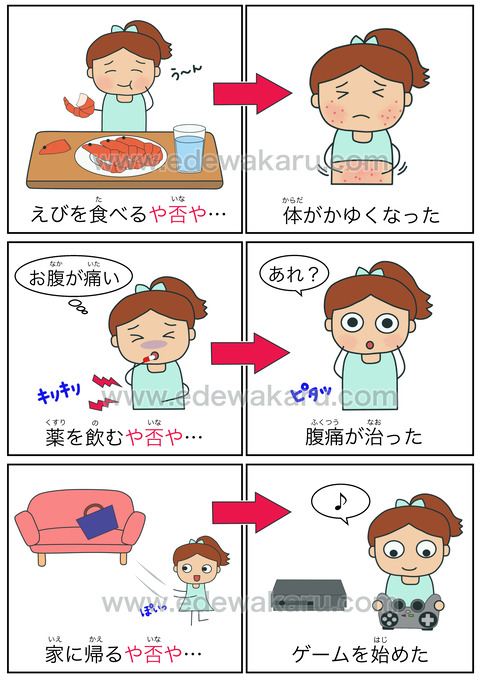
「Aや否やB」 is a sentence pattern meaning “B happened immediately after A.” It is used when you want to say that “the action B takes place immediately following action A.”
It is used in writing, so it is hardly ever used in conversation. 😅 Also, since this pattern is used for something that has already happened, it is most often used in the form 「〜や否や〜た」. 「〜や否や」 can be changed to 「〜や」. 😮
(Review: 〜として)
[Examples]
① As soon as I ate shrimp, my body started itching.
→ As soon as I ate shrimp, my body started itching.
② As soon as I took the medicine, my stomachache went away.
→ As soon as I took the medicine, my stomachache went away.
③ As soon as she got home, she started playing a game.
→ As soon as she got home, she started playing a game.
There are many patterns meaning “as soon as 〜 happens,” so learn to distinguish them. 😀
[Related patterns]
In context 5 examples
えびを食べるや否や、体がかゆくなった
→えびを食べるとすぐに、体がかゆくなったAs soon as I ate shrimp, my body started itching. → My body started itching as soon as I ate shrimp.
薬を飲むや否や、腹痛が治った
→薬を飲むとすぐに、腹痛が治ったAs soon as I took the medicine, my stomachache went away. → My stomachache went away as soon as I took the medicine.
彼女は、家に帰るや否やゲームを始めた
→彼女は、家に帰るとすぐにゲームを始めたAs soon as she got home, she started playing a game. → She started playing a game as soon as she got home.
彼はそのニュースを聞くや否や、泣き出した
→彼はそのニュースを聞くとすぐに、泣き出したAs soon as he heard the news, he burst into tears. → He burst into tears as soon as he heard the news.
山田くんは授業が始まるや否や眠ってしまった
→山田くんは授業が始まるとすぐに眠ってしまった(復習:〜てしまう(残念・後悔))Yamada-kun fell asleep as soon as class began. → Yamada-kun fell asleep as soon as class began. (Review: 〜てしまう (regret or disappointment))
Read the original source text
Meaning
〜するとすぐに
How to use it
動詞[辞書形]+や否や
動詞[辞書形]+や
Explanation
「Aや否やB」は「AするとすぐにBをした」という意味の文型です。「Aの動作に続いて、Bの動作がすぐに行われる」と言いたい時に使います。
書き言葉として使われます
ので、会話で使用されることはほとんどありません😅また、この文型はすでに発生したことに使用しますので、
「〜や否や〜た」
という形で使われることがほとんどです。「〜や否や」は「〜や」にチェンジすることができます😮
(復習:〜として)
[例]
①えびを食べる
や否や、体がかゆくなった
→えびを食べる
や、体がかゆくなった
②薬を飲む
や否や、腹痛が治った
→薬を飲む
や、腹痛が治った
③彼女は、家に帰る
や否や
ゲームを始めた
→彼女は、家に帰る
や
ゲームを始めた
「〜すると、すぐに」という意味の文型はたくさんありますので、区別して覚えておきましょう😀
【関連文型】
くらべてわかる日本語表現文型辞典
Meaning
B happens immediately after A, as if lying in wait.
How to use it
Aや否やB
[Verb—dictionary form] や否や
Explanation
【Contrast 1】
“AかAないかのうちにB” (Meaning 1, p. 49)
The time relationship between A and B is different.
○試合が始まるや否や、球場は大歓声に包まれた。(試合が始まってすぐ) — As soon as the game began, the stadium was filled with loud cheers. (The cheers came right after the game began.)
○試合が始まるか始まらないかのうちに、球場は大歓声に包まれた。(始まる前から大歓声に包まれている) — The stadium was filled with loud cheers before the game had even begun. (It was filled with cheers even before the game began.)
“AたとたんにB” (Meaning 2, p. 122)
The two can be substituted for each other. However, “AたとたんにB” emphasizes that a change occurred in B, while “Aや否やB” emphasizes that there is no time gap.
○雨がやんだとたんに、気温が上がり始めた。 — The moment the rain stopped, the temperature began to rise.
×雨がやむや否や、気温が上がり始めた。 — As soon as the rain stops, the temperature begins to rise.
“AなりB” (Meaning 2, p. 203)
“AなりB” means that B happens immediately after A, and states that there is no time gap between A and B. “Aや否やB” expresses that B happens right after A, as if lying in wait.
○彼は立ち上がるなり、倒れた。 — He stood up and immediately fell over.
×彼は立ち上がるや否や、倒れた。 — As soon as he stood up, he fell over.
○人々は日付が変わるや否や、ボージョレー・ヌーヴォーの栓を抜いた。 — As soon as the date changed, people popped open bottles of Beaujolais Nouveau.
×人々は日付が変わるなり、ボージョレー・ヌーヴォーの栓を抜いた。 — People popped open bottles of Beaujolais Nouveau as soon as the date changed.
“Aが早いかB” (Meaning 1, p. 63)
Notes
【Note 1】
・Even when there is actually some time between A and B, this can be used if the speaker thinks the interval between A and B is extremely short.
In context 4 examples
ドアを開けるや否や、犬が飛び出してきた。
As soon as I opened the door, a dog came rushing out.
新曲が発売されるや否や、爆発的な売れ行きを示した。
As soon as the new single was released, it sold explosively well.
求人広告を出すや否や、応募が殺到した。
As soon as the job advertisement was posted, applications came pouring in.
仕事が終わるや否や、彼はかばんを抱えて飛び出していった。
As soon as work was over, he grabbed his bag and dashed out.
Read the original source text
Meaning
Aの直後、すぐに待ち構えたようにB。
How to use it
Aや否やB
[動詞-る形]や否や
Explanation
【対比1】
「AかAないかのうちにB」(意味1 P.49)
AとBとの時間の関係が異なる。
○試合が始まるや否や、球場は大歓声に包まれた。(試合が始まってすぐ)
○試合が始まるか始まらないかのうちに、球場は大歓声に包まれた。(始まる前から大歓声に包まれている)
「AたとたんにB」(意味2 P.122)
置き換え可能。ただし、「AたとたんにB」はBに変化が起こったことに重点があるが、「Aや否やB」は時間差がないことに重点がある。
○雨がやんだとたんに、気温が上がり始めた。
×雨がやむや否や、気温が上がり始めた。
「AなりB」(意味2 P.203)
「AなりB」は、AのすぐあとにBという意味で、AとBに時間差がないことを述べている。「Aや否やB」は、Aの直後、待ち構えたようにBが起こることを表す
○彼は立ち上がるなり、倒れた。
×彼は立ち上がるや否や、倒れた。
○人々は日付が変わるや否や、ボージョレー・ヌーヴォーの栓を抜いた。
×人々は日付が変わるなり、ボージョレー・ヌーヴォーの栓を抜いた。
「Aが早いかB」(意味1 P.63)
Notes
【注意1】
・実際にはAとBに多少の時間差がある場合でも、話し手がA,Bの間隔が非常に短いと思えば使える。
日本語NET JLPT文法解説まとめ
Meaning
as soon as ~
How to use it
V (dictionary form) + やいなや
Explanation
no sooner than
① Volitional expressions, commands, or negative expressions cannot be used in the latter clause.
② The latter clause often involves an unexpected action.
① Volitional expressions, commands, or negative expressions cannot be used in the latter clause.
② The latter clause often involves an unexpected action.
In context 6 examples
友達の赤ん坊が私の顔を見るや否や、泣き出した。
As soon as my friend’s baby saw my face, it started crying.
田中さんは私の顔を見るや否や、どこかへ走り出した。
As soon as Mr. Tanaka saw my face, he ran off somewhere.
外を出るや否や、急に雨が降り出した。
As soon as I stepped outside, it suddenly started raining.
父は家に帰るや否や、突然倒れて眠ってしまった。
As soon as my father got home, he suddenly collapsed and fell asleep.
雷の光が見えるや否や、大きな音とともに近くに落ちた。
As soon as the flash of lightning appeared, it struck nearby with a loud rumble.
後輩は仕事がまだ残っているにも関わらず、定時になるや否や、すぐに帰ってしまった。
Even though my junior still had work left to do, they went straight home as soon as quitting time came.
Read the original source text
Meaning
〜するとすぐに
How to use it
V(辞書形) + やいなや
Explanation
no sooner than
①後件に意志性のある表現や、命令、否定を表す表現は使えない。
②後件には意外性のある動作がくることが多い。
① Volitional expressions, commands, or negative expressions cannot be used in the latter clause.
② The latter clause often involves an unexpected action.
毎日のんびり日本語教師
How to use it
Verb dictionary form + や
Verb dictionary form + や否や
Explanation
Indicates that the action in the latter clause occurs immediately after the action in the former clause.
Used for things that have already happened.
When the latter clause describes an unexpected event, it can express the speaker’s surprise.
Notes
Nothing in particular.
In context 13 examples
お母さんの顔を見るや否や、安心したのか泣き出してしまった。
The moment she saw her mother’s face, she burst into tears, perhaps relieved.
帰宅するや否や、倒れ込んだ。(一回到家就躺倒了。)
The moment I got home, I collapsed. (I collapsed as soon as I got home.)
タバコを吸うや否や、火災報知器が鳴り響いた。
The moment he lit a cigarette, the fire alarm rang out.
タイに着くや否や病気にかかってしまった。(刚一到泰国就生病了。)
I fell ill the moment I arrived in Thailand. (I fell ill as soon as I arrived in Thailand.)
椅子に座るや否やスマホを取り出した。
The moment he sat down in the chair, he took out his smartphone.
駅に到着するや、電車が来た。
Just as I arrived at the station, the train came.
私が起きたと分かるや否や、おはようの挨拶をしてくれる猫ちゃん。
A sweet kitty who greets me with “Good morning” the moment she realizes I’m awake.
教室に入るや否や髪切ったの気づいてくれて褒めてくれた。
The moment I walked into the classroom, they noticed I’d gotten a haircut and complimented me.
男の人が「漏れそう!」と言うや否や、トイレに走って行った。
The moment the man said, “I’m about to wet myself!” he ran to the restroom.
お風呂に入るや否や、気持ちよさそうな声をあげて目をつぶった。
The moment she got into the bath, she closed her eyes and let out a sound of pleasure.
髪を染めるや否や、可愛いと言われ始めた。
The moment I dyed my hair, people started telling me I was cute.
父の訃報を受け取るや、彼はすぐ新幹線で実家へ向かった。
The moment he received the news of his father’s death, he headed straight to his family home on the Shinkansen.
叶わない夢と知るや否や、自暴自棄になってしまった。
The moment I realized it was a dream that would never come true, I became despondent.
Read the original source text
How to use it
動辞形+や
動辞形+や否や
Explanation
前件の動作後すぐに後件の動作が発生することを表します。
既に発生したことに使います。
後件で予想外の出来事が述べられる場合、話者の驚きを表すことができます。
Notes
特になし
NINJAL 日本語文型データベース
Meaning
Used when you want to say that the next event occurs almost at the same time as ~. It can describe both a one-time event in the past and an event that happens repeatedly as a habit.
How to use it
Vるや否や
Notes
A verb expressing an instantaneous action or event comes in “〜”. After “〜や否や”, a sentence expressing the speaker’s wishes or intentions, or a sentence urging the other person to do something, cannot follow.
In context 5 examples
テレビ番組で紹介されるや否や、この店はたちまち人気店となった。
As soon as it was featured on a TV program, this shop immediately became popular.
審査結果が発表されるや否や、優勝者は泣き崩れた。
As soon as the judging results were announced, the winner broke down in tears.
この会社の新しい製品は発売されるや否や、瞬く間に売り切れてしまった。
As soon as this company’s new product was released, it sold out in no time.
弟は家に着くや否や、服を脱いで風呂場に向かった。
As soon as my younger brother got home, he took off his clothes and headed for the bathroom.
姉は寝起きがよく、6時に目覚まし時計が鳴るやいなや、すぐにむくっと起き上がって着替え始める。
My older sister wakes up easily, and as soon as her alarm goes off at six, she springs right up and starts getting dressed.
Read the original source text
Meaning
〜とほぼ同時に、次の出来事が起こると言いたいときに使います。過去の一度だけの出来事も、習慣的に繰り返し起こる出来事も表すことができます。
How to use it
Vるや否や
Notes
「〜」には瞬間的な動作や出来事を表す動詞がきます。「〜や否や」の後には、話し手の希望・意向を表す文や相手への働きかけの文はきません。
IMABI
As soon as
Read this IMABI lesson ↗Explanation
As soon as: ~や(いなや), ~なり, ~途端(に), ~かと思うと, & ~次第
Though “as” itself is hard enough in Japanese, Japanese also has a lot of expressions that mean “as soon as”. This lesson will investigate how to use these expressions. Take close attention to what defines them as there are differences!
~や否や & ~や
Placed after the 終止形しゅうしけい of a verb in ~や or ~や否いなや, it means “as soon as”. With 否や, it is like the second action takes place before the first action can even be confirmed or done. The most used is や否や. In fact, や否や will be used 90% of the time.
1. 地震じしんが発生はっせいするやいなや、気象庁きしょうちょうは直ただちに津波警報つなみけいほうを出しました。
As soon as the earthquake happened, the Meteorological Agency issued a tsunami warning.
2. 姉の顔を見るやいなや、泣き出した。
I began weeping as soon as I saw my sister’s face.
3a. その選手はチャンスと見るや、一気に{攻め込んだ・攻撃をしかけた}。
3b. その選手はチャンスと見るやいなや、一気に{攻め込んだ・攻撃をしかけた}。 (あまり使わない言い方)
The player felt a chance open and attacked in one burst.
4. 出発しゅっぱつするやいなや雨が降ふり出した。
It started to rain as soon as I departed.
~やいなや cannot be used to show the speaker’s wants or intentions. Also, don’t use the past tense before ~やいなや. The action can be something that you can expect. It’s important to understand that the events of the second clause are actions/movements.
5. うちの猫は魚が大好きで、あげるやいなや、一気に全部食べてしまう。
My cat loves fish, and the instant you give it to it, it’s gone in an instant.
The Conjunctive Particle なり
After the 連体形 of a verb, ~なり shows that something is done as soon as something else is done. So right when someone does something, they do something next in sequence to the first action. The subject is normally third person, and the subject is the same in both clauses.
6a. 宿題を済ませるなり、彼らはインターネットを使った。
6b. 宿題を済ませるとすぐに、彼らはインターネットを使った。(More natural)
They used the Internet as soon as they finished their homework.
7. 彼は帰るなり、トイレに行った。
He went to the bathroom as soon as he got home.
8. 社長は入ってくるなり、大声で怒鳴りました。
As soon as the company president came in, he shouted in a big voice.
The word comes from the なり in words like 身なり (appearance). The event in the second clause is often one that describes an action/condition not wanted. Although it is used some in the spoken language, it is usually reserved to writing.
After the past tense, it shows a situation that is still in play as another action begins. It is unnatural when you move in any way to a different action.
9. 彼は靴を履いたなり、畳に上がってしまった。 △
彼は靴を履いたまま、畳に上がってしまった。 〇
He accidentally stepped onto the tatami mat with his shoes still.
10. 彼女は公園でベンチに座り込んだ{なり・まま}、眠ってしまった。
She fell asleep while sitting on a park bench.
~途端(に)
When students learn of 途端に, they immediately think of ~ときに, especially when they learn that this phrase is used after the past tense. Understandable, ~たとき(に)and ~たとたん(に) vaguely resemble each other, especially when not written in 漢字.
~た途端とたん(に) is, again, only used with the past tense. It marks the instant after one does something. This “something” that happens afterward is something that is unexpected and much of a surprise.
11. 彼がドアを開けた途端、車が爆発した。
The car exploded just as he opened the door.
12. 窓まどを開けた途端に、犬が飛び出していった。
As soon as I opened the window, the dog jumped out.
13. 立ち去さった途端に、その建物たてものが爆発ばくはつしたよ!
As soon as he left, the building exploded!
14. 動画どうがを観みた途端に、眠ねむくなってしまった。
I accidentally fell asleep as soon as I saw the video.
15. 余所見をした途端、転んだ。
I fell down as soon as I turned away.
16. 酒を飲むと、(その)途端に人が変わる。
Once a person drinks, that person changes instantly.
Grammar Note: 途端 may also be used in the sense of instantly and can be seen with such statements.
As seen in the example sentences, though, ~た途端(に)can’t be used when something volitional occurs. So, although a situation may be unexpected, you would need to use a phrase like ~たら、すぐに if you are using a verb of volition.
17. ベルが鳴ったら、すぐに外に出てください。
When the bell rings, immediately go outside.
~かと思うと
Perhaps because it is rarely treated separately in grammar discussions, students have a hard time knowing how to use this phrase. This describes something happening that causes a sense of surprise, similar to ~た途端(に), which follows after an event described in the first clause. Transitivity, though, is clearly different as ~た途端(に)is used with transitive expressions, but this phrase does not have that requirement.
You cannot use this phrase for yourself. At times it may be best to use ~かと思ったら instead. Sentences of command, negation, or will appear afterwards. For some people, when the event is not of the future or going back and forth in a way that means the first action may happen again in the “future”, then the use of ~かと思うと is somewhat unnatural and should be replaced with ~かと思ったら. So, for the sentences below regarding weather, you can paraphrase with the latter and have no problem.
Examples
18. 雨が降ってきたかと{思うと ?/〇・思ったら 〇}、もう止んだ。
Just when I thought it had started to rain, it stopped.
19. 空が曇ってきたと{思うと ?/〇・思ったら 〇}、突然大雨になった。
Just when I thought it got cloudy, it started to rain heavily.
20. 彼女はA君のことを好きだと言っていたかと思うと、次はB君が好きだと言い出し、何を考えているのかよく分からない。
Just as I had thought she said she liked A-kun, she then stated that she liked B-kun, and so I don’t know what she’s thinking.
22. うちの子供は帰ってきたかと{思うと ?/〇・思ったら 〇}、もう外に遊びに行った。
The kids had already gone to play outside just when I thought they had come home.
~次第
As a regular noun, 次第 means “course of events”. It is seen after nouns a lot, especially Sino-Japanese words, but also after the 連用形 of verbs.
When it attaches to other nouns, it often means “depending on”. As such, when after the 連用形 of a verb, it may show that something is dependent on an action in question.
23. 請求せいきゅうがあり次第だ。
It’s on demand.
24. 物事は状況次第。
Circumstances alter cases.
25. こういう次第だ。
This is how it stands.
26. 万事は君の(この)取り扱い方次第だ。
It depends on the way you handle it.
27. 天気の様子次第で行くかどうか決めるんだ。
I’m going to decide on whether to go or not depending on the weather condition.
28. 大統領が決心するかどうかはそれ次第だ。
The president’s resolution depends on this.
29. 豊作になるかどうかは天気次第です。
An abundant harvest is dependent on the weather.
30. 結果は君次第だ。
The results depend on you.
31. 昇進できるかどうかは能力次第だ。
Promotion is dependent on one’s ability.
連用形 + 次第
It may also be used with the 連用形 of a verb to show what happens “as soon as…”. This is in the sense that right after something realizes, one does the next action. Thus, the second clause following must be a verb of volition in regards to the speaker. This separates it quite well from the other “as soon as” phrases in this lesson.
32. 着き次第、被災地に援助します。
As soon as we arrive, we will aid in the disaster area.
33. 手当たり次第に食べ物を買い占しめる。
To buy up food as it is made available.
34. 満員になり次第締め切ろう。
Let’s close up as soon as we become a full house.
35. 我々は雪がやみ次第、作業を再び始めるつもりです。
We plan to resume operations as soon as it stops snowing.
Adverbial 次第に
Lastly, 次第に is an adverb meaning “gradually”, “finally”, or “in order”.
36. 機械は{次第にだんだんと}廃すたれていくだろう。
Machines will gradually go out of date.
37. 騒音そうおんが次第に消えてゆく。
Noise will gradually fade away.
In context 38 examples
地震じしんが発生はっせいするやいなや、気象庁きしょうちょうは直ただちに津波警報つなみけいほうを出しました。
As soon as the earthquake happened, the Meteorological Agency issued a tsunami warning.
姉の顔を見るやいなや、泣き出した。
I began weeping as soon as I saw my sister’s face.
その選手はチャンスと見るや、一気に{攻め込んだ・攻撃をしかけた}。
The player felt a chance open and attacked in one burst.
その選手はチャンスと見るやいなや、一気に{攻め込んだ・攻撃をしかけた}。 (あまり使わない言い方)
The player felt a chance open and attacked in one burst.
出発しゅっぱつするやいなや雨が降ふり出した。
It started to rain as soon as I departed.
うちの猫は魚が大好きで、あげるやいなや、一気に全部食べてしまう。
My cat loves fish, and the instant you give it to it, it’s gone in an instant.
宿題を済ませるなり、彼らはインターネットを使った。
They used the Internet as soon as they finished their homework.
宿題を済ませるとすぐに、彼らはインターネットを使った。(More natural)
They used the Internet as soon as they finished their homework.
彼は帰るなり、トイレに行った。
He went to the bathroom as soon as he got home.
社長は入ってくるなり、大声で怒鳴りました。
As soon as the company president came in, he shouted in a big voice.
彼は靴を履いたなり、畳に上がってしまった。 △
He went up onto the tatami with his shoes still on. △
彼女は公園でベンチに座り込んだ{なり・まま}、眠ってしまった。
She fell asleep while sitting on a park bench.
彼がドアを開けた途端、車が爆発した。
The car exploded just as he opened the door.
窓まどを開けた途端に、犬が飛び出していった。
As soon as I opened the window, the dog jumped out.
立ち去さった途端に、その建物たてものが爆発ばくはつしたよ!
As soon as he left, the building exploded!
動画どうがを観みた途端に、眠ねむくなってしまった。
I accidentally fell asleep as soon as I saw the video.
余所見をした途端、転んだ。
I fell down as soon as I turned away.
酒を飲むと、(その)途端に人が変わる。
Once a person drinks, that person changes instantly.
ベルが鳴ったら、すぐに外に出てください。
When the bell rings, immediately go outside.
雨が降ってきたかと{思うと ?/〇・思ったら 〇}、もう止んだ。
Just when I thought it had started to rain, it stopped.
空が曇ってきたと{思うと ?/〇・思ったら 〇}、突然大雨になった。
Just when I thought it got cloudy, it started to rain heavily.
彼女はA君のことを好きだと言っていたかと思うと、次はB君が好きだと言い出し、何を考えているのかよく分からない。
Just as I had thought she said she liked A-kun, she then stated that she liked B-kun, and so I don’t know what she’s thinking.
うちの子供は帰ってきたかと{思うと ?/〇・思ったら 〇}、もう外に遊びに行った。
The kids had already gone to play outside just when I thought they had come home.
請求せいきゅうがあり次第だ。
It’s on demand.
物事は状況次第。
Circumstances alter cases.
こういう次第だ。
This is how it stands.
万事は君の(この)取り扱い方次第だ。
It depends on the way you handle it.
天気の様子次第で行くかどうか決めるんだ。
I’m going to decide on whether to go or not depending on the weather condition.
大統領が決心するかどうかはそれ次第だ。
The president’s resolution depends on this.
豊作になるかどうかは天気次第です。
An abundant harvest is dependent on the weather.
結果は君次第だ。
The results depend on you.
昇進できるかどうかは能力次第だ。
Promotion is dependent on one’s ability.
着き次第、被災地に援助します。
As soon as we arrive, we will aid in the disaster area.
手当たり次第に食べ物を買い占しめる。
To buy up food as it is made available.
満員になり次第締め切ろう。
Let’s close up as soon as we become a full house.
我々は雪がやみ次第、作業を再び始めるつもりです。
We plan to resume operations as soon as it stops snowing.
機械は{次第にだんだんと}廃すたれていくだろう。
Machines will gradually go out of date.
騒音そうおんが次第に消えてゆく。
Noise will gradually fade away.
Read the original source text
Explanation
As soon as: ~や(いなや), ~なり, ~途端(に), ~かと思うと, & ~次第
Though “as” itself is hard enough in Japanese, Japanese also has a lot of expressions that mean “as soon as”. This lesson will investigate how to use these expressions. Take close attention to what defines them as there are differences!
~や否や & ~や
Placed after the 終止形しゅうしけい of a verb in ~や or ~や否いなや, it means “as soon as”. With 否や, it is like the second action takes place before the first action can even be confirmed or done. The most used is や否や. In fact, や否や will be used 90% of the time.
1. 地震じしんが発生はっせいするやいなや、気象庁きしょうちょうは直ただちに津波警報つなみけいほうを出しました。
As soon as the earthquake happened, the Meteorological Agency issued a tsunami warning.
2. 姉の顔を見るやいなや、泣き出した。
I began weeping as soon as I saw my sister’s face.
3a. その選手はチャンスと見るや、一気に{攻め込んだ・攻撃をしかけた}。
3b. その選手はチャンスと見るやいなや、一気に{攻め込んだ・攻撃をしかけた}。 (あまり使わない言い方)
The player felt a chance open and attacked in one burst.
4. 出発しゅっぱつするやいなや雨が降ふり出した。
It started to rain as soon as I departed.
~やいなや cannot be used to show the speaker’s wants or intentions. Also, don’t use the past tense before ~やいなや. The action can be something that you can expect. It’s important to understand that the events of the second clause are actions/movements.
5. うちの猫は魚が大好きで、あげるやいなや、一気に全部食べてしまう。
My cat loves fish, and the instant you give it to it, it’s gone in an instant.
The Conjunctive Particle なり
After the 連体形 of a verb, ~なり shows that something is done as soon as something else is done. So right when someone does something, they do something next in sequence to the first action. The subject is normally third person, and the subject is the same in both clauses.
6a. 宿題を済ませるなり、彼らはインターネットを使った。
6b. 宿題を済ませるとすぐに、彼らはインターネットを使った。(More natural)
They used the Internet as soon as they finished their homework.
7. 彼は帰るなり、トイレに行った。
He went to the bathroom as soon as he got home.
8. 社長は入ってくるなり、大声で怒鳴りました。
As soon as the company president came in, he shouted in a big voice.
The word comes from the なり in words like 身なり (appearance). The event in the second clause is often one that describes an action/condition not wanted. Although it is used some in the spoken language, it is usually reserved to writing.
After the past tense, it shows a situation that is still in play as another action begins. It is unnatural when you move in any way to a different action.
9. 彼は靴を履いたなり、畳に上がってしまった。 △
彼は靴を履いたまま、畳に上がってしまった。 〇
He accidentally stepped onto the tatami mat with his shoes still.
10. 彼女は公園でベンチに座り込んだ{なり・まま}、眠ってしまった。
She fell asleep while sitting on a park bench.
~途端(に)
When students learn of 途端に, they immediately think of ~ときに, especially when they learn that this phrase is used after the past tense. Understandable, ~たとき(に)and ~たとたん(に) vaguely resemble each other, especially when not written in 漢字.
~た途端とたん(に) is, again, only used with the past tense. It marks the instant after one does something. This “something” that happens afterward is something that is unexpected and much of a surprise.
11. 彼がドアを開けた途端、車が爆発した。
The car exploded just as he opened the door.
12. 窓まどを開けた途端に、犬が飛び出していった。
As soon as I opened the window, the dog jumped out.
13. 立ち去さった途端に、その建物たてものが爆発ばくはつしたよ!
As soon as he left, the building exploded!
14. 動画どうがを観みた途端に、眠ねむくなってしまった。
I accidentally fell asleep as soon as I saw the video.
15. 余所見をした途端、転んだ。
I fell down as soon as I turned away.
16. 酒を飲むと、(その)途端に人が変わる。
Once a person drinks, that person changes instantly.
Grammar Note: 途端 may also be used in the sense of instantly and can be seen with such statements.
As seen in the example sentences, though, ~た途端(に)can’t be used when something volitional occurs. So, although a situation may be unexpected, you would need to use a phrase like ~たら、すぐに if you are using a verb of volition.
17. ベルが鳴ったら、すぐに外に出てください。
When the bell rings, immediately go outside.
~かと思うと
Perhaps because it is rarely treated separately in grammar discussions, students have a hard time knowing how to use this phrase. This describes something happening that causes a sense of surprise, similar to ~た途端(に), which follows after an event described in the first clause. Transitivity, though, is clearly different as ~た途端(に)is used with transitive expressions, but this phrase does not have that requirement.
You cannot use this phrase for yourself. At times it may be best to use ~かと思ったら instead. Sentences of command, negation, or will appear afterwards. For some people, when the event is not of the future or going back and forth in a way that means the first action may happen again in the “future”, then the use of ~かと思うと is somewhat unnatural and should be replaced with ~かと思ったら. So, for the sentences below regarding weather, you can paraphrase with the latter and have no problem.
Examples
18. 雨が降ってきたかと{思うと ?/〇・思ったら 〇}、もう止んだ。
Just when I thought it had started to rain, it stopped.
19. 空が曇ってきたと{思うと ?/〇・思ったら 〇}、突然大雨になった。
Just when I thought it got cloudy, it started to rain heavily.
20. 彼女はA君のことを好きだと言っていたかと思うと、次はB君が好きだと言い出し、何を考えているのかよく分からない。
Just as I had thought she said she liked A-kun, she then stated that she liked B-kun, and so I don’t know what she’s thinking.
22. うちの子供は帰ってきたかと{思うと ?/〇・思ったら 〇}、もう外に遊びに行った。
The kids had already gone to play outside just when I thought they had come home.
~次第
As a regular noun, 次第 means “course of events”. It is seen after nouns a lot, especially Sino-Japanese words, but also after the 連用形 of verbs.
When it attaches to other nouns, it often means “depending on”. As such, when after the 連用形 of a verb, it may show that something is dependent on an action in question.
23. 請求せいきゅうがあり次第だ。
It’s on demand.
24. 物事は状況次第。
Circumstances alter cases.
25. こういう次第だ。
This is how it stands.
26. 万事は君の(この)取り扱い方次第だ。
It depends on the way you handle it.
27. 天気の様子次第で行くかどうか決めるんだ。
I’m going to decide on whether to go or not depending on the weather condition.
28. 大統領が決心するかどうかはそれ次第だ。
The president’s resolution depends on this.
29. 豊作になるかどうかは天気次第です。
An abundant harvest is dependent on the weather.
30. 結果は君次第だ。
The results depend on you.
31. 昇進できるかどうかは能力次第だ。
Promotion is dependent on one’s ability.
連用形 + 次第
It may also be used with the 連用形 of a verb to show what happens “as soon as…”. This is in the sense that right after something realizes, one does the next action. Thus, the second clause following must be a verb of volition in regards to the speaker. This separates it quite well from the other “as soon as” phrases in this lesson.
32. 着き次第、被災地に援助します。
As soon as we arrive, we will aid in the disaster area.
33. 手当たり次第に食べ物を買い占しめる。
To buy up food as it is made available.
34. 満員になり次第締め切ろう。
Let’s close up as soon as we become a full house.
35. 我々は雪がやみ次第、作業を再び始めるつもりです。
We plan to resume operations as soon as it stops snowing.
Adverbial 次第に
Lastly, 次第に is an adverb meaning “gradually”, “finally”, or “in order”.
36. 機械は{次第にだんだんと}廃すたれていくだろう。
Machines will gradually go out of date.
37. 騒音そうおんが次第に消えてゆく。
Noise will gradually fade away.