日本語文型辞典
Meaning
Basic information
N/Na でなくてもいい
A-くなくてもいい
V-なくてもいい
Means “there is no need to do ….” Forms such as 「なくてもかまわない」「なくても大丈夫」 are also used. A formal expression is 「なくともよい」.
Examples
① There’s plenty of time, so you don’t have to hurry so much.
② You don’t have to exercise every day, but please do so sometimes.
③ This dye is dissolved in hot water, but the temperature doesn’t have to be very high. It dissolves quickly.
④ If you’re busy with work, you don’t have to force yourself to come.
Read the original source text
Meaning
基本情報N/Na でなくてもいいA-くなくてもいいV-なくてもいい説明「…する必要がない」という意味を表す。「なくてもかまわない」「なくても大丈夫」などが用いられることもある。あらたまった言い方に「なくともよい」がある。例文① 時間はたっぷりあるから、そんなに急がなくてもいいですよ。② 毎日でなくてもいいから、ときどき運動して下さい。③ この染料はお湯で溶かすんだけど、温度はそんなに高くなくてもいいよ。すぐ溶けるから。④ 仕事が忙しい場合は、無理して来なくてもいいですよ。
絵でわかる日本語
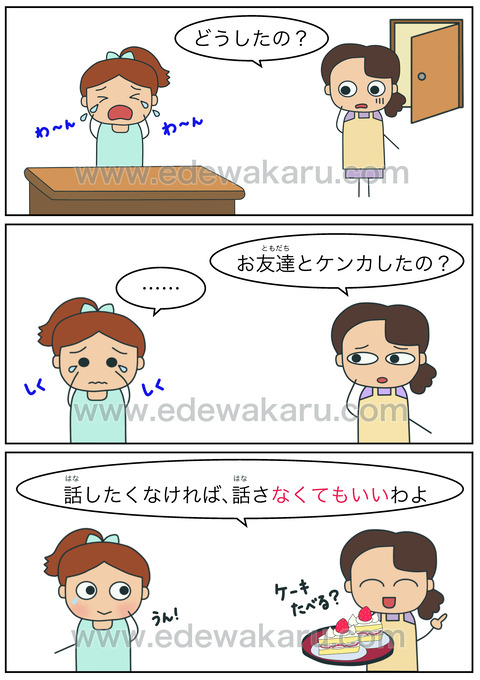
Meaning
there is no need to ~
How to use it
Verb [ない-form] + なくてもいい
Explanation
“Aなくてもいい” is a sentence pattern meaning “there is no need to do A.” It indicates that there is no need to do A.
Those at intermediate level or above should learn this together with “〜てもかまわない・〜なくてもかまわない” 😉
[Similar patterns]
In context 5 examples
A:どうしたの?お友達とケンカでもしたの?B:……A:話したくなければ、話さなくてもいいわよ
→話したくなければ、話す必要がないわよA: What’s wrong? Did you have a fight with a friend or something? B: …… A: If you don’t want to talk about it, you don’t have to. → If you don’t want to talk about it, there’s no need to.
嫌いだったら、食べなくてもいいよ〜
→嫌いだったら、食べる必要がないよIf you don’t like it, you don’t have to eat it~ → If you don’t like it, there’s no need to eat it.
時間はたくさんありますので、急がなくてもいいですよ
→時間はたくさんありますので、急ぐ必要がありませんよWe have plenty of time, so you don’t need to hurry. → We have plenty of time, so there’s no need to hurry.
娘:傘を持っていったほうがいいかな…母:今日は雨が降らないそうだから、持っていかなくてもいいと思うわよ
→持っていく必要がないと思うわよDaughter: I wonder if I should take an umbrella… Mother: They say it won’t rain today, so I don’t think you need to take one. → I don’t think there’s any need to take one.
A:昨日はごめんね…B:謝らなくてもいいよ…私も悪かったんだから
→謝る必要がないよ…私も悪かったんだからA: I’m sorry about yesterday… B: You don’t have to apologize… It was my fault too. → There’s no need to apologize… It was my fault too.
Read the original source text
Meaning
〜する必要がない
How to use it
動詞[ない形]+なくてもいい
Explanation
「Aなくてもいい」は「Aする必要がない」という意味の文型です。「A」をする必要がないことを表します。
中級レベル以上の人は「〜てもかまわない・〜なくてもかまわない」と一緒に覚えておきましょう😉
【類似文型】
どんなときどう使う 日本語表現文型辞典
Usage 1
Meaning
don't have to; not necessary to
How to use it
Vなくても + いい
Explanation
なくてもいい〈不必要〉
B:いいえ、今日は仕事が全部できたから、あしたは来なくてもいいですよ。
B:ええ、かまいませんよ。ゆっくり考えてください。
B:あ、ここにあるから持ってこなくたってかまわないよ。
1)する必要はないという意味を表す。「なくてもかまわない」は「なくてもいい」とほとんど同じように使う。
2) ❹ の「なくてもかまいませんか」は支障がないかどうか聞く言い方である。
3)話し言葉は ❺ のように「なくたっていい」と ❻ のように「なくたってかまわない」など。
1)Something needn't be done. Form なくてもかまわない is used nearly same way as なくてもいい.
2)In sentence ❹ , なくてもかまいませんか asks if there would be problem if something is not done.
3)Becomes なくたっていい in spoken language, as in sentence ❺ or なくたってかまわない, as in sentence ❻ .
In context 6 examples
A:あしたも来なければなりませんか。
A: Do I have to come again tomorrow?
医者:熱が下がったから、もう薬を飲まなくてもいいです。
Doctor: Your fever has gone down, so you don’t have to take the medicine anymore.
森さんにファクスを送りましたが、電話はかけなくてもいいでしょうか。
I sent Mr. Mori a fax, but is it all right if I don’t call him?
A:このことは今日決めなくてもかまいませんか。
A: Is it all right if we don’t decide this today?
メールで返事をくれれば、電話をくれなくたっていいよ。
If you reply by email, you don’t have to call me.
A:パソコンを持っていかなきゃいけない?
A: Do I have to take my computer with me?
Read the original source text
Meaning
don't have to; not necessary to
How to use it
Vなくても+いい
Explanation
なくてもいい〈不必要〉
B:いいえ、今日は仕事が全部できたから、あしたは来なくてもいいですよ。
B:ええ、かまいませんよ。ゆっくり考えてください。
B:あ、ここにあるから持ってこなくたってかまわないよ。
1)する必要はないという意味を表す。「なくてもかまわない」は「なくてもいい」とほとんど同じように使う。
2) ❹ の「なくてもかまいませんか」は支障がないかどうか聞く言い方である。
3)話し言葉は ❺ のように「なくたっていい」と ❻ のように「なくたってかまわない」など。
1)Something needn't be done. Form なくてもかまわない is used nearly same way as なくてもいい.
2)In sentence ❹ , なくてもかまいませんか asks if there would be problem if something is not done.
3)Becomes なくたっていい in spoken language, as in sentence ❺ or なくたってかまわない, as in sentence ❻ .
Usage 2
Meaning
doesn't have to be
How to use it
イAくなくても/ナAでなくても/Nでなくても + いい
Explanation
なくてもいい〈譲歩〉
1)譲歩を表す言い方。最上ではないがこれでいいという意味を表す。「なくてもかまわない」は「なくてもいい」と同じように使う。
2) ❺ 「なくたっていい」は話し言葉。
1)Concession. Something is not optimal but good enough. Form なくてもかまわまはない used same way as なくてもいい.
2)The なくたっていい in sentence ❺ is colloquial.
In context 5 examples
1 日だけですからホテルの部屋は広くなくても、きれいでなくてもいいです。
It’s only for one day, so the hotel room doesn’t have to be spacious or clean.
医者:毎日でなくてもいいから、もっと運動をしてください。
Doctor: You don’t have to exercise every day, but please get more exercise.
使わないものがあったらバザーに出してください。新しくなくてもかまいません。
If you have things you don’t use, please put them out for the bazaar. They don’t have to be new.
絵を描いて説明してください。絵は上手でなくてもかまいませんから。
Please draw a picture to explain. The picture doesn’t have to be good.
ぼくの部屋は静かじゃなくたっていいよ。
My room doesn’t have to be quiet.
Read the original source text
Meaning
doesn't have to be
How to use it
イAくなくても/ナAでなくても/Nでなくても+いい
Explanation
なくてもいい〈譲歩〉
1)譲歩を表す言い方。最上ではないがこれでいいという意味を表す。「なくてもかまわない」は「なくてもいい」と同じように使う。
2) ❺ 「なくたっていい」は話し言葉。
1)Concession. Something is not optimal but good enough. Form なくてもかまわまはない used same way as なくてもいい.
2)The なくたっていい in sentence ❺ is colloquial.
日本語NET JLPT文法解説まとめ
Meaning
There is no need to do something.
How to use it
V (ない-form) ない + くてもいい
Explanation
don't have to
In context 11 examples
やったー。明日は休みだから、学校に行かなくてもいい。
Yay! I don't have to go to school tomorrow because it's a day off.
前のテストで80点以上とった人は、補習授業を受けなくてもいいです。
People who got 80 points or more on the previous test don't have to take the remedial class.
この漢字はまだ書けなくてもいいです。読めれば大丈夫です。
You don't have to be able to write this kanji yet. It's fine if you can read it.
小学生以下はお金を払わなくていいです。
Elementary school students and younger don't have to pay.
今日は晴れるので、傘を持って行かなくてもいいですよ。
It's going to be sunny today, so you don't have to take an umbrella with you.
私の国では家に入るとき、靴を脱がなくてもいいです。
In my country, you don't have to take off your shoes when you enter a house.
コンサートのチケットをもらったんですが、一緒に見ませんか。
I got concert tickets. Would you like to go see it together?
明日は学校に来なくていいですよ。休みになりましたから。
You don't have to come to school tomorrow. It's been made a day off.
お腹がいっぱいでしたら、無理に食べなくてもいいですよ。
If you're full, you don't have to force yourself to eat.
ここには何も書かなくてもいいです。
You don't have to write anything here.
そんなこと言わなくてもいいじゃん。
You don't have to say something like that.
Read the original source text
Meaning
〜する必要がない。
How to use it
V(ナイ形)ない + くてもいい
Explanation
don't have to
毎日のんびり日本語教師
How to use it
Noun + で/じゃ + なくてもいい
い-adjective stem + くなくてもいい
な-adjective stem + で/じゃ + なくてもいい
Verb in ない-form + なくてもいい/ずともよい
Explanation
Expresses that there is no need to do something.
There are various ways to say this. The expressions become more formal as you go down the list.
・~なくてもいい
・~なくてもよい
・~なくても大丈夫
・~なくても問題ない
・~なくても構わない
・~なくともいい
・~なくともよい
・~ずともいい
・~ずともよい
…
When 「する」is attached to 「~ずともよい」, the form is 「せずともよい」.
Notes
Nothing in particular.
In context 8 examples
辛い時はそれ以上進まなくてもいい。
When things are painful, you don’t have to push yourself any further.
謝らなくてもいいですよ。私にも悪いところがありますから。
You don’t have to apologize. I have my faults too.
時間は余裕があるので、急がなくても大丈夫です。
We have plenty of time, so there’s no need to hurry.
すぐ結論を出せずともいい。
You don't have to come to a conclusion right away.
お金持ちにならなくてもいいけど、せめてお金に困らない人生を生きたい。
I don't have to become rich, but at least I want to live a life where I don't have to worry about money.
自分が読めるなら、字は綺麗に書かなくてもいいと思う。
If I can read it myself, I don't think I have to write neatly.
言いたくないなら言わなくてもいい。
If you don't want to say it, you don't have to.
最初は上手くなくても構わないです。誰でも始めは初心者ですから。
It's okay if you're not good at it at first. Everyone starts out as a beginner.
Read the original source text
How to use it
名詞+で/じゃ+なくてもいい
い形容詞語幹+くなくてもいい
な形容詞語幹+で/じゃ+なくてもいい
動ない形+なくてもいい/ずともよい
Explanation
物事をする必要がないことを表します。
様々な言い方があります。下に行くほど硬めの表現です。
・~なくてもいい
・~なくてもよい
・~なくても大丈夫
・~なくても問題ない
・~なくても構わない
・~なくともいい
・~なくともよい
・~ずともいい
・~ずともよい
…
「~ずともよい」に「する」を接続するときは、「せずともよい」です。
Notes
特になし
日本語文型辞典 英語版
Meaning
【なくてもいい】[N/Na でなくてもいい][A-くなくてもいい][V-なくてもいい]
Means “it is not necessary to do X.” Can be replaced by なくてもかまわない or なくても大丈夫. In formal Japanese, なくともよい, a more formal expression, may be used instead.
In context 4 examples
時間はたっぷりあるから、そんなに急がなくてもいいですよ。
We have plenty of time, so there’s no need to rush.
毎日でなくてもいいから、ときどき運動して下さい。
You don’t have to do it every day, but please get some exercise once in a while.
この染料はお湯で溶かすんだけど、温度はそんなに高くなくてもいいよ。すぐ溶けるから。
You dissolve this dye in hot water, but the temperature doesn’t have to be that high. It dissolves right away.
仕事が忙しい場合は、無理して来なくてもいいですよ。
If you’re busy at work, please don’t feel obligated to come.
AIUEO JLPT Grammar
Meaning
This sentence pattern indicates that it is not a problem or that it is acceptable not to perform a certain action, used to ask if it is permissible to avoid doing something.
How to use it
Verb ない-form + なくても + question sentence
In context 5 examples
薬を飲まなくてもいい?
Is it okay if I don’t take the medicine?
今日は勉強しなくてもいいですか?
Is it okay if I don’t study today?
この地域ではマスクを着用しなくてもいいですか?
Is it okay not to wear a mask in this area?
会議をしなくてもよろしいですか。
Can we skip the meeting?
部長に確認しなくてもよろしいでしょうか。
Is it okay without the director's confirmation?
Read the original source text
Meaning
This sentence pattern indicates that it is not a problem or that it is acceptable not to perform a certain action, used to ask if it is permissible to avoid doing something.
How to use it
動詞ない形+なくても+疑問文
Explanation · 日本語
この文型は、ある行動をしなくても問題ないことや、それを避けても許容されることを示す表現です。相手に対して、特定の行動をしないことが許可されるかどうかを尋ねるときに使います。
Bunpro Grammar Reference
Meaning
Don't have to
How to use it
Verb[なくて] + (も) + いい
Verb[なくて] + (も) + いい + です
Nuance
A grammar point used to highlight that not doing something is okay.
Explanation
なくてもいい is simply the opposite of てもいい, and highlights that it is 'ok even if (A) is not done'. This usually comes across as being quite polite, and sounds like 'don't worry about doing (A)' in English.
なくてもいい is a combination of the auxiliary verb ない in its conjunction form, with てもいい.
ミカは悪くないから謝らなくてもいいよ。
Mika, you are not in the wrong, so you don't have to apologize.
その手紙はもう届けなくてもいい。
It's okay if you don't deliver that letter anymore.
In order to make this phrase sound even more casual, the adverbial particle も may be omitted. This does not change the nuance at all, but will sound a bit more friendly (when used with people that you know well).
今日は会社に来なくていいよ。
It is fine if you don't come to the office today.
In context 15 examples
- 忙しいなら、行かなくてもいいです。
If you are busy, you do not have to go.
- 今日は会社に来なくていいよ。
It is fine if you don't come to the office today.
- その手紙はもう届けなくてもいい。
It's okay if you don't deliver that letter anymore.
- ミカは悪くないから謝らなくてもいいよ。
Mika, you are not in the wrong, so you don't have to apologize.
- 掃除をしなくてもいいですか。
It is alright even if I don't clean?
- その青いセーターを着なくてもいいですよ。
It is alright even if you do not wear that blue sweater.
- そんなに怒らなくてもいい。
You don't have to be that angry.
- これ以上飲まなくてもいい。
You don't have to drink more than this.
- 何もしなくてもいい?
I don't have to do anything?
- それをしなくてもいいと聞いたよ。
I heard that it is alright even if you don't do that.
- 昨日掃除をしたから、今日はしなくてもいいだろう。
Since I cleaned yesterday, I don't have to clean today, right?
- 日本にはバスと電車とタクシーがあるので、車を買わなくてもいい。
In Japan there are buses, trains and taxis, so you don't have to buy a car.
- 今日買い物に行けば、週末は行かなくてもいい。
If I can go shopping today, then I don't have to go on the weekend.
- 全部の漢字を覚えなくてもいいよ。2000字覚えたら新聞を読めるよ。
It is okay even if you don't remember all of the kanji. If you remember 2000 characters, you can read the newspaper.
- 明日試合があるでしょう?練習をしなくてもいいの?
You have a match tomorrow, right? Is it alright even if you don't practice?
Read the original source text
Meaning
Don't have to
How to use it
Verb[なくて] + (も) + いい
Verb[なくて] + (も) + いい + です
Nuance
A grammar point used to highlight that not doing something is okay.
Explanation
なくてもいい is simply the opposite of てもいい, and highlights that it is 'ok even if (A) is not done'. This usually comes across as being quite polite, and sounds like 'don't worry about doing (A)' in English.
なくてもいい is a combination of the auxiliary verb ない in its conjunction form, with てもいい.
ミカは悪くないから謝らなくてもいいよ。
Mika, you are not in the wrong, so you don't have to apologize.
その手紙はもう届けなくてもいい。
It's okay if you don't deliver that letter anymore.
In order to make this phrase sound even more casual, the adverbial particle も may be omitted. This does not change the nuance at all, but will sound a bit more friendly (when used with people that you know well).
今日は会社に来なくていいよ。
It is fine if you don't come to the office today.
Nuance · 日本語
何かをしなくても問題がないことを強調する文法。
文法
Meaning
There is no need to do something.
How to use it
V (ない-form) ない + くてもいい
In context 11 examples
やったー。明日は休みだから、学校に行かなくてもいい。
Yay! I don't have to go to school tomorrow because it's a day off.
前のテストで80点以上とった人は、補習授業を受けなくてもいいです。
People who got 80 points or more on the previous test don't have to take the remedial class.
この漢字はまだ書けなくてもいいです。読めれば大丈夫です。
You don't have to be able to write this kanji yet. It's fine if you can read it.
小学生以下はお金を払わなくていいです。
Elementary school students and younger don't have to pay.
今日は晴れるので、傘を持って行かなくてもいいですよ。
It's going to be sunny today, so you don't have to take an umbrella with you.
私の国では家に入るとき、靴を脱がなくてもいいです。
In my country, you don't have to take off your shoes when you enter a house.
コンサートのチケットをもらったんですが、一緒に見ませんか。
I got concert tickets. Would you like to go see it together?
明日は学校に来なくていいですよ。休みになりましたから。
You don't have to come to school tomorrow. It's been made a day off.
お腹がいっぱいでしたら、無理に食べなくてもいいですよ。
If you're full, you don't have to force yourself to eat.
ここには何も書かなくてもいいです。
You don't have to write anything here.
そんなこと言わなくてもいいじゃん。
You don't have to say something like that.
Read the original source text
Meaning
〜する必要がない。
How to use it
V(ナイ形)ない + くてもいい
NINJAL 日本語文型データベース
Meaning
Used to express that there is no need to do something or that something does not need to be a certain way.
The forms 「〜なくてもいいから」 and 「〜なくてもいいので」 are also often used to indicate an acceptable condition in sentences expressing the speaker’s intention or wishes, or in sentences that urge the other person to do something.
「〜なくてもよい」 is a formal form.
In questions addressed to the other person, the more polite form 「〜なくてもよろしい」 is also used.
How to use it
Notes
When said directly to the listener about their actions, it takes on the meaning of an instruction, so it is usual not to say it directly about the actions of someone in a higher position.
In context 17 examples
来週の交流会は自由参加だから、行かなくてもいい。
Next week’s social gathering is optional, so you don’t have to go.
「すみません、出発は何時ですか。トイレへ行く時間、ありますか」「11時です。まだ時間はありますから、急がなくてもいいですよ」
“Excuse me, what time do we leave? Will there be time to use the restroom?” “At eleven. There’s still time, so you don’t have to hurry.”
「この説明書は取っておかなくてもいいですか」「いえ、それはあとで必要になるかもしれないので、取っておいてください」
“Do I need to keep this instruction manual?” “Yes, you might need it later, so please keep it.”
電子マネーを使えば、現金を持ち歩かなくてもよくなる。
If you use electronic money, you won’t need to carry cash around.
「明日は8時に来なくてもよろしいでしょうか」「ええ、明日はそんなに早く来なくてもいいですよ」
“Would it be all right if I didn’t come at eight tomorrow?” “Yes, you don’t need to come that early tomorrow.”
「明日の旅行に持っていくかばん、これでいいかな」「1泊だけでしょ。そんなに大きくなくてもいいと思うけど」
“Is this bag okay to take on tomorrow’s trip?” “It’s only for one night, right? I don’t think it needs to be that big.”
「あの、ご飯の量が多いです。こんなに多くなくてもいいんですが」「じゃ、少し減らしましょうか」
“Oh, this is a lot of rice. It doesn’t need to be this much.” “Then shall I reduce it a little?”
システムエンジニアの仕事をするには、コンピューターの知識が必要だが、初めからパソコンに詳しくなくてもよい。
You need computer knowledge to work as a systems engineer, but you don’t need to know much about computers from the start.
「確かに私のほうが年上だけど、そんなに違わないし、言葉遣いなんか特に丁寧でなくてもいいよ」
“It’s true I’m older, but we’re not that far apart in age, so you don’t have to be especially polite with me.”
「ルームシェアって、ほかの人がいてうるさそうじゃない?」「うーん、私は大家族で育ったから、そんなに静かじゃなくてもいいかな」
“Doesn’t sharing a room seem noisy, with other people around?” “Hmm, I grew up in a big family, so I don’t mind if it isn’t that quiet.”
歯ブラシとかスポンジとかの日用品までデザインに凝る人もいるけど、私はそういうものは特におしゃれでなくてもいいと思う。
Some people care a lot about the design of everyday items like toothbrushes and sponges, but I don’t think those things need to be particularly stylish.
それほど本格的でなくてもいいから、何か楽器をやってみたいな。
I’d like to try playing some kind of instrument, even if I don’t get very serious about it.
「もう一度来てください。今週中なら、明日でなくてもいいですよ」
“Please come back one more time. As long as it’s sometime this week, it doesn’t have to be tomorrow.”
「あの、こういう形のファイル、ありますか。全く同じ物じゃなくてもいいんですけど」
“Um, do you have a file in this shape? It doesn’t have to be exactly the same.”
「大学の面接試験のときはどんな服を着たらいいですか。スーツじゃなくてもいいでしょうか」
“What should I wear to a university entrance interview? Is it all right if I don’t wear a suit?”
リサイクルショップは、新品でなくてもいいからいい物を安く買いたいという人に人気がある。
Recycling shops are popular with people who want to buy good things cheaply, even if they aren’t new.
今すぐでなくてもいいから、いつか機会があったら外国で働きたいと思っている。
It doesn’t have to be right away, but I hope to work abroad someday if I get the chance.
Read the original source text
Meaning
〜する必要がないことや、〜である必要がないことを表すときに使います。
話し手の意志・希望を表す文や相手への働きかけの文で、許容できる条件を示す「〜なくてもいいから・〜なくてもいいので」の形もよく使います。
「〜なくてもよい」は改まった形です。
相手に質問する文では、より丁寧な形として「〜なくてもよろしい」も使います。
How to use it
Notes
聞き手の行為について聞き手に直接言うときは指示のような意味になるので、立場が上の人の行為については直接言わないのが普通です。