絵でわかる日本語
Meaning
There is a possibility that 〜
How to use it
Verb / adjective / noun [plain form] + かもしれない
Explanation
“〜かもしれない” is a sentence pattern meaning “there is a possibility that 〜.” It is used when the degree of certainty is lower than with “〜でしょう・〜だろう.” In everyday conversation, the form “〜かも” is also sometimes used.
[Example]
A: It’s really cold today.
B: Yeah. It might snow.
“〜かもしれない” is a pattern studied at the beginner level, but it is also often used in conversation, so review it 😉
In context 5 examples
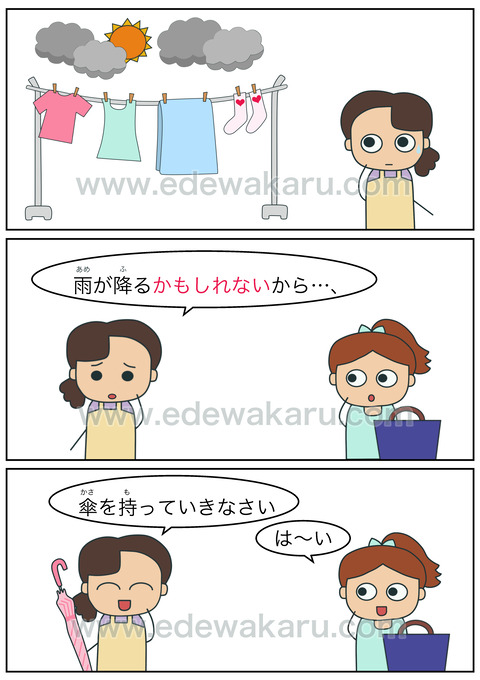
母:雨が降るかもしれないから、傘を持ってきなさい娘:は〜い
→雨が降る可能性があるから、傘を持ってきなさいMother: It might rain, so bring an umbrella. Daughter: Okaaay. →There’s a chance it’ll rain, so bring an umbrella.
毎日がんばって勉強したら、N1に合格できるかもしれない!
→N1に合格できる可能性があるIf you study hard every day, you might pass N1! →There’s a chance you’ll pass N1.
A:朝から、のどが痛いの…B:かぜをひいたかもしれないね
→かぜをひいた可能性があるねA: My throat has been sore since this morning… B: You might have caught a cold. →There’s a chance you caught a cold.
A:今日はすごく寒いねB:うん。雪が降るかもしれないわね
→雪が降る可能性があるわねA: It’s really cold today. B: Yeah. It might snow. →There’s a chance it’ll snow.
A:山田くんは、今日のパーティーにくるかなB:最近忙しそうだから、来ないかもしれないね
→最近忙しそうだから、来ない可能性があるねA: Do you think Yamada-kun will come to the party today? B: He’s seemed busy lately, so he might not come. →He’s seemed busy lately, so there’s a chance he won’t come.
Read the original source text
Meaning
〜可能性がある
How to use it
動詞・形容詞・名詞[普通形]+かもしれない
Explanation
「〜かもしれない」は「〜可能性がある」という意味の文型です。「〜でしょう・〜だろう」に比べて、確信性が低い場合に使われます。日常会話(にちじょうかいわ)では「〜かも」という形が使われることもあります。
[例]
A:今日はすごく寒いね
B:うん。雪が降る
かも
ね
「〜かもしれない」は初級で勉強する文型ですが、会話でもよく使われますので復習しておきましょう😉
NINJAL 日本語文型データベース
Meaning
This is an expression of conjecture used to say that there is a possibility of ~. It is used when fearing or hoping for that possibility. It may also be used when you want to avoid making a definite assertion and express yourself without being too forceful. The possibility may be high or low. It can be used whenever there is a possibility, even without any particular basis.
This is the form created by omitting 「しれない」 from 「〜かもしれない」.
How to use it
V plain form + かも
i-A plain form + かも
na-A plain form + かも (however, “na-Aだ” → “na-A+かも”)
N plain form + かも (however, “Nだ” → “N+かも”)
Other forms
In context 22 examples
このレシピは難しくなさそう。これなら、私にも作れるかも。
This recipe doesn't look difficult. Maybe even I could make it.
「気をつけて。財布をそんなところに置いといたら、盗まれるかもよ」
“Be careful. If you leave your wallet somewhere like that, it might get stolen.”
今日は予定が詰まってて、お昼ご飯、食べる時間ないかもなあ。
My schedule is packed today, so I might not have time to eat lunch.
あれ? ここはどこ? 道に迷ったかも。
Huh? Where am I? I might have gotten lost.
あ、もしかすると、家の鍵をかけなかったかも。
Oh, maybe I didn't lock the door at home.
このピアス、値段ついていないけどフランス製だから高いかも。
These earrings don't have a price tag, but they're made in France, so they might be expensive.
「うちの猫にこの首輪つけたらどうかな?」「うん、かわいいかもね」
“How about putting this collar on our cat?” “Yeah, it might be cute.”
「ちょっとテレビの音を小さくしたほうがいいかも。外まで聞こえそう」
“Maybe you should turn the TV down a little. It sounds like people can hear it outside.”
「洗剤はまだうちにたくさんあるから、買わなくてもいいんじゃない?」「でも、これすごく安いよ。来月になったらここまで安くないかも」
“We still have plenty of detergent at home, so don't you think we don't need to buy any?” “But this is really cheap. It might not be this cheap next month.”
うーん、塩がちょっと多かったかも。しょっぱくなっちゃった。
Hmm, maybe I added a little too much salt. It turned out too salty.
ひどい渋滞。全然進まないなあ。これじゃ、10時までに会場に着くのは無理かも。
What terrible traffic. We're not moving at all. At this rate, it might be impossible to get to the venue by 10.
「美術館までどうやっていく?」「バスもあるけど、2キロぐらいだから、歩いて行ってもそんなに大変じゃないかも」
“How do we get to the art museum?” “There's a bus, but it's about two kilometers, so walking there might not be that hard.”
今日の山中君、なんだか元気なかったね」「そういえば、ちょっと様子が変だったかもね」
“Yamanaka seemed kind of down today, didn't he?” “Now that you mention it, he might have seemed a little off.”
寒くなるかと思って上着もいちおう持ってきたけど、この天気なら、必要じゃなかったかも。
I brought a jacket just in case, thinking it might get cold, but with this weather, maybe I didn't need it.
「今度田中さんも誘ってカラオケ行かない?」「田中さんカラオケ好きじゃないかも。前にも誘ったことあるけど来なかったし」
“Why don't we invite Tanaka to karaoke next time?” “Tanaka might not like karaoke. I've invited them before, but they didn't come.”
プリンター、故障かも。電源が入らない。
The printer might be broken. It won't turn on.
「お兄ちゃん、デートかも。すごくおしゃれして出かけていったよね」
“Maybe my big brother has a date. He went out looking really dressed up.”
ん? この花、本物そっくりだけど、本物じゃないかも。
Huh? This flower looks just like the real thing, but maybe it isn't real.
あれ、ひょっとしたらみきちゃんの誕生日、今日じゃなくて昨日だったかも。
Oh, maybe Miki's birthday was yesterday, not today.
「あれ、札幌行ったの、去年だった?」「去年じゃなかったかもね。おととしだったかも」
“Wait, was it last year that you went to Sapporo?” “Maybe it wasn't last year. It might have been the year before.”
「あの人の服、裏表逆じゃないかなあ」「そうかもね」
“I wonder if that person's clothes are on inside out.” “Maybe.”
「ずいぶん人が集まってるね」「ほんとだ。何かイベントをやってるのかもね」
“A lot of people have gathered, haven't they?” “They sure have. Maybe there's some kind of event going on.”
Read the original source text
Meaning
~の可能性があるというときの推量の言い方です。可能性を恐れたり、期待したりするときに使います。はっきり断定するのを避けて、自己主張を強くしないで言いたいときにも使うことがあります。可能性が高い場合も低い場合もあります。特に根拠がなくても可能性があれば使えます。
「〜かもしれない」の「しれない」を省略した形です。
How to use it
V普通形+かも
i-A普通形+かも
na-A普通形+かも(ただし、「na-Aだ」→「na-A+かも」)
N普通形+かも(ただし、「Nだ」→「N+かも」)
その他
IMABI
Might: かもしれない
Read this IMABI lesson ↗Explanation
Might: かもしれない
To describe a 50/50 probability that “may/might” happen, ~かもしれない is used. It is composed of the particles か and も followed by the negative form of the verb 知れる, which is an intransitive verb meaning “to be known/understood.”
Orthography Note: The Kanji spelling ~かも知れない is fairly common, although the Hiragana-only spelling is most prevalent.
ConjUGATING WITH かもしれない
The particle か follows the 連体形 of predicates, but with nominal (including adjectival nouns) predicates, the copula must be deleted. It may also follow both the non-past tense and the past tense as well as the negative auxiliary ~ない. However, it does not follow polite forms as politeness is marked in it by using either ~ません or the somewhat less polite ~ないです.
Plain SpeechPolite Speech
Verbsするかもしれない
Might doするかもしれません
するかもしれないです
Might do
Adjectives古いかもしれない
Might be old古いかもしれません
古いかもしれないです
Might be old
Adjectival Nouns (だ)簡単かもしれない
Might be easy簡単かもしれません
簡単かもしれないです
Might be easy
Nouns (だ)犬かもしれない
Might be a dog犬かもしれません
犬かもしれないです
Might be a dog
~た噓だったかもしれない
Might have been a lie噓だったかもしれません
噓だったかもしれないです
Might have been a lie
~ない来ないかもしれない
Might not come来ないかもしれません
来ないかもしれないです
Might not come
Phrases like ひょっとして (by any chance) and もしかしたら・もしかすると・もしかして (perhaps/possibly) frequently accompany かもしれない.
1. 人間にんげんが全ての石油せきゆを使いきってしまう時が{訪おとずれる・来る}かもしれません。
The time may come when man will use up all oil.
2. 前の試験しけんが難しかったなら、今度こんどの試験も難しいかもしれません。
If the previous exam was difficult, the next exam may also be difficult.
3. もしかしたら彼は気が変わるかもしれません。
Perhaps his mind will change.
4. ひょっとすると雨に遭あうかもしれません。
Chances are that we’ll encounter rain.
5. セス先生は厳しすぎるかもしれない。
Seth Sensei might be too strict.
6. このレッスンは初級者には難しいかもしれません。
This lesson might be difficult to beginners.
7. ラファエル君が飲み会に行ったら、彼女に怒られるかもしれない。
If Rafael were to go to the drinking party, his girlfriend might get mad at him.
8. 円安がこの先ずっと長引くかもしれないから、今のところ、円をドルに両替しない方がいいと思いますよ。
Since the depression of the yen might last for the foreseeable future, I think it’d be best not to exchange yen for dollars for the time being.
~かもしれない vs ~だろう
Whereas ~かもしれない indicates a 50/50 probability, ~だろう・でしょう is closer to an 80% probability. It, too, is frequently used with adverbs such as ひょっとして, もしかしたら, etc.
Although the auxiliary verbs ~だろう・でしょう are derivates of the copula だ, they do not attach to things in the exact same way as だ. They instead attach to the 終止形 much like how the politeness-marker auxiliary です1 does, but they differ from です by how they do so with any inflectable word (用言).
~だろう~でしょう
Verbs雨が降るだろう
It will likely rain雨が降るでしょう
It will likely rain
Adjectives高いだろう
It will likely be expensive高いでしょう
It will likely be expensive
Adjectival Nouns新鮮だろう
It[‘s/will be] surely fresh新鮮でしょう
It[‘s/will be] surely fresh
Nouns犬だろう
It’s most likely a dog犬でしょう
It’s most likely a dog
9. 彼はひょっとしてまだ外にいるでしょう。
He might just be outside.
10. ひょっとしたら彼女はここへ来るだろう。
She will possibly come here.
~かもしれないだろう ??
~かもしれないだろう, at first glance, seems superfluous, but it is occasionally used. In this scenario, ~かもしれない refers to the probability of the situation occurring at hand, and ~だろう rhetorically questions the listener about their recognition of that probability. As such, ~だろう would be more forceful than ~じゃない ・じゃん, which has a lighter tone.
11. 最後かもしれないだろう。
This might be the last (time), you know.
You may also encounter ~だろうが after ~かもしれない to indicate frustration at what the speaker perceives to be a negative effect on a likelihood that the speaker is banking on, even though it is only a 50/50 chance.
12. もしかしたらあの女、俺達全員を殺して口封じしようとしてくるかもしれないだろうが。
Ugh, that woman could try to kill us all to keep us quiet.
From 伝説の剣士のつくりかた by 派虎衆.
Albeit old-fashioned, the auxiliary verb ~(よ)う which technically creates だろう can be conjugated normally with conjugatable parts of speech, then be followed by ~かもしれない. However, the supposition meaning of this auxiliary is hardly ever used in modern speech.
13. それだけの意味はあろうかもしれない。
It just might have that much meaning.
By 堀辰雄.
~のかもしれない
By inserting the nominalizer の, the speaker is envisioning a purely hypothetical scenario based on a given truth or the current circumstance. In doing so, the speaker highly emphasizes their opinion on how true that outcome might be, but this is more so on what they are betting on rather than suggesting a higher probability. ~のかもしれない may be used with any tense as well as positive and negative sentences.
With…
Verbs降るのかもしれない
It just might rain
Adjectives新しいのかもしれない
It might just be new
Adjectival Nouns新鮮なのかもしれない
It might just be fresh
Nouns犯人なのかもしれない
Might just be the criminal
~ない来ないのかもしれない
Might just not come
~た死んだのかもしれない
Just might have died
Grammar Notes:
By inserting の, notice that the copula in the form of な must be used with nouns and adjectival nouns in the non-past tense.
Contracting の to ん in this grammar point is not seen in standard speech.
14. まだ家へ帰っていなかったのかもしれない。
He might have not been home yet.
15. もしかしたら暑さに負けずに外に出ていたら、何か素敵なことが起きていたのかもしれない。
Perhaps if I hadn’t let the heat get to me and gone out, something fantastic might have happened.
16. 自分が本当にやりたかったことに気がついていなかったのかもしれない。
I might not have ever realized what I truly wanted to do.
17. 健太君が帰ってこないね。もしかしたら事故に遭ったのかもしれない。
Kenta hasn’t come home yet. Maybe he got into an accident.
~かも
In casual speech, ~かもしれない is frequently contracted to ~かも. What is so peculiar about this contraction is that it loses its ability to be followed by conjunctions and most final particles – with exception to ね・な.
To combat this problem, the copula だ may follow it so that it can then be followed by endings such as ~が・けど・ぞ, etc. You may even see ~かもです, which is not quite as accepted but is gaining currency among younger speakers. However, the use of だ・です after かも is still not so common, but that is likely to change in the coming decades.
18. 彼はもう帰ったかもな。
He might have already come home.
19. それ、いいかも!
That sounds good!
20. いけるかも!
That might work!
21. お金がちょっと足りねーかも。
I might be a little short on money.
22. 来週なら空いてるかも!
I might be free next week!
23. ひょっとして、俺、世界で一番かわいい猫かもにゃあ!
I might just be the cutest cat in the world!
24. 昨日はゴミ収集車が来なかったのかも。
The garbage truck might not have come yesterday.
25. スマホは不幸の原因かもだぞ!
Your smartphone might be the cause of your unhappiness!
26. あんたにとっては、些細ささいなことかもだけどな、俺には重大な問題だぞ。
For you, it may like be trivial, but to me, it’s a big deal!
27. 今なら勝ち目があるかも(だ)よ!
There might be a chance of winning now!
Grammar Note: Although ~よ may directly follow ~かも, the lack of だ causes the sentence to sound feminine.
~かもしれん
You may also encounter the casual variant ~かもしれん, which is most common in male speech or in certain regions where the contraction ~ん for ~ない is prevalent.
28. なるほど、君のいう通りかもしれんね。
Well then, you may be right.
29. 実は他の同僚も俺らの会話聞いてたかもしれんぞ。
Actually, other co-workers might’ve been listening to our conversation, too!
While です does also go after nouns, this usage of です is least problematic, simply being the polite form of the copula だ. When です follows adjectives, it does so by following the 終止形. In this capacity, it functions as an auxiliary with the sole meaning of marking politeness, losing its copular function. Similarly to this, だろう・でしょう attach to the 終止形 of conjugatable parts of speech in general as well as nouns, but when they follow conjugatable parts of speech, their “copular” functionality becomes mute, as they then only indicate supposition. ↩︎
In context 29 examples
人間にんげんが全ての石油せきゆを使いきってしまう時が{訪おとずれる・来る}かもしれません。
The time may come when man will use up all oil.
前の試験しけんが難しかったなら、今度こんどの試験も難しいかもしれません。
If the previous exam was difficult, the next exam may also be difficult.
もしかしたら彼は気が変わるかもしれません。
Perhaps his mind will change.
ひょっとすると雨に遭あうかもしれません。
Chances are that we’ll encounter rain.
セス先生は厳しすぎるかもしれない。
Seth Sensei might be too strict.
このレッスンは初級者には難しいかもしれません。
This lesson might be difficult to beginners.
ラファエル君が飲み会に行ったら、彼女に怒られるかもしれない。
If Rafael were to go to the drinking party, his girlfriend might get mad at him.
円安がこの先ずっと長引くかもしれないから、今のところ、円をドルに両替しない方がいいと思いますよ。
Since the depression of the yen might last for the foreseeable future, I think it’d be best not to exchange yen for dollars for the time being.
彼はひょっとしてまだ外にいるでしょう。
He might just be outside.
ひょっとしたら彼女はここへ来るだろう。
She will possibly come here.
最後かもしれないだろう。
This might be the last (time), you know.
もしかしたらあの女、俺達全員を殺して口封じしようとしてくるかもしれないだろうが。
Ugh, that woman could try to kill us all to keep us quiet.
それだけの意味はあろうかもしれない。
It just might have that much meaning.
まだ家へ帰っていなかったのかもしれない。
He might have not been home yet.
もしかしたら暑さに負けずに外に出ていたら、何か素敵なことが起きていたのかもしれない。
Perhaps if I hadn’t let the heat get to me and gone out, something fantastic might have happened.
自分が本当にやりたかったことに気がついていなかったのかもしれない。
I might not have ever realized what I truly wanted to do.
健太君が帰ってこないね。もしかしたら事故に遭ったのかもしれない。
Kenta hasn’t come home yet. Maybe he got into an accident.
彼はもう帰ったかもな。
He might have already come home.
それ、いいかも!
That sounds good!
いけるかも!
That might work!
お金がちょっと足りねーかも。
I might be a little short on money.
来週なら空いてるかも!
I might be free next week!
ひょっとして、俺、世界で一番かわいい猫かもにゃあ!
I might just be the cutest cat in the world!
昨日はゴミ収集車が来なかったのかも。
The garbage truck might not have come yesterday.
スマホは不幸の原因かもだぞ!
Your smartphone might be the cause of your unhappiness!
あんたにとっては、些細ささいなことかもだけどな、俺には重大な問題だぞ。
For you, it may like be trivial, but to me, it’s a big deal!
今なら勝ち目があるかも(だ)よ!
There might be a chance of winning now!
なるほど、君のいう通りかもしれんね。
Well then, you may be right.
実は他の同僚も俺らの会話聞いてたかもしれんぞ。
Actually, other co-workers might’ve been listening to our conversation, too!