絵でわかる日本語
Meaning
Even if one says “let’s ~”
How to use it
Verb [volitional form] + ったって
Explanation
“〜ようったって” is a sentence pattern meaning “even if one says ‘let’s ~’.” It is used to say “even if I say ‘let’s ~,’ I can’t” or “even if I say ‘let’s ~,’ it’s impossible to do.” “〜ようったって” is spoken language and is used with family and friends.
There are not many opportunities to study “〜ようったって,” so I think it’s good to learn it 😊
In context 4 examples
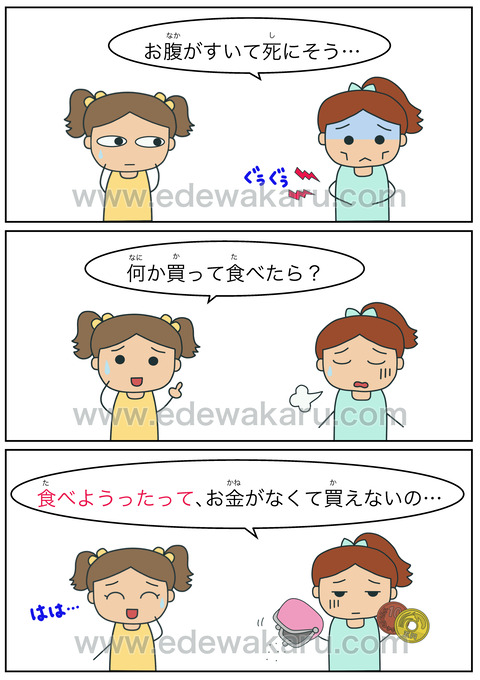
A:お腹がすいて死にそう…B:何か買って食べれたら?A:食べようったって、お金がなくて何も買えないの
→食べようと言っても、お金がなくて何も買えないのA: I’m so hungry I could die… B: Why don’t you buy something to eat? A: Even if I wanted to eat, I don’t have any money, so I can’t buy anything. →Even if I say I’ll eat, I don’t have any money, so I can’t buy anything.
夫:かぜをひいたみたいだ…妻:今日は休めばいいじゃない夫:休もうったって、今日は大事な会議があるんだ
→休もうと言っても、大事な会議があるから休めないんだHusband: I think I’ve caught a cold… Wife: Why don’t you take the day off? Husband: Even if I say I’ll take the day off, I have an important meeting today. →Even if I say I’ll take the day off, I can’t because I have an important meeting.
A:疲れたね…どこかに入ろうかB:どこかに入ろうったって、ここにはカフェもレストランもないよ
→入ろうと言っても、何もないからどこにも入れないよA: I’m tired… Shall we go somewhere? B: Even if we say we’ll go somewhere, there aren’t any cafés or restaurants here. →Even if we say we’ll go inside somewhere, there’s nowhere to go because there’s nothing here.
旅行に行こうったって、お金もなければ時間もない
→旅行に行こうと言っても、お金も時間もないEven if we say we’ll go on a trip, we have neither money nor time. →Even if we say we’ll go on a trip, we have neither money nor time.
Read the original source text
Meaning
〜しようと言っても
How to use it
動詞[意向形]+ったって
Explanation
「〜ようったって」は「〜しようと言っても」という意味の文型です。「〜しようと言っても〜できない」「〜しようと言っても〜するのは無理だ」と言いたい時に使われます。「〜ようったって」は話し言葉で、家族や友達と使う言い方です。
「〜ようったって」は勉強する機会があまりない文型ですので、覚えておくといいと思います😊
NINJAL 日本語文型データベース
Meaning
Used to say that something you intended to do does not go as planned or cannot be done.
How to use it
V(よ)うったって
Notes
A negative sentence or a sentence expressing difficulty follows “〜うったって・〜ようったって.”
In context 5 examples
まだ16歳だったら、いくら働こうったって雇ってくれる会社は多くないだろう。
If you’re only 16, there probably aren’t many companies that would hire you, no matter how much you try to work.
彼とは別れたが、彼との思い出はどんなに忘れようったって簡単には忘れられない。
I broke up with him, but no matter how hard I try to forget my memories with him, I can’t easily forget them.
最近ちょっと太ってきたから、明日から朝ランニングをしよう。まあ、いくら毎朝走ろうったって、すぐには痩せないだろうけど。
I’ve put on a little weight lately, so I’ll start running in the mornings tomorrow. Well, no matter how much I run every morning, I probably won’t lose weight right away, though.
みんなで協力してプロジェクトに取り組んでいる。自分だけ楽しようったってそうはいかない。
We’re all working together on the project. You can’t just take it easy on your own.
同級生の山下さんが事故で亡くなった。他の同級生にお葬式の連絡しようったって、連絡先がわからない。
Our classmate Yamashita died in an accident. I’d like to let our other classmates know about the funeral, but I don’t have their contact information.
Read the original source text
Meaning
〜しようと自分が思ったことが、その通りにはならない・できないと言いたいときに使います。
How to use it
V(よ)うったって
Notes
「〜うったって・〜ようったって」の後には否定の文や困難を表す文がきます。