AIUEO JLPT Grammar
Meaning
This sentence pattern expresses that while the current situation may not be ideal, it is still acceptable or provides some comfort. It conveys a sense of reassurance or hope in challenging circumstances.
How to use it
Verb だけましだ; adjective だけましだ; adjectival noun な + だけましだ
In context 5 examples
給料は下がったけど、仕事があるだけましだ。
My salary has decreased, but at least I still have a job.
怪我をしなかっただけましですよ。
I'm just glad I wasn't hurt.
ボーナスは少なかったが、もらえただけましでしょう。
The bonus was small, but at least I got one.
部屋は狭いけど、家賃が安いだけましだね。
The room is small, but at least the rent is cheap.
テストの点は悪かったけど、赤点じゃないだけましだ。
My test score was bad, but at least I didn’t fail.
Read the original source text
Meaning
This sentence pattern expresses that while the current situation may not be ideal, it is still acceptable or provides some comfort. It conveys a sense of reassurance or hope in challenging circumstances.
How to use it
動詞だけ+ましだ形容詞だけ+ましだ形容動詞な+だけ+ましだ
Explanation · 日本語
この文型は、現在の状況が理想的ではないものの、まだそれでも悪くない、少しは良いと感じるときに使われる表現です。ネガティブな状況の中で、最低限の希望や救いを感じるときに使われ、困難な状況の中でもある程度安心する気持ちを表します。
Bunpro Grammar Reference
Meaning
At least, It's better than..., One should feel grateful for
How to use it
Verb + だけまし + だ
[い]Adjective + だけまし + だ
[な]Adjective + な + だけまし + だ
Noun + である + だけまし + だ
Verb + だけまし + です
[い]Adjective + だけまし + です
[な]Adjective + な + だけまし + です
Noun + である + だけまし + です
Nuance
A construction showing that just (A), or only (A) is preferable to possible alternatives, so one should be grateful.
Explanation
だけましだ is a set phrase indicating that 'at least (A)', or that 'one should feel grateful for (A)'. This expression is often used in cases where the overall situation is negative, but it is still better than the alternative. This structure is a combination of the particle だけ 'only', and the な-Adjective 増し, meaning 'better', or 'preferable'. Originally, まし is just the conjunctive form of 増す, an う-Verb meaning to grow or increase (like 増える). Due to this, the literal meaning is 'even just (A) is a plus, compared to what could have occured'.
だけましだ will be used primarily after verbs, い-Adjectives, or な-Adjectives followed by な.
天気はあまり良くないが、久しぶりに旅行に来れただけましだ。
Although the weather isn't the best, I should be grateful that I am able to travel for the first time in a long time.
このアパートはボロボロだけど、職場に近いだけましだ。
This apartment is a wreck, but at least it is close to my work place.
味覚はないかもしれないが、元気なだけましだ。
Although I can't taste, at least I am feeling well.
In the vast majority of cases, まし will simply be written in hiragana, or even katakana as マシ. The katakana version often further emphasizes that one should be grateful for (A).
Caution
Although not as common, だけまだましだ may also be seen. As can be seen by the addition of まだ 'still', this form merely emphasized the point even further.
今日はいつもより寒いけど、風が吹いていないだけまだましだ。
It is colder than usual today, but at least it's not windy.
In context 16 examples
- ご馳走とは言えないが、食べるものがあるだけましだ。
I can't say that I feasted, but at least I had something to eat.
- このアパートはボロボロだけど、職場に近いだけましだ。
This apartment is a wreck, but at least it is close to my work place.
- 味覚はないかもしれないが、元気なだけましだ。
Although I can't taste, at least I am feeling well.
- 天気はあまり良くないが、久しぶりに旅行に来れただけましだ。
Although the weather isn't the best, I should be grateful that I am able to travel for the first time in a long time.
- 古い校舎だが、冷房があるだけましだ。
The school building is old, but at least it has air conditioning.
- あんな大事故が起きたのだから、命があるだけましだ。
Since such a big accident occured, you should be grateful that you are still alive.
- 泥棒に入られたが、金庫が無事なだけましだ。
A robber broke in, but I should be grateful that the safe is intact.
- 上手な部員はいなくても、部に後輩がいるだけましです。
Even if there are no skilled staff, there are at least some kouhai in the department.
- 料理は微妙でも、裁縫が上手なだけましだ。
Even if their cooking is questionable, at least they are good at sewing.
- 彼はやり方が強引ですが、暴力を振るわないだけましです。
His way of doing it is overbearing, but you should be grateful that he isn't violent.
- 私の旦那は料理もしない。あなたの旦那は料理をしてくれるだけましだ。
My husband doesn't even cook. At least your husband cooks for you.
- 彼女の口実はいいとは言えませんが、嘘をつかないだけましです。
It can't be said that her excuses are good, but at least she doesn't lie.
- あの講師の教え方は上手とは言えないが、黒板の字が綺麗なだけましだ。
It can't be said that that lecturer's way of teaching is good, but at least the characters they write on the chalkboard are nice.
- 仕事は辛いかもしれないけど、公務員は安定しているだけましだ。
Your job is probably tough, but a public servant's job is stable at least.
- 少額だとしても、お小遣いをもらえるだけましだ。
Even if it is a small amount, you should be grateful you are receiving an allowance.
- 今日はいつもより寒いけど、風が吹いていないだけまだましだ。
It is colder than usual today, but at least it's not windy.
絵でわかる日本語
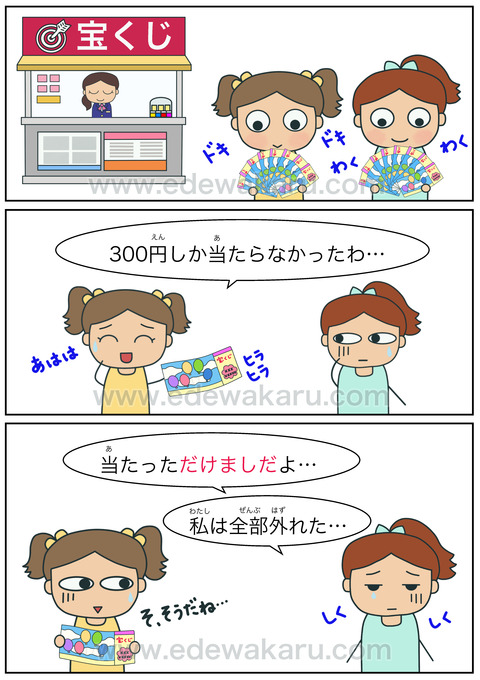
Meaning
The situation isn’t very good, but at least it didn’t get worse.
The situation isn’t very good, but it’s better than ~
How to use it
Verb/adjective [plain form] + だけましだ
Noun [dictionary form] + である + だけましだ
Explanation
「〜だけましだ」 is a sentence pattern meaning “The situation isn’t very good, but at least things didn’t turn out worse” or “The situation isn’t very good, but it’s better than 〜.”
[Examples]
① A: Did you win the lottery?
B: I only won 300 yen.
A: At least you won something! I didn’t win anything at all…
→ Winning only 300 yen isn’t very good, but it’s better than winning nothing at all.
② A: I got hit by a car, and my smartphone broke…
B: At least you weren’t injured.
→ It’s unfortunate that your smartphone broke, but at least you weren’t injured.
③ A: This year’s bonus was 50,000 yen…
B: At least you got a bonus! We didn’t get one at all this year…
→ 50,000 yen is a small bonus, but it’s better than getting no bonus.
④ My salary isn’t good, but at least I have a job.
→ It’s unfortunate that my salary isn’t good, but it’s better than having no job.
⑤ I’ve caught a cold and have a headache… But at least I don’t have a fever, I guess…
→ Having a headache isn’t good, but I guess it’s good that I don’t have a fever.
[For those who want to learn more]
There is also the form 「〜だけまだましだ」. The meaning is almost the same, but remember that 「〜だけまだましだ」 is a form that emphasizes 「〜だけましだ」 even more.
In context 5 examples
A:宝くじ当たった?B:300円しか当たらなかったよA:当たっただけましだよ!私は全部外れたよ…
A: Did you win the lottery? B: I only won 300 yen. A: At least you won something! I didn’t win anything at all…
A:車とぶつかって、スマホが壊れちゃったの…B:ケガがなかっただけましだよ(復習:壊れる・壊す①)(復習:〜ちゃう・〜じゃう)
A: I got hit by a car, and my smartphone broke… B: At least you weren’t injured. (Review: 壊れる・壊す①; 〜ちゃう・〜じゃう)
A:今年のボーナスは5万円だった…B:ボーナスがあるだけましだよ!うちなんて、今年はボーナスなしだよ…(復習:〜など・〜なんか・〜なんて)
A: This year’s bonus was 50,000 yen… B: At least you got a bonus! We didn’t get one at all this year… (Review: 〜など・〜なんか・〜なんて)
給料がよくないが、仕事があるだけましだ
My salary isn’t good, but at least I have a job.
かぜをひいて頭が痛い…でも熱がないだけましかな…(復習:〜かな・〜かしら(文法))(復習:〜かな・〜かしら(口語))
I’ve caught a cold and have a headache… But at least I don’t have a fever, I guess… (Review: 〜かな・〜かしら (grammar); 〜かな・〜かしら (colloquial speech))
Read the original source text
Meaning
あまりいい状況ではないが、もっと悪いことにならなくてよかった
あまりいい状況ではないが、〜よりはいい
How to use it
動詞・形容詞[普通形]+だけましだ
名詞[辞書形]+である+だけましだ
Explanation
「〜だけましだ」は「あまりいい状況ではないが、もっと悪いことにならなくてよかった」「あまりいい状況ではないが、〜よりいい」という意味を表す文型です。
[例]
①A:宝くじ当たった?
B:300円しか当たらなかったよ
A:当たった
だけましだ
よ!私は全部外れたよ…
→300円しか当たらないのはあまりよくないが、全部外れるよりはいい
②A:車とぶつかって、スマホが壊れちゃったの…
B:ケガがなかった
だけましだ
よ
→スマホが壊れたのは残念だが、ケガをしなくてよかった
③A:今年のボーナスは5万円だった…
B:ボーナスがある
だけましだ
よ!うちなんて、今年はボーナスなしだよ…
→ボーナスが5万円は少ないが、ないよりはいい
④給料がよくないが、仕事がある
だけましだ
→給料がよくないのは残念だが、仕事がないよりはいい
⑤かぜをひいて頭が痛い…でも熱がない
だけまし
かな…
→頭が痛いのはよくないが、熱はなくてよかったかな
【余裕がある人へ】
「〜だけましだ」には、「〜だけまだましだ」という形もあります。意味はほとんど同じですが、「〜だけまだましだ」は「〜だけましだ」を更に強調する形だと覚えておきましょう。
毎日のんびり日本語教師
How to use it
Noun + である + だけましだ
な-adjective stem + な/である + だけましだ
い-adjective plain form + だけましだ
Verb plain form + だけましだ
Explanation
This expresses that, while acknowledging that the situation is already bad, you’re glad it was limited to the degree described in the preceding phrase (the damage was kept to a minimum).
In 「~だけまだましだ」, 「まだ」 adds emphasis.
Notes
Related grammar: 「【N0文法】~ほうがましだ」
The 「だけ」 series
In context 8 examples
確かに暑いが、湿度が高くないだけまだましだ。
It’s certainly hot, but at least the humidity isn’t high.
喧嘩できるだけましだ。こっちは喧嘩する恋人さえいないんだから。
At least we can have a fight. I don’t even have a partner to fight with.
残業時間は長いが、残業代がしっかり出るだけましだ。
The overtime hours are long, but at least they pay overtime properly.
怪我はしたものの、大事にならなかっただけましです。
I did get injured, but at least it wasn’t serious.
隣の部屋から日中騒音が凄いが、深夜は静かなだけましだ。
The noise from the next room is terrible during the day, but at least it’s quiet late at night.
金品は根こそぎ盗られたが、殺されなかっただけましだと思いたい。
They stole all my valuables, but I want to think at least they didn’t kill me.
喉は痛いが、声が変わっていないだけましだ。
My throat hurts, but at least my voice hasn’t changed.
鼻水がつらいが、熱が出ていないだけまし。
My runny nose is miserable, but at least I don’t have a fever.
Read the original source text
How to use it
名詞+である+だけましだ
な形容詞語幹+な/である+だけましだ
い形容詞普通形+だけましだ
動詞普通形+だけましだ
Explanation
既に良くない状況であることは認めつつも、前項で述べられた程度にとどまって良かった(最小限の被害で済んだ)という意味を表します。
「~だけまだましだ」の「まだ」は強調を表しています。
Notes
関連文法「【N0文法】~ほうがましだ」
「だけ」シリーズ
NINJAL 日本語文型データベース
Meaning
This is used when you want to say that although the situation is bad, it is not the worst in some respect. It expresses the speaker’s subjective evaluation of a fact.
How to use it
V plain form + だけましだ
i-A plain form + だけましだ
na-A plain form + だけまし (however, “na-Aだ” → “na-Aな + だけましだ”)
N plain form + だけまし (however, “Nだ” → “Nな + だけましだ”)
Notes
It is not used in the negative form.
“〜” is filled by something the speaker subjectively considers at least somewhat good.
It changes forms in the same way as a na-adjective, as in “〜だけましだった・〜だけましに・だけましな.”
In context 19 examples
田中君は授業にいつも遅れてくるが、それでも野中君と違って講義に出てくるだけましだ。
Tanaka is always late to class, but at least he comes to lectures, unlike Nonaka.
「うちの子、どんな料理を出しても、おいしいともまずいとも言わないのよ」「でも、文句言わないだけましじゃないの」
“No matter what I serve my child, they don’t say whether it’s delicious or awful.” “But at least they don’t complain, right?”
苗から育てたバラが今年初めて花をつけた。咲いただけまし、という程度の花だったがうれしかった。
The roses I grew from seedlings bloomed for the first time this year. The flowers were only just good enough to say they had bloomed, but I was happy.
「昨日、階段から落ちてね。見て、この大きなあざ! でも骨折しなかっただけましだけどね」
“I fell down the stairs yesterday. Look at this huge bruise! But at least I didn’t break a bone.”
泥棒に入られて金目のものをすべて持っていかれたけれど、殺されなかっただけましな災難だったと思うことにした。
A thief broke in and took everything of value, but I decided to think that at least it was a calamity in which I wasn’t killed.
今のアパートは古いけど、前のアパートより家賃が安いだけましになったと思っている。
My current apartment is old, but I think things have at least improved since my rent is lower than it was at my previous apartment.
「今日は暑いけど、昨日みたいに湿度が高くないだけましに感じるね」
“It’s hot today, but at least it feels better since the humidity isn’t as high as yesterday.”
「新しい仕事、どう?」「給料は少ないけど、忙しくないだけましかな」
“How’s the new job?” “The pay is low, but at least I’m not busy.”
昨日行ったレストランは、たいしておいしくなかったが、うちの近くのレストランよりサービスがよかっただけまだましだった。
The restaurant I went to yesterday wasn’t very good, but at least the service was better than at the restaurant near my house.
裕美ちゃんの親は勉強しろってだいぶうるさかったみたいだけど、それに比べればうちの親は勉強のことでうるさくなかっただけましだった気がする。
It seems Hiromi’s parents were pretty noisy about telling her to study, but compared with that, I feel my parents at least weren’t nagging about my studies.
この家も実家と同じく狭いけど、駅に近くて便利なだけましだ。
This house is just as small as my parents’ home, but at least it’s convenient because it’s close to the station.
兄は気がきかないが、わがままじゃないだけましだと母はよく言っています。
My mother often says that my older brother is inconsiderate, but at least he isn’t selfish.
去年は不景気でボーナスも出なくて暮らしは大変だったけど、家族が病気しないで健康だっただけましかな。
Last year the economy was bad, we didn’t even get a bonus, and life was hard, but at least my family stayed healthy and didn’t get sick.
給料は安いけれど、それでもまだ正社員なだけましだ。パートタイムでは生活が不安だ。
The pay is low, but at least I have a full-time job. It would be hard to make a living working part-time.
今日は朝からゴルフだけどやけに寒いな。まあ、雨じゃないだけましだけど。
I’m playing golf today, starting this morning, and it’s unusually cold. Well, at least it isn’t raining.
インフルエンザじゃなかっただけましだったけど、風邪で大変だった。
It was better than having the flu, but I had a hard time with a cold.
海外旅行中にスリに小銭入れを盗まれました。すられたのがパスポートじゃなかっただけましかもしれませんが。
My coin purse was stolen while I was traveling abroad. I suppose it could have been worse since it wasn’t my passport that was taken.
服にケチャップがはねてしまって焦ったが、はねたのが目立たないところだっただけましだ。
I panicked when ketchup splattered on my clothes, but at least it landed somewhere inconspicuous.
試験の点数は思ったとおり悪かった。でも、合格点だっただけましだ。
My exam score was as bad as I expected. Still, at least I got a passing score.
Read the original source text
Meaning
よくない状況だが、〜の点では最悪ではないと言いたいときに使います。ある事実についての話し手の主観的な評価を述べます。
How to use it
V普通形+だけましだ
i-A普通形+だけましだ
na-A普通形+だけまし(ただし、「na-Aだ」→「na-Aな+だけましだ」)
N普通形+だけまし(ただし、「Nだ」→「Nな+だけましだ」)
Notes
否定形にはしません。
「~」には、少しはいいと主観的に思っていることがきます。
「~だけましだった・~だけましに・だけましな」などのように、ナ形容詞と同じ形に変化します。