絵でわかる日本語
Meaning
Continue to be in a state of not doing ~.
Remain in a state of being unable to ~.
How to use it
Verb [ない-form] + でいる
Verb [ない-form] + ずにいる
Explanation
「〜ないでいる・〜ずにいる」 is a sentence pattern meaning “continue to be in a state of not doing ~” or “remain in a state of being unable to ~.” 「〜ないでいる」 and 「〜ずにいる」 can be used interchangeably. The subject is something capable of volitional action, such as a person, animal, group, or organization, so it cannot be used for natural phenomena.
[Examples]
❌ This year, it has been in a state of not snowing.
❌ Even though there’s a typhoon, it has been in a state of no wind blowing at all.
Also, when 「〜ずにいる」 is used with 「する」, the form is 「〜せずにいる」, not 「〜しずにいる」.
[Examples]
❌ He is still in a state of not doing his homework.
⭕️ He is still not doing his homework.
There are many patterns that include 「〜ないで・〜ずに」. Learn 「〜ないで」 and 「〜ずに」 together 😀
[Patterns that include 「〜ないで・〜ずに」]
In context 6 examples
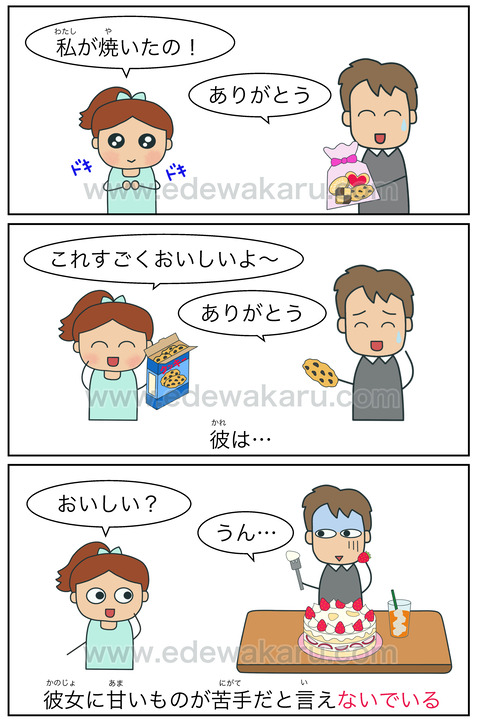
彼は、彼女に甘いものが苦手だと言えないでいる彼は、彼女に甘いものが苦手だと言えずにいる
→甘いものが苦手だと言えないままの状態を続けているHe can’t bring himself to tell his girlfriend that he doesn’t like sweet things. He can’t bring himself to tell his girlfriend that he doesn’t like sweet things. →He remains in a state of being unable to say that he doesn’t like sweet things.
お腹が痛くて、昨日から何も食べないでいるお腹が痛くて、昨日から何も食べずにいる
→何も食べられないままの状態でいるMy stomach hurts, and I haven’t eaten anything since yesterday. My stomach hurts, and I haven’t eaten anything since yesterday. →I remain in a state of not being able to eat anything.
先生:この文法は大切ですので、忘れないでいてくださいね先生:この文法は大切ですので、忘れずにいてくださいね
→忘れない状態でいてくださいね(忘れないでくださいね)Teacher: This grammar point is important, so please don’t forget it. Teacher: This grammar point is important, so please don’t forget it. →Please stay in a state of not forgetting it (please remember it).
彼女は口がかたいから、きっと誰にも秘密を言わないでいるよ彼女は口がかたいから、きっと誰にも秘密を言わずにいるよ
→誰にも言わない状態でいるよShe’s tight-lipped, so she surely won’t tell anyone the secret. She’s tight-lipped, so she surely won’t tell anyone the secret. →She’ll remain in a state of not telling anyone.
彼は、たばこを吸わないでいると怒りっぽくなるようだ彼は、たばこを吸わずにいると怒りっぽくなるようだ
→たばこを吸わない状態でいると怒りっぽくなるようだHe seems to get irritable when he goes without smoking. He seems to get irritable when he goes without smoking. →He seems to get irritable when he stays in a state of not smoking.
A:今年の抱負は何?B:お酒をやめること!A:へえ〜B:もう2週間お酒を飲まないでいるよB:もう2週間お酒を飲まずにいるよ
A: What’s your New Year’s resolution? B: To quit drinking! A: Oh, yeah? B: I’ve gone two weeks without drinking alcohol. B: I’ve gone two weeks without drinking alcohol.
Read the original source text
Meaning
〜しない状態を続けている
〜できないままの状態でいる
How to use it
動詞[ない形]+でいる
動詞[ない形]+ずにいる
Explanation
「〜ないでいる・〜ずにいる」は「〜しない状態を続けている」「〜できないままの状態でいる」という意味の文型です。「〜ないでいる」と「〜ずにいる」はチェンジすることができます。主語には「人」「動物」「グループ」「組織」など、意志動詞を使うものが入りますので、自然現象(しぜんげんしょう)などには使えません。
[例]
❌今年は雪が降ら
ないでいる
❌台風なのに、まったく風が吹か
ないでいる
また「〜ずにいる」を「する」に使う場合は、「〜しずにいる」ではなく「〜せずにいる」になります。
[例]
❌彼は、まだ宿題を
しずにいる
⭕️彼は、まだ宿題をせずにいる
「〜ないで・〜ずに」がつく文型はたくさんあります。「〜ないで」と「〜ずに」は一緒に覚えておきましょう😀
【「〜ないで・〜ずに」がつく文型】
日本語文型辞典
Meaning
Basic information
V-ないでいる
Means “to remain in a state of not doing (or being unable to do) ….” It can also be expressed as 「…(せ)ずにいる」. Since the subject must be a person or animal with feelings or will, it cannot be used in expressions such as the following.
Examples
① I have not eaten anything since yesterday.
② I have not told even my husband about this.
③ On rainy Sundays, I stayed inside without taking even one step outside.
④ My grandmother is unable even to get up by herself.
Incorrect example: It has not been raining.
Read the original source text
Meaning
基本情報V-ないでいる説明「…しない(できない)ままの状態でいる」という意味を表す。「…(せ)ずにいる」とも言える。主語にたつのは、感情や意志を持つ人や動物といったものに限られるため、次のような表現には使えない。例文① 昨日から何も食べないでいる。② このことは夫にも話さないでいる。③ 雨の日曜日は部屋から一歩も出ないでいた。④ 祖母は自分一人では起き上がることもできないでいる。例文(誤) 雨が降らないでいる。
日本語文型辞典 英語版
Meaning
【ないでいる】[V-ないでいる]
ないでいる means “remain in the same state, without doing (being able to do) X.” It can be replaced by ...(せ)ずにいる. The subject of a sentence with ないでいる must be a person or animal with feelings and/or intentions, so expressions such as the following are not acceptable:
(×)雨が降らないでいる。
The rain is still not falling.
In context 4 examples
昨日から何も食べないでいる。
I haven’t eaten anything since yesterday.
このことは夫にも話さないでいる。
I haven’t told this even to my husband.
雨の日曜日は部屋から一歩も出ないでいた。
I didn’t set foot outside all day Sunday because it was raining.
祖母は自分一人では起き上がることもできないでいる。
My grandmother is unable to get up by herself.
NINJAL 日本語文型データベース
Meaning
Expresses the meaning of remaining in a state of not doing or being unable to do ~, due to the speaker’s feelings or intentions.
How to use it
Vないでいる
In context 5 examples
今日は健康診断があるため、朝から何も食べないでいる。
I’m not eating anything from this morning because I have a medical checkup today.
社長の秘密を話したいが、誰にも話さないでいる。
I want to tell someone the president’s secret, but I’m keeping it to myself.
新しいゲームを手に入れたが、テストがあるのでまだプレイしないでいる。
I got a new game, but I have a test, so I’m still not playing it.
近所で起きた強盗事件の犯人がまだ捕まっていないので、外には出ないでいた。
Since the person who committed the robbery in the neighborhood still hadn’t been caught, I stayed inside.
年老いた母は、足腰が弱ってしまい、一人では歩けないでいる。
My elderly mother’s legs and back have grown weak, and she is unable to walk by herself.
Read the original source text
Meaning
話し手の感情や意思で~しない・できないままの状態でいるという意味を表します。
How to use it
Vないでいる