Bunpro Grammar Reference
Meaning
Very unlikely to, Does not seem that, Does not appear that
How to use it
Verb[stem]+ そうもない
Verb[stem]+ そうもありません
Nuance
A grammar point which states that the action of (A) does not even seem likely.
Explanation
そうもない is an expression used with verbs in Japanese, to indicate that some particular action is very unlikely. It is a combination of the auxiliary verb そう, the adverbial particle も, and the い-Adjective ない.
To recap, one of the primary uses of そう is to highlight appearance. Therefore, そうもない literally means 'to not even appear like (A)'. This structure will be used after verbs in their conjunctive form.
腕がまだ治っていないから、あと一週間ぐらい運動が出来そうもない。
My arm hasn't healed yet, so it is very unlikely that I will exercise for another week.
今日は雷が酷いから、釣りに行けそうもない。
Since the thunder is very bad today, it does not even appear like I can go fishing.
Caution
そうもない is very similar to そうにない. The primary difference being that そうもない is stronger. This is due to も expressing something that is surprising (or for emphasis), while に simply marks a location (or state) within which something does or does not exist. The difference can be understood as follows:
(A) そうもない - To not even look like (A), where 'even' emphasizes (A).
(A) そうにない - To not be looking like (A), where 'be' marks where (A) is 'not' existing.
Caution
そうもない is an expression that is very commonly used with potential verbs, in order to convey that the 'possibility' of something cannot be observed. While this translates as 'to not appear as if (A) can be done', realistically it comes across quite strongly, similar to 'to not stand a chance of doing (A)'.
こんな量、食べられそうもない。
This amount, it doesn't even seem like I can eat it! (There is way too much to even seem possible to eat)
今日は11時まで帰って来ないかもしれないから、いつも見ているテレビ番組が見られそうもない。
Today, I might not be coming home until 11, so I might not be able to watch the show I always watch.
In context 16 examples
- 今回のテストは受かりそうもない。
It is very unlikely I will pass the test this time.
- 今日は雷が酷いから、釣りに行けそうもない。
Since the thunder is very bad today, it does not even appear like I can go fishing.
- 腕がまだ治っていないから、あと一週間ぐらい運動が出来そうもない。
My arm hasn't healed yet, so it is very unlikely that I will exercise for another week.
- このテーブルは重たいから、一人で運べそうもない。
Since this table is so heavy, it's very unlikely that I'll be able to carry it by myself.
- あの人、僕の意見を聞いてくれそうもない。
It is very unlikely that that person will listen to my opinion.
- そんなすごい技、僕にはできそうもない。
It's very unlikely that I will be able to perform such a cool trick.
- 予報は雨だけど、全然降りそうもない。
The forecast predicted rain, but it doesn't appear that it will rain at all.
- この調子じゃ、彼は今日も来そうもない。
It is very unlikely that he will come today if it keeps on like this.
- 怪我をしてしまったから、来週の旅行は行けそうもない。
It is very unlikely that I will be able to go on the trip next week because I injured myself.
- 実現できそうもない目標ばかり立てるのはやめてください。
Please stop setting goals that are very unlikely to become a reality.
- 荷物が多すぎて、バッグに入りそうもない。
I have so many things to pack, it is very unlikely that it will all fit in the bag.
- まだ怒っているみたいだから、許してもらえそうもない。
She still looks angry, so it is very unlikely she will forgive you.
- あんまり雪が降っていないから、スキーができそうもない。
It's very unlikely that we'll be able to ski since it didn't snow very much.
- ごめんね、今週末は忙しくて遊べそうもない。
Sorry, it's very unlikely that I'll be able to hang out this weekend because I'm so busy.
- こんな量、食べられそうもない。
This amount, it doesn't even seem like I can eat it! (There is way too much to even seem possible to eat)
- 今日は11時まで帰って来ないかもしれないから、いつも見ているテレビ番組が見られそうもない。
Today, I might not be coming home until 11, so I might not be able to watch the show I always watch.
絵でわかる日本語
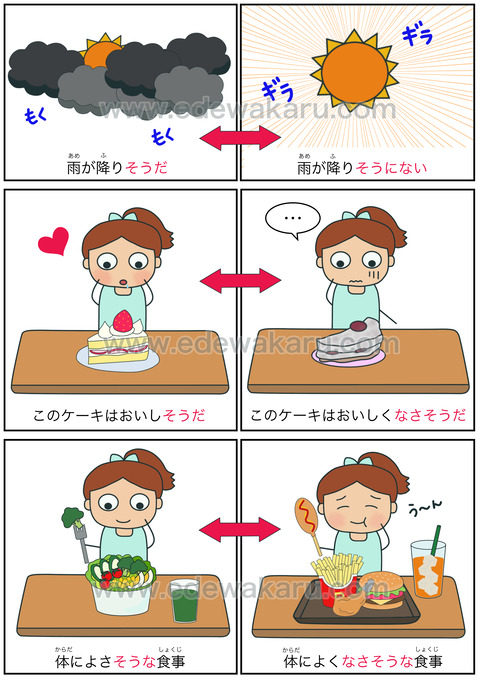
Explanation
The negative forms of “〜そうだ,” which expresses [possibility] and [appearance], are complicated, so you need to learn them well 😨
[Verbs]
〜そうにない
〜そうもない
〜そうにもない
[Adjectives]
〜なさそうだ
〜そうじゃない
This time, I’ve put together the negative forms of “〜そうだ,” which expresses [possibility] and [appearance].
Be careful: the negative forms of “〜そうだ” expressing [hearsay] are “〜ないそうだ” and “〜なかったそうだ” 😀
[Related grammar]
In context 1 examples
彼はバイトを辞めそうだ彼はバイトを辞めそうにない彼はバイトを辞めそうもない彼はバイトを辞めそうにもない
He looks like he’s going to quit his part-time job. He doesn’t look like he’s going to quit his part-time job. He doesn’t look at all like he’s going to quit his part-time job. It doesn’t look like he’s going to quit his part-time job at all.
Read the original source text
Explanation
[可能性][様態]を表す「〜そうだ」の否定形は複雑ですので、しっかりと覚えなければいけません😨
[動詞]
〜そうにない
〜そうもない
〜そうにもない
[形容詞]
〜なさそうだ
〜そうじゃない
今回は[可能性]と[様態]を表す「〜そうだ」の否定形をまとめました。
[伝聞]を表す「〜そうだ」の否定形は「〜ないそうだ」「〜なかったそうだ」になりますので、気をつけましょう
😀
【関連文法】
NINJAL 日本語文型データベース
Meaning
Used when the speaker judges that no change is happening soon or that something is not about to happen. It is also used to say, based on an overall judgment of various circumstances, that something is unlikely to come about.
How to use it
In context 5 examples
この仕事は意外と大変で、今日中に終わりそうもない。
This job is surprisingly difficult, and it doesn’t look like I’ll finish it today.
「すみません。明後日からの2泊の予約、キャンセルさせてください。風邪が治りそうもないんです」
“I’m sorry. Please cancel my reservation for two nights starting the day after tomorrow. It doesn’t look like my cold will get better.”
このペースで書いていたら、レポートの提出期限には間に合いそうもない。
At this pace, it doesn’t look like I’ll meet the report deadline.
この仕事、私は引き受けられそうもありません。どうぞ、他の人をさがしてください。
I don’t think I’ll be able to take on this job. Please look for someone else.
友達から旅行のお土産のシャツをもらった。自分では選びそうもない色だった。
A friend gave me a shirt as a travel souvenir. It was a color I probably wouldn’t have chosen myself.
Read the original source text
Meaning
すぐには変化がない、またはすぐに何かが起こることはないと話し手が判断したときに使います。また、いろいろな状況から総合的に判断して、実現の可能性はないと言いたいときにも使います。