くらべてわかる日本語表現文型辞典
Usage 1
Meaning
Meaning 1: Even after taking condition, situation, or reason A into account, result B is unexpected. It is not immediately believable or easy to accept. A and B are things that have already happened.
Meaning 2: Even in the case of A, condition or reservation B is necessary. With B in place, the conditions for A to hold are met. A has not yet been carried out, but B must be considered beforehand.
Meaning 3: Whether A will come about is unknown, but even while more or less accepting that it will, B still holds.
Meaning 4: Just as with anything else, B holds even in the case of A, without exception.
Meaning 5: Even in the case of A, B is not necessarily the result one would expect from A. A is a word that generally carries a commonly shared image or value.
Meaning 6: If even the small unit A is B, then everything else can be said to be B.
Meaning 7: A highlights and emphasizes something very small and insignificant. A is objectively a small amount, but it has great significance to the speaker.
Meaning 8: In the form “A. Even so, B.” There is little direct connection to the preceding statement, and it often appears at the beginning of a conversation. It is used to introduce a topic, set a scene, express an exclamation, or say something anew.
How to use it
(X is) AにしてもB (AにしたってB / それにしてもB)
Connection 1:
[Verb] にしても
[i-adjective – plain form] にしても
[na-adjective – だ / である / だった / ではない] にしても
Connection 2, 3:
[Verb] にしても
Connection 4, 5:
[Noun – ∅ / である / ではない / だった] にしても
Connection 6, 7:
[Noun – ∅] にしても
Connection 8:
[Sentence]. それにしても [Sentence].
Explanation
【Contrast 1】
“AにしてはB” (Meaning 1, p. 234)
“AにつけB” (Meaning 2, p. 249)
【Contrast 2】
“AとしてもB” (Meaning 1, p. 177)
The possibility of A occurring is lower in the speaker’s mind with “AとしてもB.”
○この病で死ぬにしても、苦しみたくない。(死を身近なものとして発話) — Even if I die of this disease, I don’t want to suffer. (Said with death felt as something close at hand.)
○もしいつかこの病で死ぬとしても、苦しみたくない。(意識の中の死の可能性は低い) — Even if I should die of this disease someday, I don’t want to suffer. (The possibility of death is low in the speaker’s mind.)
【Contrast 3】
“AとしてもB” (Meaning 2, p. 177)
“AとしてもB” strongly implies the supposition “even if one acted as in A.” “AにしてもB” carries the nuance of a case where one accepts that A will happen.
○雨が降るとしても、小雨程度だろう。(たぶん降らないと思うが、降っても小雨だろう。) — Even if it rains, it’ll probably be only a light shower. (I don’t think it’ll rain, but even if it does, it’ll probably be light.)
○雨が降るにしても、小雨程度だろう。(降るだろうが、小雨だろう。) — Even if it rains, it’ll probably be only a light shower. (It’ll probably rain, but it’ll be light.)
“AにしてもBにしても” (Meaning 2, p. 240)
“AにしてもBにしても” has the form “AにしてもAないにしても,” and the speaker takes the likelihood of A occurring or not occurring to be even. “AにしてもB” is closer to an expression used after accepting that A will occur.
【Contrast 4】
“AにとってB (AにとってもB)” (Meaning 1, p. 251)
“AとしてもB” (Meaning 3, p. 178)
Notes
【Note 1】
・“A. それにしてもB.” is a conjunctive expression. Although the meaning is the same, separating A and B makes this a way of emphasizing B. “~にせよ・~にしろ” are older expressions. There are two ways, a and b below, for the sentence to continue to B.
The speaker considers / accepts / understands A
However / nevertheless
The speaker judges that in reality there is C, which is far more extreme than A
Therefore
I want you to ~ / You should ~ / Do ~
a. He said he’d be late getting home today, but even so, he’s very late.
b. He said he’d be late getting home today, but even so, he could at least have called…
【Note 2】
・The verb may be omitted, giving the form “noun + にしても.”
○パソコンにしても多種多様だから、どんな機能が必要かよく考えろ。(パソコンを買う/使うにしても〜) — Even with computers, there are all kinds, so think carefully about what functions you need. (Even if you buy/use a computer…)
【Note 6, 7】
・A is a noun that includes a number.
【Note 8】
・Often, the speaker says something that occurs to them because of something in front of them or the surroundings at the time; the speaker and listener share an understanding.
・“A. それにしてもB.” is a conjunctive expression.
【Notes 1–8】
・“AにしたってB” is colloquial.
In context 32 examples
体調を崩していたにしても、この成績は悪すぎる。
Even if you were in poor health, this result is far too bad.
彼は今日、帰りが遅くなると言っていたが、それにしても遅いですね。
He said he’d be late getting home today, but even so, he’s very late, isn’t he?
親が裕福であるにしても、子どもがこんな買物をするなんて贅沢だ。
Even if the parents are wealthy, it’s extravagant for the child to make such a purchase.
運がよかったにしても、これほどうまくいくとは思わなかった。
Even if we were lucky, I never expected things to go this well.
マンションを買うにしても、ローンでしか買えないよ。
Even if you buy an apartment, you’ll only be able to buy one with a loan.
この商品を輸入するにしたって、関税が下がってからだ。
Even if we import this product, it will be after the tariffs have been lowered.
辞職するにしても、辞めるまでは社員なのだから責任はある。
Even if he resigns, he is still an employee until he leaves, so he has responsibilities.
商売をするにしても、元手が必要だ。
Even if you start a business, you need start-up capital.
彼が他の人と結婚するにしても、わたしは彼を愛し続けるでしょう。
Even if he marries someone else, I will probably continue to love him.
あの大学に合格しないにしても、受けてみようと思う。
Even if I don’t get into that university, I think I’ll give it a try.
あすは晴れるにしても、午後からだろう。
Even if it’s sunny tomorrow, it will probably only clear up in the afternoon.
手術が成功したにしても、復学できるのは一カ月ぐらい先だろう。
Even if the surgery was successful, it will probably be about a month before they can return to school.
教師にしても、学生によい成績をとらせたいという気持ちは強い。
Even teachers strongly want their students to get good grades.
君が行ってくれるというなら、私にしても安心だ。
If you say you’ll go, I feel reassured too.
我々にしても、尊敬できる上司がいるかどうかでやる気が違う。
For us too, our motivation differs depending on whether we have a boss we can respect.
政府の対応はいつも後手に回る。環境問題にしてもそうだ。
The government is always behind the curve in its response. The same is true of environmental problems.
ダイヤモンドにしても、最近では2,3万円ぐらいで手に入る。
Even diamonds can be obtained for around 20,000 to 30,000 yen these days.
フランス料理にしても、安くておいしい店がないわけではない。
Even French food: it’s not as though there are no inexpensive, delicious restaurants.
映画スターにしても、だれもが豪邸に住んでいるとは限らない。
Even movie stars don’t all necessarily live in mansions.
営業マンにしたって、いつもニコニコばかりはしていられない。
Even salespeople can’t always keep smiling.
彼女はかばんひとつにしても、大切に何年も使っている。
Even when it comes to something as small as a handbag, she takes good care of her belongings and uses them for years.
彼は世間を知らない。切符1枚にしても自分で買ったことはない。
He knows nothing about the world. He has never even bought a ticket himself.
あいさつひとつにしても、人柄がにじみ出るものだ。
Even a simple greeting can reveal a person’s character.
虫1匹にしても、そこには魂が宿っているのだ。
Even a single insect has a soul dwelling within it.
ほんの一瞬にしても疑ったことを今では後悔している。
I now regret having doubted them, even for just an instant.
ほんの一時期にしても東京に住んでいたことがある。
I have lived in Tokyo, even if only for a short period.
「休みがたった3日しかとれなかったよ」
「3日にしてもとれただけ、ましじゃないか」“I could only get three days off.” “Even three days is better than nothing, isn’t it?”
一項目にしても、合意できたことに意義がある。
Even if it was only one item, there is significance in having reached an agreement.
「お砂糖いくつ?」
「いえ、結構。それにしてもあなたは甘党なのに太らないわね。」“How many sugars?” “No, thank you. Even so, you have such a sweet tooth, but you don’t gain weight.”
「昨日のテレビ見た?」
「見た、見た。それにしても学園ドラマって面白いね。」“Did you watch TV yesterday?” “I did, I did. Even so, school dramas are interesting, aren’t they?”
それにしても、今年の夏は暑いですな。
Even so, it sure is hot this summer.
それにしても、この料理おいしいね。
Even so, this dish is delicious.
Read the original source text
Meaning
意味1:Aという条件・状況・理由を考慮してもBという結果は予想外。すぐには信じられない、簡単に納得できない。AとBはすでに起こったこと。
意味2:Aの場合でもBという条件・留保が必要。B成立によりA成立の条件が整う。Aはまだ行われていないが、その前にBを考えなければならない。
意味3:Aが成立するかどうかはわからないが、成立するとほぼ認めたうえでなお、それでもBである。
意味4:ほかの何かと同じように、例外なくAの場合でもBである。
意味5:たとえAの場合でも、Bは必ずしもAから予想される結果とは限らない。Aには一般に共通するイメージや価値を持つことばがくる。
意味6:小さな単位AでもBなのだから、ほかはすべてBだといえる。
意味7:ほんの少しの取るに足らないことをAで取り上げ、強調する。客観的に見てAは少ないが、話し手にとっては大きな意味を持つ。
意味8:「A。それにしてもB。」の形で。前件との直接のつながりはあまりなく、会話の冒頭に出てくることが多い。話題提示・場面づくり・感嘆・改めて何かを述べるときに使う。
How to use it
(Xは)AにしてもB(AにしたってB/それにしてもB)
接続1:
[動詞]にしても
[イ形-普]にしても
[ナ形-だ/である/だった/ではない]にしても
接続2,3:
[動詞]にしても
接続4,5:
[名詞-∅/である/ではない/だった]にしても
接続6,7:
[名詞-∅]にしても
接続8:
[文]。それにしても[文]。
Explanation
【対比1】
「AにしてはB」(意味1 P.234)
「AにつけB」(意味2 P.249)
【対比2】
「AとしてもB」(意味1 P.177)
「AとしてもB」のほうが話し手の意識の中でAの起こる可能性が低い。
○この病で死ぬにしても、苦しみたくない。(死を身近なものとして発話)
○もしいつかこの病で死ぬとしても、苦しみたくない。(意識の中の死の可能性は低い)
【対比3】
「AとしてもB」(意味2 P.177)
「AとしてもB」は、もしAのように行動してもという仮定の程度が強い。「AにしてもB」は、Aになると認めた場合というニュアンス。
○雨が降るとしても、小雨程度だろう。(たぶん降らないと思うが、降っても小雨だろう。)
○雨が降るにしても、小雨程度だろう。(降るだろうが、小雨だろう。)
「AにしてもBにしても」(意味2 P.240)
「AにしてもBにしても」は「AにしてもAないにしても」という形であり、Aが成立するかしないかは、半々の確率と話し手は受けとめている。「AにしてもB」はAが成立すると認めた上での表現に近い。
【対比4】
「AにとってB(AにとってもB)」(意味1 P.251)
「AとしてもB」(意味3 P.178)
Notes
【注意1】
・「A。それにしてもB。」は接続表現である。意味は同じであるが、AとBを切り離すことによって、Bが強調される言い方となる。「~にせよ・~にしろ」は古い言い方。下記のようにBに続く言い方がa・bの二通りある。
Aは考慮する、/認める、/わかる
しかし/けれども
実際はAより程度の甚だしいCという現実があると話し手は判断した
だから
〜してほしい/〜したらいいのに/〜しなさい
a.彼は今日、帰りが遅くなるといっていたが、それにしても遅い。
b.彼は今日、帰りが遅くなるといっていたが、それにしても電話ぐらいかけてくればいいのに…。
【注意2】
・動詞を省略して、「名詞+にしても」という形で表す場合もある。
○パソコンにしても多種多様だから、どんな機能が必要かよく考えろ。(パソコンを買う/使うにしても〜)
【注意6,7】
・Aは数を含む名詞。
【注意8】
・目の前にあるものやその場の環境などによって思いついたことを述べる場合が多く、話し手と聞き手の間には共通認識がある。
・「A。それにしてもB。」は接続表現である。
【注意1~8】
・「AにしたってB」は話し言葉。
Usage 2
Meaning
Meaning 1: A and B are examples. In both the case of A and the case of B, situation or state X = Y.
Meaning 2: Y holds regardless of whether it is A or B. A and B are affirmative and negative forms of a verb.
How to use it
(X is) AにしてもBにしても (Y) (AにせよBにせよ / AにしろBにしろ)
Connection 1:
[Verb] にしても [Verb] にしても
[Noun – ∅] にしても [Noun – ∅] にしても
Connection 2:
[Verb] にしても
[Verb – negative form] ないにしても
Explanation
【Contrast 1】
“AであれBであれC” (Meaning 1, p. 140)
【Contrast 2】
“AにしてもB” (Meaning 3, p. 237)
【Contrasts 1 and 2】
“AてもBても”
When Y in “AにしてもBにしても (Y)” comes before A and B, it cannot be replaced with “AてもBても.”
○この野菜は焼くにしても煮るにしても、一度茹でたほうがいい。 — Whether you grill or boil this vegetable, it’s better to parboil it first.
×この野菜は焼いても煮ても、一度茹でたほうがいい。 — Whether you grill or boil this vegetable, it’s better to parboil it first.
Notes
【Note 2】
・What the speaker wants to say is Y, and X is often omitted.
・It may also be used with B omitted.
○そんなことをされたら、私にしても困ります。→「AにしてもB」(意味4 P.237)と同じ — If something like that were done to me, I’d be in trouble too. → Same as “AにしてもB” (Meaning 4, p. 237)
○あの大学を受けないにしても、願書だけはもらっておけ。→「AにしてもB」(意味3 P.237)と同じ — Even if you don’t apply to that university, at least get an application form. → Same as “AにしてもB” (Meaning 3, p. 237)
・In order from least to most colloquial: “AにせよBにせよ,” “AにしろBにしろ,” and “AにしてもBにしても.”
In context 8 examples
彼女の持ち物は洋服にしてもハンドバッグにしても、地味すぎる。
Whether it’s her clothes or her handbag, her belongings are too plain.
料理にしろ洗濯にしろ、彼の方が私よりうまい。
Whether it’s cooking or laundry, he’s better at it than I am.
テレビを見るにしても新聞を読むにしても、老眼鏡が手放せない。
Whether I watch TV or read the newspaper, I can’t do without my reading glasses.
お金は貸すにしても借りるにしても、友情を壊すおそれがある。
Whether lending or borrowing money, there is a risk of damaging a friendship.
行くにしても行かないにしても、とにかく連絡ください。
Whether you go or don’t go, contact me anyway.
読むにしても読まないにしても、ひとまずこの本を借りておこう。
Whether I read it or not, I’ll borrow this book for now.
受けるにしても受けないにしても、一度志望校を見ておけ。
Whether you take the exam or not, go and look at your first-choice school once.
彼が来るにせよ来ないにせよ、私は出席します。
Whether he comes or not, I will attend.
Read the original source text
Meaning
意味1:AやBは例示。Aの場合もBの場合もX=Yという状況・状態。
意味2:A、BどちらにしてもY。AとBは肯定と否定の動詞が入る。
How to use it
(Xは)AにしてもBにしても(Y)(AにせよBにせよ/AにしろBにしろ)
接続1:
[動詞]にしても[動詞]にしても
[名詞-∅]にしても[名詞-∅]にしても
接続2:
[動詞]にしても
[動詞-ない形]ないにしても
Explanation
【対比1】
「AであれBであれC」(意味1 P.140)
【対比2】
「AにしてもB」(意味3 P.237)
【対比1,2】
「AてもBても」
「AにしてもBにしても(Y)」のYがAやBより前の場合は「AてもBても」で置き換えできない。
○この野菜は焼くにしても煮るにしても、一度茹でたほうがいい。
×この野菜は焼いても煮ても、一度茹でたほうがいい。
Notes
【注意2】
・話し手の述べたいことはYで、Xは省略される場合が多い。
・Bを省略した形で使うこともある。
○そんなことをされたら、私にしても困ります。→「AにしてもB」(意味4 P.237)と同じ
○あの大学を受けないにしても、願書だけはもらっておけ。→「AにしてもB」(意味3 P.237)と同じ
・「AにせよBにせよ」「AにしろBにしろ」「AにしてもBにしても」の順で話し言葉的。
AIUEO JLPT Grammar
Meaning
This sentence pattern is used similarly to the above but is typically seen in more formal settings. It is used to emphasize that regardless of the situation, the result or situation remains the same.
How to use it
Verb に + しても + verb に + しても; adjective に + しても + adjective に + しても; な-adjective に + しても + な-adjective に + しても; noun に + しても + noun に + しても
In context 5 examples
成功するにしても失敗するにしても、まずは挑戦してみよう。
Whether you succeed or fail, let’s try it first.
新しい仕事にしても、趣味にしても、まずは楽しむことが大切です。
Whether it’s a new job or a hobby, enjoying it is the most important thing.
彼にしても彼女にしても、どちらがリーダーでも構いません。
Whether it’s him or her, it doesn’t matter who the leader is.
買うにしても借りるにしても、事前に調べておいた方がいいです。
Whether you buy or rent, it’s better to research in advance.
重要であるにしてもそれほどでないにしても、報告は必要です。
Whether it’s important or not, a report is necessary.
Read the original source text
Meaning
This sentence pattern is used similarly to the above but is typically seen in more formal settings. It is used to emphasize that regardless of the situation, the result or situation remains the same.
How to use it
動詞に+しても+動詞に+しても形容詞に+しても+形容詞に+しても形容動詞に+しても+形容動詞に+しても名詞に+しても+名詞に+しても
Explanation · 日本語
この文型は、対照的な例を挙げながら、そのどちらの場合でも同じ結果や状況が成り立つことをを表す表現です。類似の表現には「〜にせよ〜にせよ」や「〜にしろ〜にしろ」がありますが、「〜にしても〜にしても」はより柔らかいニュアンスを持つことが多いです。
文法
Meaning
Whether 〜 or 〜, in either case ...
The two things in 「〜」 are either opposites or two things from the same category.
How to use it
V (dictionary form) + にしても + V (dictionary form) + にしても
N + にしても + N + にしても
Notes
More formal expressions are 「〜にせよ〜にせよ」 and 「〜にしろ〜にしろ」.
In context 5 examples
英語を学ぶにしても中国語を学ぶにしても目的や目標をはっきりしないと続かないよ。
Whether you’re learning English or Chinese, you won’t keep at it unless you make your purpose and goals clear.
体調がいいにしても良くないにしても健康診断は定期的に受けておいた方がいい。
Whether you’re feeling well or not, it’s best to get regular health checkups.
飲み会に参加するにしろ、しないにしろ明日までに参加可否を連絡ください。
Whether you attend the drinking party or not, please let us know by tomorrow if you can come.
犬にしろ猫にしろ、このマンションではペットを飼ってはいけない決まりです。
Whether it’s a dog or a cat, pets are not allowed in this apartment building.
JLPTを受けるにせよ、受けないにせよしっかりと勉強する必要がある。
Whether you take the JLPT or not, you need to study hard.
Read the original source text
Meaning
〜でも〜でも、どちらの場合でも・・・
「〜」には対立する2つのもの、あるいは同ジャンルの2つのものが来る。
How to use it
V(辞書形) + にしても + V(辞書形)+ にしても
N + にしても + N + にしても
Notes
硬い言い方は「〜にせよ〜にせよ」や「〜にしろ〜にしろ」。
Bunpro Grammar Reference
Usage 1
Meaning
Regardless of whether
How to use it
Verb (A) + にしても + Verb (B) + にしても
Noun (A) + にしても + Noun (B) + にしても
[い]Adjective (A) + にしても + [い]Adjective (B) + にしても
[な]Adjective (A) + にしても + [な]Adjective (B) + にしても
Nuance
A two-part expression that implies that going off either (A) or (B) will have the same result.
Explanation
にしても, a grammar point consisting of に, the て-form of する, and も, is used to convey that 'regardless of (A) or (B), the result will still be (C)', or '(C) is true, regardless of either (A) or (B)'. While it is common for this grammar pattern to appear with the positive and negated versions of a verb in (A) and (B), it may actually be used with any verbs, nouns, or adjectives that are contrasting in some way.
忘年会に出席するにしても、しないにしても、参加費を払わないといけないのはおかしいと思う。
I think it is unfair that we need to pay the attendance fee for the year-end party regardless of whether we attend or not.
家を立て直すにしても、リフォームするにしても、費用は同じぐらいになりそうだ。
Regardless of whether the house is rebuilt or remodeled, the cost is likely to be about the same.
水深が深いにしても、浅いにしても、ライフジャケットは着ておいた方がいい。
Regardless of whether the water is deep or shallow, you should wear a life jacket.
日本語が上手にしても、下手にしても、勉強は毎日しておいた方がいい。
Regardless of whether you are good or bad at Japanese, you should study every day.
平日にしても祝日にしても、ディズニーランドは多くの人で賑わっています。
Disneyland is crowded with people, regardless of whether it is a weekday or a holiday.
In many cases, ~にしても, ~にしろ, and ~にせよ will be completely interchangable. However, the latter ~にしろ and にせよ are more direct, so will be seen less in formal situations.
In context 17 examples
- 貸すにしても売るにしても、とにかく元を取れればそれでいい。
Regardless of whether you rent it out, or sell it, it is fine as long as I break even somehow.
- 忘年会に出席するにしても、しないにしても、参加費を払わないといけないのはおかしいと思う。
I think it is unfair that we need to pay the attendance fee for the year-end party regardless of whether we attend or not.
- 家を立て直すにしても、リフォームするにしても、費用は同じぐらいになりそうだ。
Regardless of whether the house is rebuilt or remodeled, the cost is likely to be about the same.
- 平日にしても祝日にしても、ディズニーランドは多くの人で賑わっています。
Disneyland is crowded with people, regardless of whether it is a weekday or a holiday.
- 水深が深いにしても、浅いにしても、ライフジャケットは着ておいた方がいい。
Regardless of whether the water is deep or shallow, you should wear a life jacket.
- 日本語が上手にしても、下手にしても、勉強は毎日しておいた方がいい。
Regardless of whether you are good or bad at Japanese, you should study every day.
- 食べるにしても、食べないにしても、料理代を払わないといけない。
Regardless of whether you eat or not, you still have to pay for the food.
- 貸家にしても、自宅にしても、家族がいるだけで十分。
Regardless of whether you own a house or rent one, as long as you have family, that is enough.
- 簡単にしても、難しいにしても、宿題を終わらせるべきだ。
Regardless of whether the homework is easy or hard, you must finish it.
- 煮るにしても焼くにしても、素材の良さを活かした料理にしてください。
Regardless of whether you boil it or fry it, please make use of the quality of the raw materials.
- 入社するにしてもしないにしても、明後日までには返事をください。
Regardless of whether you join the company or not, please reply by the day after tomorrow.
- 進むにしても引き返すにしても、勇気がないと決断できない。
Regardless of whether you continue forward or turn back, you can't make a decision without courage.
- 増やすにしても減らすにしても、先見の明が必要だ。
Regardless of whether it increases or decreases, it is necessary to anticipate it.
- 平日にしても祝日にしても、都会はとにかく人が多い。
Regardless of whether it is a weekday or a holiday/weekend, there are generally a lot of people in the city.
- 飛行機にしてもヘリコプターにしても、騒音問題をなんとかしてほしい。
Regardless of whether it is a plane or a helicopter, I want them to do something about the noise problem.
- 方針を変えるにしても変えないにしても、決定を急ぐ必要があります。
Regardless of whether we change the plan or not, it is necessary to make the decision soon.
- 車にしてもバイクにしても、比較的上手に運転できる方だと思います。
I think he is someone who can drive relatively well regardless of whether it is a car or a motorcycle.
Usage 2
Meaning
Even though, Even if, Even when, Also
How to use it
Verb + にしても
[い]Adjective + にしても
[な]Adjective + にしても
Noun + にしても
Nuance
A phrase that expresses that even if you go off the assumption that (A), (B) is still true.
Explanation
In the same way that にしては highlights a point to be considered about (A), or simply 'while (A)', the replacement of は with the adverbial particle も will put further emphasis on (B) being a surprising or unexpected thing that accompanies (A). This continues to reflect the case marking particle に's use as a location.
にしても may be translated as 'even considering (A), (B)', or 'even while (A), (B)', and may be used with any word in its plain form. にして by itself is often considered as a stand-alone adverbial particle, despite stemming from several parts.
パーティーに行くにしても、私はシャイだから一人で飲むことになる。
Even if I did go to a party, I am shy so I'd just end up drinking alone.
冗談にしても、言っていいことと言ってはいけないことがある。
Even if it's a joke, there are things that are fine to say and things that you can't say.
仕事で忙しいにしても、連絡はしてください。
Even if you are busy with work, please at least contact me.
今は怠惰な私にしても、元々こうだったわけではない。
Even though I'm being lazy now, this isn't what I was like originally.
にしても is very regularly used with Japanese's equivalent of WH-words, like どこ, どの, だれ, なに, etc. In these cases, it highlights that 'even considering (A) is undetermined (in location, number, amount, etc), (B)'.
ハイキングをするときは、どこに行くにしてもベルを持って行った方がいい。
No matter where you go hiking, you should take a bell with you.
もし近所のルールを守っていない人を見つけたら、誰に注意するにしても注意をしなければいけない。
In the case that you see someone not following the rules of the neighborhood, even if you're warning someone you don't know, you need to warn them.
Caution
As opposed to としても, a grammar point that will be covered in another lesson, にしても may introduce new topics (としても may not). This is due to にしても implying that (A) and (B) exist simultaneously, without the need for (B) to necessarily stem from (A). However, としても will always imply that (B) stems from (A) in some way.
このプロジェクトが難しいとしても、クライアントのためにやらないといけない。
Even if this project is hard, we have to do it for the client. (Even though it is hard, we must do it for the client)
このプロジェクトが難しいにしても、締め切りまでには終わらせないといけない。
Even if this project is hard, we must finish it by the deadline. (Even if we go off that fact that it is hard, it must be finished by the deadline)
In context 20 examples
- テスラモデルSにしても、この値段は高すぎる。
Even if it is a Tesla Model S, this price is too expensive.
- パーティーに行くにしても、私はシャイだから一人で飲むことになる。
Even if I did go to a party, I am shy so I'd just end up drinking alone.
- 仕事で忙しいにしても、連絡はしてください。
Even if you are busy with work, please at least contact me.
- 今は怠惰な私にしても、元々こうだったわけではない。
Even though I'm being lazy now, this isn't what I was like originally.
- ハイキングをするときは、どこに行くにしてもベルを持って行った方がいい。
No matter where you go hiking, you should take a bell with you.
- もし近所のルールを守っていない人を見つけたら、誰に注意するにしても注意をしなければいけない。
In the case that you see someone not following the rules of the neighborhood, even if you're warning someone you don't know, you need to warn them.
- 冗談にしても、言っていいことと言ってはいけないことがある。
Even if it's a joke, there are things that are fine to say and things that you can't say.
- ジュースがいっぱいの樽を頼むにしても、まだ足りないと思います。
Even if we order a barrel full of juice, I still think it won't be enough.
- 風邪にしても、楽しい英語の勉強はできるはずだ。
Even if I were to have a cold, I would surely be able to study English, which is fun.
- 言うにしても言い方というものがあるでしょ。
Even if you (decide to) say something, there is still something called manner of speech.
- 分からないにしても、少しくらいは調べてくれてもいいじゃないか。
Even if you don't know, you can do a bit of research, right?
- 理想を語るにしても、少しは現実を見てほしい。
Even if you are talking about ideals, I want you to take a look at reality.
- すぐ始めるにしても、肝心の山田さんがいないと始められない。
Even if we were to start immediately, we cannot start when Mr. Yamada, who is essential, is not here.
- 負けるにしても、全力で試合に臨むべきだ。
Even if you were to lose, you should still confront the match with your full strength.
- 車を買うにしても、車庫が少し狭いから、小さいのを選ばなければ。
Even if I (decide to) buy a car, the garage is a bit small, so I have to choose a small one.
- 勇者の生死は不明だ。いずれにしても、誰かが世界を救わなければいけないのだ。
The hero's life or death is uncertain. But in any case, someone has to save the world.
- どこで暮らすにしても故郷を忘れる日は一日もなく、たまに泣いてしまいます。
Even if I were to live somewhere else, there would be not a single day that I forget my hometown, and I'd sometimes cry.
- 何をするにしても手段が大切であり、手段を間違えると何も達成できません。
Even if you were to do something, the method is important, so if you make a mistake with the method then you won't achieve anything.
- このプロジェクトが難しいとしても、クライアントのためにやらないといけない。
Even if this project is hard, we have to do it for the client. (Even though it is hard, we must do it for the client)
- このプロジェクトが難しいにしても、締め切りまでには終わらせないといけない。
Even if this project is hard, we must finish it by the deadline. (Even if we go off that fact that it is hard, it must be finished by the deadline)
日本語NET JLPT文法解説まとめ
Meaning
“Whether … or …, in either case …”
The two “…” slots are filled by two contrasting things, or by two things in the same category.
How to use it
V (dictionary form) + にしても + V (dictionary form) + にしても
N + にしても + N + にしても
Explanation
“Whether … or …, in either case...”
In 〜, there are two contrasting things or two things within the same category.
The more formal expressions are 「〜にせよ〜にせよ」 and 「〜にしろ〜にしろ」.
In context 5 examples
英語を学ぶにしても中国語を学ぶにしても目的や目標をはっきりしないと続かないよ。
Whether you’re learning English or Chinese, you won’t keep at it unless you make your purpose and goals clear.
体調がいいにしても良くないにしても健康診断は定期的に受けておいた方がいい。
Whether you’re feeling well or not, it’s best to get regular health checkups.
飲み会に参加するにしろ、しないにしろ明日までに参加可否を連絡ください。
Whether you attend the drinking party or not, please let us know by tomorrow if you can come.
犬にしろ猫にしろ、このマンションではペットを飼ってはいけない決まりです。
Whether it’s a dog or a cat, pets are not allowed in this apartment building.
JLPTを受けるにせよ、受けないにせよしっかりと勉強する必要がある。
Whether you take the JLPT or not, you need to study hard.
Read the original source text
Meaning
"〜でも〜でも、どちらの場合でも・・・"
「〜」には対立する2つのもの、あるいは同ジャンルの2つのものが来る。
How to use it
V(辞書形) + にしても + V(辞書形)+ にしても
N + にしても + N + にしても
Explanation
"Whether 〜 or 〜, in either case..."
In 〜, there are two contrasting things or two things within the same category.
硬い言い方は「〜にせよ〜にせよ」や「〜にしろ〜にしろ」。
NINJAL 日本語文型データベース
Usage 1
Meaning
Used to give two examples with “~” and say that the same thing applies in either case.
The form “~にしても [interrogative word] + にしても” is also used to express that the same thing applies in every similar case.
How to use it
V1 plain form + にしても V2 plain form + にしても
i-A1 plain form + にしても i-A2 plain form + にしても
na-A1 plain form + にしても na-A2 plain form + にしても (however, “na-Aだ” → “na-A + にしても・na-Aである + にしても”)
N1 plain form + にしても N2 plain form + にしても (however, “Nだ” → “N + にしても・Nである + にしても”)
Notes
The two “~” expressions may sometimes be different parts of speech.
“~” is followed by words that are semantically related or have opposite meanings.
In context 19 examples
ここの食堂の定食は、ごはんを大盛にするにしてもしないにしても、同じ値段だ。
The set meals at this cafeteria cost the same whether you get a large serving of rice or not.
本を読むにしても何をするにしても、テレビのついている部屋ではうるさくて落ち着かない。
Whether you’re reading a book or doing anything else, it’s noisy and hard to relax in a room with the TV on.
食生活はバランスが大切だ。肉や魚を全く食べないにしても野菜を全く食べないにしても、あまり体にいいとはいえない。
Balance is important in your diet. Whether you don’t eat meat or fish at all or don’t eat vegetables at all, it can’t be very good for your health.
昨日買ったにしても今日買ったにしても、肉をスーパーに返品するのは難しいだろう。
Whether I bought the meat yesterday or today, it would probably be difficult to return it to the supermarket.
高校を卒業しなかったにしても大学に行かなかったにしても、履歴書にうそを書いてはだめだ。
Whether you didn’t graduate from high school or didn’t go to university, you must not lie on your résumé.
寒いにしても暑いにしても、制服だと調整しにくい。
Whether it’s cold or hot, it’s hard to adjust when you’re wearing a uniform.
喉が痛くないにしても頭が痛くないにしても、検査の結果がインフルエンザなら、学校を休まなければならない。
Whether you have a sore throat or a headache, if the test result says it’s influenza, you have to stay home from school.
会計係「公費で買ったものは安かったにしても高かったにしても、必ず領収書を出してください」
Accounts clerk: “Be sure to submit a receipt for anything bought with public funds, whether it was cheap or expensive.”
料理がおいしくなかったにしても店の雰囲気がよくなかったにしても、露骨に顔に出すなんて下品だと思います。
Whether the food wasn’t tasty or the atmosphere wasn’t good, I think it’s vulgar to show it so plainly on your face.
上司が優秀であるにしても部下が優秀であるにしても、どちらにしてもそれは幸運なことだ。
Whether the boss is capable or the subordinate is capable, either way it’s fortunate.
生徒たちが熱心じゃないにしても素直じゃないにしても、田中先生は気にせず淡々と授業を進めている。
Whether the students aren’t enthusiastic or aren’t cooperative, Mr. Tanaka carries on teaching calmly without worrying about it.
好きだったにしても嫌いだったにしても、あの人との関係はもう思い出したくもない。
Whether I liked or hated that person, I don’t even want to think about my relationship with them anymore.
祖母が元気じゃなかったにしても機嫌が悪かったにしても、いつものことだからそれを受け止めるしかなかった。
Whether my grandmother wasn’t feeling well or was in a bad mood, it was normal, so I had no choice but to accept it.
犬にしても猫にしても、私はアレルギーがあるから飼えない。
Whether it’s dogs or cats, I can’t keep them because I have allergies.
妹にしても弟にしても、乗り物酔いをする体質なので、長時間のバス旅行の後は、少しぐったりした様子だった。
Both my younger sister and younger brother are prone to motion sickness, so they looked a little worn out after the long bus trip.
晴天にしても晴天じゃないにしても、日中なら空には必ず太陽がある。
Whether the sky is clear or not, the sun is always in the sky during the day.
ストレスの原因が仕事であるにしても人間関係であるにしても、解消方法は必ずあるはずだ。
Whether the cause of stress is work or human relationships, there must be a way to relieve it.
締め切りが今週じゃないにしても来週じゃないにしても、近いことには変わりないんだから頑張らないと。
Whether the deadline is this week or next week, it’s still soon, so I have to do my best.
渋滞がひどかったので、バスだったにしてもタクシーだったにしても、結局かかった時間に大差はなかっただろう。
The traffic was terrible, so whether we had taken a bus or a taxi, the time it took probably wouldn’t have been much different.
Read the original source text
Meaning
〜で2つの例を挙げて、どちらの場合でも同じことが言えると言いたいときに使います。
「〜にしても[疑問詞]+にしても」の形も使い、同じような場合なら全部同じことが言えることを表します。
How to use it
V1普通形+にしてもV2普通形+にしても
i-A1普通形+にしてもi-A2普通形+にしても
na-A1普通形+にしてもna-A2普通形+にしても(ただし、「na-Aだ」→「na-A +にしても・na-Aである+にしても」)
N1普通形+にしてもN2普通形+にしても(ただし、「Nだ」→「N+にしても・Nである+にしても」)
Notes
2つの「〜」には異なる品詞がくる場合もあります。
「〜」には、意味的に関連のある言葉、または対立する意味の言葉がきます。
Usage 2
Meaning
[1] Used to express the speaker’s judgment that even if ~ is assumed, it will not have the kind of effect one would expect from it.
[2] Used to express the speaker’s judgment that although ~ is a fact, it will not have the kind of effect one would expect from it.
[3] Used to say that the situation is the same even when considered from ~’s position or point of view.
How to use it
V plain form + にしても
i-A plain form + にしても
na-A plain form + にしても (however, “na-Aだ” → “na-A + にしても・na-Aである + にしても”)
N plain form + にしても (however, “Nだ” → “N + にしても・Nである + にしても”)
na-A plain form + にしても (however, “na-Aだ” → “na-A + にしても・na-Aである + にしても”)
N plain form + にしても (however, “Nだ” → “N + にしても・Nである + にしても”)
N にしても
Notes
[1] “~” is followed by a sentence expressing a supposition. The sentence after “~にしても” usually expresses the speaker’s judgment, evaluation, or intention.
When “~” contains an interrogative word such as “what,” “where,” or “who,” it expresses that the result will be the same under any conditions.
[2] “~” is followed by a sentence stating a fact. The sentence after “~にしても” usually expresses the speaker’s judgment, evaluation, or intention.
[3] “~” is followed by a word referring to a person or thing.
When “~” is a word referring to a third party, the sentence after “~にしても” often uses an inferential expression such as “~だろう.”
When “~” refers to a thing, the form “~ひとつにしても” is also often used. It emphasizes that “~” is one typical example and that the same applies to other things.
In context 45 examples
やっぱりダイエットしたほうがいいのかなあ。もしダイエットするにしても、あまり無理なことはしたくないなあ。
I wonder if I should go on a diet after all. Even if I do, I don’t want to do anything too extreme.
バザーで売れ残った古着が全部ただになるにしても、不要なものはほしくない。
Even if all the secondhand clothes left unsold at the bazaar were free, I wouldn’t want anything I don’t need.
学校で数学を学ぶのはなぜか。たとえ大人になってから難しい公式を一切使わないにしても、論理的な思考力は日常のさまざまな場面で必要なのだ。
Why do we study math at school? Even if we never use difficult formulas at all as adults, logical thinking is needed in many everyday situations.
去年ここに店はなかったと思う。もしあったにしても、飲食店ではなかったはずだ。
I don’t think there was a shop here last year. Even if there was, it couldn’t have been a restaurant.
転職を迷っていた田中さんは、結局どうしただろう。たとえ転職しなかったにしても、社内で新しいチャンスをつかんでいるといいが。
I wonder what Tanaka, who was unsure about changing jobs, ended up doing. Even if he didn’t change jobs, I hope he found a new opportunity within the company.
2週間は難しいにしても、1週間ぐらいゆっくりと一人旅をしたい。
Even if two weeks is difficult, I’d like to take a leisurely solo trip for about a week.
野球部は毎日早朝から練習があるらしい。朝の練習はそれほど厳しくないにしても、毎日では大変だろうなあ。
It seems the baseball team practices from early morning every day. Even if the morning practice isn’t that tough, it must be hard to do it every day.
先方がどんな言い方をしたか知らないが、たとえどんなに言葉がきつかったにしても非はこちらにあるんだから、黙って頭を下げるしかないだろう。
I don’t know how the other party put it, but even if their words were very harsh, we are at fault, so we’ll probably have no choice but to keep quiet and bow our heads.
「郵便って届くのに何日かかる?」「場合によるけど、万一遅かったにしても1週間はかからないんじゃない?」
“How many days does it take for a letter to arrive?” “It depends, but even if it’s delayed, it probably won’t take a whole week, will it?”
これは夏休みに撮った写真じゃないはずだ。夏だったら、いくら暑くなかったにしても、こんなセーターを着ているようなことはないと思う。
This can’t be a photo taken during summer vacation. If it were summer, I don’t think I’d be wearing a sweater like this, even if it wasn’t very hot.
うちのベランダで野菜を作ってみたい。たとえ収穫はわずかにしても、とれたての野菜はおいしいはずだ。
I’d like to try growing vegetables on our balcony. Even if the harvest is small, freshly picked vegetables should taste good.
明日からはこの古典作品を読んでみよう。文章がどんなに難解であるにしても、しっかり時間をかけて読めば大体の内容はわかると思う。
Starting tomorrow, I’ll try reading this classic work. No matter how difficult the text is, I think I can understand the general content if I take my time and read it carefully.
たとえ料理があまり得意じゃないにしても、このレシピの通りに作ればまあまあのものができるはずです。
Even if you’re not very good at cooking, you should be able to make something decent if you follow this recipe.
その決定について、たとえ何人かは不満だったにしても、大多数の人は好意的に受け止めていたのではないかと思う。
Even if some people were dissatisfied with the decision, I think the majority of people received it favorably.
留学したかったが断念した。仮に能力的に無理ではなかったにしても、親の経済状態を考えて諦めたほうがいいと思ったのだ。
I wanted to study abroad but gave up. Even if it hadn’t been beyond my abilities, I thought it would be better to give up considering my parents’ financial situation.
たとえ短期間にしても、外国で生活してみることは貴重な経験になると思います。
I think living abroad, even for a short time, would be a valuable experience.
先日の精密検査の結果が明日出る。たとえ厄介な病気であるにしても治す方法はきっとあるはずだ。
The results of the detailed examination from the other day will come out tomorrow. Even if it is a troublesome illness, there must be a way to treat it.
うちの前の雪道で転んでしまった人がいる。たとえうちの責任じゃないにしても、雪かきはもっとしっかりしておいたほうがいいな。
Someone slipped on the snowy road in front of our house. Even if it wasn’t our fault, we should clear the snow more thoroughly.
午後2時に合格発表だ。もし不合格だったにしても、まだ第2、第3志望が残っている。
The admission results will be announced at 2 p.m. Even if I don’t pass, I still have my second and third choices.
昨日の腹痛の原因は何だったのだろう。仮に食べたものが原因ではなかったにしても、食べ物には気をつけなければ……。
I wonder what caused yesterday’s stomachache. Even if it wasn’t something I ate, I still have to be careful about food…
この店は接客がよくない。客を待たせるにしても、声ぐらいかけるべきだろう。
The service at this shop is poor. Even if they make a customer wait, they should at least say something.
いくらお金がないにしても、授業で使う教科書は買わないとだめだよ。
No matter how little money you have, you have to buy the textbook for class.
患者の病状は落ち着いている。楽観はできないにしても、さほど悲観的に考える必要はないと思う。
The patient’s condition is stable. Even if we can’t be optimistic, I don’t think we need to be too pessimistic.
一応部屋を片付けたにしても、これじゃまだ客を呼べるほどきれいにはなっていない。
Even though I did tidy up the room, it still isn’t clean enough to invite guests over.
いくら時間がなかったにしても、あんな完成度の低いレポートを出すなんて信じられない。
No matter how little time you had, I can’t believe you turned in such a poorly finished report.
仕事を頼んでいるんだから、いくら忙しいにしても、長い間全くの音信不通というのは困る。
Since I’ve asked you to do the work, it’s a problem if you are completely out of touch for a long time, no matter how busy you are.
世界一周クルーズは金銭的に難しいにしても、ゆっくりと旅がしてみたいなあ。
A round-the-world cruise may be financially out of reach, but I’d like to take a leisurely trip.
ダンス部の練習は週1回だけで、そんなに厳しいものではないらしい。しかし、いくら厳しくないにしても、続けていくのはそれなりに大変だ。
The dance club apparently practices only once a week, and it isn’t that strenuous. Still, even if it isn’t strenuous, keeping it up is fairly hard.
論文を批判されてどんなに悔しかったにしても、批判の内容は謙虚に受け止めるべきだ。
No matter how frustrated you were to have your paper criticized, you should humbly accept the substance of the criticism.
たとえわずかにしても、この野菜は私が育てて収穫したものだからうれしい。
Even if it’s only a little, I’m happy because I grew and harvested these vegetables myself.
この評論文は、文章は難解であるにしても、筆者の主張が分かりやすく説得力がある。
Although the prose in this critical essay is difficult, the author’s argument is easy to understand and persuasive.
外国人客が多い店の店員は、それほど流暢ではないにしても、たいてい英語が話せる。
Staff at shops with many foreign customers can generally speak English, even if they aren’t very fluent.
そんなに個人情報の管理がいい加減では、これまでは運良く大丈夫だったにしても、今後問題が起きないとは言えない。
If personal information is managed so carelessly, even if everything has been fine by good luck so far, we can’t say that problems won’t arise in the future.
子どものころに見た映画を久しぶりに見てみた。うっすらと覚えていたことは、完璧ではなかったにしてもだいたい正しかった。
I watched a movie I’d seen as a child for the first time in a long while. What I vaguely remembered was mostly correct, even if it wasn’t perfect.
ここしか開いていなかったから入ったが、雰囲気のいいレストランだった。偶然にしても、いい店を見つけられてよかった。
I went in because this was the only place open, and it turned out to be a restaurant with a nice atmosphere. Even if it was by chance, I’m glad I found a good place.
街で好きな俳優を見かけた。すぐ車に乗り込んで行ってしまったが、ほんの一瞬にしても、好きな俳優を見られてうれしかった。
I spotted an actor I like on the street. They got into a car and left right away, but I was happy to see my favorite actor, even if only for a moment.
近年の流行であるにしても、若者たちがみな同じような服に身を包んでいることには、戸惑いを感じる。
Even if it is a recent trend, I feel unsettled seeing all young people dressed in similar clothes.
はじめは知り合い同士じゃないにしても、一緒にゲームをすればすぐに打ち解けることができる。
Even if people don’t know each other at first, they can quickly become friendly by playing a game together.
彼が昔どんなにひどい人だったにしても、私には関係ないことです。今の彼が好きなんですから。
No matter how awful a person he used to be, it has nothing to do with me. I love who he is now.
母「今回は大したけがではなかったにしても、次はわからないよ。バイクの運転にはもっと気をつけなさいよ」
Mother: “Even if your injury wasn’t serious this time, who knows what could happen next time. Be more careful when riding your motorcycle.”
結局私は離婚した。子どもたちにしてもその方がよかったのではないだろうか。
In the end, I got divorced. Wouldn’t that have been better for the children too?
部長は小林さんと激しい議論をしたが、小林さんにしても言いたいことは言い尽くしたようだ。
The department manager had a heated argument with Kobayashi, but Kobayashi too seems to have said everything he wanted to say.
母とは長い間いい関係が保てなかった。母にしてもそれはつらいことだっただろう。
I couldn’t maintain a good relationship with my mother for a long time. That must have been painful for her too.
妹は私とは趣味がまるで違う。服の好みにしても私とは真逆だ。
My younger sister’s interests are completely different from mine. Even our tastes in clothing are the exact opposite.
山田さんは私の憧れの人だ。話し方ひとつにしても魅了される。
Yamada is someone I admire. Even the way they speak captivates me.
Read the original source text
Meaning
[1] 〜と仮定した場合も、そのことから予想されるような影響は受けないという話し手の判断を述べるときに使います。
[2] 〜は事実だがその場合も、そのことから予想されるような影響は受けないという話し手の判断を述べるときに使います。
[3] ~の立場・観点で考えても状況は同じだと言いたいときに使います。
How to use it
V普通形+にしても
i-A普通形+にしても
na-A普通形+にしても(ただし、「na-Aだ」→「na-A+にしても・na-Aである+にしても」)
N普通形+にしても(ただし、「Nだ」→「N+にしても・Nである+にしても」)
na-A普通形+にしても(ただし「na-Aだ」→「na-A+にしても・na-Aである+にしても)
N普通形+にしても(ただし「Nだ」→「N+にしても・Nである+にしても」)
Nにしても
Notes
[1] 「〜」には、仮定したことを表す文がきます。「~にしても」の後には、ふつう話し手の判断・評価・意志を表す文がきます。
「~」が疑問詞(「何・どこ・だれ」など)を含むときは、どのような条件の場合にも同じ結果になることを表します。
[2] 「〜」には事実を表す文がきます。「〜にしても」の後には、ふつう話し手の判断・評価・意志 を表す文がきます。
[3] 「~」には、人・物事を表す言葉がきます。
「~」に第三者を表す言葉がくるときは、「~にしても」の後には「~だろう」などの推量表現をよく使います。
「〜」が物事の場合、「〜ひとつにしても」の形もよく使います。「〜」がひとつの典型的な例で、他のことも同じだと強調する言い方です。
DoJG 日本語文法辞典(全集)
Meaning
Even if (someone decides to/it is true that); although/even though (it is true that/it is the case that/we admit that/we agree that/etc.); whatever/whoever/etc.; no matter what/who/how/etc.; whether X or Y; as for ~, too; even (so)
How to use it
(i) Sinformal | にしても | だ after Adjectiveなstem and Noun is omitted |
| {行く/行った}にしても | Even if someone decides to go/even though (it is the case that) someone went |
| {高い/高かった}にしても | Even if (it is true that) something is expensive/even though (it is true that) something was expensive |
| 便利{∅/である/ だった/であった}にしても | Even if (it is true that) something is convenient/even though (it is true that) something was convenient |
| 学生{∅/である/ だった/であった}にしても | Even if (it is true that) someone is a student/even though (it is true that) someone was a student |
(ii) NP | にしても | |
| この国の文化にしても | This country’s culture, too |
Explanation
A conjunction that represents the idea of "even if someone decides to do something," or "even if/though someone decides that something is true/the case".
In context 14 examples
ピアノを買うにしても、こんな狭いアパートでは置くところがない。
Even if we decide to buy a piano, we won't have a place to put it in such a small apartment.
美紀の言ったことは大げさだったにしても、すべてがウソというわけではないだろう。
Even though (we agree that) Miki's story was exaggerated, probably not all of it was untrue.
誰がこの仕事をやるにしても失敗は許されない。
No matter who is going to do this job, we have no room for mistakes.
君が行くにしても他の誰かが行くにしても今回の会議はかなりの準備が必要だ。
Whether you go or someone else does, this meeting will take a lot of preparation.
敬語の使い方にしても近頃は間違った言い方が目につく。
With honorific language, too, we often notice incorrect usage these days.
今すぐ帰るにしても、飛行機の切符が取れるだろうか。
Even if we (decide to) go home right now, I wonder if we will be able to get plane tickets.
京都は見るところがたくさんあるので、市内だけ回るにしても3日くらいとっておいた方がいいでしょう。
Kyoto has so many places to see, so even if you (decide to) stay within the city, you should plan on spending about three days.
この作品は中国大陸の影響が濃厚であるにしても、日本の画工の高い水準を示している。
Even taking the strong influence from China into account, this work demonstrates the high quality craftsmanship of Japanese painters.
今度の台風では最悪の事態は避けられたにしても、被害は甚大だ。
Even though (it is true that) we could avoid a worst-case scenario, the damage from this typhoon is (still) enormous.
ニューヨークほどではないにしても、この市でもかなり質の高い音楽が聴けます。
Even though it's not what you get in New York, you can listen to fairly high-quality music in this city, too.
何をするにしても英語はしっかり勉強しておいた方がいい。
Whatever you may do (in the future), you'd do well to study English hard.
行くにしてもやめるにしても早く決めてもらえませんか。
Whether you decide to go or not, could you make up your mind soon?
達也にしても悪気があってあんなことを言ったわけじゃない。
When he said that, Tatsuya didn't intend to be mean-spirited, either.
輸入キャンピングカー車内器具はほとんどが120Vの規格で作られているので、100V電源の日本のキャンプ場ではレンジにしてもエアコンにしても、今一つ出力が弱い。
Because most of the appliances in imported campers are designed for the 120-volt standard, stoves and air-conditioners, for example, do not have enough output at campsites in Japan, where 100 volts is the standard.
日本語文型辞典
Meaning
In casual spoken language, 「…にしたって」 is used; in formal spoken language, 「…にせよ」 and 「…にしろ」 are used.
Attached to a noun denoting a person or thing, it is used to say something about that person or thing while implying that the same can be said in other cases as well. When taking up one example among many and emphasizing that the others are of course the same, the form 「…ひとつにしても」 is used, as in ④ and ⑤.
It means “even if one accepts for the sake of argument that the situation described is the case.” What follows is something that differs from what would naturally be expected. It is also often used with interrogatives such as 「いくら」 and 「どんなに」, as in ⑤.
It is used to present two things in the same category or two contrasting things, meaning “in either case.”
Accompanied by an interrogative such as 「いずれ」「だれ」 or 「なに」, it means “in any case” or “in anyone’s case.” A clause containing an interrogative, as in ④ and ⑤, may also be used.
See also: それにしても
How to use it
Nにしても
…にしても
N(である)にしても
A/V にしても
…にしても…にしても
NにしてもNにしても
VにしてもVにしても
question word+にしても
それにしても
In context 21 examples
彼にしても、こんな騒ぎになるとは思ってもいなかったでしょう。
Even he probably never imagined things would turn into such a commotion.
母にしても初めから賛成していたわけではありません。
Even my mother had not been in favor from the beginning.
かなりハードな仕事だし、給料にしても決していいというわけでもない。
The work is quite demanding, and the pay is certainly not good either.
歩き方ひとつにしてもきちんと作法に則っている。
Even his way of walking strictly follows proper etiquette.
身につけているものひとつにしても育ちのよさが感じられた。
Even the clothes she wore gave a sense of her good upbringing.
子供のいたずらにしても笑って済ませられる問題ではない。
Even if it is a child’s prank, this is not something that can be brushed off with a laugh.
たとえ失敗作であるにしても十分に人を引き付ける魅力がある。
Even if it is a failure, it has enough appeal to attract people.
忙しいにしても連絡ぐらいは入れられただろうに。
Even if you were busy, you could at least have contacted me.
私を嫌っているにしても、こんな仕打ちはあんまりだ。
Even if you hate me, this treatment is too much.
いくら貧しいにしても人から施しは受けたくない。
No matter how poor I am, I don’t want to accept charity from others.
山田にしても佐藤にしても、この仕事に向いているとはいえない。
Neither Yamada nor Sato can be said to be suited to this job.
犬にしても猫にしてもこのマンションではペットを飼ってはいけないことになっている。
Whether it’s a dog or a cat, pets are not allowed in this apartment building.
当選にしても落選にしても、今回の選挙に立候補したことは大いに意味があった。
Whether I win or lose, there was great significance in running in this election.
行くにしても行かないにしても、一応準備だけはしておきなさい。
Whether you go or not, at least make the preparations.
勝つにしても負けるにしても、正々堂々と戦いたい。
Whether I win or lose, I want to fight fair and square.
勝ったにしても負けたにしても、よく頑張ったとほめてやりたい。
Whether we won or lost, I want to praise them for trying hard.
いずれにしても結論は次回に持ち越されることになった。
In any case, the conclusion was postponed until the next meeting.
だれにしてもそんなことはやりたくない。
No one wants to do such a thing.
なんにしても年内に立ち退いてもらいます。
Whatever the case, you will have to move out by the end of the year.
だれがやったにしても、我々全員で責任をとらなければならない。
Whoever did it, we all have to take responsibility.
何をするにしても、よく考えてから行動しなさい。
Whatever you do, think it through carefully before you act.
Read the original source text
Meaning
基本情報説明くだけた話しことばでは「…にしたって」、改まった話しことばでは「…にせよ」「…にしろ」が用いられる。
人やものを表す名詞に付いて、それ以外の場合にも同様のことがいえるという含みをもたせながら、その人やものについて述べるのに用いられる。いろいろある中の一つを取りあげて述べ、他のものは当然そうだという含みを強調するときは、④⑤のように「…ひとつにしても」となる。
「…で述べられているような事態であることをかりに認めた場合でも」という意味を表す。後ろには、そこから当然予測されることとは食い違うことがらが述べられる。⑤のように「いくら」「どんなに」などの疑問詞と共に用いられることも多い。
同じジャンルの二つのもの、あるいは対立するふたつのものごとを取りあげて、「そのどちらの場合でも」という意味を表す。
「いずれ」「だれ」「なに」などの疑問詞を伴って、「どんな場合でも」や「だれの場合でも」などの意を表す。④⑤のように疑問詞を含む節が用いられることもある。
⇾それにしても
How to use it
Nにしても
…にしても
N(である)にしても
A/V にしても
…にしても…にしても
NにしてもNにしても
VにしてもVにしても
疑問詞+にしても
それにしても
絵でわかる日本語
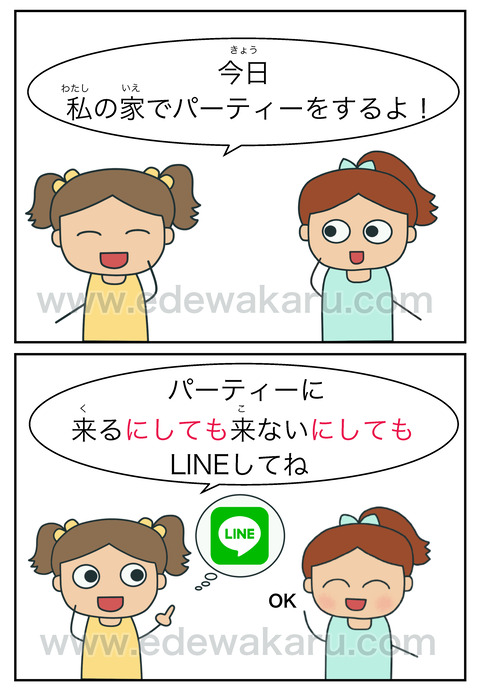
Meaning
Whether it is case A or case B…
Both A and B, in either case…
How to use it
Verb, adjective, or noun [plain form] + にしても〜にしても
Explanation
“AにしてもBにしても” is a sentence pattern meaning “whether it is case A or case B, either way.” Sometimes it takes the form “AにしてもAないにしても,” and sometimes “A” and “B” are things from the same group. 😮
[Learn these together]
“〜にしても〜にしても” can be changed to “〜にしろ〜にしろ” or “〜にせよ〜にせよ.” 😊 Remember that “〜にしろ” and “〜にせよ” are slightly more formal than “〜にしても.” 😀
[Examples]
Whether or not you come to the party, send me a LINE message.
= Whether or not you come to the party, send me a LINE message.
= Whether or not you come to the party, send me a LINE message.
Whether it’s a dog or a cat, keeping a pet is hard.
= Whether it’s a dog or a cat, keeping a pet is hard.
= Whether it’s a dog or a cat, keeping a pet is hard.
There are many expressions and words used with “〜にしても,” “〜にしろ,” and “〜にせよ,” so I think it’s useful to learn them as a set. 😉
In context 4 examples
パーティーに来るにしても来ないにしてもLINE(ライン)してね
→パーティーに来る場合も来ない場合もどちらの場合でもLINEしてね(復習:「Google」や「Twitter」は日本語でどう読むの?)Whether you come to the party or not, send me a LINE message. (Review: How do you pronounce “Google” and “Twitter” in Japanese?)
N1を受けるにしても受けないにしても、毎日しっかり勉強しなくちゃ
→N1を受ける場合も受けない場合も、毎日しっかり勉強しなくちゃ(復習:〜なくちゃ)Whether you take N1 or not, you have to study hard every day. (Review: 〜なくちゃ)
犬にしても猫にしてもペットを飼うのは大変だ
→犬でも猫でもどちらの場合でも、ペットを飼うのは大変だWhether it’s a dog or a cat, keeping a pet is hard. → Either way, whether it’s a dog or a cat, keeping a pet is hard.
高いにしても安いにしても、教科書は買わざるを得ない
→高くても安くてもどちらの場合でも、教科書は買わざるを得ない(復習:〜ざるを得ない)Whether they’re expensive or cheap, I have no choice but to buy the textbook. (Review: 〜ざるを得ない)
Read the original source text
Meaning
〜の場合も〜の場合も〜
〜も〜もどちらの場合でも〜
How to use it
動詞・形容詞・名詞[普通形]+にしても〜にしても
Explanation
「AにしてもBにしても」は「Aの場合もBの場合も、どちらの場合でも」という意味を表す文型です。「AにしてもAないにしても」になる場合と、「A」と「B」に同じグループのものがくる場合があります😮
【一緒に覚えましょう】
「〜にしても〜にしても」は「〜にしろ〜にしろ」「〜にせよ〜にせよ」にチェンジすることができます
😊「〜にしろ」「〜にせよ」は「〜にしても」より少しかたい言い方だと覚えておきましょう😀
[例]
パーティーに来る
にしても
来ない
にしても
LINEしてね
=パーティーに来る
にしろ
こない
にしろ
LINEしてね
=パーティーに来る
にせよ
来ない
にせよ
LINEしてね
犬
にしても
猫
にしても
ペットを飼うのは大変だ
=犬
にしろ
猫
にしろ
ペットを飼うのは大変だ
=犬
にせよ
猫
にせよ
ペットを飼うのは大変だ
「〜にしても」「〜にしろ」「〜にせよ」を使う表現や単語はたくさんありますので、セットで覚えておくといいと思います😉
どんなときどう使う 日本語表現文型辞典
Usage 1
Meaning
whether (it's)
How to use it
V-dictionary form / N + にしても + V-dictionary form / N + にしても
Explanation
にしても~にしても
~でも~でも
1)「~でも~でも」と例をいくつか挙げて「その全部に当てはまる」と言いたいときに使う。
2) ❹ のように、対立的なものを並べて「そのどちらの場合でも」という意味で使うこともある。
3)「にしろ~にしろ・にせよ~にせよ」と用法は同じ。
3)Patterns にしろ~にしろ, and にせよ~にせよ are used same way.
1)Lists multiple examples and shows that something is true in every case.
2)Also used to describe contrasts, as in sentence ❹ , to show that something is true in either case.
In context 4 examples
リンさんにしてもカンさんにしても、このクラスの男の人はみんな背が高い。
Whether it’s Mr. Lin or Mr. Kan, all the men in this class are tall.
東京にしても横浜にしても大阪にしても、日本の大都市には地方から出てきた若者が多い。
Whether it’s Tokyo, Yokohama, or Osaka, Japan’s major cities have many young people who have come from rural areas.
大学にしても専門学校にしても、進学するなら目的をはっきり持つことです。
Whether you go to a university or a vocational school, if you continue your education, you should have a clear purpose.
賛成するにしても反対するにしても、それなりの理由を言ってください。
Whether you agree or disagree, please give your reasons.
Read the original source text
Meaning
whether (it's)
How to use it
Vる/N+にしても+Vる/N+にしても
Explanation
にしても~にしても
~でも~でも
1)「~でも~でも」と例をいくつか挙げて「その全部に当てはまる」と言いたいときに使う。
2) ❹ のように、対立的なものを並べて「そのどちらの場合でも」という意味で使うこともある。
3)「にしろ~にしろ・にせよ~にせよ」と用法は同じ。
3)Patterns にしろ~にしろ, and にせよ~にせよ are used same way.
1)Lists multiple examples and shows that something is true in every case.
2)Also used to describe contrasts, as in sentence ❹ , to show that something is true in either case.
Usage 2
Meaning
(hypothetical adversative conjunction) even if
How to use it
N / [plain form] (な-adjective + である / N + である) + にしても
Explanation
にしても〈逆接仮定〉
~と仮定しても
1)「~にしても、…」の形で、「もし~となっても、~であっても」と言い、「…」で、話者の主張・判断・評価・納得できない気持ち・非難などを述べる。
2)「たとえ・仮に・疑問詞」などの言葉とともに使うことが多い。
3)話し言葉では、 ❹ のように「にしたって」を使う。
4)同様の言い方に「としても・にしろ・にせよ」がある。
2)Often used with たとえ, 仮に, or interrogatives.
3)In spoken language, becomes にしたって, as in sentence ❹ .
4) Similar expres-sions are: としても, にしろ, にせよ.
1)Even if something happens, (something else will occur). Describes speaker's asser-tions, judgments, evaluations, feelings of inability to agree, or criticisms.
In context 4 examples
たとえ新しい仕事を探すにしても、ふるさとを離れたくない。
Even if I look for a new job, I don’t want to leave my hometown.
たとえ誰も訪ねてこないにしても、部屋の中をかたづけておいた方がいい。
Even if nobody comes to visit, it would be better to tidy up the room.
仮にこの仕事をやらなければならないにしても、長く続けたくはない。
Even if I have to do this job, I don’t want to keep doing it for long.
いたずらにしたって、相手が眠れなくなるほど電話をかけてくるとはひどい。
Even if it was a prank, it’s awful to keep calling until the other person can’t sleep.
Read the original source text
Meaning
(hypothetical adversative conjunction) even if
How to use it
N/〔普通形〕(ナAである/Nである)+にしても
Explanation
にしても〈逆接仮定〉
~と仮定しても
1)「~にしても、…」の形で、「もし~となっても、~であっても」と言い、「…」で、話者の主張・判断・評価・納得できない気持ち・非難などを述べる。
2)「たとえ・仮に・疑問詞」などの言葉とともに使うことが多い。
3)話し言葉では、 ❹ のように「にしたって」を使う。
4)同様の言い方に「としても・にしろ・にせよ」がある。
2)Often used with たとえ, 仮に, or interrogatives.
3)In spoken language, becomes にしたって, as in sentence ❹ .
4) Similar expres-sions are: としても, にしろ, にせよ.
1)Even if something happens, (something else will occur). Describes speaker's asser-tions, judgments, evaluations, feelings of inability to agree, or criticisms.
Usage 3
Meaning
(concession) no matter how; even if
How to use it
N / [plain form] (な-adjective + である / N + である) + にしても
Explanation
にしても〈譲歩〉
~のはわかるが、しかし
1)「~にしても…」の形で「~はわかるが、しかし…」と言う表現。「…」には話す人の意見・不審な気持ち・納得できない気持ち・非難・判断・評価が来ることが多い。
2) ❶ のように「いくら・どんなに」などの疑問詞とともに使われることもある。
3)「にしろ・にせよ」も同じような意味に使うが「にしても」より硬い表現。
4)くだけた話し言葉では ❹ のように「にしたって」となる。
2)Can be used with interrogatives such as いくら or どんなに, as in sentence ❶ .
3)Patterns にしろ and にせよ are used with same meaning, but are more formal than にしても.
4)In informal speech becomes にしたって, as in sentence ❹ .
1)Speaker understands but doesn't necessarily agree. Often what follows is speaker's opinion, suspicions, feeling of inability to agree, criticism, judgment, or evaluations.
In context 4 examples
いくら忙しかったにしても、電話をかける時間くらいはあったと思う。
No matter how busy you were, I think you had at least enough time to make a phone call.
今度の事件とは関係なかったにしろ、あのグループの人たちが危ないことをしているのは確かだ。
Even if they weren’t involved in this incident, it’s certain that the people in that group are doing dangerous things.
西さんほどではないにせよ、東さんだってよく遅れてくる。
Although he’s not as bad as Mr. Nishi, Mr. Higashi is often late too.
会議中にしたって、コーヒーぐらい飲んでもいいよね。
Even during a meeting, it’s okay to have at least a cup of coffee, isn’t it?
Read the original source text
Meaning
(concession) no matter how; even if
How to use it
N/〔普通形〕(ナAである/Nである)+にしても
Explanation
にしても〈譲歩〉
~のはわかるが、しかし
1)「~にしても…」の形で「~はわかるが、しかし…」と言う表現。「…」には話す人の意見・不審な気持ち・納得できない気持ち・非難・判断・評価が来ることが多い。
2) ❶ のように「いくら・どんなに」などの疑問詞とともに使われることもある。
3)「にしろ・にせよ」も同じような意味に使うが「にしても」より硬い表現。
4)くだけた話し言葉では ❹ のように「にしたって」となる。
2)Can be used with interrogatives such as いくら or どんなに, as in sentence ❶ .
3)Patterns にしろ and にせよ are used with same meaning, but are more formal than にしても.
4)In informal speech becomes にしたって, as in sentence ❹ .
1)Speaker understands but doesn't necessarily agree. Often what follows is speaker's opinion, suspicions, feeling of inability to agree, criticism, judgment, or evaluations.
日本語文型辞典 英語版
Meaning
【にしても】Becomes ...にしたって in casual speech, and...にせよ or ...にしろ in formal speech.
With a noun expressing a person or a thing, used to talk about the person or thing while implying that there is something else similar to the person or thing. When emphasizing the implication that one thing or person is chosen among various things/persons and other things/persons don’t need to be mentioned, にしても becomes ...ひとつにしても as shown in
(4)
and
(5)
.
Expresses the meaning of “even if I admit the situation mentioned in....” Followed by some state or event contradictory to what is normally expected. Often used with an interrogative, such as いくら or どんなに, as shown in
(5)
.
Taking two items in the same genre or two opposing items, expresses the meaning of “either way.”
With an interrogative such as いずれ, だれ or なに, means something like “in any case” or “whoever it is.” There are also some cases in which にしても is preceded by a clause containing an interrogative, as shown in
(4)
and
(5)
.
How to use it
1. Nにしても
2. ...にしても[N(である)にしても][A/V にしても]
3. ...にしても...にしても[NにしてもNにしても][VにしてもVにしても]
4. question word+にしても
5. それにしても→
In context 21 examples
彼にしても、こんな騒ぎになるとは思ってもいなかったでしょう。
For him as well, he never thought it would become such a big deal.
母にしても初めから賛成していたわけではありません。
For my mother, too, it’s not that she agreed from the beginning.
かなりハードな仕事だし、給料にしても決していいというわけでもない。
This is such hard work, and in addition, the salary is not very good either.
歩き方ひとつにしてもきちんと作法に則っている。
Considering just how to walk, for instance, she is following the manners properly.
身につけているものひとつにしても育ちのよさが感じられた。
Looking just at what he wears, I could see he has been brought up well.
子供のいたずらにしても笑って済ませられる問題ではない。
Even if this is just children’s mischief, it’s no laughing matter.
たとえ失敗作であるにしても十分に人を引き付ける魅力がある。
Even if this work is a failure, it has enough appeal to attract people.
忙しいにしても連絡ぐらいは入れられただろうに。
Even though she was busy, she could just have made contact with me.
私を嫌っているにしても、こんな仕打ちはあんまりだ。
Even if he dislikes me, it’s too much of him to behave like that.
いくら貧しいにしても人から施しは受けたくない。
No matter how poor I am, I don’t want to receive alms.
山田にしても佐藤にしても、この仕事に向いているとはいえない。
Speaking of Yamada or Sato, I can’t say this job is suitable for either.
犬にしても猫にしてもこのマンションではペットを飼ってはいけないことになっている。
Putting aside whether it is a dog or a cat, this apartment does not allow pets.
当選にしても落選にしても、今回の選挙に立候補したことは大いに意味があった。
Whether she was elected or not, it was significant to run in this election.
行くにしても行かないにしても、一応準備だけはしておきなさい。
Whether you go or not, you’d better be prepared in any case.
勝つにしても負けるにしても、正々堂々と戦いたい。
Whether I win or lose, I’d like to play fair.
勝ったにしても負けたにしても、よく頑張ったとほめてやりたい。
Whether she wins or not, I’d like to praise her for her great effort.
いずれにしても結論は次回に持ち越されることになった。
At any rate, it was decided that the decision would be postponed.
だれにしてもそんなことはやりたくない。
No one wants to do such a thing.
なんにしても年内に立ち退いてもらいます。
I will have you moved out before the end of the year, no matter what.
だれがやったにしても、我々全員で責任をとらなければならない。
Whoever did it, we all have to take responsibility.
何をするにしても、よく考えてから行動しなさい。
Whatever you do, think carefully before taking action.
Read the original source text
Meaning
【にしても】Becomes ...にしたって in casual speech, and...にせよ or ...にしろ in formal speech.
With a noun expressing a person or a thing, used to talk about the person or thing while implying that there is something else similar to the person or thing. When emphasizing the implication that one thing or person is chosen among various things/persons and other things/persons don’t need to be mentioned, にしても becomes ...ひとつにしても as shown in
(4)
and
(5)
.
Expresses the meaning of “even if I admit the situation mentioned in....” Followed by some state or event contradictory to what is normally expected. Often used with an interrogative, such as いくら or どんなに, as shown in
(5)
.
Taking two items in the same genre or two opposing items, expresses the meaning of “either way.”
With an interrogative such as いずれ, だれ or なに, means something like “in any case” or “whoever it is.” There are also some cases in which にしても is preceded by a clause containing an interrogative, as shown in
(4)
and
(5)
.
How to use it
1. Nにしても
2. ...にしても[N(である)にしても][A/V にしても]
3. ...にしても...にしても[NにしてもNにしても][VにしてもVにしても]
4. 疑問詞+にしても
5. それにしても→