文法
Meaning
Whenever ~ / Every time ~
How to use it
V (dictionary form) + たびに
Nの + たびに
Notes
・It is difficult to use for things that are obvious or habitual.
・A negative or adjective sentence cannot follow in the second clause.
Incorrect usage example
Because it is difficult to use when talking about something obvious or habitual, the following example sounds unnatural.
❌ Every time I go to school, I study.
In context 15 examples
あの人は会うたびに面白い話を聞かせてくれる。
Every time I see that person, they tell me an amusing story.
父は外国に行くたびに、たくさんおみやげを買ってきてくれる。
Every time my father goes abroad, he buys and brings back lots of souvenirs for me.
YouTubeを見るたびに、広告が表示されるのはうんざりだ。
I’m fed up with ads appearing every time I watch YouTube.
ミスをするたびに部長にしかられる。
Every time I make a mistake, the department manager scolds me.
引越しのたびに荷物が増える。
My belongings increase with every move.
あの二人は仲が悪くて、会うたびに喧嘩している。
Those two don’t get along and fight every time they meet.
海外旅行するたびに、お腹をこわす。
I get an upset stomach every time I travel abroad.
私は海外旅行のたびに、その国の人とできるだけコミュニケーションをとるようにしている。
Every time I travel abroad, I try to communicate as much as possible with people from that country.
旅行のたびに、同僚や先輩、上司へのお土産を考えなければならないのは面倒だ。
It’s a hassle having to think of souvenirs for my coworkers, senior colleagues, and boss every time I travel.
彼は会うたびに、違う女性と一緒にいる。
Every time I see him, he’s with a different woman.
この曲を聞くたびに、彼のことを思い出す。
Every time I hear this song, I think of him.
その歌を歌うたびに、幼いころのことを思い出す。
Every time I sing that song, I remember my childhood.
彼女は会うたびに、綺麗になっていく。
She gets prettier every time I see her.
やっちゃん、会うたびに大きくなってるねー。
Yacchan, you’re getting bigger every time I see you!
僕の妻はコンビニに行くたびにアイスクリームを買って帰る。
My wife buys ice cream every time she goes to the convenience store.
Read the original source text
Meaning
〜のときはいつも / 〜するといつも
How to use it
V(辞書形)+ たびに
Nの + たびに
Notes
・当然のこと、習慣的なことには使いにくい。
・後件に否定文・形容詞文はこない。
誤用例
当然のこと、習慣的なことを言う場合は使いにくいので、次のような例文は不自然となる。
❌ 学校へ行くたびに、勉強します。
Bunpro Grammar Reference
Meaning
Each time, Every time, Whenever
How to use it
Verb[る]+ たびに
Noun + の + たびに
Nuance
An expression that states that something happens every (A), where the focus is on the unique occurrence or degree of (A).
Explanation
度に is the adverbial form of the noun 度, meaning 'time' (as in 'at the time of'). たびに is frequently paired with either verbs, or nouns, in order to show that something happens 'whenever (A)', or 'each time (A)'.
After nouns, the case marking particle の will be required before たびに.
タナカ君と飲みに行くたびに、二日酔いになる。
Every time I go out to drink with Tanaka-kun, I get a hangover.
牛乳を飲むたびにお腹が痛くなる。
Every time I drink milk, I get a stomach ache.
私は休みのたびにハワイへ行きます。
Whenever I have a holiday, I go to Hawaii.
彼は洗い物のたびに指を切る。
Every time he does the dishes, he cuts his finger.
Fun Fact
Like ごとに, たびに means 'every'. However, たびに is most often used to convey the nuance of するごとに 'every time doing'. Due to this, たびに will almost always be used to highlight some kind of action or event, rather than random amounts of time.
仕事を休むたびに、雨が降って予定が台無しになる。
Every time I take a day off, it rains and messes up my plans. (Natural Japanese, as たびに follows an action)
2週間たびに、実家に帰る。
Every two weeks, I go to my parents house. (Unnatural Japanese, as たびに does not follow an action. 2(に)週間(しゅうかん)経(た)つたびに would work here)
In context 18 examples
- 君は会う度に大人になってゆく。
Every time I see you, I see how much you have matured.
- タナカ君と飲みに行くたびに、二日酔いになる。
Every time I go out to drink with Tanaka-kun, I get a hangover.
- 牛乳を飲むたびにお腹が痛くなる。
Every time I drink milk, I get a stomach ache.
- 私は休みのたびにハワイへ行きます。
Whenever I have a holiday, I go to Hawaii.
- 彼は洗い物のたびに指を切る。
Every time he does the dishes, he cuts his finger.
- この映画を見る度に、泣いてしまう。
Every time I watch this movie, I cry.
- 旅行の度に、いい思い出を作ろう。
Let's make good memories each time we take a trip.
- 冬の間は、休みの度にスキーに行っています。
I go skiing every holiday in winter.
- 買い物へ行く度に、いらないものを買っちゃう。
Whenever I go shopping I buy things I don't need.
- 電車が通る度に音が鳴るからストレスだ。
I am stressed out because every time the train passes it makes noise.
- 何かが起こる度に呼び出されて大変です。
I am called in every time something happens, and it is driving me nuts.
- 車の調子がおかしいな。曲がる度に音がする。
There is something wrong with my car. It makes a sound every time I make a turn.
- 勉強する度に、どんどん日本語が上手くなりますね。
Your Japanese improves every time you study.
- 彼は来る度に長居するからあまり来て欲しくない。
I don't want him to visit me because he stays so long every time he comes.
- 冬こそ大嫌いな季節ですよ。雪が降る度に雪かきをしなければいけないからです。
I hate winter more than any other season. Because every time it snows, I have to clear snow away.
- 検査の度に何か病気が見つかるのは年のせいかな。
Every time I get a medical check up, some kind of illness is discovered. I wonder if it has to do with my age.
- 仕事を休むたびに、雨が降って予定が台無しになる。
Every time I take a day off, it rains and messes up my plans. (Natural Japanese, as たびに follows an action)
- 2週間たびに、実家に帰る。
Every two weeks, I go to my parents house. (Unnatural Japanese, as たびに does not follow an action. 2(に)週間(しゅうかん)経(た)つたびに would work here)
Read the original source text
Meaning
Each time, Every time, Whenever
How to use it
Verb[る]+ たびに
Noun + の + たびに
Nuance
An expression that states that something happens every (A), where the focus is on the unique occurrence or degree of (A).
Explanation
度に is the adverbial form of the noun 度, meaning 'time' (as in 'at the time of'). たびに is frequently paired with either verbs, or nouns, in order to show that something happens 'whenever (A)', or 'each time (A)'.
After nouns, the case marking particle の will be required before たびに.
タナカ君と飲みに行くたびに、二日酔いになる。
Every time I go out to drink with Tanaka-kun, I get a hangover.
牛乳を飲むたびにお腹が痛くなる。
Every time I drink milk, I get a stomach ache.
私は休みのたびにハワイへ行きます。
Whenever I have a holiday, I go to Hawaii.
彼は洗い物のたびに指を切る。
Every time he does the dishes, he cuts his finger.
Fun Fact
Like ごとに, たびに means 'every'. However, たびに is most often used to convey the nuance of するごとに 'every time doing'. Due to this, たびに will almost always be used to highlight some kind of action or event, rather than random amounts of time.
仕事を休むたびに、雨が降って予定が台無しになる。
Every time I take a day off, it rains and messes up my plans. (Natural Japanese, as たびに follows an action)
2週間たびに、実家に帰る。
Every two weeks, I go to my parents house. (Unnatural Japanese, as たびに does not follow an action. 2(に)週間(しゅうかん)経(た)つたびに would work here)
Nuance · 日本語
(A)ごとに何かが起こるということを表す表現。(A)の頻度を強調した表現。
Explanation · 日本語
「度に」は、名詞「度」の副詞的な形です。動詞や名詞と一緒に使われて、「(A) のときはいつも (B)」や「(A) するときは、毎回 (B)」という意味を表します。
「たびに」が名詞と使われるときは、間に格助詞「の」が必要です。
タナカ君と飲みに行くたびに、二日酔いになる。
Every time I go out to drink with Tanaka-kun, I get a hangover.
牛乳を飲むたびにお腹が痛くなる。
Every time I drink milk, I get a stomach ache.
私は休みのたびにハワイへ行きます。
Whenever I have a holiday, I go to Hawaii.
彼は洗い物のたびに指を切る。
Every time he does the dishes, he cuts his finger.
豆知識
「たびに」は「ごとに」のように「毎〜」という意味を持ちますが、動作や出来事に対して使われます。回数を表すときには使われません。
仕事を休むたびに、雨が降って予定が台無しになる。
Every time I take a day off, it rains and messes up my plans. (Natural Japanese, as たびに follows an action)
2週間たびに、実家に帰る。
Every two weeks, I go to my parents house. (Unnatural Japanese, as たびに does not follow an action. 2(に)週間(しゅうかん)経(た)つたびに would work here)
DoJG 日本語文法辞典(全集)
Meaning
Every time; each time; on every occasion; whenever
How to use it
(i) Vinformal nonpast | たびに | |
| 食べるたびに | Each time someone eats something |
| 勉強するたびに | Each time someone studies (something) |
(ii) Noun | のたびに | |
| 試験のたびに | On every examination occasion |
(iii) VN | のたびに | |
| 勉強のたびに | On every occasion of study |
Explanation
A conjunction to express that each time someone/something does something, something else takes place.
In context 9 examples
日本へ行くたびに新しいことを学んで帰ります。
Each time I go to Japan I come home having learned something new.
父は旅行のたびにお土産を買ってきてくれる。
On every trip my father comes back with souvenirs.
あの人と話すたびに心が和みます。
Each time I talk with her my heart softens.
この本は読むたびに新しい発見がある。
Each time I read this book I make new findings.
僕は東京に行くたびに恩師のお宅を訪ねることにしている。
I make it a point of visiting my professor's residence every time I go to Tokyo.
私の孫は会うたびに前より大きくなっている。
My grandson is growing bigger than before each time I see him.
モーツアルトの音楽を聞くたびに人生が豊かになった気がする。
Each time I listen to Mozart's music I feel my life is enriched.
誕生日のたびに夫は薔薇の花を買ってくれます。
On every birthday my husband buys me roses.
うちでは給料日のたびに銀座のレストランで食事をします。
Our family eats at a restaurant in Ginza every payday.
絵でわかる日本語
Meaning
Whenever 〜, always do ...
Every time 〜, do ...
How to use it
Verb [dictionary form] + たびに
Noun [dictionary form] + のたびに
Explanation
“〜たびに” is a sentence pattern that emphasizes something happening repeatedly each time, as in “whenever 〜, ...” 😊 In kanji, it is written “〜度に.” It is not a difficult pattern, but there are cases where it cannot be used, so learn them well. 😉
[Cases where “〜たびに” cannot be used]
① It is not used for everyday activities.
❌ Every morning when I wake up, I drink coffee.
❌ Every time I go to school, I buy bread to take with me.
② It cannot be used in sentences with “〜と” expressing a habit or inevitable result.
❌ Every time spring comes, it gets warmer.
❌ Every time my son comes home, he plays games.
[For those who want to learn more]
“〜たびに” can also mean “become increasingly 〜.” 😮
[Examples]
Every time I see her, she gets prettier.
→ She keeps getting prettier.
Every time it rains, the temperature drops.
→ Each time it rains, the temperature keeps dropping.
(As winter approaches, it often rains, and when it rains, the temperature keeps dropping, doesn’t it? 😉)
There are several patterns similar to “〜たびに”; I’ll cover them another time. 😀
In context 3 examples
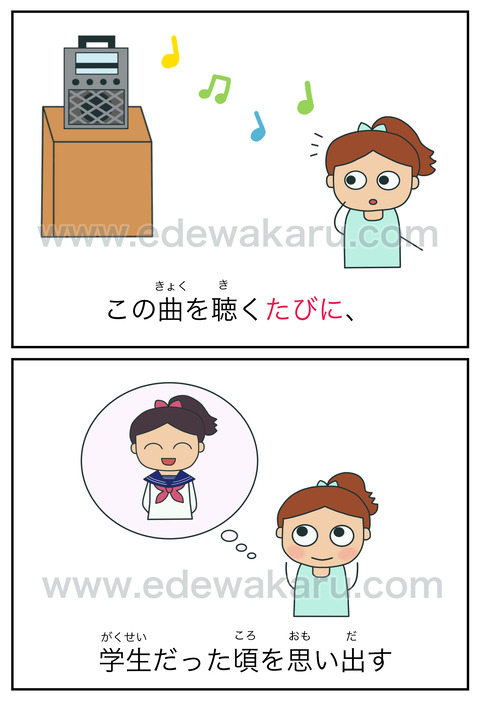
この曲を聴くたびに、学生だった頃を思い出す
→この曲を聴く時はいつも、学生だった頃を思い出すEvery time I hear this song, I remember when I was a student. → Whenever I hear this song, I remember when I was a student.
彼は会うたびに、違う女の子とデートしている
→彼は会う時はいつも、違う女の子とデートしているEvery time he meets her, he dates a different girl. → Whenever he meets her, he dates a different girl.
父は日本に出張するたびに、お土産を買ってきてくれる
→父は日本に出張する時は毎回、お土産を買ってきてくれるEvery time my father goes on a business trip to Japan, he buys me a souvenir. → Each time my father goes on a business trip to Japan, he buys me a souvenir.
Read the original source text
Meaning
〜時はいつも…する
〜時は毎回…する
How to use it
動詞[辞書形]+たびに
名詞[辞書形]+のたびに
Explanation
「〜たびに」は「〜する時はいつも…」というように、毎回繰り返して起こることを強調する文型です
😊漢字で書くと
「〜度に」
となります。難しい文型ではありませんが、使えない場合がありますのでしっかりと覚えておきましょう😉
[「〜たびに」が使用できない場合]
①日常的にすることには使わない
❌毎朝起きるたびに、コーヒーを飲む
❌学校へ行くたびに、パンを買っていく
②「習慣」や「必然的結果」を表す「〜と」が使われる文には使用不可
❌春になるたびに、暖かくなる
❌息子は家に帰るたびに、ゲームをします
【余裕のある人へ】
「〜たびに」には「ますます〜になる」という意味もあります
😮
[例文]
彼女は会う
たびに、きれいになっていく
→彼女はますますきれいになっていく
雨が降る
たびに、気温が下がっていく
→雨が1回降るとどんどん気温が下がっていく
(冬が近づくと雨がよく降り、雨が降るとどんどん気温が下がっていきますよね😉)
「〜たびに」は類似文型がいくつかありますので、また次回掲載します😀
日本語文型辞典
Meaning
Basic information
N のたびに / V-るたびに
Explanation
Means “each time” or “whenever …, at that time.”
Examples
① At every health checkup, I’m told that I’m overweight.
② Whenever I go to the mountains, I get caught in the rain.
③ My father always buys a souvenir from the place he visits on each business trip.
④ My hometown changes every time I return, and the old, peaceful scenery is gradually disappearing.
⑤ She wears different glasses every time I see her.
⑥ Whenever I look at this photograph, I remember the old days.
Read the original source text
Meaning
基本情報NのたびにV-るたびに説明「その時ごとに」「…するといつもその時には」という意味。例文① 健康診断のたびに、太りすぎだと言われる。② 山に行くたびに雨に降られる。③ 父は出張のたびにかならずその土地の土産を買ってくる。④ ふるさとは帰るたびに変わっていって、昔ののどかな風景がだんだんなくなっていく。⑤ 彼女は会うたびにちがうメガネをかけている。⑥ この写真を見るたびにむかしを思い出す。
日本語文型辞典 英語版
Meaning
【たびに】[Nのたびに][V-るたびに]
Means “each time,” “every time I do...I always....”
In context 6 examples
健康診断のたびに、太りすぎだと言われる。
Every time I have a check-up, I’m told that I’m too fat.
山に行くたびに雨に降られる。
Every time I go to the mountains, I get rained on.
父は出張のたびにかならずその土地の土産を買ってくる。
My father always makes sure to buy us local souvenirs every time he goes on a business trip.
ふるさとは帰るたびに変わっていって、昔ののどかな風景がだんだんなくなっていく。
I see changes in my hometown every time I go back, and the tranquil scenery of the old days is gradually disappearing.
彼女は会うたびにちがうメガネをかけている。
She’s wearing a different pair of glasses every time I see her.
この写真を見るたびにむかしを思い出す。
Every time I look at this photo, I recall the past.
くらべてわかる日本語表現文型辞典
Meaning
Meaning 1: Whenever situation A occurs, B happens.
Meaning 2: As A is repeated, the degree of B gradually changes.
How to use it
AたびにB (AたびごとにB)
Connection 1:
[Verb—る form] たびに
[Noun—の] たびに
Connection 2:
[Verb—る form] たびに
Explanation
【Contrast 1】
“AにつけB” (Meaning 1, p. 249)
With “AにつけB,” B is a naturally arising emotional state. “AたびにB” has no such restriction.
×父は東京へ行くにつけ、お土産を買ってきてくれる。 — Whenever my father goes to Tokyo, he buys me a souvenir.
○父は東京へ行くたびに、お土産を買ってきてくれる。 — Every time my father goes to Tokyo, he buys me a souvenir.
When B is a spontaneous emotional state, they have the same meaning, but “AにつけB” feels like an old-fashioned way of speaking.
○この手紙を読むにつけ、母のことが思い出される。 — Whenever I read this letter, I am reminded of my mother.
○この手紙を読むたびに、母のことが思い出される。 — Every time I read this letter, I am reminded of my mother.
“AごとにB” (Meaning 1, p. 91)
When A is repeated intermittently or mechanically, “AごとにB” means that the same B always results (or is done). When A is something repeated intermittently or mechanically (if A is a noun), they can be substituted for each other; but “AごとにB” cannot be used for something that occurs irregularly.
○彼は日曜ごとに、出かけている。 — He goes out every Sunday.
○彼は日曜のたびに、出かけている。 — He goes out every Sunday.
×この地方は台風ごとに、被害を受けている。 — This region suffers damage with each typhoon.
○この地方は台風のたびに、被害を受けている。 — This region suffers damage every time there is a typhoon.
When A is a verb, “AごとにB” is difficult to substitute, even if the action is intermittent or mechanical.
×客がここを通るごとに、ランプがつく仕組みです。 — It is designed so that the lamp turns on each time a customer passes here.
○客がここを通るたびに、ランプがつく仕組みです。 — It is designed so that the lamp turns on every time a customer passes here.
【Contrast 2】
“AごとにB” (Meaning 2, p. 91)
Notes
【Note 1】
・It is difficult to use when the relationship between A and B is expected.
×学校へ来るたびに、よく勉強します。 — Every time I come to school, I study hard.
However, if there are other ways or things to do besides B when situation A occurs, it can be used even when A and B have an expected relationship.
○電車に乗るたびに切符を買うのは面倒なので、定期を買った。 — It’s a hassle to buy a ticket every time I take the train, so I bought a commuter pass.
・“AたびにB” also carries the nuance that B does not happen when A does not occur. It is difficult to use when the connection between A and B is habitual.
×学校へ行くたびに、阪急梅田駅を通ります。 — Every time I go to school, I pass through Hankyu Umeda Station.
However, it is possible if “AたびにB” is used as an emphatic expression.
○「阪急梅田駅を知っていますか?」 — “Do you know Hankyu Umeda Station?”
“Yes. I know it well because I pass through it every time I go to school.”
・A negative sentence or an adjective sentence cannot come in B.
×国へ帰るたびに、友達に会いません。 — Every time I return to my country, I don’t see my friends.
×この料理を食べるたびに、おいしいです。 — Every time I eat this dish, it is delicious.
・B cannot describe a state in which the same thing exists without changing.
×あの角を曲がるたびに、銀行があります。 — There is a bank every time I turn that corner.
・“AたびごとにB” is an emphatic expression.
In context 8 examples
父は東京へ行くたびに、土産を買って来てくれる。
Every time my father goes to Tokyo, he brings me a souvenir.
あの地方は台風のたびに被害を受けている。
That region suffers damage every time there is a typhoon.
あの二人は会うたびごとにけんかしている。
Those two fight every time they meet.
空港近くの家では、ジェット機が通過するたびに、窓を閉めなければ話も聞こえないという。
They say that in houses near the airport, whenever a jet passes, you have to close the windows or you can’t hear each other talk.
彼女は見るたびに美しくなっている。
She gets more beautiful every time I see her.
彼の英語は聞くたびに上達している。
His English improves every time I hear it.
帰郷するたびに、ふるさとの自然が失われていくのを感じる。
Every time I return to my hometown, I feel the natural landscape of my birthplace disappearing.
我が社は新商品を開発するたびに、シェアを拡大してきた。
Our company has expanded its market share every time it has developed a new product.
Read the original source text
Meaning
意味1:Aの事態になったときはいつもB。
意味2:Aを繰り返していくうちに、だんだんBの程度が変化する。
How to use it
AたびにB(AたびごとにB)
接続1:
[動詞-る形]たびに
[名詞-の]たびに
接続2:
[動詞-る形]たびに
Explanation
【対比1】
「AにつけB」(意味1 P.249)
「AにつけB」はB部分が自然に起こる心の状態が来る。「AたびにB」には、そのような制限がない。
×父は東京へ行くにつけ、お土産を買ってきてくれる。
○父は東京へ行くたびに、お土産を買ってきてくれる。
Bが自発的な心理状態の場合は、意味は同じであるが、「AにつけB」の方が、古風な言い方という感じがする。
○この手紙を読むにつけ、母のことが思い出される。
○この手紙を読むたびに、母のことが思い出される。
「AごとにB」(意味1 P.91)
「AごとにB」は断続的・機械的に繰り返されるAの時には、いつも同じBになる(Bをする)の意味で、Aが断続的・機械的に繰り返されるものについては(Aが名詞の場合)置き換えできるが、Aが不定期のものには「AごとにB」は使えない。
○彼は日曜ごとに、出かけている。
○彼は日曜のたびに、出かけている。
×この地方は台風ごとに、被害を受けている。
○この地方は台風のたびに、被害を受けている。
Aが動詞の場合は、断続的・機械的なものであっても「AごとにB」では置き換えにくい。
×客がここを通るごとに、ランプがつく仕組みです。
○客がここを通るたびに、ランプがつく仕組みです。
【対比2】
「AごとにB」(意味2 P.91)
Notes
【注意1】
・AとBの関係が当然のときは、使いにくい。
×学校へ来るたびに、よく勉強します。
ただし、Aの事態になったときに、B以外にも方法やすることがある場合は、AとBが当然の関係であっても使える。
○電車に乗るたびに切符を買うのは面倒なので、定期を買った。
・「AたびにB」はAではないときはBしないというニュアンスも含んでいる。AとBとの結びつきが習慣的なことには使いにくい。
×学校へ行くたびに、阪急梅田駅を通ります。
ただし、「AたびにB」を強調表現として用いているものなら可能。
○「阪急梅田駅を知っていますか?」
「ええ、学校へ行くたびに通っているので、よく知っていますよ。」
・Bに否定文・形容詞文はこない。
×国へ帰るたびに、友達に会いません。
×この料理を食べるたびに、おいしいです。
・Bに同一のものが変化せずに存在するという状態はつかない。
×あの角を曲がるたびに、銀行があります。
・「AたびごとにB」は強調表現。
日本語NET JLPT文法解説まとめ
Meaning
Whenever ~ / Every time ~
How to use it
V (dictionary form) + たびに
Nの + たびに
Explanation
“whenever,” “every time ~.”
It expresses admiration, frustration, and other such emotions about the same result occurring whenever a certain situation takes place.
・It is difficult to use for things that are natural or habitual.
・A negative sentence or an adjective sentence cannot follow.
In context 15 examples
あの人は会うたびに面白い話を聞かせてくれる。
Every time I see that person, they tell me an amusing story.
父は外国に行くたびに、たくさんおみやげを買ってきてくれる。
Every time my father goes abroad, he buys and brings back lots of souvenirs for me.
YouTubeを見るたびに、広告が表示されるのはうんざりだ。
I’m fed up with ads appearing every time I watch YouTube.
ミスをするたびに部長にしかられる。
Every time I make a mistake, the department manager scolds me.
引越しのたびに荷物が増える。
My belongings increase with every move.
あの二人は仲が悪くて、会うたびに喧嘩している。
Those two don’t get along and fight every time they meet.
海外旅行するたびに、お腹をこわす。
I get an upset stomach every time I travel abroad.
私は海外旅行のたびに、その国の人とできるだけコミュニケーションをとるようにしている。
Every time I travel abroad, I try to communicate as much as possible with people from that country.
旅行のたびに、同僚や先輩、上司へのお土産を考えなければならないのは面倒だ。
It’s a hassle having to think of souvenirs for my coworkers, senior colleagues, and boss every time I travel.
彼は会うたびに、違う女性と一緒にいる。
Every time I see him, he’s with a different woman.
この曲を聞くたびに、彼のことを思い出す。
Every time I hear this song, I think of him.
その歌を歌うたびに、幼いころのことを思い出す。
Every time I sing that song, I remember my childhood.
彼女は会うたびに、綺麗になっていく。
She gets prettier every time I see her.
やっちゃん、会うたびに大きくなってるねー。
Yacchan, you’re getting bigger every time I see you!
僕の妻はコンビニに行くたびにアイスクリームを買って帰る。
My wife buys ice cream every time she goes to the convenience store.
Read the original source text
Meaning
〜のときはいつも / 〜するといつも
How to use it
V(辞書形)+ たびに
Nの + たびに
Explanation
"whenever" , "every time ~".
It expresses admiration, frustration, and other such emotions about the same result occurring whenever a certain situation takes place.
・当然のこと、習慣的なことには使いにくい。
・後件に否定文・形容詞文はこない。
NINJAL 日本語文型データベース
Meaning
Used when you want to say that something happens or someone does something every time ~ occurs. It is also used when you want to say that the same change can be observed each time.
How to use it
Vるたびに
Nのたびに
Other
Notes
A sentence expressing a state does not come after either 「~」 or 「〜たびに」.
In context 12 examples
ミンさんは仕事で日本に来るたびに、国の知り合いにたくさんお土産を買って帰ります。
Whenever Min comes to Japan for work, he buys lots of souvenirs for acquaintances back home and takes them back.
この大きな家を見るたびに、いったいどんな金持ちが住んでいるのかと思ってしまう。
Every time I see this big house, I can’t help wondering what kind of rich person on earth lives there.
妹はテレビに好きな歌手が出てくるたびに、「きゃー、かっこいい」と叫ぶ。
Whenever my favorite singer appears on TV, my younger sister yells, “Aah, he’s so cool!”
議員が汚職したというニュースを聞くたびに、またかと腹が立つ。
Every time I hear news that a politician has been involved in a corruption scandal, I get angry and think, “Again?”
中学生の甥は会う度に背が高くなっていて、先日ついに私の身長を抜いた。
Every time I see my junior high school-aged nephew, he’s grown taller, and the other day he finally surpassed my height.
弟は旅行のたびに、必ず旅先で忘れ物をしてくる。
Every time my younger brother travels, he always leaves something behind at his destination.
あの子は待ち合わせのたびに遅刻して来るから、次は時間を早めに言っておこうかな。
That kid is late every time we meet, so maybe next time I’ll tell them an earlier time.
あの学生はテストのたびにカンニングをしようとするが、そんなことまでしていい点をとっても意味がないと思う。
That student tries to cheat on every test, but I don’t think there’s any point in getting good grades by going that far.
会議のたびに大量の紙の資料を配るのをやめて、デジタルデータ化すべきだ。
We should stop handing out large amounts of printed material at every meeting and digitize it.
「ごみ拾いボランティア参加のみなさん、今日は非常に気温が上がっているので、休憩の度に、しっかり水分を摂るようにしてください」
To everyone taking part in today’s litter-picking volunteer activity: It’s extremely hot today, so please be sure to drink plenty of water every time you take a break.
子どものころ、よく兄とけんかした。私が負けそうになると、そのたびに母が飛んできて、けんかを止めてくれた。
When I was a child, I often fought with my older brother. Whenever I started to lose, my mother would come running and stop the fight.
当時、私は片言の日本語しか話せなかった。それでも何か言うと、そのたびに日本人から「日本語が上手ですね」と言われた。
At the time, I could speak only broken Japanese. Even so, whenever I said something, Japanese people would tell me, “Your Japanese is very good.”
Read the original source text
Meaning
〜ときには毎回、あることが起きる・あることをすると言いたいときに使います。また、〜ときには毎回、同じ変化が見られると言いたいときにも使います。
How to use it
Vるたびに
Nのたびに
その他
Notes
「~」にも「〜たびに」の後にも、状態を表す文はきません。
IMABI
Whenever II: ~度に, ~都度, & ~につけ
Read this IMABI lesson ↗Explanation
Whenever II: ~度に, ~都度, & ~につけ
This lesson will discuss slightly more advanced phrases that equate to “whenever”.
~度に
~度(毎)に means “whenever”. 度 is the native word/counter for the number of times, making it common in set phrases such as 度を重ねる (to continue repeat itself). Grammatically speaking, it is after either nouns or the non-past form of a verb. What it follows is either a definite integer of place, time, action, or activity. This X is the trigger for Y, which without doubt will occur. Thus, whenever you say “whenever” with ~度に, you are saying that Y will 100% happen.
Now, the ごと is important to keep in mind. In the past, it was not uncommon to see ~ごとに after verbs. Now, it causes the sentence to become unnatural. So, as an effect, ~度毎に is also typically only found with nouns.
Examples
1. 幾度いくども失敗しっぱいを繰くり返すのはつらいですね。
Repeating a failure countless times is painful, isn’t it?
2. 何事なにごとも度たびを重かさねれば必かならずや上達じょうたつする。
If you repeat anything all the time, you will certainly improve.
3. 機会きかいがある度に
Whenever you get a chance
4. 俺おれはやる度に失敗しちまうんだよ。(Casual; masculine)
Whenever I do it, I end up failing (which is why I won’t do it)
Grammar Notes:
1. This makes it very similar to ~につけ, which will be discussed in this lesson. However, if you interchange it for ~度に, you speak objectively and the emotional feel is lost entirely.
2. There is some similarity between ~ごとに and ~たびに. ~ごとに shows that when there is a chance, a habitual action is simply repeated. ~たびに, despite also showing same habitual action, when one encounters a particular opportunity, it gives a sense that it is not incidental. Thus, even if the action is special but the timing is not, you can’t use ~たびに.
~都度
The most appropriate translation of 都度 is “whenever”. Like 度, it must be used with の when with another nominal phrase, and it may also be accompanied by に. What is neat about 都度 is that it is often seen in the pattern その都度.
都度 is less emphatic and less likely to be in more personal situations. It is very similar “each time it happens”.
Examples
5. 取引とりひきのつど残高欄ざんだからんに残高金額きんがくが示されるようにしたものです。
Whenever it is exchanged, the balance amount is made shown in the bank balance column.
6. 彼氏に会うその都度つど、彼女はとても嬉うれしくなるようです。
It seems that she becomes very happy whenever she meets her boyfriend.
7. 夫の両親が来る時はその都度喧嘩けんかが始まる。
Whenever my husband’s parents come, an argument gets started (with them).
~につけ
Following nouns or the 連体形 of verbs or adjectives, ~につけ means “each time when/both…and…”. It is mainly used in the written language, but it is also used in formal speaking situations. What comes before it/what it follows is a constant that causes a change. In other words, if there is a situation X, then no matter what, along with X, Y reflexively occurs, and at the same time, a psychological change is brought about.
In the case that Y describes a past event, X is the trigger in remembering Y, and a sense of emotion suitable to that memory is expressed. This pattern is often after verbs such as 見る, 聞く, and 思う. The pattern is then often followed by phrase that captures the emotion the speaker wishes to portray.
~につけて is naturally more suitable for the spoken language, but when used in examples like the first one and others such as 雨につけ風につけ, ~につけて is impossible. This is due to the antithetical element.
There is also ~につけても. This adds the particle も, which in this situation adds the function of analogy. So, aside from A, it is used to show various changes of B happening.
Examples
8. 喜びにつけ悲しみにつけ
Both in joy and in sorrow
9. あいつを見るにつけ、兄を思い出させる。
Each time I see him, he reminds me of my older brother.
10. 試験をもう一度失敗するにつけ、憂鬱ゆううつが蘇よみがえる。
Each time when I fail the exam once more, my depression comes back.
11. 何事につけても、喜んでお手伝いします。
Whatever you do, we’re ready to gladly help you.
12. 年のせいなんだろう、暑いにつけ、寒いにつけ、よく風邪を引くようになった。
I wonder if it’s because of my age; both when hot and when cold, I have become more prone to having colds.
13. この写真を見るにつけ、いつも思い出すのは、あの決して美しくはなかった青春時代のことである。(Written)
Each time I see this photo, I always remember my completely ugly youth.
In context 15 examples
幾度いくども失敗しっぱいを繰くり返すのはつらいですね。
Repeating a failure countless times is painful, isn’t it?
何事なにごとも度たびを重かさねれば必かならずや上達じょうたつする。
If you repeat anything all the time, you will certainly improve.
機会きかいがある度に
Whenever you get a chance
俺おれはやる度に失敗しちまうんだよ。(Casual; masculine)
Whenever I do it, I end up failing (which is why I won’t do it)
This makes it very similar to ~につけ, which will be discussed in this lesson. However, if you interchange it for ~度に, you speak objectively and the emotional feel is lost entirely.
This makes it very similar to ~につけ, which will be discussed in this lesson. However, if you replace it with ~度に, you speak objectively and the emotional quality is lost entirely.
There is some similarity between ~ごとに and ~たびに. ~ごとに shows that when there is a chance, a habitual action is simply repeated. ~たびに, despite also showing same habitual action, when one encounters a particular opportunity, it gives a sense that it is not incidental. Thus, even if the action is special but the timing is not, you can’t use ~たびに.
There is some similarity between ~ごとに and ~たびに. ~ごとに indicates that a habitual action is simply repeated whenever there is an opportunity. ~たびに also indicates the same habitual action, but when one encounters a particular opportunity, it gives the sense that the occasion is not incidental. Thus, even if the action is special but the timing is not, you cannot use ~たびに.
取引とりひきのつど残高欄ざんだからんに残高金額きんがくが示されるようにしたものです。
Whenever it is exchanged, the balance amount is made shown in the bank balance column.
彼氏に会うその都度つど、彼女はとても嬉うれしくなるようです。
It seems that she becomes very happy whenever she meets her boyfriend.
夫の両親が来る時はその都度喧嘩けんかが始まる。
Whenever my husband’s parents come, an argument gets started (with them).
喜びにつけ悲しみにつけ
Both in joy and in sorrow
あいつを見るにつけ、兄を思い出させる。
Each time I see him, he reminds me of my older brother.
試験をもう一度失敗するにつけ、憂鬱ゆううつが蘇よみがえる。
Each time when I fail the exam once more, my depression comes back.
何事につけても、喜んでお手伝いします。
Whatever you do, we’re ready to gladly help you.
年のせいなんだろう、暑いにつけ、寒いにつけ、よく風邪を引くようになった。
I wonder if it’s because of my age; both when hot and when cold, I have become more prone to having colds.
この写真を見るにつけ、いつも思い出すのは、あの決して美しくはなかった青春時代のことである。(Written)
Each time I see this photo, I always remember my completely ugly youth.
Read the original source text
Explanation
Whenever II: ~度に, ~都度, & ~につけ
This lesson will discuss slightly more advanced phrases that equate to “whenever”.
~度に
~度(毎)に means “whenever”. 度 is the native word/counter for the number of times, making it common in set phrases such as 度を重ねる (to continue repeat itself). Grammatically speaking, it is after either nouns or the non-past form of a verb. What it follows is either a definite integer of place, time, action, or activity. This X is the trigger for Y, which without doubt will occur. Thus, whenever you say “whenever” with ~度に, you are saying that Y will 100% happen.
Now, the ごと is important to keep in mind. In the past, it was not uncommon to see ~ごとに after verbs. Now, it causes the sentence to become unnatural. So, as an effect, ~度毎に is also typically only found with nouns.
Examples
1. 幾度いくども失敗しっぱいを繰くり返すのはつらいですね。
Repeating a failure countless times is painful, isn’t it?
2. 何事なにごとも度たびを重かさねれば必かならずや上達じょうたつする。
If you repeat anything all the time, you will certainly improve.
3. 機会きかいがある度に
Whenever you get a chance
4. 俺おれはやる度に失敗しちまうんだよ。(Casual; masculine)
Whenever I do it, I end up failing (which is why I won’t do it)
Grammar Notes:
1. This makes it very similar to ~につけ, which will be discussed in this lesson. However, if you interchange it for ~度に, you speak objectively and the emotional feel is lost entirely.
2. There is some similarity between ~ごとに and ~たびに. ~ごとに shows that when there is a chance, a habitual action is simply repeated. ~たびに, despite also showing same habitual action, when one encounters a particular opportunity, it gives a sense that it is not incidental. Thus, even if the action is special but the timing is not, you can’t use ~たびに.
~都度
The most appropriate translation of 都度 is “whenever”. Like 度, it must be used with の when with another nominal phrase, and it may also be accompanied by に. What is neat about 都度 is that it is often seen in the pattern その都度.
都度 is less emphatic and less likely to be in more personal situations. It is very similar “each time it happens”.
Examples
5. 取引とりひきのつど残高欄ざんだからんに残高金額きんがくが示されるようにしたものです。
Whenever it is exchanged, the balance amount is made shown in the bank balance column.
6. 彼氏に会うその都度つど、彼女はとても嬉うれしくなるようです。
It seems that she becomes very happy whenever she meets her boyfriend.
7. 夫の両親が来る時はその都度喧嘩けんかが始まる。
Whenever my husband’s parents come, an argument gets started (with them).
~につけ
Following nouns or the 連体形 of verbs or adjectives, ~につけ means “each time when/both…and…”. It is mainly used in the written language, but it is also used in formal speaking situations. What comes before it/what it follows is a constant that causes a change. In other words, if there is a situation X, then no matter what, along with X, Y reflexively occurs, and at the same time, a psychological change is brought about.
In the case that Y describes a past event, X is the trigger in remembering Y, and a sense of emotion suitable to that memory is expressed. This pattern is often after verbs such as 見る, 聞く, and 思う. The pattern is then often followed by phrase that captures the emotion the speaker wishes to portray.
~につけて is naturally more suitable for the spoken language, but when used in examples like the first one and others such as 雨につけ風につけ, ~につけて is impossible. This is due to the antithetical element.
There is also ~につけても. This adds the particle も, which in this situation adds the function of analogy. So, aside from A, it is used to show various changes of B happening.
Examples
8. 喜びにつけ悲しみにつけ
Both in joy and in sorrow
9. あいつを見るにつけ、兄を思い出させる。
Each time I see him, he reminds me of my older brother.
10. 試験をもう一度失敗するにつけ、憂鬱ゆううつが蘇よみがえる。
Each time when I fail the exam once more, my depression comes back.
11. 何事につけても、喜んでお手伝いします。
Whatever you do, we’re ready to gladly help you.
12. 年のせいなんだろう、暑いにつけ、寒いにつけ、よく風邪を引くようになった。
I wonder if it’s because of my age; both when hot and when cold, I have become more prone to having colds.
13. この写真を見るにつけ、いつも思い出すのは、あの決して美しくはなかった青春時代のことである。(Written)
Each time I see this photo, I always remember my completely ugly youth.
毎日のんびり日本語教師
Meaning
Whenever ~
Every time ~
How to use it
Noun + の + 度に
Verb, dictionary form + 度に
Explanation
When attached to an action noun or a verb in dictionary form, it means “whenever ~” or “every time ~.” This grammar especially emphasizes the repetition of an action each time.
「この度」 means “this time” and is an idiomatic expression.
Notes
Similar grammar includes 「~毎に(ごとに)」.
When attached to a verb in dictionary form, they can be used interchangeably.
〇
With each new experience, you gain confidence.
〇
With each new experience, you gain confidence.
「毎に」 cannot be attached to action nouns, but it can be used with numerals.
〇
I get thinner every time I exercise.
✕
I get thinner every exercise.
✕
I get thinner every day.
〇
I get thinner every one day.
In context 7 examples
一つ失敗するたびにまた一つ成長する。
With each mistake, you grow a little more.
地震の度に津波が来るかどうか心配になる。(担心地震是否会引发海啸。)
Every time there’s an earthquake, I worry about whether a tsunami will come.
彼の顔を見るたびに吐き気がしてくる。(每次看到他就想吐。)
Every time I see his face, I start to feel nauseous.
コンビニに寄る度にスイーツを買っちゃう。
Every time I stop by the convenience store, I end up buying sweets.
実家に帰省するたびに、飼い猫たちが出迎えてくれる。
Every time I visit my family home, my cats come out to greet me.
デートの度に必ず雨が降っている気がする。
I feel like it rains every time I go on a date.
自分の欠点を知るたびにまた強くなれる。
Every time I learn about one of my flaws, I become stronger.
Read the original source text
Meaning
~ときいつも
毎回~
How to use it
名詞+の+度に
動辞形+度に
Explanation
動作性の名詞や動辞形に接続することで「~ときにいつも」「毎回~する」という意味になります。特に毎回の動作の反復を強調して言う文法です。
「この度(这次)」は慣用表現です。
Notes
似ている文法に「~毎に(ごとに)」があります。
動辞形に接続する時はお互いに言い換えることができます。
〇
経験を重ねる度に自信が得られる。
〇
経験を重ねる毎に自信が得られる。
「毎に」は動作性の名詞が接続できませんが、数詞はできます。
〇
運動の度に痩せていく
✕
運動毎に痩せていく。
✕
一日の度に痩せていく。
〇
1日毎に痩せていく。