絵でわかる日本語
NINJAL 日本語文型データベース
Meaning
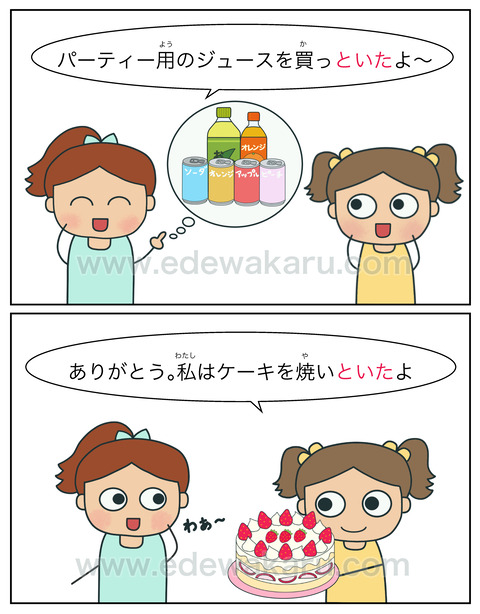
[1] Used when you want to say that you do something in advance, thinking ahead so that things will go well or you won’t be inconvenienced later.
It is a phonetic change of 「~ておく」.
[2] Used when you want to say that, with some intention, you leave something as it is in its current state.
It is a phonetic change of 「~ておく」.
[3] Used when you want to say that, with some intention, you take some measure or action instead of leaving something as it is in its current state.
It is a phonetic change of 「~ておく」.
How to use it
Notes
[1] Used when the state resulting from an action remains.
“〜” is followed by verbs expressing intentional actions, such as “買う,” “考える,” and “準備する.”
[2] “〜” is followed by verbs expressing intentional actions, such as “置く,” “開ける,” and “出す,” or by causative forms of verbs, such as “遊ばせる” and “やらせる.”
[3] “〜” is followed by verbs expressing intentional actions, such as “戻す,” “片付ける,” and “修理する.”
In context 16 examples
母「健太、お客さんが来るから、トイレの掃除、しといて」
Mother: “Kenta, we’re having a guest over, so clean the bathroom, okay?”
あさっては引越しだ。皿やカップはこの段ボール箱に入れとこう。
We’re moving the day after tomorrow. Let’s put the plates and cups in this cardboard box.
あすは一日中忙しい日だ。今日はよく寝とこう。
Tomorrow’s going to be a busy day from start to finish. I’d better get a good night’s sleep today.
あ、コーヒーがない。家族みんなコーヒーを飲むから忘れないで買っとかないと。
Oh, we’re out of coffee. The whole family drinks it, so I mustn’t forget to buy some.
「明日、東京駅に8時集合だよ。早いよ」「うん、もう着る服も出しといた」
“We’re meeting at Tokyo Station at eight tomorrow. That’s early.” “Yeah, I’ve already laid out the clothes I’m going to wear.”
「船に酔いやすい人は、乗船の前に酔い止めの薬を飲んどいたほうがいいよ」
“If you tend to get seasick, you’d better take some motion sickness medicine before boarding.”
「もうすぐお父さんが帰ってくるから、玄関の電気は、このままつけとくね」
“Dad will be home soon, so I’ll leave the entryway light on for now.”
「お母さん、僕の机の上はしばらくこのままにしといてよ。後で自分で片づけるから」
“Mom, leave the top of my desk as it is for a while. I’ll tidy it up myself later.”
「脱いだ服はこんなところに置いとかないで、ちゃんと片付けてよね」
“Don’t leave the clothes you’ve taken off lying around like this. Put them away properly.”
「ねえ、『積ん読』って何?」「買った本をすぐには読まないで、ひとまずどこかに積んどくことだよ」
“Hey, what does ‘tsundoku’ mean?” “It means buying books, not reading them right away, and leaving them piled up somewhere for the time being.”
悪口なんか気にしない。言いたい人には言わせとけばいい。
I don’t care about people badmouthing me. Let people who want to say things say them.
「ただいま。車の鍵、ここに置いとくね」
“I’m home. I’ll leave the car keys here.”
「使ったお皿やコップはシンクに入れといてよ」
“Put the plates and cups you’ve used in the sink.”
今日着たシャツ、汚れたから今日中に洗っとこう。
The shirt I wore today got dirty, so I’ll wash it today.
「自転車がパンクしました。後で取りに来ますから、修理しといてくれませんか」
“My bicycle has a flat tire. I’ll come pick it up later, so could you repair it for me?”
「この荷物、ここに置かないでガレージに運んどいたほうがいいよ」
“You’d better move this luggage to the garage instead of leaving it here.”
Read the original source text
Meaning
[1] 先のことを考えて、そのときうまくいくように、あるいは困らないように、あらかじめ~すると言いたいときに使います。
「~ておく」が音声的に変化した形です。
[2] ある意図があって、今の状態のままに放置・放任すると言いたいときに使います。
「~ておく」が音声的に変化した形です。
[3] ある意図があって今の状態のままに放置・放任しないで、何らかの処置・処理をすると言いたいときに使います。
「~ておく」が音声的に変化した形です。
How to use it
Notes
[1] 行為の結果の状態が残る場合に使います。
「〜」には、「買う・考える・準備する」など、意志的な行為を表す動詞がきます。
[2] 「~」には、「置く・開ける・出す」など、意志的な行為を表す動詞や、「遊ばせる・やらせる」など、動詞の使役の形がきます。
[3] 「~」には、「戻す・片付ける・修理する」など、意志的な行為を表す動詞がきます。
Bunpro Grammar Reference
Meaning
To do in advance, To do for, To unfortunately do
How to use it
Verb[て̶お̶く̶]+ とく
Verb[て̶あ̶げ̶る̶]+ たる
Verb[て̶し̶ま̶う̶]+ てまう
Nuance
An abbreviated pronunciation of a common pattern, used in Kansai.
Explanation
関西弁 has abbreviations or alterations for several of the standard Japanese expressions that interact with the て form of verbs. Each of these behave in the same way as their counterparts:
とく - Replaces ておく (to do something in advance).
たる - Replaces てあげる (to so something for someone else).
てまう - Replaces てしまう (to do something completely/without realizing).
Both とく and たる will replace the て in whatever verb they appear with. However, まう will appear after て, in the same way as しまう.
Fun Fact
たる may appear to have nothing to do with てあげる, but this is simply because たる is an abbreviation/sound shift of てやる (the casual form of てあげる). However, because てやる is not often used in modern Japanese, たる is often likened to てあげる instead (despite てあげる not being its origin). Abbreviations are regularly created this way in Japanese, with the first and last sounds of two mora (kana syllables) creating one new sound. てお (from ておく) becomes と, and てや (from てやる) becomes た.
Fun Fact
In 関西弁, there is actually a direct abbreviation of てあげる in the form of たげる. However, this is not used as often as たる (the abbreviation of てやる).
Notes
Kansai dialect
In context 15 examples
- テストの前に、よく寝ておく。
テストの前に、よくねとく。Before a test, I sleep well.
- 玄関にゴミ置いとくから買い物行くついでにゴミ出しといて。
I'm going to leave the trash by the door, so can you take it out when you go shopping?
- 今日は欲しいものなんでも買ったるわ。
Today, I am going to buy you anything you want.
- 俺がおごったるから、好きなもん頼みな。
I'm going to pay for your meal, so order whatever you like.
- やばい、二度寝してもうた。
Shoot, I went back to sleep.
- 赤ちゃんが起きてまうから、静かにしといて。
You are going to wake the baby, so please keep quiet.
- 洗濯機に洗濯物入れとくから、後で干しといて。
I'm going to load the washing machine with laundry, so can you hang them up later?
- 毎日勉強を教えてあげる。
毎日勉強をおしえたる。I will teach you how to study every day.
- サッカーを教えてあげる。
サッカーをおしえたる。I will teach you how to play soccer. (do you the favor of teaching you)
- ここかそこにリンゴを置いておく。
ここかそこにリンゴをおいとく。I will place the apple either here or there.
- 私は寿司 が好きではないので、食べないでおく。
私は寿司 が好きではないので、たべんとく。I do not like sushi, so I will not eat it. (I am going to prevent myself from eating in advance because I don't like sushi)
- 朝の10時まで寝てしまった。
朝の10時までねてもうた。I accidentally slept until 10 in the morning.
- 漢字を来年までに覚えておくこと。
漢字を来年までにおぼえとくこと。Make sure to memorize kanji by next year.
- 私が空港まで送ったげる。
I'll take you to the airport.
- 焼肉に連れてってくれるなら、引っ越しを手伝ったげる。
If you are going to take me to yakiniku, I will help you move.
Read the original source text
Meaning
To do in advance, To do for, To unfortunately do
How to use it
Verb[て̶お̶く̶]+ とく
Verb[て̶あ̶げ̶る̶]+ たる
Verb[て̶し̶ま̶う̶]+ てまう
Nuance
An abbreviated pronunciation of a common pattern, used in Kansai.
Explanation
関西弁 has abbreviations or alterations for several of the standard Japanese expressions that interact with the て form of verbs. Each of these behave in the same way as their counterparts:
とく - Replaces ておく (to do something in advance).
たる - Replaces てあげる (to so something for someone else).
てまう - Replaces てしまう (to do something completely/without realizing).
Both とく and たる will replace the て in whatever verb they appear with. However, まう will appear after て, in the same way as しまう.
Fun Fact
たる may appear to have nothing to do with てあげる, but this is simply because たる is an abbreviation/sound shift of てやる (the casual form of てあげる). However, because てやる is not often used in modern Japanese, たる is often likened to てあげる instead (despite てあげる not being its origin). Abbreviations are regularly created this way in Japanese, with the first and last sounds of two mora (kana syllables) creating one new sound. てお (from ておく) becomes と, and てや (from てやる) becomes た.
Fun Fact
In 関西弁, there is actually a direct abbreviation of てあげる in the form of たげる. However, this is not used as often as たる (the abbreviation of てやる).
Notes
関西弁
Nuance · 日本語
関西で使われていて、一般的な表現を略して発音した表現。