絵でわかる日本語
Meaning
Without ~, ~ cannot
If ~ is not considered, ~ cannot
Without including ~, ~ cannot
How to use it
Noun [dictionary form] + 抜きには〜ない
Noun [dictionary form] + 抜きでは〜ない
Noun [dictionary form] + 抜きにしては〜ない
Explanation
“A抜きにBない” is a sentence pattern meaning “without A, there is no B” or “if A is not considered, there is no B.” It is used to emphasize that “B is impossible without A.” “B” is followed by a negative form or expression, such as “〜ない,” “〜できない,” or “〜得ない.” Also, “〜抜きに〜ない” can be changed to “〜抜きでは〜ない” or “〜を抜きにしては〜ない” 😊
[Example]
Without breakfast,
抜きには
I have no energy
ない
= Without breakfast,
抜きでは
I have no energy
ない
= Without breakfast,
抜きにしては
I have no energy
ない
There are several sentence patterns with “抜く・抜き.” It may help to learn to distinguish them so you don’t get confused.
[Related patterns]
In context 6 examples
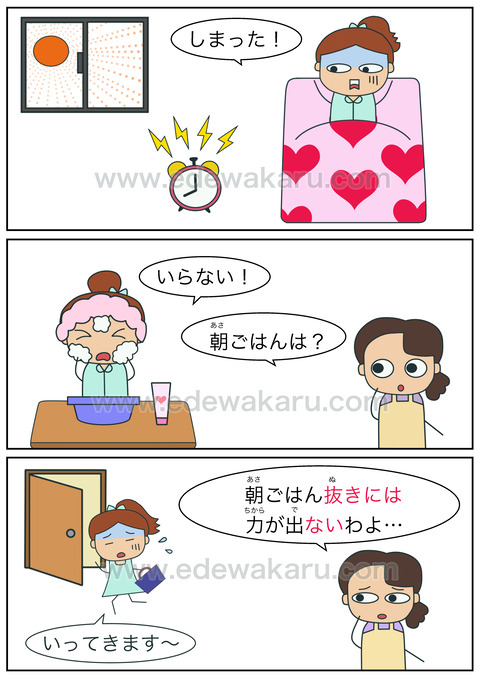
娘:遅刻しそうだから、ごはんいらない母:朝ごはん抜きには力が出ないわよ…
→朝ごはんを食べなければ、力が出ないわよ…Daughter: I might be late, so I don’t need food. Mother: You won’t have any energy without breakfast… →You won’t have any energy if you don’t eat breakfast…
彼女の活躍抜きには、チームは優勝しなかっただろう
→彼女の活躍がなければ、チームは優勝しなかっただろうWithout her outstanding performance, the team probably wouldn’t have won the championship. →If it weren’t for her outstanding performance, the team probably wouldn’t have won the championship.
両親の協力抜きには留学できなかったと思う
→両親の協力がなければ留学できなかったと思うI don’t think I could have studied abroad without my parents’ support. →I don’t think I could have studied abroad without my parents’ support.
これは重大なことなので、社長の意見抜きには決めかねる
→社長の意見がなければ決めかねるThis is an important matter, so I can’t make a decision without the president’s opinion. →I can’t make a decision without the president’s opinion.
先生のご指導抜きには、N1には合格できませんでした
→先生のご指導がなければ、N1には合格できませんでしたI couldn’t have passed N1 without my teacher’s guidance. →I couldn’t have passed N1 without my teacher’s guidance.
寿司抜きには、日本料理を語れない
→寿司を入れなければ、日本料理は語れないYou can’t talk about Japanese cuisine without sushi. →You can’t talk about Japanese cuisine without including sushi.
Read the original source text
Meaning
〜なければ〜ない
〜を考えなければ〜ない
〜を入れないでは〜ない
How to use it
名詞[辞書形]+抜きには〜ない
名詞[辞書形]+抜きでは〜ない
名詞[辞書形]+抜きにしては〜ない
Explanation
「A抜きにBない」は「AがなければBはない」「Aを考えなければBはない」という意味を表す文型です。「AがなければBは不可能だ」というのを強調したい時に使われます。「B」には「〜ない」「〜できない」「〜得ない」など、
否定形・否定表現(ひていひょうげん)
がきます。 また「〜抜きに〜ない」は「〜抜きでは〜ない」「〜を抜きにしては〜ない」にチェンジすることができます😊
[例]
朝ごはん
抜きには
力が出
ない
わよ!
=朝ごはん
抜きでは
力が出
ない
わよ!
=朝ごはん
抜きにしては
力が出
ない
わよ!
「抜く・抜き」がつく文型はいくつかあります。混乱しないように、区別して覚えておくといいと思います。
【関連文型】