DoJG 日本語文法辞典(全集)
Meaning
Decide on ~; make it ~
Explanation
Someone has decided on something.
In context 3 examples
私はこのアパートにする・します。
I've decided on this apartment.
A:あなたは何にしますか。 B:私はステーキにします。
A: What have you decided on? B: I've decided on steak.
岡田さんはアメリカの車にしました。
Mr. Okada (has) decided on an American car.
絵でわかる日本語
Usage 1
Read this source entry ↗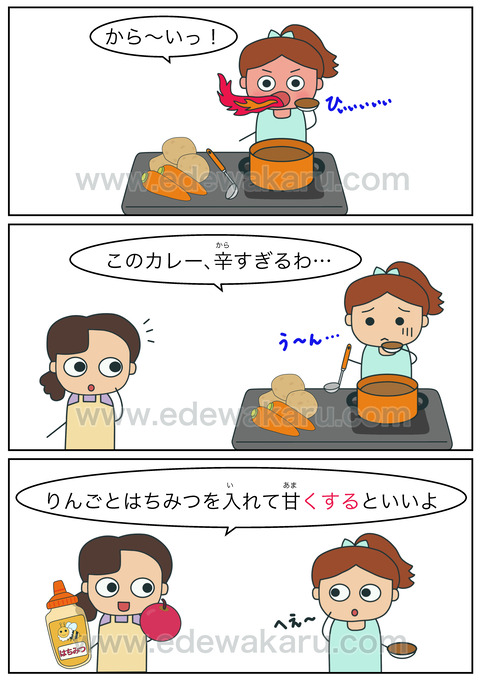
Meaning
Change something into a particular state.
How to use it
い-adjective [drop い] + くする
な-adjective [drop な] + にする
Explanation
“Aにする” is a sentence pattern meaning “to change something into state A.” An adjective goes in place of “A.”
[Examples]
①Mother: Try adding apples and honey to make it sweet~
→ Change it from a spicy state to a “sweet” state.
②Mother: Clean your room!
→ Change it from a dirty state to a “clean” state.
③A: Hey, the sound is way too loud! Could you turn it down a little?
→ Change the sound from loud to “quiet.”
④I got scolded by the teacher for shortening my uniform skirt.
→ I changed the skirt from long to “short,” and got scolded.
⑤I turned on the air conditioner and made the room warm.
→ I turned on the air conditioner and changed the room from cold to “warm.”
⑥Beer tastes better if you chill it before drinking~
→ It tastes better if you put it in the fridge and change it to a “cold” state.
“〜にする” also has a use that expresses [decision], so learn that as well 😉
In context 6 examples
娘:このカレー、辛すぎるわ…母:りんごとはちみつを入れて甘くするといいよ〜
Daughter: This curry is way too spicy… Mother: Try adding apples and honey to make it sweet~
母:部屋をきれいにしなさい!息子:は〜い
Mother: Clean your room! Son: Okaaay.
A:ちょっと、音が大きすぎるよ!もう少し小さくしてくれる?B:あ、ごめんね…
A: Hey, the sound is way too loud! Could you turn it down a little? B: Oh, sorry…
制服のスカートを短くしたら、先生に怒られた
I got scolded by the teacher for shortening my uniform skirt.
エアコンをつけて、部屋を暖かくした
I turned on the air conditioner and made the room warm.
ビールは、冷たくしてから飲んだほうがおいしいよ〜
Beer tastes better if you chill it before drinking~
Read the original source text
Meaning
〜の状態に変化させる
How to use it
い形容詞[ーい]+くする
な形容詞[ーな]+にする
Explanation
「Aにする」は「Aの状態に変える」という意味の文型です。「A」には形容詞が入ります。
[例]
①母:りんごとはちみつを入れて甘
くする
といいよ〜
→辛い状態から「甘い」状態に変化させる
②母:部屋をきれい
にしなさい!
→汚い状態から「きれいな」状態に変える
③A:ちょっと、音が大きすぎるよ!もう少し小さ
くしてくれる?
→音を大きい状態から「小さい」状態に変化させる
④制服のスカートを短
くしたら、先生に怒られた
→スカートを長い状態から「短い」状態に変えたら、怒られた
⑤エアコンをつけて、部屋を暖か
くした
→エアコンをつけて、寒い状態から「暖かい」状態に変化させた
⑥ビールは、冷た
くして
から飲んだほうがおいしいよ〜
→冷蔵庫に入れて、「冷たい」状態に変えたほうがおいしいよ
「〜にする」には[決定]を表す用法もありますので、一緒に覚えておきましょう😉
Usage 2
Read this source entry ↗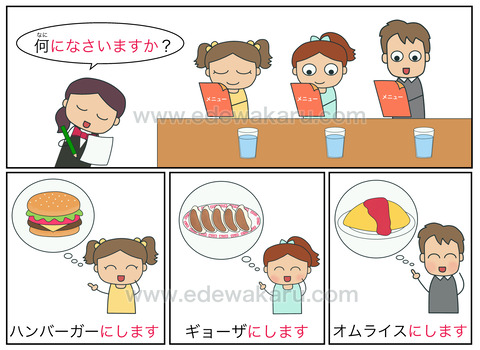
Meaning
Decide on〜
How to use it
Noun [dictionary form] + にする
In context 4 examples
店員:何になさいますか?客A:ハンバーガーにします客B:ギョーザにします客C:オムライスにします
→店員:何に決めましたか?客A:ハンバーガーに決めました客B:ギョーザに決めました客C:オムライスに決めました(*「なさる」は「する」の尊敬語)Clerk: What would you like? Customer A: I’ll have a hamburger. Customer B: I’ll have gyoza. Customer C: I’ll have omurice. →Clerk: What have you decided on? Customer A: I’ve decided on a hamburger. Customer B: I’ve decided on gyoza. Customer C: I’ve decided on omurice. (*“なさる” is the respectful form of “する.”)
A:リーダーは誰にする?B:山田くんにしよう
→山田くんに決めようA: Who should we choose as the leader? B: Let’s go with Yamada. →Let’s decide on Yamada.
A:彼女へのプレゼントは何にするつもりなの?B:花にしたよ
→花に決めたよA: What are you planning to get her for a present? B: I decided on flowers. →I decided on flowers.
A:旅行はいつ行くことにしたの?B:来週にしたよ
→来週に決めたよA: When did you decide to go on the trip? B: I decided on next week. →I decided on next week.
Read the original source text
Meaning
〜に決める
How to use it
名詞[辞書形]+にする
どんなときどう使う 日本語表現文型辞典
Meaning
will have; decide on
Explanation
B:のどがかわいたから、コーラにします。
客:きれいですね。じゃ、これにします。
Nに+する
いくつかある選択肢の中から意識的にある一つを選んで決めるときに使う。「になる」より話す人の積極的な姿勢を表す。
Consciously decides on one selection from a variety. Expresses speaker's proactive attitude more than does になる.
In context 3 examples
A:いい喫茶店ですね。何を頼みましょうか。
A: What a nice café. What shall we order?
店員:こちらのかばんはデザインが新しいんですよ。
Shop assistant: This bag has a new design.
テニス部の部長:雨がやまないので、練習は午後からにします。接続
Tennis club captain: Since the rain hasn’t stopped, we’ll start practice in the afternoon. Connection
Read the original source text
Meaning
will have; decide on
Explanation
B:のどがかわいたから、コーラにします。
客:きれいですね。じゃ、これにします。
Nに+する
いくつかある選択肢の中から意識的にある一つを選んで決めるときに使う。「になる」より話す人の積極的な姿勢を表す。
Consciously decides on one selection from a variety. Expresses speaker's proactive attitude more than does になる.
日本語NET JLPT文法解説まとめ
Meaning
Used when choosing and deciding on one option from among various choices.
How to use it
N + にする
Explanation
"decide on"
Used to decide on one out of the various options.
In context 5 examples
【レストランで】
[At a restaurant]
【ホテルの受付で】
[At a hotel reception desk]
【服屋で】
[At a clothing store]
【授業中止の案内】
[Announcement of class cancellation]
【予定を決める】
[Making plans]
Read the original source text
Meaning
色々ある選択肢の中から、1つを選んで決めるときに使う。
How to use it
N + にする
Explanation
"decide on"
Used to decide on one out of the various options.
毎日のんびり日本語教師
Usage 1
Read this source entry ↗How to use it
Na-adjective stem + にする
Noun + にする
I-adjective stem + くする
Verb nai-form + なくする
Explanation
Expresses making a thing, state, or quality change intentionally into the desired result.
When attaching to a verb, use 「【N4文法】~ようにする/ないようにする」.
Notes
Related grammar: 「【N5文法】~になる/くなる」
In context 8 examples
我が子を弁護士にしたい。(想让自己的孩子成为律师。)
I want to make my child a lawyer. (I want my own child to become a lawyer.)
ちょっと静かにしてください。
Please be a little quieter.
練習は不可能を可能にする。
Practice makes the impossible possible.
お腹を冷やさないように、暖かくして寝てください。
Please keep warm when you go to bed so your stomach doesn't get cold.
壁の色を黒くしたい。(想把墙壁的颜色弄黑。)
I want to make the wall black. (I want to paint the wall black.)
辛いのが苦手なので、カレー作るときはいつも甘くする。
I can't handle spicy food, so I always make curry sweet.
プレゼンを誰でも分かるように簡単な内容にした。
I made the presentation simple enough for anyone to understand.
今日のメイクは大人っぽい雰囲気にした。
I went for a mature look with today's makeup.
Read the original source text
How to use it
な形容詞語幹+にする
名詞+にする
い形容詞語幹+くする
動ない形+なくする
Explanation
物事や状態、性質を人為的に望んでいる結果へと変化させることを表します。
動詞に接続する場合は「【N4文法】~ようにする/ないようにする」を用います。
Notes
関連文法「【N5文法】~になる/くなる」
Usage 2
Read this source entry ↗How to use it
Noun + にする
Noun + particle + にする
Explanation
This grammar is used for a subjective decision based on the speaker's own will or judgment.
It is often used when choosing one option from several or when placing an order.
Notes
Related grammar: 「【N3文法】~ことにする/こととする」
Related grammar: 「【N4文法】~になる/となる」
In context 6 examples
私はコーラにします。
I'll have a cola.
妹へのプレゼントはマフラーにしました。
I chose a scarf as a present for my younger sister.
お酒は飲めないので、他のにしてください。
I can't drink alcohol, so please make it something else.
喉が渇いたら、健康のため、炭酸飲料ではなく水にしましょう。
When you're thirsty, let's have water rather than a carbonated drink for our health.
仕事の補佐をお願いするなら、私は必ずAさんにする。
If I were to ask someone to assist me with work, I'd definitely choose A.
この髪型にしたのは、最近海外で流行っているからだ。
I chose this hairstyle because it's recently become popular overseas.
Read the original source text
How to use it
名詞+にする
名詞+助詞+にする
Explanation
話し手自身の意志や判断による主観的な決定に用いる文法です。
いくつかの選択肢の中から一つ選んだり、あるいは注文するときなどによく用います。
Notes
関連文法「【N3文法】~ことにする/こととする」
関連文法「【N4文法】~になる/となる」
AIUEO JLPT Grammar
Meaning
「〜にする・〜くする」is used to express intentional changes, or decisions and choices. “〜にする” attaches to adjectives or nouns, while “〜くする” attaches to adjectives.
How to use it
Noun に + する; Adjectival noun に + する; Adjective く-form + する
In context 5 examples
ご注文は何にしますか?
What will you order?
お茶にしますか、それともコーヒーにしますか?
Will you have tea or coffee?
政府は新しい政策を発表することにしました。
The government has decided to announce a new policy.
価格をもっと安くすることはできますか?
Can you make the price lower?
どれにするか、もう決めた?
Have you decided which one to choose?
Read the original source text
Meaning
「〜にする・〜くする」is used to express intentional changes, or decisions and choices. “〜にする” attaches to adjectives or nouns, while “〜くする” attaches to adjectives.
How to use it
名詞に+する形容動詞に+する形容詞く形+する
Explanation · 日本語
「〜にする・〜くする」は、意図的に変化させることを表すほかに、選択や決定を表す表現としても使用されます。「〜にする」は形容動詞や名詞に接続し、「〜くする」は形容詞に接続します。
Bunpro Grammar Reference
Usage 1
Meaning
Adjective + する, To make something/someone (more)
How to use it
[な]Adjective + に + する
[い]Adjective[く]+ する
Noun + に + する
[な]Adjective + に + します
[い]Adjective[く]+ します
Noun + に + します
Nuance
A construction indicating that something is being made to have the characteristic of (A).
Explanation
When combined with a な-Adjective, にする (or くする in the case of い-Adjectives) carries the meaning of 'to make more (A)'.
Just like the にする grammar point that is used for highlighting decisions, this にする construction implies that the speaker has a high level of control over the action.
この建物をもっと丈夫にする方法がありますか?
Is there any way to make this building more durable?
汚い部屋を綺麗にするのは大変だ。
It is difficult to make a dirty room clean.
風呂を熱くするよ。いい?
I'm going to make the bath hot. Is that okay?
このコーヒーを甘くするために、砂糖をください。
Please give me sugar to make this coffee more sweet.
Basically, this changes the adjective into an adverb, and then uses する to show that the adjective itself is the thing that is being done.
Fun Fact
にする is one of four regularly repeating grammar patterns in Japanese that highlight the level of control that the speaker has over the action/result of an action. From highest to lowest level of control, these are as follows:
にする - High level of control, the speaker/subject can perform this action themselves.
になる - High level of control, the speaker/subject can perform this action themselves, but there is no external target.
とする - Medium level of control, the speaker/subject can perform this action, but some outside factors may need to be considered (difficulty, other people, time, etc.).
となる - Low level of control, the speaker/subject has almost no control over these actions, and something that came about purely due to external factors is being discussed.
In context 16 examples
- 頑張って部品を小さくしてください。
Please try your best to make the parts smaller.
- このコーヒーを甘くするために、砂糖をください。
Please give me sugar to make this coffee more sweet.
- 汚い部屋を綺麗にするのは大変だ。
It is difficult to make a dirty room clean.
- 風呂を熱くするよ。いい?
I'm going to make the bath hot. Is that okay?
- この建物をもっと丈夫にする方法がありますか?
Is there any way to make this building more durable?
- 布団を新しくしたから気持ちいい。
I got a new futon, so it is comfortable. (Literally - I did it new)
- 歯医者さんで歯を白くしてもらった。
I had the dentist make my teeth whiter. (Literally - Do white)
- お花見には温かくして行った方がいい。
You should make yourself warm when going to a flower-viewing party. (Literally - Do warm)
- この部屋を大きくしたいです。
I want to make this room bigger. (Literally - Do big)
- 昼休みを短くして早く帰りたい。
I want to make my lunch break shorter and go home earlier. (Literally - Do short)
- 翻訳を面白くするアプリがある。
There is an app that makes translating (more) fun. (Literally - Do fun)
- 法律を新しくしてほしい。
I want them to renew (make new) the law. (Literally - Do new)
- 庭を元気にするアイデアはない?
Do you have any ideas on how to make the yard (more) healthy? (Literally - Do healthy)
- 一生懸命親切にしてくれた。
(They) went all out to make (themselves) generous (for me). (Literally - Do kindness)
- 顔を黒くしすぎです。
You make your face too dark (with makeup). (Literally - Do black/dark)
- もっと簡単に便利にする方法がありますよ。
There is a way to make it more simple and convenient, you know. (Literally - Do convenient)
Usage 2
Meaning
To decide on, To choose, To make something into, To view something as
How to use it
Noun + に + する
Noun + に + します
Nuance
A phrase used for expressing that the speaker has decided on doing (A), or going with (A).
Explanation
にする is a structure that combines the に particle (a location/target), with the verb する. It means to 'make/decide' something in a certain way. The nuance with にする is that the speaker has direct control over the outcome. This is where the strong feeling of 'choice' comes from. The noun that comes before にする is the thing that is being decided.
俺はビールにする。
I'm going to decide on this beer.
In this example, although the common translation is 'to decide', it is actually much closer to the slang expression 'to do (A)' in English. This means that the literal translation is actually 'I'll do a beer', or 'I'll make it a beer'.
Sometimes the particle と is used instead of に. Although this has the same meaning, it changes the nuance slightly. When と is used, it takes away the feeling of being a direct decision. とする tends to be used in more formal situations, but this is only because と is less 'definite', so results in the phrase sounding less pushy.
今日はここまでとする。
Today, I will decide to make this the end. (Why don't we call it a day, if that's ok)
今日はここまでとする。
Today, I will decide to make this the end. (Why don't we call it a day, if that's ok)
If you were going to compare these two to an English equivalent, it would be similar to the difference between the following sentences.
に - I'll buy a burger. (A burger is the direct target of 'buy')
と - I'll go with a burger. (You aren't 'going' anywhere, it just sounds softer)
This grammar point may be used for more abstract nouns, and does not specifically need to be 'items'.
ハイキングへ行くの日曜日にする?
Is Sunday ok for hiking? (Literally, 'as for heading hiking, will you make it Sunday?')
In context 16 examples
- 何にする?
What will you decide on?
- 今日はここまでにする。
Today, I will decide to end it here. (I'm going to call it a day)
- ハイキングへ行くの日曜日にする?
Is Sunday ok for hiking? (Literally, 'as for heading hiking, will you make it Sunday?')
- 今日はここまでとする。
Today, I will decide to make this the end. (Why don't we call it a day, if that's ok)
- 俺はビールにする。
I'm going to decide on this beer.
- 今日の晩ごはんは何にする?
What are you going to have for dinner tonight? (Decide on)
- このかばんにします。
To decide on this bag.
- 明日の朝ごはんは魚にします。
To decide on fish for breakfast tomorrow.
- このレストランにします。
To decide on this restaurant.
- ここにする。
To decide on here.
- お風呂に入るのは7時にする。
To decide on taking a bath at seven o'clock.
- 来月にします。
To decide on next month.
- テストは月曜日にするって先生が言った。
The teacher said, 'I have decided on Monday for the test.' (Literally - We'll do it)
- この赤い上着にする。
To decide on this red jacket.
- この音楽にする。
To decide on this music.
- どちらにしますか。
Which will you decide on?
Read the original source text
Meaning
To decide on, To choose, To make something into, To view something as
How to use it
Noun + に + する
Noun + に + します
Nuance
A phrase used for expressing that the speaker has decided on doing (A), or going with (A).
Explanation
にする is a structure that combines the に particle (a location/target), with the verb する. It means to 'make/decide' something in a certain way. The nuance with にする is that the speaker has direct control over the outcome. This is where the strong feeling of 'choice' comes from. The noun that comes before にする is the thing that is being decided.
俺はビールにする。
I'm going to decide on this beer.
In this example, although the common translation is 'to decide', it is actually much closer to the slang expression 'to do (A)' in English. This means that the literal translation is actually 'I'll do a beer', or 'I'll make it a beer'.
Sometimes the particle と is used instead of に. Although this has the same meaning, it changes the nuance slightly. When と is used, it takes away the feeling of being a direct decision. とする tends to be used in more formal situations, but this is only because と is less 'definite', so results in the phrase sounding less pushy.
今日はここまでとする。
Today, I will decide to make this the end. (Why don't we call it a day, if that's ok)
今日はここまでとする。
Today, I will decide to make this the end. (Why don't we call it a day, if that's ok)
If you were going to compare these two to an English equivalent, it would be similar to the difference between the following sentences.
に - I'll buy a burger. (A burger is the direct target of 'buy')
と - I'll go with a burger. (You aren't 'going' anywhere, it just sounds softer)
This grammar point may be used for more abstract nouns, and does not specifically need to be 'items'.
ハイキングへ行くの日曜日にする?
Is Sunday ok for hiking? (Literally, 'as for heading hiking, will you make it Sunday?')
Nuance · 日本語
話し手が(A)をする、または(A)でいく事を選択したこと表す表現。
文法
Meaning
Used when choosing and deciding on one option from among various choices.
How to use it
N + にする
In context 5 examples
【レストランで】
A:う〜ん、私はステーキにします。Bさんは?
B:私はスパゲティにします。[At a restaurant] A: Hmm, I'll have the steak. How about you, B? B: I'll have the spaghetti.
【ホテルの受付で】
A:お部屋はツインベットとダブルベット、どちらになさいますか。
B:ダブルベッドにします。[At a hotel reception desk] A: Would you like a twin bed or a double bed? B: I'll take a double bed.
【服屋で】
A:どっちにしようかなあ。こっちはデザインがいいし。でも、こっちはセールで値段が安いし。
B:欲しいのにしたら?
A:うん、じゃあデザインがかっこいいのにする。[At a clothing store] A: Which one should I choose? This one has a nice design. But this one is on sale and cheaper. B: Why not get the one you want? A: Yeah, then I'll get the one with the cool design.
【授業中止の案内】
大型の台風が近づいてきているので、今日は休みにします。[Announcement that class is canceled] A large typhoon is approaching, so there will be no class today.
【予定を決める】
A:来週の土曜日、USJに行かない?
B:いいね、行こう!
A:やったー。じゃあ、待ち合わせ場所はどこにする?
B:10時に大阪駅はどう?
A:オッケー。[Making plans] A: Do you want to go to USJ next Saturday? B: Sounds good, let's go! A: Yay! So where shall we meet? B: How about Osaka Station at 10? A: Okay.
Read the original source text
Meaning
色々ある選択肢の中から、1つを選んで決めるときに使う。
How to use it
N + にする
NINJAL 日本語文型データベース
Meaning
[1] Used when the speaker wants to say that they will decide on something of their own accord. It expresses the speaker’s proactive attitude.
It is also used in situations where one suggests a choice or decision in forms such as “~にしましょう・~にしませんか.”
[2] Used to express intentionally changing something into a particular state. This is the form used when talking about changing it into a state expressed by a na-adjective or noun.
How to use it
Nにする
na-Aにする
Nにする
Notes
[1] The subject is usually first person. When expressing a third party’s intention, use it with words at the end of the sentence such as “~らしい・~そうだ・~と言っている.”
In context 17 examples
店員「お食事の後のお飲み物は、コーヒーと紅茶、どちらがよろしいですか」客「私はコーヒーにします」
Staff: “For a drink after your meal, would you prefer coffee or tea?” Customer: “I’ll have coffee.”
「両方着てみましたが、こちらにします。これをください」
“I tried both on, but I’ll take this one. I’ll buy it.”
父「今日は雨が降りそうだから、残念だけど、ピクニックは延期にしよう」
Father: “It looks like it’s going to rain today, so unfortunately, let’s postpone the picnic.”
「明日の待ち合わせ場所はどこにする?」「駅前のカフェはどう?」
“Where should we meet tomorrow?” “How about the café in front of the station?”
迷ったが、結局ラーメンは大盛りにはしないで、普通のにした。
I was unsure, but in the end I didn’t get the large ramen; I went with the regular size.
「論文のテーマをジェンダー問題にするなら、この本を読んだほうがいいですよ」
“If you’re going to make gender issues the topic of your thesis, you should read this book.”
松下さんは、今年の旅行先はニュージーランドにしたと言っていた。
Matsushita said that she had chosen New Zealand as her travel destination for this year.
友達が来るので、これから部屋をきれいにする。
A friend is coming over, so I’m going to clean the room now.
骨を丈夫にするために、毎日牛乳を飲んでいる。
I drink milk every day to make my bones strong.
私は部屋を真っ暗にしないと寝られません。
I can’t sleep unless I make the room completely dark.
「もっと表現をシンプルにしたほうが、わかりやすくていい文章になりますよ」
“If you simplify the wording more, it will make the writing clearer and better.”
食卓を華やかにしたいホームパーティーに、ぜひおすすめしたいお料理をご紹介します。
I’d like to introduce a dish I highly recommend for a home party where you want to make the dining table look festive.
ジャムが入っていたびんを捨てないで、花びんにした。
I didn’t throw away the jar that had held jam; I turned it into a vase.
「すみません、ご飯がちょっと多いので、半分にしてもらえますか」
“Excuse me, there’s a little too much rice. Could you make it half as much?”
息子を町工場の後継者にするために、いろいろな技術を教えている。
I’m teaching my son various skills so that he can become the successor to a small factory in town.
中身が重かったので、破れないように、紙袋を二重にして持った。
The contents were heavy, so I doubled the paper bag and carried it to keep it from tearing.
「今日はどんな髪型になさいますか」「この写真みたいなショートにしてください」
“What kind of hairstyle would you like today?” “Please cut it short like in this picture.”
Read the original source text
Meaning
[1] 話し手の意志で~に決めると言いたいときに使います。話し手の積極的な姿勢を表します。
「~にしましょう・~にしませんか」などの形で選択や決定を呼びかける場面でも使われます。
[2] 人が意図的に物事を〜の状態に変えることを表すときに使います。ナ形容詞・名詞で表される状態に変えることを言う場合の形です。
How to use it
Nにする
na-Aにする
Nにする
Notes
[1] 主語はふつう一人称です。第三者の意志を表す場合は「~らしい・~そうだ・~と言っている」などの言葉を文末につけて使います。