DoJG 日本語文法辞典(全集)
Usage 1
Meaning
Assume that; regard ~ as; let; suppose
How to use it
(i) Noun1 は Noun2 | (だ) とする | |
| 一ドルは百三十円(だ) とする | We assume that one dollar is 130 yen |
(ii) Sinformal nonpast | とする | |
| 山田さんが来られないとする(ちょっと困る) | If we assume that Mr. Yamada cannot come, (we are at a bit of a loss) |
| 日本へ行くとすれば(いつ行ったらいいだろう) | Assuming that we go to Japan, (I wonder what would be the best time) |
(iii) Sinformal past | とする | |
| 百万円もらったとしよう | Suppose you received ¥1,000,000 |
| あと百日の命だと言われたとする | Let’s suppose that you were told you only had 100 days left to live |
Explanation
とする (1) A phrase indicating that someone assumes something.
In context 16 examples
温度は一定(だ)とする。
We assume that the temperature is constant.
一日に五百マイル運転できるとすれば・すると、何日で着きますか。
Assuming that we can drive 500 miles a day, how many days will it take to get there?
温暖化現象がこのまま続いたとしよう。
Suppose the greenhouse effect continued on like this.
今、空気抵抗は無視出来るものとする。
Now let's assume that we can ignore air resistance.
男性の女性に対するこのような行為は性的いやがらせであるとする。
Let's assume such behaviour by men towards women is regarded as a sexual harassment.
西洋では日本のいわゆる私小説は小説ではないとされる。
In the West the Japanese so-called 'I' novels are not regarded as novels.
私はアメリカを第二の故郷とすることに違和感を覚えない。
I don't feel uneasy regarding America as my second home country.
夏の九週間集中日本語講座の単位は六単位とする。
We let the units of the 9-week intensive Japanese course in summer count for 6 units.
利息は年3.5%とする。
Let the interest rate be 3.5 % annually.
日本経済がこのまま下降線をたどるとすると、日本語ブームもやがては終わるかもしてない。
If we assume that the Japanese economy keeps going down as it is now, the Japanese language boom may eventually come to an end.
日本が集団主義的な国だとすれば、欧米は、やはり、個人主義的な国と言えるだろう。
If we assume that Japan is a country of groups, then Europe and the States can be said to be countries of individualism.
為替レートを一ドル百円とすれば、この家はいくらになりますか。
Assuming that the exchange rate is one dollar to 100 yen, how much will this house amount to?
X+Y=20で、Xが8だとすれば、Yは12になる。
If we assume that X = 8 in X + Y = 20, Y will be 12.
一男を養子とすることには依存はない。
I have no objection to regarding Kazuo as our adopted son.
大陸の中国が完全に資本主義社会になったとしよう。中国は何年後に経済大国になるであろうか。
Suppose that continental China became a completely capitalized society. How long do you think it would take for the country to become an economic giant?
ニューヨークの物価指数を100としよう。
Let New York's price index be 100.
Usage 2
Meaning
Feel ~; look ~
How to use it
(i) Noun1 は Noun2 | (だ) とする | |
| 一ドルは百三十円(だ) とする | We assume that one dollar is 130 yen |
(ii) Sinformal nonpast | とする | |
| 山田さんが来られないとする(ちょっと困る) | If we assume that Mr. Yamada cannot come, (we are at a bit of a loss) |
| 日本へ行くとすれば(いつ行ったらいいだろう) | Assuming that we go to Japan, (I wonder what would be the best time) |
(iii) Sinformal past | とする | |
| 百万円もらったとしよう | Suppose you received ¥1,000,000 |
| あと百日の命だと言われたとする | Let’s suppose that you were told you only had 100 days left to live |
Explanation
とする (2) To have a sensory or psychological experience.
In context 10 examples
あの人はちょっとしたことでかっとする。
That person flares up at the slightest provocation.
あの男の人は目がギョロリとしている。
He has goggling eyes.
姉は足がすらっとしている。
My older sister has slender legs.
今日の天気はからっとしていて、気持ちがいい。
It is nice and dry today.
昔の恋人を東京駅で見かけて、はっとした。
I was taken aback when I saw my old girlfriend at Tokyo station.
ジョンは遅刻して先生に叱られたのに、けろっとしていた。
John was scolded by his teacher when he came in late, but he didn't show any sense of wrong doing.
日本語の試験が思ったよりよく出来たのでほっとした。
I felt relieved because I did better in a Japanese test than I expected.
部長は部下に反対された時、むっとした。
The department chief looked offended when he was opposed by his subordinate.
難しいと思っていた日本語の試験が易しかったのでほっとした。
The Japanese test which I thought would be difficult turned out to be easy, and I felt relieved.
休みの日は何もしないで、ぼうっとしているのが好きです。
On my days off I like to do nothing and to be completely laid back.
日本語文型辞典
Usage 1
Meaning
Basic information: Explanation: 「する」 is added to an adverb ending in 「と」 to indicate that something is in that manner or state. When a word can be used as an adverb without 「と」, as with 「ぽんやり」「はっきり」 in ④, 「と」 may be omitted. In ⑦–⑨, 「して」 may be omitted. Other examples: 「ちゃんと/ゆったりと/かっかと/悠々と/悠然と/毅然とする」. Examples: ① I just made the deadline, and felt relieved. ② The child never sits still, not even for a moment. ③ He remains unruffled, no matter what he's told. ④ My hazy memories gradually became clearer as time passed. ⑤ He responded to the reporter's questions with a dignified attitude. ⑥ Dress more neatly. ⑦ I woke up with a start at the sound of the phone in the middle of the night. ⑧ No matter what anyone says, he calmly smokes his cigarette. ⑨ She stiffened and glared at me. ⑩ The snow that began yesterday is still falling even now, after a night has passed.
Read the original source text
Meaning
基本情報説明語尾に「と」の付く副詞に「する」が付いて、そういう様子・状態であるということを示す。④の「ぽんやり」「はっきり」のように「と」がつかなくても副詞として使える語の場合は、「と」を省略することができる。⑦~⑨では「して」を省略することができる。その他の例「ちゃんと/ゆったりと/かっかと/悠々と/悠然と/毅然とする」など。例文① ぎりぎりで締め切りに間に合い、ほっとした。② 子供は少しの間もじっとしていない。③ 何を言われても平然としている。④ ぽんやり(と)していた記憶が時間が経つにつれてだんだんはっきり(と)してきた。⑤ 記者の質問に対し堂々とした態度で応対した。⑥ もっときちんとした格好をしなさい。⑦ 真夜中の電話の音にはっとして目が覚めた。⑧ 何を言われても、平然としてたばこを吹かしている。⑨ 彼女はきっとして、私をにらみつけた。⑩ 昨日からの雪は、一夜明けた今も依然として降り続いている。
Usage 2
Meaning
Basic information: N/Na だとする A/V とする
Means “to suppose …,” setting up a condition as something hypothetical or imagined for the time being, regardless of what reality is actually like. The speaker has a strong sense of consciously setting the condition as a hypothetical one.
Used in formal expressions, such as news reports and legal articles.
a. …とする
Means “regard as …” or “decide that ….” The 「だ」 after a noun is often omitted.
b. …こととする
Means “regard as …,” “judge that …,” or “decide that ….”
Means “decide” or “judge.”
c. …ものとする
Means “regard as …” or “interpret as ….”
⇾よう28
Means “regard / think of / decide that … is ….” It has various meanings, such as taking someone's actions or methods as a model, establishing an action as a habit, or treating one thing as another. ①–④ can also be paraphrased as 「Nにする」, but the figurative use in ⑤ cannot.
How to use it
とする【supposition】
…とする【regarding as】
N/Na(だ)とする
A/V とする
V-ようとする
NをNとする
In context 19 examples
今仮に3億円の宝くじがあなたに当たったとします。あなたは、それで何をしますか。
Suppose, for a moment, that you won 300 million yen in the lottery. What would you do with it?
今、東京で関東大震災と同程度の地震が起こったとしよう。その被害は当時とは比べものにならないものになるだろう。
Suppose an earthquake as strong as the Great Kanto Earthquake occurred in Tokyo now. The damage would be incomparable to that at the time.
例えば50人来るとして、会費は一人いくらぐらいにすればよいでしょうか。
Supposing, for example, that 50 people come, about how much should each person's fee be?
それはそうとして、我々はどうしたらよいでしょうか。
Putting that aside, what should we do?
酔ったうえでの失言(だ)として、彼の責任は問われないことになった。
It was decided that he would not be held responsible, on the grounds that the remark was made while he was drunk.
多額の不正融資が行われた証拠があるにもかかわらず、事実無根として片付けられた。
Despite evidence that large-scale illegal loans had been made, the matter was dismissed as completely baseless.
裁判長は過失は被告側にあるとし、被害者に賠償金を払うよう命じた。
The presiding judge ruled that the fault lay with the defendant and ordered him to pay compensation to the victim.
今の法律では夫婦はどちらか一方の姓を選ばなければならないとされている。
Under current law, married couples are required to choose one spouse's surname.
≪規則≫会議を欠席する場合は、事前に議長宛に届けを提出することとする。
<Rules> Anyone unable to attend a meeting shall submit notice in advance to the chairperson.
この度の法律改正は喜ぶべきこととして受け止められている。
This latest revision of the law is being received as something to be welcomed.
意見を言わない者は賛成しているものとする。
Anyone who does not express an opinion will be considered to be in favor.
1週間たってもお返事がない場合はご辞退なさったものとして扱います。
If we receive no reply after one week, we will treat it as a refusal.
時計は正午を知らせようとしている。
The clock is about to strike noon.
お風呂に入ろうとしたところに、電話がかかってきた。
Just as I was about to get into the bath, the phone rang.
私は恩師の生き方を手本としている。
I take my mentor's way of life as a model.
祖父は散歩を日課としている。
My grandfather makes taking a walk part of his daily routine.
この試験では60点以上を合格とする。
In this exam, a score of 60 or higher counts as a pass.
看護婦は昔は女の仕事とされていたが、この頃は男の看護士もいるそうだ。
Nursing used to be considered women's work, but these days there are apparently male nurses too.
芭蕉は人生を旅として生きた。
Bashō lived his life as a journey.
Read the original source text
Meaning
基本情報N/Na だとするA/V とする
「かりに…と考える」という意味で、現実がどうであるかということは別にして、とりあえず仮定・想像の上でのことがらとして条件を設定する用法。かりのものとして設定するという話し手の意識的な条件設定の意識が強い。
ニュース報道や法律の条文など、かたい表現で用いられる。
a. …とする
「…と見なす」「…と決める」という意味を表す。名詞のあとの「だ」は省略されることが多い。
b. …こととする
「…と見なす」「…と判断する」「…と決める」という意味を表す。
「…と決める」「…と判断する」という意味を表す。
c. …ものとする
「…と見なす」「…と解釈する」という意味を表す。
⇾よう28
「…を…のように見なす/考える/決る」という意味を表す。人の行動や方法を手本にしたり、行動を習慣として決めたり、ものごとを異なるものに見立てたりするといった様々な意味を表す。①~④は「Nにする」とも言いかえられるが、⑤のような比喩的な用法の場合は言いかえられない。
How to use it
とする【仮定】
…とする【見なし】
N/Na(だ)とする
A/V とする
V-ようとする
NをNとする
絵でわかる日本語
Meaning
〜と決める — to decide that …
〜と決定する — to determine that …
〜と判断する — to judge that …
How to use it
Verb・adjective・noun[plain form]+とする
*For affirmative present forms of な-adjectives and nouns, “ーだとする” can also be used.
Explanation
“〜とする” is a sentence pattern used to mean “to decide that …,” “to judge that …,” or “to regard … as.” It is used when setting rules, regulations, or laws, and when expressing a judgment. 😊
You may hear it at work, but it is a very formal expression, so it is rarely used in everyday conversation. 😥 It is often used in news reports and newspapers, so remember it. 😀 (Review: “news” and “newspaper”)
In context 3 examples
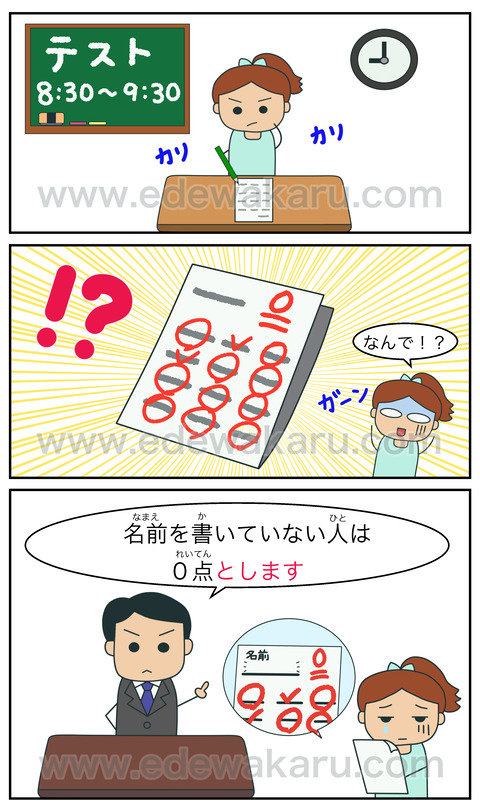
名前を書いていない人は、0点とします
→名前を書いていない人は、0点と判断しますPeople who have not written their names will be given zero points. →People who have not written their names will be judged to receive zero points.
パーティーの参加費は1人1000円とする
→パーティーの参加費は1人1000円と決めたThe participation fee for the party is set at 1,000 yen per person. →We decided to set the participation fee for the party at 1,000 yen per person.
3回遅刻をしたら、1回欠席とする
→3回遅刻をしたら、1回欠席と判断するIf you are late three times, it will count as one absence. →If you are late three times, we will judge it to be one absence.
Read the original source text
Meaning
〜と決める
〜と決定する
〜と判断する
How to use it
動詞・形容詞・名詞[普通形]+とする
*な形容詞・名詞の現在肯定形の場合は「ーだとする」も使える
Explanation
「〜とする」は「〜と決める」「〜と判断する」「〜と見なす」という意味で使われる文型です。
ルール
や
規則、
法律
などを決めた時や、判断を表す場合に使います😊
会社では聞く機会があると思いますが、とてもかたい言い方ですので日常会話(にちじょうかいわ)で使われることは少ないです😥ニュースや新聞などで使用されることはよくありますので、覚えておきましょう😀 (復習:「ニュース」と「新聞」)
日本語文型辞典 英語版
Usage 1
Meaning
This pattern combines the verb する with an adverb that has the particle と attached to it. Indicates that something has a certain appearance or condition. As shown in
(4)
, と is not obligatory for words like ぼんやり (vaguely) and はっきり (clearly), which can be used as adverbs without it. In
(7)
-
(9)
, して can be dropped. Other adverbs that combine with する include ちゃんと (properly), ゆったりと (easily/comfortably), かっかと (briskly/furiously), 悠々と (calmly/leisurely), 悠然と (with composure), and 毅然と (resolutely).
【とする2】[N/Na だとする][A/V とする]
Means “suppose we say that....” Used to establish the conditions for a hypothetical or imaginary situation, regardless of what the actual state of affairs may be. Conveys a strong sense that the speaker is deliberately setting the conditions for a hypothetical situation.
a. ...とする[N/Na (だ)とする][A/V とする]
Means ...と見なす(consider to be...) or ...と決める(decide that...). After nouns, the copula だ is often dropped.
b. ...こととするMeans “consider to be...,” “judge to be...,” or “decide that....”
Means ...と決める (decide that...) or ...と判断する (judge to be...).
c. ...ものとする
Means ...と見なす (consider to be...) or ...と解釈する (interpret as...).
→
8
Means “consider...to be...,” “think of...as...,” or “decide that...is like....” Conveys a variety of meanings, such as using someone’s actions or way of doing things as a model, deciding to make a habit of something, or comparing one thing to something else.
(1)
-
(4)
can be replaced by Nにする, but metaphorical usages like the one shown in
(5)
do not allow this.
How to use it
1. ...とする〈supposition〉
2. ...とする〈regard as〉Used in news reports, legal texts, and other modes of formal expression.
3. V-ようとする
4. NをNとする
In context 29 examples
ぎりぎりで締め切りに間に合い、ほっとした。
I was relieved that I managed to make the deadline just in time.
子供は少しの間もじっとしていない。
Kids can’t stay still even for a short while.
何を言われても平然としている。
No matter what they say to her, she remains unruffled.
ぼんやり(と)していた記憶が時間が経つにつれてだんだんはっきり(と)してきた。
My memories, which had been blurry, gradually became sharper with time.
記者の質問に対し堂々とした態度で応対した。
He handled the reporter’s questions in a dignified manner.
もっときちんとした格好をしなさい。
Dress a little more respectably!
真夜中の電話の音にはっとして目が覚めた。
I woke with a start at the sound of the telephone in the middle of the night.
何を言われても、平然としてたばこを吹かしている。
No matter what people say to her, she just keeps puffing on her cigarette with an air of unconcern.
彼女はきっとして、私をにらみつけた。
She cast a sharp glance at me.
昨日からの雪は、一夜明けた今も依然として降り続いている。
The snow started yesterday, continued overnight, and is still falling steadily.
今仮に3億円の宝くじがあなたに当たったとします。あなたは、それで何をしますか。
Let’s say you just won 300 million yen in a lottery. What would you do with it?
今、東京で関東大震災と同程度の地震が起こったとしよう。その被害は当時とは比べものにならないものになるだろう。
Imagine that an earthquake of the same intensity as the Great Kanto Earthquake has just hit Tokyo. The damage would no doubt be beyond compare with what happened then.
例えば 50 人来るとして、会費は一人いくらぐらいにすればよいでしょうか。
Say, for example, that fifty people come...how much should we charge per person?
それはそうとして、我々はどうしたらよいでしょうか。
Be that as it may, what do you think we should do?
酔ったうえでの失言(だ)として、彼の責任は問われないことになった。
It was decided that he had made the inappropriate remark while intoxicated, so he was not held accountable.
多額の不正融資が行われた証拠があるにもかかわらず、事実無根として片付けられた。
Despite the existence of proof that illicit loans of large sums of money had been made, the case was dismissed as groundless.
裁判長は過失は被告側にあるとし、被害者に賠償金を払うよう命じた。
The presiding judge determined that the fault lay with the defendant and ordered him to pay the victim compensation.
今の法律では夫婦はどちらか一方の姓を選ばなければならないとされている。
The current law stipulates that a married couple must choose the surname of either one spouse or the other.
《規則》会議を欠席する場合は、事前に議長宛に届けを提出することとする。
《regulation》In the event that a member is unable to attend a meeting, he or she shall submit written notice to the chair in advance.
この度の法律改正は喜ぶべきこととして受け止められている。
The legal revisions carried out at this time are being received as a welcome change.
意見を言わない者は賛成しているものとする。
Those who state no opinion will be considered to be in favor of this measure.
1週間たってもお返事がない場合はご辞退なさったものとして扱います。
If we receive no response from you after a week has passed, we will treat you as having forfeited (your place).
時計は正午を知らせようとしている。
The clock is about to strike noon.
お風呂に入ろうとしたところに、電話がかかってきた。
Just as I was about to get into the bathtub, there was a phone call.
私は恩師の生き方を手本としている。
I take my mentor’s way of living as my model.
祖父は散歩を日課としている。
My grandfather goes for a walk every day as part of his routine.
この試験では 60 点以上を合格とする。
On this exam, the passing grade is set at 60 or above.
看護婦は昔は女の仕事とされていたが、この頃は男の看護士もいるそうだ。
In the past, nursing was considered to be a profession for women, but apparently these days there are male nurses too.
芭蕉は人生を旅として生きた。
Matsuo Basho lived his life as a journey.
Usage 2
Meaning
【を...とする】[NをNとする]
→
【とする2】2a
In context 2 examples
その中学はその生徒を退学処分とするという決定をおこなったようだ。
It seems that the junior high school has taken the decision to expel that pupil.
我々は、ここに、我々の国を本日より共和制とすることを宣言する。
We hereby declare our country to be a republic from this day forth.
Read the original source text
Meaning
【を...とする】[NをNとする]
→
【とする2】2a
Yokubi — The Common Grammar Guide (https://yoku.bi)
Explanation
とする has four main uses. The first means that someone supposes/assumes something, used with statements. Think of it like "pretend that/act as though". This is easiest to see as an invitation, but can be part of a longer sentence about someone else's presumptions too.
The second is a として auxiliary, with a general vague "operating as X" meaning. This is directly related to the first use, think of it like "thinking of Y as an X". In this usage it commonly goes directly after nouns.
The third use means that something undergoes an "experiential" state, basically used with "mimetic" words like つるつる "slick". Mimetic means words that represent sounds (onomatopoeias) or sound-like attributes.
Lastly, とする can show up after a verb in volitional form. This can give it two separate, but often similar, meanings.
The first meaning is that of something that is "about to happen". Either as a volitional action under the control of the subject, or as something involuntary and unavoidable (like an act of nature, etc).
The other meaning is closer to "attempting to do something" and can be only used for voluntary actions.
When the verb is a voluntary action, sometimes the line between the "about to" and "attempt to" meaning can be ambiguous. If you think about it, if you are attempting to do something but fail because you get interrupted, you were also about to do it. So the construction can assume both meanings at the same time:
In context 1 examples
頬がぴりっとする。
I felt a tingle on my cheek.
AIUEO JLPT Grammar
Meaning
This sentence pattern expresses that something is regarded or treated in a certain way for a specific purpose or role. The expression 「〜を〜とする」 is used to designate something for a particular role or purpose.
How to use it
Noun を + noun と + する or して or した
In context 5 examples
彼は弁護士を目標として勉強を続けている。
He continues to study with the goal of becoming a lawyer.
この契約を条件として、新しいプロジェクトが始まる。
The new project will start on the condition of this contract.
彼を中心としたチームがその問題を解決した。
The team centered around him solved the problem.
この出来事を契機として、会社の方針が大きく変わった。
The company’s policy changed significantly as a result of this event.
この計画は、予算の増額を前提としています。
This plan assumes an increase in the budget.
Read the original source text
Meaning
This sentence pattern expresses that something is regarded or treated in a certain way for a specific purpose or role. The expression 「〜を〜とする」 is used to designate something for a particular role or purpose.
How to use it
名詞を+名詞と+するorしてorした
Explanation · 日本語
この文型は、何かを特定の目的や役割と見なす、または扱うことを表す表現です。「〜を〜とする」や「〜を〜として」は、あるものを特定の立場や役割に据える場合に使われ、「〜を〜とした」は、その状態が過去に決定されたことや、その状態を前提としたニュアンスがあります。
Bunpro Grammar Reference
Meaning
Try to, Attempt to, To be about to
How to use it
Verb[おう] + とする
Verb[おう] + とします
Nuance
A structure that highlights the strong will to attempt, or be about to perform an action.
Explanation
When combined with the auxiliary verb う (or よう), とする carries the meaning of 'to try to do (A)', or 'to be about to do (A)'. The case marking particle と in this expression highlights a 'result'.
To use おうとする, modify the (A) verb into its う or よう receiving form, and then add とする.
この子はなんでも食べようとするから、お菓子は隠してね。
This one will try to eat anything, so please hide any snacks.
先生が話している間に帰ろうとすると、先生に怒られる。
If you try to go home while the teacher is talking, he will yell at you.
As う and よう mark volition (the express intent to do something), とする adds the nuance that the express intent has been decided, and all that remains is to 'do' the action. This translates quite closely to 'to endeavor to do' in English, where the past form 'endeavored to do' will suggest that the attempt was unsuccessful.
今年は毎日日本語の勉強をしようとしたが、時間がなくて出来なかった。
I tried to study Japanese everyday this year, but I couldn't because I didn't have time.
クラスメイトのスズキさんに話し掛けようとしたけど、緊張し過ぎて話せなかった。
I tried to talk to my classmate, Suzuki-san, but I got so nervous that I couldn't.
Caution
ようとする is also regularly used to indicate when one action interrupts another. In these cases, the nuance is not quite 'to have endeavored', but more '(A) was already underway, when (B)'. Again, it will just show that the (A) action was decided upon 100%, when something caused an unexpected change.
家を出ようとしたら、急に雨が降り始めた。
It suddenly started to rain when I was about to leave the house.
部屋が暗かったから電気を点けようとしたら、妻に電気を点けるなと言われた。
As I tried to turn on the lights in my room because it was dark, my wife told me not to.
In context 18 examples
- 一度に二つのことをしようとするな。
Don't try to do two things at once.
- この子はなんでも食べようとするから、お菓子は隠してね。
This one will try to eat anything, so please hide any snacks.
- 先生が話している間に帰ろうとすると、先生に怒られる。
If you try to go home while the teacher is talking, he will yell at you.
- クラスメイトのスズキさんに話し掛けようとしたけど、緊張し過ぎて話せなかった。
I tried to talk to my classmate, Suzuki-san, but I got so nervous that I couldn't.
- 今年は毎日日本語の勉強をしようとしたが、時間がなくて出来なかった。
I tried to study Japanese everyday this year, but I couldn't because I didn't have time.
- ひよこは親のように飛ぼうとしても、できなかった。
Even though the chick attempted to fly like its parents, it couldn't.
- 答えようとしたのに、隣の人に遮られた。
I tried to answer but the person next to me cut me off.
- 見ようとしたわけではないのに、見えてしまいました。
Even though I tried not to look, I inevitably saw it. (It's not like I tried to look)
- 私は止めようとしたのに、言うことを聞いてくれないんです。
I attempted to stop them, but they won't listen to what I say.
- 見て!子犬がしっぽを捕まえようとしている!とてもかわいい!
Look! The puppy is trying to catch its tail! It's so cute!
- 犯人は、逃げようとした時に、警察に捕まえられた。
Just as the culprit tried to escape, he was caught by police.
- 「鬱」の書き順が何回覚えようとしても、覚えられない。
No matter how many times I try to remember the stroke order of '鬱' I cannot remember it.
- 囚人1:「 どうしてここにいるんだ?」
囚人2:「天皇の最も貴重な宝石を盗もうとしたんだ。」Prisoner 1: 'Why are you here?' Prisoner 2: 'I attempted to steal the Emperor's most valuable gem.'
- 禁煙区域でタバコを吸おうとする人が多いので、監視装置を設置することになった。
There are many people who attempt to smoke at non-smoking areas, so it has been decided that surveillance equipment will be installed.
- A(エー):「なぜ君はそんな顔をしているの?」
B(ビー):「 昨日、好きな人を呼び出して、告白しようとした・・・」A: 'Why are you making such a face?' B: 'Yesterday I called the person I like and tried to confess my love…'
- A(エー):「何をしているの?!」
B(ビー):「ネズミを捕まえようとしているわ。そんなに驚かないで!とにかく、手伝って!」A: 'What are you doing?!' B: 'I am trying to catch a mouse! Don't be so taken aback! Just help me!'
- 家を出ようとしたら、急に雨が降り始めた。
It suddenly started to rain when I was about to leave the house.
- 部屋が暗かったから電気を点けようとしたら、妻に電気を点けるなと言われた。
As I tried to turn on the lights in my room because it was dark, my wife told me not to.
Read the original source text
Meaning
Try to, Attempt to, To be about to
How to use it
Verb[おう] + とする
Verb[おう] + とします
Nuance
A structure that highlights the strong will to attempt, or be about to perform an action.
Explanation
When combined with the auxiliary verb う (or よう), とする carries the meaning of 'to try to do (A)', or 'to be about to do (A)'. The case marking particle と in this expression highlights a 'result'.
To use おうとする, modify the (A) verb into its う or よう receiving form, and then add とする.
この子はなんでも食べようとするから、お菓子は隠してね。
This one will try to eat anything, so please hide any snacks.
先生が話している間に帰ろうとすると、先生に怒られる。
If you try to go home while the teacher is talking, he will yell at you.
As う and よう mark volition (the express intent to do something), とする adds the nuance that the express intent has been decided, and all that remains is to 'do' the action. This translates quite closely to 'to endeavor to do' in English, where the past form 'endeavored to do' will suggest that the attempt was unsuccessful.
今年は毎日日本語の勉強をしようとしたが、時間がなくて出来なかった。
I tried to study Japanese everyday this year, but I couldn't because I didn't have time.
クラスメイトのスズキさんに話し掛けようとしたけど、緊張し過ぎて話せなかった。
I tried to talk to my classmate, Suzuki-san, but I got so nervous that I couldn't.
Caution
ようとする is also regularly used to indicate when one action interrupts another. In these cases, the nuance is not quite 'to have endeavored', but more '(A) was already underway, when (B)'. Again, it will just show that the (A) action was decided upon 100%, when something caused an unexpected change.
家を出ようとしたら、急に雨が降り始めた。
It suddenly started to rain when I was about to leave the house.
部屋が暗かったから電気を点けようとしたら、妻に電気を点けるなと言われた。
As I tried to turn on the lights in my room because it was dark, my wife told me not to.
Nuance · 日本語
何かを行うための強い意識や、今から何かを始めるということを強調するために使われる表現。
Explanation · 日本語
助動詞「う」または「よう」に「とする」が付くと、「(A) をするつもりだ」や「(A) をする直前だ」という意味を表します。この格助詞の「と」は「結果」を表します。
「ようとする」と使うときは、(A) の動詞を「う」や「よう」の意向形にして、そのあとに「とする」を付けます。
この子はなんでも食べようとするから、お菓子は隠してね。
This one will try to eat anything, so please hide any snacks.
先生が話している間に帰ろうとすると、先生に怒られる。
If you try to go home while the teacher is talking, he will yell at you.
「う」と「よう」は、何かをする意思があることを表します。これに「とする」を加えることで、その意思は固まっていて、あとは実際に行動するだけというようなニュアンスが出ます。「(A) しようと努力する」というニュアンスを含むこともあります。また、「する」が過去形の場合は、「試してみたけど、失敗した」ような意味になることが多いです。
今年は毎日日本語の勉強をしようとしたが、時間がなくて出来なかった。
I tried to study Japanese everyday this year, but I couldn't because I didn't have time.
クラスメイトのスズキさんに話し掛けようとしたけど、緊張し過ぎて話せなかった。
I tried to talk to my classmate, Suzuki-san, but I got so nervous that I couldn't.
注意点
「ようとする」は、何かをしようと思っていたら、別の出来事が起きる場面でもよく使われます。この場合は「努力する」というよりも、「(A) をする直前に、予想していなかった (B) が起きた」のような意味になります。
家を出ようとしたら、急に雨が降り始めた。
It suddenly started to rain when I was about to leave the house.
部屋が暗かったから電気を点けようとしたら、妻に電気を点けるなと言われた。
As I tried to turn on the lights in my room because it was dark, my wife told me not to.