文法
Meaning
Not only ~
Used when you want to say that something affects a wider range, rather than being limited to a narrow scope.
How to use it
V (plain form) + にとどまらず
いA + だけにとどまらず
ナAである + にとどまらず
N (である) + にとどまらず
In context 5 examples
彼のYouTubeはビデオは趣味の程度にとどまらず、編集スキルや話し方などはテレビ番組と変わりません。
His YouTube videos are more than just a hobby; his editing skills and way of speaking are on a par with those of TV programs.
彼女のギターは趣味のレベルにとどまらず、プロも驚くほどの腕前です。
Her guitar playing is more than just a hobby; her skill is enough to amaze even professionals.
彼のアニメや漫画は日本にとどまらず、海外でも多くのファンを増やしている。
His anime and manga have gained many fans not only in Japan but overseas as well.
癌は肺にとどまらず、全身へと転移している。
The cancer has spread beyond the lungs and metastasized throughout the body.
この少女漫画は女性にとどまらず、男性にも人気があります。
This girls' manga is popular with men as well as women.
Read the original source text
Meaning
〜だけでなくその事柄が狭い範囲だけでなく、もっと広い範囲を対象に影響していると言いたいときに使う。
How to use it
V(普通形) + にとどまらず
いA + だけにとどまらず
ナAである + にとどまらず
N(である) + にとどまらず
Bunpro Grammar Reference
Meaning
Not limited to, Not only...but also, Not stopping at
How to use it
Verb + にとどまらず
Noun + (である)+ にとどまらず
[な]Adjective + である + にとどまらず
Nuance
A formal structure, showing that something is not limited to (A). Not stopping at (A).
Explanation
にとどまらず is a formal structure that pairs the case marking particle に, the う-Verb 止まる 'to remain', or 'to be limited to', and the classical auxiliary verb ず 'not'. にとどまらず is generally translated as 'not limited to (A)', or 'not stopping at (A)', and follows words indicating an extent, before going on to explain how something spreads beyond (A).
にとどまらず will be seen following either nouns, or verbs in their dictionary form.
彼は会社の経費を管理するにとどまらず、社員の給料も管理している。
He not only manages the company's expenses, but also the salaries of its employees.
先生は授業を行うにとどまらず、部活の指導などもしなくてはならない。
Teachers must not only teach classes, but also supervise club activities.
寿司は日本にとどまらず、世界中で人気がある。
Sushi is popular not only in Japan but all over the world.
この漫画は子供にとどまらず、大人の間でも話題になっている。
This manga is not limited to children, but has become a topic of conversation among adults as well.
This expression may be used to highlight either positive or negative effects.
Caution
にとどまらず will only be used when (B) is something that is expanding outward from the pre-existing boundaries of (A). This means that (B) will not be something that isn't directly tied to (A) somehow.
このコンサートのチケットにとどまらず、限定グッズなども高かった。
Not only were tickets to this concert expensive, but also limited edition merchandise. (Unnatural Japanese)
In context 18 examples
- 共感は人間にとどまらず、動物にも見られるものである。
Compassion is not only limited to humans but is something that can also be observed in animals.
- 彼は会社の経費を管理するにとどまらず、社員の給料も管理している。
He not only manages the company's expenses, but also the salaries of its employees.
- 先生は授業を行うにとどまらず、部活の指導などもしなくてはならない。
Teachers must not only teach classes, but also supervise club activities.
- 寿司は日本にとどまらず、世界中で人気がある。
Sushi is popular not only in Japan but all over the world.
- この漫画は子供にとどまらず、大人の間でも話題になっている。
This manga is not limited to children, but has become a topic of conversation among adults as well.
- 先日の悪夢が夢にとどまらず、まさか現実になってしまうとは…。
It is unbelievable that yesterday's nightmare was not only a dream, but would actually happen in reality…
- ボックスステーション7、日本国内にとどまらず、海外でも普及しています。
Boxstation7 is not only popular in Japan, but also abroad.
- 日本語の学習によって語学力にとどまらず、日本風の考え方も身に着ける。
By studying Japanese, one does not only acquire linguistic ability but also a Japanese way of thinking.
- 会社ウェブサイト:「当社は製品を販売するにとどまらず、その商品の設計もいたします。」
Company website: 'Our company is not only selling products but also designing them.'
- 間博士の研究分野は遺伝学にとどまらず、微生物学にまで及ぶ。
Doctor Hazama's field of research is not limited to genetics, but it also extends to microbiology.
- 近年ではK(ケー)-POPは韓国内にとどまらず、世界中で大人気となっています。
Limited not only to within Korea, K-pop has become popular worldwide as of late.
- 飼い猫の癌が足にとどまらず全身に転移している事を受け、急いで治療を受けさせる事にした。
Accepting that my pet cat's cancer is not limited to her leg, but has moved to her whole body, I quickly decided to make her undertake treatment.
- 私が運営しているフィットネスの利用者は若い男女にとどまらず、高齢者や障害者にまで及びます。
Among my fitness operation’s consumers, not limited to young men and women, they also extend to the elderly and handicapped.
- そのアイドルは外見の良さにとどまらず歌唱力やコミュニケーション能力も高い。
Not stopping at her good looks, that idol also has things like high singing skills and communication ability.
- 大雨による被害は洪水だけにとどまらず、山岳地方では多くの場所で地滑りが発生した。
With damages not only limited to flooding due to the heavy rain, there were also many areas in the mountain region where landslides occured.
- このNGO(エヌジーオー)は絶対的貧困の撲滅にとどまらず、相対的貧困の削減にも取り組んでいます。
This NGO not only works to eliminate absolute poverty, but also addresses the reduction of relative poverty.
- 国内で一位を争うほどの人気を誇るテーマパークは、休日にとどまらず平日も混雑しているそうです。
Among the national theme parks that boast popularity to the degree of fighting for the number one spot, I heard that they are crowded not only on the weekends, but also weekdays.
- このコンサートのチケットにとどまらず、限定グッズなども高かった。
Not only were tickets to this concert expensive, but also limited edition merchandise. (Unnatural Japanese)
DoJG 日本語文法辞典(全集)
Meaning
Doesn’t stop with ~; doesn’t end with ~; not limited to ~; going beyond ~; not only ~ (but also ~)
How to use it
(i) Noun(だけ) | にとどまらず | |
| 日本(だけ) にとどまらず | Something is not limited to Japan, and ~ |
| その時代(だけ) にとどまらず | Something goes beyond that age ~ |
(ii) Vinformal(だけ) | にとどまらず | |
| {読む/読んだ}(だけ) にとどまらず | Not only does/did someone read something, but ~ |
(iii) {Noun/Adjectiveなstem} | であるにとどまらず | |
| 証明するものであるにとどまらず | Something not only serves as evidence |
| 重要であるにとどまらず | Something is not only important |
(iv) Adjectiveいinformal | だけにとどまらず | |
| 面白いだけにとどまらず | Something is not only interesting |
Explanation
A phrase indicating that something goes beyond a spatial/temporal boundary.
In context 11 examples
彼の研究範囲は哲学(だけ)にとどまらず、認知心理学の領域にまで広がっている。
His area of research is not limited merely to philosophy, but extends to cognitive psychology as well.
彼女は小説を広く読む(だけ)にとどまらず、自分でもいくつか書いて、すでに雑誌に発表している。
Not only does she avidly read novels, she also has written a couple of novels herself, which have been published in magazines.
博士は専門の数学にとどまらず、コンピュータサイエンスでも優れた研究をしている。
The doctor is doing excellent research not only in his speciality, mathematics, but also in computer science.
本研究室での研究は、単なる理論にとどまらず、その応用も重視している。
At our lab, we don't just focus on theory, we also emphasize its application.
先輩方には単に学生時代にとどまらず、卒業後も人生のよき先輩として貴重なアドバイスをいただいてまいりました。
My senior schoolmates, as people more experienced in life, have given me invaluable advice, not only when I was a student but also after I graduated.
本医学部は医学の専門知識だけにとどまらず、人間愛、使命感、責任感、といった人間教育にも力を注いでいます。
This medical school not only teaches technical expertise, it also makes an effort to teach ethics (literally: human education), such as respect (literally: love) for human beings, a sense of mission and a sense of responsibility.
室内楽では一人一人の奏者が自分のパートを理解するだけにとどまらず、他のすべてのパートも理解しなければならない。
In chamber music, each player has to understand not only his or her own part, but everyone else's as well.
この薬は髪が薄くなるのを防ぐだけにとどまらず、白髪を黒い髪に戻します。
Not only does this medicine prevent your hair from thinning, it brings your grey hair back to its original black colour.
本学の博士号は専門的知識における卓越性を証明するものであるにとどまらず、取得者が人間的力量の持ち主であることを宣言するものです。
A doctorate from this university not only serves as evidence of excellence in professional knowledge, it also declares that the holder possesses great potential as a person.
力学という学問は、物質世界を統制する科学技術の体系として重要であるにとどまらず、世界を認識するための体系として重要である。
The field of mechanics is important not only as a system of science and technology that controls the material world, but also as a system for understanding the world.
彼女の講演はただ面白いだけにとどまらず、必ず深い哲学が含まれている。
Not only are her lectures interesting, they always have some deep philosophical meaning, too.
どんなときどう使う 日本語表現文型辞典
Meaning
not only, but
How to use it
N / [plain form] (な-adjective + である / N + である) + にとどまらずFW
Explanation
~だけでなく
「~にとどまらず…」の形で、ある事柄が、「~」という狭い範囲を越えて、「…」という、より広い範囲に及ぶ、という意味。
Something transcends limited sphere described before pattern, extending to broader sphere described after pattern.
In context 3 examples
彼のテニスは単なる趣味にとどまらず、今やプロ級の腕前です。
His tennis is more than just a hobby; he now plays at a professional level.
田中教授の話は専門の話題だけにとどまらず、いろいろな分野にわたるので、いつもとても刺激的だ。
Professor Tanaka’s talks are always very stimulating because they range across many fields instead of being limited to his area of expertise.
学歴重視は子どもの生活から子どもらしさを奪うにとどまらず、社会全体を歪めてしまう。
An emphasis on academic credentials not only deprives children of their childhood, but also distorts society as a whole.
Read the original source text
Meaning
not only, but
How to use it
N/〔普通形〕(ナAである/Nである)+にとどまらずFW
Explanation
~だけでなく
「~にとどまらず…」の形で、ある事柄が、「~」という狭い範囲を越えて、「…」という、より広い範囲に及ぶ、という意味。
Something transcends limited sphere described before pattern, extending to broader sphere described after pattern.
絵でわかる日本語
Meaning
Not only..., but also...
How to use it
Verb [plain form] + にとどまらず
Noun [dictionary form] + にとどまらず
Explanation
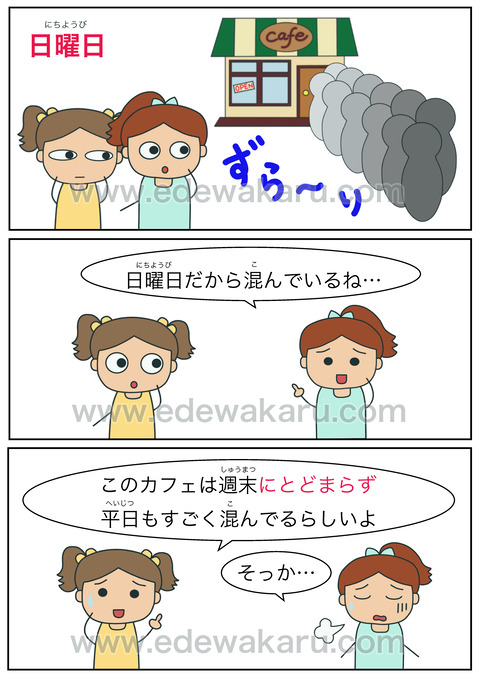
“AにとどまらずB” is a sentence pattern meaning “not only A, but also B.” It is used when you want to say that something extends beyond A to the broader scope of B. Therefore, “B” is a broader scope than “A,” or something to a greater degree.
[Examples]
① I hear this café is very crowded on weekdays too, not just weekends.
→ It is more remarkable for it to be crowded on weekdays than on weekends.
② She is a singer who is active around the world, not just in Japan.
→ [The world] is a wider scope than [Japan].
③ That company’s cosmetics are bought by men too, not just women.
→ This extends beyond [women] to the broader group of [men].
④ Japanese anime is popular overseas too, not just in Japan.
→ [Overseas] is a wider scope than [within Japan].
⑤ He works not only as an actor, but also as a singer and model.
→ This extends beyond [acting] to the broader range of [singing and modeling].
Remember that “〜にとどまらず” means “not only..., but across a broader range than that.” 😀
In context 5 examples
このカフェは、週末にとどまらず平日もすごく混んでるらしいよ
→週末だけでなく、さらに平日も混んでるらしいよI hear this café is very crowded on weekdays too, not just on weekends. → I hear it’s crowded not only on weekends, but also on weekdays.
彼女は日本にとどまらず、世界で活躍している歌手です
→日本だけでなく、世界で活躍している歌手ですShe is a singer who is active around the world, not just in Japan. → She is a singer active not only in Japan, but throughout the world.
あの会社の化粧品は、女性にとどまらず男性にも買われている
→女性にだけでなく、男性にも買われているThat company’s cosmetics are bought by men too, not just women. → They’re bought not only by women, but also by men.
日本のアニメは、国内にとどまらず海外でも人気がある
→国内だけでなく、さらに海外でも人気があるJapanese anime is popular overseas too, not just in Japan. → It’s popular not only in Japan, but also overseas.
彼は俳優にとどまらず、歌手やモデルとしても活動している
→俳優だけでなく、さらに歌手やモデルとしても活動しているHe works not only as an actor, but also as a singer and model. → He works not only as an actor, but also as a singer and model.
Read the original source text
Meaning
〜だけでなく、さらに〜も
How to use it
動詞[普通形]+にとどまらず
名詞[辞書形]+にとどまらず
Explanation
「AにとどまらずB」は「Aだけでなく、さらにBも」という意味を表す文型です。「Aだけでなく、さらに範囲が広いBにまで及んでいる」と言いたい時に使いますので、「B」には「A」よりも広い範囲のことや、程度がもっとすごいものが入ります。
[例]
①このカフェは、週末
にとどまらず
平日もすごく混んでるらしいよ
→【週末】より【平日】が混んでいる方が程度がすごい
②彼女は日本
にとどまらず、世界で活躍している歌手です
→【日本】より【世界】の方が広い範囲
③あの会社の化粧品は、女性
にとどまらず
男性にも買われている
→【女性】だけではなく【男性】にまで広がる広い範囲
④日本のアニメは、国内
にとどまらず
海外でも人気がある
→【国内】より【海外】の方が広い範囲
⑤彼は俳優
にとどまらず、歌手やモデルとしても活動している
→【俳優】だけでなく【歌手・モデル】という広い範囲
「〜にとどまらず」は、「〜だけでなく、それよりもっと広い範囲で〜」という意味だと覚えておきましょう😀
日本語文型辞典
Meaning
Basic information
Nにとどまらず
Follows a noun referring to a region, period of time, etc., and means “not confined to that range” or “not only that.”
Examples
① The trend spread beyond the large cities to the provinces as well.
② The drought was not limited to that year; it continued for the following three years, too.
③ The damage caused by air pollution spread beyond the elderly and young children, reaching even young adults.
Read the original source text
Meaning
基本情報Nにとどまらず説明地域や時間などを表す名詞を受けて、「その範囲には収まらず」「それだけでなく」という意味を表す。例文① その流行は大都市にとどまらず地方にも広がっていった。② 干ばつはその年だけにとどまらず、その後3年間も続いた。③ 大気汚染による被害は、老人や幼い子供達にとどまらず、若者達にまで広がった。
日本語文型辞典 英語版
Meaning
【にとどまらず】[Nにとどまらず]
With a noun expressing a region or time, expresses the meaning of “without staying in” or “not only something, but also....”
In context 3 examples
その流行は大都市にとどまらず地方にも広がっていった。
The fad didn’t stop within the big cities but spread to the countryside, too.
干ばつはその年だけにとどまらず、その後3年間も続いた。
The drought hit us not only that year but also the following three years.
大気汚染による被害は、老人や幼い子供達にとどまらず、若者達にまで広がった。
The damage caused by air pollution affected not only the elderly and little children but also young people.
くらべてわかる日本語表現文型辞典
Meaning
It does not stop within the scope of A but extends to B as well. Indicates the strength of influence or momentum.
How to use it
AにとどまらずB
[Noun – ∅] にとどまらず
Explanation
【Contrast 1】
“AばかりかBも” (Meaning 1, p. 277)
“AだけでなくB”
“AばかりかBも” and “AだけでなくBも” have the broad meaning “both A and B” or “A, and moreover B”; A and B may be separate things or part of a sequence. However, “AにとどまらずB” means moving from A to B with momentum, so its range of use is narrower.
○ガス代ばかりか水道代も値上がりするらしい。 — It seems that not only gas bills but also water bills will go up.
×ガス代にとどまらず、水道代も値上がりするらしい。 — It seems that gas bills will go up, and the increase will extend to water bills too.
○最近は忙しくて、土曜日だけでなく日曜日も仕事をしています。 — Lately I’ve been so busy that I work not only on Saturdays but also on Sundays.
×最近は忙しくて、土曜日にとどまらず日曜日も仕事をしています。 — Lately I’ve been so busy that my work extends from Saturday into Sunday.
In context 4 examples
この日本酒は、国内にとどまらず、海外にもファンを増やしている。
This sake is gaining fans not only in Japan but also overseas.
この事件は政界にとどまらず、財界にも飛び火した。
The scandal spread from the political world to the business world as well.
損害額は千万単位にとどまらず、億の位にまでいくといわれている。
The amount of damage is said to reach not just tens of millions but hundreds of millions.
かつての日本では、ゴルフやマージャンが単なる娯楽にとどまらず、仕事上必要な技能だった。
In Japan in the past, golf and mahjong were not mere pastimes but skills necessary for work.
Read the original source text
Meaning
Aの範囲におさまらず、Bにも及ぶ。影響力・勢いの強さを示す。
How to use it
AにとどまらずB
[名詞-∅]にとどまらず
Explanation
【対比1】
「AばかりかBも」(意味1 P.277)
「AだけでなくB」
「AばかりかBも」「AだけでなくBも」は、AもBも、AそのうえBもという広い意味で、AとBは別個のものでも、あるいは続きのあるものでもいいが、「AにとどまらずB」は、勢いにのってAからBに進んでいくという意味を示すため、使用範囲は狭くなる。
○ガス代ばかりか水道代も値上がりするらしい。
×ガス代にとどまらず、水道代も値上がりするらしい。
○最近は忙しくて、土曜日だけでなく日曜日も仕事をしています。
×最近は忙しくて、土曜日にとどまらず日曜日も仕事をしています。
日本語NET JLPT文法解説まとめ
Meaning
“Not only ~”
Used to say that something affects a broader range, not just a narrow one.
How to use it
V (plain form) + にとどまらず
いA + だけにとどまらず
ナAである + にとどまらず
N (である) + にとどまらず
Explanation
not only, but
In context 5 examples
彼のYouTubeはビデオは趣味の程度にとどまらず、編集スキルや話し方などはテレビ番組と変わりません。
His YouTube videos are more than just a hobby; his editing skills and way of speaking are on a par with those of TV programs.
彼女のギターは趣味のレベルにとどまらず、プロも驚くほどの腕前です。
Her guitar playing is more than just a hobby; her skill is enough to amaze even professionals.
彼のアニメや漫画は日本にとどまらず、海外でも多くのファンを増やしている。
His anime and manga have gained many fans not only in Japan but overseas as well.
癌は肺にとどまらず、全身へと転移している。
The cancer has spread beyond the lungs and metastasized throughout the body.
この少女漫画は女性にとどまらず、男性にも人気があります。
This girls' manga is popular with men as well as women.
Read the original source text
Meaning
"〜だけでなく"
その事柄が狭い範囲だけでなく、もっと広い範囲を対象に影響していると言いたいときに使う。
How to use it
V(普通形) + にとどまらず
いA + だけにとどまらず
ナAである + にとどまらず
N(である) + にとどまらず
Explanation
not only, but
毎日のんびり日本語教師
How to use it
Noun + (だけ/のみ)にとどまらず
Verb plain form + (だけ)にとどまらず
い-adjective + だけにとどまらず
な-adjective stem + な/である + だけにとどまらず
Explanation
When attached to a noun indicating a scope such as time or place, this expresses that the effect extends beyond that scope.
When attached to something other than a noun, it can also express addition, as in examples (7) and (8): in addition to what was stated in the preceding clause, something further or beyond that is stated in the following clause.
It can freely be rephrased as 「~だけでなく」, 「~のみならず」, or 「~ばかりでなく」.
Notes
Similar grammar: 「【N3 Grammar】~だけでなくて/だけじゃなくて」
Similar grammar: 「【N3 Grammar】~ばかりでなくて/ばかりじゃなくて」
Similar grammar: 「【N2 Grammar】~のみならず」
Comparison of similar grammar
~とどまらず
Emphasizes that the effect extends beyond the scope
~だけでなく
Conversational
~ばかりでなく
Written language
~のみならず
Rather formal written language
In context 8 examples
彼女はアイドル活動だけにとどまらず、作家活動までしている。
She does more than idol activities; she is also active as a writer.
癌の転移は肺にとどまらず、全身に及んでいる。
The cancer has spread not only to the lungs but throughout the body.
津波の被害は海岸部だけにとどまらず、内陸の広い地域にまで達した。
The tsunami damage was not confined to the coastal areas; it reached as far as a wide area inland.
不審な飛行物体の目撃情報は、市内にとどまらず、数十キロ離れた街でも確認された。
Reports of sightings of suspicious flying objects were confirmed not only in the city but also in towns several dozen kilometers away.
雨だけにとどまらず、雷まで鳴り始めている。
Not only is it raining, but thunder has even started rumbling.
彼はアメリカ国内にとどまらず、世界中で評価されている。
He is acclaimed not only in the United States but around the world.
彼女は可愛いだけにとどまらず、愛嬌もある。
She is not only cute, but also charming.
夢や目標は思うだけにとどまらず、口に出して言ってみると良い。
It's good not to stop at just thinking about your dreams and goals, but to try saying them out loud.
Read the original source text
How to use it
名詞+(だけ/のみ)にとどまらず
動詞普通形+(だけ)にとどまらず
い形容詞+だけにとどまらず
な形容詞語幹+な/である+だけにとどまらず
Explanation
時間や場所などの範囲を表す名詞に接続して、その範囲外にも影響が及んでいることを表します。
また、名詞以外に接続する場合は、例文(7)(8)のように、前項で述べたものに加え、更にそれ以上のことを後項で述べる累加・添加の用法もあります。
「~だけでなく」「~のみならず」「~ばかりでなく」に自由に言い換えることができます。
Notes
似ている文法「【N3文法】~だけでなくて/だけじゃなくて」
似ている文法「【N3文法】~ばかりでなくて/ばかりじゃなくて」
似ている文法「【N2文法】~のみならず」
似ている文法の比較
~とどまらず
範囲外に影響が及ぶことを強調
~だけでなく
話し言葉
~ばかりでなく
書き言葉
~のみならず
硬めの書き言葉
NINJAL 日本語文型データベース
Meaning
Used to say that something does not remain within the limited scope of “~” but extends to a wider scope. It is also used to say that there is more in addition to “~.”
How to use it
V plain form + にとどまらず
i-A plain form + にとどまらず
na-A plain form + にとどまらず (however, “na-Aだ” → “na-Aである + にとどまらず”)
Nにとどまらず・N plain form + にとどまらず (however, “Nだ” → “N + にとどまらず・Nである + にとどまらず”)
Notes
“~” is followed by something mentioned in the context or something that is easy to anticipate in that situation. After “~にとどまらず,” there is a clause expressing something that extends beyond “~,” a more advanced state than “~,” or another thing that is harder to anticipate than “~.”
“も、さえ、まで” are often attached to words expressing something more advanced or a different thing. They are not attached to words expressing a wider scope.
In context 21 examples
薬物は自身の心身の健康に害を及ぼすにとどまらず、犯罪や事故といった社会的問題を引き起こすものである。
Drugs not only harm one’s physical and mental health, but also cause social problems such as crime and accidents.
不景気で失職が増えているにとどまらず倒産も相次いでいる。
Not only are more people losing their jobs because of the recession, but bankruptcies are also occurring one after another.
彼はリーダーの資格があると言えるのか。判断力がないにとどまらず誠意に欠けているではないか。
Can he really be said to be qualified as a leader? He not only lacks judgment, but also lacks sincerity.
そのテロ事件は、人々に大きな衝撃を与えたにとどまらず、その後の国家間の外交にも多大な影響を及ぼした。
The terrorist incident not only shocked people greatly, but also had a major impact on diplomacy between countries afterward.
彼は時の権力に屈しなかったにとどまらず、たぐいまれな指導力で民衆を自由平等運動へと導いた。
He not only refused to yield to the powers of the day, but also led the people into the movement for freedom and equality with his extraordinary leadership.
ここから見える山々の景色はただ美しいにとどまらず、神々しささえ感じさせる。
The mountain scenery visible from here is not merely beautiful; it even evokes a sense of the divine.
あの人が雑誌に投稿した文章はいい加減な点が多いにとどまらず、内容もつまらなかった。
The article that person submitted to the magazine not only had many careless points, but was also uninteresting in content.
半世紀前、この町の産業は非常に乏しかったにとどまらず、先行きの見通しもなかった。
Half a century ago, this town not only had very little industry, but also had no prospects for the future.
その法改正は、好ましくなかったにとどまらず、危険でもあった。しかし、誰もそれを阻むことができなかった。
The legal amendment was not only undesirable, but also dangerous. However, no one could stop it.
駅前の再開発計画は白紙に戻った。計画自体の見通しが明るくなかったにとどまらず、準備委員会のメンバーがどんどん辞めていくという事態にもなっていたのである。
The redevelopment plan for the area in front of the station was scrapped. The plan itself not only had a dim outlook, but the situation had also reached the point where members of the preparatory committee were quitting one after another.
市長の答弁は無責任であるにとどまらず、住民の要求を無視したもののように感じられた。
The mayor’s response seemed not only irresponsible, but also to ignore the residents’ demands.
その案は内容が生産的でないにとどまらず、一時的な打開案だという感が否めない。
The proposal was not only unproductive in content; it was also undeniably a temporary stopgap measure.
田中氏の講演会で、聴衆は友好的だったにとどまらず、心から彼を崇拝している態度を見せた。
At Mr. Tanaka’s lecture, the audience was not only friendly, but also showed that they sincerely admired him.
企画書は一部の計算が正確ではなかったにとどまらず、そもそも予算額が間違っていた。
Not only were some of the calculations in the proposal inaccurate, but the budget amount itself was wrong to begin with.
今や日本にとどまらず、世界中の研究者たちがその研究成果に注目している。
Researchers around the world, not just in Japan, are now paying attention to the results of that research.
このアニメは子どもにとどまらず、大人にも人気がある。
This anime is popular not only with children but also with adults.
A組の「あいさつ運動」の取り組みはクラス内にとどまらず、学校全体にいい影響を与えた。
Class A’s “Greeting Campaign” had an influence for the better not only within the class, but throughout the entire school.
山下さんのシャンソンは今や趣味にとどまらず、月1回のコンサートをするまでになった。
Yamashita’s chanson singing is now more than a hobby; it has reached the point where he gives a concert once a month.
小林氏はこのオーケストラの指揮者であるにとどまらず、監査役でもある。
Mr. Kobayashi is not only the conductor of this orchestra, but also a member of its audit committee.
子どもの万引きは一過的な罪であるにとどまらず、その後の人格形成にまで大きく影響する。
Shoplifting by children is not merely a temporary offense; it can also have a major effect on their character development later on.
この映画は不評だったにとどまらず、多くの倫理上の議論を巻き起こした。
This film was not only poorly received, but also sparked many ethical debates.
Read the original source text
Meaning
ある事柄が~という限られた範囲に収まらないで、もっと広い範囲にまで及ぶと言いたいときに使います。また、~の他にもあると言いたいときにも使います。
How to use it
V普通形+にとどまらず
i-A普通形+にとどまらず
na-A普通形+にとどまらず(ただし、「na-Aだ」→「na-Aである+にとどまらず」)
Nにとどまらず・N普通形+にとどまらず(ただし、「Nだ」→「N+にとどまらず・Nである+にとどまらず」)
Notes
「~」には、文脈にある事柄や、その場面で予想しやすい事柄がきます。「~にとどまらず」の後には、「~」より広い範囲や「~」より進んだ状態、「〜」より予想しにくい別の事柄を表す文がきます。
より程度の進んだ事柄、別の事柄を表す言葉には「も、さえ、まで」をつけることが多いです。より広い範囲を表す言葉にはつけません。
IMABI
Addition
Read this IMABI lesson ↗Explanation
Addition: ~に加えて, ~にとどまらず, ~もさることながら, ~はおろか, ~はもちろん, ~はもとより, ~ともあれ
When a speaker feels obligated to mention yet another thing into the mix, that is usually done so with negative connotation, and it is this that will be the theme of this lesson.
~に加えて
The transitive verb 加える roughly translates to “to add,” but it may also be translated as “to count (someone) in,” “to deal (damage),” “or even “to gather (speed).”
1. 料理に胡椒こしょうは一つまみも加える必要はない。
There is no need to add a pinch of pepper to a dish.
2. お茶に砂糖を加える。
To mix sugar in the tea.
3. 圧力を加える。
To add pressure.
咥える should not, however, be confused with the homophonous transitive verb 咥える・銜える, which means “to put in one’s mouth,” although they are etymologically tied.
4. 子供は指を銜くわえる嫌いがある。
Children have the tendency to have their fingers in their mouth.
Perhaps the most important use of this verb is its appearance in the phrase ~に加えて meaning “in addition to.” It is used a lot in enumerating negative situations.
5. 彼女は日本語に加えて、英語もあまり分からないみたいだね。
In addition to Japanese, it looks like she barely understands English.
6. イギリスに加えて、フランスもドイツも多文化主義の非を鳴らしています。
In addition to England, France and Germany are also denouncing multiculturalism.
7. そのことに加えて、彼は自分の名前を忘れたよ!
In addition to that, he also forgot his own name!
8. 5日のニューヨーク株式市場かぶしきしじょうは、東京市場で株価が大幅おおはばに値下がりしたことに加えて、アメリカが景気を下支したざさえするために行っている量的緩和りょうてきかんわの縮小しゅくしょう時期など、アメリカの金融きんゆう政策に対する不安から幅広い銘柄めいがらに売り注文が広がりました。
As for the New York Stock Exchange on the fifth, selling orders have spread in a wide range of brands from worries towards American financial policies such as the quantitative easing curtailment period America is carrying out in order to backup the economy in addition to the large drop in prices due to the Tokyo Exchange.
From NHK.
~にとどまらず
The speech modal ~にとどまらず attaches to nouns which can be perceived as some sort of parameter/level/stage with which the following clause indicates an extension of said parameter.
10. マスメディアによる情報というものは、今や一国にとどまらず、世界中に伝わる。
Information by the media doesn’t stay in one country now; it travels the world.
11. 農作物は、台風に襲われた直後にとどまらず、一年中その影響を受ける。
Crops don’t just receive the effects directly after being hit by a typhoon; they feel the impact throughout the year.
12. 彼女は成功にとどまらず、社会貢献に尽力した。
She not only stopped at success, but she also labored as a contribution to society.
Though ~にとどまらず usually attaches itself to nouns, it can on occasion follow the 連体形 of verbs, but in doing so, it is not used with static verbs, as such verbs do not agree with the concept of extending parameters.
13. 一人の人間の明るさは、場を明るくするにとどまらず、周囲の人々に心身の活力をも与えるものである。
The brightness of a person not only brightens up the area, but also it gives energy to the hearts and minds of the surrounding people.
14. 更に執刀した岡山大学病院の大藤剛宏医師は手術後の記者会見で「中葉を使った移植は男の子1人を助けるにとどまらず、これまで助けることができなかった子どもたちに光が当たるという意義がある」と話しました。
In addition, Dc. Oto Takahiro of Okayama University Hospital who did the surgery in a press conference afterwards said that “the transplant using the middle lobe [of the lung] does not just save this one boy, but it gives light to other children that have not been able to be helped till now”.
From the NHK article 『生体肺移植の男児 容体安定』 on 2013年7月2日
When used with adjectives/adjectival noun predicates, the nature of the situation must be in some state of transition to account for an extension of the parameter being described to remain grammatical. So, although adjectival expressions may literally be static by definition, they can be implemented in dynamic circumstances.
As this pattern follows the 連体形, but because it is also generally restricted to rather stiff written language, we can expect it to follow the である-連体形 for adjectival nouns, but as for adjectives1, we find that the particle だけ (only) is placed in between the adjective (though still in the 連体形) and ~に留まらず.
15. あの法令は単に違憲であるにとどまらず、ネットのおかげで実効性も失われて久しい。
That ordinance is not only simply unconstitutional, but thanks to the Internet, it has lost its effectiveness for quite some time.
16. 健康に良いだけにとどまらず、シジミは旨味成分もたくさん含まれています。
Freshwater clams are not just good for your health, but they also contain lots of umami components.
Though not grammatically necessary and in some sense redundant, the particle だけ can generally be seen used with this pattern in general, resulting in ~だけにとどまらず.
17. 弊社は社会貢献だけにとどまらず、様々な活動を展開しております。
Our company is not limiting itself to just contributing to society but is expanding its reach into all sorts of activities.
Orthography Note: Though not typically written in Kanji, its Kanji spelled is ~に留まらず.
~もさることながら
The pattern ~もさることながら follows nouns deemed to obviously be of a certain quality (most often positive), and that the following clause adds to the worth/validity of said statement. This, in turn, is translated into English as “it goes without saying that…”
18. 中華料理ちゅうかりょうりは味あじもさることながら、健康けんこうにいいですよ。
It goes without saying that Chinese food is tasty, but it’s also good for you.
19. 彼女は人柄もさることながら、その頭の働きの良さで周囲の人をぐいぐいと引っ張っていくんですよ。
Her personality goes without saying, and her great mind pulls those around towards her.
Orthography Note: The full Kanji spelling of this pattern is 然る事乍ら.
Grammar Note: 然る is an old-fashioned 連体詞 derived from the Classical Japanese verb 然り, which has the meaning of “to be said/some thing” in a very vague sense, and if it were directly translated into something in Modern Japanese, it would be closest to そういう or とある, which results in it directly equating to “such.” Given how affirming the noun-predicate is, we see that the particle ながら attaches itself to state that the two clauses of the sentence are concurrently in agreeance to that effect.
~はもちろん・もとより・おろか
~はもちろん(のこと)is used when juxtaposing two predicates as being “as matter of fact.” The first clause which it attaches to must be a nominal(ized) phrase, but what follows after it is typically a verbal/adjectival which affirms the first predicate.
In the examples that follow, we can see how the literal meaning of もちろん, that being “of course,” can be taken literally here. To truly understand how this pattern works regarding nuance, though, let’s posit that the first clause is X and the second clause is Y. In the mind of the speaker, X is mentioned first as it has the highest relevance or the highest recognition of being obvious, whereas Y adds to what is obvious or fully expected given knowledge of the situation. Y may at times be far more impressive than Y, but the reason why X is mentioned first is because it has the most relevance.
Speech Style Note: While ~はもちろん is largely used in the written language, whenever it is utilized in the spoken language, it is often rendered as ~もちろんのこと, which grammatically allows for said dependent clause to more clearly function as a noun-predicate that is more parallel in structure to predicate Y.
20. 彼は英語はもちろん、スペイン語も韓国語もできます。
Not to mention English, he can also speak Spanish and Korean.
21 あの子は書くのはもちろん、読むこともできない。
That kid can’t even read, let alone write.
22. 彼は、母語はもちろん(のこと)、他にも7つの言語も話せますよ。
Not only his native language, but he can also speak seven other languages.
23. 彼は修士を得るのはもちろん、入学さえできない。
He can’t even enter college, let alone receive a master’s degree.
Now, whenever Y is not something that cannot be deemed obvious given the situation at hand, ~はもちろん becomes ungrammatical, and it would need to be replaced with something broader such as ~だけでなく.
24. この米には、もみ{だけでなく 〇・はもちろん X}、砂まで入ってるのよ。
Not only is there husks in this rice, there’s even sand in it.
While it may be intrinsically obvious that someone who excels in his main language does indeed have mastery in other languages like in Ex. 22, there is nothing intrinsic about rice being contaminated with all sorts of things.
~はもとより
The nuance spin that ~はもとより provides is that it quality X is “principally” so. Meaning, based on principle, X is that standard which is both most pertinent and obvious in nature, and then Y builds onto that execution of standard. Just as with ~はもちろん(のこと), X is a nominal(ized) phrase, while Y is usually a verbal/adjectival predicate which expands on that notion.
25. 彼女は料理はもとより食器も洗ってくれます。
She not only cooks, but she also washes the dishes.
26. 彼は英語はもとより、スペイン語も韓国語もできます。
Not to mention English, he can also speak Spanish and Korean.
27. 低賃金、劣悪な労働条件、一方的な首切りなどの経済・労働問題はもとより、各種の人道的問題までも引き起こしている。
They are not only suffering from low wages, cases of poor working condition, and economic and labor problems such as one-sided layoffs, they are also troubled to the extent of various forms of discrimination.
28. 地方ごとに、味はもとより、料理の仕方も違ってきますね。
With each region, not to mention flavor, but even cooking methods differ, don’t they?
~はおろか
The word おろか indicates that the noun in the dependent clause X is negligible in how bad Y is obviously true.
29. 一ドルはおろか一セントも持ってないよ。
I don’t have a cent, let alone a dollar!
30. 父はおろか、僕の犬でさえ反対したようだ。
Not to mention my father, even my dog seemed to object.
31. 僕はバイオリンはおろか、ギターも弾けないんだ。
I can’t even play the guitar, much less a violet.
32. あの子は話すのはおろか、足も動かせません。
That child can’t even move her legs, let alone speak.
漢字 Notes: The Kanji spellings of these phrases are as follows:
①おろか → 疎か
②もちろん → 勿論
③もとより →【元・固・素】より.
~ともあれ
~ともあれ is an adverbial phrase that means “never mind/putting aside.” It is also seen in 何はともあれ meaning “in any case.” Grammatically speaking, あれ is the 已然形 of the existential verb ある, which means that as a whole, this adverbial phrase pinpoints the noun in said dependent clause X is already obviously an established issue, but that Y is the ‘real’ problem at hand.
33. 中国語はともあれ、問題は日本語の勉強なんだぞ。
Never mind Chinese, the problem is my Japanese studies!
34. 何はともあれ、後でしよう。
In any case, let’s do (this) later.
In older language, the き-連体形 of adjectives does become valid with this grammar structure.
i. 良き素材で醸されたお酒は香味や余韻の良きにとどまらず、飲み手にはその格に相応しい陶酔感をもたらします。
Sake brewed with excellent ingredients not only has superb flavor and aftertaste, as it provides a level of intoxication befitting of its worth to the consumer. ↩︎
In context 32 examples
料理に胡椒こしょうは一つまみも加える必要はない。
There is no need to add a pinch of pepper to a dish.
お茶に砂糖を加える。
To mix sugar in the tea.
圧力を加える。
To add pressure.
子供は指を銜くわえる嫌いがある。
Children have the tendency to have their fingers in their mouth.
彼女は日本語に加えて、英語もあまり分からないみたいだね。
In addition to Japanese, it looks like she barely understands English.
イギリスに加えて、フランスもドイツも多文化主義の非を鳴らしています。
In addition to England, France and Germany are also denouncing multiculturalism.
そのことに加えて、彼は自分の名前を忘れたよ!
In addition to that, he also forgot his own name!
5日のニューヨーク株式市場かぶしきしじょうは、東京市場で株価が大幅おおはばに値下がりしたことに加えて、アメリカが景気を下支したざさえするために行っている量的緩和りょうてきかんわの縮小しゅくしょう時期など、アメリカの金融きんゆう政策に対する不安から幅広い銘柄めいがらに売り注文が広がりました。
As for the New York Stock Exchange on the fifth, selling orders have spread in a wide range of brands from worries towards American financial policies such as the quantitative easing curtailment period America is carrying out in order to backup the economy in addition to the large drop in prices due to the Tokyo Exchange.
マスメディアによる情報というものは、今や一国にとどまらず、世界中に伝わる。
Information by the media doesn’t stay in one country now; it travels the world.
農作物は、台風に襲われた直後にとどまらず、一年中その影響を受ける。
Crops don’t just receive the effects directly after being hit by a typhoon; they feel the impact throughout the year.
彼女は成功にとどまらず、社会貢献に尽力した。
She not only stopped at success, but she also labored as a contribution to society.
一人の人間の明るさは、場を明るくするにとどまらず、周囲の人々に心身の活力をも与えるものである。
The brightness of a person not only brightens up the area, but also it gives energy to the hearts and minds of the surrounding people.
更に執刀した岡山大学病院の大藤剛宏医師は手術後の記者会見で「中葉を使った移植は男の子1人を助けるにとどまらず、これまで助けることができなかった子どもたちに光が当たるという意義がある」と話しました。
In addition, Dc. Oto Takahiro of Okayama University Hospital who did the surgery in a press conference afterwards said that “the transplant using the middle lobe [of the lung] does not just save this one boy, but it gives light to other children that have not been able to be helped till now”.
あの法令は単に違憲であるにとどまらず、ネットのおかげで実効性も失われて久しい。
That ordinance is not only simply unconstitutional, but thanks to the Internet, it has lost its effectiveness for quite some time.
健康に良いだけにとどまらず、シジミは旨味成分もたくさん含まれています。
Freshwater clams are not just good for your health, but they also contain lots of umami components.
弊社は社会貢献だけにとどまらず、様々な活動を展開しております。
Our company is not limiting itself to just contributing to society but is expanding its reach into all sorts of activities.
中華料理ちゅうかりょうりは味あじもさることながら、健康けんこうにいいですよ。
It goes without saying that Chinese food is tasty, but it’s also good for you.
彼女は人柄もさることながら、その頭の働きの良さで周囲の人をぐいぐいと引っ張っていくんですよ。
Her personality goes without saying, and her great mind pulls those around towards her.
彼は英語はもちろん、スペイン語も韓国語もできます。
Not to mention English, he can also speak Spanish and Korean.
彼は、母語はもちろん(のこと)、他にも7つの言語も話せますよ。
Not only his native language, but he can also speak seven other languages.
彼は修士を得るのはもちろん、入学さえできない。
He can’t even enter college, let alone receive a master’s degree.
この米には、もみ{だけでなく 〇・はもちろん X}、砂まで入ってるのよ。
Not only is there husks in this rice, there’s even sand in it.
彼女は料理はもとより食器も洗ってくれます。
She not only cooks, but she also washes the dishes.
彼は英語はもとより、スペイン語も韓国語もできます。
Not to mention English, he can also speak Spanish and Korean.
低賃金、劣悪な労働条件、一方的な首切りなどの経済・労働問題はもとより、各種の人道的問題までも引き起こしている。
They are not only suffering from low wages, cases of poor working condition, and economic and labor problems such as one-sided layoffs, they are also troubled to the extent of various forms of discrimination.
地方ごとに、味はもとより、料理の仕方も違ってきますね。
With each region, not to mention flavor, but even cooking methods differ, don’t they?
一ドルはおろか一セントも持ってないよ。
I don’t have a cent, let alone a dollar!
父はおろか、僕の犬でさえ反対したようだ。
Not to mention my father, even my dog seemed to object.
僕はバイオリンはおろか、ギターも弾けないんだ。
I can’t even play the guitar, much less a violet.
あの子は話すのはおろか、足も動かせません。
That child can’t even move her legs, let alone speak.
中国語はともあれ、問題は日本語の勉強なんだぞ。
Never mind Chinese, the problem is my Japanese studies!
何はともあれ、後でしよう。
In any case, let’s do (this) later.