くらべてわかる日本語表現文型辞典
Meaning
Meaning 1: A states the topic, and B gives an example of it. Indirectly expresses that A is B.
Meaning 2: Limits A’s role and gives an evaluation of it in B.
Meaning 3: At A’s level, one can say B or give the evaluation B.
Meaning 4: States in B an opinion from the standpoint of A.
How to use it
A としては B (A として B)
[Noun — ∅] としては
Explanation
【Contrast 2】
「A にしては B」(Meaning 1, p. 233)
【Contrast 3】
「A なりに B」(Meaning 1, p. 205)
「A なりに B」means B when evaluated within the bounds of A, and B is unlikely to carry a negative evaluation. 「A としては B」means B beyond the bounds of A, and B can receive either a positive or a negative evaluation.
○ベテランの判断としては、甘すぎた。
×ベテランの判断なりに、甘すぎた。
○1年生としては、立派な作文だ。(1年生以上の作文力がある)
○1年生なりに、立派な作文だ。(1年生の作文の中では立派だ)
「A 割に B」(Meaning 2, p. 333)
「A にしては B」(Meaning 1, p. 233)
【Contrast 4】
「A なりに B」(Meaning 2, p. 205)
In context 16 examples
この地方の産物としてはりんごが有名だ。
As a local product, apples are famous in this region.
お見舞いに喜ばれるものとして、くだものや雑誌がある。
Fruit and magazines are examples of things that make good get-well gifts.
政府が今すぐ着手すべきこととしては、経済復興が考えられる。
Economic recovery is one thing the government should tackle immediately.
君が読むべき論文としては、これがいいだろう。
This would be a good paper for you to read.
これは論文としては、構成がいまひとつだ。
As a research paper, this one’s structure leaves something to be desired.
俳句は定型詩としては、もっとも短いものだ。
Haiku is the shortest form of fixed verse.
彼は日本人としては背が高い。
He is tall for a Japanese person.
うちの犬は番犬として役に立たない。
Our dog is no use as a guard dog.
初めての取り引きとしては成功だろう。
It would count as a success for a first business deal.
彼は新人としてはよくやっていた。
He did well for a newcomer.
ベテランの判断として甘すぎたのではないか。
Wasn’t that too lenient for a veteran’s judgment?
1年生としては立派な作文だ。
That is an excellent essay for a first-year student.
卒業生として、後輩の活躍に励まされることが多い。
As a graduate, I am often encouraged by the achievements of those who came after me.
社長としては、田中さんの行いは許せなかったのだろう。
From the president’s standpoint, Tanaka’s conduct was probably unforgivable.
政府としては、十分誠意を尽くすつもりだ。
The government intends to make a full and sincere effort.
親としては、子どもに期待をかけるのは当然だ。
As a parent, it is only natural to have expectations of one’s children.
Read the original source text
Meaning
意味1:Aで主題を、Bでその例示を述べる。AはBだと婉曲的に表す。
意味2:Aの役割を限定し、Bでその評価を述べる。
意味3:Aのレベルなら、Bと言ってもいい、Bという評価が下せる。
意味4:Aの立場からの意見をBで述べる。
How to use it
AとしてはB(AとしてB)
[名詞-∅]としては
Explanation
【対比2】
「AにしてはB」(意味1 P.233)
【対比3】
「AなりにB」(意味1 P.205)
「AなりにB」はAの枠の中で評価した場合Bだという意味で、Bにマイナス評価はつきにくい。「AとしてはB」はAの枠を越えBだという意味で、Bはプラス・マイナス両評価が可能。
○ベテランの判断としては、甘すぎた。
×ベテランの判断なりに、甘すぎた。
○1年生としては、立派な作文だ。(1年生以上の作文力がある)
○1年生なりに、立派な作文だ。(1年生の作文の中では立派だ)
「A割にB」(意味2 P.333)
「AにしてはB」(意味1 P.233)
【対比4】
「AなりにB」(意味2 P.205)
DoJG 日本語文法辞典(全集)
Meaning
For
How to use it
Noun | としては | |
| 先生としては | For a teacher |
Explanation
A compound particle which indicates a standard for comparisons.
In context 3 examples
このステーキは日本のステーキとしては安い・安いです。
This steak is inexpensive for Japanese steak.
ジョンソンさんは日本語の一年生としては日本語が上手だ。
Mr. Johnson is good at Japanese for a first-year student (of Japanese).
これは日本のアパートとしては大きい方です。
For a Japanese apartment, this is one of the bigger ones.
日本語文型辞典
Meaning
Basic information: Explanation: Formed by adding 「は」 to the particle 「として」, but 「は」 is not usually omitted in the following uses.
Attaches to a word referring to a person or organization and means “from that position or viewpoint.” Polite forms such as 「…としましては/いたしましては」 may also be used.
Attaches to a noun referring to a person or organization, and is used to state that something has a numerical value or quality that deviates from the standard or average for the group to which they belong. Can be paraphrased as 「…にしては」.
How to use it
Nとしては【position・viewpoint】
Nとしては【deviation from the average】
In context 8 examples
彼としては、辞職する以外に方法がなかったのでしょう。
From his standpoint, he probably had no choice but to resign.
私といたしましては、ご意見に賛成しかねます。
From my standpoint, I cannot agree with your opinion.
吉田さんとしては、ああとしか答えようがなかったのでしょう。
From Mr. Yoshida's standpoint, he probably had no choice but to answer that way.
委員会としては、早急に委員長を選出する必要がある。
The committee needs to elect a chairperson as soon as possible.
父は、日本人としては背の高いほうです。
My father is on the tall side for a Japanese person.
100キロの体重は普通の男性だったらずいぶん重いと思うが、相撲取りとしてはむしろ軽いほうである。
A weight of 100 kilograms would seem quite heavy for an ordinary man, but it's actually on the light side for a sumo wrestler.
大学院を出てすぐ大学に就職できる人は、研究者としては幸運な部類に入る。
For a researcher, someone who can get a university job straight after graduate school is among the lucky ones.
学生数 2000 人というのは大学としてはかなり規模が小さい。
A student body of 2,000 is quite small for a university.
Read the original source text
Meaning
基本情報説明「として」に「は」のついたものだが、以下の用法では、通常「は」は省略されない。
人物や組織を表す言葉に付いて、「その立場・観点から言えば/考えると」という意味を表す。「…としましては/いたしましては」のように、丁寧な形が用いられることもある。
人物や組織を表す名詞に付いて、その属するグループの標準・平均と比べた場合、それからはずれた数値や性質をもっていることを述べる場合に用いる。「…にしては」と言いかえられる。
How to use it
Nとしては【立場・観点】
Nとしては【平均値とのずれ】
絵でわかる日本語
Usage 1
Read this source entry ↗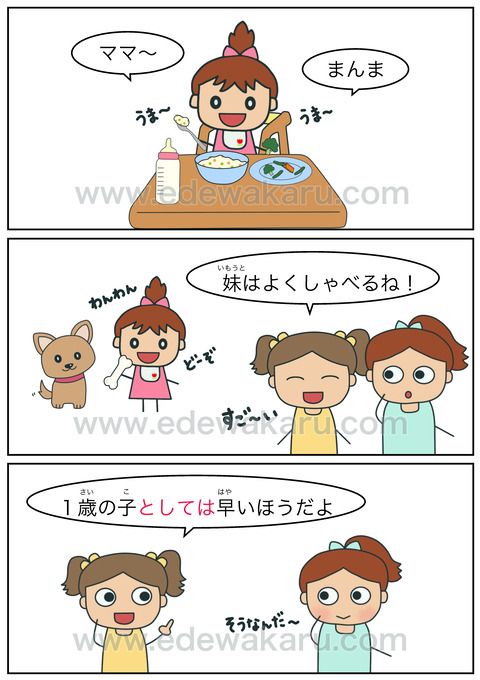
Meaning
... compared with the average for ...
How to use it
Noun [dictionary form] + としては
Explanation
“Aとしては” is a grammar pattern meaning “compared with the average for A.” “A” can be a [person], [organization], [group], etc., and it is used when you want to say “... compared with an average A.” The は in 〜としては cannot be omitted.
[Examples]
① A: My little sister talks a lot! For a one-year-old, she’s quite advanced.
→She talks earlier than an average one-year-old.
② I think he is tall for a Japanese person.
→I think he is taller than the average Japanese person.
③ She is strong for a woman.
→She is stronger than an average woman.
④ That’s big for a three-year-old!
→That’s bigger than an average three-year-old!
⑤ Having 1,000 students is large for a language school, I think.
→I think it’s larger than a typical language school.
In this use, it can be changed to the N2 pattern 〜にしては.
There are several similar patterns, so let’s review them.
[Related patterns]
In context 5 examples
A:妹はよくしゃべるね!1歳の子としては早いほうだよB:そうかな〜
A: My little sister talks a lot! For a one-year-old, she’s quite advanced. B: Do you think so~?
彼は日本人としては背が高いと思う
I think he is tall for a Japanese person.
彼女は、女性としては力が強い
She is strong for a woman.
A:お子さん、おいくつですか?B:3歳になったばかりですA:あら、3歳児としては大きいですね!
A: How old is your child? B: They just turned three. A: Oh, they’re big for a three-year-old!
学生が1000人いるなんて、語学学校(ごがくがっこう)としては大きいと思うよ
I think having 1,000 students is large for a language school.
Read the original source text
Meaning
〜の平均と比べると〜
How to use it
名詞[辞書形]+としては
Explanation
「Aとしては」は「Aの平均と比べると〜」という意味の文型です。「A」には[人][組織] [グループ]などが入り、「普通のAよりも〜」と言いたい時に使われます。「〜としては」の「は」は、省略できません。
[例]
①A:妹はよくしゃべるね!1歳の子
としては
早いほうだよ
→普通の1歳の子より、しゃべるのが早いよ
②彼は日本人
としては
背が高いと思う
→日本人の平均身長よりも高いと思う
③彼女は、女性
としては
力が強い
→普通の女性よりも力が強い
④3歳児
としては
大きいですね!
→普通の3歳児よりも大きいですね!
⑤学生が1000人いるなんて、語学学校
としては
大きいと思うよ
→一般的な語学学校よりも大きいと思うよ
この用法の場合は、N2の文型「〜にしては」にチェンジできます。
似ている文型がいくつかありますので、復習をしておきましょう。
【関連文型】
Usage 2
Read this source entry ↗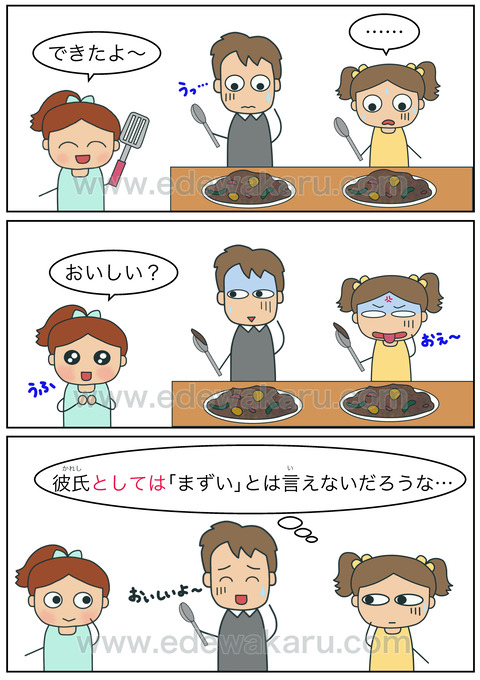
Meaning
from the standpoint of ...
considering it from the perspective of ...
How to use it
Noun [dictionary form] + としては
Explanation
“Aとしては” is a grammar pattern meaning “from the standpoint of A” or “considering it from the perspective of A.” “A” can be a [person], [organization], [group], etc.
The は in 〜としては cannot be omitted.
As in example ⑤, the polite forms are 〜としましては and 〜といたしましては.
[Example]
As for our store, we are unable to accommodate your request.
= As for our store, we are unable to accommodate your request.
The similar pattern 〜として expresses [standing, qualification, or title], so let’s review it.
[Related patterns]
[Similar patterns]
In context 5 examples
彼氏としては「まずい」とは言えないだろうな…
→彼氏の立場から言えば、「まずい」とは言えないだろうな…From the standpoint of a boyfriend, he probably can’t say, “It tastes bad”… →From a boyfriend’s perspective, he probably can’t say, “It tastes bad”…
学校としては、アルバイトをしてもいいとは言えません
→学校は、アルバイトをしてもいいとは言えませんFrom the school’s standpoint, we can’t say that part-time work is allowed. →The school can’t say that part-time work is allowed.
私としては、彼の意見には賛成できません
→私の立場から言うと、彼の意見には賛成できませんFrom my standpoint, I can’t agree with his opinion. →From my standpoint, I can’t agree with his opinion.
彼女としては、会社を辞めるしかなかったんだろう
→彼女の立場から考えると、辞めるしかなかったんだろうFrom her standpoint, she probably had no choice but to quit the company. →Considering her position, she probably had no choice but to quit.
当店としましては、お客様のご要望にはお応えいたしかねます
→当店は、お客様のご要望にはお応えいたしかねますAs for our store, we are unable to accommodate our customers’ requests. →Our store is unable to accommodate our customers’ requests.
Read the original source text
Meaning
〜の立場から言えば
〜の点から考えると
How to use it
名詞[辞書形]+としては
Explanation
「Aとしては」は「Aの立場から言えば」「Aの点から考えると」という意味の文型です。「A」には[人][組織][グループ]などが入ります。
「〜としては」の「は」は省略できません。
また例文⑤のように、丁寧な形は
「〜としましては・〜といたしましては」
になります。
[例]
当店
としましては、お応えいたしかねます
=当店
といたしましては、お応えいたしかねます
類似文型に[立場・資格・名目]を表す「〜として」がありますので、復習しておきましょう。
【関連文型】
【類似文型】
日本語文型辞典 英語版
Meaning
【としては】Formed by attaching the particle は to として. In the usage shown below, は is usually not dropped.
Used with nouns denoting people or organizations and means “speaking from/considering such-and-such a stance or perspective....” Sometimes used in polite forms, such as ...としましては or ...といたしましては.
Attaches to a noun denoting a person or organization. Used to say that the person or organization in question deviates from the standard or average of the group to which it belongs, in terms of numbers or a certain characteristic. Can be replaced by ...にしては.
How to use it
1. Nとしては〈position, viewpoint〉
2. Nとしては〈divergence from the average〉
In context 8 examples
彼としては、辞職する以外に方法がなかったのでしょう。
I can imagine that, from his point of view, there was no other choice but to resign.
私といたしましては、ご意見に賛成しかねます。
If I may speak for myself, I'm afraid I cannot agree with your opinion.
吉田さんとしては、ああとしか答えようがなかったのでしょう。
For Yoshida-san, perhaps that was the only response it was possible to make.
委員会としては、早急に委員長を選出する必要がある。
From the perspective of the committee, it is necessary to select a chairperson as soon as possible.
父は日本人としては背の高いほうです。
My father is tall for a Japanese person.
100 キロの体重は普通の男性だったらずいぶん重いと思うが、相撲取りとしてはむしろ軽いほうである。
I think a body weight of 100 kilograms would be quite heavy for an ordinary man, but for a sumoo wrestler it’s actually rather light.
大学院を出てすぐ大学に就職できる人は、研究者としては幸運な部類に入る。
Anyone who can find a university position right after finishing graduate school would be classed among the luckiest of researchers.
学生数 2000 人というのは大学としてはかなり規模が小さい。
A student body of 2,000 is rather small for a university.
Bunpro Grammar Reference
Meaning
As a, For a, As for
How to use it
Noun + としては
Nuance
A hypothetical grammar point that expresses that going with the general conclusion of (A), (B) is the case.
Explanation
Like として, a grammar point meaning 'as', としては functions as an extension of this, with the は particle merely emphasizing the (A) subject as a stand-alone entity that is about to be compared with something, or that the speaker is assuming the result of (B), from the standpoint of (A). としては may be translated as 'as (A)', or 'for an (A)'. (A) will frequently highlight a person or organization in cases where the speaker is making an assumption from that standpoint.
This structure will be used after nouns, and is a combination of と, the て-form of する, and は. The literal translation is something similar to 'going off that (A) is (A), (B)'.
あの人は先輩としてはいいけど、友達になろうとは思えない。
As a senpai, he is a good person, but I don't think I would want to be friends with him.
あの会社は建築会社としてはホワイトな方だと思う。
I think that company is white as far as construction companies go.
In cases where the noun connected to としては is not a person or organization, the translation will often simply be 'as for'. In these sentences, としては is merely highlighting the broad topic of (A), before the speaker offers their thoughts about what applies to that topic.
アイデアとしてはいいんですが、実際にやるとなるとものすごい費用がかかると思います。
That is good as an idea, but I think it would cost a tremendous amount of money to actually do it.
ピアノは趣味としては好きだけど、ピアノで食べていこうとは思わない。
I like playing the piano as a hobby, but I don't want to make a living out of it.
In contrast to にしては, としては is more frequently used to make broad judgements taking into consideration all aspects of (A), and what would usually be expected of (A), rather than for giving personal opinions.
In context 17 examples
- 概論としては、まだ不十分です。
For an outline, it still needs work.
- あの人は先輩としてはいいけど、友達になろうとは思えない。
As a senpai, he is a good person, but I don't think I would want to be friends with him.
- あの会社は建築会社としてはホワイトな方だと思う。
I think that company is white as far as construction companies go.
- アイデアとしてはいいんですが、実際にやるとなるとものすごい費用がかかると思います。
That is good as an idea, but I think it would cost a tremendous amount of money to actually do it.
- ピアノは趣味としては好きだけど、ピアノで食べていこうとは思わない。
I like playing the piano as a hobby, but I don't want to make a living out of it.
- 晴れ着としては、ぼろすぎないか?
For your Sunday best (clothes), aren't they a little raggedy?
- アイデアとしてはいいが、実現するのは難しい。
As an idea, that is good. However, it will be difficult in practice.
- イメージとしては分かりますが、説明が曖昧すぎます。
As a mental image I understand, but the explanation is too vague.
- 趣味としてはいいが、編物だけで食べていくのは難しい。
As a hobby it is fine, but it is difficult to make a living off of just knitting.
- 素質としては十分だが、まだまだ荒削りだ。
As for its qualities it is adequate, but it is still very much a work in progress.
- いい作品だけど、生け花の先生としてはまだまだだ。
It is a good work, but for a flower arrangement teacher, you still have a ways to go.
- 灯りとしては十分ですが、これで部屋を暖めるのは無理ですね。
As a light (source) it is sufficient, but it is impossible to heat this room with it.
- 君が昨日言っていたこと、案外提案としてはいいのかもしれない。
What you said yesterday is probably good for an unexpected proposal.
- 人気は出てきましたが、売上としてはまだ足りません。
It has become popular, but as for sales, it is still insufficient.
- とてもいい友達だと思うけど、恋人としては考えられない。
I think of him as a very good friend, but I can't think of him as a lover.
- 私にとって彼女の体型は完璧だが、彼女としては、それでは満足できないらしい。
According to me, I think that her body shape is perfect, but for her, it seems that she's not satisfied with it.
- マラソンを完走してみんな「すごい」と言っているけど、叔父さんとしてはタイムに満足していないらしい。
Everyone is saying 'Amazing!' for finishing the marathon, but as for my uncle, it seems that he's not satisfied with the time.
Read the original source text
Meaning
As a, For a, As for
How to use it
Noun + としては
Nuance
A hypothetical grammar point that expresses that going with the general conclusion of (A), (B) is the case.
Explanation
Like として, a grammar point meaning 'as', としては functions as an extension of this, with the は particle merely emphasizing the (A) subject as a stand-alone entity that is about to be compared with something, or that the speaker is assuming the result of (B), from the standpoint of (A). としては may be translated as 'as (A)', or 'for an (A)'. (A) will frequently highlight a person or organization in cases where the speaker is making an assumption from that standpoint.
This structure will be used after nouns, and is a combination of と, the て-form of する, and は. The literal translation is something similar to 'going off that (A) is (A), (B)'.
あの人は先輩としてはいいけど、友達になろうとは思えない。
As a senpai, he is a good person, but I don't think I would want to be friends with him.
あの会社は建築会社としてはホワイトな方だと思う。
I think that company is white as far as construction companies go.
In cases where the noun connected to としては is not a person or organization, the translation will often simply be 'as for'. In these sentences, としては is merely highlighting the broad topic of (A), before the speaker offers their thoughts about what applies to that topic.
アイデアとしてはいいんですが、実際にやるとなるとものすごい費用がかかると思います。
That is good as an idea, but I think it would cost a tremendous amount of money to actually do it.
ピアノは趣味としては好きだけど、ピアノで食べていこうとは思わない。
I like playing the piano as a hobby, but I don't want to make a living out of it.
In contrast to にしては, としては is more frequently used to make broad judgements taking into consideration all aspects of (A), and what would usually be expected of (A), rather than for giving personal opinions.
Nuance · 日本語
(A)の結果からすると、(B)であるということを表す時に使われる仮定表現。
Explanation · 日本語
「としては」は「として」の延長線上にある文法で、助詞の「は」が (A) を主題として強調します。この文法は (A) を何かと比較する場合や、話し手が (A) の視点から仮定して (B) を述べる場合に、「(A) の点から考えると」や「(A) の立場では」というような意味で使われます。(A) には人や組織が入ることがよくありますが、これは文法が話し手がその立場から何かを推測して述べるために使われることが多いためです。
この文法は「と」と「する」のテ形、そして「は」からできており、名詞の後に置いて使われます。この文法には「(A) が (A) であることから判断すると (B)」というようなニュアンスがあります。
あの人は先輩としてはいいけど、友達になろうとは思えない。
As a senpai, he is a good person, but I don't think I would want to be friends with him.
あの会社は建築会社としてはホワイトな方だと思う。
I think that company is white as far as construction companies go.
「としては」の前に人や組織以外の名詞が置かれる場合、この表現は「(A) については」や「(A) に関しては」という意味になります。この用法の「としては」は (A) という広い話題を示し、話し手がその話題についての見解を述べるときに使われます。
アイデアとしてはいいんですが、実際にやるとなるとものすごい費用がかかると思います。
That is good as an idea, but I think it would cost a tremendous amount of money to actually do it.
ピアノは趣味としては好きだけど、ピアノで食べていこうとは思わない。
I like playing the piano as a hobby, but I don't want to make a living out of it.
「にしては」と「としては」を比べると「にしては」は話し手が個人的な意見を述べるときに使われるのに対し、「としては」は (A) のさまざまな側面や一般的にはどのように考えられるかを考慮した上での判断を述べるときに使われます。
IMABI
Standpoint: として(は) VS にとって(は)
Read this IMABI lesson ↗Explanation
Standpoint: として(は) VS にとって(は)
This lesson is about relatively similar speech modals that concern describing standpoint or point of view. Although their English translations cause great confusion to learners, don’t let this beat you.
~として(は)
1. The first uses of ~として that we will study are after nominal phrases. This is something really important to keep in mind because other usages of this will go after other things. So, don’t get things confused in your mind.
The first thing that として is most known for is when it shows “qualification/title”. In other words, it functions like the as in “to carry out one’s duty as an officer”. It can also be used to show what you have something as. This is somewhat causative in nature, but in this sense it is closer to utility. So, just as you can say, “to use a sharp stick as a knife”, you can say 鋭い枝をナイフとして使う. Notice, though, that “as” in English can be used in many more situations than what has just been defined for として.
“(Aは)B としては” is typically just a contrastive usage of として, but it can have nuances more similar to “among” in the sense of ~の場合には. It could also emphasis a side of judgment. For instance, if you were to say 私としては, you are emphasizing your side of opinion.
Particle Note: When used to modify another noun phrase, which is possible as well in English, you must use ~としての.
1. ジョン万次郎まんじろうは、日本人として始めて、アメリカで教育を受けた。
Jon Manjiro was the first person as a Japanese to receive an education in America.
2. 石炭を燃料として使う。
To use coal as fuel.
3. 私一己としては
For my own part/personally
4. 私としては、彼の意見に反対です。
As for me, I don’t agree with his opinion.
5. 最高傑作として作る。X → 最高傑作を作る。
To create as a masterpiece.
6. 最高傑作としての条件 〇
Conditions as a best work masterpiece
7. くそあいつは教師としても無能だぞ。(Vulgar)
That guy is also incompetent as a teacher.
Usage Note: This usage is deemed to be case.
2. Shows complete negation with a word showing unit.
8. 僕は、一日として彼女のことを思わない日はない。
There’s not even a single day that I don’t think about her.
9. 一人として賛成しません。
Not one person can agree.
Usage Note: This usage is deemed to be adverbial.
3. After the 終止形 it means “in assuming that” or “with the reason of”.
10. 話は後でするとして、まず食事にしましょう。
Let’s leave talking for later and eat first.
Usage Note: This usage is deemed to be conjunctive.
Grammar Note: として is a grammaticalized object that should be studied separately from とする. Though its usages derive from it, it has become its own grammar point in its own right. Thus, it should be differentiated from a として from とする used at the end of a dependent clause, in which て would still have a conjunctive function. The として is also not the same as the として found in the 連用形 of タル形容動詞.
11. 堂堂としている。
It’s magnificent. (Grand; impressive)
12. われわれはその実験の結果を基礎として、学会雑誌に発表することになりました。
We had the results of that experiment as our basis and published (the results) in a scientific journal.
In Relation to ~とする
Up to now, there have been several mentions of ~とする. How exactly does this fit with this section? Furthermore, how are you supposed to know what you’re looking at? “AをBとする” is “to make/have A be B” a certain way where と shows the content/substance of a result. ~とする can mean “to presume; to think that; etc.
13. その結果を基礎としている。
To be having the results as the basis.
14. 業としている。
To be pursuing a vocation.
15. 石炭を燃料とする。
To have coal be (used as) fuel.
16. 今は配慮を必要としている。
We need forethought now.
17. 一時として目が離せないよ。
My eyes can leave a single moment.
18. 長官として発言する。
To speak as a general.
19. 初めて会う人やよく知らない人には敬語を使うのが礼儀だとされていますよ。
It is deemed proper etiquette to use Keigo towards people such as those you first meet or don’t know well.
20. 人を殺すのが犯罪(だ)とされていない者はいるのか。
Is there a person that doesn’t deem killing a person a crime?
~としても
~としても is after nominal phrases to mean “even the position of…” or “even if…were to…”.
21. 私としても、この事柄は重要ではないとよく分かります。
As for me, too, I understand well that this matter is not important.
22. 新車を買うとしても、今度もやっぱ(り)黒いのにしよう。
Even if we were to buy a new vehicle, let’s surely get the black one this time.
23. 行けるとしても、少し遅れてしまうかも。
Even if we were able to go, we would end up being a little late.
24. 生まれ変わったとしても、またそんなことをするのか。
Even if I were born again, would such a thing happen again?
~にとって
~にとって, equivalent to “(の立場・たちば)からみて”, means “to/for” and shows someone’s perspective on something. ~にとって may be with は to make a slightly contrasting image or with の attributively. It may be ~にとりまして in polite speech and ~にとっちゃ(あ) in slang.
25. 彼にとっちゃその方がええんだよ。(砕けた)
For him, that way’s better.
26. 初心者にとってはあのクラスは難しい。
That class is difficult to beginners.
27. 人間にとっての事柄ことがら
A circumstance to humans
28. 韓国語を知っている人にとって、日本語は難しくないはずです。
For people who know Korean, Japanese isn’t supposed to be difficult.
29. 核爆弾かくばくだんは世界平和にとっての重大な脅威きょういです。
Nuclear weapons are great threats to world peace.
~として VS ~にとって
Many students often overextend the usages of these two speech modals. Common mistakes include confusing these patterns with topicalization and “although phrases”. As a quick exercise, consider the following sentences and what you should do to fix them.
30a. 彼女は学生として、学校へ行かず、遊んでばかりいるよ。X
30b. 外国人として大変なのは食べ物だと思います。X
30c. 僕にとってその色はあんまり好きじゃない。X
Hopefully you found something wrong with these sentences. The first order of business is to where these speech modals literally come from. ~として comes from the case particle と + the verb する; ~にとって comes from the case particle に + the verb 取る. Once put together, they mark their own unique case function. Thus, some people often call them “compound case particles”.
“Noun + ~として” and “Noun + ~にとって” both show position/point of view, but in the case of the former, it is often used to state an action that one does/did as qualification and/or from a position/standpoint. This may sound confusing, but consider the following.
31. クラスの代表として委員会に出席しました。(Qualification/position)
I attended the committee meeting as the class representative.
32. あなたの医者として、食事の量を減らすよう忠告します。
As your doctor, I advise you to decrease the amount you eat.
On the other hand, ~にとって shows an evaluation or value judgment from the/a standpoint (of someone).
33. 私にとりまして、出張は大変思い出深かったです。
For me, the business trip was very profoundly memorable.
Usage Note: ~にとりまして is normally used when talking to someone much older than you. So, the above sentence would most likely be 私にとって、出張は大変思い出深かったです.
34. これは私にとって忘れられない思い出です。
This is a memory to me that I can’t forget.
35. これはあたしにとってとっても大切なものなんだわ。(Feminine; Emphatic)
This is something very important to me.
With は
は is added to them when raising a circumstance as the topic, emphasis, or show a contrast.
36. 私としては、その考えには賛成いたしかねます。
As for me, I can’t agree to that idea.
37. あんたにとっちゃ朝飯前かもしれんが、俺にとっちゃ大変な仕事なんだよ。(砕けた)
To you it may be trivial, but to me it’s a big job.
Contrast
38. 人{として・にとって]大切なことは何か。
With ~として, the sentence suggests that what’s being important should be done by people whereas ~にとって simply states what’s so, or in this case simply stating a question.
39.
Aさん: A銀行がB銀行と合併がっぺいするそうですよ。
Bさん: へえ。でも、A銀行{としては・にとっては}、そう悪いことではないんじゃないですか。
Aさん: でも、B銀行としては黙って見ているわけにはいかないんじゃないですか。
40.
Aさん: 文部省もんぶしょうとしてはどう考えていますか。
Bさん: 文部省としましては、今回の処置しょちはやむを得ないものと考えております。(謙譲語)
Exercise: Translate the last two passages!
These patterns also differ greatly in what kinds of sentences they’re used in.
~として
Circumstance There is a sentence that shows that something happens, and the sentence after shows an opinion or stance concerning it.
Opinion Used to present one’s opinion and then show an opposite position.
41. 市から感謝状と記念品をいただきました。これは我が家の家宝として大切にしたいです。
I received a letter of thanks and mementos from the city. I would like to treat this as a family treasure in our home.
42. 義務教育の段階で外国語を教えた方がいい。外国語が話せるのは社会人として絶対に必要な教育である。
Foreign language should be taught at the level of mandatory education. Being able to speak a foreign language is absolutely necessary education for a person of society.
~にとって
~にとって~の/ことは~だ/である A very emphatic derivative of the basic form.
In topic sentence After introducing the topic, a concrete explanation follows.
43. 今僕にとって唯一の楽しみになっているのは日本語の勉強です。
What has now become my sole enjoyment is my Japanese studies.
44. 昔の人々の生活にとって、お寺は欠かせないものだった。
The temple was a necessary thing to the lives of the ancient.
Words Used with Them
1. XとしてY
Words that follow Y:
Verbs that describe action: 言う、許す、行動する.
Verbs/adjectives that describe condition: 恥ずかしい、有名だ、知られている.
45. 彼は弁護士としては無能です。
He is no good as a lawyer.
2. XにとってY
Words that follow Y:
Potential expressions: 可能だ、忘れられない.
Adjectives of evaluation: 大切だ、難しい、大変だ.
Adjective + Noun
46. 世界の経済にとって、金融きんゆうを引き締しめるのは好このましくない事態だ。
For the world economy, tightening the money market is not a desirable situation.
In context 50 examples
The first uses of ~として that we will study are after nominal phrases. This is something really important to keep in mind because other usages of this will go after other things. So, don’t get things confused in your mind.
The first uses of ~として that we will study follow nominal phrases. This is important to keep in mind because other uses of this expression follow other things. So, don’t get them mixed up.
ジョン万次郎まんじろうは、日本人として始めて、アメリカで教育を受けた。
Jon Manjiro was the first person as a Japanese to receive an education in America.
石炭を燃料として使う。
To use coal as fuel.
私一己としては
For my own part/personally
私としては、彼の意見に反対です。
As for me, I don’t agree with his opinion.
最高傑作として作る。X → 最高傑作を作る。
To create as a masterpiece.
最高傑作としての条件 〇
Conditions as a best work masterpiece
くそあいつは教師としても無能だぞ。(Vulgar)
That guy is also incompetent as a teacher.
僕は、一日として彼女のことを思わない日はない。
There’s not even a single day that I don’t think about her.
一人として賛成しません。
Not one person can agree.
After the 終止形 it means “in assuming that” or “with the reason of”.
Let’s leave talking for later and eat first.
話は後でするとして、まず食事にしましょう。
Let’s leave talking for later and eat first.
堂堂としている。
It’s magnificent. (Grand; impressive)
われわれはその実験の結果を基礎として、学会雑誌に発表することになりました。
We had the results of that experiment as our basis and published (the results) in a scientific journal.
その結果を基礎としている。
To be having the results as the basis.
業としている。
To be pursuing a vocation.
石炭を燃料とする。
To have coal be (used as) fuel.
今は配慮を必要としている。
We need forethought now.
一時として目が離せないよ。
My eyes can leave a single moment.
長官として発言する。
To speak as a general.
初めて会う人やよく知らない人には敬語を使うのが礼儀だとされていますよ。
It is deemed proper etiquette to use Keigo towards people such as those you first meet or don’t know well.
人を殺すのが犯罪(だ)とされていない者はいるのか。
Is there a person that doesn’t deem killing a person a crime?
私としても、この事柄は重要ではないとよく分かります。
As for me, too, I understand well that this matter is not important.
新車を買うとしても、今度もやっぱ(り)黒いのにしよう。
Even if we were to buy a new vehicle, let’s surely get the black one this time.
行けるとしても、少し遅れてしまうかも。
Even if we were able to go, we would end up being a little late.
生まれ変わったとしても、またそんなことをするのか。
Even if I were born again, would such a thing happen again?
彼にとっちゃその方がええんだよ。(砕けた)
For him, that way’s better.
初心者にとってはあのクラスは難しい。
That class is difficult to beginners.
人間にとっての事柄ことがら
A circumstance to humans
韓国語を知っている人にとって、日本語は難しくないはずです。
For people who know Korean, Japanese isn’t supposed to be difficult.
核爆弾かくばくだんは世界平和にとっての重大な脅威きょういです。
Nuclear weapons are great threats to world peace.
彼女は学生として、学校へ行かず、遊んでばかりいるよ。X
As a student, she doesn’t go to school and just keeps playing. X
外国人として大変なのは食べ物だと思います。X
As a foreigner, I think the difficult thing is food. X
僕にとってその色はあんまり好きじゃない。X
For me, I don’t like that color very much. X
クラスの代表として委員会に出席しました。(Qualification/position)
I attended the committee meeting as the class representative.
あなたの医者として、食事の量を減らすよう忠告します。
As your doctor, I advise you to decrease the amount you eat.
私にとりまして、出張は大変思い出深かったです。
For me, the business trip was very profoundly memorable.
これは私にとって忘れられない思い出です。
This is a memory to me that I can’t forget.
これはあたしにとってとっても大切なものなんだわ。(Feminine; Emphatic)
This is something very important to me.
私としては、その考えには賛成いたしかねます。
As for me, I can’t agree to that idea.
あんたにとっちゃ朝飯前かもしれんが、俺にとっちゃ大変な仕事なんだよ。(砕けた)
To you it may be trivial, but to me it’s a big job.
人{として・にとって]大切なことは何か。
What is important for a person?
市から感謝状と記念品をいただきました。これは我が家の家宝として大切にしたいです。
I received a letter of thanks and mementos from the city. I would like to treat this as a family treasure in our home.
義務教育の段階で外国語を教えた方がいい。外国語が話せるのは社会人として絶対に必要な教育である。
Foreign language should be taught at the level of mandatory education. Being able to speak a foreign language is absolutely necessary education for a person of society.
今僕にとって唯一の楽しみになっているのは日本語の勉強です。
What has now become my sole enjoyment is my Japanese studies.
昔の人々の生活にとって、お寺は欠かせないものだった。
The temple was a necessary thing to the lives of the ancient.
XとしてY
Words that follow Y:
彼は弁護士としては無能です。
He is no good as a lawyer.
XにとってY
Words that follow Y:
世界の経済にとって、金融きんゆうを引き締しめるのは好このましくない事態だ。
For the world economy, tightening the money market is not a desirable situation.
Read the original source text
Explanation
Standpoint: として(は) VS にとって(は)
This lesson is about relatively similar speech modals that concern describing standpoint or point of view. Although their English translations cause great confusion to learners, don’t let this beat you.
~として(は)
1. The first uses of ~として that we will study are after nominal phrases. This is something really important to keep in mind because other usages of this will go after other things. So, don’t get things confused in your mind.
The first thing that として is most known for is when it shows “qualification/title”. In other words, it functions like the as in “to carry out one’s duty as an officer”. It can also be used to show what you have something as. This is somewhat causative in nature, but in this sense it is closer to utility. So, just as you can say, “to use a sharp stick as a knife”, you can say 鋭い枝をナイフとして使う. Notice, though, that “as” in English can be used in many more situations than what has just been defined for として.
“(Aは)B としては” is typically just a contrastive usage of として, but it can have nuances more similar to “among” in the sense of ~の場合には. It could also emphasis a side of judgment. For instance, if you were to say 私としては, you are emphasizing your side of opinion.
Particle Note: When used to modify another noun phrase, which is possible as well in English, you must use ~としての.
1. ジョン万次郎まんじろうは、日本人として始めて、アメリカで教育を受けた。
Jon Manjiro was the first person as a Japanese to receive an education in America.
2. 石炭を燃料として使う。
To use coal as fuel.
3. 私一己としては
For my own part/personally
4. 私としては、彼の意見に反対です。
As for me, I don’t agree with his opinion.
5. 最高傑作として作る。X → 最高傑作を作る。
To create as a masterpiece.
6. 最高傑作としての条件 〇
Conditions as a best work masterpiece
7. くそあいつは教師としても無能だぞ。(Vulgar)
That guy is also incompetent as a teacher.
Usage Note: This usage is deemed to be case.
2. Shows complete negation with a word showing unit.
8. 僕は、一日として彼女のことを思わない日はない。
There’s not even a single day that I don’t think about her.
9. 一人として賛成しません。
Not one person can agree.
Usage Note: This usage is deemed to be adverbial.
3. After the 終止形 it means “in assuming that” or “with the reason of”.
10. 話は後でするとして、まず食事にしましょう。
Let’s leave talking for later and eat first.
Usage Note: This usage is deemed to be conjunctive.
Grammar Note: として is a grammaticalized object that should be studied separately from とする. Though its usages derive from it, it has become its own grammar point in its own right. Thus, it should be differentiated from a として from とする used at the end of a dependent clause, in which て would still have a conjunctive function. The として is also not the same as the として found in the 連用形 of タル形容動詞.
11. 堂堂としている。
It’s magnificent. (Grand; impressive)
12. われわれはその実験の結果を基礎として、学会雑誌に発表することになりました。
We had the results of that experiment as our basis and published (the results) in a scientific journal.
In Relation to ~とする
Up to now, there have been several mentions of ~とする. How exactly does this fit with this section? Furthermore, how are you supposed to know what you’re looking at? “AをBとする” is “to make/have A be B” a certain way where と shows the content/substance of a result. ~とする can mean “to presume; to think that; etc.
13. その結果を基礎としている。
To be having the results as the basis.
14. 業としている。
To be pursuing a vocation.
15. 石炭を燃料とする。
To have coal be (used as) fuel.
16. 今は配慮を必要としている。
We need forethought now.
17. 一時として目が離せないよ。
My eyes can leave a single moment.
18. 長官として発言する。
To speak as a general.
19. 初めて会う人やよく知らない人には敬語を使うのが礼儀だとされていますよ。
It is deemed proper etiquette to use Keigo towards people such as those you first meet or don’t know well.
20. 人を殺すのが犯罪(だ)とされていない者はいるのか。
Is there a person that doesn’t deem killing a person a crime?
~としても
~としても is after nominal phrases to mean “even the position of…” or “even if…were to…”.
21. 私としても、この事柄は重要ではないとよく分かります。
As for me, too, I understand well that this matter is not important.
22. 新車を買うとしても、今度もやっぱ(り)黒いのにしよう。
Even if we were to buy a new vehicle, let’s surely get the black one this time.
23. 行けるとしても、少し遅れてしまうかも。
Even if we were able to go, we would end up being a little late.
24. 生まれ変わったとしても、またそんなことをするのか。
Even if I were born again, would such a thing happen again?
~にとって
~にとって, equivalent to “(の立場・たちば)からみて”, means “to/for” and shows someone’s perspective on something. ~にとって may be with は to make a slightly contrasting image or with の attributively. It may be ~にとりまして in polite speech and ~にとっちゃ(あ) in slang.
25. 彼にとっちゃその方がええんだよ。(砕けた)
For him, that way’s better.
26. 初心者にとってはあのクラスは難しい。
That class is difficult to beginners.
27. 人間にとっての事柄ことがら
A circumstance to humans
28. 韓国語を知っている人にとって、日本語は難しくないはずです。
For people who know Korean, Japanese isn’t supposed to be difficult.
29. 核爆弾かくばくだんは世界平和にとっての重大な脅威きょういです。
Nuclear weapons are great threats to world peace.
~として VS ~にとって
Many students often overextend the usages of these two speech modals. Common mistakes include confusing these patterns with topicalization and “although phrases”. As a quick exercise, consider the following sentences and what you should do to fix them.
30a. 彼女は学生として、学校へ行かず、遊んでばかりいるよ。X
30b. 外国人として大変なのは食べ物だと思います。X
30c. 僕にとってその色はあんまり好きじゃない。X
Hopefully you found something wrong with these sentences. The first order of business is to where these speech modals literally come from. ~として comes from the case particle と + the verb する; ~にとって comes from the case particle に + the verb 取る. Once put together, they mark their own unique case function. Thus, some people often call them “compound case particles”.
“Noun + ~として” and “Noun + ~にとって” both show position/point of view, but in the case of the former, it is often used to state an action that one does/did as qualification and/or from a position/standpoint. This may sound confusing, but consider the following.
31. クラスの代表として委員会に出席しました。(Qualification/position)
I attended the committee meeting as the class representative.
32. あなたの医者として、食事の量を減らすよう忠告します。
As your doctor, I advise you to decrease the amount you eat.
On the other hand, ~にとって shows an evaluation or value judgment from the/a standpoint (of someone).
33. 私にとりまして、出張は大変思い出深かったです。
For me, the business trip was very profoundly memorable.
Usage Note: ~にとりまして is normally used when talking to someone much older than you. So, the above sentence would most likely be 私にとって、出張は大変思い出深かったです.
34. これは私にとって忘れられない思い出です。
This is a memory to me that I can’t forget.
35. これはあたしにとってとっても大切なものなんだわ。(Feminine; Emphatic)
This is something very important to me.
With は
は is added to them when raising a circumstance as the topic, emphasis, or show a contrast.
36. 私としては、その考えには賛成いたしかねます。
As for me, I can’t agree to that idea.
37. あんたにとっちゃ朝飯前かもしれんが、俺にとっちゃ大変な仕事なんだよ。(砕けた)
To you it may be trivial, but to me it’s a big job.
Contrast
38. 人{として・にとって]大切なことは何か。
With ~として, the sentence suggests that what’s being important should be done by people whereas ~にとって simply states what’s so, or in this case simply stating a question.
39.
Aさん: A銀行がB銀行と合併がっぺいするそうですよ。
Bさん: へえ。でも、A銀行{としては・にとっては}、そう悪いことではないんじゃないですか。
Aさん: でも、B銀行としては黙って見ているわけにはいかないんじゃないですか。
40.
Aさん: 文部省もんぶしょうとしてはどう考えていますか。
Bさん: 文部省としましては、今回の処置しょちはやむを得ないものと考えております。(謙譲語)
Exercise: Translate the last two passages!
These patterns also differ greatly in what kinds of sentences they’re used in.
~として
Circumstance There is a sentence that shows that something happens, and the sentence after shows an opinion or stance concerning it.
Opinion Used to present one’s opinion and then show an opposite position.
41. 市から感謝状と記念品をいただきました。これは我が家の家宝として大切にしたいです。
I received a letter of thanks and mementos from the city. I would like to treat this as a family treasure in our home.
42. 義務教育の段階で外国語を教えた方がいい。外国語が話せるのは社会人として絶対に必要な教育である。
Foreign language should be taught at the level of mandatory education. Being able to speak a foreign language is absolutely necessary education for a person of society.
~にとって
~にとって~の/ことは~だ/である A very emphatic derivative of the basic form.
In topic sentence After introducing the topic, a concrete explanation follows.
43. 今僕にとって唯一の楽しみになっているのは日本語の勉強です。
What has now become my sole enjoyment is my Japanese studies.
44. 昔の人々の生活にとって、お寺は欠かせないものだった。
The temple was a necessary thing to the lives of the ancient.
Words Used with Them
1. XとしてY
Words that follow Y:
Verbs that describe action: 言う、許す、行動する.
Verbs/adjectives that describe condition: 恥ずかしい、有名だ、知られている.
45. 彼は弁護士としては無能です。
He is no good as a lawyer.
2. XにとってY
Words that follow Y:
Potential expressions: 可能だ、忘れられない.
Adjectives of evaluation: 大切だ、難しい、大変だ.
Adjective + Noun
46. 世界の経済にとって、金融きんゆうを引き締しめるのは好このましくない事態だ。
For the world economy, tightening the money market is not a desirable situation.