どんなときどう使う 日本語表現文型辞典
Meaning
ought not to, impermissible
How to use it
Vる + まじき (する can also be すまじき) FW
Explanation
~てはいけない/~べきではない
「~まじきN」の形で、ある立場や職業の人のしてはいけない行為を非難の感情を込めて言う言い方。「あるまじき・許すまじき」など限られた例しか今は使われない。文語的な硬い表現。
In form ~まじき N, feeling of criticism to-ward action that worker or person in certain position ought not to do. Used only in very limited cases, such as あるまじき (unworthy of) or ゆするまじき (unforgivable). Formal, literary expression.
In context 2 examples
学生にあるまじき行為をした者は退学処分にする。
Anyone who commits an act unbecoming of a student will be expelled.
ほかの人の案を盗むなんて許すまじきことだ。
Stealing someone else’s idea is unforgivable.
Read the original source text
Meaning
ought not to, impermissible
How to use it
Vる+まじき(「する」は「すまじき」もある)FW
Explanation
~てはいけない/~べきではない
「~まじきN」の形で、ある立場や職業の人のしてはいけない行為を非難の感情を込めて言う言い方。「あるまじき・許すまじき」など限られた例しか今は使われない。文語的な硬い表現。
In form ~まじき N, feeling of criticism to-ward action that worker or person in certain position ought not to do. Used only in very limited cases, such as あるまじき (unworthy of) or ゆするまじき (unforgivable). Formal, literary expression.
絵でわかる日本語
Meaning
Must not ~
Must not ~ as a ~
How to use it
Verb [dictionary form] + まじき
Noun [dictionary form] + にあるまじき
Noun [dictionary form] + としてあるまじき
Explanation
「〜まじき」 is a sentence pattern meaning “must not ~.” When used in the forms 「Aにあるまじき〜」 and 「Aとしてあるまじき〜」, 「A」 is a profession, position, or status, and the expressions mean “must not ~ as an A” or “should not do ~ as an A.” 「あるまじき」 and 「許すまじき」 are commonly used forms and express strong condemnation, meaning “absolutely must not ~” or “~ is unforgivable.” This is an old-fashioned expression, and the words it can be used with are largely fixed.
[Examples]
① Cheating is an unacceptable act.
→ Cheating is an act that must not happen.
② Shoplifting? That is an unacceptable act for a police officer.
→ As a police officer, that is something one absolutely must not do.
③ Being absent without permission is unacceptable for a working adult.
→ Being absent without permission is unforgivable for a working adult.
④ He made a statement unbecoming of a politician.
→ He made a statement that a politician should not make.
⑤ She behaved in a way unbecoming of a store clerk and was fired from the restaurant.
→ She behaved in a way that was unacceptable for a store clerk and was fired.
⑥ Drunk driving is an unforgivable act.
→ Drunk driving is an act that absolutely must not happen.
「〜まじき」 is not used very often in everyday conversation, but those taking N1 should make sure to learn it 😊
In context 6 examples
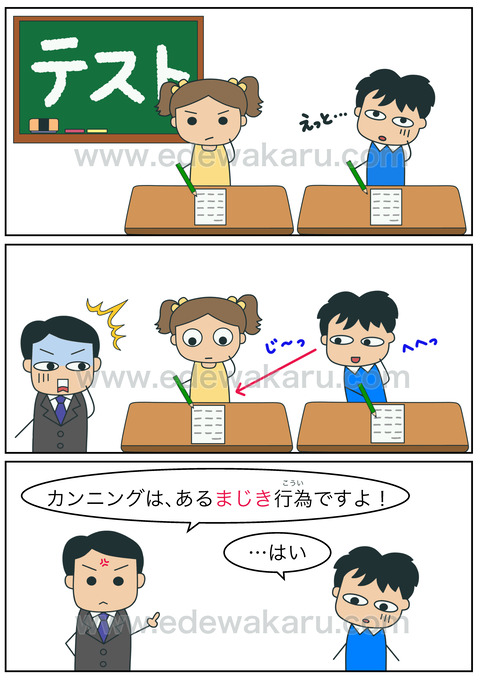
カンニングは、あるまじき行為だ
Cheating is an unacceptable act.
万引きをするなんて、警察官としてあるまじき行為だ
Shoplifting is an act unbecoming of a police officer.
無断欠席(むだんけっせき)するとは、社会人にあるまじきことだ
Being absent without permission is unacceptable for a working adult.
彼は、政治家としてあるまじき発言をした
He made a statement unbecoming of a politician.
彼女は店員にあるまじき行動をし、レストランを首になった
She behaved in a way unbecoming of a store clerk and was fired from the restaurant.
飲酒運転(いんしゅうんてん)は許すまじき行為だ
Drunk driving is an unforgivable act.
Read the original source text
Meaning
〜てはいけない
〜として〜てはいけない
How to use it
動詞[辞書形]+まじき
名詞[辞書形]+にあるまじき
名詞[辞書形]+としてあるまじき
Explanation
「〜まじき」は「〜てはいけない」という意味の文型です。「Aにあるまじき〜」「Aとしてあるまじき〜」の形で使われる場合は「A」には[職業・立場・地位]などが入り、「Aとして〜てはいけない」「Aとして〜するべきではない」という意味になります。「あるまじき」「許すまじき」はよく使われる形で、「絶対に〜てはいけない」「〜するのは許されない」という強い非難の気持ちを表します。古い言い方で、使える単語がほとんど決まっています。
[例]
①カンニングは、ある
まじき
行為だ
→カンニングは、あってはいけない行為だ
②万引きをするなんて、警察官
としてあるまじき
行為だ
→警察官として、絶対にしてはいけない行為だ
③無断欠席するとは、社会人
にあるまじき
ことだ
→無断欠席は、社会人として許されないことだ
④彼は、政治家
としてあるまじき
発言をした
→政治家として、するべきではない発言をした
⑤彼女は店員
にあるまじき
行動をし、レストランを首になった
→店員として許されない行動をし、首になった
⑥飲酒運転は許す
まじき
行為だ
→飲酒運転は、絶対にしてはいけない行為だ
「〜まじき」は日常会話で使われることはあまり多くありませんが、N1を受ける人はしっかりと覚えておきましょう😊
IMABI
Negative Volition: ~まい
Read this IMABI lesson ↗Explanation
Negative Volition: ~まい
The auxiliary verb まい is best known as the negative volitional auxiliary. In Modern Japanese, it functions as the opposite of the volitional auxiliary ~(よ)う, but historically it is the antonym of ~べし (=~べきだ).
Although its use in the spoken language has diminished quite a lot, it remains fairly common in the written language, particularly grammatical structures, as well as certain dialects with some unique adaptations.
Conjugating with ~まい
「~まい」の接続
In prescriptive Standard Japanese, the auxiliary verb ~まい follows the 未然形 with 一段 verbs (which includes the passive/causative auxiliary verbs ~(ら)れる ~(さ)せる1, ~しめる), サ変 verbs (する), and カ変 verbs (来る), but it follows the 終止形 with 五段 verbs and the politeness marking auxiliary verb ~ます.
Verb ClassBaseExample
一段動詞∅-未然形食べまい
五段動詞∅-終止形言うまい
サ変動詞shi-未然形しまい
カ変動詞ko-未然形来まい
~ます∅-終止形~ますまい
Although the above chart represents the standardized conjugation norms for this auxiliary, considerable fluctuation has existed for centuries, to the point that some variation has become accepted in modern times.
StandardAcceptedDialectal
上一段
例、見る見まい見るまい見よまい
下一段
例、食べる食べまい食べるまい食べよまい
五段
例、行く行くまい行かまい
行こまい
サ変
例、するしまいするまい
すまい2せまい
カ変
例、来るこまいくるまいくまい
きまい
From the perspective of the 未然形, if ~まい is inherently less modern, then it would only seem logical for it to be paired with the traditional 未然形 for when there is a discrepancy, such as which exists for the サ変 verb する—se– being the traditional 未然形 seen in constructions like せず (=しない). Yet, despite せまい being the historically pure form, its use among modern speakers across dialects is only marginal. Conversely, 来る is regular in this regard for maintaining こまい over きまい, with the latter using き as an alternative 未然形 mirroring し for する in the same capacity but never having gained widespread acceptance. Moreover, 五段 verbs have experienced dialectal acceptance of ~まい attaching to their 未然形.
Having ~まい follow the 終止形 with all classes of verbs has become so prevalent that doing so has become generally accepted and will at some point in the future become standardized. In the cases of するまい vs すまい and 来るまい vs 来(く)まい, this is a matter of whether the traditional 終止形 of these verbs without the final /ru/ is used over the modern 終止形 with the final /ru/.
Conjugating ~まい
「~まい」の活用
~まい, like all other auxiliary verbs, has its own bases. However, much has changed over time, and as a consequence, only its 終止形 and 連体形 remain in use.
終止形 連体形
まいまい
The 連体形 is practically only used with the nominalizers こと and もの.
Negative Volition
打ち消しの意志
The primary usage of ~まい is to show negative volition – “shall not.” This can be roughly reworded as ~ないようにするつもりだ. Although it isn’t that common in the spoken language, it is very succinct and it can be said that is more emphatic as an effect.
1. もう言うまい!
I shall say no more.
2. もう二度とそんな過ちは繰り返すまい。
I shall not make such a mistake again.
3. 債権者もそんな過酷な手段は認めますまい。
Not even the creditor would approve of such a cruel means.
4. 絶対に落第すまい3ぞ!
I will absolutely not fail!
5. じっと女の顔を見た刹那、わたしは男を殺さない限り、此処は去るまいと覚悟しました。
The moment I fixed my glance on the woman’s face, I was determined not to leave until I killed the man.
From 『藪の中』 by 芥川龍之介.
Negative Supposition
打ち消しの推量
The auxiliary verb ~まい may also indicate ‘negative supposition,’ which is parallel to how the auxiliary verb ~(よ)う may indicate ‘affirmative supposition,’ but unlike the latter, ~まい is just as often used to indicate negative volition as it does negative supposition.
Negative supposition indicates what the speaker views as unlikely to occur. In modern language, this would be usually rendered with ~ないだろう. However, ~まい still holds on in this capacity in literature as well as in the speech of older generations, as well as by anyone who wishes to sound more assertive.
Though quite uncommon nowadays, it is also possible to see this usage adapted to polite speech in the form of ~ますまい.
6. 知らなかったわけではあるまい。
It’s not that they didn’t know.
7. 妻の罪はそれだけではない。それだけならばこの闇の中に、今程おれも苦しみはしまい。
The wife’s crime wasn’t just that. If it were, I too wouldn’t be suffering as I am now in this darkness.
From 『藪の中』 by 芥川龍之介.
8. 兎に角わたしはどうしても、死に切る力がなかったのです。小刀を喉に突き立てたり、山の裾の池へ身を投げたり、いろいろな事もして見ましたが、死にきれずにこうしている限り、これも自慢にはなりますまい。
Anyway, in the end, I did not have the strength to really die. I had thrust the knife into my throat, thrown myself into the pond at the foot of the mountain, and all sorts of other things, but insofar I am like this unable to die, this too is surely nothing to boast.
From『藪の中』 by 芥川龍之介.
9. その後の事を申し上げるだけ、無用の口数に過ぎますまい。
Merely speaking of what happened after would be no more than useless words.
From 『藪の中』 by 芥川龍之介.
10. 併し死刑の宣告を受けた人は、処刑の日を前知している代わりには、いよいよ刑に逢うまで、若し赦免になりはすまいか、偶然助かりはすまいか、奇蹟がありはすまいかなんぞと思っているのです。
However, for those who receive a death sentence, mustn’t they be hoping for a pardon, being suddenly saved, or even a miracle up until the moment they meet their punishment instead of knowing their execution date?
From 『死』 by 森鴎外.
11. いくら肉親の妹だって、姉の骨まで見たことはあるまいから、分かるもんか。
Even if it was your own little sister, you’d never understand since you’ve never seen your sister turned to bones.
From 『死体紹介人』 by 川端康成.
12. 「里子ちゃん、いらっしゃい。お雑煮のお餅を焼きましょうね。里子ちゃんも、お手つだいしてちょうだい。」などと言って、菊子は里子を台所へ呼び寄せ、信吾の寝部屋の廊下を走らせまいとするつもりらしいが、里子は聞く風もなく、ぺたぺた廊下を走りつづけた。
Kikuko had said, “Satoko-chan, come here. Let’s make some zoni mochi. Won’t you please help?” to call Satoko to the kitchen, and although it seemed she had intended for her not to run down the hall past Shingo’s bedroom, Satoko paid no heed to this and continued running down loudly through the hall.
From 『山の音』 by 川端康成.
13. 争いが無ければ、かかる嘆きはあるまいものを4。
If there were no war, nay, there would be no such grief as this.
Prohibition
禁止
Similar to the concept of showing negative volition, when used in the second person, ~まい may be used in the same sense as ~てはいけない. In doing so, it is usually followed by the final particle ぞ.
14. 迂闊なことは言うまいぞ。
You mustn’t speak absurdities.
15. 一兵たりとも逃がすまいぞ。
You mustn’t let a single soldier escape.
16. あとわずかだ、油断すまいぞ。
Just a little more; you mustn’t let your guard down.
17. 決して他人には漏らすまいぞ。
You absolutely mustn’t leak this to anyone.
~まいとする
~まいとする is equivalent to ~ないようにする・ないでおこうとする in more modern phrasing, as such it is most prevalent in the written language or when the speaker wishes to sound far more assertive with their intent of non-action. This structure is the antonym of ~ようとする.
18. 笑うまいとしても、つい笑ってしまうだろう。
Even if you try not to laugh, you’ll eventually end up laughing.
19. 瑠璃子は涙を見せまいとしていたが、その瞳は真っ赤になっていた。
Ruriko tried to not let her tears be seen, but her eyes were bright red.
20. 世の中に反逆的に生きることに夢中だった俺は、時間という世間の常識にも縛られまいとしていた。
I have strived not to be bound by the world’s common sense notion of “time,” having devoted myself to living life rebelling against the world.
21. 学生たちは、先生の動作を食い入るように見つめ、少しも見逃すまいとしていたようだった。
It seemed as though the students had intently stared at their sensei’s every move, daring not to miss anything.
22. パニックを起こすまいとしたが、全身の感覚が麻痺していくのがわかった。
I tried not to panic, but I knew that my whole body’s senses were numbing up.
Just as is the case with ~ようとする, ~まいとする may be adapted to utilize other verbs besides する which may be used with the quotative particle と, and it is also possible to use the clause containing ~まい as an adverbial clause without する.
23. 会うまいと決心した。
I decided that I wasn’t going to meet (him).
24. その時までは決して彼に会うまいと心に決めていた。
Until that time (would come to pass), I decided in my heart that I would never meet him.
25. 彼女は眠るまいと決心していたが、結局眠りにつけてしまった。
She was resolute not to sleep, but she finally ended up falling asleep.
26. 武史は、絶対に{逃がさまい △・逃がすまい ◎}と、相手の肩を掴んで、手に力を入れた。
Takeshi, daring not to allow the other person to get away, snags them by the shoulder, and squeezes down.
~でもあるまい & ~こともあるまい
The grammatical patterns ~でもあるまい and ~こともあるまい are both used to indicate a scenario deemed inappropriate by being critical to the point of downplaying the situation altogether, which results in these patterns being rendered in English as “it’s not as if…” When such statements are directed towards oneself, there is a rather strong self-deprecating tone produced.
As for how the two structures differ, they are merely different adaptions based on the kind of predicate involved. For noun-predicates, use Noun + ~でもあるまい, and for verbal predicates, use 連体形 + ~こともあるまい.
27. 本当のことを言われたからと言って、何もそんなに怒ることはあるまい。
There is nothing to be so mad about just for being told the truth.
This use of ~まい does remain prevalent in the spoken language, but when it is used, it is usually accompanied with the particle し, here used like a final particle to tone down the seriousness of the situation the speaker thinks is out of line. Note also that でもあるまい may be rendered as ではあるまい5 or even じゃあるまい, with the latter being colloquial in tone due to the contraction of では to じゃ.
28. 車で15分ほどの所に住む人は泊まりに行くこともあるまいし。
Besides, people who live 15 minutes away by car would not stay (there).
29. 子供じゃあるまいし、自分で買いなさい。
It’s not as if you’re a kid; buy it yourself.
Though somewhat less common these days, this use of ~まい may be seen with the final particle に, which emphasizes the speaker’s displeasure/dissatisfaction.
30. 黙っていれば言うこともあるまいに。
If you’d just stay quiet, you’d have nothing to say.
As you can see, negative supposition and the sense of prohibition are both at play here.
31. 馬鹿じゃあるまいし、そんなことをするな。
It’s not as if you’re an idiot, so don’t do that.
~まいか
As mentioned above, ~まいか may be used to express a request in the same way ~ないか is used in more modern speech. As such, this is rather old-fashioned in Standard Japanese. Or, it may be analogous to ~ないのだろうか to indicate supposition via the negative. The difference is based on intonation: upward intonation = ないか; downward intonation = ~ないのだろうか6.
32. 天気予報は雪だったが、このぶんだと、今日はもう降るまいか。
The weather forecast called for snow, but at this rate, there won’t be any snow today, huh.
33. 寒いから毛布を持ってきてくれまいか。
It’s cold, so could you bring me a blanket?
34. 儂にもその製法を教えてもらえまいか。
Could I have you teach me that formulation, too?
~のではあるまい(か)
Of course, the nominalizer の may be used in conjunction with the auxiliary ~まい. In doing so, ~のではあるまい functions parallel to how ~のではない does in modern speech. Whether ~まい should be interpreted as literally expressing negative supposition or agreeance via a rhetorical, negative tag-question. Unlike its Modern Japanese equivalent ~のではないか, the negative tag-question marker ~まい(か)has a downward intonation7.
As for the exact function of ~のではある (=のだ) in conjunction with ~まい, のである itself indicates the speaker’s confidence in affirming the statement in light of a context at works, but the conviction is not quite 100% due to the suppositional nature of ~まい.
Speech Style Note: のではあるまい may be rendered as のじゃあるまい to reflect the pattern’s use in the speech of older generation.
35. 元々、魚がお好きなのじゃあるまいか。
Haven’t you always liked fish (which is why you like it so much)?
36. 別にわざとしたんじゃあるまいよ。
It’s not like I did it particularly on purpose, you know?
37. よもや戦(いくさ)が恐ろしいのではありますまいな?
Surely war isn’t so terrifying, no?
38. このお酒は儂が最も好きな日本酒のうちのひとつであり、まさかお前がわざわざ買ってくれたのではあるまいか。
This sake is one of my favorite sakes, don’t tell me you were the one who went out of your way to buy it for me?
~あろうことかあるまいことか
Seen as such in なろうことかなるまいことか, ~まい may also indicate what ought not to be so and in a rather condescending light.
39. あろうことかあるまいことか、新しく買った携帯を海に投げるなんて・・・
Of all things, throwing your newly bought phone into the ocean…
40. 自分の思い通りになろうことかなるまいことか、よく考えてみろ。
There is no sense in thinking things will go your way; think about it.
~まじき
Though the 連体形 of ~まい is no longer used much in modern speech, the 連体形8 of its predecessor, まじき, is actually more productive, surviving in the phrase あるまじき (unworthy/improper) and a handful of other phrases. This usage derives from its prohibition nuance.
41. あるまじき行為だ。
It is an improper act.
42. すまじき9ものは宮仕え。(Set Phrase)
It is better to work for oneself than to work for someone else.
~まじき = ~まじい
Occasionally in Early Modern Japanese literature, you may encounter まじい, which is the stage its 連体形・終止形 took before being further reduced to ~まい.
43. 「早くね、早くね。」と、言うなり後向いて走り出したのは噓みたいにあっけなかったが、遠ざかる後姿を見送っていると、なぜまたあの娘はいつもああ真剣な様子なのだろうと、この場にあるまじい不審が島村の心を掠めた。
Her running off as soon as she looked back saying “hurry, hurry!” seemed all too much like a lie, but as Shimamura looked at her retreating figure go farther away, a suspicion unfit for the scene grazed his mind as he thought again about why she was always so serious.
From 『雪国』 by 川端康成。
44. 士官の軍刀と、半玉の守り袋や花簪の鈴とが、足拍子につれて鳴った。兵士にあるまじい、哀傷の歌詞でありながら、二十五前後の青年と十五六の少女との合唱であるために、進軍の歌の響きがあった。
The officer’s saber and the young geisha’s little pouch and bells on her flowery hairpin resounded with the beating of their feet. Though the lyrics were elegiac and unbecoming of a solider, as it was the ensemble of a twenty-five or so year old lad and a fifteen, sixteen or so year old girl, it had the quality of a marching song.
From 『童謡』 by 川端康成.
45. 触れるほど顔を重ねて見るほど、能面にはあるまじい邪道だろう。
It was surely heresy unworthy of the Noh mask to even touch or try to put over one’s face.
From 『山の音』 by 川端康成.
For the short causatives form ~さす and ~す, ~まい is observed following the 終止形, as these shortened forms exhibit 五段 conjugations. ↩︎
Some speakers feel that すまい is more emphatic than しまい, but this perception is likely due to the pervasive use of 終止形+~まい, which affects する as with any other verb, predating the use of し(未然形)+ ~まい over the historical form せまい. ↩︎
Regarding the use of the verb する with this usage of ~まい, some speakers feel that すまい is more effective at expressing one’s intent (lack thereof) than しまい. This may be due to すまい having existed in this capacity for much longer. ↩︎
~ものを is a somewhat old-fashioned compound final particle which expresses lament. ↩︎
The difference between は and も here is a subtle one. Whereas は would downplay the scenario as not being so in light of what it could be, も would soften the tone and in light of not being so. ↩︎
This is the opposite intonation found with the modern ~ないのだろうか. ↩︎
The downward intonation is explained from the culture of giving a “yes” even when there is the potential of a situation “not” being so, which also explains way negative structures are used in “affirmative” tag questions. ↩︎
The auxiliary verb 〜まい derives from the Classical Japanese auxiliary verb 〜まじ, itself a contraction of 〜ましじ, a combination of two moribund auxiliaries: 〜まし (supposition marker) and 〜じ (negative volition marker). 〜まし itself is believed to be an adjectivalized form of the volition auxiliary 〜む, which is the ancestor to the Modern Japanese volitional auixilaries 〜よう・う. ↩︎
Also seen as せまじきものは宮仕え. The form せまい was, in fact, used in Edo Period colloquial speech, and it can be still heard in situations such as authentic kabuki performances. ↩︎
In context 45 examples
もう言うまい!
I shall say no more.
もう二度とそんな過ちは繰り返すまい。
I shall not make such a mistake again.
債権者もそんな過酷な手段は認めますまい。
Not even the creditor would approve of such a cruel means.
絶対に落第すまい3ぞ!
I will absolutely not fail!
じっと女の顔を見た刹那、わたしは男を殺さない限り、此処は去るまいと覚悟しました。
The moment I fixed my glance on the woman’s face, I was determined not to leave until I killed the man.
知らなかったわけではあるまい。
It’s not that they didn’t know.
妻の罪はそれだけではない。それだけならばこの闇の中に、今程おれも苦しみはしまい。
The wife’s crime wasn’t just that. If it were, I too wouldn’t be suffering as I am now in this darkness.
兎に角わたしはどうしても、死に切る力がなかったのです。小刀を喉に突き立てたり、山の裾の池へ身を投げたり、いろいろな事もして見ましたが、死にきれずにこうしている限り、これも自慢にはなりますまい。
Anyway, in the end, I did not have the strength to really die. I had thrust the knife into my throat, thrown myself into the pond at the foot of the mountain, and all sorts of other things, but insofar I am like this unable to die, this too is surely nothing to boast.
その後の事を申し上げるだけ、無用の口数に過ぎますまい。
Merely speaking of what happened after would be no more than useless words.
併し死刑の宣告を受けた人は、処刑の日を前知している代わりには、いよいよ刑に逢うまで、若し赦免になりはすまいか、偶然助かりはすまいか、奇蹟がありはすまいかなんぞと思っているのです。
However, for those who receive a death sentence, mustn’t they be hoping for a pardon, being suddenly saved, or even a miracle up until the moment they meet their punishment instead of knowing their execution date?
いくら肉親の妹だって、姉の骨まで見たことはあるまいから、分かるもんか。
Even if it was your own little sister, you’d never understand since you’ve never seen your sister turned to bones.
「里子ちゃん、いらっしゃい。お雑煮のお餅を焼きましょうね。里子ちゃんも、お手つだいしてちょうだい。」などと言って、菊子は里子を台所へ呼び寄せ、信吾の寝部屋の廊下を走らせまいとするつもりらしいが、里子は聞く風もなく、ぺたぺた廊下を走りつづけた。
Kikuko had said, “Satoko-chan, come here. Let’s make some zoni mochi. Won’t you please help?” to call Satoko to the kitchen, and although it seemed she had intended for her not to run down the hall past Shingo’s bedroom, Satoko paid no heed to this and continued running down loudly through the hall.
争いが無ければ、かかる嘆きはあるまいものを4。
If there were no war, nay, there would be no such grief as this.
迂闊なことは言うまいぞ。
You mustn’t speak absurdities.
一兵たりとも逃がすまいぞ。
You mustn’t let a single soldier escape.
あとわずかだ、油断すまいぞ。
Just a little more; you mustn’t let your guard down.
決して他人には漏らすまいぞ。
You absolutely mustn’t leak this to anyone.
笑うまいとしても、つい笑ってしまうだろう。
Even if you try not to laugh, you’ll eventually end up laughing.
瑠璃子は涙を見せまいとしていたが、その瞳は真っ赤になっていた。
Ruriko tried to not let her tears be seen, but her eyes were bright red.
世の中に反逆的に生きることに夢中だった俺は、時間という世間の常識にも縛られまいとしていた。
I have strived not to be bound by the world’s common sense notion of “time,” having devoted myself to living life rebelling against the world.
学生たちは、先生の動作を食い入るように見つめ、少しも見逃すまいとしていたようだった。
It seemed as though the students had intently stared at their sensei’s every move, daring not to miss anything.
パニックを起こすまいとしたが、全身の感覚が麻痺していくのがわかった。
I tried not to panic, but I knew that my whole body’s senses were numbing up.
会うまいと決心した。
I decided that I wasn’t going to meet (him).
その時までは決して彼に会うまいと心に決めていた。
Until that time (would come to pass), I decided in my heart that I would never meet him.
彼女は眠るまいと決心していたが、結局眠りにつけてしまった。
She was resolute not to sleep, but she finally ended up falling asleep.
武史は、絶対に{逃がさまい △・逃がすまい ◎}と、相手の肩を掴んで、手に力を入れた。
Takeshi, daring not to allow the other person to get away, snags them by the shoulder, and squeezes down.
本当のことを言われたからと言って、何もそんなに怒ることはあるまい。
There is nothing to be so mad about just for being told the truth.
車で15分ほどの所に住む人は泊まりに行くこともあるまいし。
Besides, people who live 15 minutes away by car would not stay (there).
子供じゃあるまいし、自分で買いなさい。
It’s not as if you’re a kid; buy it yourself.
黙っていれば言うこともあるまいに。
If you’d just stay quiet, you’d have nothing to say.
馬鹿じゃあるまいし、そんなことをするな。
It’s not as if you’re an idiot, so don’t do that.
天気予報は雪だったが、このぶんだと、今日はもう降るまいか。
The weather forecast called for snow, but at this rate, there won’t be any snow today, huh.
寒いから毛布を持ってきてくれまいか。
It’s cold, so could you bring me a blanket?
儂にもその製法を教えてもらえまいか。
Could I have you teach me that formulation, too?
元々、魚がお好きなのじゃあるまいか。
Haven’t you always liked fish (which is why you like it so much)?
別にわざとしたんじゃあるまいよ。
It’s not like I did it particularly on purpose, you know?
よもや戦(いくさ)が恐ろしいのではありますまいな?
Surely war isn’t so terrifying, no?
このお酒は儂が最も好きな日本酒のうちのひとつであり、まさかお前がわざわざ買ってくれたのではあるまいか。
This sake is one of my favorite sakes, don’t tell me you were the one who went out of your way to buy it for me?
あろうことかあるまいことか、新しく買った携帯を海に投げるなんて・・・
Of all things, throwing your newly bought phone into the ocean…
自分の思い通りになろうことかなるまいことか、よく考えてみろ。
There is no sense in thinking things will go your way; think about it.
あるまじき行為だ。
It is an improper act.
すまじき9ものは宮仕え。(Set Phrase)
It is better to work for oneself than to work for someone else.
「早くね、早くね。」と、言うなり後向いて走り出したのは噓みたいにあっけなかったが、遠ざかる後姿を見送っていると、なぜまたあの娘はいつもああ真剣な様子なのだろうと、この場にあるまじい不審が島村の心を掠めた。
Her running off as soon as she looked back saying “hurry, hurry!” seemed all too much like a lie, but as Shimamura looked at her retreating figure go farther away, a suspicion unfit for the scene grazed his mind as he thought again about why she was always so serious.
士官の軍刀と、半玉の守り袋や花簪の鈴とが、足拍子につれて鳴った。兵士にあるまじい、哀傷の歌詞でありながら、二十五前後の青年と十五六の少女との合唱であるために、進軍の歌の響きがあった。
The officer’s saber and the young geisha’s little pouch and bells on her flowery hairpin resounded with the beating of their feet. Though the lyrics were elegiac and unbecoming of a solider, as it was the ensemble of a twenty-five or so year old lad and a fifteen, sixteen or so year old girl, it had the quality of a marching song.
触れるほど顔を重ねて見るほど、能面にはあるまじい邪道だろう。
It was surely heresy unworthy of the Noh mask to even touch or try to put over one’s face.
NINJAL 日本語文型データベース
Meaning
A way of criticizing an act that is morally unacceptable from a particular position.
How to use it
VるまじきN
Notes
The form 「NにあるまじきNだ」 is commonly used. 「〜に」 or 「〜として」 may indicate a person’s position, status, or profession.
Common expressions include 「あるまじき」「許すまじき」「言うまじき」.
In context 3 examples
犯罪を犯すなど、教師にあるまじき行為だ。
Committing a crime and the like is conduct unbecoming of a teacher.
本校の学生としてあるまじき行為をしたため、以下の学生を停学処分とする。
The following student will be suspended for engaging in conduct unbecoming of a student at this school.
いくらそのタレントが気に食わないからといって、SNSに悪口を書くなんて、許すまじきことだ。
No matter how much you dislike that celebrity, posting insults about them on social media is unforgivable.
Read the original source text
Meaning
ある立場から道徳的に考えて、してはいけない行為を非難する言い方です。
How to use it
VるまじきN
Notes
「NにあるまじきNだ」という形式を多く使います。「〜に」や「〜として」で人の立場・地位・職業を示すことがあります。
「あるまじき」「許すまじき」「言うまじき」とよく使います。
AIUEO JLPT Grammar
Meaning
This sentence pattern conveys strong prohibition, particularly for actions deemed morally or ethically unacceptable. It is often used to criticize behavior inappropriate for a person’s profession or position.
How to use it
Verb dictionary form + まじき
In context 5 examples
国会議員としてあるまじき行為を行い、辞職に追い込まれた。
He committed an act unbecoming of a member of parliament and was forced to resign.
教師としてあるまじき発言が問題視されている。
His remarks, unbecoming of a teacher, are being criticized.
警察官としてあるまじき行動により、彼は免職された。
He was dismissed for actions unworthy of a police officer.
医者として許すまじき過失が、患者の命を危険にさらした。
A mistake that should never be made by a doctor put the patient’s life in danger.
弁護士としてあるまじき行為で、彼は資格を失った。
He lost his qualification due to behavior unbecoming of a lawyer.
Read the original source text
Meaning
This sentence pattern conveys strong prohibition, particularly for actions deemed morally or ethically unacceptable. It is often used to criticize behavior inappropriate for a person’s profession or position.
How to use it
動詞辞書形+まじき
Explanation · 日本語
この文型は、強い禁止の意味を表す表現で、特に道徳的・倫理的にその行為が許されない場合に使われます。多くの場合、職業や立場にふさわしくない行為を批判するときに用いられます。
文法
Meaning
Used to express criticism of an act or attitude that one should not engage in, considering one's profession or position.
How to use it
V (dictionary form) + まじき
※「する」 may also be expressed as 「すまじき」.
Notes
Its use is limited to expressions such as 「あるまじき」 and 「許すまじき」.
In context 4 examples
生徒に暴力を振るうなんて、教師としてあるまじき行為だ。
For a teacher to use violence against a student is conduct unbecoming of a teacher.
SNSで学校の悪口や授業の様子を投稿するなど、許すまじき行為だ。
Posting insults about the school or footage of classes on social media is an unforgivable act.
試験中にカンニングのような許すまじき行為をした者は0点にします。
Anyone who commits an unforgivable act such as cheating during an exam will receive a zero.
飲酒運転によるひき逃げは許すまじき犯罪だ。
A hit-and-run caused by drunk driving is an unforgivable crime.
Read the original source text
Meaning
〜してはいけない職業や立場を考えると、すべきではない行為や態度について、非難の気持ちを込めて言う時に使う。
How to use it
V(辞書形)+ まじき
※「する」は「すまじき」と言うこともできる
Notes
「あるまじき」や「許すまじき」など、使用範囲は限られている。
Bunpro Grammar Reference
Meaning
Unbecoming of, Unworthy of, Not proper for, Should not, Must not, Cannot
How to use it
Noun (A) + にある(1) + まじき + Noun (B)
許すまじき + Noun
(1)としてある
Nuance
A formal, old-fashioned expression, showing that something is unbecoming of (A), or must not (A). (A) is judged as improper, so (B).
Explanation
まじき is the attributive form of まじ, a classical auxiliary verb that has been replaced almost entirely by まい 'must not', 'should not' in modern Japanese. まじ itself has this same meaning of 'must not', and will only be seen in a very limited number of formal expressions. Although slightly different in nuance, まじき is often translated simply as 'not proper for (A)', or 'unbecoming of (A)' in each case.
The most common pattern that まじき will be seen in is (A) にあるまじき (B), where the case-marking particle に follows a noun, then is linked to the う-Verb ある, before まじき will connect to a second noun.
生徒に手を挙げることは先生にあるまじき行為だ。
Raising your hand to a student is unbecoming of a teacher.
彼は飲酒運転という警察官にあるまじき行動をし、クビになった。
He was fired for drunk driving, an unbecoming behavior for a police officer.
Occasionally, に will be replaced by として 'as', with the rest of the structure remaining the same.
先日、斉藤首相は総理としてあるまじき発言をし、SNSで炎上している。
Recently, Prime Minister Saito has been under fire on social media for making comments that are unbecoming of a prime minister.
彼は医師としてあるまじきミスをしてしまい、医師免許を剥奪された。
He made a mistake that was unbecoming of a physician and was stripped of his medical license.
許すまじき 'must not be forgiven', or simply 'unforgivable' is another pattern that may be seen.
煽り運転のような許すまじき行為をした場合、免許は取り消しになります。
If you commit unforgivable acts such as tailgating, your license will be revoked.
In context 16 examples
- リヒャルトは王としてあるまじき汚名を着せられ、やがて廃位された。
Richard was tarred with the stigma unbecoming of the position of the king and was eventually dethroned.
- 生徒に手を挙げることは先生にあるまじき行為だ。
Raising your hand to a student is unbecoming of a teacher.
- 彼は飲酒運転という警察官にあるまじき行動をし、クビになった。
He was fired for drunk driving, an unbecoming behavior for a police officer.
- 煽り運転のような許すまじき行為をした場合、免許は取り消しになります。
If you commit unforgivable acts such as tailgating, your license will be revoked.
- 先日、斉藤首相は総理としてあるまじき発言をし、SNSで炎上している。
Recently, Prime Minister Saito has been under fire on social media for making comments that are unbecoming of a prime minister.
- 彼は医師としてあるまじきミスをしてしまい、医師免許を剥奪された。
He made a mistake that was unbecoming of a physician and was stripped of his medical license.
- 言うまでもないが、公金横領など政治家としてあるまじき行為だ。
It goes without saying, but something like misappropriation of public funds is an act unbecoming of a statesman.
- 妻を下げるような発言をするなんて、夫にあるまじき行為だ。
Something like saying remarks that bring down his wife, it is behavior that is unbecoming of a husband.
- 戦場から離脱することは武士にあるまじき行為と咎められ、罰せられた。
Fleeing from the battlefield was condemned as unbecoming of a warrior and punished.
- ララティーナは貴族にあるまじき態度で、甘やかされた子供のようなふるまいをした。
Lalatina behaved in a manner unbecoming of a noble, like a spoiled child.
- ニュースの主題:「看護師としてあるまじき行動」高齢患者から500万円詐取
News title: 'Behavior unbecoming of a nurse': Fraud of 5000000 yen from an elderly patient
- 医療費を多く請求する為に必要ではない治療を行うなんて医師にあるまじき行為です。
Something like administering unnecessary treatments in order to raise the medical costs, it is behavior that is not proper for a doctor.
- 彼女は生徒と関係を持つという先生としてあるまじき事をしたために懲戒処分となった。
Due to that she had relations with a student that was unbecoming of a teacher, she was subjected to judicial punishment.
- 思い通りにいかない度に園児に対して暴力を振るうなんて、保育士として許すまじき行為です。(許す)
Something like getting abusive with kindergarteners every time something does not go right, it is behavior that must not be forgiven as a childcare worker.
- 飲み歩いたせいで次の日の会社に遅刻するなんて、社会人としてあるまじき行動だ。
To think that he would be late to work the next day due to going bar hopping, it is behavior that is unbecoming of a functioning member of society.
- 小説:「深く考えず勝手に好きなことをいうのは普通の人にとっては許せるかもしれないが、外交官にとってはゆるすまじき悪行だったのだ。」
Novel: 'Saying whatever one wants, without thinking deeply might be allowed for an ordinary person, but for a diplomat, it is a misdeed that cannot be forgiven.'
くらべてわかる日本語表現文型辞典
Meaning
To assert that A is absolutely impermissible, that it must never happen, and that it is B.
How to use it
AまじきB
[Verb—dictionary form] まじき
In context 4 examples
生徒をいじめるなど、教師としてあるまじき行いだ。
Bullying a student is conduct unbecoming of a teacher.
セクハラは、許すまじき犯罪だ。
Sexual harassment is an unforgivable crime.
教師を公然と侮辱するなど、学生としてとるまじき態度だ。
Publicly insulting a teacher is an attitude unbecoming of a student.
職務上、知りえた情報はたとえ家族であっても口にするまじきこと。
Information learned in the course of one's duties must not be spoken of, even to one's family.
Read the original source text
Meaning
絶対にAはいけない、あってはならないBだと断言する。
How to use it
AまじきB
[動詞-る形]まじき
日本語NET JLPT文法解説まとめ
Meaning
Used to express criticism of an act or attitude that one should not engage in, considering one's profession or position.
How to use it
V (dictionary form) + まじき
※「する」 may also be expressed as 「すまじき」.
Explanation
Its use is limited to expressions such as 「あるまじき」 and 「許すまじき」.
In context 4 examples
生徒に暴力を振るうなんて、教師としてあるまじき行為だ。
For a teacher to use violence against a student is conduct unbecoming of a teacher.
SNSで学校の悪口や授業の様子を投稿するなど、許すまじき行為だ。
Posting insults about the school or footage of classes on social media is an unforgivable act.
試験中にカンニングのような許すまじき行為をした者は0点にします。
Anyone who commits an unforgivable act such as cheating during an exam will receive a zero.
飲酒運転によるひき逃げは許すまじき犯罪だ。
A hit-and-run caused by drunk driving is an unforgivable crime.
Read the original source text
Meaning
〜してはいけない職業や立場を考えると、すべきではない行為や態度について、非難の気持ちを込めて言う時に使う。
How to use it
V(辞書形)+ まじき
※「する」は「すまじき」と言うこともできる
Explanation
「あるまじき」や「許すまじき」など、使用範囲は限られている。