AIUEO JLPT Grammar
Meaning
This sentence pattern indicates a repetitive action or that only a certain thing exists, emphasizing an excessive or one-sided situation. It connects with the dictionary form of verbs or nouns. In casual speech, 「ばかり」can be shortened to 「ばっか」 or 「ばっかり」.
How to use it
Verb dictionary form + ばかり; noun + ばかり
In context 5 examples
彼はテレビを見るばっかりで、勉強しません。
He does nothing but watch TV and doesn’t study.
甘い物ばっかり食べていると、太ってしまいます。
If you eat nothing but sweets, you’ll gain weight.
このソフトはエラーばかりで、使い物にならない。
This software is full of errors and is unusable.
彼は文句ばっか言って、何も行動しない。
He does nothing but complain and doesn’t take any action.
技術ばかりに頼って、人間の能力を軽視するのは危険だ。
Relying only on technology and underestimating human abilities is dangerous.
Read the original source text
Meaning
This sentence pattern indicates a repetitive action or that only a certain thing exists, emphasizing an excessive or one-sided situation. It connects with the dictionary form of verbs or nouns. In casual speech, 「ばかり」can be shortened to 「ばっか」 or 「ばっかり」.
How to use it
動詞辞書形+ばかり名詞+ばかり
Explanation · 日本語
この文型は、特定の動作や状態が繰り返されることや、特定の事物だけが存在することを示す表現で、動詞の辞書形や名詞に接続して使います。この表現は、過剰な状況や偏った状況を強調するために使われます。口語では、「ばかり」を「ばっか」や「ばっかり」ということがあります。
文法
Meaning
Indicates that there are many of the same thing or that the same action is done repeatedly. It is often used with a negative connotation.
How to use it
V (て-form) + ばかり
N + ばかり
In context 15 examples
友達はいつもゲームしてばかりいる。
My friend is always playing games.
田中さんはいつも仕事中に寝てばかりいます。
Mr. Tanaka is always sleeping at work.
私の父は休みの日にいつも、テレビを見てばかりいます。
On his days off, my father is always watching TV.
食べてばかりいると、太りますよ。
If you do nothing but eat, you'll gain weight.
遊んでばかりいないで、勉強もしなさい。
Don't just play around; study too.
毎日お酒を飲んでばかりいると、いつか体を壊しますよ。
If you do nothing but drink alcohol every day, you'll ruin your health someday.
座ってばかりなので、お尻が痛いです。
I've been sitting down all the time, so my bottom hurts.
山田先生はいつも怒ってばかりで、授業が楽しくない。
Mr. Yamada is always getting angry, so his classes aren't fun.
この会社の社員は若い女性ばかりだ 。
The employees at this company are all young women.
友達は旅行中、セルフィーばかりしていました。
My friend did nothing but take selfies while traveling.
トムさんは文句ばかりで、全然宿題をしてこない。
Tom does nothing but complain and never does his homework.
一人暮らしの息子は、ファストフードやインスタント食品ばかり食べているので少し心配です。
I'm a little worried because my son, who lives alone, eats nothing but fast food and instant meals.
彼はいつも嘘ばかりついているから信用されていない。
He is not trusted because he is always telling lies.
ここ数日、雨ばかりね。
It's been nothing but rain these past few days.
甘い物ばかり食べていると、虫歯になるよ。
If you eat nothing but sweets, you'll get cavities.
Read the original source text
Meaning
同じ物がたくさんある、同じことを何度もするという意味を表す。 マイナスの意味で使われることが多い。
How to use it
V(て形) + ばかり
N + ばかり
Bunpro Grammar Reference
Meaning
Just, Only, Nothing but
How to use it
Verb[て]+ ばかり
Noun + ばかり
Nuance
A slightly formal way of subjectively expressing the only thing that is happening. Nothing but (A).
Explanation
When used after verbs followed by the conjunction particle て, or nouns, the adverbial particle ばかり highlights that 'nothing but (A) is being done', or 'only (A) exists'. In relation to verbs, てばかり is often followed by いる, as a modified version of the standard ている. However, adding いる is not a requirement, and the same nuance may be conveyed without it.
先生はいつも怒ってばかりいる。
Our teacher does nothing but get angry.
最近はお菓子ばかり食べているから、お腹がでてきた。
Recently, I've been eating nothing but sweets, so my stomach is bulging out.
When a sentence consists of a part (A) and a part (B), ばかり will be followed by either で (with verbs or nouns), or いて (only with verbs). This is when ばかり appears directly before the sentence conjunction point, and other combinations are possible (such as ばかりだから).
先月生まれた息子がずっと泣いてばかりいて、全然寝れない。
My son who was born last month does nothing but cry, so I can't sleep.
彼は毎日残業してばかりで、全然家の事を手伝ってくれない。
All he does is work overtime everyday, and he won't help me with house chores.
彼は口を開けると文句ばかりで、一緒にいるだけで疲れる。
When he opens his mouth, all he can do is complain, so just being with him is exhausting.
It should be noted that the で with ばかり here is not the particle で, but the conjunctive form of the auxiliary verb, だ.
Fun Fact
ばかり is rarely seen using kanji, but it originally comes from 許り (sometimes 計り). This kanji means 'to let off', or 'to let through', and implies that (A) is the only thing that is being 'permitted' in a specific situation.
In context 17 examples
- 彼は毎日残業してばかりで、全然家の事を手伝ってくれない。
All he does is work overtime everyday, and he won't help me with house chores.
- 先生はいつも怒ってばかりいる。
Our teacher does nothing but get angry.
- 最近はお菓子ばかり食べているから、お腹がでてきた。
Recently, I've been eating nothing but sweets, so my stomach is bulging out.
- 先月生まれた息子がずっと泣いてばかりいて、全然寝れない。
My son who was born last month does nothing but cry, so I can't sleep.
- 彼は口を開けると文句ばかりで、一緒にいるだけで疲れる。
When he opens his mouth, all he can do is complain, so just being with him is exhausting.
- 彼はいつも嘘ばかり言っている。
He does nothing but tell lies.
- 私の弟はゲームをしてばかりですよ。
My little brother does nothing but play video games.
- 知らない顔ばかりだから緊張する。
Because there are only/nothing but unfamiliar faces I feel nervous.
- 甘い物を食べてばかりいると、虫歯が増える。
If you only/do nothing but eat sweets, you will have more cavities.
- 人生つらいことばかりではない。いい日もあるよ。
Life is not always (nothing but) hard. There are good days too.
- いつももらってばかりですみません。
It seems that I do nothing but receive (gifts) from you. Sorry about that.
- 負けてばかりだから、もうあのゲームはしたくない。
I do nothing but lose, so I don't want to play that game anymore.
- 遊んでばかりで勉強しないなら、大人になってから苦労するよ。
If you do nothing but play and don't study, you will have a rough time when you get older.
- あの人は夢を追いかけてばかり、現実を無視している。
He does nothing but chase his dreams. He completely disregards reality.
- 彼の役目は皿を洗うことなのに、落としてばかりです。
Even though he should be washing the dishes, he does nothing but drop them.
- うちの子は毎日スマホで映画を見たりゲームをしたりしてばかり、全然勉強しないわ。
My child does nothing but watch movies on his smartphone and play games. He does not study at all.
- 口先ばかりで、結局何もやってくれない。
She is all talk and doesn't do anything for me in the end. (only / nothing but)
Read the original source text
Meaning
Just, Only, Nothing but
How to use it
Verb[て]+ ばかり
Noun + ばかり
Nuance
A slightly formal way of subjectively expressing the only thing that is happening. Nothing but (A).
Explanation
When used after verbs followed by the conjunction particle て, or nouns, the adverbial particle ばかり highlights that 'nothing but (A) is being done', or 'only (A) exists'. In relation to verbs, てばかり is often followed by いる, as a modified version of the standard ている. However, adding いる is not a requirement, and the same nuance may be conveyed without it.
先生はいつも怒ってばかりいる。
Our teacher does nothing but get angry.
最近はお菓子ばかり食べているから、お腹がでてきた。
Recently, I've been eating nothing but sweets, so my stomach is bulging out.
When a sentence consists of a part (A) and a part (B), ばかり will be followed by either で (with verbs or nouns), or いて (only with verbs). This is when ばかり appears directly before the sentence conjunction point, and other combinations are possible (such as ばかりだから).
先月生まれた息子がずっと泣いてばかりいて、全然寝れない。
My son who was born last month does nothing but cry, so I can't sleep.
彼は毎日残業してばかりで、全然家の事を手伝ってくれない。
All he does is work overtime everyday, and he won't help me with house chores.
彼は口を開けると文句ばかりで、一緒にいるだけで疲れる。
When he opens his mouth, all he can do is complain, so just being with him is exhausting.
It should be noted that the で with ばかり here is not the particle で, but the conjunctive form of the auxiliary verb, だ.
Fun Fact
ばかり is rarely seen using kanji, but it originally comes from 許り (sometimes 計り). This kanji means 'to let off', or 'to let through', and implies that (A) is the only thing that is being 'permitted' in a specific situation.
Nuance · 日本語
あることしか起こっていないことを主観的に表す少し丁寧な表現。(A)しかない。
Explanation · 日本語
「ばかり」は、動詞と接続助詞の「て」、または名詞に付いて、「(A) だけする」や「(A) しかない」のような意味を表します。動詞に付くときは「てばかりいる」という形になることが多いです。ただし、「いる」がなくても同じような意味を表すことができます。
先生はいつも怒ってばかりいる。
Our teacher does nothing but get angry.
最近はお菓子ばかり食べているから、お腹がでてきた。
Recently, I've been eating nothing but sweets, so my stomach is bulging out.
文が (A) と (B) に分かれているときは、「ばかり」のあとに、「で」(動詞や名詞の場合)や、「いて」(動詞の場合)が付いて、 (A) と (B) をつなぎます。このほかにも、「ばかりだから」などの言い方もあります。
先月生まれた息子がずっと泣いてばかりいて、全然寝れない。
My son who was born last month does nothing but cry, so I can't sleep.
彼は毎日残業してばかりで、全然家の事を手伝ってくれない。
All he does is work overtime everyday, and he won't help me with house chores.
彼は口を開けると文句ばかりで、一緒にいるだけで疲れる。
When he opens his mouth, all he can do is complain, so just being with him is exhausting.
ここで使われている「で」は、助動詞「だ」の連用形です。助詞ではありません。
豆知識
「ばかり」が漢字で書かれることはほとんどありませんが、漢字で書くと「許り」(または「計り」)になります。この漢字には「許す」という意味があって、ある状況で(A)だけが「許されている」ことを表しています。
DoJG 日本語文法辞典(全集)
Meaning
Only; just; be ready to do something; have just done something; just did something; be just doing something; about
How to use it
(i) Vinformal nonpast | ばかり | |
| 話すばかり | Be ready to talk |
(ii) Vて | ばかり | |
| 話してばかり | Be just talking |
| 食べてばかり | Be just eating |
(iii) Vinformal past | ばかり | |
| 話したばかり | Have just talked |
| 食べたばかり | Just have eaten |
(iv) {Adjective い informal nonpast/Adjectiveな stem} | ばかり | |
| 高いばかり | Just expensive |
| 静かなばかり | Just quiet |
(v) Noun | ばかり | |
| 先生ばかり | Only teachers |
(vi) Noun+Particle | ばかり | |
| 学生にばかり | Only to students |
(vii) Quantifier | ばかり | |
| 一時間ばかり | About an hour |
Explanation
A particle which indicates that something is the only thing or state which exists, or the action someone will take, takes, is taking or took.
In context 13 examples
デザートは食べるばかりになっている・います。
The only thing left to do with the dessert is to eat it./The dessert is ready to eat.
友子は遊んでばかりいる・います。
The only thing Tomoko is doing is playing./Tomoko is doing nothing but playing.
私は昼ご飯を食べたばかりだ・です。
I had my lunch and haven't done anything else since then./I have just eaten my lunch.
このレストランは安いばかりだ・です。
The only merit of this restaurant is that the food is inexpensive./This restaurant is just cheap.
デニスはビールばかり飲んでいる・います
Dennis is drinking only beer.
私は一月ばかりパリにいた・いました。
I was in Paris for about a month.
このレポートはあと結論を書くばかりだ。
The only thing left to do with this report is to write a conclusion.
春江は泣いてばかりいて何も話そうとしない。
Harue is just crying and won't talk about anything.
松山さんは今シカゴに着いたばかりです。
Mr. Matsuyama has just arrived in Chicago now.
この仕事は面倒なばかりであまり儲かりません。
This job is troublesome and doesn't bring us big profits.
この寮に住んでいるのは男子学生ばかりだ。
The students who are living in this dorm are all boys.
フィッシャー先生はリサとばかり話している。
Professor Fisher is talking only with Lisa.
十人ばかりの友達が手伝ってくれました。
About ten friends helped me.
絵でわかる日本語
Meaning
About ~
How to use it
Quantity word+ばかり
Explanation
「Quantity word+ばかり」is a grammar pattern meaning “about ~.” It is used when you want to say “approximately ~” without stating the quantity precisely. Be careful: 「〜ばかり」is not used for [times of day] or [dates].
[Cases where 「〜ばかり」cannot be used]
① Time of day
❌ I get up at about 8 o’clock every day.
⭕️ I get up at around 8 o’clock every day.
⭕️ I get up around 8 o’clock every day.
② Date
❌ I plan to go on a trip around March 28.
⭕️ I plan to go on a trip around March 28.
⭕️ I plan to go on a trip around March 28.
「Quantity word+ばかり」is a softer way of speaking. In conversation, 「〜ほど」or 「〜ぐらい」is more commonly used 😊 Learn it as one of the “ばかり series” 😉
[The “ばかり” series]
〜たばかり
〜てばかりいる・〜てばかりだ
〜てばかりはいられない・〜てばかりもいられない
〜と言わんばかりに・〜とばかりに
〜とばかり思っていた
〜とばかりは言えない
〜ばかり (quantity word+ばかり)
〜ばかりだ
〜ばかりだ (preparation complete)
〜ばかりで
〜ばかりでなく〜も
〜ばかりに
〜ばかりの (metaphor)
〜ばかりは
〜んばかり
In context 5 examples
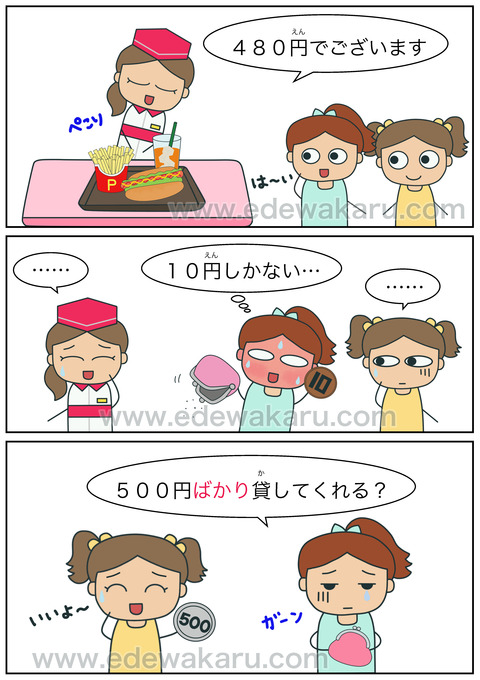
A:500円ばかり貸してくれる?B:いいよ〜(復習:貸す・借りる)
A: Could you lend me about 500 yen? B: Sure~ (Review: lend and borrow)
学校まではバスで1時間ばかりかかる(復習:〜かかる)
It takes about an hour by bus to get to school. (Review: 〜かかる)
レポートを書き上げるのに、3日ばかりかかった(復習:〜上げる)
It took about three days to finish writing the report. (Review: 〜上げる)
A:すみません、デパートはどこですか?B:この道をまっすぐ100m(メートル)ばかり行くと着きますよ
A: Excuse me, where is the department store? B: Go straight down this road for about 100 meters and you’ll get there.
母:りんごを3個ばかり買ってきてちょうだい娘:え〜、面倒くさい…(復習:〜てくる)(復習:〜てちょうだい)(復習:〜くさい)
Mother: Please buy about three apples for me. Daughter: Ugh, what a hassle… (Review: 〜てくる) (Review: 〜てちょうだい) (Review: 〜くさい)
Read the original source text
Meaning
〜くらい
How to use it
数量詞+ばかり
Explanation
「数量詞+ばかり」は「〜くらい」という意味を表す文型です。数量をはっきり言わず、「だいたい〜くらい」と言いたい時に使います。「〜ばかり」は【時刻】【日にち】を表す場合には使いませんので気をつけましょう。
[「〜ばかり」が使えない場合]
①時刻
❌毎日8時
ばかり
に起きます
⭕️毎日8時
ぐらい
に起きます
⭕️毎日8時
頃
に起きます
②日にち
❌3月28日
ばかり
に旅行に行く予定です
⭕️3月28日
ぐらい
に旅行に行く予定です
⭕️3月28日
頃
に旅行に行く予定です
「数量詞+ばかり」 はやわらかい言い方です。会話でもは「〜ほど」や「〜ぐらい」の方がよく使われます😊「ばかりシリーズ」の1つとして覚えておきましょう😉
【「ばかり」シリーズ】
〜たばかり
〜てばかりいる・〜てばかりだ
〜てばかりはいられない・〜てばかりもいられない
〜と言わんばかりに・〜とばかりに
〜とばかり思っていた
〜とばかりは言えない
〜ばかり(数量詞+ばかり)
〜ばかりだ
〜ばかりだ(準備完了)
〜ばかりで
〜ばかりでなく〜も
〜ばかりに
〜ばかりの(比喩)
〜ばかりは
〜んばかり
日本語文型辞典
Meaning
Attached to words expressing quantities, it indicates an approximate amount. In ①–⑤, it can be rephrased with “hodo.” In everyday spoken language, “hodo” is more commonly used.
In modern Japanese, as in ① and ②, it can be used to indicate a length of time, but not a time of day or date. In those cases, “gurai” or “goro” is used.
Examples ③ and ④ are like “Please give me three apples” and “Please lend me 1,000 yen,” but adding “bakari” softens the expression by making the quantity less definite. It can also be attached to words like “sukoshi,” “wazuka,” and “shoushou,” as in ⑥ and ⑦.
“Bakkari” is also used in spoken language.
a. N (+ particle +) bakari
Means “nothing other than that” and is used to say that there is “a lot of only the same thing” or that “the same thing is repeated again and again.”
“Bakari” attached after a noun, as in ①–⑤ and ⑧, takes the forms “bakari ga” and “bakari o” before the particles “ga” and “o,” but “ga” and “o” are often omitted. When another particle is present, it follows the “noun + particle,” becoming “to bakari” or “ni bakari,” as in ⑥ and ⑦. It does not follow “made” or “yori.” It also does not follow “kara” when “kara” gives a reason. It is similar to “dake” and “nomi,” but when the implication is “repeated many times,” “always,” or “all,” “dake” and “nomi” cannot be used.
b. V-te bakari iru
Used when the speaker speaks critically of repeatedly doing the same thing or always being in the same state. It cannot be replaced by “dake” or “nomi.”
c. …bakari de
Expresses the speaker's negative evaluation that there is nothing beyond the thing singled out with “bakari.” A negative expression follows in the latter part.
d. N bakari wa
Attached to “kore,” “sore,” “are,” or a noun, it emphasizes such meanings as “that alone, whatever else may be the case” or “at least on that occasion.” A stiff, written-style expression. When used in everyday speech, it sounds old-fashioned and exaggerated.
Indicates that little time has passed since an action was completed. Even if it is not immediately after the action, it can be used when the speaker feels that little time has passed, as in ⑤.
Indicates a one-way change in a bad direction. It can be rephrased as “…suru ippou da.”
Often used in the forms “V-ru bakari ni shite aru” and “V-ru bakari ni natte iru.” Used to say that preparations are complete and one is ready to proceed to the next action at any time, as in ①–③. It may also mean that “everything has been done, and all that remains is to …,” as in ④.
a. …bakari no N
Uses a simile to indicate an extreme degree. Many expressions are idiomatic; the phrasing is written in style and often used in stories.
b. V-n bakari
The form is made by removing “nai” from “V-nai” and adding “n.”
①–③ mean “an N so … that it seems about to …,” while ④ means “was so beautiful that it seemed to shine”; these use simile to express an extreme degree. ⑤ and ⑥ mean “in a state that almost looks as if … is about to happen” or “in a state that could be described as ….” ⑦–⑨ use the form “…to iwan bakari,” expressing that the speaker got that impression from someone's attitude or the like, although they did not actually say it.
Often used together with words such as “yousu,” “taido,” “me-tsuki,” and “kuchou.”
a. …bakari ni
Means “precisely because of that.” It is followed by content indicating that the result was remaining in a bad state or that a bad event occurred.
b. R-tai bakari ni
Means “because one wants to do something very much” or “because one does not want to do something.” The following content indicates that, to that end, one is willing to endure hardship or even do something one does not want to do.
Also used in the form “V-te bakari wa irarenai.” Means “one cannot go on doing only that,” and is used to express the speaker's feeling that, regarding the current situation, “one mustn't simply feel at ease” or “one mustn't let one's guard down.” Often used with words describing emotions or attitudes such as “warau,” “naku,” “yorokobu,” “boukansuru,” and “anshin suru.”
Means “it cannot be decided categorically; there are cases when that is not so” or “one cannot say that it is generally so.”
Means “I had misunderstood and believed that.” Used when something prompts the speaker to realize that they had been mistaken; when this is clear from the situation, the latter part is omitted.
⇾ to bakari
How to use it
Quantity word + bakari
…bakari [limitation]
Na bakari de
A-i bakari de
V-ru bakari de
V-ta bakari da
V-ru bakari da [one-way change]
V-ru bakari da [preparations complete]
…bakari [simile]
A-i bakari no N
V-ru bakari no N
…bakari ni
A bakari ni
V-bakari ni
hoshii bakari ni
V-te bakari mo irarenai
…to bakari wa ienai
10 …to bakari omotte ita
N/Na da to bakari omotte ita
A/V to bakari omotte ita
11 …to bakari (ni)
In context 81 examples
一時間ばかり待ってください。
Please wait about an hour.
三日ばかり会社を休んだ。
I took about three days off work.
りんごを三つばかりください。
Please give me about three apples.
1000 円ばかり貸してくれませんか。
Could you lend me about 1,000 yen?
この道を100メートルばかり行くと大きな道路に出ます。
If you go about 100 meters along this road, you'll come to a major road.
来るのが少しばかり遅すぎたようだ。
It seems I was just a little too late in coming.
ちょっとばかり頭がいいからといってあんなにいばることはないじゃないか。
Just because you're a little smart, you don't have to act so conceited, do you?
(誤) 3時ばかりに来てください。
(Incorrect) Please come at about three o'clock.
(正) 3時{ぐらい/ごろ}に来てください。
(Correct) Please come around three o'clock.
(誤) 10月3日ばかりに来てください。
(Incorrect) Please come around October 3.
(正) 10月3日{ぐらい/ごろ}に来てください。
(Correct) Please come around October 3.
このごろ、夜遅くへんな電話ばかりかかってくる。
These days, strange phone calls keep coming in, one after another.
うちの子はまんがばかり読んでいる。
My child does nothing but read manga.
彼はいつも文句ばかり言っている。
He's always doing nothing but complaining.
今日は朝から失敗ばかりしている。
I've been making mistake after mistake since this morning.
6月に入ってから、毎日雨ばかりだ。
Since June began, it's been nothing but rain every day.
子供とばかり遊んでいる。
I'm always playing with children.
父は末っ子にばかり甘い。
Father is indulgent only toward the youngest child.
この店の材料は厳選されたものばかりで、いずれも最高級品だ。
The ingredients at this shop are all carefully selected, and every one is top quality.
(正) うちの子はいい子ばかりだ。
(Correct) My children are all good kids.
(誤) うちの子はいい子{だけ/のみ}だ。
(Incorrect) My children are only good kids.
(正) 母は朝から晩まで小言ばかり言っている。
(Correct) Mother does nothing but nag from morning till night.
(誤) 母は朝から晩まで小言{だけ/のみ}言っている。
(Incorrect) Mother says only nagging from morning till night.
彼は寝てばかりいる。
He does nothing but sleep.
遊んでばかりいないで、勉強しなさい。
Stop doing nothing but playing and study.
食べてばかりいると太りますよ。
If you do nothing but eat, you'll gain weight.
母は朝から怒ってばかりいる。
Mother has been doing nothing but getting angry since morning.
彼は言うばかりで自分では何もしない。
He only talks; he never does anything himself.
サウナなんか熱いばかりで、ちっともいいと思わないね。
Saunas are just hot, and I don't think they're any good at all.
このごろの野菜はきれいなばかりで味はもうひとつだ。
Vegetables these days are just pretty; their taste leaves something to be desired.
忙しいばかりで、ちっとももうからない。
I'm busy all the time, but I'm not making any money at all.
そればかりはお許し下さい。
Please forgive me for that one thing.
命ばかりはお助け下さい。
Please spare my life, if nothing else.
今度ばかりは許せない。
This time, I can't forgive you.
他のことは譲歩してもいいが、この条件ばかりはゆずれない。
I can yield on other matters, but I cannot give way on this condition.
いつもは厳格な父も、この時ばかりは叱らなかった。
Even my usually strict father didn't scold me on this occasion.
さっき着いたばかりです。
I just arrived a little while ago.
このあいだ買ったばかりなのに、テレビが壊れてしまった。
Even though I only just bought it the other day, the TV has broken.
まだ3時になったばかりなのに、表はうす暗くなってきた。
It's only just turned three, but it's already getting dim outside.
日本に来たばかりのころは、日本語もよく判らなくて本当に困った。
When I had just come to Japan, I couldn't understand Japanese well, and I was really troubled.
山田さんは一昨年結婚したばかりなのに、もう離婚を考えているらしい。
Even though Mr. Yamada only got married the year before last, it seems he's already thinking about divorce.
手術が終わってからも、父の病気は悪くなるばかりでした。
Even after the surgery was over, my father's illness only kept getting worse.
コンピュータが導入されてからも、仕事は増えるばかりでちっとも楽にならない。
Even after computers were introduced, the workload only kept increasing, and things didn't get any easier at all.
英語も数学も学校を出てからは、忘れていくばかりだ。
Since leaving school, I've only been forgetting both English and mathematics.
荷物もみんな用意して、すぐにも出かけるばかりにしてあった。
All the luggage had been prepared, and everything was ready to leave at once.
部品も全部そろって後は組み立てるばかりという時になって、説明書がないことに気がついた。
All the parts were ready, and just as we were about to assemble them, we realized there were no instructions.
料理もできた。ビールも冷えている。後は、お客の到着を待つばかりだ。
The food is ready. The beer is cold. All that's left is to wait for the guests to arrive.
今はただ祈るばかりだ。
Now all I can do is pray.
頂上からの景色は輝くばかりの美しさだった。
The view from the summit was dazzlingly beautiful.
船はまばゆいばかりの陽の光を浴びながら進んでいった。
The ship continued on, bathed in blinding sunlight.
透き通るばかりの肌の白さに目をうばわれた。
I was captivated by her skin, so white it seemed translucent.
用意された品々は目を見張るばかりの素晴らしさである。
The prepared items are so wonderful they take your breath away.
雲つくばかりの大男が現れた。
A gigantic man, as tall as a cloud, appeared.
デパートはあふれんばかりの買物客でごったがえしていた。
The department store was packed with shoppers, almost overflowing with them.
彼のスピーチが終わると、われんばかりの拍手がわきおこった。
When his speech ended, applause erupted so loud it seemed about to burst.
山々は赤に黄色に燃えんばかりに輝いている。
The mountains gleam as if about to blaze red and yellow.
お姫様の美しさは輝かんばかりでした。
The princess's beauty seemed to shine.
泣かんばかりに頼むので、しかたなく引き受けた。
He pleaded as if about to cry, so I reluctantly agreed.
ひさびさの再会を喜んだ祖母は手をひかんばかりにして我々を招きいれた。
Delighted at seeing us again after so long, Grandmother welcomed us in with her arms as if about to pull them off.
彼女は意外だと言わんばかりに不満気な顔をしていた。
She wore a dissatisfied expression, as if to say that it was unexpected.
彼はまるで馬鹿だと言わんばかりの目付きで私の方を見た。
He looked at me with an expression as if to say I was a complete fool.
彼はほとんど返事もせずに、早く帰れと言わんばかりだった。
He barely answered and acted as if to say, “Go home quickly.”
働きがないばかりに、妻に馬鹿にされている。
Because he is useless, his wife looks down on him.
二人は好き合っているのだが、親同士の仲が悪いばかりに、いまだに結婚できずにいる。
The two love each other, but because their parents don't get along, they still haven't been able to marry.
彼の言葉を信じたばかりにひどいめにあった。
I had a terrible time just because I believed what he said.
コンピュータを持っていると言ったばかりに、よけいな仕事まで押しつけられる羽目になってしまった。
Just because I said I had a computer, I ended up having extra work foisted on me.
彼に会いたいばかりに、こんなに遠くまでやって来た。
I came all this way just because I wanted to see him.
嫌われたくないばかりに、心にもないお世辞を言ってしまった。
Just because I didn't want to be disliked, I ended up giving insincere flattery.
わずかな金がほしいばかりに、人を殺すなんて、なんて馬鹿げたことだろう。
How foolish it is to kill someone just because you want a little money.
父が亡くなって一か月が過ぎた。これからの生活を考えると泣いてばかりもいられない。
A month has passed since Father died. When I think about life from now on, I can't just keep crying.
このごろ体の調子がどうも良くない。かといって、休んでばかりもいられない。
Lately I haven't been feeling well. Even so, I can't just keep taking time off.
ひとごとだと思って、笑ってばかりもいられない。
I can't just keep laughing, thinking it's someone else's problem.
よその国のことだと傍観してばかりもいられない。
I can't just stand by and watch because it's happening in another country.
一概にマンガが悪いとばかりは言えない。中にはすばらしいものもある。
You can't categorically say that manga is bad. Some of it is excellent.
一流大学を出て、一流企業に勤めているからといって、人間としてりっぱだとばかりはいえない。
Just because someone graduated from a top university and works for a top company, you can't say that they are admirable as a person.
河田さんは独身だとばかり思っていたが、もうお子さんが二人もあるそうだ。
I had always thought Mr. Kawada was single, but apparently he already has two children.
試験は来週だとばかり思っていたら、今週の金曜日だった。
I thought the exam was next week, but it turned out to be this Friday.
A:昨日はどうしてパーティーに来なかったんですか。
B:えっ、昨日だったんですか。明日だとばかり思っていました。A: Why didn't you come to the party yesterday? B: Huh, it was yesterday? I was sure it was tomorrow.
相手チームの調子が崩れた。彼らはこのときとばかりに攻め込んだ。
The opposing team lost its rhythm. They attacked as if this were just the moment they'd been waiting for.
「えいっ」とばかり切りつけた。
He slashed at him with a cry of “Hiyah!”
今がチャンスとばかりに攻めかかった。
He launched an attack as if to say, “Now's our chance!”
Read the original source text
Meaning
数量を表す言葉に付いて、だいたいの量を表す。①~⑤は、「ほど」でいいかえることができる。日常の話しことばでは「ほど」の方がよく使われる。
現代語では①②のように時間の長さを表すときには使えるが、時刻・日付には使えない。その場合には「ぐらい」や「ごろ」を使う。
③④は、「りんごを三つください」「1000 円貸してください」と同じであるが、「ばかり」をつけて数量をはっきり言わないことで表現がやわらかくなっている。⑥⑦のように、「すこし」「わずか」「少々」などにも付く。
話しことばでは、「ばっかり」も使われる。
a. N(+助詞+)ばかり
「それだけで他はない」という意味を表し、「同じものだけをたくさん」「同じことを何度もくりかえす」ことを述べる場合に使われる。
①~⑤⑧のように名詞の後に付く「ばかり」は、助詞「が」「を」の前に付いて「ばかりが」「ばかりを」となるが、「が」「を」は省かれることが多い。その他の助詞がある場合には、「名詞+助詞」の後に付いて⑥⑦のように「とばかり」「にばかり」になる。「まで」「より」の後には付かない。また、理由を表す「から」にも付かない。「だけ」「のみ」に似ているが、「何度も繰り返して」「いつも」「すべて」などの含みがある時には、「だけ」や「のみ」を使うことはできない。
b. V-てばかりいる
同じことを何度も繰り返したり、いつも同じ状態にあることを話し手が批判的に述べる場合に用いる。「だけ」「のみ」と入れかえることはできない。
c. …ばかりで
「ばかり」で取り立てられたことだけで、それ以上のことはないという話し手のマイナス評価を表す。後半には、否定表現が続く。
d. Nばかりは
「これ・それ・あれ」や名詞に付いて、「他の事はともかくそれだけは」「少なくともそのときだけは」などの強調を表す。書きことば的なかたい表現。日常の話しことばに使うと古めかしく大げさな感じがする。
動作が完了してから、時間があまりたっていないことを表す。動作の直後でなくても、⑤のように、話し手にとって時間がたっていないと感じる場合にも使える。
悪い方向への一方的な変化を表す。「…する一方だ」と言いかえることができる。
「V-るばかりにしてある」「V-るばかりになっている」の形でよく使われる。①~③のように、準備が完了して、いつでも次の行動に移れる状態になっていることを述べる時に使う。また、④のように、「すべてをやって、あとは…するだけだ」という意味で使うこともある。
a. …ばかりのN
比喩を使って程度がはなはだしいことを表す。慣用的な表現が多く、書きことば的な言い方で、物語などによく使われる。
b. V-んばかり
形は「V-ない」の「ない」をとって「ん」を付ける。
①~③は、「…しそうなほどのN」、④は「輝いてみえるほど美しかった」という意味で、比喩を使って程度がはなはだしいことを表す。⑤⑥は、「ほとんど、今にも…しそうなようすで」「…していると言ってもよい状態で」という意味を表す。⑦~⑨は、「…と言わんばかり」の形で使われて、実際にそう言ったわけではないが、態度などから話し手にそのように感じられたことを表す。
「様子・態度・目付き・口調」などの言葉とともに用いられることが多い。
a. …ばかりに
まさにその事のせいでという意味。後ろには、その結果悪い状態にとどまったり悪い出来事が生じたりするという内容が続く。
b. R-たいばかりに
「どうしてもしたい」あるいは「したくない」のでという意味。後ろには、そのためには苦労もいとわない、したくないこともあえてするという内容が続く。
「V-てばかりはいられない」の形でも使う。「それだけしているわけにはいかない」の意味で、現在の状態について、話し手が「安心していてはいけない」「ゆだんしていてはいけない」と感じていることを表すのに使う。「笑う・泣く・喜ぶ・傍観する・安心する」などの感情や態度を表す言葉と共に使われることが多い。
「一概に決めつけられない、そうでない場合もある」「一般にそうだとは言えない」という意味。
「かんちがいしていてそう思いこんでいた」という意味で何かのきっかけで、それまで思い違いをしていたことに話し手が気づいた時に用いる。状況から明らかなときは後ろの部分は省略される。
⇾とばかり
How to use it
数量詞+ばかり
…ばかり【限定】
Naばかりで
A-いばかりで
V-るばかりで
V-たばかりだ
V-るばかりだ【一方的な変化】
V-るばかりだ【準備の完了】
…ばかり【比喩】
A-いばかりのN
V-るばかりのN
…ばかりに
Aばかりに
V-ばかりに
ほしいばかりに
V-てばかりもいられない
…とばかりはいえない
10 …とばかりおもっていた
N/Na だとばかりおもっていた
A/V とばかりおもっていた
11 …とばかり(に)
日本語文型辞典 英語版
Meaning
Attaches to an expression of amount or quantity and expresses an approximate amount. In
(1)
-
(5)
, ばかり can be replaced by ほど. In daily conversation, ほど is used more often.
In modern Japanese, ばかり can be used to express a length or span of time, as shown in
(1)
and
(2)
. However, it cannot be used for a specific time of day or date. In such cases, ぐらい or ごろ should be used instead.
(×)3時ばかりに来てください。
Please come at three o’clock or so.
(○)3時{ぐらい/ごろ}に来てください。
Please come at three o’clock or so.
(×)10 月3日ばかりに来てください。
Please come around the 3rd of October.
(○)10 月3日{ぐらい/ごろ}に来てください。
Please come around the 3rd of October.
(3)
and
(4)
mean the same as “please give me three apples” and “please lend me a thousand yen,” but adding ばかり makes the quantity a little less definite and softens the expression. ばかり can also be combined with すこし (a little), わずか (slightly), or 少々 (a bit), as in
(6)
and
(7)
.
a. N(+助詞+)ばかり
Means “only this and nothing else.” Used to say that there are many things of the same kind, or repeated occurrences of the same action or event.
As shown in
(1)
-
(5)
and
(8)
, ばかり is often placed immediately after a noun. When it is used before が or を, it may keep the form ばかりが or ばかりを, but が and を are often dropped. With other particles, ばかり attaches to the combination of “noun + particle” and takes the forms Nとばかり and Nにばかり, as shown in
(6)
and
(7)
. ばかり is never used right after まで or より, or after から when it expresses a reason. ばかり is similar to だけ and のみ. However, when it implies “repeating over and over,” “always,” or “all,” だけ and のみ cannot be used instead.
(○)うちの子はいい子ばかりだ。
My children are all good kids.
(×)うちの子はいい子{だけ/のみ}だ。
My children are only good kids.
(○)母は朝から晩まで小言ばかり言っている。
My mother does nothing but pick on us from morning till night.
(×)母は朝から晩まで小言{だけ/のみ}言っている。
My mother only picks on us from morning till night.
b. V-てばかりいる
Used to say that a certain action has been repeated many times or that someone/something always remains in the same state. Conveys a critical attitude on the part of the speaker. In this usage, ばかり cannot be replaced by だけ or のみ.
c. ...ばかりで[Na ばかりで][A-いばかりで][V-るばかりで]
Means that the only thing that exists or happens is what is emphasized by ばかり, and nothing more. Conveys a negative evaluation on the part of the speaker. Followed by a negative expression in the last part of the sentence.
d. Nばかりは
When ばかりは is attached to a noun or a demonstrative such as これ, それ, or あれ, it emphasizes “that alone and nothing else,” or “on that occasion, if no other.” A formal expression used in written language. If used in everyday spoken Japanese, it sounds pompous and old-fashioned.
Means that not much time has passed since a certain action was completed. As shown in
(5)
, it can also be used when the speaker feels that not much time has elapsed, even if the action did not occur immediately before the time of speech.
Expresses a one-way change for the worse. Can be rephrased as ...する一方だ.
Often used in the forms V-るばかりにしてある and V-るばかりになっている. As shown in
(1)
-
(3)
, it is used to say that preparations are complete and the next action can be taken at any time. Can also be used to say “I’ve done everything, so the only thing left that I can do is...,” as shown in
(4)
.
Used to state metaphorically that the degree of something is enormous or intense. Many expressions with ばかりのN are idiomatic, and this pattern tends to be used in written language. It is often used in stories and tales.
b. V-んばかり
This pattern uses the negative form of a verb (V-ない), but ない is replaced with ん.
Used metaphorically to express an enormous or excessive degree of something.
(1)
-
(3)
mean “N which seems almost about to...,” and
(4)
means “she was so beautiful that it looked as if she was shining.”
(5)
and
(6)
mean “it almost seems as if she is about to....” and “it could be said that she was actually doing...,” respectively. In
(7)
-
(9)
, the form ...と言わんばかり is used, which means that although something was not actually said, the speaker gets a certain feeling from another person’s appearance or behavior.
Often used with words such as 様子 (appearance), 態度 (attitude), 目付き (expression), or 口調 (tone).
Means “precisely because of a certain thing.” Followed by a clause describing an unfavorable situation that persists or an unfavorable event that arose as a result of that thing.
b. R-たいばかりにほしいばかりに
Means “I want (to do) it, no matter what” or “I don’t want (to do) it at all.” Followed by a clause indicating that the speaker doesn’t mind suffering or is ready to do something s/he really doesn’t want to do, in order to get what s/he wants.
Can also be used in the form V-てばかりはいられない. Means “can’t just do such-and-such and nothing else” and is used to say, with respect to a current state of affairs, that the speaker feels that s/he or someone else “shouldn’t be complacent” or “had better stay on guard.” Often used with words that express some kind of feeling or behavior, like 笑う (laugh), 泣く (cry), 喜ぶ (be glad), 傍観する (sit back and watch), or 安心する (feel relieved).
Means “we cannot make a sweeping assumption, because there are cases where this doesn’t hold true,” or “we cannot say such-and-such in general.”
1
B:えっ、昨日だったんですか。明日だとばかり思っていました。
What? Was it yesterday? I was sure it was going to be tomorrow.
Means “I was mistakenly under the impression that....” Used when something has prompted the speaker to realize that s/he was wrong. When the context is clear, a follow-up explanation can be omitted.
1
→
How to use it
1. 数量詞+ばかり
2. ...ばかり〈limit, restriction〉In spoken Japanese, ばっかり may also be used.
3. V-たばかりだ
4. V-るばかりだ〈unidirectional change〉
5. V-るばかりだ〈completion of preparation〉
6. ...ばかり〈figure of speech〉a. ...ばかりのN[A-いばかりのN][V-るばかりのN]
7. ...ばかりにa. ...ばかりに[Aばかりに][V-たばかりに]
8. V-てばかりもいられない
9. ...とばかりはいえない
0. ...とばかりおもっていた[N/Na だとばかりおもっていた][A/V とばかりおもっていた]
1. ...とばかり(に)
In context 73 examples
一時間ばかり待ってください。
Please wait for an hour or so.
三日ばかり会社を休んだ。
I took about three days off work.
りんごを三つばかりください。
Please give me three or so apples.
1000 円ばかり貸してくれませんか。
Could you lend me a thousand yen or so?
この道を 100 メートルばかり行くと大きな道路に出ます。
If you continue on this road a hundred meters or so, you’ll get to a main road.
来るのが少しばかり遅すぎたようだ。
It seems I’ve come a little too late.
ちょっとばかり頭がいいからといってあんなにいばることはないじゃないか。
There’s no reason for him to be acting so high and mighty just because he’s a little clever.
このごろ、夜遅くへんな電話ばかりかかってくる。
Recently I’ve been getting nothing but strange phone calls late at night.
うちの子はまんがばかり読んでいる。
My child reads nothing but comics.
彼はいつも文句ばかり言っている。
He does nothing but complain all the time.
今日は朝から失敗ばかりしている。
All I’ve done since morning today is make mistakes.
6月に入ってから、毎日雨ばかりだ。
Since the beginning of June, it’s been raining all day every day.
子供とばかり遊んでいる。
She’s always playing just with the children.
父は末っ子にばかり甘い。
My father indulges only the youngest of his children.
この店の材料は厳選されたものばかりで、いずれも最高級品だ。
The ingredients used in this store are all strictly selected, so everything is the highest grade.
彼は寝てばかりいる。
He does nothing but sleep.
遊んでばかりいないで、勉強しなさい。
Don’t just play all the time, study.
食べてばかりいると太りますよ。
If you’re always eating, you’ll get fat, you know.
母は朝から怒ってばかりいる。
My mother has been angry since this morning.
彼は言うばかりで自分では何もしない。
He is always complaining but does nothing on his own.
サウナなんか熱いばかりで、ちっともいいと思わないね。
A sauna is just hot, and that’s all. I don’t find it the least bit appealing.
このごろの野菜はきれいなばかりで味はもうひとつだ。
Vegetables these days just look nice on the outside and don’t taste very good.
忙しいばかりで、ちっとももうからない。
I’m just busy all the time, and I don’t make any money at all.
そればかりはお許し下さい。
Please forgive me. I’ll do anything but that.
命ばかりはお助け下さい。
I’ll give you anything, but please spare my life.
今度ばかりは許せない。
I can’t tolerate it this time.
他のことは譲歩してもいいが、この条件ばかりはゆずれない。
I can compromise on other things, but with respect to this condition I cannot give in.
いつもは厳格な父も、この時ばかりは叱らなかった。
Even my father, who was always strict, didn’t scold us that time.
さっき着いたばかりです。
I just arrived a few moments ago.
このあいだ買ったばかりなのに、テレビが壊れてしまった。
Here I just bought a new TV the other day, and already it’s broken.
まだ3時になったばかりなのに、表はうす暗くなってきた。
Even though it’s only three o’clock, it’s starting to get dark outside.
日本に来たばかりのころは、日本語もよく判らなくて本当に困った。
When I first came to Japan, I had a lot of trouble because I couldn’t understand Japanese very well.
山田さんは一昨年結婚したばかりなのに、もう離婚を考えているらしい。
Even though Yamada-san just got married two years ago, apparently she’s already thinking about a divorce.
手術が終わってからも、父の病気は悪くなるばかりでした。
Even after the operation, my father’s illness kept on getting worse.
コンピュータが導入されてからも、仕事は増えるばかりでちっとも楽にならない。
Even since we started to use computers, the amount of work just keeps on increasing and it doesn’t get any easier at all.
英語も数学も学校を出てからは、忘れていくばかりだ。
Since I left school, English and math just keep on slipping from my mind.
荷物もみんな用意して、すぐにも出かけるばかりにしてあった。
I got all my baggage ready and was all set to leave immediately.
部品も全部そろって後は組み立てるばかりという時になって、説明書がないことに気がついた。
I had all the parts ready and the only thing left to do was assemble them, when I noticed there was no instruction manual.
料理もできた。ビールも冷えている。後は、お客の到着を待つばかりだ。
The food is ready. The beer is chilled. Now all that’s left is to wait for our guests to arrive.
今はただ祈るばかりだ。
All I can do now is pray.
頂上からの景色は輝くばかりの美しさだった。
The view from the top of the mountain was dazzlingly beautiful.
船はまばゆいばかりの陽の光を浴びながら進んでいった。
The ship was moving forward in a radiant glow of sunshine.
透き通るばかりの肌の白さに目をうばわれた。
My eyes were captivated by the clarity of her fair skin.
用意された品々は目を見張るばかりの素晴らしさである。
The goods they’ve prepared are truly a wonderful sight to behold.
雲つくばかりの大男が現れた。
A towering giant appeared (= a huge man whose head almost reached the clouds).
デパートはあふれんばかりの買物客でごったがえしていた。
The department store was all but overflowing with throngs of customers.
彼のスピーチが終わると、われんばかりの拍手がわきおこった。
When his speech ended, thunderous applause broke out.
山々は赤に黄色に燃えんばかりに輝いている。
The mountains are glowing as if they are burning red and yellow.
お姫様の美しさは輝かんばかりでした。
The beauty of the princess was dazzling.
泣かんばかりに頼むので、しかたなく引き受けた。
She implored me, almost in tears, so I had no choice but to accept the task.
ひさびさの再会を喜んだ祖母は手をひかんばかりにして我々を招きいれた。
Overjoyed at seeing us after such a long time, my grandmother half pulled us into her house.
彼女は意外だと言わんばかりに不満気な顔をしていた。
She had an expression of dissatisfaction, as if to say that this was all so unexpected.
彼はまるで馬鹿だと言わんばかりの目付きで私の方を見た。
The look in his eyes was as much as to say that I was a complete fool.
彼はほとんど返事もせずに、早く帰れと言わんばかりだった。
Hardly replying at all, he looked as if he wanted me to leave instantly.
働きがないばかりに、妻に馬鹿にされている。
Because he is shiftless, his wife treats him like a fool.
二人は好き合っているのだが、親同士の仲が悪いばかりに、いまだに結婚できずにいる。
The two of them like each other, but because their parents don’t get along, they still haven’t been able to get married.
彼の言葉を信じたばかりにひどいめにあった。
All because I believed what he said, I got into big trouble.
コンピュータを持っていると言ったばかりに、よけいな仕事まで押しつけられる羽目になってしまった。
All because I said I had a computer, I ended up being forced to do a lot of extra work.
彼に会いたいばかりに、こんなに遠くまでやって来た。
I came here from so far away just because I wanted to see him.
嫌われたくないばかりに、心にもないお世辞を言ってしまった。
Just because I didn’t want to be disliked, I paid him a lot of compliments that I didn’t really mean.
わずかな金がほしいばかりに、人を殺すなんて、なんて馬鹿げたことだろう。
How ridiculous to kill someone just because you want a little money.
父が亡くなって一か月が過ぎた。これからの生活を考えると泣いてばかりもいられない。
It has been a month since my father passed away. Thinking about my life from now on, I can’t just sit here and cry.
このごろ体の調子がどうも良くない。かといって、休んでばかりもいられない。
I haven’t been feeling very well recently. But having said that, I can’t afford to just keep on resting.
ひとごとだと思って、笑ってばかりもいられない。
I shouldn’t feel as if it has nothing to do with me and just keep laughing at it.
よその国のことだと傍観してばかりもいられない。
We shouldn’t just stand by as if it were of no concern to our country.
一概にマンガが悪いとばかりは言えない。中にはすばらしいものもある。
We cannot necessarily say that comics are all bad. There are some that are terrific.
一流大学を出て、一流企業に勤めているからといって、人間としてりっぱだとばかりはいえない。
We can’t say that she’s a wonderful human being just because she graduated from a top-ranked university and works at a leading company.
河田さんは独身だとばかり思っていたが、もうお子さんが二人もあるそうだ。
I’ve always thought that Kawada-san is single, but now I hear that he already has two children.
試験は来週だとばかり思っていたら、今週の金曜日だった。
I was thinking all along that the exam was going to be next week, but I’ve just found out that it’s this Friday.
A:昨日はどうしてパーティーに来なかったんですか。
Why didn’t you come to the party yesterday?
相手チームの調子が崩れた。彼らはこのときとばかりに攻め込んだ。
The opposing team lost its stride. This was the moment for them to launch an attack.
「えいっ」とばかり切りつけた。
She slashed at him fiercely.
今がチャンスとばかりに攻めかかった。
As if this was his last chance, he threw himself into an attack.
日本語NET JLPT文法解説まとめ
Meaning
Expresses the meaning of there being a lot of the same thing or doing the same thing over and over. It is often used with a negative connotation.
How to use it
V (て-form) + ばかり
N + ばかり
Explanation
It refers to having a lot of the same thing, or doing the same thing repeatedly. It's often used in a negative sense.
In context 17 examples
友達はいつもゲームしてばかりいる。
My friend is always playing games.
田中さんはいつも仕事中に寝てばかりいます。
Mr. Tanaka is always sleeping at work.
私の父は休みの日にいつも、テレビを見てばかりいます。
On his days off, my father is always watching TV.
食べてばかりいると、太りますよ。
If you do nothing but eat, you'll gain weight.
遊んでばかりいないで、勉強もしなさい。
Don't just play around; study too.
毎日お酒を飲んでばかりいると、いつか体を壊しますよ。
If you do nothing but drink alcohol every day, you'll ruin your health someday.
座ってばかりなので、お尻が痛いです。
I've been sitting down all the time, so my bottom hurts.
山田先生はいつも怒ってばかりで、授業が楽しくない。
Mr. Yamada is always getting angry, so his classes aren't fun.
この会社の社員は若い女性ばかりだ。
The employees at this company are all young women.
友達は旅行中、セルフィーばかりしていました。
My friend did nothing but take selfies while traveling.
トムさんは文句ばかりで、全然宿題をしてこない。
Tom does nothing but complain and never does his homework.
一人暮らしの息子は、ファストフードやインスタント食品ばかり食べているので少し心配です。
I'm a little worried because my son, who lives alone, eats nothing but fast food and instant meals.
彼はいつも嘘ばかりついているから信用されていない。
He is not trusted because he is always telling lies.
ここ数日、雨ばかりね。
It's been nothing but rain these past few days.
甘い物ばかり食べていると、虫歯になるよ。
If you eat nothing but sweets, you'll get cavities.
ファストフードばかり食べていると、病気になるよ。
If you eat nothing but fast food, you'll get sick.
最近、失敗ばかりで本当に嫌になるよ。
I've had nothing but failures lately, and I'm really fed up.
Read the original source text
Meaning
同じ物がたくさんある、同じことを何度もするという意味を表す。 マイナスの意味で使われることが多い。
How to use it
V(て形) + ばかり
N + ばかり
Explanation
It refers to having a lot of the same thing, or doing the same thing repeatedly. It's often used in a negative sense.
毎日のんびり日本語教師
How to use it
① Noun (+ particle) + ばかり
② Quantity + ばかり
Explanation
① Expresses that only a certain thing or state exists and is being repeated.
It often conveys the speaker's critical attitude, but it can also be used with a positive meaning.
② Attaches to a quantity and indicates a value around that amount. Leaving the quantity imprecise gives it a softer nuance.
Notes
The 「ばかり」 series
In context 12 examples
うちの子は友達とばかり遊んでいて、勉強を全くしてくれない。
My child does nothing but play with friends and won't study at all.
ベッドに入っても気付いたらスマホばかりしている。
Even when I get into bed, before I know it I'm just using my phone.
ここ数日はずっと雨ばかり降っている。
It's been raining nonstop for the past few days.
彼は私にばかり当たりが強い。
He's especially hard on me.
部長にばかり責任を押し付けるのはかわいそうだ。
It's unfair to put all the blame on the department head.
部屋の中にばかりいると運動不足になります。
If you stay inside all the time, you'll get too little exercise.
頭の中でばかり考えて、実行に移さない。
I do nothing but think about it in my head and never put it into action.
ここは良いものばかりで目移りする。
Everything here is so good that I can't decide what to choose.
2日ばかり休みをいただけませんか?(可以休息两天吗。)
Could I have about two days off? (Could I take two days off?)
ここから200mばかり行ったところを右に曲がってください。
Please turn right about 200 meters from here.
少しばかり約束の時間を過ぎてしまった。
I ended up going a little over the agreed time.
5000円ばかり貸してください。
Please lend me about 5,000 yen.
Read the original source text
How to use it
①名詞(+助詞)+ばかり
②数量詞+ばかり
Explanation
①ある物事や状態だけが存在し、それが繰り返されていることを表します。
多くは話し手の批判的な態度を表しますが、プラスの意味で用いられることもあります。
②数量詞に接続して、その数量前後の値を表します。数量を明確にしないことで柔らかなニュアンスとなります。
Notes
「ばかり」シリーズ
NINJAL 日本語文型データベース
Meaning
[1] Used to indicate an approximate quantity. By not stating the quantity precisely, this expression gives a somewhat formal impression.
“心ばかり” is an idiomatic expression.
[2] Means that there is nothing except “〜,” and that there are many of the same thing, or that the same thing is done repeatedly or happens many times. It is often used critically when the speaker wants to say that they do not think this is a good thing.
How to use it
N (quantity expression) ばかり
Other
N ばかり
Notes
[1] “〜” is a word expressing a quantity. Words such as “わずか・少し,” which express a small amount, can also be used with “ばかり,” even though they are not quantity expressions.
[2] When “〜” is “noun+が” or “noun+を,” “が・を” is often replaced with “ばかり.” If you want to emphasize “〜,” a particle can follow “ばかり,” as in “ばかりが・ばかりを.”
With particles other than “が・を,” the particle can come before “ばかり,” as in “でばかり・ばかりで” and “にばかり・ばかりに,” or after “ばかり.”
In context 16 examples
ちょっと気分転換に20分ばかり歩いてきます。
I’m going for a walk of about 20 minutes to clear my head.
3日ばかり連絡しなかっただけなのに、母に怒られた。
My mother got angry at me even though I hadn’t contacted her for only about three days.
この事務所では、150人ばかりの人が働いています。
About 150 people work at this office.
申し訳ないが、1万円ばかり貸してもらえないだろうか。
I’m sorry to ask, but could you lend me about 10,000 yen?
出張のお土産です。心ばかりですが皆さんで召し上がってください。
This is a souvenir from my business trip. It’s just a small token, but please share it among yourselves.
この小説の主人公はわずかばかりのお金を持って一人で旅に出た。
The protagonist of this novel set out alone on a journey with only a small amount of money.
「久野はただ今席を外しておりますが、すぐに参りますので、少しばかりこちらでお待ちいただけますか」
“Mr. Kuno is away from his desk at the moment, but he’ll be right back, so could you wait here for a little while?”
お菓子ばかり食べていると、太りますよ。
If you eat nothing but snacks, you’ll gain weight.
大学生の息子は勉強しないでアルバイトばかりしている。
My son, who is a university student, does nothing but work part-time instead of studying.
あの人は他の人の悪口ばかり言うので、みんなから嫌われている。
Everyone dislikes that person because they do nothing but badmouth other people.
頭がいい妹ばかりがかわいがられて、みんな私には関心がない。
Only my smart younger sister gets doted on, and nobody pays any attention to me.
若い頃は異性にモテることばかりを考えて、ファッションを選んでいた。
When I was young, I chose my clothes with nothing but attracting members of the opposite sex on my mind.
「私ばかりに聞かないで、わからないことはちゃんと自分で先生に聞いたら?」
“Don’t ask only me. If there’s something you don’t understand, why don’t you ask the teacher yourself?”
いつも仕事が丁寧なので、つい西村さんにばかり頼んでしまう。
Since Ms. Nishimura always does her work carefully, I can’t help relying on her all the time.
新しいスーパーが近所にできた。最近はそこでばかり買い物している。
A new supermarket opened nearby. Lately, I’ve been doing all my shopping there.
最近、地元の友だちとばかり会っている。
Lately, I’ve been meeting only friends from my hometown.
Read the original source text
Meaning
[1] だいたいの量を表すときに使います。数量をはっきり言わないことで、少し改まった印象を感じさせる表現です。
「心ばかり」は慣用的な言い方です。
[2] 〜の他のことがなく、同じものがたくさん、または、同じことを何度もする、同じことが何度もあるという意味を表します。話し手があまりいいことだと思っていないことを批判的に言いたいときによく使います。
How to use it
N(数量詞)ばかり
その他
Nばかり
Notes
[1] 「〜」には、数量を表す言葉がきます。数量詞ではありませんが、「わずか・少し」など少ないことを表す言葉は、「ばかり」と一緒に使うことができます。
[2] 「〜」が「名詞+が」や「名詞+を」のとき、「が・を」を「ばかり」に置き換えることが多いです。「〜」を強調したい場合は「ばかりが・ばかりを」のように「ばかり」の後に助詞がつく形になります。
「が・を」以外の助詞の場合は、「でばかり・ばかりで」「にばかり・ばかりに」のように、「ばかり」の前に助詞がつくことも「ばかり」の後に助詞がつくこともあります。
Yokubi — The Common Grammar Guide (https://yoku.bi)
Explanation
だけ, のみ, and ばかり are variations of "just" or "only". しか is similar, but it can only be used in negative statements.
だけ means "just so", in terms of amount. It acts like a particle.
のみ is like a less colloquial だけ.
ばかり is yet another "only" word. It can also be pronounced ばっか or ばっかり. Xばかり focuses on everything falling within the definition of X as being true, whereas だけ and のみ focus on things that fall outside of the statement being false. Think of the difference in vibes between "There is only this" and "There is nothing else".
The structure \<verb\>てばかりいる is often used to convey a critical attitude towards someone stating they do just one thing over and over to the point where it's detrimental.
ばかり can also be used with temporal statements to convey how soon or early something happened.
しか is used with negative statements to convey the same meaning as だけ but with the focus on everything else that is not what is being marked.
The compound だけしか exists too. It works exactly the same as しか but has stronger emphasis.
In context 4 examples
悪いことばかりじゃないと思います。
I don't think it's all bad things.
分からないことばかりだった
It was all stuff I didn't understand.
彼は寝てばかりいる
He does nothing but sleep
戦いはまだ始まったばかりだ。
The battle has only just started.
くらべてわかる日本語表現文型辞典
Usage 1
Meaning
Meaning 1: Only A; A makes up a large proportion of the whole; A continues to increase in degree.
Meaning 2: In the form 「AばかりのB」, means “a B like A” or “a B to the extent of A.”
Meaning 3: Everything is finished, and all that remains is to do that thing; just before doing something.
Meaning 4: In the form 「Aたばかり」, means immediately after doing A.
Meaning 5: In the form 「Aてばかり」, a state in which the frequency of A is conspicuously high, to the point that it seems like there is nothing else.
Meaning 6: In the form 「Aてばかりもいられない」, means that one cannot go on remaining in the state of A.
How to use it
A ばかり (A ばかりだ / A ばかりの B / A たばかり / A てばかり / A てばかりもいられない / A ばっかり)
Connection 1:
[Verb—dictionary form / ている] ばかり
[i-adjective—い] ばかり
[na-adjective—な/である] ばかり
[Noun—∅] ばかり
Connection 2:
[Verb—dictionary form] ばかりの
Connection 3:
[Verb—dictionary form] ばかり
Connection 4:
[Verb—た-form] ばかり
Connection 5:
[Verb—て-form] ばかり
Connection 6:
[Verb—て-form] ばかりもいられない
Explanation
【Contrast 1】
「A一方だ」 (Meaning 1, p. 34)
「Aばかり」 (Meaning 5, p. 275)
【Contrast 2】
「AほどB」 (Meaning 1, p. 289)
「AばかりのB」 can be replaced with 「AほどのB」, but not the other way around.
【Contrast 3】
「Aまでだ」 (Meaning 3, p. 294)
【Contrast 4】
「AところB(Aたところ)」 (Meaning 1, p. 166)
「Aたばかり」 can be used when the speaker feels that not much time has passed since A, whether it was immediately afterward or some time has passed. 「Aたところ」 can only be used immediately after A in reality.
○教師になったばかりだから、生徒の質問に答えるのも四苦八苦だ。 — I’ve only just become a teacher, so I’m struggling to answer my students’ questions.
×教師になったところだから、生徒の質問に答えるのも四苦八苦だ。 — I’ve just become a teacher, so I’m struggling to answer my students’ questions.
○このベンチはペンキを塗ったばかりなので、まだ座れませんよ。 — This bench was just painted, so you can’t sit on it yet.
○このベンチはペンキを塗ったところなので、まだ座れませんよ。 — This bench was just painted, so you can’t sit on it yet.
「ばかり」 can be followed by 「の」, but 「ところ」 cannot.
「ところ」 can be followed by 「に」, but 「ばかり」 cannot.
○12月になったばかりのある日 — One day shortly after December began
×12月になったところのある日 — One day just after December began
○ご飯を食べたところに彼が来た。 — He came just after I had eaten.
×ご飯を食べたばかりに彼が来た。 — He came just after I had eaten.
【Contrast 5】
「Aばかり」 (Meaning 1, p. 274)
When A in 「Aばかり」 is a noun versus a て-form, the sentence has the same meaning, but the nuance differs. With a noun, the focus is on limiting it to that thing; with a て-form, the focus is on the high frequency of the action.
○あの子はゲームばかりしている。 — That child does nothing but play video games.
○あの子はゲームをしてばかりいる。 — That child is always playing video games.
With a “する verb,” the nuance differs.
○母はきれい好きで、毎日掃除ばかりしている。(掃除をする割合が多い) — My mother is a clean freak and does mostly cleaning every day. (Cleaning makes up a large proportion of what she does.)
○母はきれい好きで、毎日掃除をしてばかりいる。(他のことをしないぐらい掃除をしている) — My mother is a clean freak and does nothing but clean every day. (She cleans so much that she hardly does anything else.)
When A in 「Aばかり」 is in the dictionary form, it describes a state in which there is only A and nothing else at all. With a て-form, it means A happens frequently or makes up a large proportion, or that A is repeated.
○弟は子どもの頃、泣いてばかりいた。(泣いていることが多かった) — When my younger brother was a child, he was always crying. (He cried a lot.)
○弟は何を聞いても泣くばかりだった。(泣く以外何もしない) — No matter what you asked him, all my younger brother did was cry. (He did nothing except cry.)
「A一方だ」 (Meaning 2, p. 35)
Notes
【Note 1】
・When A in 「Aばかり」 is a noun versus a dictionary-form verb, the sentence has the same meaning, but the nuance differs. With a noun, it is limited to that thing; with a dictionary-form verb, the amount or degree of the action is emphasized.
○彼は何も食べないで酒ばかり飲んでいる。 — He does nothing but drink alcohol without eating anything.
○彼は何も食べないで酒を飲むばかりだ。 — He has nothing to do but drink alcohol without eating anything.
【Note 5】
・「Aてばかりいる」 is used for people. When used for things, it is personification.
【Notes 1–6】
・「Aばっかり」 is colloquial.
In context 24 examples
課長には毎日毎日怒鳴られるばかりで、気分が暗くなる。
My section chief yells at me day after day, and it’s getting me down.
かばんに荷物をたくさん入れると、重いばかりで持ち運びに不便だ。
If you put a lot of things in your bag, it’s just heavy and inconvenient to carry.
そんなにケーキやチョコレートばっかり食べていると太りますよ。
If you eat nothing but cake and chocolate like that, you’ll get fat.
説明が不十分で、混乱は深まるばかりだ。
The explanation is inadequate, and the confusion is only getting worse.
峠から見た景色は、驚くばかりの美しさだった。
The view from the mountain pass was breathtakingly beautiful.
あのホテルのフロントは、あきれるばかりのひどい対応だった。
The front desk at that hotel provided service so awful it was appalling.
金メダルを取った選手はきらめくばかりの笑顔で表彰台に上がった。
The athlete who won the gold medal stepped onto the podium with a dazzling smile.
空が一瞬明るくなり、続いて耳をつんざくばかりの雷鳴がとどろいた。
The sky brightened for an instant, followed by a deafening clap of thunder.
全員集合し、あとは先生の指示を待つばかりだ。
Everyone has gathered, and now all that remains is to wait for the teacher’s instructions.
掃除も飾り付けも終え、客が来たら料理を出すばかりにしておく。
The cleaning and decorating are done; I’ll leave things ready so that all we have to do is serve the food when the guests arrive.
警備も整い、あとは大統領の到着を待つばかりになっている。
Security is in place, and now all that remains is to wait for the president to arrive.
早朝の空港には整備も終わり乗客が乗るばかりの機体が並んでいた。
At the early-morning airport, aircraft that had been serviced and were ready for passengers to board were lined up.
起きたばかりで、まだ何も用意をしていない。
I just woke up and haven’t prepared anything yet.
その言葉は習ったばかりなので、よく覚えています。
I just learned that word, so I remember it well.
田中さんなら、いま帰ったばかりですから追いかければ間に合うよ。
If you mean Mr. Tanaka, he just left, so you can catch up with him if you hurry.
買ったばかりの洋服を汚されてしまった。
Someone went and stained the clothes I had just bought.
仕事中に彼らは、くだらないことを話してばかりいる。
At work, they do nothing but talk about trivial things.
古いパソコンをもらったが、壊れてばっかりで修理代が高くつく。
I got an old computer, but it keeps breaking down, and the repair bills are adding up.
寝てばっかりいると、太りますよ。
If you do nothing but sleep, you’ll get fat.
一緒に食事にいっても、彼は飲んでばかりだからつまらない。
Even when we go out to eat together, he does nothing but drink, so it’s no fun.
大学3年生ともなれば、夏休みといっても遊んでばかりもいられない。
Now that I’m a third-year university student, I can’t spend the whole summer vacation just having fun.
もう大人なんだからいつまでも親に甘えてばかりもいられない。
You’re an adult now, so you can’t keep relying on your parents forever.
わが社も衛生管理に努めなければ、他社の不祥事を笑ってばかりもいられない。
Unless our company also works on hygiene management, we can’t just keep laughing at other companies’ scandals.
「町内会の役員、引き受けたんだって?」
「うん、忙しいからって、断ってばかりもいられないだろう。」“I heard you agreed to take on the neighborhood association officer role?” “Yeah. I can’t keep turning it down just because I’m busy.”
Read the original source text
Meaning
意味1:Aだけ、全体から見てAの割合が多い、Aの程度が深まる一方だ。
意味2:「AばかりのB」の形で。AのようなB、AほどのBという意味。
意味3:すべてのことが終わり、あとはそのことをするだけ、何かをする直前。
意味4:「Aたばかり」の形で。Aをした後、直後という意味。
意味5:「Aてばかり」の形で。ほかがないと思えるほどAの頻度が目立って高い状態。
意味6:「Aてばかりもいられない」の形で。Aの状態を続けているわけにはいかないという意味。
How to use it
Aばかり(Aばかりだ/AばかりのB/Aたばかり/Aてばかり/Aてばかりもいられない/Aばっかり)
接続1:
[動詞-る形/ている]ばかり
[イ形-い]ばかり
[ナ形-な/である]ばかり
[名詞-∅]ばかり
接続2:
[動詞-る形]ばかりの
接続3:
[動詞-る形]ばかり
接続4:
[動詞-た形]ばかり
接続5:
[動詞-て形]ばかり
接続6:
[動詞-て形]ばかりもいられない
Explanation
【対比1】
「A一方だ」(意味1 P.34)
「Aばかり」(意味5 P.275)
【対比2】
「AほどB」(意味1 P.289)
「AばかりのB」は「AほどのB」と置き換え可能だが、逆はできない。
【対比3】
「Aまでだ」(意味3 P.294)
【対比4】
「AところB(Aたところ)」(意味1 P.166)
「Aたばかり」は話し手が、Aからまだあまり時間がたっていないと感じれば、直後であっても時間が経過していても使えるが、「Aたところ」は実際にAの直後でなければ使えない。
○教師になったばかりだから、生徒の質問に答えるのも四苦八苦だ。
×教師になったところだから、生徒の質問に答えるのも四苦八苦だ。
○このベンチはペンキを塗ったばかりなので、まだ座れませんよ。
○このベンチはペンキを塗ったところなので、まだ座れませんよ。
「ばかり」は「の」と接続することができるが、「ところ」はできない。
「ところ」は「に」と接続することができるが、「ばかり」はできない。
○12月になったばかりのある日
×12月になったところのある日
○ご飯を食べたところに彼が来た。
×ご飯を食べたばかりに彼が来た。
【対比5】
「Aばかり」(意味1 P.274)
「Aばかり」のAが名詞の場合とテ形の場合では、文の意味は同じだが
ニュアンスが異なる。名詞の場合はそのものに限定されていることを、テ形の場合は行為の頻度の多さを強調する。
○あの子はゲームばかりしている。
○あの子はゲームをしてばかりいる。
「する動詞」の場合はニュアンスが異なる。
○母はきれい好きで、毎日掃除ばかりしている。(掃除をする割合が多い)
○母はきれい好きで、毎日掃除をしてばかりいる。(他のことをしないぐらい掃除をしている)
「Aばかり」のAがル形の場合は、ほかのことは一切なくAしかない状態。テ形の場合は、Aが起こる頻度・割合が多い、Aが繰り返されるという意味。
○弟は子どもの頃、泣いてばかりいた。(泣いていることが多かった)
○弟は何を聞いても泣くばかりだった。(泣く以外何もしない)
「A一方だ」(意味2 P.35)
Notes
【注意1】
・「Aばかり」のAが名詞の場合とル形の場合では文の意味は同じだが、ニュアンスは異なる。名詞の場合はそのものに限定していることを、ル形の場合は行為の多さや程度を強調する。
○彼は何も食べないで酒ばかり飲んでいる。
○彼は何も食べないで酒を飲むばかりだ。
【注意5】
・「Aてばかりいる」は人に使う。物に使う場合は擬人化した表現。
【注意1~6】
・「Aばっかり」は話し言葉。
Usage 2
Meaning
Indicates an approximate number, meaning “about” or “roughly.” The speaker has a sense that A is a small amount.
How to use it
A (numeral) ばかり
[Numeral] ばかり
Explanation
【Contrast 1】
「Aくらい(ぐらい)B」 (Meaning 5, p. 81)
「AほどB(Aほど)」 (Meaning 4, p. 290)
The speaker often has a sense of “only” or “just” with 「Aばかり」.
「Aくらい」 and 「Aほど」 express an approximate number or time.
○患者の命はあと3日ぐらいだ。 — The patient has about three days left to live.
○患者の命はあと3日ほどだ。 — The patient has about three days left to live.
×患者の命はあと3日ばかりだ。 — The patient has only about three days left to live.
Notes
【Note 1】
・Used together with words such as “just,” “a little,” and “a small amount” to emphasize that the amount is small.
○少しばかりお時間をいただけませんでしょうか。 — Could I have just a little of your time?
In context 4 examples
あの服がほしかったのだが、500円ばかり足りなくて買えなかった。
I wanted those clothes, but I was about 500 yen short, so I couldn’t buy them.
1週間ばかり休暇をもらって、旅行に行こうと思っている。
I’m thinking of taking about a week off and going on a trip.
そこにあるミカンを二つばかり取ってちょうだい。
Please take about two of the mandarins over there.
手伝ってくれる人が3人ばかり必要なのでだれか来てくれませんか。
We need about three people to help us, so could someone come?
Read the original source text
Meaning
約~・~ぐらい・〜ほど、という大体の数を示す。話し手にはAは少しであるという意識がある。
How to use it
A(数詞)ばかり
[数詞]ばかり
Explanation
【対比1】
「Aくらい(ぐらい)B」(意味5 P.81)
「AほどB(Aほど)」(意味4 P.290)
「Aばかり」はたった・ほんのという意識が話し手にあることが多い。
「Aくらい」「Aほど」は大体の数や時を表す。
○患者の命はあと3日ぐらいだ。
○患者の命はあと3日ほどだ。
×患者の命はあと3日ばかりだ。
Notes
【注意1】
・わずか・ちょっと・少しなどと一緒に用い、少ないことを強調する。
○少しばかりお時間をいただけませんでしょうか。
IMABI
Combination Particles with ばかり
Read this IMABI lesson ↗Explanation
Combination Particles with ばかり
ばかり is a very important particle and is in many combination particles.
The Adverbial Particle ばかり
ばかり is used in several important usages and may be ばっかり, ばかし, or ばっか in colloquial settings.
1. Shows degree.
1. リンゴを二つばかりください。
Please give me (approximately) two apples.
2. 旅行の費用ひようは全部で50万円ばかりかかりました。
The total cost of the trip came to around 500,000 yen.
3. 運動選手さんは10キロばかり競走きょうそうに走りました。
The athlete ran about 10 kilometers in the race.
2. Shows limitation.
1. Used with nominals to show everything is just a certain thing.
2. After a noun or in between て and いる meaning “just doing”.
3. ばかりだ expresses what’s yielded in a one-sided situation.
4. 見渡す限り一面雪ばかりでした。
There was nothing but snow as far as I could see.
5. 弟は外で遊んでばかりいます。
My younger brother does nothing but play outside.
6. 兄はコンピューターを使ってばかりいる。でも、毎度クラッシュしてしまうから、お返しされるんだ。
My older brother is always just using the computer. But, since every time he uses it it crashes, I get payback.
7. 国際問題は悪くなるばかりだ。
The international problem is just getting worse.
8. その子犬はいつも眠ってばかりいる。
That puppy is always just sleeping.
9. 家にばかりいないで、たまには外出しよう。
Don’t just stay home. Let’s go out once in a while.
10.突然とつぜんの停電ていでんで人々は逃げ場を求めながら右往左往うおうさおうするばかりだった。
People could only move in confusion while looking for a place to escape by the sudden blackout.
3. Either after ~ん, which must follow the original 未然形 for all verbs, or the 連体形, ばかり may also show that “something is as if it is going to happen”. It does not have to literally be the case. This pattern may also be used to show an excessive/extreme degree.
11. 雨が降り出さんばかりの空模様もようだ。
The sky is as if it’s about to rain.
12.袋ふくろははち切れるんばかりにつまっていた。
The bag was filled as if it was about to burst.
13. ボールは爆発せんばかりに、膨ふくらんでいた。
The ball expanded as if it were about to explode.
14. 彼は爆発せんばかりに、頬ほおを膨らませていた。
He was about to explode (in anger).
Historical Note: The ~ん comes from the old negative ending ~ぬ, and the pattern ~ぬばかりだ was equivalent to しないだけで・・・したかと思うほど. It eventually got confused with the old volitional form ~ん・む, which brought about the sense that it looks like it’s about to happen.
Reading Note: 頬 can also be read as ほほ.
4. After ~た it shows what is yielded right after something. It is of a moment. In other words, the event in question can’t have a long duration. So, things like 徹夜したばかり are wrong.
15. 20歳になったばかりだ。
I just turned 20.
16. 僕はたった今着いたばかりだ。
I only just arrived.
17. 寝たばかりのようだ。
It looks like he just fell asleep.
18. 寝たばかり。X
I just slept.
19. はい、昨日覚えたばかりですから。
Yes, it’s because I just learned it yesterday.
20. 起きたばかりです。
I just woke up.
21. 私は習ったばかりの日本語を使ってみました。
I tried using Japanese I had just learned.
22. 学期が始まったばかりなので、まだあんまり忙しくない。
Since the semester started, I’m still not that busy.
23. さっき食べたばかりなのに、またすぐお腹なかが空いてしまった。
Although I had just eaten a little while ago, I got hungry again right away.
24. この本は出版されたばかりだ。
This book has just been printed.
25. 昼ご飯を食べたばっかりなのに、もうお腹がすきました。
Although I just ate lunch, I’m already hungry.
読み物: アイヌ語を守ろう!
アイヌ語は、単語のひとつひとつにも物語のような概念がいねんがあるらしいですね。アイヌ語が消えて行くのはもったいないです。アイヌ語は絶滅ぜつめつの危機ききにある言語ですが、まだ一筋ひとすじの希望の光があると思います。言語は人間のごとく生きているものです。アイヌ語の命が絶たたれたならば、それは世界は人間性を形成する大事な部分も失ってしまうほどのことなのです。それぞれの言語は独自性どくじせいを保っていて、代々受け継つがれた情報のかたまりであり、それが記号化されたものです。アイヌ語が絶滅する可能性は高いですが、きっと蘇よみがえらせられるでしょう。アイヌ語のネイティブは高齢者こうれいしゃばかりになってしまっているので、テープなどで保存していると以前聞いたことがありますが、どうでしょうかね…。
1. What is the overall gist?
2. Find and explain the usage of ばかり.
3. What is the Ainu language described as?
4. What has been done according to the reading to preserve it?
Reading Note: 代々 = だいだい・よよ. The last reading is less common.
Combination Particles of ばかり
The chart below illustrates the usages and meanings of the combination particles of ばかり. Then, the chart will be followed by examples.
Meaning Description
~ばかりに Only Because Shows what happens solely due to…
~ばかりか Not only, but Shows a negative extreme and then another.
~ばかり[で・じゃ]なく Not only, but also Shows an extreme and then presents another.
Grammar Note: ~ばかりに is only seen after a dependent clause. All other ばかり are simply the two separate particles used right next to each other.
Examples
26. あの終電車に乗ったばかりに、事故に遭あった。
I was in the wreck only because I road on the last train.
27. 犯罪はんざいの場にたまたま居合わせたばかりに、事件に巻き込まれてしまうということはよくあります。
Getting dragged into a case solely due to the fact that you just happen to be at the crime scene happens a lot.
28. 彼はお金がないばかりに友だちも少ない。
His friends are even few solely because he has no money.
29. 頭ばかりか胸も痛いです。
Not only my head but my chest hurts, too.
30. 彼は教授きょうじゅにゴマをするばかりか、カンニングまでしていい点を取ろうとするそうです。友人ではあるけど、信じられないよ。
I hear that not only butters up his professors, but even goes so far as to cheat to try to get a good grade. Although he’s a friend, I can’t believe it.
31. 日本語ばかりでなく韓国語も勉強したいです。
Not only do I want to study Japanese, but I also want to study Korean.
32. 喉のどが渇かわいたばかりじゃなく、お腹も空すいた。
Not only am I thirsty, I’m also hungry.
In context 37 examples
リンゴを二つばかりください。
Please give me (approximately) two apples.
旅行の費用ひようは全部で50万円ばかりかかりました。
The total cost of the trip came to around 500,000 yen.
運動選手さんは10キロばかり競走きょうそうに走りました。
The athlete ran about 10 kilometers in the race.
After a noun or in between て and いる meaning “just doing”.
There was nothing but snow as far as I could see.
ばかりだ expresses what’s yielded in a one-sided situation.
There was nothing but snow as far as I could see.
見渡す限り一面雪ばかりでした。
There was nothing but snow as far as I could see.
弟は外で遊んでばかりいます。
My younger brother does nothing but play outside.
兄はコンピューターを使ってばかりいる。でも、毎度クラッシュしてしまうから、お返しされるんだ。
My older brother is always just using the computer. But, since every time he uses it it crashes, I get payback.
国際問題は悪くなるばかりだ。
The international problem is just getting worse.
その子犬はいつも眠ってばかりいる。
That puppy is always just sleeping.
家にばかりいないで、たまには外出しよう。
Don’t just stay home. Let’s go out once in a while.
突然とつぜんの停電ていでんで人々は逃げ場を求めながら右往左往うおうさおうするばかりだった。
People could only move in confusion while looking for a place to escape by the sudden blackout.
Either after ~ん, which must follow the original 未然形 for all verbs, or the 連体形, ばかり may also show that “something is as if it is going to happen”. It does not have to literally be the case. This pattern may also be used to show an excessive/extreme degree.
The sky is as if it’s about to rain.
雨が降り出さんばかりの空模様もようだ。
The sky is as if it’s about to rain.
袋ふくろははち切れるんばかりにつまっていた。
The bag was filled as if it was about to burst.
ボールは爆発せんばかりに、膨ふくらんでいた。
The ball expanded as if it were about to explode.
彼は爆発せんばかりに、頬ほおを膨らませていた。
He was about to explode (in anger).
After ~た it shows what is yielded right after something. It is of a moment. In other words, the event in question can’t have a long duration. So, things like 徹夜したばかり are wrong.
I just turned 20.
20歳になったばかりだ。
I just turned 20.
僕はたった今着いたばかりだ。
I only just arrived.
寝たばかりのようだ。
It looks like he just fell asleep.
寝たばかり。X
I just slept.
はい、昨日覚えたばかりですから。
Yes, it’s because I just learned it yesterday.
起きたばかりです。
I just woke up.
私は習ったばかりの日本語を使ってみました。
I tried using Japanese I had just learned.
学期が始まったばかりなので、まだあんまり忙しくない。
Since the semester started, I’m still not that busy.
さっき食べたばかりなのに、またすぐお腹なかが空いてしまった。
Although I had just eaten a little while ago, I got hungry again right away.
この本は出版されたばかりだ。
This book has just been printed.
昼ご飯を食べたばっかりなのに、もうお腹がすきました。
Although I just ate lunch, I’m already hungry.
Find and explain the usage of ばかり.
3. What is the Ainu language described as?
あの終電車に乗ったばかりに、事故に遭あった。
I was in the wreck only because I road on the last train.
犯罪はんざいの場にたまたま居合わせたばかりに、事件に巻き込まれてしまうということはよくあります。
Getting dragged into a case solely due to the fact that you just happen to be at the crime scene happens a lot.
彼はお金がないばかりに友だちも少ない。
His friends are even few solely because he has no money.
頭ばかりか胸も痛いです。
Not only my head but my chest hurts, too.
彼は教授きょうじゅにゴマをするばかりか、カンニングまでしていい点を取ろうとするそうです。友人ではあるけど、信じられないよ。
I hear that not only butters up his professors, but even goes so far as to cheat to try to get a good grade. Although he’s a friend, I can’t believe it.
日本語ばかりでなく韓国語も勉強したいです。
Not only do I want to study Japanese, but I also want to study Korean.
喉のどが渇かわいたばかりじゃなく、お腹も空すいた。
Not only am I thirsty, I’m also hungry.
Adverbial Particles
Read this IMABI lesson ↗Explanation
第032課: Adverbial Particles
All of the particles that will be discussed in this lesson are those that you should already know from Modern Japanese. Essentially little has changed, which will hopefully make this an easy lesson. The particles that will be studied in this lesson are the following.
まで など し(も) ばかり
のみ だに すら さえ
The Particle まで
As you know, the particle まで created some sort of extent, and this is rather concrete, even when it is dealing with unexpected degree as opposed to other phrases like にかけて. As is the case in Modern Japanese, this particle may follow noun phrases and the 連体形. Just like in Modern Japanese it can be paired with either the particles から or より to create “from…to…”.
1. 明くるより暮るるまで、東の山ぎはを眺めて過ぐす。
From the time the sun came up till it went down, I passed the time by gazing at the edge of the eastern hills.
From the 更級日記.
2. 夜更くるまで酒飲み物語して、あるじの親王、酔ひて入りたまひなむとも。
The Prince of the household drank and talked until night and was completely drunk as he tried to enter (his bedroom).
From the 伊勢物語.
3. 武蔵の國まで惑ひ歩きけり。
He walked wandering as far as Musashi Province.
From the 伊勢物語.
4. わが宿は道もなきまで荒れにけり。
As for our house, it has been overrun to the point that the road has disappeared.
From the 古今和歌集.
5. 朝ぼらけ有明の月と見るまでに吉野の里に降れる白雪
It’s the white snow piled up in Yoshino village to the point that one mistakes it for the moon at dawn’s light shining across.
From the 古今和歌集.
The Particle など
The particle など first appeared in the 平安時代. Its primary function is to show example(s), implying similar items of such group are included as well. However, just as in Modern Japanese, it may just be used primarily to soften the sentence.
6. 雨など降るもをかし。
It is also charming when the rain and such falls.
From the 枕草子.
7. いみじううつくしきちごの、いちごなど食ひたる。
Extremely kids ate strawberries and such.
From the 枕草子.
8. いざ、いと心安き所にて、のどかに聞こえむなど語らひ給へば…
Since (Genji) said such things as “Well, let’s talk all relaxed somewhere very comfortable”,…
From the 源氏物語.
9. 閼伽棚に菊紅葉など折り散らしたる、さすがに住む人のあればなるべし。
The chrysanthemums and colored leaves bent and scattered on the water offering board is no doubt because people are living there.
From the 徒然草.
10. 大人、童、下衆なんど、かたちよし。
The adults, children, and low class people and such have beautiful appearances.
From the 宇津保物語.
11. 車の音すれば、若き者どもの覗きなどすべかめるに
It looked like the young (lady) attendants were looking for an opening of such when there was noise from a cart, but…
From the 源氏物語.
The Particle し(も)
Up until the 平安時代, the particle し was seen in all sorts of positions in a sentence, but it quickly became more commonly seen in combinations such as し…ば… or combined with bound particles. This is where the form しも comes to play, which is sometimes classified as a bound particle with there being も. The particle is quite emphatic and singles out a single item from a list of things, and thus, it is very limiting. Just like in Modern Japanese, this means it’s perfect for strengthening a negation.
12. 今し、かもめむれゐてあそぶ所あり。
Right now, there is a place where the seagulls are gathering and playing.
From the 土佐日記.
13. 折りしも雨風うしつづきて、心あわただしく散りすぎぬ。
The rain and wind unfortunately continued, and (the cherry blossoms) restlessly ended up scattering away.
From the 徒然草.
14. 飛鳥川の淵瀬常ならぬ世にしあれば
Since this is the world just like the rapids and abysses of the Asuka river ever changing
From the 徒然草.
15. 心には月見むとしも思はねどうきには空ぞながめられける。
Though in my heart, I didn’t have any thought of looking at the moon, in my sorrow I found myself gazing at the sky.
From the 後拾遺集.
The Particle ばかり
Just like in Modern Japanese, the primary usage of ばかり is to show approximation. This approximation deals with numbers, place, age, time, weight, etc. It can also show degree/extent. The use of “just”, which is also found in Modern Japanese, began in the 平安時代. This is pretty distinguishable from the other usage because it wouldn’t be used with a “counter/quantity noun”.
Now, the intense repetition usage found in things like 鳴いてばかりいる in Modern Japanese started out in the 鎌倉時代 as a final particle usage, but now it is the most important usage, with its use for “just” as a means of restriction being almost entirely given to だけ and its approximation usage fighting with くらい over minute semantics (Lesson 83).
Origin Note: The particle ばかり comes from the verb 計る. If you know that はかり・秤 means a “scale/weighing machine” even to this day, you can see the direct correlation it has with its fundamental meaning of showing approximation, which all of its other usages evolved from over time.
Sound Change Note: Starting in the 江戸時代, the particle underwent dialectical sound changes, of which some have survived into Modern Japanese as slang/colloquial variants. Those that are important include ばっかり, ばっかし, ばかし, and ばっか.
Base Note: ばかり goes after the 終止形 for approximation usages but after the 連体形 for limitation usages.
Examples
16. 廣瀬河袖衝許 淺乎也 心深目手 吾念有良武 (原文)
広瀬川袖つくばかり浅きをや 心深めて我が思へるらむ。
Just like the Hirose River being so shallow that my sleeves are wet,
I wonder why I’m taking it so deep to the heart.
From the 万葉集.
17. 如此許恋乍不有者高山之磐根四巻手死奈麻死物乎 (原文)
かくばかり恋ひつつあらずは高山の磐根し枕まきて死なましものを
Without yearning and suffering this much,
I want to end up dying upon the rocks as my pillow in that tall mountain.
From the 万葉集.
18. されど、なほ夕顔という名ばかりはをかし。
But after all, only the name of the evening face is charming.
From the 枕草子.
19. 頚もちぎるばかり引きたるに。
They pulled (his head) to the extent that his neck was almost torn off.
From the 徒然草.
20. 卯のときばかりにふねいだす。
We set out on the boat around the Hour of the Rabbit.
From the 土佐日記.
21. 人しれずおつる涙のつもりつつ數かくばかりなりにけるかな。
As my tears in secret piled up, I ended up at the point of writing down the number of tears in vain.
From the 拾遺和歌集.
22. 命あらば逢ふよもあらん世の中になど死ぬばかりおもふ心ぞ。
If I had life, I would probably have a time of being able to meet that person, but even so, why does my heart fret as if I’m going to die?
From the 金葉集.
Word Note: 世の中 in this passage has both the meaning of “male-female relationship” and “longevity”. This adds to the modern translation as referring to the speaker and the partner as well as the twist on “life”.
23. 吾屋前 芽子花咲有 見来益 今二日許 有者将落 (原文)
我が屋戸の萩が花咲けり見に来ませいま二日ばかりあらば散りなむ
The ogi flowers have bloomed at my yard. Come see them! Won’t they scatter away in two days?
From the 万葉集.
24. 有明のつれなく見えし別れより暁ほど憂きものはなし。
Nothing is better than the dawn from the day we parted as the dawn moonlight shined coldly above.
From the 古今和歌集.
25. かぞふれば年の残りもなかりけり老いぬるばかり悲しきはなし。
When you count, there is no remaining years. There is nothing more said that getting old.
From the 新古今和歌集.
26. 今来んと言ひしばかりに長月のありあけの月を待ちいでつるかな。
I wait for the moon of the dawn of the ninth month saying it will show now, but will it emerge?
From the 古今和歌集.
The Particle のみ
The particle のみ during the 奈良時代 was used far more frequently than ばかり, but ever since it has lost its steam, and even in Modern Japanese were it has survived to, it is used in a limited fashion in more literary/formal situations. Its use, just like today is to show “limitation” meaning “only”. Up until the 平安時代, it would be placed before particles like を and に, but the order switched to をのみ and にのみ respectively, as is the case to the present day.
27. ただ浪の白きのみぞ見ゆる。
The only thing that was visible was the white of the waves.
From the 土佐日記.
28. 秋の夜も名のみなりけり逢ふといへば事ぞともなく明けぬるものを。
The fall night was in name only. If I were to meet (my lover), I wish this night would end oh so soon.
From the 古今和歌集.
29. 筑波祢尓 可加奈久和之能 祢乃未乎可 奈伎和多里南牟 安布登波奈思尓 (原文)
筑波嶺に かか鳴く鷲の音のみをか 泣きわたりなむ 逢ふとはなしに。
Like the eagles crying at Tsukubane, I too shall cry for I can no longer see that child.
From the 万葉集.
30. 花は盛りに、月はくまなきをのみ見るものかは。
Should we look at the moon only when it is clear or at flowers only at their peak?
From the 徒然草.
The Particles だに, すら, & さえ
Except for some particle details, the original coverage of these particles almost completely applies here as well.
だに was used a lot in the 奈良時代 to primarily show minimal desire (せめて…でも), and then afterwards it began being used to show minimal example, eventually replacing すら. However, as we know, in Modern Japanese さえ took over all of them.
すら was used in the ancient period too, in which it showed minimal example. So, at least in the 奈良時代, the two particles weren’t really confused in function with each other. There wasn’t even any true consistency on how it was used with case particles. Combinations like をすら, すらを, すらに, にすら, etc. were all common. At one point it also appeared as そら, and managed to survive into Modern Japanese be being consistently used in writing.
さえ is slightly different in that it can mean “on top of that” and show minimal example. “Minimal example” in Modern Japanese can appear as でさえ(も) to distinguish the usages. It came from the verb “to add”, 添ふ. This shouldn’t be a surprise. It too was used in the ancient period. With the similar roles of だに, すら, and さえ, it’s not surprising that they’d be confused with each other and that one would become used more than the others as a result.
Examples
31. 今一度聲をだに聞かせ給へ。
Now let me hear your voice at least once.
From the 源氏物語.
32. かたみに打ちて、男をさへぞ打つめる。
They took turns hitting each other, and it appears that they even hit the men!
From the 枕草子.
33. 昇らんをだに見送り給へ。
At the very least, watch me ascend.
From the 竹取物語.
34. 言不問 木尚妹興兄 有云乎 直独子尓 有之苦者 (原文)
言問はぬ木すら妹いもと兄せありとふをただ独子ひとりごにあるが苦しさ。
They say that even the mute tree has sisters and brothers; oh how hard it must be as an only child!
From the 万葉集.
35. ひとつ子にさへありければ、いとかなしうし給ひけり。
In addition, since he was the only child, (the mother) was even more saddened.
From the 伊勢物語.
36. 星の光だに見えず暗きに。
It was dark and even the light of the stars wasn’t visible.
From the 更級日記.
37. 人所寝 味宿不寝 早敷八四 公目尚 欲嘆 (原文)
人の寝る 味眠は寝ずて愛はしきやし 君が目すらを欲りて嘆くも。
Having not had sweet sleep with someone, my dear, I sigh desiring at least a glimpse of you.
From the 万葉集.
In context 37 examples
明くるより暮るるまで、東の山ぎはを眺めて過ぐす。
From the time the sun came up till it went down, I passed the time by gazing at the edge of the eastern hills.
夜更くるまで酒飲み物語して、あるじの親王、酔ひて入りたまひなむとも。
The Prince of the household drank and talked until night and was completely drunk as he tried to enter (his bedroom).
武蔵の國まで惑ひ歩きけり。
He walked wandering as far as Musashi Province.
わが宿は道もなきまで荒れにけり。
As for our house, it has been overrun to the point that the road has disappeared.
朝ぼらけ有明の月と見るまでに吉野の里に降れる白雪
It’s the white snow piled up in Yoshino village to the point that one mistakes it for the moon at dawn’s light shining across.
雨など降るもをかし。
It is also charming when the rain and such falls.
いみじううつくしきちごの、いちごなど食ひたる。
Extremely kids ate strawberries and such.
いざ、いと心安き所にて、のどかに聞こえむなど語らひ給へば…
Since (Genji) said such things as “Well, let’s talk all relaxed somewhere very comfortable”,…
閼伽棚に菊紅葉など折り散らしたる、さすがに住む人のあればなるべし。
The chrysanthemums and colored leaves bent and scattered on the water offering board is no doubt because people are living there.
大人、童、下衆なんど、かたちよし。
The adults, children, and low class people and such have beautiful appearances.
車の音すれば、若き者どもの覗きなどすべかめるに
It looked like the young (lady) attendants were looking for an opening of such when there was noise from a cart, but…
今し、かもめむれゐてあそぶ所あり。
Right now, there is a place where the seagulls are gathering and playing.
折りしも雨風うしつづきて、心あわただしく散りすぎぬ。
The rain and wind unfortunately continued, and (the cherry blossoms) restlessly ended up scattering away.
飛鳥川の淵瀬常ならぬ世にしあれば
Since this is the world just like the rapids and abysses of the Asuka river ever changing
心には月見むとしも思はねどうきには空ぞながめられける。
Though in my heart, I didn’t have any thought of looking at the moon, in my sorrow I found myself gazing at the sky.
廣瀬河袖衝許 淺乎也 心深目手 吾念有良武 (原文)
廣瀬河袖衝許 淺乎也 心深目手 吾念有良武 (Original text)
如此許恋乍不有者高山之磐根四巻手死奈麻死物乎 (原文)
如此許恋乍不有者高山之磐根四巻手死奈麻死物乎 (Original text)
されど、なほ夕顔という名ばかりはをかし。
But after all, only the name of the evening face is charming.
頚もちぎるばかり引きたるに。
They pulled (his head) to the extent that his neck was almost torn off.
卯のときばかりにふねいだす。
We set out on the boat around the Hour of the Rabbit.
人しれずおつる涙のつもりつつ數かくばかりなりにけるかな。
As my tears in secret piled up, I ended up at the point of writing down the number of tears in vain.
命あらば逢ふよもあらん世の中になど死ぬばかりおもふ心ぞ。
If I had life, I would probably have a time of being able to meet that person, but even so, why does my heart fret as if I’m going to die?
吾屋前 芽子花咲有 見来益 今二日許 有者将落 (原文)
吾屋前 芽子花咲有 見来益 今二日許 有者将落 (Original text)
有明のつれなく見えし別れより暁ほど憂きものはなし。
Nothing is better than the dawn from the day we parted as the dawn moonlight shined coldly above.
かぞふれば年の残りもなかりけり老いぬるばかり悲しきはなし。
When you count, there is no remaining years. There is nothing more said that getting old.
今来んと言ひしばかりに長月のありあけの月を待ちいでつるかな。
I wait for the moon of the dawn of the ninth month saying it will show now, but will it emerge?
ただ浪の白きのみぞ見ゆる。
The only thing that was visible was the white of the waves.
秋の夜も名のみなりけり逢ふといへば事ぞともなく明けぬるものを。
The fall night was in name only. If I were to meet (my lover), I wish this night would end oh so soon.
筑波祢尓 可加奈久和之能 祢乃未乎可 奈伎和多里南牟 安布登波奈思尓 (原文)
筑波祢尓 可加奈久和之能 祢乃未乎可 奈伎和多里南牟 安布登波奈思尓 (Original text)
花は盛りに、月はくまなきをのみ見るものかは。
Should we look at the moon only when it is clear or at flowers only at their peak?
今一度聲をだに聞かせ給へ。
Now let me hear your voice at least once.
かたみに打ちて、男をさへぞ打つめる。
They took turns hitting each other, and it appears that they even hit the men!
昇らんをだに見送り給へ。
At the very least, watch me ascend.
言不問 木尚妹興兄 有云乎 直独子尓 有之苦者 (原文)
言不問 木尚妹興兄 有云乎 直独子尓 有之苦者 (Original text)
ひとつ子にさへありければ、いとかなしうし給ひけり。
In addition, since he was the only child, (the mother) was even more saddened.
星の光だに見えず暗きに。
It was dark and even the light of the stars wasn’t visible.
人所寝 味宿不寝 早敷八四 公目尚 欲嘆 (原文)
人所寝 味宿不寝 早敷八四 公目尚 欲嘆 (Original text)
Read the original source text
Explanation
第032課: Adverbial Particles
All of the particles that will be discussed in this lesson are those that you should already know from Modern Japanese. Essentially little has changed, which will hopefully make this an easy lesson. The particles that will be studied in this lesson are the following.
まで など し(も) ばかり
のみ だに すら さえ
The Particle まで
As you know, the particle まで created some sort of extent, and this is rather concrete, even when it is dealing with unexpected degree as opposed to other phrases like にかけて. As is the case in Modern Japanese, this particle may follow noun phrases and the 連体形. Just like in Modern Japanese it can be paired with either the particles から or より to create “from…to…”.
1. 明くるより暮るるまで、東の山ぎはを眺めて過ぐす。
From the time the sun came up till it went down, I passed the time by gazing at the edge of the eastern hills.
From the 更級日記.
2. 夜更くるまで酒飲み物語して、あるじの親王、酔ひて入りたまひなむとも。
The Prince of the household drank and talked until night and was completely drunk as he tried to enter (his bedroom).
From the 伊勢物語.
3. 武蔵の國まで惑ひ歩きけり。
He walked wandering as far as Musashi Province.
From the 伊勢物語.
4. わが宿は道もなきまで荒れにけり。
As for our house, it has been overrun to the point that the road has disappeared.
From the 古今和歌集.
5. 朝ぼらけ有明の月と見るまでに吉野の里に降れる白雪
It’s the white snow piled up in Yoshino village to the point that one mistakes it for the moon at dawn’s light shining across.
From the 古今和歌集.
The Particle など
The particle など first appeared in the 平安時代. Its primary function is to show example(s), implying similar items of such group are included as well. However, just as in Modern Japanese, it may just be used primarily to soften the sentence.
6. 雨など降るもをかし。
It is also charming when the rain and such falls.
From the 枕草子.
7. いみじううつくしきちごの、いちごなど食ひたる。
Extremely kids ate strawberries and such.
From the 枕草子.
8. いざ、いと心安き所にて、のどかに聞こえむなど語らひ給へば…
Since (Genji) said such things as “Well, let’s talk all relaxed somewhere very comfortable”,…
From the 源氏物語.
9. 閼伽棚に菊紅葉など折り散らしたる、さすがに住む人のあればなるべし。
The chrysanthemums and colored leaves bent and scattered on the water offering board is no doubt because people are living there.
From the 徒然草.
10. 大人、童、下衆なんど、かたちよし。
The adults, children, and low class people and such have beautiful appearances.
From the 宇津保物語.
11. 車の音すれば、若き者どもの覗きなどすべかめるに
It looked like the young (lady) attendants were looking for an opening of such when there was noise from a cart, but…
From the 源氏物語.
The Particle し(も)
Up until the 平安時代, the particle し was seen in all sorts of positions in a sentence, but it quickly became more commonly seen in combinations such as し…ば… or combined with bound particles. This is where the form しも comes to play, which is sometimes classified as a bound particle with there being も. The particle is quite emphatic and singles out a single item from a list of things, and thus, it is very limiting. Just like in Modern Japanese, this means it’s perfect for strengthening a negation.
12. 今し、かもめむれゐてあそぶ所あり。
Right now, there is a place where the seagulls are gathering and playing.
From the 土佐日記.
13. 折りしも雨風うしつづきて、心あわただしく散りすぎぬ。
The rain and wind unfortunately continued, and (the cherry blossoms) restlessly ended up scattering away.
From the 徒然草.
14. 飛鳥川の淵瀬常ならぬ世にしあれば
Since this is the world just like the rapids and abysses of the Asuka river ever changing
From the 徒然草.
15. 心には月見むとしも思はねどうきには空ぞながめられける。
Though in my heart, I didn’t have any thought of looking at the moon, in my sorrow I found myself gazing at the sky.
From the 後拾遺集.
The Particle ばかり
Just like in Modern Japanese, the primary usage of ばかり is to show approximation. This approximation deals with numbers, place, age, time, weight, etc. It can also show degree/extent. The use of “just”, which is also found in Modern Japanese, began in the 平安時代. This is pretty distinguishable from the other usage because it wouldn’t be used with a “counter/quantity noun”.
Now, the intense repetition usage found in things like 鳴いてばかりいる in Modern Japanese started out in the 鎌倉時代 as a final particle usage, but now it is the most important usage, with its use for “just” as a means of restriction being almost entirely given to だけ and its approximation usage fighting with くらい over minute semantics (Lesson 83).
Origin Note: The particle ばかり comes from the verb 計る. If you know that はかり・秤 means a “scale/weighing machine” even to this day, you can see the direct correlation it has with its fundamental meaning of showing approximation, which all of its other usages evolved from over time.
Sound Change Note: Starting in the 江戸時代, the particle underwent dialectical sound changes, of which some have survived into Modern Japanese as slang/colloquial variants. Those that are important include ばっかり, ばっかし, ばかし, and ばっか.
Base Note: ばかり goes after the 終止形 for approximation usages but after the 連体形 for limitation usages.
Examples
16. 廣瀬河袖衝許 淺乎也 心深目手 吾念有良武 (原文)
広瀬川袖つくばかり浅きをや 心深めて我が思へるらむ。
Just like the Hirose River being so shallow that my sleeves are wet,
I wonder why I’m taking it so deep to the heart.
From the 万葉集.
17. 如此許恋乍不有者高山之磐根四巻手死奈麻死物乎 (原文)
かくばかり恋ひつつあらずは高山の磐根し枕まきて死なましものを
Without yearning and suffering this much,
I want to end up dying upon the rocks as my pillow in that tall mountain.
From the 万葉集.
18. されど、なほ夕顔という名ばかりはをかし。
But after all, only the name of the evening face is charming.
From the 枕草子.
19. 頚もちぎるばかり引きたるに。
They pulled (his head) to the extent that his neck was almost torn off.
From the 徒然草.
20. 卯のときばかりにふねいだす。
We set out on the boat around the Hour of the Rabbit.
From the 土佐日記.
21. 人しれずおつる涙のつもりつつ數かくばかりなりにけるかな。
As my tears in secret piled up, I ended up at the point of writing down the number of tears in vain.
From the 拾遺和歌集.
22. 命あらば逢ふよもあらん世の中になど死ぬばかりおもふ心ぞ。
If I had life, I would probably have a time of being able to meet that person, but even so, why does my heart fret as if I’m going to die?
From the 金葉集.
Word Note: 世の中 in this passage has both the meaning of “male-female relationship” and “longevity”. This adds to the modern translation as referring to the speaker and the partner as well as the twist on “life”.
23. 吾屋前 芽子花咲有 見来益 今二日許 有者将落 (原文)
我が屋戸の萩が花咲けり見に来ませいま二日ばかりあらば散りなむ
The ogi flowers have bloomed at my yard. Come see them! Won’t they scatter away in two days?
From the 万葉集.
24. 有明のつれなく見えし別れより暁ほど憂きものはなし。
Nothing is better than the dawn from the day we parted as the dawn moonlight shined coldly above.
From the 古今和歌集.
25. かぞふれば年の残りもなかりけり老いぬるばかり悲しきはなし。
When you count, there is no remaining years. There is nothing more said that getting old.
From the 新古今和歌集.
26. 今来んと言ひしばかりに長月のありあけの月を待ちいでつるかな。
I wait for the moon of the dawn of the ninth month saying it will show now, but will it emerge?
From the 古今和歌集.
The Particle のみ
The particle のみ during the 奈良時代 was used far more frequently than ばかり, but ever since it has lost its steam, and even in Modern Japanese were it has survived to, it is used in a limited fashion in more literary/formal situations. Its use, just like today is to show “limitation” meaning “only”. Up until the 平安時代, it would be placed before particles like を and に, but the order switched to をのみ and にのみ respectively, as is the case to the present day.
27. ただ浪の白きのみぞ見ゆる。
The only thing that was visible was the white of the waves.
From the 土佐日記.
28. 秋の夜も名のみなりけり逢ふといへば事ぞともなく明けぬるものを。
The fall night was in name only. If I were to meet (my lover), I wish this night would end oh so soon.
From the 古今和歌集.
29. 筑波祢尓 可加奈久和之能 祢乃未乎可 奈伎和多里南牟 安布登波奈思尓 (原文)
筑波嶺に かか鳴く鷲の音のみをか 泣きわたりなむ 逢ふとはなしに。
Like the eagles crying at Tsukubane, I too shall cry for I can no longer see that child.
From the 万葉集.
30. 花は盛りに、月はくまなきをのみ見るものかは。
Should we look at the moon only when it is clear or at flowers only at their peak?
From the 徒然草.
The Particles だに, すら, & さえ
Except for some particle details, the original coverage of these particles almost completely applies here as well.
だに was used a lot in the 奈良時代 to primarily show minimal desire (せめて…でも), and then afterwards it began being used to show minimal example, eventually replacing すら. However, as we know, in Modern Japanese さえ took over all of them.
すら was used in the ancient period too, in which it showed minimal example. So, at least in the 奈良時代, the two particles weren’t really confused in function with each other. There wasn’t even any true consistency on how it was used with case particles. Combinations like をすら, すらを, すらに, にすら, etc. were all common. At one point it also appeared as そら, and managed to survive into Modern Japanese be being consistently used in writing.
さえ is slightly different in that it can mean “on top of that” and show minimal example. “Minimal example” in Modern Japanese can appear as でさえ(も) to distinguish the usages. It came from the verb “to add”, 添ふ. This shouldn’t be a surprise. It too was used in the ancient period. With the similar roles of だに, すら, and さえ, it’s not surprising that they’d be confused with each other and that one would become used more than the others as a result.
Examples
31. 今一度聲をだに聞かせ給へ。
Now let me hear your voice at least once.
From the 源氏物語.
32. かたみに打ちて、男をさへぞ打つめる。
They took turns hitting each other, and it appears that they even hit the men!
From the 枕草子.
33. 昇らんをだに見送り給へ。
At the very least, watch me ascend.
From the 竹取物語.
34. 言不問 木尚妹興兄 有云乎 直独子尓 有之苦者 (原文)
言問はぬ木すら妹いもと兄せありとふをただ独子ひとりごにあるが苦しさ。
They say that even the mute tree has sisters and brothers; oh how hard it must be as an only child!
From the 万葉集.
35. ひとつ子にさへありければ、いとかなしうし給ひけり。
In addition, since he was the only child, (the mother) was even more saddened.
From the 伊勢物語.
36. 星の光だに見えず暗きに。
It was dark and even the light of the stars wasn’t visible.
From the 更級日記.
37. 人所寝 味宿不寝 早敷八四 公目尚 欲嘆 (原文)
人の寝る 味眠は寝ずて愛はしきやし 君が目すらを欲りて嘆くも。
Having not had sweet sleep with someone, my dear, I sigh desiring at least a glimpse of you.
From the 万葉集.