AIUEO JLPT Grammar
Meaning
「〜とおり・どおり」is a sentence pattern used to indicate that an action or result is in accordance with a given instruction or prediction. It emphasizes acting or achieving the result exactly as instructed or predicted.
How to use it
Verb dictionary form + とおり; verb た-form + とおり; noun + の + とおり; noun + どおり
In context 5 examples
先生が言ったとおりにしてください。
Please do as the teacher said.
計画どおりに進めましょう。
Let’s proceed according to the plan.
予想どおり、彼が勝った。
As expected, he won.
料理はレシピのとおりに作りました。
I cooked the dish as per the recipe.
会議はスケジュールどおりに行われました。
The meeting was held as scheduled.
Read the original source text
Meaning
「〜とおり・どおり」is a sentence pattern used to indicate that an action or result is in accordance with a given instruction or prediction. It emphasizes acting or achieving the result exactly as instructed or predicted.
How to use it
動詞辞書形+とおり動詞た形+とおり名詞の+とおり名詞+どおり
Explanation · 日本語
「〜とおり・どおり」は、ある指示や予測に従って行動したり、結果が一致したりすることを表します。指示された方法や予想された結果と同じように行動することを強調します。
Bunpro Grammar Reference
Meaning
In that way, Exactly, Precisely, Just as
How to use it
Verb[る](1) + とおり
Noun + どおり
Noun + の + とおり
(1) Verb[た]
Nuance
A phrase that expresses agreement about (A), due to the logic following the same road.
Explanation
Often, the noun とおり carries the meaning of 'in that way', or 'just like that'. In its kanji form, とおり will be written as 通り, and literally means 'street', or 'way'. However, it is regularly used to indicate the level of 'sameness' one thing has with another. This 'sameness' meaning appears when とおり is used as a suffix.
とおり (or どおり) may be used with verbs or nouns. In the case of verbs, it is common to see it being used after both the plain form, and the simple-past form.
お客様のおっしゃる通りです。
Honored guest, the thing you say is precisely correct. (That's exactly right)
彼は僕の思った通りの時間に帰ってきた。
Just as I expected, he came back when I thought he would come back.
Both どおり and のとおり may be used directly after nouns. However, とおり will only be used when the case marking particle の comes between the noun and とおり.
計画どおりに進めて行きます。
We will continue as the plan suggests.
ご覧の通り、私の手には何もありません。
As you can see, I have nothing in my hands.
While both of these structures may be used interchangeably, どおり is more common, especially in speech.
Fun FactConstructions like 言った通り and その通り are used very frequently, simply as a polite way to agree with what has been said by another. In these cases, it translates similarly to 'that's exactly right', or 'that's it!'.
リカの言った通りだった!あそこのパン屋さんはすごくおいしかった!
It was exactly as you said, Rika! The bakery over there was very delicious!
本当にその通りです!何でいつも私たちがやらないといけないんですか。
That's honestly exactly it! Why do we have to do it all the time?
In context 18 examples
- 思った通りでした。
It was just as I thought.
- 彼は僕の思った通りの時間に帰ってきた。
Just as I expected, he came back when I thought he would come back.
- 計画どおりに進めて行きます。
We will continue as the plan suggests.
- ご覧の通り、私の手には何もありません。
As you can see, I have nothing in my hands.
- お客様のおっしゃる通りです。
Honored guest, the thing you say is precisely correct. (That's exactly right)
- あなたのおっしゃる通りです。
It will be precisely/just as you say.
- 合格者は次の通りです。
Those who passed are as follows... (Precisely)
- お察しの通り、彼は病気です。
Exactly/Just as you may guess, he is quite ill.
- 物事はいつも計画通りにはいかないものだなぁ。
Things will not always go precisely/exactly as planned.
- 結果はすべて予想していた通りだった。
The results were just as we expected.
- 今回は僕の言う通りにしてくれないか?
Can't you just do precisely/just as I say this time?
- 契約どおり、二年間は会社を替えられない。分かるか?
Precisely/Just as the contract states, you can't change the company for two years. Got it?
- 原因は先日報告した通りです。
The cause is exactly/just as I reported the other day.
- 説明書の通りにやらないと、故障の原因になりますよ。
If you don't follow the instructions precisely/exactly, that might lead to it breaking down.
- 今、卒業論文が順調です。予定どおりに完成させられそうです。
Right now my graduation thesis is coming along nicely. I can finish it exactly/just as planned.
- まったくその通りだ。すぐにやらないからこんなことになるんだ。こう言えば満足??
That's precisely/exactly it. It ended up like this because I didn't do it immediately. Satisfied now?
- リカの言った通りだった!あそこのパン屋さんはすごくおいしかった!
It was exactly as you said, Rika! The bakery over there was very delicious!
- 本当にその通りです!何でいつも私たちがやらないといけないんですか。
That's honestly exactly it! Why do we have to do it all the time?
どんなときどう使う 日本語表現文型辞典
Meaning
same as; just as
How to use it
Vる・Vた/Nの+とおりに N+どおりに
Explanation
とおり(に)
~と同じに
一致する内容であることを表す。「ように」と意味・用法が同じだが「ように」より「まったく同じに」という感じが強い。
Indicates agreement in content. Same mean-ing and usage as ように, but has stronger emphasis on being exactly the same.
In context 4 examples
ものごとは自分の考えのとおりにはいかないものだ。
Things don’t go the way you think they will.
わたしの言ったとおりにやってみてください。
Please try doing it just as I told you.
この本の作者に初めて直接会うことができた。わたしが前から思っていたとおりの方だった。
I was able to meet the author of this book in person for the first time. They were just the kind of person I had imagined.
案内書を見ながら日光を歩いた。そのすばらしさは案内書どおりだった。
I walked around Nikko while looking at the guidebook. It was just as wonderful as the guidebook had said.
Read the original source text
Meaning
same as; just as
How to use it
Vる・Vた/Nの+とおりに N+どおりに
Explanation
とおり(に)
~と同じに
一致する内容であることを表す。「ように」と意味・用法が同じだが「ように」より「まったく同じに」という感じが強い。
Indicates agreement in content. Same mean-ing and usage as ように, but has stronger emphasis on being exactly the same.
日本語文型辞典 英語版
Meaning
Do you know how many different readings the character 生 has?
Attaches to a number or an interrogative like 何 (nan-) or 幾 (iku-). Expresses that there are multiple methods or varieties of something.
Attaches to nouns that refer to a plan, project, instructions, orders, etc., or to the verb stem of verbs of thought such as 思う (think/consider) and 考える (think/deliberate). Means “in the same way as such-and-such,” “just like that,” or “just as it is.” Always takes the form ...どおり. Other examples include 命令どおり (according to orders), 型どおり (according to the prescribed form), 見本どおり (according to the sample/example), 文字どおり (literally/to the letter), and 想像どおり (as imagined).
Attaches to the dictionary form or ta-form of 言う (say), 思う (think), and other verbs of utterance or thought. Means that something is similar to what was previously stated or thought.
How to use it
1. 数詞/なん/いく とおり
2. ...どおり[Nどおり][R-どおり]
3. V-る/V-た とおり
In context 11 examples
駅からあの建物までには3通りの行き方がある。
There are three different routes from the station to that building.
やり方は何とおりもありますがどの方法がよろしいでしょう。
There are a number of different ways to do it, but which one do you think is best?
「生」の読み方はいくとおりあるか知っていますか。
Do you know how many different ways 生 can be read?
計画はなかなか予定どおりには進まないものだ。
Projects never seem to proceed according to plan.
すべて課長の指示どおり手配いたしました。
I have made all the arrangements in accordance with the section chief's instructions.
自分の気持ちを思いどおりに書くことは簡単そうに見えて難しい。
It may seem easy to express just how you feel in writing, but it's actually difficult.
世の中は自分の考えどおりには動いてはくれないものだ。
The world doesn’t operate the way you think it should.
おっしゃるとおりです。(=あなたの意見に賛成です)
It’s just as you say. (= I agree with you.)
私の言うとおりに繰り返して言ってください。
Please repeat after me, just as I say it.
先生の奥さんは私が想像していたとおりの美人でした。
My teacher’s wife was as beautiful as I had imagined she would be.
ものごとは自分で考えているとおりにはなかなか進まない場合が多い。
There are many cases when things just don’t proceed as you think they will.
Read the original source text
Meaning
Do you know how many different readings the character 生 has?
Attaches to a number or an interrogative like 何 (nan-) or 幾 (iku-). Expresses that there are multiple methods or varieties of something.
Attaches to nouns that refer to a plan, project, instructions, orders, etc., or to the verb stem of verbs of thought such as 思う (think/consider) and 考える (think/deliberate). Means “in the same way as such-and-such,” “just like that,” or “just as it is.” Always takes the form ...どおり. Other examples include 命令どおり (according to orders), 型どおり (according to the prescribed form), 見本どおり (according to the sample/example), 文字どおり (literally/to the letter), and 想像どおり (as imagined).
Attaches to the dictionary form or ta-form of 言う (say), 思う (think), and other verbs of utterance or thought. Means that something is similar to what was previously stated or thought.
How to use it
1. 数詞/なん/いく とおり
2. ...どおり[Nどおり][R-どおり]
3. V-る/V-た とおり
NINJAL 日本語文型データベース
Meaning
Used to say that something is exactly the same as 「~」 or turns out to be just like 「~」.
How to use it
Vるとおり・Vたとおり
Notes
「~」 is often a verb that expresses an act of thinking or perceiving, such as 「言う・期待する・書く・見る・聞く」, or a noun that expresses its object.
In context 5 examples
医者の言うとおり、やっぱり酒は飲みすぎたらいけないのだ。
Just as the doctor said, you really shouldn’t drink too much.
この地図を見ればわかるとおり、この市には小さい公園があちこちにあります。
As you can see from this map, there are small parks all over this city.
この記事に書いてあるとおり、健康のためにはやはり睡眠が大切なんだなあ。
Just as this article says, sleep really is important for your health.
思ったとおり、彼女は指定の場所に現れなかった。
Just as I expected, she didn’t show up at the designated place.
先にお伝えした通り、来週木曜日(23日)に企画者会議を行います。
As I informed you earlier, we will hold the planning committee meeting next Thursday (the 23rd).
Read the original source text
Meaning
~と全く同じような事態だ・~とそっくりそのままになると言いたいときに使います。
How to use it
Vるとおり・Vたとおり
Notes
「~」には「言う・期待する・書く・見る・聞く」など、思考や見聞の動作を表す動詞や、その対象を表す名詞がよくきます。
絵でわかる日本語
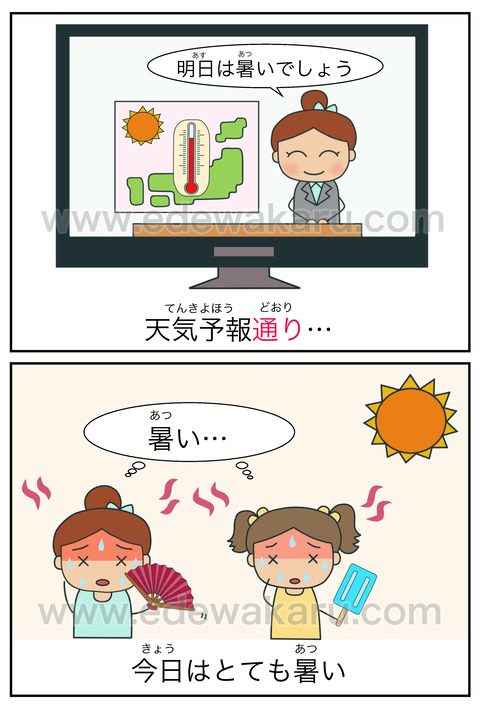
Meaning
Just like 〜
Just as it is
How to use it
Verb [dictionary form] + 通り
Verb [た-form] + 通り
Noun [dictionary form] + 通り
Noun [dictionary form] + の通り
Explanation
“〜通り” is a sentence pattern meaning “just like 〜.” When using this pattern, be careful about the reading. 😮 With verbs, it is always “〜とおり”; with nouns, it is “noun + どおり” or “noun + のとおり.” 😉
[With verbs, read it as “〜とおり”]
Please write it just as I say it.
Please write it just as I said it.
[With noun + 通り, read it as “〜どおり”]
It was hot today, just as the weather forecast predicted.
N1 was difficult, just as expected.
We’ll carry it out as scheduled.
[With noun + の通り, read it as “〜とおり”]
It was hot today, just as the weather forecast predicted.
N1 was difficult, just as expected.
Learn the words that are commonly used. 😀
[Commonly used expressions]
予定通り・予定の通り — as scheduled
計画通り・計画の通り — as planned
命令通り・命令の通り — as ordered
想像通り・想像の通り — just as imagined
希望通り・希望の通り — as desired
指示通り・指示の通り — as instructed
[For those who want to learn more]
“文字通り” is an idiom, so learn it.
“文字通り” → just as the words say; literally, without exaggeration
Learn it well and try using it in conversation. 😉
In context 3 examples
天気予報通り、今日はとても暑い
→天気予報(が伝えていたの)と同じように、今日はとても暑いIt’s very hot today, just as the weather forecast predicted. → It’s very hot today, just as the weather forecast (said it would be).
思った通り、N1は難しかった
→思っていたのと同じように、N1は難しかったAs I thought, N1 was difficult. → N1 was difficult, just as I thought it would be.
予定通り、来週から日本に出張します
→予定と同じように、来週から日本に出張しますAs scheduled, I’m going on a business trip to Japan starting next week. → I’m going on a business trip to Japan starting next week, just as scheduled.
Read the original source text
Meaning
〜と同じように
〜そのまま
How to use it
動詞[辞書形]+通り
動詞[た形]+通り
名詞[辞書形]+通り
名詞[辞書形]+の通り
Explanation
「〜通り」は「〜と同じように」という意味を表す文型です。この文型を使用するときに気をつけなければいけないのは読み方です😮動詞の場合は全部「〜とおり」になり、「名詞+どおり」「名詞+のとおり」となります😉
[動詞の場合は「〜とおり」]
私が言う
とおり
に書いてください
私が言った
とおり
に書いてください
[名詞+通りの場合は「〜どおり」]
天気予報
どおり、今日は暑かった
予想
どおり、N1は難しかった
予定
どおり
行います
[名詞+の通りの場合は「〜とおり」]
天気予報の
とおり、今日は暑かった
予想の
とおり、N1は難しかった
よく使われる単語は覚えておきましょう😀
[よく使われるもの]
予定通り・予定の通り
計画通り・計画の通り
命令通り・命令の通り
想像通り・想像の通り
希望通り・希望の通り
指示通り・指示の通り
【余裕がある人へ】
「文字通り」は慣用表現ですので覚えておきましょう。
「文字通り」→文字に書いているのと同じように・誇張せずそのまま
しっかりと覚えて会話で使ってみてくださいね😉
日本語文型辞典
Meaning
Attached to numerals or interrogative words such as 「何(なん)」 and 「幾(いく)」, it expresses the number of methods or types.
Attached to nouns for plans, schedules, instructions, or orders, or to the continuative form of thought verbs such as 「思う」 and 「考える」, it means “in the same way,” “as instructed,” or “as is.” In this usage it is always 「…どおり」. Other examples include 「命令どおり・型どおり・見本どおり・文字どおり・想像どおり」.
Attached to the dictionary or past form of verbs expressing speech or thought, such as 「言う」 and 「思う」, it means “just as” or “as … said/thought.”
How to use it
Numeral/なん/いく とおり
…どおり
N どおり
R-どおり
V-る/V-た とおり
In context 11 examples
駅からあの建物までには3通りの行き方がある。
There are three ways to get from the station to that building.
やり方は、何とおりもありますがどの方法がよろしいでしょう。
There are many ways to do it; which method would you prefer?
「生」の読み方は、いくとおりあるか知っていますか。
Do you know how many different ways the kanji 「生」 can be read?
計画はなかなか予定どおりには進まないものだ。
Plans rarely go ahead according to schedule.
すべて課長の指示どおり手配いたしました。
I made all the arrangements according to the section chief's instructions.
自分の気持ちを思いどおりに書くことは、簡単そうに見えて難しい。
Writing down your feelings just as you feel them looks easy, but it's difficult.
世の中は自分の考えどおりには動いてはくれないものだ。
The world doesn't move according to our own ideas.
おっしゃるとおりです。(=あなたの意見に賛成です。)
That's exactly right. (= I agree with your opinion.)
私の言うとおりに繰り返して言ってください。
Please repeat after me exactly as I say it.
先生の奥さんは私が想像していたとおりの美人でした。
The teacher's wife was as beautiful as I had imagined.
ものごとは自分で考えているとおりにはなかなか進まない場合が多い。
Things often do not go as smoothly as one imagines.
Read the original source text
Meaning
数詞や「何(なん)・幾(いく)」などの疑問詞に付いて、方法や種類の数を表す。
予定・計画・指示・命令などの名詞や「思う・考える」などの思考動詞の連用形に付いて、「それと同様に」「その通りに」「そのままに」といった意味を表す。この用法ではいつも「…どおり」となる。この他の例として「命令どおり・型どおり・見本どおり・文字どおり・想像どおり」などがある。
「言う」「思う」などの発言や思考を表す動詞の辞書形/タ形に付いて、それと同じようであるという意味を表す。
How to use it
数詞/なん/いく とおり
…どおり
Nどおり
R-どおり
V-る/V-た とおり
毎日のんびり日本語教師
How to use it
Verb dictionary form + 通り (とおり)
Verb ta-form + 通り (とおり)
Noun + の + 通り (とおり)
Noun + 通り (どおり)
Explanation
Means “in accordance with” or “the same as.”
It combines with particular words such as plans, schedules, orders, instructions, imagining, thinking, and considering.
Notes
Nothing in particular.
In context 8 examples
計画は予定通りに進んでいる。
The plan is proceeding as scheduled.
私の指示通りにやらなかったからこんなことになったんだろう。
This must have happened because you didn’t do it according to my instructions.
書通りに操作してみたが、よく分からなかった。
I tried operating it as written in the book, but I didn’t really understand.
ここに書いている通りにやれと言われたのでやったのに、なぜ叱られなければならないのか。
I did it because I was told to do it just as it’s written here, so why do I have to be scolded?
人生とは、自分が思い描いた通りに進まないものだ。
Life doesn’t go the way you picture it.
あれから事態は悪化する一方で、想像した通りの結果になった。
Things only got worse after that, and the result was just as I had imagined.
彼女は噂通りの美人だった。
She was as beautiful as the rumors said.
そちらのおっしゃる通りです。
That’s exactly as you say.
Read the original source text
How to use it
動辞形+通り(とおり)
動た形+通り(とおり)
名詞+の+通り(とおり)
名詞+通り(どおり)
Explanation
「~に従い」「~と同じ」という意味を表します。
予定や計画、命令、指示、想像する、思う、考えるなど特定の単語と結びつきます。
Notes
特になし