どんなときどう使う 日本語表現文型辞典
Meaning
is best, safest
How to use it
〔Plain form〕(present tense only)(ナAである/Nである)+ にこしたことはないS
Explanation
~方がいい、~方が安全だ
常識的に考えて、その方がいい、その方が安全だ、と言いたいときの表現。このことは当然のことだから、反対意見はないだろうと思われるようなことを言うときに使う。
Common sense says something is best or safest. Speaker feels statement is so true no one will hold an opposing opinion.
In context 4 examples
決められた時間より早めに着くにこしたことはない。
It’s best to arrive earlier than the designated time.
けんかなどはしないにこしたことはないが、がまんできない場合もあるだろう。
It’s best to avoid quarrels, though there may be times when you can’t put up with it.
体は健康であるにこしたことはない。
It’s best to be healthy.
収入は多いにこしたことはないが、働きすぎて体を壊したらだめだ。
The higher the income, the better, but you mustn’t ruin your health by working too much.
Read the original source text
Meaning
is best, safest
How to use it
〔普通形〕(現在形だけ)(ナAである/Nである)+にこしたことはないS
Explanation
~方がいい、~方が安全だ
常識的に考えて、その方がいい、その方が安全だ、と言いたいときの表現。このことは当然のことだから、反対意見はないだろうと思われるようなことを言うときに使う。
Common sense says something is best or safest. Speaker feels statement is so true no one will hold an opposing opinion.
日本語文型辞典
Meaning
Nであるにこしたことはない
Na(である)にこしたことはない
A-いにこしたことはない
V-るにこしたことはない
It means “it is better to ….” It is often used for things that are generally considered to be obviously desirable.
Examples:
1. It is better to be healthy.
2. The more money one has, the better.
3. As long as you do not have to worry about cleaning, the more spacious the house, the better.
4. My father always tells me that it is best to do everything carefully, yet yesterday he fell down the stairs and broke his leg.
Read the original source text
Meaning
基本情報NであるにこしたことはないNa(である)にこしたことはないA-いにこしたことはないV-るにこしたことはない説明「…のほうがいい」という意味を表す。常識的に当然と考えられていることについて使う場合が多い。例文① 体はじょうぶにこしたことはない。② 金はあるにこしたことはない。③ そうじのことを考えないかぎり、家は広いにこしたことはない。④ なにごとも慎重にやるにこしたことはないといつも私に言っている父が、きのう階段から落ちて足を折った。
日本語文型辞典 英語版
Meaning
【にこしたことはない】[Nであるにこしたことはない][Na (である)にこしたことはない][A-いにこしたことはない][V-るにこしたことはない]
Expresses the meaning of “...is better.” This expression is often used to indicate something naturally considered as common knowledge.
In context 4 examples
体はじょうぶにこしたことはない。
Keeping your health is always better.
金はあるにこしたことはない。
Money is never unnecessary.
そうじのことを考えないかぎり、家は広いにこしたことはない。
As long as you don’t think about cleaning, spacious houses are always better.
なにごとも慎重にやるにこしたことはないといつも私に言っている父が、きのう階段から落ちて足を折った。
My father, who had kept saying to me that things should always be done carefully, fell down the stairs and broke his leg.
IMABI
Best That
Read this IMABI lesson ↗Explanation
Best That: ~方 Patterns & ~に越したことはない
For some reason, students are compelled to use the word 方 excessively.
Best/Better That
方がいい means “best to…” and with verbs, you should use the past tense, and with adjectives or the negative, you should use the non-past tense. However, this can still be used with the non-past of verbs, and いい can be replaced with phrases like 賢明だ (wise).
~方がいい is used in the written and spoken language. It is often used in daily conversation, but it is often used by Japanese learners when giving suggestions/advice, which may lead some Japanese to smirk.
Non-past +方がいい is primarily used with one’s in-group as it is used a lot in situations where you are giving direct advice on what is best to do. Past+方がいい is felt to be more euphemistic and is often used towards one’s out-group. However, some people have personal preferences for one or the other.
1. 今すぐ行った方がいいです。
It’d be best to go right now.
2. 寝た方がいい。
It’s best to sleep.
3. よく考えた方がいい。
You’d better think that over.
4. 泳ぐ前に、日焼ひやけ止どめを塗ぬった方がいいよ。
It’s best to put on sunblock before swimming.
5. 卵たまごは食べない方がいい。 (Contrasting and or highlighting)
It’s best to not eat eggs.
6. {ほとんどの}わずかな店みせしか開いていないから、今食品を買った方がいい。
Since there are only but a few stores that are open, it’s best to buy food now.
7. 彼はそこへ行った方がよい。
It is best for him to go there.
8. 毎日運動した方がいい。
It’s best to exercise every day.
Nuance Note: Even when there is not a second reference mentioned, this pattern implies a comparison between things. It may sound pushy depending on the context as it can be used to impose your will/thought. When you want to make a simple suggestion, you can use ~たらいい.
Again, other things than just いい may also appear in this fashion.
9. 当人に会って直接に話し合った方が効果こうかはあると思います。
I think that it is effective to meet with the said person and directly talk together (about it).
Non-Past + 方がいい
It is also worth noting that when you use the pattern “Non-past+方がいい”, there could be several things that are good to do in the said situation, but you pick one as an example of being good.
10. 折りにふれて想起そうきするほうがいい。
Occasionally, it is good to call it to mind.
~がよい
~がよい can create a suggestion bordering on a command, and it uses older grammar by just directly following verbs without the need of a nominalizer like の.
11. そうするがよい。
You had better do it.
~方: How to…
Following the stem of a verb, ~方かた means “how to…”. Sometimes this may not show up in translation. For instance, 読み方 may very well be able to be translated as “how to read,” but it can also be sufficiently translated as “reading” depending on context.
12. 弟の笑い方が気に食わねー。(Slang)
I can’t stand the way my little brother smiles.
13. 日本語の書き方をよく知っていますか。
Do you know how to write Japanese well?14. 行き方が全く分からない。
I don’t know the way to go at all.
15. どの読み方を使うべきかは分かりません。
I don’t know which reading I’m supposed to use.
16. 本当に酷ひどい言い方だよ。
That’s a hideous way to talk.
17. しかたがありません。(Set Phrase)
It can’t be helped.
18. 簡単な覚え方を教えてくださいませんか。
Could you teach me an easy way to remember?
~に越したことはないが
~に越こしたことはない(が) means “can never…too much” and is used in giving common sense advice. The verb 越す has meanings all related to the idea of “surpassing”. This phrase is used to show that nothing beats doing X. So, when young people use it in certain situations, it can make them sound arrogant.
If turned into ~に越したことはなかった, you end up showing regret. This is because you recognize what was the best thing to do, but you didn’t do it. This directly follows verbs and adjectives, but for adjectival nouns, the copula is either as である or not there at all (which is most common).
19. 傘かさを持つに越したことはない。
It’s always best to have an umbrella.
20. 貯金をするに越したことはなかったが、ちょっと生活を楽しむことができた。
Nothing would have beat saving, but I got to enjoy life a little.
21. 用心ようじんに越したことはないが、そんな服装を着るなんて派手はですぎるじゃない?
You can never be too careful, but isn’t wearing an outfit like that too showy?
In context 20 examples
今すぐ行った方がいいです。
It’d be best to go right now.
寝た方がいい。
It’s best to sleep.
よく考えた方がいい。
You’d better think that over.
泳ぐ前に、日焼ひやけ止どめを塗ぬった方がいいよ。
It’s best to put on sunblock before swimming.
卵たまごは食べない方がいい。 (Contrasting and or highlighting)
It’s best to not eat eggs.
{ほとんどの}わずかな店みせしか開いていないから、今食品を買った方がいい。
Since there are only but a few stores that are open, it’s best to buy food now.
彼はそこへ行った方がよい。
It is best for him to go there.
毎日運動した方がいい。
It’s best to exercise every day.
当人に会って直接に話し合った方が効果こうかはあると思います。
I think that it is effective to meet with the said person and directly talk together (about it).
折りにふれて想起そうきするほうがいい。
Occasionally, it is good to call it to mind.
そうするがよい。
You had better do it.
弟の笑い方が気に食わねー。(Slang)
I can’t stand the way my little brother smiles.
日本語の書き方をよく知っていますか。
Do you know how to write Japanese well?
どの読み方を使うべきかは分かりません。
I don’t know which reading I’m supposed to use.
本当に酷ひどい言い方だよ。
That’s a hideous way to talk.
しかたがありません。(Set Phrase)
It can’t be helped.
簡単な覚え方を教えてくださいませんか。
Could you teach me an easy way to remember?
傘かさを持つに越したことはない。
It’s always best to have an umbrella.
貯金をするに越したことはなかったが、ちょっと生活を楽しむことができた。
Nothing would have beat saving, but I got to enjoy life a little.
用心ようじんに越したことはないが、そんな服装を着るなんて派手はですぎるじゃない?
You can never be too careful, but isn’t wearing an outfit like that too showy?
Read the original source text
Explanation
Best That: ~方 Patterns & ~に越したことはない
For some reason, students are compelled to use the word 方 excessively.
Best/Better That
方がいい means “best to…” and with verbs, you should use the past tense, and with adjectives or the negative, you should use the non-past tense. However, this can still be used with the non-past of verbs, and いい can be replaced with phrases like 賢明だ (wise).
~方がいい is used in the written and spoken language. It is often used in daily conversation, but it is often used by Japanese learners when giving suggestions/advice, which may lead some Japanese to smirk.
Non-past +方がいい is primarily used with one’s in-group as it is used a lot in situations where you are giving direct advice on what is best to do. Past+方がいい is felt to be more euphemistic and is often used towards one’s out-group. However, some people have personal preferences for one or the other.
1. 今すぐ行った方がいいです。
It’d be best to go right now.
2. 寝た方がいい。
It’s best to sleep.
3. よく考えた方がいい。
You’d better think that over.
4. 泳ぐ前に、日焼ひやけ止どめを塗ぬった方がいいよ。
It’s best to put on sunblock before swimming.
5. 卵たまごは食べない方がいい。 (Contrasting and or highlighting)
It’s best to not eat eggs.
6. {ほとんどの}わずかな店みせしか開いていないから、今食品を買った方がいい。
Since there are only but a few stores that are open, it’s best to buy food now.
7. 彼はそこへ行った方がよい。
It is best for him to go there.
8. 毎日運動した方がいい。
It’s best to exercise every day.
Nuance Note: Even when there is not a second reference mentioned, this pattern implies a comparison between things. It may sound pushy depending on the context as it can be used to impose your will/thought. When you want to make a simple suggestion, you can use ~たらいい.
Again, other things than just いい may also appear in this fashion.
9. 当人に会って直接に話し合った方が効果こうかはあると思います。
I think that it is effective to meet with the said person and directly talk together (about it).
Non-Past + 方がいい
It is also worth noting that when you use the pattern “Non-past+方がいい”, there could be several things that are good to do in the said situation, but you pick one as an example of being good.
10. 折りにふれて想起そうきするほうがいい。
Occasionally, it is good to call it to mind.
~がよい
~がよい can create a suggestion bordering on a command, and it uses older grammar by just directly following verbs without the need of a nominalizer like の.
11. そうするがよい。
You had better do it.
~方: How to…
Following the stem of a verb, ~方かた means “how to…”. Sometimes this may not show up in translation. For instance, 読み方 may very well be able to be translated as “how to read,” but it can also be sufficiently translated as “reading” depending on context.
12. 弟の笑い方が気に食わねー。(Slang)
I can’t stand the way my little brother smiles.
13. 日本語の書き方をよく知っていますか。
Do you know how to write Japanese well?14. 行き方が全く分からない。
I don’t know the way to go at all.
15. どの読み方を使うべきかは分かりません。
I don’t know which reading I’m supposed to use.
16. 本当に酷ひどい言い方だよ。
That’s a hideous way to talk.
17. しかたがありません。(Set Phrase)
It can’t be helped.
18. 簡単な覚え方を教えてくださいませんか。
Could you teach me an easy way to remember?
~に越したことはないが
~に越こしたことはない(が) means “can never…too much” and is used in giving common sense advice. The verb 越す has meanings all related to the idea of “surpassing”. This phrase is used to show that nothing beats doing X. So, when young people use it in certain situations, it can make them sound arrogant.
If turned into ~に越したことはなかった, you end up showing regret. This is because you recognize what was the best thing to do, but you didn’t do it. This directly follows verbs and adjectives, but for adjectival nouns, the copula is either as である or not there at all (which is most common).
19. 傘かさを持つに越したことはない。
It’s always best to have an umbrella.
20. 貯金をするに越したことはなかったが、ちょっと生活を楽しむことができた。
Nothing would have beat saving, but I got to enjoy life a little.
21. 用心ようじんに越したことはないが、そんな服装を着るなんて派手はですぎるじゃない?
You can never be too careful, but isn’t wearing an outfit like that too showy?
絵でわかる日本語
Meaning
It is best to 〜 / It is best not to 〜
〜 is best / not doing 〜 is best
(Naturally) 〜 would be better
How to use it
Verb・adjective・noun [dictionary form] + に越したことはない
Verb・adjective・noun [ない-form] + に越したことはない
*For な-adjectives, it becomes “ーな + にこしたことがない”
*For な-adjectives and nouns, the form “ーである + に越したことはない” can also be used
Explanation
“〜に越したことはない” is a grammar pattern meaning “it is best to 〜.” It is used when saying that, among various options (such as methods), that one is the best 😊 It resembles “〜たほうがいい,” but “〜たほうがいい” expresses the better option in a comparison, whereas “〜に越したことはない” means that, among the available options, “〜 is naturally the best” 😮 In most cases, the two can be rewritten as one another 😌
[Examples]
Beer is better cold.
→When choosing between cold and not cold, I prefer it cold.
Beer is best cold.
→Cold is the best.
There is also the expression “〜のに越したことはない,” so learn it along with this one 😉
In context 3 examples
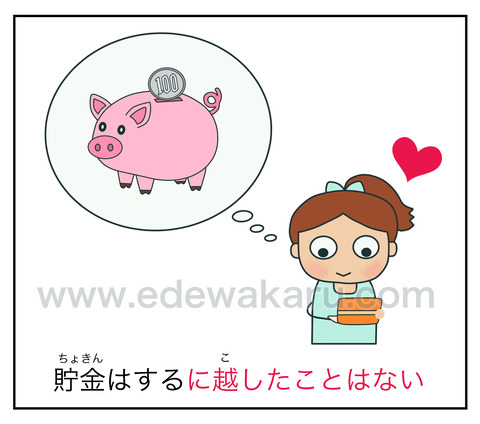
貯金はするに越したことはない
→貯金は当然しておいたほうがいいIt’s best to save money. →You should naturally save money.
健康のためには、タバコは吸わないに越したことはない
→健康のためには、タバコは吸わないのが一番いいFor the sake of your health, it’s best not to smoke at all. →For the sake of your health, not smoking is best.
給料はいいに越したことはない
→給料はいいのが一番いいThe higher the salary, the better. →A good salary is best.
Read the original source text
Meaning
〜するのが一番いい・〜しないのが一番いい
〜が一番いい ・〜ないのが一番いい
(当然)〜のほうがいい
How to use it
動詞・形容詞・名詞[辞書形]+に越したことはない
動詞・形容詞・名詞[ない形]+に越したことはない
*な形容詞は「ーな+にこしたことがない」になる
*な形容詞・名詞は「ーである+に越したことはない」という言い方もある
Explanation
「〜に越したことはない」は「〜するのが一番いい」 という意味で使用される文型です。これは色々(方法などが)ある中で、それが一番いいと言いたい時に使われます😊「〜たほうがいい」に似ていますが、「〜たほうがいい」は比較をしていい方を表す表現で、「〜に越したことはない」はいくつかある中で「〜が当然一番いい」ということを表します😮ほとんどの場合、書き換えることはできます😌
[例]
ビールは冷たい
ほうがいい
→「冷たい」か「冷たくない」かだと「冷たい」ほうが好き
ビールは冷たい
に越したことはない
→「冷たい」のがベストだ
「〜のに越したことはない」という言い方もありますので、一緒に覚えておきましょう😉
くらべてわかる日本語表現文型辞典
Meaning
Meaning 1: It is better to have A than not to have it. It is desirable to have the positive thing A.
Meaning 2: In the form “〜ないに越したことはない.” If possible, it is desirable that the negative thing A not occur.
How to use it
Aに越したことはない
Construction 1:
[Verb—る form / ている form] に越したことはない
[い-adjective—い] に越したことはない
[な-adjective—である] に越したことはない
[Noun—∅] に越したことはない
Construction 2:
[Verb—ない form] に越したことはない
[い-adjective—くない] に越したことはない
[Noun—∅] がないに越したことはない
[Noun—ではない] に越したことはない
In context 8 examples
値段は安いに越したことはないが、やはり品質が一番だ。
The cheaper the price, the better, but quality comes first after all.
就職するなら、技術力や語学力はあるに越したことはない。
If you’re going to get a job, it’s better to have technical skills and language skills.
明るいうちに帰りなさい。用心するに越したことはないですよ。
Come home while it’s still light. You can’t be too careful.
芸能人になるなら、白い歯に越したことはないよ。
If you want to become an entertainer, having white teeth is definitely preferable.
平和が一番だ。戦争なんてないに越したことはない。
Peace is best. It’s better if there are no wars.
自動車保険は使わないに越したことはないが、もしものときのために入っておいたほうがいい。
It’s better not to have to use car insurance, but you should get it in case something happens.
天災は忘れた頃にやってくるといわれるが、災害など起こらないに越したことはない。
They say natural disasters strike when people have forgotten about them, but it’s better if disasters never happen.
申請手続きはわずらわしくないに越したことはない。
It’s better if the application procedure isn’t troublesome.
Read the original source text
Meaning
意味1:AでないよりAであったほうがいい。Aというプラスのことがあるのが望ましい。
意味2:「〜ないに越したことはない」の形で。できれば、Aというマイナスのことがないのが望ましい。
How to use it
Aに越したことはない
接続1:
[動詞-る形/ている形]に越したことはない
[イ形-い]に越したことはない
[ナ形-である]に越したことはない
[名詞-∅]に越したことはない
接続2:
[動詞-ない形]に越したことはない
[イ形-くない]に越したことはない
[名詞-∅]がないに越したことはない
[名詞-ではない]に越したことはない
毎日のんびり日本語教師
How to use it
Verb dictionary form + に越したことはない
Verb nai-form + に越したことはない
い-adjective dictionary form + に越したことはない
な-adjective stem + に越したことはない
な-adjective stem + である + の + に越したことはない
Noun + に越したことはない
Noun + である + の + に越したことはない
Explanation
Expresses that, among all the methods one can think of, that method is relatively good.
It is used for things that are generally accepted as common sense or are self-evident.
It often expresses a modest evaluation that this method would be preferable if possible, rather than an emphatic evaluation that it is the very best.
Notes
Nothing in particular.
In context 10 examples
健康のためには運動するに越したことはないが、習慣化するのが難しい。
For your health, it's best to exercise, but it's hard to make it a habit.
家まで近いからよく通ってるけど、この道は夜一人で歩かないに越したことはない。
I often take this road because it's close to my house, but it's best not to walk along it alone at night.
結婚相手はと聞かれれば、当然金持ちであるに越したことはない。
If you ask what kind of person I'd marry, naturally, the richer the better.
たとえわずかでも、宿題は早めに終わらせるに越したことはない。
Even if it's only a little, it's best to finish your homework early.
未来の選択肢は多いに越したことはないだろう。
It's probably best to have more options for the future.
お客様とのトラブルは無いに越したことはない。(最好不要跟客人引起纠纷。)
It's best to avoid trouble with customers. (It's better not to get into disputes with customers.)
何をされるか分からないので、用心するに越したことはない。
Since you never know what someone might do, it's best to be cautious.
パソコンは高性能であるのに越したことはない。(最好是要高性能的电脑。)
The higher the performance of a computer, the better. (It's best to have a high-performance computer.)
自分の好きな事をして生きていけるのならそれに越したことはない。
If you can make a living doing what you love, nothing could be better.
いつ故障するか分からないのだから、定期的にバックアップを取るなどの備えは多いに越したことはない。
Since you never know when it might break, the more preparations you make, such as backing up regularly, the better.
Read the original source text
How to use it
動辞形+に越したことはない
動ない形+に越したことはない
イ形辞書形+に越したことはない
ナ形語幹+に越したことはない
ナ形語幹+である+の+に越したことはない
名詞+に越したことはない
名詞+である+の+に越したことはない
Explanation
考えられる全ての方法の中でその方法が比較的良いことを表します。
社会通念上一般常識的なこと、当然なことに用います。
最も良いという積極的な評価ではなく、できればこの方法が良いという消極的評価を表す場合が多いです。
Notes
特になし
NINJAL 日本語文型データベース
Meaning
Used to state a judgment that, although it is not absolutely necessary, common sense suggests that ~ is better or is a good course of action.
How to use it
V-dictionary form に越したことはない / Vない に越したことはない
i-Aい に越したことはない / i-Aくない に越したことはない
na-A に越したことはない・na-Aである に越したことはない / na-Aでない に越したことはない
N に越したことはない・Nである に越したことはない / Nでない に越したことはない
In context 20 examples
健康のために、日頃から運動するに越したことはない。
For your health, it is best to exercise regularly.
電気製品は性能から考えて最新モデルを買うに越したことはないと思います。
Considering their performance, I think it's best to buy the latest model of electrical appliances.
旅行先がいくら安全な所でも、用心するに越したことはありません。
No matter how safe your travel destination is, it's best to be cautious.
人の悪口は言わないで済むのなら、言わないに越したことはありません。
If you can avoid speaking ill of people, it is best not to.
娘が夜でもピアノの練習ができるように、防音室を作った。ご近所とのトラブルはないにこしたことはないので。
I built a soundproof room so my daughter could practice piano even at night. It's best not to have trouble with the neighbors.
「善は急げ」と言うように、行動は早いに越したことはない。
As the saying “The early bird catches the worm” goes, it is best to act quickly.
給料はいいに越したことはありませんが、それより大事なのは好きな仕事かどうかということです。
A good salary is certainly preferable, but what matters more is whether you like the job.
いつ病気になるかわからないので、保険に入るなどの備えは多いに越したことはありません。
Since you never know when you might get sick, it's best to have plenty of preparations, such as taking out insurance.
通勤が大変なので、家は勤務先から遠くないにこしたことはない
Commuting is difficult, so it's best if the house isn't far from work.
「山頂へのルートは危なくないに越したことはないですよね。時間はかかるけど、こちらのルートを行きましょう」
“It's best if the route to the summit isn't dangerous, right? It takes longer, but let's take this route.”
近年、手書きをする機会が減っていますが、字はきれいに越したことはありません。
These days, there are fewer opportunities to write by hand, but it is always better to have neat handwriting.
人は健康であるに越したことはない。日頃から健康には気をつけたいものだ。
It is best for people to be healthy. We should take care of our health every day.
パソコンやスマホは高性能であるに越したことはないという意見もあるが、機能が限られていても安いほうがいいという意見もある。
Some people say that computers and smartphones are best when they have high performance, while others think that cheaper is better even if the features are limited.
交際相手はギャンブル好きでないにこしたことはないが、のめり込むほどでなければ問題ないと思う。
It's best if your partner isn't fond of gambling, but I think it's not a problem as long as they don't get too involved in it.
運動会の日は多少暑くても晴天に越したことはない。
On the day of the sports festival, sunny weather is best, even if it is somewhat hot.
車を買うなら環境負荷が少ないものに越したことはないと言う人が増えてきた。
More and more people say that if you buy a car, one with a lower environmental impact is best.
特に子どものお菓子は、香料や着色料などが無添加であるに越したことはないというのが一般的な親の考えだろう。
Most parents probably think it is best for children's snacks in particular to contain no additives such as flavorings or colorings.
仕事が忙しいときは、飲み会は平日でないに越したことはないよね。
When work is busy, it's best if the drinking party isn't on a weekday, right?
栄養面を考えると、食事はインスタントでないに越したことはありません。
From a nutritional perspective, it is best if meals aren't instant food.
電話と違って、メールは何時に送ることもできるが、深夜や早朝でないにこしたことはない。
Unlike a phone call, an email can be sent at any time, but it's best not to send one late at night or early in the morning.
Read the original source text
Meaning
そうでなければいけないというほどではないが、常識的に考えて、~ほうがいい、または、~が良い手段だという判断を述べるときに使います。
How to use it
Vるに越したことはない/Vないに越したことはない
i-Aいに越したことはない/i-Aくないに越したことはない
na-Aに越したことはない・na-Aであるに越したことはない/na-Aでないに越したことはない
Nに越したことはない・Nであるに越したことはない/Nでないに越したことはない