文法
Meaning
Looks like 〜 / feels like 〜
Used when you want to say that something is not actually so, but looks or feels as though it is.
How to use it
V (plain form) + かのようだ
い-adjective (plain form) + かのようだ
な-adjective (plain form) + かのようだ
N (plain form) + かのようだ
※For the affirmative present form of a な-adjective: な-adjective + である + かのようだ
※For the affirmative present form of N: N + かのようだ / N + である + かのようだ
Notes
When a noun follows, the form is “〜かのようなN.”
In context 6 examples
3月なのにまた、寒くなりましたね。まるで真冬に戻ったかのようですね。
It’s March, but it’s gotten cold again. It’s as if we’ve gone back to the middle of winter.
妻は付き合って初めてあげたネックレスを10年経った今でも、宝物かのように大切にしている。
Even now, ten years later, my wife cherishes the necklace I first gave her when we started dating as if it were a treasure.
彼はまるで全てを知っているかのように話しているが、全て彼の想像にすぎない。
He talks as if he knows everything, but it’s all just his imagination.
彼は今日初めて会うのに、前に何度も会ったことがあるかのような態度で話してくる。
Even though he’s meeting me for the first time today, he talks to me as if we’ve met many times before.
Instagramでたくさんの人にフォロワーされると、まるで有名人にでもなったかのようだ。
When lots of people follow you on Instagram, it feels as if you’ve become a celebrity.
彼女は辛い出来事があったにもかかわらず、何事もなかったかのように明るく振舞っていた。
Despite having gone through something painful, she acted cheerfully as if nothing had happened.
Read the original source text
Meaning
〜ように見える / 〜ように感じる
実際にはそうではないが〜のように見えたり感じたりすると言いたい時に使う。
How to use it
V(普通形)+ かのようだ
イA(普通形)+ かのようだ
ナA(普通形)+ かのようだ
N(普通形)+ かのようだ
※ナAの現在形の肯定形は「ナAである + かのようだ」
※Nの現在形の肯定形は「N + かのようだ / Nである + かのようだ」
Notes
後ろに名詞が来る場合は「〜かのようなN」となる
Bunpro Grammar Reference
Meaning
As if, Just like
How to use it
Verb + かのようだ(1)
[い]Adjective + かのようだ(1)
[な]Adjective + である + かのようだ(1)
Noun + である + かのようだ(1)
(1) かのように + Phrase、かのような + Noun
Verb + かのようです(1)
[い]Adjective + かのようです(1)
[な]Adjective + である + かのようです(1)
Noun + である + かのようです(1)
(1) かのように + Phrase、かのような + Noun
Nuance
An expression highlighting that the manner in which (B) is doing something is questionably like (A). As if it were (A).
Explanation
かのようだ is a set phrase in Japanese indicating that something 'appears to be (A)', but the speaker is not certain. It will be translated as 'as if (A)', or 'just like (A)'. This is a combination of the adverbial particle か, の and the auxiliary verb 様だ 'appearing to be'. The more literal meaning can be thought of as 'is it not like (A)?', due to the uncertainty expressed by か.
かのようだ may follow verbs and い-Adjectives, or な-Adjectives and nouns followed by である.
このVR(ブイアール)フライトゲームはものすごくリアルだ。まるで本物の飛行機を操縦しているかのようだ。
This VR flight game is so realistic. It is just as if I am flying an actual airplane.
なんだこの静けさは。この町には誰もいないかのようだ。
What is this quietness? It is as if there is no one in this town.
彼はまるで私と話すのが面倒であるかのようだ。
He talks to me as if it was a chore.
彼と僕は兄弟であるかのようだが、実は彼は僕のパートナーです。
It is as if he and I are brothers, but actually he is my partner.
When ようだ is altering the meaning of a verb or a noun later in the sentence, ように or ような may also be used.
長谷川くんのお母さんは私を自分の子供であるかのように小さい頃から可愛がってくれていた。
Hasegawa-kun's mother has taken care of me just as if I was her own child.
このスーパーに入ると、まるで母国に帰ってきたかのような感じがする。
When I enter this supermarket, I feel as if I am back in my home country.
This grammar construction will often be seen with expressions that emphasize the speaker's assumption about (A), such as まるで. If compared to English, this merely strengthens the sentence in a similar way to the difference between 'it's as if (A)', and 'it's just as if (A)'.
In context 18 examples
- その作品は、あの有名な作品を真似たかのようですね。
That item looks as if it is imitating that other famous item.
- このVR(ブイアール)フライトゲームはものすごくリアルだ。まるで本物の飛行機を操縦しているかのようだ。
This VR flight game is so realistic. It is just as if I am flying an actual airplane.
- 彼はまるで私と話すのが面倒であるかのようだ。
He talks to me as if it was a chore.
- なんだこの静けさは。この町には誰もいないかのようだ。
What is this quietness? It is as if there is no one in this town.
- 彼と僕は兄弟であるかのようだが、実は彼は僕のパートナーです。
It is as if he and I are brothers, but actually he is my partner.
- 長谷川くんのお母さんは私を自分の子供であるかのように小さい頃から可愛がってくれていた。
Hasegawa-kun's mother has taken care of me just as if I was her own child.
- このスーパーに入ると、まるで母国に帰ってきたかのような感じがする。
When I enter this supermarket, I feel as if I am back in my home country.
- 彼はまるでお腹に風船を入れているかのようだ。
It is just as if he has a balloon in his belly.
- あの会社は営業中も休業しているかのようだ。
That company looks as if they are closed even during operation hours.
- 彼は相当目がいい。望遠鏡を使っているかのようだ。
He has extremely good eyesight. It is as if he is using a telescope.
- あのシャツの色と柄じゃあ、包帯をしているかのようですね。
That shirt's color and patterns makes it look as if you are wearing a bandage.
- あのピッチャー、豆を撒いているかのような投げ方をする。
That pitcher's throw is as if he is spreading seeds.
- ライバル会社のあの人、まるでうちの会社の方針を知っているかのようだ。
That person from a rival company acts as if he knows our company's plans.
- 誰かと待ち合わせているかのように見えたが、ただぼーっと立っていただけだった。
(He) appeared as if (he) was waiting for someone, but (he) was just standing there, spacing out.
- 初めてなのに、分量が分かっているかのように料理を作っている。
Even though it's their first time, they are making food as if they understand how much of each item they need.
- うちの犬は生きていたとき私をときどきじろじろ見たもので、あたかも何か言いたいかのようだった。
My dog used to stare at me from time to time when it was still around just like it was trying to tell me something.
- その歌手の振る舞いは名高い歌手であるかのようだが、実はキャリアを始めたばかりだ。
That singer's behavior is as if she is famous, but in reality, she has just begun her career.
- その日、隣の家の子供とすこし話した。10才の子供でも喋り方はまるでもう大人であるかのようだった。
On that day I spoke to the neighbor's child a bit. Despite being a ten year old, they spoke as if they were an adult.
絵でわかる日本語
Meaning
although it isn’t really 〜, it seems like 〜
How to use it
Verb or adjective [plain form] + かのようだ
Noun [dictionary form] + であるかのようだ
Explanation
“〜かのようだ” is a sentence pattern meaning “although it isn’t really 〜, it seems like 〜.” It is just right when you want to say “although it isn’t really 〜, it feels as if it were 〜.” 😊 Its form changes depending on what comes after it. 😀
(Review: 〜によって (distinction))
[Forms of “〜かのよう”]
① 〜かのようだ。
② 〜かのように + verb or adjective
③ 〜かのような + noun
[Examples]
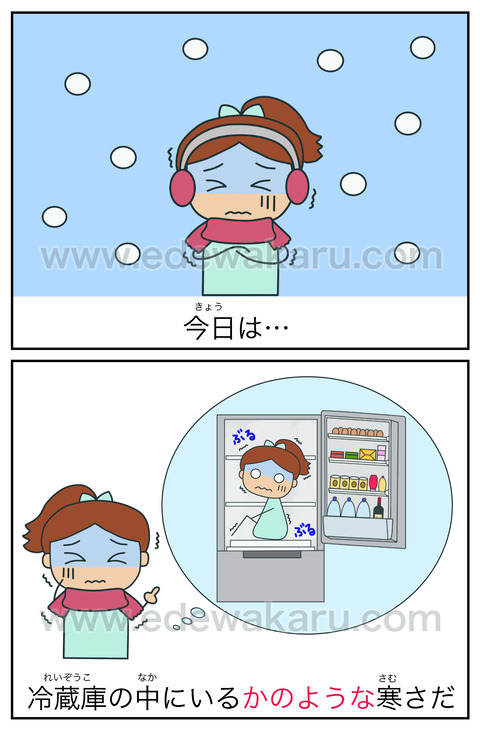
① It’s cold today. It’s as if I were inside a refrigerator.
② Today it’s cold as if I were inside a refrigerator. [“寒い” is an adjective]
③ Today it’s refrigerator-like cold. [“寒さ” is a noun]
This pattern is also often used together with “まるで.” 😀
(Review: まるで〜)
Advanced learners should also remember that it is often used with “あたかも” and “さも.” 😉
[Examples]
It’s cold today.
It’s as if I were
まるで
inside a refrigerator.
It’s cold today.
It’s as if I were
あたかも
inside a refrigerator.
It’s cold today.
It’s as if I were inside a refrigerator,
さも.
In context 4 examples
今日は冷蔵庫の中にいるかのような寒さだ
→今日は、冷蔵庫の中にいるような寒さだIt’s cold today, as if I were inside a refrigerator. → Today, it’s as cold as if I were inside a refrigerator.
10月なのに、このところ夏であるかのような暑さだ
→10月なのに、このところ夏のような暑さだ(復習:〜ところ(Nのところ))It’s October, but lately it’s as hot as if it were summer. → It’s October, but lately it’s as hot as summer. (Review: 〜ところ (Nのところ))
彼は何でも知っているかのように話す
→彼は何でも知っているような感じで話すHe talks as if he knows everything. → He talks as though he knows everything.
彼女の肌は雪であるかのように白い
→彼女の肌は雪のように白いHer skin is white as if it were snow. → Her skin is white like snow.
Read the original source text
Meaning
実際は〜ではないが、〜ようだ
How to use it
動詞・形容詞[普通形]+かのようだ
名詞[辞書形]+であるかのようだ
Explanation
「〜かのようだ」は「実際は〜ではないが、〜ようだ」という意味を表す文型です。「実際は〜ではないが、〜のように感じる」と言いたい時にぴったりの表現です😊後ろに何がくるかによって、形が変わります😀
(復習:〜によって(区別))
[「〜かのよう」の形]
①〜かのようだ。
②〜かのように+動詞・形容詞
③〜かのような+名詞
[例]
①今日は寒い。冷蔵庫の中にいる
かのようだ
②今日は冷蔵庫の中にいる
かのように
寒い【「寒い」は形容詞】
③今日は冷蔵庫の中にいる
かのような
寒さだ【「寒さ」は名詞】
また、この文型は
「まるで」
と一緒によく使います😀
(復習:まるで〜)
上級レベルの人は
「あたかも」「さも」
ともよく使うと覚えておきましょう😉
[例]
今日は寒い。
まるで
冷蔵庫の中にいる
かのようだ
今日は寒い。
あたかも
冷蔵庫の中にいる
かのようだ
今日は寒い。
さも
冷蔵庫の中にいるかのようだ
くらべてわかる日本語表現文型辞典
Meaning
Meaning 1: The speaker feels that something is just like A, even though A may not actually be the case.
Meaning 2: Although the actual situation is unknown, the speaker thinks or feels that B is A.
How to use it
A かのようだ (A かのような B / A かのように B)
[verb] かのようだ
[noun である / ではない / だった] かのようだ
[な-adjective である / だった / ではない] かのようだ
Explanation
[Contrast 1]
「A ように B」 (Meaning 4, p. 320)
One variant of 「A ように B」, 「A (の) ようだ」, conveys conjecture: “it is unclear, but it seems that …”. 「A かのようだ」 does not have this meaning.
○雨が降っているようだ。(雨の音などによって、降っていると思う) — It seems to be raining. (I think so because, for example, I hear the rain.)
○雨が降っているかのようだ。(本当は降っていないが、降っているように感じる) — It is as if it were raining. (It is not actually raining, but it feels as though it is.)
[Contrast 2]
「A ように B」 (Meaning 2, p. 319)
One variant of 「A ように B」, 「A (の) ようだ」, and 「A かのようだ」 both mean that the speaker feels the situation is A, but 「A かのようだ」 sounds more ambiguous.
○いくら大臣でも女性を軽視するような発言は許せない。 — Even if he is a cabinet minister, remarks that seem to belittle women are unacceptable.
○いくら大臣でも女性を軽視するかのような発言は許せない。 — Even if he is a cabinet minister, remarks that seem as if they belittle women are unacceptable.
In context 8 examples
彼の話し方はその事件を実際に見ていたかのようだ。
The way he talks is as if he had actually witnessed the incident.
彼女はぼくのことを好きであるかのような態度をとる。
She acts as if she likes me.
弟はまるで私がいじめたかのように母に告げ口をする。
My younger brother tells our mother on me as if I had bullied him.
彼女はまるで母親であるかのように優しく私を慰めてくれた。
She comforted me gently, as if she were my mother.
彼は出て行けというかのような目で私を見た。
He looked at me with eyes that seemed to say, “Get out.”
その部屋には心が癒されるかのような音楽が流れていた。
Music that seemed to soothe the soul was playing in that room.
部下のわがままを黙認するかのような部長の態度は許せない。
I can’t stand the department head’s attitude, which seems to condone his subordinates’ selfishness.
彼女は「たくさん別荘があると管理が大変よ」と、自慢しているかのように話した。
She spoke as if she were bragging when she said, “Having lots of vacation homes is a lot of work to manage.”
Read the original source text
Meaning
意味1:(Aは事実ではないかもしれないが)まるでAみたいだと話し手が感じる。
意味2:実際は分からないが、話し手はBをAだと思っている、感じている。
How to use it
Aかのようだ(AかのようなB/AかのようにB)
[動詞]かのようだ
[名詞-である/ではない/だった]かのようだ
[ナ形-である/だった/ではない]かのようだ
Explanation
【対比1】
「AようにB」(意味4 P.320)
「AようにB」のバリエーションの一つ「A(の)ようだ」には、はっきりわからないが、という推量の意味があるが、「Aかのようだ」にはこの意味がない。
○雨が降っているようだ。(雨の音などによって、降っていると思う)
○雨が降っているかのようだ。(本当は降っていないが、降っているように感じる)
【対比2】
「AようにB」(意味2 P.319)
「AようにB」のバリエーションの一つ「A(の)ようだ」と「Aかのようだ」は、話し手がその事態をAと感じているという意味では同じだが、「Aかのようだ」の方があいまいな感じが強い。
○いくら大臣でも女性を軽視するような発言は許せない。
○いくら大臣でも女性を軽視するかのような発言は許せない。
日本語NET JLPT文法解説まとめ
Meaning
"Seem like ~ / feel as though ~"
Used when you want to say that something seems or feels a certain way, even though it is not actually so.
How to use it
V (plain form) + かのようだ
い-adjective (plain form) + かのようだ
な-adjective (plain form) + かのようだ
Noun (plain form) + かのようだ
※ For the affirmative present form of a な-adjective, use 「な-adjectiveである + かのようだ」
※ For the affirmative present form of a noun, use 「Noun + かのようだ / Nounである + かのようだ」
Explanation
"seems / feels like"
Used when you want to say that something seems or feels a certain way, even though it is not actually so.
When followed by a noun, it takes the form 「〜かのようなN」.
In context 6 examples
3月なのにまた、寒くなりましたね。まるで真冬に戻ったかのようですね。
It’s March, but it’s gotten cold again. It’s as if we’ve gone back to the middle of winter.
妻は付き合って初めてあげたネックレスを10年経った今でも、宝物かのように大切にしている。
Even now, ten years later, my wife cherishes the necklace I first gave her when we started dating as if it were a treasure.
彼はまるで全てを知っているかのように話しているが、全て彼の想像にすぎない。
He talks as if he knows everything, but it’s all just his imagination.
彼は今日初めて会うのに、前に何度も会ったことがあるかのような態度で話してくる。
Even though he’s meeting me for the first time today, he talks to me as if we’ve met many times before.
Instagramでたくさんの人にフォロワーされると、まるで有名人にでもなったかのようだ。
When lots of people follow you on Instagram, it feels as if you’ve become a celebrity.
彼女は辛い出来事があったにもかかわらず、何事もなかったかのように明るく振舞っていた。
Despite having gone through something painful, she acted cheerfully as if nothing had happened.
Read the original source text
Meaning
"〜ように見える / 〜ように感じる"
実際にはそうではないが〜のように見えたり感じたりすると言いたい時に使う。
How to use it
V(普通形)+ かのようだ
イA(普通形)+ かのようだ
ナA(普通形)+ かのようだ
N(普通形)+ かのようだ
※ナAの現在形の肯定形は「ナAである + かのようだ」
※Nの現在形の肯定形は「N + かのようだ / Nである + かのようだ」
Explanation
"seems / feels like"
Used when you want to say that something seems or feels a certain way, even though it is not actually so.
後ろに名詞が来る場合は「〜かのようなN」となる
NINJAL 日本語文型データベース
Meaning
This is used when comparing something to something similar so that its form, nature, or appearance is easy to picture. It clearly indicates that it is not actually that way.
How to use it
V plain form + かのようだ
i-A plain form + かのようだ
na-A plain form + かのようだ (however, “na-Aだ” → “na-A+かのようだ・na-Aである+かのようだ”)
N plain form + かのようだ (however, “Nだ” → “N+かのようだ・Nである+かのようだ”)
Notes
It changes into the same forms as a na-adjective, such as 「~かのような・~かのように・~かのようで」. 「〜かのような」 modifies the noun that follows. 「〜かのように」 modifies the verb or adjective that follows.
In context 22 examples
この島は素晴らしい楽園です。さながら天国にいるかのようです。
This island is a wonderful paradise. It is just as if I were in heaven.
その青年は浜辺に座って長い間空と海を見つめていた。まるで、それ以外のものは目に入らないかのようだった。
The young man sat on the beach and gazed at the sky and sea for a long time. It was as if nothing else entered his sight.
休暇をとって田舎で2週間、毎日野原や小川で遊んだ。まるで子どもの頃に戻ったかのようで楽しかった。
I took a vacation and spent two weeks in the countryside, playing in fields and streams every day. It was fun, as if I had gone back to being a child.
ここから見る剣山の姿には圧倒される。まるで人間をあざ笑うかのような鋭さを感じる。
The view of Mount Tsurugi from here is overwhelming. I feel a sharpness as if it were mocking humanity.
その女優が入ってきた瞬間、会場はまるで花が咲いたかのように華やかな雰囲気になった。
The moment the actress came in, the venue took on a bright atmosphere as if flowers had bloomed.
うちの犬は、7歳の由美の言うことはまったく聞きません。まるで由美より犬の方が偉いかのようです。
Our dog never listens to seven-year-old Yumi. It is as if the dog is superior to Yumi.
リンさんはパーティー会場のざわめきを離れて、会場の外で一人ぼんやりとたたずんでいた。まるで人との交わりがうっとうしいかのようだった。
Lin left the bustle of the party and stood alone outside, absentmindedly. It was as if socializing with people was a nuisance to her.
彼女は、誰とも話したくないかのような暗い表情だったので、そっとしておいてあげるのがいいと思った。
She had a gloomy expression as if she didn't want to talk to anyone, so I thought it would be best to leave her alone.
ずいぶん前に別れた男性と偶然街で出会った。ずっと私と親しかったかのような彼の口ぶりに戸惑ってしまった。
I happened to run into a man I had broken up with a long time ago. I was taken aback by the way he spoke, as if he had been close to me all along.
妹とけんかした。私は何も悪くないのに、全部私が悪いかのように親に言われて、本当に嫌だった。
I had a fight with my younger sister. Even though I hadn't done anything wrong, my parents spoke as if everything was my fault, and I really hated it.
この2本の線は、目の錯覚によって上のほうが下より長いかのように見えるが、実際には同じ長さである。
Because of an optical illusion, these two lines look as if the top one is longer than the bottom one, but they are actually the same length.
ある時期この二人の結婚は確実かのようだったが、両人ともに結婚には興味がなかったらしく、そのまま別れてしまった。
For a while, it seemed as if the two were certain to marry, but apparently neither of them was interested in marriage, and they ended up breaking up.
医師の説明をうけて診察室から出てきた父は、まるで病状には無関心であるかのような表情だった。
After hearing the doctor's explanation, my father came out of the examination room with an expression as if he were indifferent to his condition.
立ち上げた事業はうまくいかなかったが、僕が無責任だったかのような評価はしないでほしい。僕なりに頑張ったんだから。
The business I started didn't go well, but please don't judge me as if I were irresponsible. I did my best in my own way.
日本では、母親だけが子どもの世話をするのが当然であるかのようにふるまう父親がいまだに少なくない。
Even now in Japan, quite a few fathers behave as if it were only natural for mothers to take care of the children.
部長はこの計画の実行は全く困難ではないかのように落ち着きはらっているが、本当に大丈夫なのか心配だ。
The department head is completely calm, as if carrying out this plan were not at all difficult, but I worry whether it will really be all right.
うちの母は、誰にでも命令ばかりする。この家の女王であるかのようだ。
My mother is always ordering everyone around. It's as if she were the queen of this house.
オリンピックの出場メンバーの一人だった祖父は、当時の自慢話をよくする。まるで自分だけがヒーローだったかのようだ。
My grandfather, who was one of the Olympic team members, often boasts about those days. It's as if he alone had been the hero.
震災の跡地に作られたその公園は春の花がいっぱいで、あの出来事が現実ではなかったかのようだった。
That park, built on the site of the earthquake disaster, is full of spring flowers, and it was as if the event had never been real.
謙虚さを忘れ、現在の幸せが当然得られるものであるかのような思い込みをしてしまうと、やがて幸せも逃げてしまうことになる。
If we forget humility and come to believe that our present happiness is something we are naturally entitled to, then eventually happiness will slip away from us.
あの島で見た日の入りの光景は今でも忘れられない。まるで現実ではないかのような崇高さがあった。
I still cannot forget the sunset I saw on that island. It had a sublime quality, as if it were unreal.
外国旅行が好きな妹は、まるで鳥か何かのように、身軽にすいすいと海外を飛びまわる。
My younger sister loves traveling abroad and flits easily from place to place overseas, as if she were some kind of bird.
Read the original source text
Meaning
物事の形・性質・様子などがイメージしやすいように、よく似た何かにたとえて表現するときに使います。実際はそうではないということをはっきり言う表現です。
How to use it
V普通形+かのようだ
i-A普通形+かのようだ
na-A普通形+かのようだ(ただし、「na-Aだ」→「na-A+かのようだ・na-Aである+かのようだ」)
N普通形+かのようだ (ただし、「Nだ」→「N+かのようだ・Nである+かのようだ」)
Notes
「~かのような・~かのように・~かのようで」のように、ナ形容詞と同じ形に変化します。「〜かのような」は後にくる名詞を説明します。「〜かのように」は後にくる動詞や形容詞を説明します。