絵でわかる日本語
Meaning
I don’t really know whether ~, but ~
I don’t clearly know whether ~, but ~
How to use it
Question word + ともなく
Explanation
“〜ともなく” is used together with question words and means “I don’t really know where/when/who ~, but ~” or “I can’t say exactly where/when/who ~, but ~.” In many cases, it is used in the form “question word + particle + ともなく.”
[Examples]
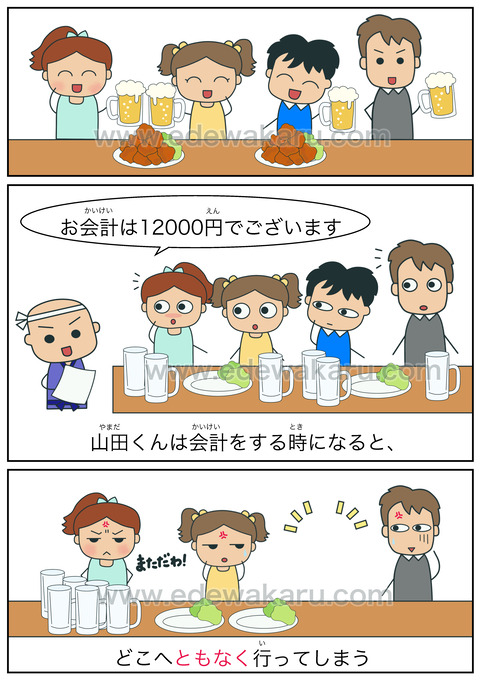
① When it’s time for Yamada to pay, he goes off somewhere, no one knows where.
→He goes somewhere, though it’s unclear exactly where.
② A nice smell of bread is coming from somewhere.
→A nice smell of bread is coming from somewhere, though I’m not sure where.
③ A beautiful singing voice can be heard from somewhere.
→A beautiful singing voice can be heard from somewhere, though I’m not sure where.
④ In Japan, at some point, people came to eat fried chicken at Christmas.
→At some point, though it’s unclear exactly when, people came to eat fried chicken at Christmas.
⑤ When the concert ended, applause broke out from someone, no one knows who.
→Applause broke out, though it’s unclear who started it.
⑥ After graduation, my friend and I stopped contacting each other, without either of us knowing exactly who stopped first.
→We stopped contacting each other, though it’s unclear which of us stopped first.
Also, “〜ともなく,” which expresses [uncertainty], can be changed to “〜ともなしに.”
[Example]
A nice smell of bread came from somewhere.
=A nice smell of bread came from somewhere.
“〜ともなく” also means [doing ~ unconsciously], so remember that as well 😊
In context 6 examples
山田くんは会計をする時になると、どこへともなく行ってしまう
When it’s time for Yamada to pay, he goes off somewhere.
どこからともなく、パンのいいにおいがする
A nice smell of bread is coming from somewhere.
どこからともなくきれいな歌声が聞こえてくる
A beautiful singing voice can be heard from somewhere.
日本では、いつからともなくクリスマスにフライドチキンを食べるようになった
In Japan, at some point, people came to eat fried chicken at Christmas.
コンサートが終わると、誰からともなく拍手が起こった
When the concert ended, applause broke out from somewhere.
卒業してから友達とは、どちらからともなく連絡をしなくなった
After graduating, neither my friend nor I contacted the other anymore.
Read the original source text
Meaning
〜か、よくわからないが〜
〜か、はっきりわからないが〜
How to use it
疑問詞+ともなく
Explanation
「〜ともなく」は疑問詞と一緒に使われ、「〜か、よくわからないが〜」「〜か、はっきりわからないが〜」という意味を表す文型です。多くの場合は
「疑問詞+助詞+ともなく」
という形で使われます。
[例]
①山田くんは会計をする時になると、
どこへともなく
行ってしまう
→どこへか、はっきりわからないが行ってしまう
②
どこからともなく、パンのいいにおいがする
→どこからかよくわからないが、パンのいいにおいがする
③どこから
ともなく
きれいな歌声が聞こえてくる
→どこからかよくわからないが、きれいな歌声が聞こえてくる
④日本では、いつから
ともなく
クリスマスにフライドチキンを食べるようになった
→いつからかはっきりわからないが、フライドチキンを食べるようになった
⑤コンサートが終わると、誰から
ともなく
拍手が起こった
→誰からかわからないが、拍手が起こった
⑥卒業してから友達とは、どちらから
ともなく
連絡をしなくなった
→どちらからかわからないが、連絡をしなくなった
また[不確か]を表す「〜ともなく」は、「〜ともなしに」にチェンジすることができます。
[例]
どこから
ともなく、パンのいいにおいがしてきた
=どこから
ともなしに、パンのいいにおいがしてきた
「〜ともなく」には【無意識に〜する】という意味もありますので、一緒に覚えておきましょう😊
NINJAL 日本語文型データベース
Meaning
[1] Expresses a state in which there is no particular intention to do ~. It is used to mean doing things such as “見る・聞く・考える” (look, listen, think) without a clear intention or purpose.
[2] Expresses doing something or something happening without being able to specify exactly ~.
How to use it
Vるともなしに
Vるともなしに
Nともなしに
Other
Notes
[1] “~” is limited to certain verbs such as “見る・聞く・考える” (look, listen, think), where the will or awareness involved in the action is not clearly expressed. The sentence following “~ともなしに” also uses the same or a similar verb.
[2] “~” is a question word such as “誰” (who), a question word with a particle attached, such as “どこへ・いつから” (where to, since when), or a sentence containing a question word. The following sentence expresses an action or event that occurs in that state.
In context 12 examples
暇だと、見るともなしにSNSを見てしまう。
When I have free time, I end up looking at social media without really intending to.
子どもたちの遊ぶ声を聞くともなしに聞いていたら、自分の子ども時代のことが懐かしくなった。
As I listened without really paying attention to the sound of the children playing, I began to feel nostalgic about my own childhood.
当時つき合っていた男性のことを思い出すともなしに思い出して、急に会いたくなった。
I found myself remembering the man I was dating at the time, and suddenly wanted to see him.
ホテルからの景色を見るともなしに眺めながら音楽を聴いている時間は最高だ。
The time I spend listening to music while gazing without really looking at the view from the hotel is wonderful.
誰に見せるともなしに、妻は小説を書き続けている。
My wife continues writing novels without intending to show them to anyone.
何を考えるともなしに、ぼーっとしている時間も大切なのです。
It is important to spend time simply zoning out without thinking about anything in particular.
クラスリーダーなら村田さんだと、誰ともなしに言い出した。
Without anyone in particular being the first to say it, someone said that Murata would make a good class leader.
入学当初の落ち着かない気持ちは、いつともなしに消えていった。
The unsettled feeling I had when I first started school gradually faded away at some point.
この曲を聴いていると何故ともなしに涙が出てくる。
Whenever I listen to this song, tears come to my eyes for some reason.
ローカル線に乗ってどこへともなしに旅をしてみたい。
I’d like to take a trip on a local train without any particular destination.
林の中を歩いていたら、どこからともなしに蝶が飛んできた。
As I was walking in the woods, a butterfly flew toward me from somewhere.
いつからともなしに私は彼が好きになった。
At some point, I fell in love with him.
Read the original source text
Meaning
[1] 〜する意図が特にない状態を表します。はっきりした意図や目的がない状態で「見る・聞く・考える」などの動作をするという意味で使います。
[2] はっきり〜と特定できない状態で、あることをする・あることが起きるということを表します。
How to use it
Vるともなしに
Vるともなしに
Nともなしに
その他
Notes
[1] 「~」は行為の意志・意識がはっきり表に出ない「見る・聞く・考える」など限られた動詞だけです。「~ともなしに」の後の文にも「〜」と同じか似た意味の動詞を使います。
[2] ~には「誰」などの疑問詞か、「どこへ・いつから」など疑問詞に助詞がついた形、または疑問詞を含む文が来ます。後にはその状態で生じる動作や出来事を表す文がきます。