絵でわかる日本語
Meaning
Worth doing
Effective to do
How to use it
Verb [ます-form] + がい
Explanation
“〜がい” attaches to the ます-form of a verb and is a sentence pattern meaning “worth doing.”
“〜かいあって” (Review: 〜かいあって) means “the effort paid off,” and although it is pronounced “〜かい,” this pattern uses “〜がい,” with が. Both are written with the kanji 甲斐, so be careful. 😨
[Examples]
It paid off to give it (as a present); they were very happy.
For them to be this happy, it was worth giving it to them.
For them to be this happy, it was worth giving it to them.
“〜がい” is a suffix that attaches to the ます-form of verbs, and the verbs it is used with are mostly fixed, so learn the common ones. 😉
[Verbs commonly used with “〜がい”]
・やりがい
・生きがい
・教えがい
・育てがい
・作りがい
・働きがい
and others
It would be good to learn this together with “〜かいあって” (Review: 〜かいあって). 😀
In context 3 examples
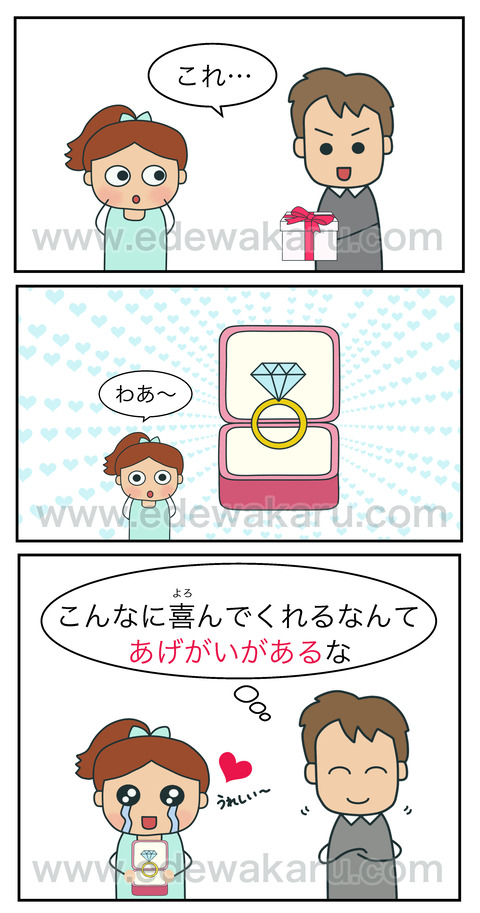
こんなに喜んでくれるなんて、あげがいがあるな(復習:〜なんて(感情))
→こんなに喜んでくれるなんて、あげた価値があるなIt’s worth giving it to them when they’re this happy. (Review: 〜なんて (emotions)) → It’s worth having given it to them when they’re this happy.
この仕事はやりがいがある
→この仕事はやる価値があるThis job is rewarding. → This job is worth doing.
何か生きがいを見つけたい
→何か生きるための価値を見つけたい(生きるための喜びのこと)I want to find something that makes life worth living. → I want to find something that makes life worth living (something that brings joy to life).
Read the original source text
Meaning
〜する価値がある
〜する効果がある
How to use it
動詞[ます形]+がい
Explanation
「〜がい」は動詞の【ます形】について「〜する価値がある」という意味を表す文型です。
「〜かいあって」(復習:〜かいあって)は「〜した効果があって」という意味で、「〜かい」と発音しますが、今回の文型は「〜がい」と「が」になります。漢字で書くと、どちらも「甲斐」となりますので気を付けてください😨
[例]
(プレゼントを)あげた
かいあって、とても喜んでくれた
こんなに喜んでくれるなんて、あげた
かいがある
な
こんなに喜んでくれるなんて、あげ
がいがある
な
「〜がい」は動詞の【ます形】につく接尾語で、使われる動詞はほとんど決まっていますので、よく使うものを覚えておきましょう😉
[「〜がい」をよく使う動詞]
・
やりがい
・
生きがい
・
教えがい
・
育てがい
・
作りがい
・
働きがい
など
「〜かいあって」(復習:〜かいあって)と一緒に覚えておくといいと思います😀
毎日のんびり日本語教師
How to use it
Verbます-form + 甲斐(がい)
Explanation
It takes the forms 「~甲斐がある」 and 「~甲斐がない」 and expresses that something has or lacks value or meaning.
「甲斐」 is normally read as 「かい」, but when it connects to a verbます-form, it is read as 「がい」.
Notes
Related grammar: 「【N2文法】~甲斐がある/~甲斐があって/~甲斐がない/~甲斐もなく」
In context 6 examples
マラソンは私の生き甲斐だ。
Marathons are my reason for living.
この仕事はやりがいがある。
This job is rewarding.
彼は小食で料理のし甲斐がない。(他食量小到觉得不值得做一顿饭。)
He eats very little, so it’s not worth cooking for him. (He eats so little that it doesn’t feel worth making a meal.)
相手が強くなきゃ倒しがいがない。
If your opponent isn’t strong, there’s no satisfaction in beating them.
結果が見えないと頑張りがいがない。
If I can’t see the results, there’s no point in working hard.
始めは下手くそだったので、よくピアノの先生から「教え甲斐がある」と言われていた。
When I first started, I was terrible, so my piano teacher often used to say, “You’re worth teaching.”
Read the original source text
How to use it
動ます形+甲斐(がい)
Explanation
「~甲斐がある」「~甲斐がない」の形を取り、価値や意味があることを表します。
「甲斐」は本来「かい」と読みますが、動ます形と接続するときは「がい」と読みます。
Notes
関連文法「【N2文法】~甲斐がある/~甲斐があって/~甲斐がない/~甲斐もなく」