絵でわかる日本語
Usage 1
Read this source entry ↗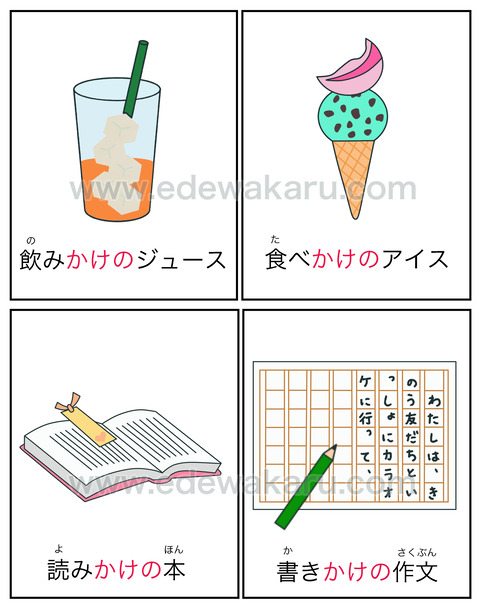
Meaning
In the middle of doing 〜
Just beginning to do 〜
How to use it
Verb [ます-form] + かける
Verb [ます-form] + かけの + noun
Explanation
“〜かける” means “in the middle of doing 〜” or “just beginning to do 〜,” and expresses a state partway through or at the beginning. As in the examples above, when used with an intentional verb, it means “in the middle of doing 〜, and it is not finished yet.” 😀
[For those who want to learn more]
When used with an unintentional verb, it means “the state of 〜 has begun, but has not yet fully become that state.” 😮
[Examples]
① That flower is beginning to wither.
→ It has not completely withered yet, but is beginning to.
② That apple is beginning to rot.
→ It has not rotted yet, but is beginning to.
③ That light bulb is about to burn out.
→ It has not burned out yet, but looks as though it will soon.
“〜かける・〜かけのN” can also mean “be on the verge of doing 〜,” so review it.
In context 5 examples
飲みかけのジュース
→飲んでいる途中のジュース(まだ飲み終わっていない)A half-drunk juice → Juice that is in the middle of being drunk (not finished yet)
食べかけのアイス
→食べている途中のアイス(まだ食べ終わっていない)A half-eaten ice cream → Ice cream that is in the middle of being eaten (not finished yet)
読みかけの本
→読んでいる途中の本(まだ読み終わっていない)A half-read book → A book that is in the middle of being read (not finished yet)
書きかけの作文
→書いている途中の作文(まだ書き終わっていない)An unfinished essay → An essay that is in the middle of being written (not finished yet)
飲みかけのジュースが置いてある
→飲んでいる途中のジュースが置いてあるThere is a half-drunk juice left sitting there. → There is juice left sitting there that someone is in the middle of drinking.
Read the original source text
Meaning
〜している途中
〜し始めたところ
How to use it
動詞[ます形]+かける
動詞[ます形]+かけの+名詞
Explanation
「〜かける」は「〜している途中」「〜し始めたところ」という意味で、【途中・開始の状態】を表します。上の例文のように意志動詞に使うと
「〜している途中で〜がまだ終わっていない」
という意味で使われます😀
【余裕がある人へ】
無意志動詞に使うと
「〜という状態が始まってまだその状態になっていない」
という意味になります😮
[例]
①あの花は枯れ
かけている
→
まだ完全に枯れていないが、枯れ始めている
②あのリンゴは腐り
かけだ
→
まだ腐っていないが、腐り始めている
③あの電球は切れ
かけている
→
まだ切れていないが、もうすぐ切れそう
「〜かける・〜かけのN」には、「〜しそうになる」という意味もありますので復習をしておきましょう。
Usage 2
Read this source entry ↗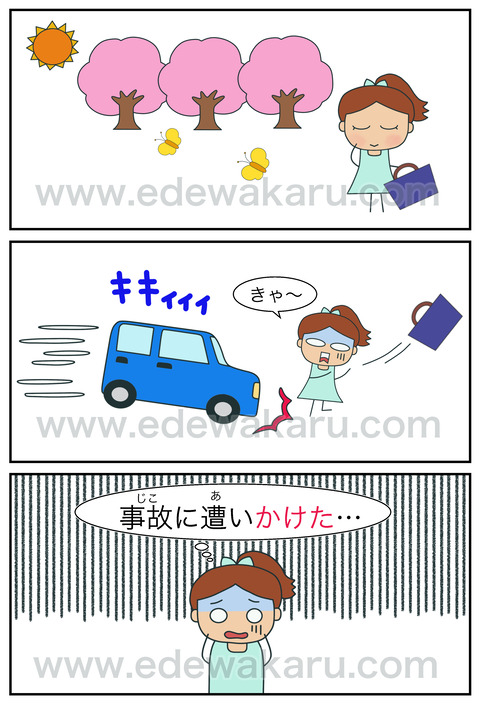
Meaning
Almost ~
How to use it
Verb [ます-form] + かける
Verb [ます-form] + かけの + noun
Explanation
“〜かける” is a sentence pattern meaning “almost ~.” It expresses a [state just before something happens], as in “something was just about to happen” 😀 Because it describes a state just before an event, it is used for things that did not actually happen. Remember it as “I almost did ~, but didn’t” 😉
“〜かける・〜かけのN” also has a usage expressing [in the middle of something], so let’s review that too.
In context 6 examples
事故に遭いかけた
→もう少しで事故に遭いそうになったI almost got into an accident. →I almost got into an accident.
高いワイングラスを落としかけた
→もう少しで高いワイングラスを落としそうになったI almost dropped an expensive wine glass. →I almost dropped an expensive wine glass.
階段から落ちかけた
→もう少しでかいだんから落ちそうになったI almost fell down the stairs. →I almost fell down the stairs.
完成したドミノを倒しかけた…危なかった〜
→完成したドミノを、もう少しで倒しそうになったI almost knocked over the finished domino setup… That was close! →I almost knocked over the completed dominoes.
川で溺れかけたところをたすけてもらった
→川で溺れそうになったところをたすけてもらったI was rescued just as I was about to drown in the river. →I was rescued when I almost drowned in the river.
A:かぜは治った?B:たぶんもう大丈夫。まだちょっと喉が痛いけどね…A:治りかけの時が大事だから、気をつけてね
→もう少しで治りそうな時が大事だから、気をつけてねA: Have you recovered from your cold? B: I’m probably okay now. My throat still hurts a little, though… A: The period when you’re almost recovered is important, so take care. →The period when you’re almost recovered is important, so take care.
Read the original source text
Meaning
〜しそうになる
How to use it
動詞[ます形]+かける
動詞[ます形]+かけの+名詞
Explanation
「〜かける」は「〜しそうになる」という意味を表す文型です。「〜が起こる直前だった」というように【直前状態】を表すものです😀直前状態ですので、実際には起きていないことに使います。「もうすこしで〜しそうだったが、〜しなかった」というように覚えましょう😉
「〜かける・〜かけのN」には【途中】を表す用法もありますので、復習をしておきましょう。