AIUEO JLPT Grammar
Meaning
「〜がち」is used to indicate that a certain behavior or state tends to occur frequently, often used for things that are undesirable or avoidable. It typically includes the speaker’s subjective judgment.
How to use it
Verb masu-stem + がち
In context 5 examples
彼は仕事が忙しくて、最近は家に帰るのが遅れがちです。
He’s been busy with work, and lately, he tends to come home late.
この季節は風邪を引きがちなので、気をつけてください。
It’s easy to catch a cold during this season, so please be careful.
彼女は会議中に居眠りしがちです。
She tends to doze off during meetings.
彼女は緊張しがちで、いつも何かを心配しているようです。
She tends to get nervous and always seems to be worried about something.
彼は自分の意見を押しつけがちだ。
He tends to impose his opinions on others.
Read the original source text
Meaning
「〜がち」is used to indicate that a certain behavior or state tends to occur frequently, often used for things that are undesirable or avoidable. It typically includes the speaker’s subjective judgment.
How to use it
動詞ます形+がち
Explanation · 日本語
「〜がち」は、ある行動や状態が繰り返されやすい傾向や、頻度が高いことを表す表現です。この文型は、特に望ましくないことや、避けたいことが頻繁に起こるときに使われます。話し手の主観的な判断が含まれることが多いです。
文法
Meaning
Indicates that something often happens / that one often ends up in a certain state / or that something is done frequently. It is used in a negative sense.
How to use it
V (ます-form)ます + がち
N + がち
In context 14 examples
田中さん、最近休みがちだけど何かあったのかな。
Tanaka-san has been absent a lot lately. I wonder if something happened.
大学を卒業すると、当時の友達とは疎遠になりがちだ。
After graduating from university, people tend to grow distant from their friends from that time.
一人暮らしの男性の食事は栄養がかたよりがちなので、しっかりバランスの良い食事をするようにしましょう。
Meals for men who live alone tend to be nutritionally unbalanced, so try to eat properly balanced meals.
外食が多いと、野菜が不足しがちだ。
If you eat out a lot, you tend not to get enough vegetables.
最近、仕事でミスばかりしていたせいで何事にも慎重になりがちだ。
Lately, because I kept making mistakes at work, I tend to be cautious about everything.
最近、メールの返信を忘れがちで、上司からよく怒られる。
Lately, I tend to forget to reply to emails, and my boss often gets angry with me.
トムさんは約束を忘れがちで、みんな困っている。
Tom often forgets his promises, and everyone is having trouble because of it.
社会人になってから、車で通勤しているので、運動不足になりがちだ。
Since becoming a working adult, I commute by car, so I tend not to get enough exercise.
助詞の間違いは、特に初級者にはありがちなことだ。
Mistakes with particles are common, especially among beginners.
娘は病気がちで、よく学校を休みます。
My daughter is often sick and frequently misses school.
日本人は私の国の人に比べると遠慮しがちな人が多い。
Compared with people in my country, many Japanese people tend to be reserved.
仕事が忙しいと、彼女へLINEの返事も忘れがちになる。
When work gets busy, I tend to forget to reply to my girlfriend's LINE messages, too.
マークさんはクールだと思われがちだけど、実はそんなことないよ。
People tend to think Mark is cool and aloof, but actually he isn't like that.
息子さんのそのような態度は思春には見られがちなので、あまり気にすることはないですよ。
That kind of attitude is common in adolescence, so you don't need to worry too much.
Read the original source text
Meaning
よく~になる / ~状態になることが多い / ~する回数が多いといった意味を表す。良くない意味で使われる。
How to use it
V(ます形)ます + がち
N + がち
Bunpro Grammar Reference
Meaning
Apt to do, Tend to do, Prone to do
How to use it
Verb[stem]+ がち
Noun + がち
Noun (1) + がち + な(2) + Noun
(1) Verb[stem]
(2) の
Nuance
A word that expresses strong, often negative tendencies, or things that are prone to winning out in the end.
Explanation
がち is a suffix in Japanese that will be used after nouns, or the conjunctive form of verbs. It conveys that someone is 'apt to (A)', 'tends to (A)', or 'is prone to (A)'. Although not always negative, がち is most frequently used to express negative tendencies.
ここに来るといつもパフェを頼みがちだけど、今日はパンケーキを頼む。
When I come here I always tend to order parfait, but today I am getting a pancake.
うちの子は病気がちなので、週に二、三日ぐらいは学校を休みます。
My child is prone to getting sick, so they usually miss two or three days of school each week.
サボりがちな人はだいたい成績が悪い。
People who tend to skip school usually have bad grades.
Fun Fact
がち as a grammar structure comes from the word 勝ち, meaning 'a win'. 勝ち in itself is used to express something that appears 'repeatedly', or 'again and again'. Due to this, がち may be thought of as similar to 'to win out' in English, meaning that 'although there are many possibilities, (A) winning out is the most likely'. This 'winning out' may be due to preference, or sheer good/bad luck.
暇なときはテレビを見がちだけど、忙しい時には全然見ない。
Watching TV wins out when I am bored, but when I am busy I don't watch it at all.
俺が回すと当たりがちだから、俺にやらせてみろ。
Hitting the jackpot wins out when I spin it, so why don't you let me do it.
釣れないことはありがちだから、落ち込まなくてもいいよ。そういう日もあるさ。
Times that you cannot catch anything often win out, so don't be so upset. It happens.
In context 18 examples
- それは初心者にありがちのミスですね。
That is a mistake beginners tend to make.
- ここに来るといつもパフェを頼みがちだけど、今日はパンケーキを頼む。
When I come here I always tend to order parfait, but today I am getting a pancake.
- うちの子は病気がちなので、週に二、三日ぐらいは学校を休みます。
My child is prone to getting sick, so they usually miss two or three days of school each week.
- サボりがちな人はだいたい成績が悪い。
People who tend to skip school usually have bad grades.
- 彼はいつも遠慮がちだ。
He always tends to hold back.
- 私の息子は病気がちだ。
My boy is apt to get sick.
- あの人はすぐ、痩せることを諦めがちだ。
That person is prone to quickly give up on losing weight.
- 私は昔から遅刻しがちだ。
I have always been prone to being late.
- 車ばかり乗っていると、運動不足になりがちだ。
If you are always riding around in a car, you tend to not get enough exercise.
- サボりがちな生徒を家まで迎えに行って、学校へ連れてきた。
I went to the house of the student who tends to skip school, and brought him back.
- 私は元気だと思われがちですが、実は体が弱いんです。
I am prone to be considered energetic, but I actually have a delicate constitution.
- 好きなことを先にして、すべきことを後回しにしがちで良くないな。
It's not good that I am prone to do things I want first and postpone important things I should be doing for later.
- 彼は最近学校を休みがちなので心配です。
I am worried because recently he has developed a tendency to skip class.
- 恥ずかしがり屋だからなのか、彼女はいつも伏し目がちです。
She always tends to drop her eyes, maybe it is because she is shy.
- 学生たちは忘れがちだが、この問題は意外とテストに出る。
Students are apt to forget, but this problem will actually appear on the test.
- 暇なときはテレビを見がちだけど、忙しい時には全然見ない。
Watching TV wins out when I am bored, but when I am busy I don't watch it at all.
- 俺が回すと当たりがちだから、俺にやらせてみろ。
Hitting the jackpot wins out when I spin it, so why don't you let me do it.
- 釣れないことはありがちだから、落ち込まなくてもいいよ。そういう日もあるさ。
Times that you cannot catch anything often win out, so don't be so upset. It happens.
DoJG 日本語文法辞典(全集)
Meaning
Tend to; be prone to; be apt to; be liable to; be subject to; often
How to use it
(i) Vます | がちだ | |
| 忘れがちだ | Tend to forget |
(ii) Noun | がちだ | |
| 留守がちだ | Tend not to be home |
Explanation
A suffix to express an undesirable tendency in someone or something.
In context 13 examples
田中君は最近授業を休みがちだ。
Tanaka tends to miss classes these days.
それは日本に短期間滞在した外国人にありがちな誤解だ。
That's the kind of misunderstanding which foreigners who stay in Japan for a short period of time are subject to.
私は小さい時病気がちでした。
I was often ill when I was very young.
この辺りは昼間留守がちの家が多い。
Around here many people are often away from their houses during the day. (literally: Around here there are many houses which residents are often away from during the day.)
夏はややもすると塩分が不足しがちだ。
Our bodies are apt to lack salt in the summer.
この時計は最近遅れがちだ。
This watch tends to lose time these days.
人はともすると自分の都合いいように物事を考えがちだ。
People tend to think (about things) in a way that suits themselves.
若いうちはとかく物事一途に考えがちだ。
Young people tend to think (about things) too seriously and narrow-mindedly.
私は最近週末もうちを空けがちです。
These days I seldom stay home even on weekends.
これはアメリカ人の学生が犯しがちな間違いだ。
This is the kind of mistake which American students are apt to make.
明日は曇りがちの天気でしょう。
It will be mostly cloudy tomorrow.
私のクラスには病気がちの学生が何人かいる。
There are some students in my class who often get ill.
彼女は遠慮がちに話した。
She talked hesitantly (literally: with a tendency to hesitate).
どんなときどう使う 日本語表現文型辞典
Meaning
liable to; prone to
How to use it
Vます/N+がち
Explanation
よく~になる/~の状態になることが多い
1)「~がち」の形で「~の状態になりやすい傾向がある・~の割合、~の回数が多い」と言いたいときの言い方。主によくない傾向に使う。
2)「とかく~がち」の形でよく使う。ほかに、忘れがち・怠けがち・遠慮がち・病気がち・遅れがち、などの例がある。
2)Often used in pattern とかく~がち. Other examples include 忘れがち (forgetful),怠けがち (slothful), 病気がち (sickly), and 遅れがち (tend to be late).
1)Tendency toward some state, high proportion, or frequency. Usually used for adverse tendencies.
In context 4 examples
森さんは小学校4年生のとき体を悪くして、学校もとかく休みがちだった。
Mr. Mori became ill when he was in fourth grade, and tended to miss school often.
田中さんは留守がちだから、電話してもいないことが多い。
Mr. Tanaka is often away, so when you call, he's usually not there.
今週は曇りがちの天気が続いたが、今日は久しぶりによく晴れた。
It stayed mostly cloudy this week, but today it cleared up nicely for the first time in a while.
環境破壊の問題は自分の身に迫ってこないと、無関心になりがちである。
People tend to become indifferent to environmental destruction unless it directly affects them.
Read the original source text
Meaning
liable to; prone to
How to use it
Vます/N+がち
Explanation
よく~になる/~の状態になることが多い
1)「~がち」の形で「~の状態になりやすい傾向がある・~の割合、~の回数が多い」と言いたいときの言い方。主によくない傾向に使う。
2)「とかく~がち」の形でよく使う。ほかに、忘れがち・怠けがち・遠慮がち・病気がち・遅れがち、などの例がある。
2)Often used in pattern とかく~がち. Other examples include 忘れがち (forgetful),怠けがち (slothful), 病気がち (sickly), and 遅れがち (tend to be late).
1)Tendency toward some state, high proportion, or frequency. Usually used for adverse tendencies.
絵でわかる日本語
Meaning
Often does 〜 /
Tends to do 〜
Easily gets into the state of 〜
How to use it
Verb [ます-form] + がちだ
Verb [ます-form] + がちの + noun
Explanation
“〜がち” is a sentence pattern that means “often does 〜.” It is used when you want to say that something happens frequently, and it is used for negative things. For positive things, use “よく〜する” 😀
[Example]
❌He often gets 100 points.
⭕️He often gets 100 points.
“〜がち” is also commonly used in conversation, so be sure to memorize it 😄 If you remember “がち = tendency,” you may confuse it with “〜ぽい,” so it’s better to remember that “〜がち” is used for things that happen frequently 😊
In context 5 examples
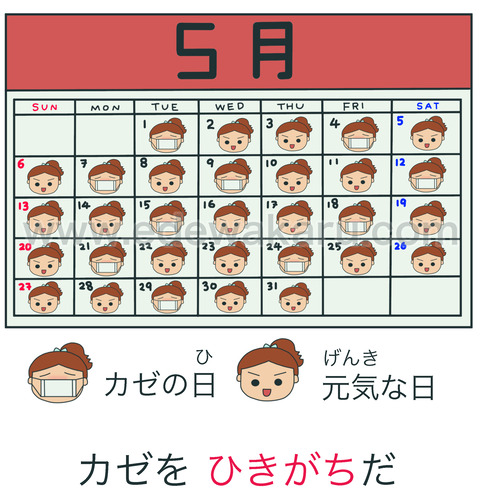
最近カゼをひきがちだ
→最近よくカゼをひく/カゼをひく回数が多いRecently, I tend to catch colds often. →Recently, I catch colds often / I catch colds frequently.
お正月は運動不足になりがちだ
→運動不足になりやすいPeople tend to get too little exercise over New Year’s. →It is easy to get too little exercise over New Year’s.
A:ここのところ、山田くんは学校を休みがちだねB:うん。どうしたのかな…
→よく学校を休むA: Lately, Yamada-kun has been missing school often. B: Yeah. I wonder what’s wrong… →He often misses school.
先生:最近、遅刻しがちですよ。気をつけてください学生:すみません
→最近、よく遅刻をしますねTeacher: You’ve been late a lot recently. Please be careful. Student: I’m sorry. →You’ve been late often recently.
多くの学生は「〜がち」と「〜っぽい」を混乱しがちだ
→多くの学生は「〜がち」と「〜っぽい」を混乱する傾向があるMany students tend to confuse “〜がち” and “〜っぽい.” →Many students tend to confuse “〜がち” and “〜っぽい.”
Read the original source text
Meaning
よく〜する
/
〜する傾向がある
〜の状態になりやすい
How to use it
動詞[ます形]+がちだ
動詞[ます形]+がちの+名詞
Explanation
「〜がち」は「よく〜する」という意味を表す文型です。「回数が多い」と言いたい時に使われ、マイナスのことに使用されます。いいことには「よく〜する」を使うようにしましょう😀
[例]
❌彼は100点を取り
がちだ
⭕️彼は
よく1
00点を取る
「〜がち」は、会話でもよく使う文法ですからしっかり覚えましょう😄
「がち=傾向」と覚えてしまうと「〜ぽい」と混乱しますので「〜がち」は「回数が多い」ことに使う
と覚えるといいですね😊
日本語文型辞典
Meaning
Attached to a noun, it means that something is prone to being in the state expressed by the noun, or has a strong tendency toward that quality. It is used when the state differs from the normal one or is regarded negatively, and its use is lexically limited. ③④ are idiomatic expressions.
Attached to a verb, it means that one ends up doing something even without intending to. It refers to actions that are likely to be judged negatively. It is often used with words such as “どうしても・つい・うっかり” or with forms such as “てしまう.” “ありがちな” in ⑤ means “common.”
How to use it
Nがち
R-がち
In context 9 examples
その作家は、ここ数年病気がちでなかなかまとまった仕事ができないと言っている。
The writer says that they have often been ill over the past few years and haven't been able to do much substantial work.
このところ、はっきりしない曇りがちの天気が続いているので、洗濯ものが干せなくて困る。
The weather has been overcast and unsettled for a while, so I can't hang out the laundry, which is a problem.
どうしてあんなことをしたんだと問いつめると、彼女は伏し目がちに、どうしてもお金がほしかったのだと答えた。
When I pressed her, asking why she had done that, she replied with her eyes lowered that she had really needed money.
「よかったらうちまで車で送ってもらえないでしょうか」と、彼女は遠慮がちにたずねた。
She asked hesitantly, “If you don't mind, could you give me a ride home?”
寒い季節は家の中にこもりがちだが、たまには外にでて体を動かした方がいい。
In the cold season, we tend to stay cooped up at home, but we should go outside and move our bodies once in a while.
彼女に電話すると、どうしても長話になりがちで、いつも父親に文句を言われる。
Whenever I call her, the conversation inevitably tends to go on for a long time, and my father always complains to me.
甘いものはついつい食べ過ぎてしまいがちなので、ダイエット中は気をつけましょう。
It's easy to end up eating too many sweets, so be careful when you're on a diet.
惰性で仕事を続けていると、この仕事に飛び込んだ頃の若々しい情熱をつい忘れが
If you keep working out of inertia, you'll tend to forget the youthful passion you had when you first plunged into this work.
「『役不足』とは『その役を務めるには能力が不足している』という意味だ」という解釈は、ありがちな間違いだ。
The interpretation that “役不足” means “lacking the ability to perform that role” is a common mistake.
Read the original source text
Meaning
名詞に付いて、「その名詞が表す状態になりやすい、その性質がかなりある」という意味を表す。その状態がふつうの状態とは異なる場合、マイナス評価を受けるような場合に用い、語彙的には限られている。③④は慣用句。
動詞に付いて、意図しなくてもついそうしてしまうという意味を表す。マイナス評価されるような動作について言う。「どうしても・つい・うっかり」などの語や「てしまう」などとともに用いられることが多い。⑤の「ありがちな」は「よくある」の意。
How to use it
Nがち
R-がち
日本語文型辞典 英語版
Meaning
Attaches to a noun and expresses that something has the characteristics of that noun or tends to be in the state it implies. Used when the state implied by the noun is considered unusual or has a negative connotation. Thus the words with which がち can be combined are limited. Examples
(3)
and
(4)
are idiomatic expressions.
Attaches to a verb and means that one tends to do something even when one doesn’t mean to. Describes an unfavorable action. Often used withどうしても (can’t help but do something), つい (involuntarily, unwittingly), うっかり(carelessly, without realizing), and てしまう (end up doing something). ありがちな in
(5)
means “something that happens frequently.”
How to use it
1. Nがち
2. R-がち
In context 9 examples
その作家は、ここ数年病気がちでなかなかまとまった仕事ができないと言っている。
The writer says she has been sickly in recent years and has found it hard to complete any work.
このところ、はっきりしない曇りがちの天気が続いているので、洗濯ものが干せなくて困る。
Because we’ve been having such unsettled, mostly cloudy weather these days, it’s a real problem not to be able to hang the wash out to dry.
どうしてあんなことをしたんだと問いつめると、彼女は伏し目がちに、どうしてもお金がほしかったのだと答えた。
When I demanded to know why she had done such a thing, she answered, with downcast eyes, that she had been desperate for money.
「よかったらうちまで車で送ってもらえないでしょうか」と、彼女は遠慮がちにたずねた。
“Could you possibly take me home in your car?” she hesitantly asked me.
寒い季節は家の中にこもりがちだが、たまには外にでて体を動かした方がいい。
We tend to stay inside in the cold season, but it’s better to go outside once in a while and get some exercise.
彼女に電話すると、どうしても長話になりがちで、いつも父親に文句を言われる。
When I phone her, it tends to be a long call and my father complains to me about it.
甘いものはついつい食べ過ぎてしまいがちなので、ダイエット中は気をつけましょう。
It’s so easy to end up eating too many sweets, so we have to be careful when we’re on a diet.
惰性で仕事を続けていると、この仕事に飛び込んだ頃の若々しい情熱をつい忘れがちになる。
When we keep on working from sheer force of habit, we tend to forget the youthful zest we once had when we started the job.
「『役不足』とは『その役を務めるには能力が不足している』という意味だ」という解釈は、ありがちな間違いだ。
Interpreting the expression yakubusoku as “lacking the ability to fulfil that role” is a common error.
Read the original source text
Meaning
Attaches to a noun and expresses that something has the characteristics of that noun or tends to be in the state it implies. Used when the state implied by the noun is considered unusual or has a negative connotation. Thus the words with which がち can be combined are limited. Examples
(3)
and
(4)
are idiomatic expressions.
Attaches to a verb and means that one tends to do something even when one doesn’t mean to. Describes an unfavorable action. Often used withどうしても (can’t help but do something), つい (involuntarily, unwittingly), うっかり(carelessly, without realizing), and てしまう (end up doing something). ありがちな in
(5)
means “something that happens frequently.”
How to use it
1. Nがち
2. R-がち
日本語NET JLPT文法解説まとめ
How to use it
V (ます-form)ます + がち
N + がち
In context 14 examples
田中さん、最近休みがちだけど何かあったのかな。
Tanaka-san has been absent a lot lately. I wonder if something happened.
大学を卒業すると、当時の友達とは疎遠になりがちだ。
After graduating from university, people tend to grow distant from their friends from that time.
一人暮らしの男性の食事は栄養がかたよりがちなので、しっかりバランスの良い食事をするようにしましょう。
Meals for men who live alone tend to be nutritionally unbalanced, so try to eat properly balanced meals.
外食が多いと、野菜が不足しがちだ。
If you eat out a lot, you tend not to get enough vegetables.
最近、仕事でミスばかりしていたせいで何事にも慎重になりがちだ。
Lately, because I kept making mistakes at work, I tend to be cautious about everything.
最近、メールの返信を忘れがちで、上司からよく怒られる。
Lately, I tend to forget to reply to emails, and my boss often gets angry with me.
トムさんは約束を忘れがちで、みんな困っている。
Tom often forgets his promises, and everyone is having trouble because of it.
社会人になってから、車で通勤しているので、運動不足になりがちだ。
Since becoming a working adult, I commute by car, so I tend not to get enough exercise.
助詞の間違いは、特に初級者にはありがちなことだ。
Mistakes with particles are common, especially among beginners.
娘は病気がちで、よく学校を休みます。
My daughter is often sick and frequently misses school.
日本人は私の国の人に比べると遠慮しがちな人が多い。
Compared with people in my country, many Japanese people tend to be reserved.
仕事が忙しいと、彼女へLINEの返事も忘れがちになる。
When work gets busy, I tend to forget to reply to my girlfriend's LINE messages, too.
マークさんはクールだと思われがちだけど、実はそんなことないよ。
People tend to think Mark is cool and aloof, but actually he isn't like that.
息子さんのそのような態度は思春期には見られがちなので、あまり気にすることはないですよ。
That kind of behavior is common in adolescence, so you don't need to worry about it too much.
Read the original source text
How to use it
V(ます形)ます + がち
N + がち
毎日のんびり日本語教師
How to use it
Verb ます-form + がち
Noun + がち
Explanation
Expresses a bad tendency and implies that the state has occurred repeatedly over time.
Notes
It cannot be used for something positive.
×
Ever since being hospitalized, my health has tended to recover rapidly.
〇
Ever since being hospitalized, my health has been recovering rapidly.
(My health recovered in the blink of an eye after I was hospitalized.)
×
Recently, my father tends to exercise for the sake of his health.
〇
Recently, my father has been exercising for the sake of his health.
(My father has been exercising often lately for the sake of his health.)
In context 8 examples
学校を卒業すると、かつての友達とは疎遠になりがちだ。
After graduating from school, people tend to grow distant from their old friends.
暑いときは冷たいものを食べがちで、よくお腹を壊す。
When it's hot, I tend to eat cold things, and I often get an upset stomach.
年を取るとやっぱり病気がちになる。
As you get older, you do tend to get sick more often.
天気が悪いと気持ちが沈みがちになる。(天气不好心情会变得低沉。)
When the weather is bad, your mood tends to sink. (When the weather is bad, your mood tends to become low.)
食生活の乱れからか、便秘がちだ。
Perhaps because of my irregular diet, I tend to be constipated.
女性は少食だと思われがちだが、実はそうではない。
Women are often thought to eat little, but actually that's not true.
人は自分に好意を示してくれた人を好きになりがち。
People tend to like those who have shown them affection.
今日は朝から曇りがちな天気です。
It's been cloudy on and off today since this morning.
Read the original source text
How to use it
動ます形+がち
名詞+がち
Explanation
悪い傾向があることを表し、その状態が以前から何度も発生していることを暗示します。
Notes
良いことに対しては使えません。
×
入院してからというもの、体調がみるみる回復しがちだ。
〇
入院してからというもの、体調がみるみる回復してきた。
(住院以后转眼间就恢复了健康。)
×
父は最近健康のために運動しがちだ。
〇
父は最近健康のために運動をしている。
(爸爸最近为了健康经常运动。)