文法
Meaning
You should 〜 / It is only natural to 〜
Used to say that it is only natural to do 〜.
How to use it
V (dictionary form) + べきだ
※「する」becomes 「すべきだ」
Notes
・Use 「〜なければならない」 when something is required by rules such as laws or regulations.
・Use 「〜なければならない」 when talking about yourself as well.
・The negative form is 「〜べきではない」.
・When referring to someone else’s actions, it often conveys a suggestion or advice.
In context 15 examples
学生は遊んでないで、もっと勉強すべきだ。
Students should study more instead of just playing around.
遅刻する場合は、早めに連絡すべきだ。
If you're going to be late, you should contact them as early as possible.
乗り物の中ではお年寄りに席をゆずるべきだと思う。
I think you should give your seat to elderly people on public transportation.
動物を飼ったら最後まで世話をするべきだ。
If you get a pet, you should take care of it for its whole life.
たくさん遊びたいなら、宿題は早く終わらせるべきだ。
If you want to play a lot, you should finish your homework early.
お金を拾ったら警察に届けるべきだ。
If you find money, you should turn it in to the police.
お金を借りたら、必ず返すべきだ。
If you borrow money, you should always pay it back.
君はまだ若いんだから、もっと色んなことにチャレンジすべきだ。
You're still young, so you should try lots of different things.
社会人なんだから、毎日新聞は読むべきだよ。
You're a working adult, so you should read the newspaper every day.
健康のためにも、毎日野菜は食べるべきだ。
For your health, you should eat vegetables every day.
仕事が面白くないのなら、続けるべきではないと思う。
If you don't find your job interesting, I don't think you should stay in it.
目上の人と話すときは、きちんと敬語を使うべきだ。
When speaking with someone senior to you, you should use honorific language properly.
友達が困っていたら、普通助けるべきだと思います。
If a friend is in trouble, I think you should normally help them.
マークさんは何でも「はい、はい」って言っちゃって・・・、嫌なら嫌ってはっきりと言うべきだよ。
Mark just says “yes, yes” to everything... If you don't like something, you should say so clearly.
たとえ、冗談でも嘘はつくべきではないと思う。
I don't think you should lie, even as a joke.
Read the original source text
Meaning
〜した方がいい / 〜するのが当然だ
常識的に〜するのが当然だと言う時に使う。
How to use it
V(辞書形)+ べきだ
※「する」は「すべきだ」となる
Notes
・法律や規則など、ルールとして決まっている場合は「〜なければならない」を使う。
・自分自身について述べる場合も「〜なければならない」を使う。
・否定形は「〜べきではない」
・相手の行為について言う場合は、勧めや忠告の意味を持つことが多い。
DoJG 日本語文法辞典(全集)
Meaning
Should; ought to
How to use it
(i) Vinformal nonpast | べきだ | |
| 行くべきだ | Should go |
Exception | する→{す/する} べきだ | Should do |
(ii) {Adjective な stem/Noun} | であるべきだ | |
| 積極的であるべきだ | Someone should be positive |
| 目的であるべきだ | Something should be an objective |
Explanation
An auxiliary which expresses the speaker's judgment that someone/something should do something or should be in some state.
In context 14 examples
この論文は書き直すべきだ。
This thesis should be rewritten.
そんなことを人に言うべき{では/じゃ}ありません。
You shouldn't say that kind of thing to people.
君も来るべきでしたよ。
You should have come, too.
山田には話すべき{では/じゃ}なかった。
I shouldn't have told that to Yamada.
話すべきことは全部話しました。
I told you everything I should tell you.
自分のことは自分です(る)べきだ。
You should look after yourself. (literally: You should do your own business by yourself.)
今、家を買うべきじゃないよ。
You shouldn't buy a house now.
それは課長にも言っておくべきだったね。
We should have told that to our boss, too, shouldn't we?
彼は結婚なんかす(る)べきじゃなかったんだ。
He shouldn't have married.
我々はもっと創造的であるべきだ。
We should be more creative.
この状態が現実であるべきだ。
This state should be the reality.
調査の結果、驚くべきことが分かった。
As a result of the investigation, a surprising thing (literally: something one should be surprised at) was discovered.
田中は全く軽蔑すべき男だ。
Tanaka is indeed a despicable man (literally: a man whom one should despise).
あるべき所に記述がない。
There's no description where there should be one.
どんなときどう使う 日本語表現文型辞典
Meaning
should
How to use it
Vる + べきだ (する can also be すべきだ)
Explanation
~した方がいい
1)「するのが、または、しないのが人間としての義務だ」と言いたいときの表現。
2) ❶ のように相手の行為について忠告する場合、 ❷ ~ ❹ のように 話者が義務だと主張したり、勧めたり、しない方がいいと言ったりする場合に使う。
3)規則や法律で決まっている場合は「なければならない」を使う。
◆ × 海外旅行に行くときはパスポートを持って行くべきだ。
3)For rules or laws, -~なければならない is used.
1)Doing or not doing something is obligatory.
2)Speaker uses as in sentence ❶ to advise someone, as in sentences ❷ to ❹ to assert obligatory nature of something, to recommend for or against action.
In context 4 examples
1万円拾ったんだって? そりゃあ、すぐに警察に届けるべきだよ。
I hear you found 10,000 yen? Then you should report it to the police right away.
親が生きているうちにもっと親孝行するべきだった、と後悔している。
I regret that I should have done more for my parents while they were alive.
現代はなにごとも地球規模で考えるべきだ。
In the modern age, we should think about everything on a global scale.
レストランやロビーでは、携帯電話で大声で話をするべきではない。
You shouldn’t talk loudly on your mobile phone in restaurants or lobbies.
Read the original source text
Meaning
should
How to use it
Vる+べきだ(「する」は「すべきだ」もある)
Explanation
~した方がいい
1)「するのが、または、しないのが人間としての義務だ」と言いたいときの表現。
2) ❶ のように相手の行為について忠告する場合、 ❷ ~ ❹ のように 話者が義務だと主張したり、勧めたり、しない方がいいと言ったりする場合に使う。
3)規則や法律で決まっている場合は「なければならない」を使う。
◆ × 海外旅行に行くときはパスポートを持って行くべきだ。
3)For rules or laws, -~なければならない is used.
1)Doing or not doing something is obligatory.
2)Speaker uses as in sentence ❶ to advise someone, as in sentences ❷ to ❹ to assert obligatory nature of something, to recommend for or against action.
絵でわかる日本語
Meaning
It is natural to do …
It is right to do …
Must do …
It would be better to do …
How to use it
Verb [dictionary form] + べきだ
Explanation
「〜べきだ」is a sentence pattern meaning “it is natural to do …” or “must do ….” It is used when, based on common sense, you want to say “must do …” or “it would be better to do ….” Also, as in example ④, the negative form 「〜べきではない」means “it is not good to do …” or “it would be better not to do …” 😀
In the case of 「する」, there are two forms, 「〜するべき」and「〜すべき」, so learn them together.
[Examples]
勉強
するべきだ
勉強
すべきだ
It is often used in writing, but it is also common in conversation, so be sure to learn it well 😉
【Patterns containing「べき」】
〜べからず・〜べからざる
〜べきだ
〜べきだった・〜べきではなかった
〜べく
〜べくして
〜べくもない
〜べし
In context 4 examples
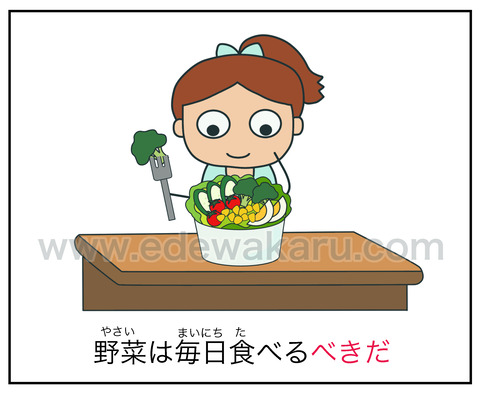
野菜は毎日食べるべきだ
→野菜は毎日食べたほうがいいYou should eat vegetables every day. →It would be better to eat vegetables every day.
学生はしっかり勉強するべきだ
→学生はしっかり勉強しなければならないStudents should study hard. →Students must study hard.
上司には敬語を使うべきだ
→上司には敬語を使うのが当然だYou should use honorific language with your boss. →It is natural to use honorific language with your boss.
人の悪口を言うべきではない
→人の悪口を言うのはよくないYou should not speak ill of others. →It is not good to speak ill of others.
Read the original source text
Meaning
〜するのが当然だ
〜するのが正しい
〜しなければならない
〜たほうがいい
How to use it
動詞[辞書形]+べきだ
Explanation
「〜べきだ」は「〜するのが当然だ」「〜なければならない」という意味を表す文型です。これは常識から考えて「〜なければならない」「〜たほうがいい」と言いたい時に使われます。また、例文④のように
否定形は「〜べきではない」で「〜するのはよくない」「〜しないほうがいい」という意味で使用されます
😀
「する」の場合は「〜するべき」「〜すべき」というように2つの形があります
ので、一緒に覚えておきましょう。
[例]
勉強
するべきだ
勉強
すべきだ
書き言葉でもよく使われますが、会話でもよく使いますのでしっかりと覚えておきましょう😉
【「べき」がつく文型】
〜べからず・〜べからざる
〜べきだ
〜べきだった・〜べきではなかった
〜べく
〜べくして
〜べくもない
〜べし
くらべてわかる日本語表現文型辞典
Meaning
Meaning 1: Strongly express the speaker’s opinion or values about what one should do, should not do, or must do.
Meaning 2: In the form 「AべきB」, means B that is suitable for doing A.
Meaning 3: In the form 「AべきB」, something that was expected to happen as a matter of course, or will certainly happen.
Meaning 4: In the form 「AべくしてAた」, A is the natural result.
Meaning 5: In the form 「AべくB」, do B with the aim of A.
Meaning 6: In the forms 「Aべからず」 and 「AべからざるB」, A is prohibited; one must not do A.
Meaning 7: In the form 「Aべくもない」, it is impossible to do A; there is no room or possibility for doing A.
How to use it
A べきだ (A べき B / A べきではない / A べし / A べく B / A べからず / A べからざる B / A べくして B / A べくもない)
[Verb—dictionary form] べきだ
However, for 「する」, it is 「する/す」べきだ.
Explanation
【Contrast 5】
「AためにB」 (Meaning 1, p. 126)
The meaning is the same. 「AべくB」 is a formal, written expression, and A is not often used for everyday actions.
×キャンディーを買うべくスーパーへ行った。 — I went to the supermarket in order to buy candy.
Notes
【Note 1】
・The form 「Aべし」 can be used as a command.
○仕事には、常に最善を尽くすべし。 — Always do your best at work.
【Note 2】
・The form 「Aべし」 may be used in newspaper headlines, advertisements, and the like to attract attention.
○12歳にしてこの堂々たる演技は、まさに恐るべし。 — This dignified performance at the age of 12 is truly astonishing.
・A is a verb expressing emotion.
【Note 6】
・This is a formal expression, often used in announcements and notices.
In context 28 examples
少なくとも6時間は睡眠をとるべきだよ。
You should get at least six hours of sleep.
相手が目上の人でも、言うべきことははっきりと言うべきだ。
Even when speaking to someone senior to you, you should say clearly what needs to be said.
一度や二度の失敗で、あきらめるべきではない。
You shouldn’t give up after just one or two failures.
子どもは親の言うことを聞くべきだ。
Children should listen to what their parents say.
深刻化するいじめや不登校の増大など、学校は憂うべき状態にある。
With bullying becoming more serious and school absenteeism increasing, schools are in a state that should cause concern.
アジアの経済発展は、わが国にとっても歓迎すべきことだ。
Asia’s economic development is something our country should welcome too.
彼女は親切でいつも明るい愛すべき人物だ。
She is a lovable person, kind and always cheerful.
映画のラストで驚くべき真相が明らかにされる。
An astonishing truth is revealed at the end of the movie.
来るべき時がついにやってきた。これで我が社もおしまいだ。
The time that was bound to come has finally arrived. This is the end for our company.
生あるものは、いずれ散るべき運命にある。
All living things are destined to perish eventually.
来たるべき20日に、決起集会を行う。
We will hold a rally on the coming 20th.
次期社長はあの人に決まったのか。やはりなるべき人がなったな。
So that person has been chosen as the next company president? As expected, the right person got the job.
相手との力の差を考えれば、この試合は勝つべくして勝ったといえる。
Considering the difference in strength between the opponents, you could say they won this match because they were bound to win.
芸術一家に生まれた彼は、トップスターになるべくしてなったのだ。
Born into a family of artists, he was destined to become a top star.
未経験者がしっかりとした装備もせず山に入ったんだから、この遭難は起こるべくして起こったのだ。
An inexperienced person went into the mountains without proper equipment, so this accident was bound to happen.
国の恋人と7年も離れていたのだから、二人は別れるべくして別れたといえる。
Having been apart from his girlfriend for seven years, you could say the two were bound to break up.
未知の生命を発見するべく、アフリカの密林へと向かった。
They headed into the jungles of Africa to discover unknown life.
我々は問題を穏便に解決すべく、議論を重ねてきた。
We have held many discussions to resolve the problem peacefully.
医師たちは一人でも多くの命を救うべく、働き続けた。
The doctors kept working to save as many lives as possible.
生徒を力づけるべく、自身の失敗談を語った。
He told a story about his own failure to encourage the students.
芝生に立ち入るべからず。
Keep off the grass.
当マンションにおいては、ペットを飼うべからず。
Pets must not be kept in this apartment building.
幼児虐待は許すべからざる犯罪だ。
Child abuse is an unforgivable crime.
商取引において信用は、必要欠くべからざるものだ。
In commercial transactions, trust is absolutely essential.
わが社が業界第一位になったということは、疑うべくもない事実だ。
The fact that our company became number one in the industry is beyond doubt.
今の生活を続けていたら安定した収入など望むべくもないことだ。
If you keep living the way you do now, a stable income is out of the question.
犯人が死んでしまっては、本当の動機はもはや知るべくもない。
Now that the culprit is dead, the real motive can no longer be known.
突然の事故で家族を失った彼の心情は推し量るべくもない。
It is impossible to fathom the feelings of someone who lost their family in a sudden accident.
Read the original source text
Meaning
意味1:Aしたほうがいい、Aしないほうがいい、Aしなければならないと、話し手の意見や価値観を強く述べる。
意味2:「AべきB」の形で。AするのがふさわしいBだ。
意味3:「AべきB」の形で。当然そうなると予想されたことや、確実にそうなること。
意味4:「AべくしてAた」の形で。Aは当然の結果だ。
意味5:「AべくB」の形で。Aを目的としてBをする。
意味6:「Aべからず」「AべからざるB」の形で。Aは禁止。Aてはならない。
意味7:「Aべくもない」の形で。Aすることができない。Aする余地や可能性がない。
How to use it
Aべきだ(AべきB/Aべきではない/Aべし/AべくB/Aべからず/AべからざるB/AべくしてB/Aべくもない)
[動詞-る形]べきだ
ただし、「する」は、[する/す]べきだ
Explanation
【対比5】
「AためにB」(意味1 P.126)
意味は同じ。「AべくB」は硬い表現で、書き言葉的でありAは日常的な行為にはあまり使われない。
×キャンディーを買うべくスーパーへ行った。
Notes
【注意1】
・「Aべし」の形で命令表現になることがある。
○仕事には、常に最善を尽くすべし。
【注意2】
・「Aべし」の形で注意・関心をひくために新聞見出しや広告などで使うことがある。
○12歳にしてこの堂々たる演技は、まさに恐るべし。
・Aは感情を表す動詞。
【注意6】
・硬い表現で、告知文などに使われることが多い。
日本語NET JLPT文法解説まとめ
Meaning
~should / ~ought to
Used when saying that, as a matter of common sense, one ought to do something.
How to use it
V (dictionary form) + べきだ
※「する」becomes 「すべきだ」
Explanation
should
・When something is established as a rule by laws or regulations, use 「〜なければならない」.
・When talking about yourself, also use 「〜なければならない」.
・The negative form is 「〜べきではない」.
・When talking about another person's actions, it often carries the meaning of a recommendation or advice.
In context 16 examples
学生は遊んでないで、もっと勉強すべきだ。
Students should study more instead of just playing around.
遅刻する場合は、早めに連絡すべきだ。
If you're going to be late, you should contact them as early as possible.
乗り物の中ではお年寄りに席をゆずるべきだと思う。
I think you should give your seat to elderly people on public transportation.
動物を飼ったら最後まで世話をするべきだ。
If you get a pet, you should take care of it for its whole life.
たくさん遊びたいなら、宿題は早く終わらせるべきだ。
If you want to play a lot, you should finish your homework early.
お金を拾ったら警察に届けるべきだ。
If you find money, you should turn it in to the police.
お金を借りたら、必ず返すべきだ。
If you borrow money, you should always pay it back.
君はまだ若いんだから、もっと色んなことにチャレンジすべきだ。
You're still young, so you should try lots of different things.
社会人なんだから、毎日新聞は読むべきだよ。
You're a working adult, so you should read the newspaper every day.
健康のためにも、毎日野菜は食べるべきだ。
For your health, you should eat vegetables every day.
仕事が面白くないのなら、続けるべきではないと思う。
If you don't find your job interesting, I don't think you should stay in it.
目上の人と話すときは、きちんと敬語を使うべきだ。
When speaking with someone senior to you, you should use honorific language properly.
友達が困っていたら、普通助けるべきだと思います。
If a friend is in trouble, I think you should normally help them.
マークさんは何でも「はい、はい」って言っちゃって・・・、嫌なら嫌ってはっきりと言うべきだよ。
Mark just says “yes, yes” to everything... If you don't like something, you should say so clearly.
たとえ、冗談でも嘘はつくべきではないと思う。
I don't think you should lie, even as a joke.
理由がどうであれ、やっぱり戦争はすべきではないと思う。
Whatever the reason, I still don't think we should go to war.
Read the original source text
Meaning
〜した方がいい / 〜するのが当然だ
常識的に〜するのが当然だと言う時に使う。
How to use it
V(辞書形)+ べきだ
※「する」は「すべきだ」となる
Explanation
should
・法律や規則など、ルールとして決まっている場合は「〜なければならない」を使う。
・自分自身について述べる場合も「〜なければならない」を使う。
・否定形は「〜べきではない」
・相手の行為について言う場合は、勧めや忠告の意味を持つことが多い。
NINJAL 日本語文型データベース
Meaning
Expresses the assertion that, in general, doing ~ is right and proper. It is often used to make an assertion from an emotional or ethical standpoint. It may also be said as advice or a suggestion to the listener.
How to use it
Notes
It is not used for obligations based on objective standards, such as rules.
In context 17 examples
借りたお金はできるだけ早く返すべきだ。
You should repay borrowed money as soon as possible.
公共の建物の中ではスマホはマナーモードに切り替えるべきだ。
You should switch your smartphone to silent mode inside public buildings.
天候が悪いときは、登山を中止するべきだ。安全が第一だ。
When the weather is bad, you should cancel the hike. Safety comes first.
部長「山本君、さっきの電話だけど、社外の人にはもっと丁寧に応対するべきだよ。」
Department manager: “Yamamoto, about that phone call earlier—you should be more polite when dealing with people outside the company.”
高齢者の運転事故が起きている。高齢になったら運転免許証は返納すべきだろう。
There have been driving accidents involving elderly people. Once you get older, you should probably return your driver’s license.
「あなたは言いたいことを心にため込んでいるみたいだけど、もっとはっきり自分の意見を言うべきだと思うよ」
“It seems you keep everything you want to say bottled up, but I think you should state your opinion more clearly.”
政治家の収賄に対しては、私たち国民は厳しくあるべきだ。
We citizens should take a firm stance against politicians accepting bribes.
生活困窮者への手当てはもっと手厚くあるべきだと思う。
I think support for people in financial hardship should be more generous.
男性は男らしくあるべきだ、女性は女らしくあるべきだという考えは、もう時代遅れだ。
The idea that men should be masculine and women should be feminine is outdated now.
山田先生は、学ぶことは楽しくあるべきだと常におっしゃっていた。
Professor Yamada always used to say that learning should be enjoyable.
教師はすべての生徒たちに対して公平であるべきだ。
Teachers should be fair to all their students.
家事は手抜きでいい。完璧であるべきだなんて考えないほうがいい。
It’s fine to cut corners on housework. You shouldn’t think that everything has to be perfect.
「山本さん、我々二人で起業するにしても、もう少し慎重であるべきではないでしょうか。資金面とか……」
“Mr. Yamamoto, even if the two of us are going to start a business together, shouldn’t we be a little more cautious? About the financing and so on…”
教師「論文というのは論旨がもっと明確であるべきだよ。書きなおしてみなさい」
Teacher: “The argument in an academic paper should be much clearer. Try rewriting it.”
芸術は誰でも気軽に平等に楽しめるものであるべきだ。
Art should be something that everyone can enjoy equally and without hesitation.
物わかりのいい親であるべきだとずっと思いこんできたが、私は物わかりがよすぎたかもしれない。
I’ve always believed I should be an understanding parent, but perhaps I’ve been too understanding.
うちの家族はもっと節約志向であるべきだというのが祖父の口癖だった。
My grandfather’s catchphrase was that our family should be more thrifty.
Read the original source text
Meaning
一般的に見て〜することは正しい、当然だという主張を表します。心情的、倫理的見地から主張するときに使うことが多いです。聞き手に忠告や助言として言うこともあります。
How to use it
Notes
規則など、客観的な基準による義務には使いません。
IMABI
Phrases Made w/ the Bases of ~べきだ
Read this IMABI lesson ↗Explanation
Phrases Made w/ the Bases of ~べきだ: ~べくもない, ~べからず・ざる, ~べく, ~べくして, & ~べし
Back in our first lesson on ~べきだ, we learned how it is an auxiliary verb pertaining to “obligation” but that its scope of use has been diminished substantially in Modern Japanese. Nonetheless, the auxiliary still holds on, with most of its bases still functional despite having become archaic.
In this lesson, we will go over various advanced grammar points which are derived from its other bases, and in doing so, we will view these other bases as being derived from ~べきだ’s predecessor ~べし.
The Extant Bases of ~べし
The auxiliary “verb/adjective” ~べきだ is etymologically1 better viewed as an “auxiliary adjective,” as it is merely slightly corrupted by the addition of the copula verb to its 連体形. While this did give rise to its new, modern 終止形 of ~べきだ, it also rendered certain other bases obsolete, notably its /-kari/ 連用形 and its 已然形, whose functionalities have been taken over by the copula built into ~べきだ.
Nonetheless, this lesson will be more so an introduction to ~べし as it pertains to Modern Japanese than it is a second installment of ~べきだ. As such, without further ado, the bases of ~べし are as follows:
未然形連用形終止形連体形已然形命令形
べから-べく-
(べかり-)べしべき-・
(べかる-) (べけれ- ) 〇
Orthography Note: ~べし can rarely be seen written in kanji as 可し.
While the modern ~べきだ heavily emphasizes duty and what is deemed appropriate, in the past, these usages all stimmed for an overarching notion of latent potential as well as natural course of events, with agency or the lack thereof among other factors dictating the exact nuance of the auxiliary. The loss of nuances attached to latent potential (潜勢), nuances which we will soon touch upon in their individual environments, is likely attributed to the inclusion of the declarative copula だ into the structure.
~べからず・べからざる
The 未然形 of ~べし, べから-, is heavily used in Modern Japanese with the classical negative auxiliary verb ~ず in the context of to-the-point negative imperatives. While not so common in the spoken language, this pattern is great for signage. Think “DO NOT TOUCH” or “KEEP OFF THE GRASS” as perfect environments for this grammar to be employed.
1. 触るべからず!
DO NOT TOUCH!
2. 芝に入るべからず!
KEEP OFF THE GRASS!
3. この橋、渡るべからず
DO NOT CROSS THIS BRIDGE!
4. 関係者以外、敷地内に入るべからず
NO UNAUTHORIZED PERSONS ARE ALLOWED TO ENTER THE PREMISES
5. 働かざる者は食うべからず
Those who do not work shall not eat
The auxiliary ~べし largely revolves around the notion of obligation, which is also anchored in place by the notion of “latent potential.” The things that ought to be the case are the things that one naturally can and should do. As it pertains to negative structures, we see that while still quite archaic, ~べからず can still be used to mean ~することができない, with a heavy emphasis on it naturally being the case that the agent cannot perform X. Moreover, this lack of “latent potential” is more likely to be seen as ~べからざる with X directly modifying a nominal phrase. Note that ざる‐ is simply the 連体形 of the auxiliary ~ず.
6. 予測すべからざる事態
A situation that one cannot predict
7. 許すべからざる罪
An unforgivable sin/crime
8. 現代社会では、スマホやインターネットなどは欠くべからざる存在となっている。
In the modern age, things such as smartphones and the Internet have become indispensable things (in our lives).
9. 遼平君は、我がチームには、欠くべからざる一員である。
Ryohei-kun is an integral member of our team.
10. 羽はねなければ空をも飛ぶべからず。
If one has no wings, one cannot fly through the skies.
Another pattern utilizing ~べからず worth noting is ~ざるべからず, which is akin to the modern ~なければならない to indicate obligation via a double negative construction. Of the two, ~ざるべからず places even heavier emphasis on the duty bore by the agent.
11. 天皇てんのうを重おもんぜざるべからず。
One must honor the emperor.
~べくもない
~べくもない is a combination of the /ku/-type 連用形 of ~べし followed by the adverbial particle も and the negative auxiliary ~ない. Together, the structure translates to “there is no way/it is possible” even if there is intention to make it happen. While we view the modern ~べきだ as pertaining solely to “obligation,” several other usages existed for its predecessor ~べし which have since fallen out of use. Of these, the indication of “potential,” albeit always with negative forms, was one of those now obsolete meanings. Granted, this sense of “potential” does derive from the underlining meaning of “obligation/strong resolve/appropriateness,” with negation facilitating the inability for said impetus to be set in motion.
12. 将来、東京大学の教授になろうなんて望むべくもない。
There’s no way that I could ever become something like a Tokyo University professor in the future.
13. そう聞いても、ザイダさんには想像するべくもない光景だった。
Though Zaida-san was hearing about it, the scene was one that she couldn’t have ever imagined.
14. セスは遼平を死ぬほど愛している、これは疑うべくもない。
Seth loves Ryohei to death; there is no doubt about that.
The closest structure to ~べくもない would be ~できるはずがない, which focuses on there being no means, whereas with ~べくもない, the focus would be on there being no chance of that resolve or circumstance ever coming to pass in a very emotionally charged fashion. One other major difference, however, is that ~べくもない can also be paired with non-volitional verbs to indicate the zero chance of something ever occurring.
15. 季節の推移はやむべくもない。
The changing of the seasons is inevitable.
~べく
The /ku/-type 連用形 of ~べし, ~べく attaches to verbs of volition, which serves as the initiative that the speaker feels determined/obligated to pursuit, with the predicate Y that follows being the means. As such, ~べく is quite similar to ~ために but with added emphasis on duty.
16. 早く帰るべく、準備じゅんびをし始めた。
I’ve become to make preparations so that I may get home early.
17. 我々は、将来を担うべく努力することを誓います。
We vow to endeavor to bear the future.
18. 国民を守るべく、研鑽を欠かさない。
(He) never falls short of improving (himself) so that (he) may protect (his) citizenry.
19. 作文嫌いを克服すべく、毎日、セス先生が掲げてきた「The Document Challenge」に挑むことにしています。
So that I may overcome my dislike of writing, I have decided to take on “The Document Challenge” which Seth-sensei has touted up to this point.
20. 筆者は最近、社長になるべく日夜努力を重ねている。
I (the person writing to you) have been recently working day and night to become a company president.
One set phrase which utilizes ~べく that is of considerable importance in formal settings, is the word しかるべく which roughly translates to “as one sees fit.” It combines しかり―a contraction of しかあり meaning “absolutely the case”―and ~べく.
21. しかるべく対応いたします。
I shall handle the matter as is appropriate.
~べくして
Utilizing the conjunctive particle して, ~べくして is most often used to indicate the necessity behind something that is predicted by the speaker to happen having happened. Incidentally, in this construction, the verb that precedes ~べくして will also be the same verb that follows it, leading to a translation for ~べくして of “it’s only natural that.” This meaning of a “natural course of events” is inherently tied to the latent potential hinted at in other structures (like in ~べくもない in the negative).
While this structure is largely used with intransitive verbs, the commonality behind all examples of this pattern does not lie in transitivity but rather in how “volition” does not play a part in the action occurring.
22. これは勝つべくして勝った試合です。
As for what you see here, this match was one that we were naturally going to win.
23. チャンスを掴める人は、掴むべくして掴んでいる。
Those who snag chances are those who naturally grab them (as they come along).
24. 起こるべくして起こった出来事だ。
What occurred is what would have naturally taken place.
25. 負けるべくして負けた。
It’s only natural that (we) lost.
Though not nearly as common and not touched on at all in the JLPT N1, ~べくして does have a rarely seen 逆接 nuance of “even if one can do X, (outcome Y is unfeasible).” This can also be adapted in a way so that the verb standing in as Y is marked by a negative form of ~べし to capitalize on this unfeasibility, which in the case of Ex. is to indicate a negative command of the vein of “should not.”
26. その教科書を読むべくして理解しがたい。
Even if you can read the textbook, it is difficult to understand.
27. この説せつは言うべくして行うべからず。
Even if you can say the theory, you shouldn’t carry it out.
~べし
Though clearly archaic, from the sense of obligation, the 終止形 ~べし may also indicate a forceful command related to duty. It is the affirmative rendition of ~べからず mentioned earlier.
28. 辞職すべし。
You should resign!
29. 培った力を存分に発揮すべし!
You must make full use of the strength/skills you’ve nurtured!
~ざるべし
When ~べし follows the negative auxiliary verb ~ず, ~べし follows its 連体形2, and in this context, ~べし simply denotes the meaning of “absolute certainty” that the predicates is NOT the case, as it is being paired with the negative.
30. この人々の深き志は、この海にも劣らざるべし。
The deep kindness of those here surely outmatches that of this sea (in its depth).
From the 『土佐日記』.
~べし is believed to be derived from the adjective 宜(うべ)し, with a likely meaning of “to be certain.” ↩︎
The 連体形 is employed instead of the 終止形 with ラ変-type conjugations. ↩︎
In context 30 examples
触るべからず!
DO NOT TOUCH!
芝に入るべからず!
KEEP OFF THE GRASS!
この橋、渡るべからず
DO NOT CROSS THIS BRIDGE!
関係者以外、敷地内に入るべからず
NO UNAUTHORIZED PERSONS ARE ALLOWED TO ENTER THE PREMISES
働かざる者は食うべからず
Those who do not work shall not eat
予測すべからざる事態
A situation that one cannot predict
許すべからざる罪
An unforgivable sin/crime
現代社会では、スマホやインターネットなどは欠くべからざる存在となっている。
In the modern age, things such as smartphones and the Internet have become indispensable things (in our lives).
遼平君は、我がチームには、欠くべからざる一員である。
Ryohei-kun is an integral member of our team.
羽はねなければ空をも飛ぶべからず。
If one has no wings, one cannot fly through the skies.
天皇てんのうを重おもんぜざるべからず。
One must honor the emperor.
将来、東京大学の教授になろうなんて望むべくもない。
There’s no way that I could ever become something like a Tokyo University professor in the future.
そう聞いても、ザイダさんには想像するべくもない光景だった。
Though Zaida-san was hearing about it, the scene was one that she couldn’t have ever imagined.
セスは遼平を死ぬほど愛している、これは疑うべくもない。
Seth loves Ryohei to death; there is no doubt about that.
季節の推移はやむべくもない。
The changing of the seasons is inevitable.
早く帰るべく、準備じゅんびをし始めた。
I’ve become to make preparations so that I may get home early.
我々は、将来を担うべく努力することを誓います。
We vow to endeavor to bear the future.
国民を守るべく、研鑽を欠かさない。
(He) never falls short of improving (himself) so that (he) may protect (his) citizenry.
作文嫌いを克服すべく、毎日、セス先生が掲げてきた「The Document Challenge」に挑むことにしています。
So that I may overcome my dislike of writing, I have decided to take on “The Document Challenge” which Seth-sensei has touted up to this point.
筆者は最近、社長になるべく日夜努力を重ねている。
I (the person writing to you) have been recently working day and night to become a company president.
しかるべく対応いたします。
I shall handle the matter as is appropriate.
これは勝つべくして勝った試合です。
As for what you see here, this match was one that we were naturally going to win.
チャンスを掴める人は、掴むべくして掴んでいる。
Those who snag chances are those who naturally grab them (as they come along).
起こるべくして起こった出来事だ。
What occurred is what would have naturally taken place.
負けるべくして負けた。
It’s only natural that (we) lost.
その教科書を読むべくして理解しがたい。
Even if you can read the textbook, it is difficult to understand.
この説せつは言うべくして行うべからず。
Even if you can say the theory, you shouldn’t carry it out.
辞職すべし。
You should resign!
培った力を存分に発揮すべし!
You must make full use of the strength/skills you’ve nurtured!
この人々の深き志は、この海にも劣らざるべし。
The deep kindness of those here surely outmatches that of this sea (in its depth).
Obligation: ~べきだ
Read this IMABI lesson ↗Explanation
Obligation: ~べきだ
In this lesson, we will learn about the auxiliary verb1 ~べきだ, which often translates into English as “ought to/should.” While similar in meaning to the modal ~はずだ, ~べきだ possesses a far stronger tone, making it not as common in everyday speech but a powerful, useful auxiliary to have in one’s repertoire nonetheless.
Curriculum Note: While there are several more forms derived from ~べきだ’s predecessor ~べし, the content of this lesson will largely focus on ~べきだ, saving the rest of the discussion for a later advanced lesson.
Conjugating w/ ~べきだ
The auxiliary verb ~べきだ principally follows the 終止形 of verbs, but it does not attach to other auxiliary verbs or adjectives.
一段動詞食べるべきだ (ought to eat)
五段動詞死ぬべきだ (ought to die)
サ変(する)するべきだ (ought to do)
すべきだ
カ変(来る)来るべきだ (ought to come)
While it may be tempting to view ~べきだ as following the 連体形 of verbs, this is not the case2. From the chart above, you may notice how する appears irregular for allowing both すべきだ and するべきだ. The reason for this pertains to the collapse of the 終止形 and 連体形 in appearance (though never function) being incomplete in this environment.
The original 終止形 of the verb する (to do) was す and する was originally the verb’s 連体形. Now that the 連体形 is identical in appearance to the 終止形 for all verbs in Modern Japanese, it is convention which has allowed the original 終止形 to hang on with this structure. In fact, the majority of speakers prefer すべきだ over するべきだ. However, both forms are considered correct, and using one form over the other does not affect the tone or nuance of one’s statement.
This fluctuation in form does beg the question what happens to the various typological subsets of する verbs that exist: those which end in /-jiru~zuru/ and those which end in /-suru/ but cause 促音化 to occur to final mora of the root morpheme.
CategoryNeo-ClassicalTransitional FormModern
①感ずべきだ感ずるべきだ感じるべきだ
②重んずべきだ重んずるべきだ重んじるべきだ
③達すべきだ達するべきだ達するべきだ
Category ① involves する verbs made by attaching す (its original 終止形) to Sino-Japanese morphemes ending in /ɴ/, which resulted in す → ず. For these verbs, the variety of forms demonstrated above are all in use, with the modern usage of ~じるべきだ being most predominant and ~ずべきだ being most notably anachronistic yet representative of Early Modern Japanese-like speech.
Category ② involves する verbs which all result from the condensing of various morphemic information into ん upon す attaching, which itself triggered the voicing of す on top of it all. Verbs in this category include 重んじる (from 重見する meaning “to esteem”), 先んじる (from 先にする meaning “to forestall/anticipate”), and 軽んじる (from 軽見する meaning “to look down on”).
Category ③ involves する verbs attaching to Sino-Japanese morphemes ending in つ, which then triggers 促音化. These verbs exhibit the opposite trend of “す” over “する” in relation to ~べきだ, but it is not to say that ~すべきだ would be incorrect.
There are also verbs ending in ~じる in Modern Japanese which do not derive from combinations with する that maintain their older 終止形 when used with the auxiliary verb ~べきだ. The most notable example of this is 恥ずべき (disgraceful/shameful/dishonorable), which is the combination of the classical form of the verb 恥じる (to feel ashamed)—恥づ—and its 終止形 to the auxiliary ~べし. While 恥じるべきだ is not incorrect, the set phrase-like ring that 恥ずべき has prevents this more modern from being used as frequently.
Lastly, as ~べきだ utilizes the copula in its own conjugations, those forms are as follows:
Plain SpeechPolite Speech
Non-Past~べきだ~べきです
Past~べきだった~べきでした
Negative~べきではない
~べきじゃない~べきではありません
~べきじゃありません
~べきではないです
~べきじゃないです
Negative Past~べきではなかった
~べきじゃなかった~べきではありませんでした
~べきじゃありませんでした
~べきではなかったです
~べきじゃなかったです
※Not all forms of the copula are shown in this chart, but it is understood that those other forms not listed may be invoked when appropriate.
Obligation: ~べきだ
When something is naturally what one “ought to do,” ~べきだ is the most direct, assertive means of expressing this notion. While other patterns such as ~はずだ are similar in meaning, ~べきだ is the most rigid, stern, and direct wording.
1a. 野菜は、毎日食べるべきだ。
1b. 野菜は、毎日食べたほうがいい。
1c. 野菜は、毎日食べなければならない。
1d. 野菜を毎日食べるのは当然のことだ。
1a. One ought to eat vegetables every day.
1b. It is best to eat vegetables every day.
1c. You must eat vegetables every day.
1d. Eating vegetables every day is the natural thing to do.
2. 職場ではきちんと敬語を使うべきです。
One should use honorific speech properly in the workplace.
3. みんなオレの家族になるべきだ!
Everyone should become a part of my family!
4. 私は、若者言葉は話す相手によって使って良いかどうかをよく考えるべきだと思います。
I think one should carefully consider whether it is appropriate to use youth slang based on who one is speaking to.
5. 空き家は、売るべきでしょうか、それとも壊すべきでしょうか。
As far as abandoned houses go, should one sell or demolish it?
6. 借りたものは必ず返すべきだ。
One must always return what one has borrowed.
7. すべての道を試してから、最後の最後に降伏す(る)べきだよ。
You should only give up after having tried every avenue.
8. 取り扱い方は、もうちょっと慎重にす(る)べきだろうね。
I suppose you should be a little more careful in how you handle things.
9. 事故の時や予定より遅れそうな場合は、早めに連絡すべきだ。
You should contact (them/us) ahead of time in case of an accident or if it looks like you are running behind.
10. 英語力を向上させたいのなら、英語のクラスを受講するべきです。
If you want to improve your English, you should take English classes.
This also means that ~べきだ is not as commonly heard in speech, as people are not constantly at each other’s throats about their obvious responsibilities. However, it is not to say that ~べきだ is limited to formal, written language either. Even so, overuse of this pattern would make your speech sound bombastic at best.
11. 妊娠してる人とか、体の不自由な女性には席を譲るべきだし、若い女の子だってそうするべき。
People should give up their seats to pregnant women and women with disabilities, and it’s only right for young ladies to do so.
As Ex. 11 shows, when ~べきだ is employed in the spoken language, it may be affected by colloquial adaptations no differently than anything else, including but excluded to copula ellipsis. Of course, every grammatical phenomenon functions within its own constrains and dynamics. Meaning, copula ellipsis is not inherently colloquial and may occur out of grammatical necessity due to modality constraints (Ex. 12).
12. 日本の新幹線や特急列車に、優先席は設定されていません。つまり、日本の社会的ルール上、新幹線や特急列車で「席を譲るべき3」とはされていない、と考えるのが妥当でしょう。
There are no priority seats on the bullet train or limited express train lines in Japan. In other words, it is reasonable to assume that Japanese social rules do not require people to “give up their seats” on bullet trains or limited express trains.
While easily translated into English as “ought to” or “should,” it is important to limit the scope of these words to the notion of what “one must do,” as opposed to “should/ought to be the case.” Although this nuance is built into ~べきだ’s predecessor, its modern application is limited almost entirely to verbs with willful agents.
Of course, the speaker often projects what ought to happen with said execution of will onto others. In actuality, this is usually the case. Nonetheless, there is still a range of entities that can fill the roll of agent for this pattern.
13. 生きるべきか死ぬべきか、それが問題だ。(No Overt Agent in Mind)
Literally: To live or die, that is the question.
To be, or not to be, that is the question.
14. 政府は失業者の税負担を免除すべきだと思う。(Third-Person Entity as Agent)
I think that the government ought to exempt unemployed individuals from paying taxes.
15.我々はご主人様のお目覚めを願うべきであります。 (First Person Plural)
We should pray for our master’s awakening.
16. 言うべきことは強く言うべきだ 。(Second Person)
You should firmly say what needs to be said.
At times, it may not seem like there would even be a willful agent, but in the underlining structure of the phrase, one would have to be there to facilitate the obligation inherent of ~べきだ.
17. さすがはエンジニアの端くれとでもいうべきだろうか。(General Statement in Third Person ≈ No Overt Agent)
Perhaps this is to be expected of a humble engineer.
You may also see ~べきだ paired with the passive voice, which also excludes overt agents, they such statements function under the presumption that an agent exists.
18. トランプ氏は、「今すぐにでも利下げすべきだ。パウエルは一刻も早く解任されるべきだ」と投稿した。
Trump posted, “(They) need to lower interest rates now! Powell needs to be fired ASAP!”
Even when ~べきだ is paired with intransitive verbs with no apparent agent, a condition is being stated as being obligatory, and the speaker is asserting that the agent/subject of said state be (made) compliant. These situations also allow for the subject to be non-sentient and even lack willpower to execute an action, but the speaker remains resolute in their opinion on the state needing to be the case.
19. 男とは本来ならこうあるべきだ。
This is how men ought to be.
20. 世界は終わるべきだ。
The world should end.
21. マスコミの責任は重いし、抜本的に変わるべきだと思います。
The media bears a great deal of responsibility and needs to change at a fundamental level.
22. そういう社会は破壊されるべきだ。
Such a society ought to be destroyed.
One must not overlook how ~べきだ, no differently than any other auxiliary verb, can interact with other structures. For instance, it can find itself in subordinate clauses such as imbedded questions or be used in the て form.
23. 何を与えるべき4かは、お子さまを観察していれば見えてきます。
Observing your child will help you decided what you ought to give them.
24.「落とした人はきっと困っているはず」と拾ったものの、警察に届けるべきか、それとも持ち主が戻ってくるかもしれないのでその場に置いておくべきか、迷ってしまうこともあるでしょう。
You may find yourself picking up something, thinking, “the person who dropped this must be in a world of trouble over it,” but then wonder whether you should take it to the police or leave it there in case the owner returns.
25. 総理の指示を聞けないのなら、辞任すべきで、それを居直って、罷免され、英雄気取りでいる心理は、どうしても分からない。
If (someone) can’t follow the Prime Minister’s directives, (that person) should resign. I just can’t understand the mindset of someone who, despite being dismissed, still feigns to be a hero.
W/ Negation: ~べきではない
As mentioned, the conjugation powers of ~べきだ are held by the copula verb ~だ built into it. When conjugated into the negative, the obligation at hand is in the negative, naturally, as opposed to being in the affirmative.
26. お金がないなら遊びに行くべきではありません。
If you have no money, they you shouldn’t go out.
27. 人を見た目で判断すべきではない。
Literally: You shouldn’t judge people by their appearance.
You ought not judge a book by its cover.
28. 肉に甲乙をつけるべきではない。
We shouldn’t discriminate between meats.
29. 勝てるはずがない戦争はすべきではない。
One shouldn’t fight wars that one can’t win.
30. 嘘はつくべきではないと思う。
I don’t think we should lie.
There are times, of course, in which ~ない is not meant to be taken literally, most notably when used in rhetorical questions, no differently than “isn’t it?” in English. Such questions can be formed with ~べきではない.
31. どの会社もテレワークを推進すべきじゃないですか?
Shouldn’t all companies be promoting teleworking?
32. 研究者になりたいと思うなら大学院に行くべきではありませんか?
If you wish to be a researcher, shouldn’t you go to graduate school?
It just so happens that with the predecessor of ~べきだ, the original iteration of this obligatory marker, ~べし, allowed for negation to occur before and after it, capitalizing on an array of nuancing based on the implication of hierarchy between the notions of “negation” and “obligation.” Is the obligation such that one must make sure not to do something as a command (~べからず), or is something clearly not the case (~ざるべし)? In the latter case, the sense of “obligation” is more akin to “certainty of something being the case.”
33. この人々の深き志は、この海にも劣らざるべし。
The deep kindness of those here surely outmatches that of this sea (in its depth).
From the 『土佐日記』.
34. 財多しとて頼むべからず。
One mustn’t rely on one’s wealth even if it is in abundance.
From the 『徒然草』.
The Grammaticality of ~ないべきだ
While these two patterns, ~べからず and ~ざるべし are archaic, they create a basis for the grammaticality of ~ないべきだ, although from a standpoint based purely on whether it is possible for these morphemes to be combined in the order of [negation + obligation]. When one encounters instances of ~ないべきだ in modern speech, the speaker is implying very strongly that an inaction ought to be the case. A great example of this can be easily heard in gaming streams where player movements are crucial to get right.
35. 出撃したばかりのユニットはまあ、今のところ、【動かないべきだ △・動くべきではない ◎】。
You should NOT, um, move the units you’ve just sent out for right now.
Even though examples can be readily found, statistically, very few speakers utilize ~ないべきだ in their own speech. This may be influenced both by how ~べきではない is taught to be the standard form of negation for it as well as by the disconnect ~ないべきだ has in meaning with ~ざるべし. Despite being its natural predecessor, ~ざるべし does not pertain to obligation, but rather certainty that something will not or is not happening. As such, the modality of theses structures are not synonymous, as obligation implies an agent who would need to willingly carry out the action at hand, whereas certainty needs only a subject to be anchored in the situation that is most likely the case. While parallels can be made between these scenarios, they are certainly and ought not be viewed as one and the same.
Regret: ~べきだった・べきではなかった
When ~べきだ or its negative iterations are used in the past tense, the pattern indicates regret/criticism depending on what the speaker implies ought to have been the case. Naturally, this environment is also a perfect setting for the auxiliary to be used in first person contexts directed at oneself.
36. 若いときに、もうちょっと韓国語を勉強するべきだったな。
Man, I should’ve learned Korean a little bit more (than I did) when I was young.
37. 彼らは、どちらにしろ、喧嘩すべきじゃなかった。
They shouldn’t have fought, either way.
38. 一言言っておくべきだったな。
Man, I should’ve said something.
39. 早めに連絡すべきでした。
I should have contacted (them) sooner.
W/ Adjectives?
While exceedingly rare in modern Japanese, you may still find examples of ~べきだ occurring with adjectives and adjectival nouns. To match the slightly outdated tone associated with ~べきだ , however, it must attach to these parts of speech as follows:
Adjectives連用形+ある(連体形)+べきだ~くあるべきだ
Adjectival Nouns連体形(である)~であるべきだ
Although ~べきだ is almost entirely limited to verbs with willful agents in modern speech, when it is invoked with adjectival expressions, then the sense of “ought to be the case” is, in fact, implied—making it more similar to its predecessor ~べし.
40. 人はあらゆる面で美しくあるべきだ。
People should be beautiful in every aspect.
41. 刑務所は死刑より厳しくあるべきだと思う。
I think prisons should be harsher than the death penalty.
~べき Used Adjectivally
A function inherent of the 連体形 is allowing verbal constructions to modify a noun. As the ~べき in ~べきだ is, itself the 連体形 of its predecessor ~べし, that means that ~べき ought to still hold this function in modern speech. Lo and behold, it most certainly does.
42. 一人暮らしで重視すべき条件は?
What are important conditions one ought to heavily consider when living alone?
43. 恥ずべき行為だ。
It’s a shameless act.
44. 今後10年間かけて達成するべき5つの目標を設定しました。
I have set five goals that I ought to achieve over the next ten years.
Of course, ~べきだという may also be seen in appropriate environments when it is an embedded quote that is being used as a modifier.
45. できるからといってやるべきだということにはならない。
Just because you can doesn’t mean you should.
~べきだ ought to be more accurately viewed as a corrupted “auxiliary adjective,” as its morphology is still indicative of it having derived from an adjective. ↩︎
Historically, the predecessor of ~べきだ—~べし—did irregularly attach to the 連体形 of ラ変 verbs. However, since ~べし’s inception well before Old Japanese, it is clear from the wealth of examples found in early writings that the ending has principally followed the 終止形. ↩︎
The argument can be made that copula ellipsis is inappropriate in this example, and that ~べき ought to be replaced with ~べきだ or ~べし to properly complete the embedded quote. ↩︎
The ellipsis of ~だ is obligatory when ~べきだ is followed by か in an embedded question. ↩︎
In context 48 examples
野菜は、毎日食べるべきだ。
1a. One ought to eat vegetables every day.
野菜は、毎日食べたほうがいい。
1a. One ought to eat vegetables every day.
野菜は、毎日食べなければならない。
1a. One ought to eat vegetables every day.
野菜を毎日食べるのは当然のことだ。
1a. One ought to eat vegetables every day.
職場ではきちんと敬語を使うべきです。
One should use honorific speech properly in the workplace.
みんなオレの家族になるべきだ!
Everyone should become a part of my family!
私は、若者言葉は話す相手によって使って良いかどうかをよく考えるべきだと思います。
I think one should carefully consider whether it is appropriate to use youth slang based on who one is speaking to.
空き家は、売るべきでしょうか、それとも壊すべきでしょうか。
As far as abandoned houses go, should one sell or demolish it?
借りたものは必ず返すべきだ。
One must always return what one has borrowed.
すべての道を試してから、最後の最後に降伏す(る)べきだよ。
You should only give up after having tried every avenue.
取り扱い方は、もうちょっと慎重にす(る)べきだろうね。
I suppose you should be a little more careful in how you handle things.
事故の時や予定より遅れそうな場合は、早めに連絡すべきだ。
You should contact (them/us) ahead of time in case of an accident or if it looks like you are running behind.
英語力を向上させたいのなら、英語のクラスを受講するべきです。
If you want to improve your English, you should take English classes.
妊娠してる人とか、体の不自由な女性には席を譲るべきだし、若い女の子だってそうするべき。
People should give up their seats to pregnant women and women with disabilities, and it’s only right for young ladies to do so.
日本の新幹線や特急列車に、優先席は設定されていません。つまり、日本の社会的ルール上、新幹線や特急列車で「席を譲るべき3」とはされていない、と考えるのが妥当でしょう。
There are no priority seats on the bullet train or limited express train lines in Japan. In other words, it is reasonable to assume that Japanese social rules do not require people to “give up their seats” on bullet trains or limited express trains.
生きるべきか死ぬべきか、それが問題だ。(No Overt Agent in Mind)
Literally: To live or die, that is the question.
政府は失業者の税負担を免除すべきだと思う。(Third-Person Entity as Agent)
I think that the government ought to exempt unemployed individuals from paying taxes.
我々はご主人様のお目覚めを願うべきであります。 (First Person Plural)
We should pray for our master’s awakening.
言うべきことは強く言うべきだ 。(Second Person)
You should firmly say what needs to be said.
さすがはエンジニアの端くれとでもいうべきだろうか。(General Statement in Third Person ≈ No Overt Agent)
Perhaps this is to be expected of a humble engineer.
トランプ氏は、「今すぐにでも利下げすべきだ。パウエルは一刻も早く解任されるべきだ」と投稿した。
Trump posted, “(They) need to lower interest rates now! Powell needs to be fired ASAP!”
男とは本来ならこうあるべきだ。
This is how men ought to be.
世界は終わるべきだ。
The world should end.
マスコミの責任は重いし、抜本的に変わるべきだと思います。
The media bears a great deal of responsibility and needs to change at a fundamental level.
そういう社会は破壊されるべきだ。
Such a society ought to be destroyed.
何を与えるべき4かは、お子さまを観察していれば見えてきます。
Observing your child will help you decided what you ought to give them.
「落とした人はきっと困っているはず」と拾ったものの、警察に届けるべきか、それとも持ち主が戻ってくるかもしれないのでその場に置いておくべきか、迷ってしまうこともあるでしょう。
You may find yourself picking up something, thinking, “the person who dropped this must be in a world of trouble over it,” but then wonder whether you should take it to the police or leave it there in case the owner returns.
総理の指示を聞けないのなら、辞任すべきで、それを居直って、罷免され、英雄気取りでいる心理は、どうしても分からない。
If (someone) can’t follow the Prime Minister’s directives, (that person) should resign. I just can’t understand the mindset of someone who, despite being dismissed, still feigns to be a hero.
お金がないなら遊びに行くべきではありません。
If you have no money, they you shouldn’t go out.
人を見た目で判断すべきではない。
Literally: You shouldn’t judge people by their appearance.
肉に甲乙をつけるべきではない。
We shouldn’t discriminate between meats.
勝てるはずがない戦争はすべきではない。
One shouldn’t fight wars that one can’t win.
嘘はつくべきではないと思う。
I don’t think we should lie.
どの会社もテレワークを推進すべきじゃないですか?
Shouldn’t all companies be promoting teleworking?
研究者になりたいと思うなら大学院に行くべきではありませんか?
If you wish to be a researcher, shouldn’t you go to graduate school?
この人々の深き志は、この海にも劣らざるべし。
The deep kindness of those here surely outmatches that of this sea (in its depth).
財多しとて頼むべからず。
One mustn’t rely on one’s wealth even if it is in abundance.
出撃したばかりのユニットはまあ、今のところ、【動かないべきだ △・動くべきではない ◎】。
You should NOT, um, move the units you’ve just sent out for right now.
若いときに、もうちょっと韓国語を勉強するべきだったな。
Man, I should’ve learned Korean a little bit more (than I did) when I was young.
彼らは、どちらにしろ、喧嘩すべきじゃなかった。
They shouldn’t have fought, either way.
一言言っておくべきだったな。
Man, I should’ve said something.
早めに連絡すべきでした。
I should have contacted (them) sooner.
人はあらゆる面で美しくあるべきだ。
People should be beautiful in every aspect.
刑務所は死刑より厳しくあるべきだと思う。
I think prisons should be harsher than the death penalty.
一人暮らしで重視すべき条件は?
What are important conditions one ought to heavily consider when living alone?
恥ずべき行為だ。
It’s a shameless act.
今後10年間かけて達成するべき5つの目標を設定しました。
I have set five goals that I ought to achieve over the next ten years.
できるからといってやるべきだということにはならない。
Just because you can doesn’t mean you should.