AIUEO JLPT Grammar
Meaning
This sentence pattern indicates that something includes not only a certain thing but also others, expressing multiple items or aspects.
How to use it
Verb + だけでなく; adjective + だけでなく; な-adjective + な + だけでなく; noun + だけでなく
In context 5 examples
彼は日本語だけでなく、英語も話せます。
He can speak not only Japanese but also English.
このレストランは美味しいだけでなく、価格も安いです。
This restaurant is not only delicious but also reasonably priced.
この本は面白いだけでなく、ためにもなります。
This book is not only interesting but also informative.
彼女はきれいなだけでなく、頭もいいです。
She is not only beautiful but also smart.
このスマートフォンは軽いだけでなく、バッテリーの持ちも良いです。
This smartphone is not only light but also has good battery life.
Read the original source text
Meaning
This sentence pattern indicates that something includes not only a certain thing but also others, expressing multiple items or aspects.
How to use it
動詞+だけでなく形容詞+だけでなく形容動詞な+だけでなく名詞+だけでなく
Explanation · 日本語
この文型は、ある事柄に加えて他の事柄も含むことを表す表現で、単一の要素に限らず、他の要素も並列して述べたいときに使われます。
Bunpro Grammar Reference
Usage 1
Meaning
Not only… but also
How to use it
Verb + だけ + でなく(1)
[い]Adjective + だけ + でなく(1)
[な]Adjective + な + だけ + でなく(1)
Noun + だけ + でなく(1)
(1) ではなく(て)、じゃなく(て)
Nuance
A somewhat casual expression used to show that something is not just (A), but also (B).
Explanation
だけでなく (an abbreviation of だけではなく) is a common construction in Japanese which translates to 'not only (A), but also (B)'. Sometimes the (B) statement may be left unsaid. This expression may connect to any (A) phrase that だけ would usually be able to connect to.
痩せるためには運動をするだけでなく、食べるものにも気を付けなくてはいけない。
To lose weight, not only should you exercise, but you must also be careful of what you eat.
名古屋の夏は暑いだけでなく、湿気もひどい。
Summer in Nagoya is not only hot, but the humidity is terrible too.
田舎は静かなだけでなく、空気もきれいだ。
The countryside is not only quiet, but the air is also clean.
トーマスは車だけでなく、バイクとボートも持っている。
Not only does Thomas own a car, but he also has a bike, and a boat.
Caution
The で in では is not the particle で, but the auxiliary verb だ in its conjunctive form. は is regularly dropped from では expressions, or it may also be changed to じゃ, for ease of pronunciation.
タケルはピアノだけじゃなく、ギターも弾けると聞いた。
I heard that Takeru can not only play the piano, but also the guitar.
The conjunction particle て should follow なく, as it is the conjunctive form of the い-Adjective ない. However, the て in this particular construction is very often omitted.
トムは日本語だけでなくて、中国語も話せる。
Not only can Tom speak Japanese, but also Chinese.
Caution
In writing, if there is no comma (known as a 読点 in Japanese) after なく, the full なくて construction will be required. When a comma is present, both forms are grammatically correct.
角にあるラーメン屋はおいしいだけでなくて量も多い。
The ramen shop on the corner is not only delicious, but the portions are large too.
In context 19 examples
- ぶどうは甘いだけでなく、みずみずしい。
Grapes are not only sweet, but also juicy.
- 田舎は静かなだけでなく、空気もきれいだ。
The countryside is not only quiet, but the air is also clean.
- トーマスは車だけでなく、バイクとボートも持っている。
Not only does Thomas own a car, but he also has a bike, and a boat.
- トムは日本語だけでなくて、中国語も話せる。
Not only can Tom speak Japanese, but also Chinese.
- 痩せるためには運動をするだけでなく、食べるものにも気を付けなくてはいけない。
To lose weight, not only should you exercise, but you must also be careful of what you eat.
- 名古屋の夏は暑いだけでなく、湿気もひどい。
Summer in Nagoya is not only hot, but the humidity is terrible too.
- 私だけでなく、私の友達も日本語が喋れる。
Not only me, but also my friends can speak Japanese.
- あの人は日本語だけでなく、韓国語、中国語とタイ語も話せる。
That person can speak not only Japanese, but also Korean, Chinese, and Thai.
- ジョニー・デップはカナダだけでなく、日本も訪れたことがある。
Johnny Depp has not only visited Canada, but has visited Japan as well.
- 彼女だけでなく、私もこの映画が好きだよ。
Not only does she like this movie but I do too.
- 彼氏が料理だけでなく、家事も出来るから、凄い助かる。
Not only can my boyfriend cook, but he can also do housework, so it is really helpful.
- あの人は約束を破るだけでなく、嘘もつく。
Not only does that person break promises but they also tell lies.
- 海は綺麗なだけでなく、温かい。
The ocean is not only beautiful, but also warm.
- あの選手は怪我しただけでなく、次の試合に出られない。
That athlete not only got hurt, but also can't play in the next game.
- このバスは臭いだけでなく、遅いし、運転が下手。
The bus is not only stinky, but it is slow and the driving is bad too.
- 日本の人口が減るだけでなく、高齢者も増える。
Not only will the population of Japan decline, but also the number of elderly will increase.
- 姉は太っているだけでなく、ニキビもいっぱいできている。大丈夫かな。
My older sister is not only gaining weight, but also has bad acne. I wonder if she is okay.
- タケルはピアノだけじゃなく、ギターも弾けると聞いた。
I heard that Takeru can not only play the piano, but also the guitar.
- 角にあるラーメン屋はおいしいだけでなくて量も多い。
The ramen shop on the corner is not only delicious, but the portions are large too.
Usage 2
Meaning
Not only ~ but ~ also, Not just ~ but ~ also
How to use it
Noun + だけ + でなく(て)(1) + Noun + も
(1) じゃなく(て)
Nuance
An expression which states that not only (A), but also (B), when emphasizing (B).
Explanation
As an extension of the standard だけでなく, meaning 'not only, but also', adding the adverbial particle も to the (B) part of a sentence will place extra emphasis on the thing that is being included in the same category as (A).
だけ itself is an adverbial particle, so will primarily follow nouns. After this, the negative conjunctive form of the auxiliary verb だ (でなく) will create the 'not only' meaning.
アメリカだけではなく、韓国とチリにも行った事があります。
Not only the US, I have also been to Korea and Chile.
日本は地震だけでなく、台風も多いです。
Not only are there earthquakes in Japan, there are also many typhoons.
て is not strictly required as part of this structure, but will help to create a far more natural 'separation' between (A) and (B) when it is used.
漫画は子供だけではなくて、大人にも人気があります。
Not only is manga popular amongst children, it is popular among adults too.
Either じゃなく or じゃなくて may also be used, as is the case with all でなく and ではなく based grammar structures.
お年玉は子供だけじゃなく、大人ももらえたらいいのにね。
Don't you think it would be nice if adults also got money during new years and not just kids?
遊園地だけじゃなくて動物園にも連れて行ってほしい。
Not only the amusement park, I also want you to take me to the zoo.
In context 17 examples
- アイスクリームだけじゃなくて、プリンも買いました。
I didn't just buy ice cream, I also bought pudding.
- アメリカだけではなく、韓国とチリにも行った事があります。
Not only the US, I have also been to Korea and Chile.
- 日本は地震だけでなく、台風も多いです。
Not only are there earthquakes in Japan, there are also many typhoons.
- 漫画は子供だけではなくて、大人にも人気があります。
Not only is manga popular amongst children, it is popular among adults too.
- お年玉は子供だけじゃなく、大人ももらえたらいいのにね。
Don't you think it would be nice if adults also got money during new years and not just kids?
- 遊園地だけじゃなくて動物園にも連れて行ってほしい。
Not only the amusement park, I also want you to take me to the zoo.
- 机だけじゃなくて、椅子もほしい。
I don't just want a desk, I want a chair too.
- 市場だけでなく、スーパーにもいきませんか。
Won't you not only go to the market, but the store too?
- 君だけじゃなく、僕も悪かったと思っている。
It's not only you, I think that I am also to blame.
- 体だけじゃなく、心も疲れてしまった。
I am tired not only physically but mentally as well.
- 人間だけじゃなく、動物も涙を流すらしい。
I heard that not only humans, but animals cry too.
- 彼は強いだけではなく、とても優しい人だ。
He is not only strong, but also very kind.
- 車だけじゃなく、船も運転できます。
I can not only drive a car, but can also a boat.
- 鳥だけじゃなくて、猫にも餌をあげています。
I feed not only birds, but also cats.
- 原因はそれだけじゃなく、他にもあると思います。
That is not the only reason, I think there is something else too.
- 私だけじゃなく、何人もの社員が反対しています。
Not only me, but many employees disagree too.
- 実は、それだけじゃなくて、もっと悪い報告もあるんです…
To be honest, it's not only that, (but) I have something even worse to tell you...
Read the original source text
Meaning
Not only ~ but ~ also, Not just ~ but ~ also
How to use it
Noun + だけ + でなく(て)(1) + Noun + も
(1) じゃなく(て)
Nuance
An expression which states that not only (A), but also (B), when emphasizing (B).
Explanation
As an extension of the standard だけでなく, meaning 'not only, but also', adding the adverbial particle も to the (B) part of a sentence will place extra emphasis on the thing that is being included in the same category as (A).
だけ itself is an adverbial particle, so will primarily follow nouns. After this, the negative conjunctive form of the auxiliary verb だ (でなく) will create the 'not only' meaning.
アメリカだけではなく、韓国とチリにも行った事があります。
Not only the US, I have also been to Korea and Chile.
日本は地震だけでなく、台風も多いです。
Not only are there earthquakes in Japan, there are also many typhoons.
て is not strictly required as part of this structure, but will help to create a far more natural 'separation' between (A) and (B) when it is used.
漫画は子供だけではなくて、大人にも人気があります。
Not only is manga popular amongst children, it is popular among adults too.
Either じゃなく or じゃなくて may also be used, as is the case with all でなく and ではなく based grammar structures.
お年玉は子供だけじゃなく、大人ももらえたらいいのにね。
Don't you think it would be nice if adults also got money during new years and not just kids?
遊園地だけじゃなくて動物園にも連れて行ってほしい。
Not only the amusement park, I also want you to take me to the zoo.
Nuance · 日本語
ある物が(A)でもあるが(B)でもあるということ(B)を強調して表す表現。
Explanation · 日本語
「だけでなく」は「(A) 以外にもある」と言うときに使われる文法です。この「だけでなく」を含む文の後半に副助詞の「も」を付けると、(B) も (A) と同じカテゴリーのものであることをより強調する表現になります。
「だけ」そのものは副助詞で、主に名詞のあとに置かれます。そのあと、助動詞「だ」の連用形の否定形が来ます。
アメリカだけではなく、韓国とチリにも行った事があります。
Not only the US, I have also been to Korea and Chile.
日本は地震だけでなく、台風も多いです。
Not only are there earthquakes in Japan, there are also many typhoons.
「て」は絶対に必要なわけではありませんが、これを付けることで、文の (A) と (B) をより自然に分けることができます。
漫画は子供だけではなくて、大人にも人気があります。
Not only is manga popular amongst children, it is popular among adults too.
「でなく」や「ではなく」を含むほかの文法と同じように、この文法でも「じゃなく」や「じゃなくて」という形を使うことができます。
お年玉は子供だけじゃなく、大人ももらえたらいいのにね。
Don't you think it would be nice if adults also got money during new years and not just kids?
遊園地だけじゃなくて動物園にも連れて行ってほしい。
Not only the amusement park, I also want you to take me to the zoo.
どんなときどう使う 日本語表現文型辞典
Meaning
not only…but also
How to use it
(ただ) + N / 〔Plain form〕 (ナAな・ナAである / Nである) + だけでなく
Explanation
(ただ)~だけでなく
~だけでなく
1)「~だけでなく、範囲はもっと大きくほかにも及ぶ」と言いたいときに使う。
2)日常会話の中では、「だけでなく・ばかりでなく・にかぎらず」などを使う。
2)In daily conversation だけでなく, ばかりでなく, and にかぎらず are used.
1)Something is not only within particular sphere, but extends far beyond those limits.
In context 4 examples
肉や魚だけでなく、野菜もたくさん食べたほうがいい。
You should eat plenty of vegetables, not just meat and fish.
東京都民だけでなく、全国民が今度の都知事の選挙に関心を持っている。
Not only residents of Tokyo but people throughout the country are interested in the upcoming Tokyo gubernatorial election.
食品はただ味がいいだけでなく、安全で健康的であることも大切だ。
Food should not only taste good; it is also important that it be safe and healthy.
田中さんはただプロ野球の選手であるだけでなく、市のスポーツ教室のためにも活躍している。
Mr. Tanaka is not only a professional baseball player, but also contributes to the city's sports classes.
Read the original source text
Meaning
not only…but also
How to use it
(ただ)+N/〔普通形〕(ナAな・ナAである/Nである)+だけでなく
Explanation
(ただ)~だけでなく
~だけでなく
1)「~だけでなく、範囲はもっと大きくほかにも及ぶ」と言いたいときに使う。
2)日常会話の中では、「だけでなく・ばかりでなく・にかぎらず」などを使う。
2)In daily conversation だけでなく, ばかりでなく, and にかぎらず are used.
1)Something is not only within particular sphere, but extends far beyond those limits.
絵でわかる日本語
Meaning
both A and B
A as well as B
How to use it
Verb, adjective, or noun [plain form] + だけでなく〜も
Explanation
“AだけでなくBも” is a grammar pattern meaning “both A and B” or “A as well as B.” It is also used to say “B is ... in addition to A” or “B is ... besides A.” The expressions 〜も and 〜まで often follow 〜だけでなく.
[Patterns often used with 〜だけでなく]
・〜だけでなく + 〜も
・〜だけでなく + 〜まで
In conversation, 〜だけでなく is also often expressed as 〜だけじゃなく.
[Example]
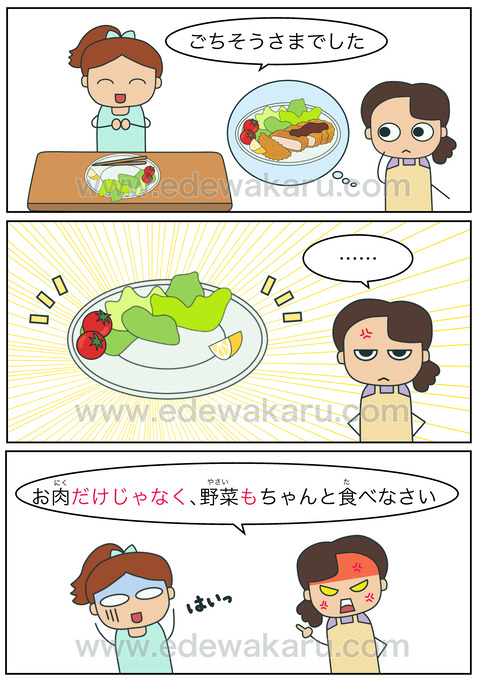
Eat your vegetables properly, not just meat.
= Eat your vegetables properly, not just meat.
Let’s review the patterns similar to 〜だけでなく〜も 😊
[Related patterns]
In context 6 examples
母:お肉だけでなく、野菜もちゃんと食べなさい!!娘:は〜い
→お肉も野菜も、どちらもちゃんと食べなさいMother: Eat your vegetables properly too, not just meat!! Daughter: Okaaay. →Eat both the meat and the vegetables properly.
彼女は英語だけでなく、中国語も話せる
→英語も中国語も、どちらも話せるShe can speak Chinese as well as English. →She can speak both English and Chinese.
雨だけでなく、風まで強くなってきた
→雨も風も、どちらも強くなってきたNot only the rain, but even the wind is getting stronger. →Both the rain and the wind are getting stronger.
彼は頭がいいだけでなく、スポーツもできる
→彼は勉強もスポーツもどちらもできるHe’s not only smart, he’s good at sports too. →He’s good at both academics and sports.
彼女は遅刻してきただけでなく、宿題もしてこなかった
→遅刻もしたし、宿題もしてこなかったShe was not only late, she also didn’t do her homework. →She was late, and she also didn’t do her homework.
このアニメは日本だけでなく、海外でも人気だ
→日本でも海外でも、人気だThis anime is popular overseas as well as in Japan. →It’s popular both in Japan and overseas.
Read the original source text
Meaning
〜も〜も、どちらも〜
〜も〜も、両方〜
How to use it
動詞・形容詞・名詞[普通形]+だけでなく〜も
Explanation
「AだけでなくBも」は「AもBも、どちらも」「AもBも、両方〜」という意味の文型です。「A以外にBも〜だ」「Aの他にBも〜」と言いたい時にも使われます。「〜だけでなく」の後ろには「〜も」「〜まで」などがよく使用されます。
[「〜だけでなく」とよく使われる文型]
・〜だけでなく+〜も
・〜だけでなく+〜まで
また「
〜だけでなく」を会話で使う場合は「〜だけじゃなく」もよく使われます。
[例]
お肉
だけでなく、野菜もちゃんと食べなさい
=お肉
だけじゃなく、野菜もちゃんと食べなさい
「〜だけでなく〜も」に似ている文型を復習しておきましょう😊
【関連文型】
NINJAL 日本語文型データベース
Meaning
This is used when you want to say that there is something else to add to “〜.”
How to use it
V plain form + だけでなく
i-A plain form + だけでなく
na-A plain form + だけでなく (however, “na-Aだ” → “na-Aな + だけでなく・na-Aである + だけでなく”)
N + だけでなく・N plain form + だけでなく (however, “Nだ” → “Nである + だけでなく”)
Other
Notes
“〜” is filled by something mentioned in the context or something easy to expect in that situation. After “〜だけでなく” comes a sentence describing another matter that is harder to expect than “〜” and has the same evaluation (positive or negative).
The word describing the other matter is often followed by “も.”
In context 21 examples
体調が悪い。寒気がするだけでなく吐き気もしてきた。
I feel unwell. Not only do I have chills, but I’m also starting to feel nauseous.
林さんは、アイディアがあるだけでなく、実行力もある。リーダーとしてふさわしい。
Hayashi not only has ideas, but also has the ability to put them into action. He’s suited to be a leader.
何もやる気がしないだけでなく、起き上がる気力もない。
Not only do I feel like doing nothing, but I don’t even have the energy to get up.
このごろ祖父は耳が遠くなっただけでなく、記憶力も落ちたようだ。
Lately, my grandfather seems not only to have become hard of hearing, but also to have lost his memory.
面接試験で、私は質問に答えられなかっただけでなく、面接官が言っていることさえ理解できなかった。
During the interview, not only could I not answer the questions, I couldn’t even understand what the interviewer was saying.
川井さんの論文は着眼点がいいだけでなく、論旨も非常に明快だ。
Kawai’s paper not only has a good point of view, but its argument is also very clear.
この薬は苦くないだけでなく、効き目も早くてありがたい。
This medicine is not only not bitter, but it also works quickly, which is a relief.
隣のアパートの解体工事がやっと終わった。工事中は、騒々しかっただけでなく、ほこりもひどかった。
The demolition work on the apartment next door finally ended. While it was going on, it was not only noisy, but there was also a lot of dust.
先日旅行に行ったが、天気が良くなかっただけでなく、ホテルも満足できなかった。
I went on a trip the other day, but not only was the weather bad, I wasn’t satisfied with the hotel either.
私は食べることが好きなだけでなく、料理を作るのも好きです。
I not only like eating, but I also like cooking.
国が平和であるだけでなく、暮らしも豊かであることが理想ではないか。
Isn’t it ideal for a country to be not only peaceful, but also prosperous?
このあたりは交通が便利でないだけでなく、治安も心配なので、住みたくない。
Not only is transportation inconvenient around here, but I’m also concerned about safety, so I don’t want to live here.
安藤さんは画家として有名だっただけでなく、文筆家としても世に知られていた。
Ando was not only famous as a painter, but also known to the public as a writer.
A氏の講演はテーマが現実的ではなかっただけでなく、同じことを繰り返し話しているだけで面白くなかった。
Mr. A’s lecture not only had an unrealistic theme, but was also uninteresting because he just repeated the same things.
トレーニングを積んだ人だけでなく、運動が得意ではない人も楽しめるスポーツをご紹介します。
We’ll introduce sports that everyone can enjoy, not only people who have trained but also those who aren’t good at exercise.
高橋さんはお寺の住職であるだけでなく、保育園の園長でもある。
Takahashi is not only the head priest of a temple, but also the director of a nursery school.
ハイキング当日は晴天だっただけでなく、さわやかな風が吹いていて、気持ちよく歩けた。
On the day of the hike, not only was the weather sunny, but a refreshing breeze was blowing, so we were able to enjoy the walk.
私は、自分中心で、家族のことを考えていなかった。いい親ではなかっただけでなく、いい伴侶でもなかったことを今、悔いている。
I was self-centered and didn’t think about my family. I regret now that I was not only a bad parent, but also a bad partner.
この曲は、ピアノでだけでなく、バイオリンやフルートで演奏しても素晴らしい。
This piece is wonderful not only on the piano but also when played on the violin or flute.
このホテルのスタッフは大人の客に対してだけでなく、子どもの客に対しても丁寧な言葉遣いをする。
The staff at this hotel speak politely not only to adult guests but to child guests as well.
この動物園の開園50周年のイベントを行うことになった。今後、イベントとして何をするかだけでなく、具体的な運営をどうするかについても考えなければならない。
We’ve decided to hold an event for the zoo’s 50th anniversary. From now on, we’ll have to think not only about what activities to hold, but also about the specific arrangements for running them.
Read the original source text
Meaning
~に付け加えることが他にもまだあると言いたいときに使います。
How to use it
V普通形+だけでなく
i-A普通形+だけでなく
na-A普通形+だけでなく(ただし、「na-Aだ」→「na-Aな+だけでなく・na-Aである+だけでなく」)
Nだけでなく・N普通形+だけでなく(ただし、「Nだ」→「Nである+だけでなく」)
その他
Notes
「~」には、文脈にある事柄や、その場面で予想しやすい事柄がきます。「~だけでなく」の後には、「~」と同じ評価(プラス評価またはマイナス評価)の、「〜」より予想しにくい別の事柄を表す文がきます。
別の事柄を表す言葉に「も」をつけることが多いです。
文法
Meaning
It is not limited to that; there is more. Indicates that the scope extends beyond ~.
How to use it
V (plain form) + だけでなく
イA (plain form) + だけでなく
ナAな / である + だけでなく
N (である) + だけでなく
In context 12 examples
肉だけじゃなく、野菜もしっかり食べなさい。
Eat vegetables properly, not just meat.
トムさんは日本語だけでなく、中国語も話せる。
Tom can speak Chinese as well as Japanese.
ワンピースは日本だけじゃなく、海外でも人気の漫画だ。
One Piece is a popular manga not only in Japan but also overseas.
ここのレストランはどれも安いだけでなく、美味しい。
All the restaurants here are not only inexpensive but also delicious.
この映画はストリーだけでなく、音楽も最高だ。
This movie has not only a great story but also great music.
彼は勉強だけでなく、スポーツもできるし、女子からはモテモテだ。
He can not only study well but also play sports, and he’s very popular with girls.
津波のせいで、家だけでなく、家族も失った。
Because of the tsunami, I lost not only my home but also my family.
彼女は国内だけでなく、海外でも活躍している。
She is active not only domestically but also overseas.
漢字は中国人だけでなく、日本人も使います。
Kanji are used not only by Chinese people but also by Japanese people.
図書館では本が借りられるだけでなく、勉強もできる。
At the library, you can not only borrow books but also study.
今日はトムさんだけでなく、ジェームスさんも遅れてきました。
Today, not only Tom but also James arrived late.
漢字は書くのが難しいだけでなく、読むのも難しいです。
Kanji are not only difficult to write, but also difficult to read.
Read the original source text
Meaning
それだけではない。他にもある。範囲が〜より広く及ぶことを表す。
How to use it
V(普通形) + だけでなく
イA(普通形) + だけでなく
ナAな / である+ だけでなく
N(である) + だけでなく
日本語文型辞典
Meaning
ひとりNだけでなく
Means “not only that.” Used in written language and for somewhat formal topics. A still more literary expression is “ひとり…のみならず.” Example sentences: ① Bullying among children is a problem not only in Japan but in countries around the world. ② I would like to promote this activity by appealing not only to our school but also to the wider community.
Read the original source text
Meaning
基本情報ひとりNだけでなく説明「単にそれだけでなく」という意味。書きことばで、ややかたい話題で使う。さらに文語的な表現として「ひとり…のみならず」がある。例文① 子供のいじめは、ひとり日本だけでなく世界諸国の問題でもある。② この活動は、ひとり本校だけでなく、広く地域に呼びかけて進めたい。
日本語文型辞典 英語版
Meaning
【ひとり...だけでなく】[ひとりNだけでなく]
Means “not simply this only.” Used in written language and particularly for formal or serious topics.
The more classical and literary version of the above is ひとり...のみならず.
In context 2 examples
子供のいじめは、ひとり日本だけでなく世界諸国の問題でもある。
Bullying among children is a problem that is not unique to Japan but is found in all countries of the world.
この活動は、ひとり本校だけでなく、広く地域に呼びかけて進めたい。
We would like to promote this activity not only within one school but also make a wider appeal to the community.
日本語NET JLPT文法解説まとめ
Meaning
It is not only that. There is more as well.
Indicates that the scope extends beyond ~.
How to use it
V (plain form) + だけでなく
イA (plain form) + だけでなく
ナAな / である + だけでなく
N (である) + だけでなく
Explanation
not only....but also
In context 12 examples
肉だけじゃなく、野菜もしっかり食べなさい。
Eat vegetables properly, not just meat.
トムさんは日本語だけでなく、中国語も話せる。
Tom can speak Chinese as well as Japanese.
ワンピースは日本だけじゃなく、海外でも人気の漫画だ。
One Piece is a popular manga not only in Japan but also overseas.
ここのレストランはどれも安いだけでなく、美味しい。
All the restaurants here are not only inexpensive but also delicious.
この映画はストリーだけでなく、音楽も最高だ。
This movie has not only a great story but also great music.
彼は勉強だけでなく、スポーツもできるし、女子からはモテモテだ。
He can not only study well but also play sports, and he’s very popular with girls.
津波のせいで、家だけでなく、家族も失った。
Because of the tsunami, I lost not only my home but also my family.
彼女は国内だけでなく、海外でも活躍している。
She is active not only domestically but also overseas.
漢字は中国人だけでなく、日本人も使います。
Kanji are used not only by Chinese people but also by Japanese people.
図書館では本が借りられるだけでなく、勉強もできる。
At the library, you can not only borrow books but also study.
今日はトムさんだけでなく、ジェームスさんも遅れてきました。
Today, not only Tom but also James arrived late.
漢字は書くのが難しいだけでなく、読むのも難しいです。
Kanji are not only difficult to write, but also difficult to read.
Read the original source text
Meaning
それだけではない。他にもある。
範囲が〜より広く及ぶことを表す。
How to use it
V(普通形) + だけでなく
イA(普通形) + だけでなく
ナAな / である+ だけでなく
N(である) + だけでなく
Explanation
not only....but also