絵でわかる日本語
Meaning
The last time 〜 happened, and since then, ... not
How to use it
Verb [た-form] + きり〜ない
Explanation
“〜たり…ない” is a sentence pattern meaning “〜 happened for the last time, and since then, ... not.” In most cases, it is used when the speaker wants to emphasize feelings of anxiety or regret, or that they are worried. 😀
[For those who want to learn more]
Some people insert “っ” and say “〜たっきり…ない” when using “〜たきり…ない,” but the meaning is the same. 😊
[Example]
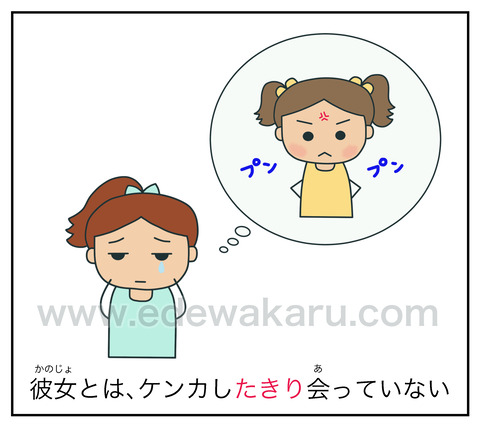
I haven’t seen her since we had a fight.
Also remember that expressions such as “これっきり,” “それっきり,” and “あれっきり” are used. 😀
[Example]
I went to Japan on a trip five years ago, but haven’t gone since then.
This pattern is also often used in conversation, so learn it well. 😉
In context 3 examples
彼女とは、ケンカしたきり会っていない
→彼女とは、ケンカしたのが最後で、その後ずっと会っていないI haven’t seen her since we had a fight. → The last time I saw her was when we had a fight, and I haven’t seen her since.
娘はアメリカに行ったきり帰ってこない
→娘はアメリカに行ったのが最後で、その後帰ってこないMy daughter went to America and hasn’t come back. → The last time she came back was when my daughter went to America; she hasn’t come back since.
日本には5年前に旅行に行ったきり行っていない
→日本には5年前に旅行に行ったのが最後で、その後ずっと行っていないI haven’t been to Japan since I went there on a trip five years ago. → The last time I went to Japan was on a trip five years ago, and I haven’t been since.
Read the original source text
Meaning
〜したのが最後で、その後ずっと…ない
How to use it
動詞[た形]+きり〜ない
Explanation
「〜たり…ない」は「〜したのが最後で、その後ずっと…ない」という意味を表す文型です。この文型はほとんどの場合、
話者の不安な気持ちや残念だと思う気持ち、心配しているようすを強調したい時に使われます
😀
【余裕がある人へ】
「〜たきり…ない」を使う時に
「〜たっきり…ない」
というように「っ」を入れる人もいますが、意味は同じです😊
[例]
彼女とは、ケンカをし
たっきり
会ってい
ない
また、「これっきり」「それっきり」「あれっきり」という言い方もあるというのを覚えておきましょう😀
[例]
日本には5年前に旅行に行きましたが、
それっきり
行っていません
会話でもよく使う文型ですのでしっかりと覚えておきましょう😉
毎日のんびり日本語教師
Meaning
~ever since ~
How to use it
Verb た-form + きり~(ない)/っきり~(ない)
Noun indicating time + きり~(ない)/っきり~(ない)
(Time-indicating)これ/それ/あれ + きり~(ない)/っきり~(ない)
Explanation
This expresses that since the event in the first part occurred, the event in the second part has not occurred even once.
「~ない」 can be omitted; in that case, the sentence ends in the form 「~きりだ」.
Notes
Similar grammar: 「~きり/っきり」
In context 8 examples
彼とは数年前卒業したっきり連絡もない。
I haven't been in touch with him since we graduated a few years ago.
花火大会は今年っきりだそうだ。
I hear this year's fireworks festival will be the last one.
本を誰かに貸したっきり行方が分からなくなってしまった。
I lent the book to someone, and since then I haven't known where it is.
それっきり音沙汰が無い。
I haven't heard from them since then.
沖縄は新婚旅行で行ったっきりだ。
I've only been to Okinawa once, on my honeymoon.
トイレ行くといったっきり帰ってこない。
They said they were going to the bathroom, but they haven't come back.
子供が出てったっきり帰ってこない。
The child went out and hasn't come back.
お粥なんて子供の時に食べたきり食べてない。
I haven't eaten rice porridge since I was a child.
Read the original source text
Meaning
~て以来
How to use it
動た形+きり~(ない)/っきり~(ない)
時間を表す名詞+きり~(ない)/っきり~(ない)
(時間を表す)これ/それ/あれ+きり~(ない)/っきり~(ない)
Explanation
前項が発生して以来、後項が一度も発生していないことを表します。
「~ない」は省略することができ、その場合文末は「~きりだ」の形になります。
Notes
似ている文法「~きり/っきり」
AIUEO JLPT Grammar
Meaning
This sentence pattern expresses that after an action or event, nothing changes and the state remains the same. It emphasizes the lack of expected subsequent actions or results and often follows the verb’s past form with a negative clause.
How to use it
Verb た-form きり + negative sentence
In context 5 examples
彼は海外出張に行ったきり、戻ってこない。
He went on a business trip abroad and hasn’t come back.
そのプロジェクトは始まったきり、進展がない。
That project started but hasn’t made any progress since.
彼女とは一度会ったきり、連絡が途絶えた。
I met her once, and then we lost contact.
祖父は入院したきり、退院していない。
My grandfather was hospitalized and hasn’t been discharged yet.
彼は去年会社を辞めたきり、次の仕事を探していない。
He left his company last year and hasn't been looking for another job since.
Read the original source text
Meaning
This sentence pattern expresses that after an action or event, nothing changes and the state remains the same. It emphasizes the lack of expected subsequent actions or results and often follows the verb’s past form with a negative clause.
How to use it
動詞た形きり+否定文
Explanation · 日本語
この文型は、ある動作や出来事が起こった後、そのまま続かず、何も変わらない状態が続いていることを表す表現です。多くの場合、期待された次の動作や結果が起こらないことを強調するために使われます。動詞た形に接続し、後に否定文が続く形が多いです。