Bunpro Grammar Reference
Meaning
Can't not, No way to avoid
How to use it
Verb[ない]+ わけにはいかない
Verb[ない]+ わけにはいきません
Nuance
A strong expression highlighting that not doing (A) cannot be so, or will not go.
Explanation
As an extension of the grammar pattern 訳にはいかない 'can't afford to do (A)', or 'impossible to do (A)', ない訳にはいかない creates a double negative which is frequently translated simply as 'can't not (A)', or 'no way to avoid (A)'.
As this is a combination of the negated form of a verb, 訳 'reason', or 'logic', に, は, and the negated form of 行く, the literal meaning is just 'there's no reason that (A) can't be done', or 'it cannot be so that (A) won't be done'.
いつもお世話になっている先輩の結婚式だから、行きたくなくても行かない訳にはいかない。
It's the wedding of a senior who has always been a great help to me, so even if I didn't want to go, I can't not go.
ダイエット中だからといって、何も食べない訳にはいかない。
Just because I am on a diet doesn't mean that I can avoid eating food.
めんどくさいからと言って、宿題をしない訳にはいかない。
Just because it's a hassle doesn't mean that you don't do your homework.
Compared to other similar structures like なければならない, ないといけない, and various others, ない訳にはいかない implies that there are some circumstances as to why (A) cannot be avoided, so will often be used when giving an excuse or reasoning as to why one must do (A).
In context 15 examples
- 訳あって、白髪を染めないわけにはいかないんです。
For some reason, he cannot avoid dyeing his gray hair.
- いつもお世話になっている先輩の結婚式だから、行きたくなくても行かない訳にはいかない。
It's the wedding of a senior who has always been a great help to me, so even if I didn't want to go, I can't not go.
- めんどくさいからと言って、宿題をしない訳にはいかない。
Just because it's a hassle doesn't mean that you don't do your homework.
- ダイエット中だからといって、何も食べない訳にはいかない。
Just because I am on a diet doesn't mean that I can avoid eating food.
- ベテランの職人でも、トレーニングをしないわけにはいかない。
Even a veteran worker cannot avoid training.
- 面倒だからといって、打ち合わせをしないわけにはいかない。
Even though it is troublesome, there is no way to avoid having a meeting.
- 締切前だからといって、まったく寝ないわけにはいかない。
Even if it is just before the deadline, you can't not sleep at all. (no way to avoid)
- 慣れたメニューだとはいえ、味見しないわけにはいかない。
Although it is a menu I am used to, there is no way to avoid taste testing.
- 初級問題だとはいえ、何度か見直しをしないわけにはいかない。
Although it is a beginner problem, there is no way to avoid revising it several times.
- 帰りが深夜になってしまったが、化粧を落とさないわけにはいきません。
My return home unfortunately became late, but there is no way to avoid having to take off my makeup.
- 疲れたからといって、勉強をしないわけにはいかない。
Just because you are tired, you can't not study. (no way to avoid)
- 好き嫌いが激しいからといって、出されたものを食べないわけにはいかない。
Just because you are very particular about your likes and dislikes, you can't not eat the food that was put out. (no way to avoid)
- 苦手だからといって、家事をしないわけにはいきません。
Just because you are bad at it, you can't avoid doing housework.
- ケンカが気まずいからといって、彼女の誕生日パーティに行かないわけにはいかない。
Just because it is awkward after a fight, there's no way to avoid going to her birthday party.
- 受験生だからといって、アルバイトをしないわけにはいかない事情がある。
While I may be a student preparing for exams, I have a situation where I cannot avoid having a part time job.
Read the original source text
Meaning
Can't not, No way to avoid
How to use it
Verb[ない]+ わけにはいかない
Verb[ない]+ わけにはいきません
Nuance
A strong expression highlighting that not doing (A) cannot be so, or will not go.
Explanation
As an extension of the grammar pattern 訳にはいかない 'can't afford to do (A)', or 'impossible to do (A)', ない訳にはいかない creates a double negative which is frequently translated simply as 'can't not (A)', or 'no way to avoid (A)'.
As this is a combination of the negated form of a verb, 訳 'reason', or 'logic', に, は, and the negated form of 行く, the literal meaning is just 'there's no reason that (A) can't be done', or 'it cannot be so that (A) won't be done'.
いつもお世話になっている先輩の結婚式だから、行きたくなくても行かない訳にはいかない。
It's the wedding of a senior who has always been a great help to me, so even if I didn't want to go, I can't not go.
ダイエット中だからといって、何も食べない訳にはいかない。
Just because I am on a diet doesn't mean that I can avoid eating food.
めんどくさいからと言って、宿題をしない訳にはいかない。
Just because it's a hassle doesn't mean that you don't do your homework.
Compared to other similar structures like なければならない, ないといけない, and various others, ない訳にはいかない implies that there are some circumstances as to why (A) cannot be avoided, so will often be used when giving an excuse or reasoning as to why one must do (A).
Nuance · 日本語
(A)をやらないことにはならない、又はやらなくてはいけないということを表す表現。
Explanation · 日本語
「ない訳にはいかない」は「事情があって (A) したくてもできない」ことを意味する「訳にはいかない」が発展してできた文型です。「ない訳にはいかない」は「どうしても (A) しなければならない」や「(A) をしない選択肢はない」といった意味で使われます。
この表現は動詞の否定形と「訳」、「に」、「は」、そして「行く」の否定形の組み合わせであり、文字通りには「(A) をしない理由はない」といった意味になります。
いつもお世話になっている先輩の結婚式だから、行きたくなくても行かない訳にはいかない。
It's the wedding of a senior who has always been a great help to me, so even if I didn't want to go, I can't not go.
ダイエット中だからといって、何も食べない訳にはいかない。
Just because I am on a diet doesn't mean that I can avoid eating food.
めんどくさいからと言って、宿題をしない訳にはいかない。
Just because it's a hassle doesn't mean that you don't do your homework.
「なければならない」や「ないといけない」のような表現と似ていますが、「ない訳にはいかない」は、話し手の意思に関係なく、(A) を避けられない事情があることを表します。そのため、なぜ (A) をしなければならないのか、説明したり言い訳したりするときによく使われます。
どんなときどう使う 日本語表現文型辞典
Usage 1
Meaning
can't avoid; can't help; must
How to use it
Vない+わけにはいかない
Explanation
どうしても~しなければならない
1)心理的、社会的、人間関係などの事情で「それをしないことは避けられない」または「しなければならない」と言いたいときに使う。
2)「する義務がある・する必要がある」と事情を説明する場合によく使う。
1)Owing to reasons of psychological or social issues, or interpersonal relations; something cannot be avoided or must be done.
2)Often indicates responsibility or need to do something.
In context 3 examples
今日は37度の熱があるけれど、会議でわたしが発表することになっているので、出席しないわけにはいかない。
I have a fever of 37 degrees today, but since I’m scheduled to give a presentation at the meeting, I can’t miss it.
25日には本社の社長が初めて日本に来るので空港まで迎えに行かないわけにはいかない。
The company president is coming to Japan for the first time on the 25th, so I have to go meet him at the airport.
今度の試験に失敗したら、卒業できない。今週は勉強しないわけにはいかない。
If I fail this exam, I won’t be able to graduate. I have to study this week.
Read the original source text
Meaning
can't avoid; can't help; must
How to use it
Vない+わけにはいかない
Explanation
どうしても~しなければならない
1)心理的、社会的、人間関係などの事情で「それをしないことは避けられない」または「しなければならない」と言いたいときに使う。
2)「する義務がある・する必要がある」と事情を説明する場合によく使う。
1)Owing to reasons of psychological or social issues, or interpersonal relations; something cannot be avoided or must be done.
2)Often indicates responsibility or need to do something.
Usage 2
Meaning
can't avoid; can't help; must
How to use it
Vない+わけにはいかない
Explanation
ないわけにはいかない
どうしても~しなければならない
1)心理的、社会的、人間関係などの事情で「それをしないことは避けられない」または「しなければならない」と言いたいときに使う。
2)「する義務がある・する必要がある」と事情を説明する場合によく使う。
2)Often indicates responsibility or need to do something.ないわけにはいかない
1)Owing to reasons of psychological or social issues, or interpersonal relations; something cannot be avoided or must be done.
In context 3 examples
今日は37度の熱があるけれど、会議でわたしが発表することになっているので、出席しないわけにはいかない。
I have a fever of 37 degrees today, but since I’m scheduled to give a presentation at the meeting, I can’t miss it.
25日には本社の社長が初めて日本に来るので空港まで迎えに行かないわけにはいかない。
The company president is coming to Japan for the first time on the 25th, so I have to go meet him at the airport.
今度の試験に失敗したら、卒業できない。今週は勉強しないわけにはいかない。
If I fail this exam, I won’t be able to graduate. I have to study this week.
Read the original source text
Meaning
can't avoid; can't help; must
How to use it
Vない+わけにはいかない
Explanation
ないわけにはいかない
どうしても~しなければならない
1)心理的、社会的、人間関係などの事情で「それをしないことは避けられない」または「しなければならない」と言いたいときに使う。
2)「する義務がある・する必要がある」と事情を説明する場合によく使う。
2)Often indicates responsibility or need to do something.ないわけにはいかない
1)Owing to reasons of psychological or social issues, or interpersonal relations; something cannot be avoided or must be done.
絵でわかる日本語
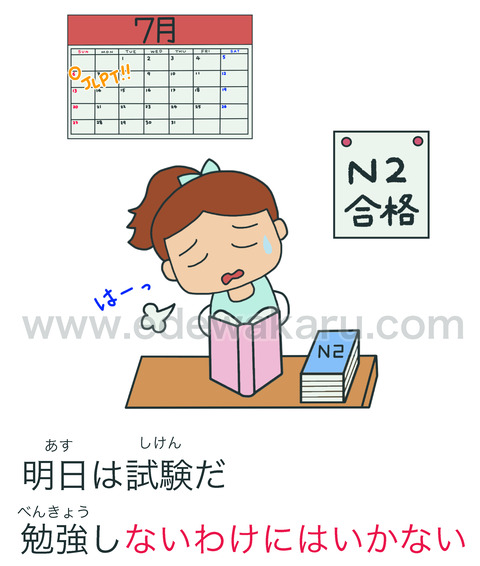
Meaning
(Because of circumstances around you) Must 〜
How to use it
Verb [ない-form] + わけにはいかない
Explanation
As with the previous “〜わけにはいかない,” the key point with “〜ないわけにはいかない” is that there are circumstances around you. Today’s “〜ないわけにはいかない” means “because of circumstances, one must 〜.” The difference between “〜わけにはいかない” and “〜ないわけにはいかない” is whether they attach to the dictionary form or the ない-form, but it’s easy to mix them up, so learn to distinguish them 😊
[Summary]
〜わけにはいかない →
Cannot do 〜
〜ないわけにはいかない →
Must 〜
[Dictionary form] 食べるわけにはいかない →
Cannot eat
[ない-form] 食べないわけにはいかない → Must eat
[The “わけ” series]
〜わけ (notional noun)
〜わけがない
〜わけがわからない (notional noun)
〜わけだ (realization)
〜わけではない
〜わけない (notional noun)
〜わけにはいかない
In context 3 examples
明日は試験だ。勉強しないわけにはいかない
→明日は試験だから、勉強しなければならない(周囲の事情:試験がある)I have an exam tomorrow. I have to study. →Because I have an exam tomorrow, I have to study (circumstance: there is an exam).
上司に誘われたら、行かないわけにはいかない
→上司に誘われから、行かなければならない(周囲の事情:上司に誘われた)If my boss invites me, I have to go. →Because my boss invited me, I have to go (circumstance: my boss invited me).
今日は日曜日だが、社長命令では出勤しないわけにはいかない
→今日は日曜日だが、社長命令だから出勤しなければならない(周囲の事情:社長命令)Today is Sunday, but since it’s an order from the company president, I have to go to work. →Today is Sunday, but because it’s an order from the company president, I have to go to work (circumstance: the president’s order).
Read the original source text
Meaning
(何か周囲に事情があって)
〜なければならない
How to use it
動詞[ない形]+わけにはいかない
Explanation
「〜ないわけにはいかない」は前回の「〜わけにはいかない」と同じように
周囲に事情がある
というのがポイントです。 今回の「〜ないわけにはいかない」は「周囲に事情があって〜なければならない」という意味になります。「〜わけにはいかない」と「〜ないわけにはいかない」原形につくか、ない形につくかの違いですが、混乱しやすいですので区別して覚えましょう😊
【まとめ】
〜わけにはいかない→
〜することができない
〜ないわけにはいかない→
〜なければならない
[原形]食べるわけにはいかない→
食べることができない
[ない形]食べないわけにはいかない→食べなければならない
【「わけ」シリーズ】
〜わけ(実質名詞)
〜わけがない
〜わけがわからない(実質名詞)
〜わけだ(納得)
〜わけではない
〜わけない(実質名詞)
〜わけにはいかない
NINJAL 日本語文型データベース
Meaning
Used when psychological resistance based on social constraints, such as common sense and norms, or moral values means that, even though you do not want to, you have to do something.
How to use it
Vないわけにはいかない
Notes
The subject is usually first person, but is often left unstated.
It is often used together with an expression explaining why something cannot be avoided.
In context 6 examples
国の母が病気だそうだ。帰国しないわけにはいかない。
I hear my mother back home is ill. I have no choice but to return home.
ああ、また仕事が残ってしまった。今日も残業しないわけにはいかないなあ。
Oh, I’ve got work left over again. I guess I have no choice but to work overtime again today.
昔世話になった人に頼まれて、お金を貸さないわけにはいかなかった。しかし、結局お金は返してもらえなかった。
Someone who helped me a long time ago asked me for a favor, and I couldn’t refuse to lend them money. But in the end, they never paid me back.
この仕事、誰もやらないのなら、比較的時間がある私がやらないわけにはいかないだろう。
If nobody else is going to do this job, I suppose I have no choice but to do it, since I have relatively more time.
世の中には、自分がしたくなくてもしないわけにはいかないことが、なんと多いことか!
There are so many things in this world that we have no choice but to do, even when we don’t want to!
借金の返済でどうしてもまとまったお金が必要だった。住んでいるマンションを売らないわけにはいかなくなった。
I absolutely needed a substantial amount of money to repay my debts. I ended up having no choice but to sell the apartment I live in.
Read the original source text
Meaning
常識・規範などの社会的な制約や、道徳的価値観に対する心理的な抵抗があるので、〜したくなくてもしなければならないと言いたいときに使います。
How to use it
Vないわけにはいかない
Notes
主語はふつう一人称ですが、文中に表さないことが多いです。
できない理由を説明する表現をよく一緒に使います。