DoJG 日本語文法辞典(全集)
Meaning
[emphatic] {do/does/did} V; will V; {am/are/is/was/were} Adjective/Noun; (not) V/Adjective/Noun
How to use it
(i) Vます | は{する(が)/しない} | |
| 話しは{する(が)/しない} | Someone will tell (but)/will not tell |
(ii) Vて | は{いる(が)/ いない} | {みる(が)/みない}, etc. |
| 食べては{いる(が)/ いない} | Someone is eating (but)/is not eating |
(iii) Adjective い stem | くは{ある (が)/ ない} | |
| 面白くは{ある (が)/ ない} | Something is interesting (but)/is not interesting |
(iv) Adjective な stem/Noun | では{ある (が)/ ない} | |
| 便利では{ある (が)/ ない} | Something is convenient (but)/is not convenient |
| 学生では{ある (が)/ ない} | Someone is a student (but)/is not a student |
Explanation
A particle which emphatically affirms or negates the proposition represented by the preceding verbal and other related elements.
In context 14 examples
行きはしますが、何も手伝えませんよ。
I am going (there) but I cannot help you, all right?
疲れてはいるが、まだ休みたくない。
I am tired but I don't want to take a break yet.
あの男には説明しても分かりはしない。
That guy would not understand even if you explained it to him.
あのズボンは安くはあるが、ちょっと時代遅れだ。
Those pants are cheap but they are a little too old-fashioned.
この本は内容を考えれば決して高くはない。
This book is not expensive at all when you consider its content.
酒は飲みはするが、それほど好きではない。
I do drink but don't like it very much.
彼は日本語を読めはするが、話せはしない。
He can read Japanese but cannot speak it.
彼女はベッドに横になってはいるが、目は開いている。
She is lying in bed but her eyes are open.
試験を受けてはみるが、通る自信は全然ない。
I will take the exam (and see what will happen), but I have no confidence that I will pass it.
彼は何を言っても聞きはしない。
He does not listen, no matter what we tell him.
この花瓶は高くはあるが、それだけの値打ちはある。
This vase is expensive but it is valuable to that extent.
この問題はよく考えれば難しくはないはずだ。
If you think carefully, this problem should not be difficult.
あの男は優秀ではあったが、不正なことをしたので首になった。
He was smart but he was fired because he did something illegal.
彼は日本人ではあるが、あまり日本語を話せない。
He is Japanese but cannot speak Japanese well.
絵でわかる日本語
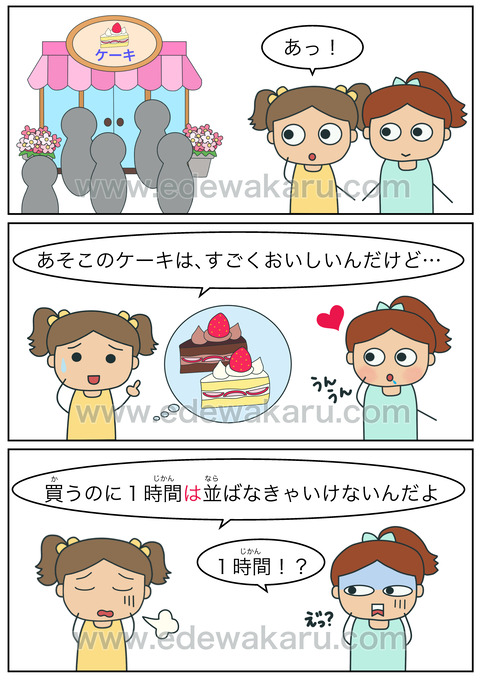
Meaning
At least about 〜
How to use it
Quantity + は
Explanation
“Aは〜” is a sentence pattern meaning “at least about A.” “A” is a quantity word such as [number of times, number of items, hours, or yen], and it is used when you want to say “do 〜 at least about A” or “do 〜 at least A.”
“Quantity + は” is also often used in conversation, so be sure to learn it 😉
In context 7 examples
あそこのケーキは、買うのに1時間は並ばなきゃいけなんだよ
→最低1時間くらい並ばなきゃいけないんだよYou have to wait in line for at least an hour to buy the cake over there. → You have to wait in line for at least about an hour.
A:この本、読んだことがある?B:うん。この本が大好きで、3回は読んだよ〜
→この本が大好きで、最低3回くらい読んだよ〜A: Have you ever read this book? B: Yeah. I love this book, and I’ve read it at least three times~ → I love this book, and I’ve read it at least about three times~
毎日2km(キロ)は走っています
→毎日最低2kmくらい走っていますI run at least 2 km every day. → I run at least about 2 km every day.
学校まで電車で30分はかかります
→学校まで電車で最低30分くらいかかりますIt takes at least 30 minutes to get to school by train. → It takes at least about 30 minutes to get to school by train.
1日に10個は、新しい単語を覚えるようにしている
→最低10個くらい覚えるようにしているI try to learn at least 10 new words a day. → I try to learn at least about 10 new words.
A:1日10回は彼氏にLINEするの♪B:…ラブラブなんだね
→最低10回くらいLINEするのA: I message my boyfriend at least 10 times a day♪ B: …You two are so lovey-dovey. → I message him at least about 10 times.
A:車っていくらくらいするのかな…B:う〜ん。中古でも50万円はするんじゃない?
→中古でも最低50万円くらいするんじゃない?A: I wonder how much a car costs… B: Hmm. Even used, it probably costs at least 500,000 yen, don’t you think? → Even used, it probably costs at least about 500,000 yen, don’t you think?
Read the original source text
Meaning
最低〜くらい〜
How to use it
数量+は
Explanation
「Aは〜」は「最低Aくらい〜」という意味の文型です。「A」には[回・個・時間・円]などの数量詞が入り、「最低Aくらい〜する」「少なくともAくらい〜する」と言いたい時に使われます。
「数量+は」は、会話でもよく使われますので覚えておきましょう😉
どんなときどう使う 日本語表現文型辞典
Usage 1
Meaning
as for…has…
How to use it
NはNが
Explanation
は~が~
「N1はN2が…」という形で、あるもの(N1)を話題にし、その部分やそれに属するもの(N2)の状態・性質などを表す言い方。
Takes up a topic N1; describes condition or nature of N2 that is part of or belongs to N1.
In context 4 examples
あの人は目がとてもきれいです。
That person’s eyes are very beautiful.
この料理は味がちょっと薄いです。
This dish is a little bland.
リンさんの家は庭が広くて、いいなあ。
Lin’s house has a spacious garden. I’m so envious.
メキさんは足が速いです。彼はサッカーの選手です。
Meki is a fast runner. He is a soccer player.
Read the original source text
Meaning
as for…has…
How to use it
NはNが
Explanation
は~が~
「N1はN2が…」という形で、あるもの(N1)を話題にし、その部分やそれに属するもの(N2)の状態・性質などを表す言い方。
Takes up a topic N1; describes condition or nature of N2 that is part of or belongs to N1.
Usage 2
Meaning
(does) this, but not that
How to use it
N (+ particle) は + 〔Polite form〕・〔Plain form〕が、N (+ particle) は~
Explanation
は~が、~は
1)二つのことを対比して言うときに使う。 ❶ のように「本を」に「は」がつく場合は「を」は消える。(本をは読みました)そのほかの助詞は ❸ ~ ❺ のようにそのまま残る。
2)くだけた話し言葉では「が」が「けど」になる。
1)Contrasts two things. As in sentence ❶ , particle を disappears when は is used. Other particles, such in sentences ❸ to ❺ , remain.
2)In informal speech, が becomes けど.
In context 5 examples
この本はもう読みましたが、あの本はまだです。
I’ve already read this book, but I haven’t read that one yet.
わたしたちの学校では、春は遠足に行きますが、秋は行きません。
At our school, we go on a field trip in spring, but not in autumn.
机の上には本がたくさんありますが、本だなにはあまりありません。
There are lots of books on the desk, but not many on the bookshelf.
わたしは図書館へは自転車で行きますが、学校へは歩いて行きます。
I go to the library by bicycle, but I walk to school.
タンさんにはプレゼントをあげたけど、カンさんにはあげなかった。
I gave Tan a present, but I didn’t give one to Kan.
Read the original source text
Meaning
(does) this, but not that
How to use it
N(+助詞)は+〔丁寧形〕・〔普通形〕+が、N(+助詞)は~
Explanation
は~が、~は
1)二つのことを対比して言うときに使う。 ❶ のように「本を」に「は」がつく場合は「を」は消える。(本をは読みました)そのほかの助詞は ❸ ~ ❺ のようにそのまま残る。
2)くだけた話し言葉では「が」が「けど」になる。
1)Contrasts two things. As in sentence ❶ , particle を disappears when は is used. Other particles, such in sentences ❸ to ❺ , remain.
2)In informal speech, が becomes けど.
Usage 3
Meaning
more than; less than
How to use it
NはN より
Explanation
は~より
学生1:そうですねえ。かたかなの言葉は漢字の言葉より難しいです。
学生2:わたしは、かたかなの言葉も漢字の言葉も同じぐらい難しいと思います。
1)「N1はN2より…」の形で話す人があるものを話題として取り上げ(「N1は」)、その状態を、ほかのものを基準にして(「N2より」)、比較して言うときの言い方。
2)比較を表すこの言い方は、否定の形では言わないのが普通である。
◆ × バスは電車より速くないです。/
× わたしは兄より早く起きません。
3) ❺ ❻ のように、「疑問詞+より」の形で、最上級を表す。
◆ × バスは電車より速くないです。/ × わたしは兄より早く起きません。
3)Superlatives are expressed by interrogatives + より, as in sentences ❺ and ❻ .
1)Speaker takes up topic (N1)and compares it to separate standard.
2)Normally, comparatives are not used in negative.
In context 6 examples
今日はきのうより暖かいです。
Today is warmer than yesterday.
このアパートは前のアパートより便利です。
This apartment is more convenient than the previous one.
水は空気より重い。
Water is heavier than air.
先生:かたかなの言葉は、漢字の言葉より易しいですか。
Teacher: Are words written in katakana easier than words written in kanji?
父は家族の中でだれよりも早く起きます。
My father gets up earlier than anyone else in the family.
人間の命は何よりたいせつです。
Human life is more precious than anything.
Read the original source text
Meaning
more than; less than
How to use it
NはN より
Explanation
は~より
学生1:そうですねえ。かたかなの言葉は漢字の言葉より難しいです。
学生2:わたしは、かたかなの言葉も漢字の言葉も同じぐらい難しいと思います。
1)「N1はN2より…」の形で話す人があるものを話題として取り上げ(「N1は」)、その状態を、ほかのものを基準にして(「N2より」)、比較して言うときの言い方。
2)比較を表すこの言い方は、否定の形では言わないのが普通である。
◆ × バスは電車より速くないです。/
× わたしは兄より早く起きません。
3) ❺ ❻ のように、「疑問詞+より」の形で、最上級を表す。
◆ × バスは電車より速くないです。/ × わたしは兄より早く起きません。
3)Superlatives are expressed by interrogatives + より, as in sentences ❺ and ❻ .
1)Speaker takes up topic (N1)and compares it to separate standard.
2)Normally, comparatives are not used in negative.
毎日のんびり日本語教師
Usage 1
Read this source entry ↗Meaning
Presentation of the topic and subject
How to use it
Noun + は + noun + が ~
Explanation
This sentence pattern is called the は-が construction. The が-marked phrase indicates the subject (the target of the predicate), while 「は」 indicates the topic.
The topic is an element that can be rephrased as “as for ~” or “speaking of ~.”
Notes
Nothing in particular.
In context 10 examples
象は鼻が長い。
Elephants have long trunks.
スマホはiPhoneがいい。(智能手机iPhone好。)
As for smartphones, iPhones are good. (iPhones are good smartphones.)
うちの猫は毛が長い。
Our cat has long fur.
父は髪が薄い。(父亲的头发很稀少。)
My father has thinning hair. (My father's hair is sparse.)
ロシアは国土面積が世界一だ。
Russia has the world's largest land area.
私はロックが好きです。
I like rock music.
山の頂上は景色が綺麗です。(山顶的景色很美。)
The view from the mountaintop is beautiful. (The mountaintop scenery is beautiful.)
私は毛虫が嫌いです。(我讨厌毛毛虫。)
I hate caterpillars. (I hate caterpillars.)
(私は)話が全然分かりません。
(I) don't understand the story at all.
(私は)目の前が真っ暗になった。(眼前一片漆黑。)
(I) suddenly felt as if everything had gone dark before my eyes. (Everything went dark before my eyes.)
Read the original source text
Meaning
主題と主語の提示
How to use it
名詞+は+名詞+が~
Explanation
ハガ構文と呼ばれる文型で、ガ格は主語(述語の対象)を表し、「は」は主題を表します。
主題とは「~について言えば」と言い換えられる要素を指します。
Notes
特になし
Usage 2
Read this source entry ↗How to use it
Noun A + は + noun A + で
(Noun A + も + noun A + で)
Explanation
The same noun is used to connect the clauses and express a contrast between things.
When the contrast with the preceding clause is made explicit, the following clause may take the form 「~も~で」.
Notes
Nothing in particular.
In context 6 examples
学生も色々忙しいが、先生も先生で忙しい。
Students are busy with all sorts of things, and teachers are busy in their own way too.
母には叱られるし、姉も姉で色々言ってくる。
My mother scolds me, and my older sister has all sorts of things to say in her own way too.
猫になりたい人は多いけど、猫も猫で大変なこともありそう。
Many people want to be cats, but cats probably have their own share of difficulties too.
母は家事で忙しそうだし、父は父でテレビを見ている。
My mother seems busy with housework, and my father, for his part, is watching TV.
仕事に追われて使われている私を、彼女も彼女で応援してくれている。
She supports me, even as I’m being worked to the bone and hounded by my job.
男性も理想の恋人像を語るが、女性も女性で男性に色々求めている。
Men talk about their ideal partner, and women, for their part, make all sorts of demands of men.
Read the original source text
How to use it
名詞A+は+名詞A+で
(名詞A+も+名詞A+で)
Explanation
同じ名詞を使って接続し、物事の対比を表します。
前件とはっきり対比させる場合、後件は「~も~で」になることがあります。
Notes
特になし
AIUEO JLPT Grammar
Usage 1
Meaning
This sentence pattern is used with particles (に・へ・で・と・から・まで) and「は」to emphasize a specific place, time, means, or other elements. It is used when making the part other than the subject the main focus of the sentence.
How to use it
Noun + には; Noun + へは; Noun + では; Noun + とは; Noun + からは; Noun + までは
In context 5 examples
あなたとは絶交です。
I'm no longer friends with you.
駅からは、歩いて行きます。
I walk from the station.
図書館では、静かにしてください。
Please be quiet in the library.
お店にはどう行きますか。
How do you go to the store?
学校までは、歩いて行きます。
I walk to school.
Read the original source text
Meaning
This sentence pattern is used with particles (に・へ・で・と・から・まで) and「は」to emphasize a specific place, time, means, or other elements. It is used when making the part other than the subject the main focus of the sentence.
How to use it
名詞+には名詞+へは名詞+では名詞+とは名詞+からは名詞+までは
Explanation · 日本語
この文型は、助詞(に・へ・で・と・から・まで)と「は」を組み合わせて、特定の場所や時間、手段、相手などを強調するために使用されます。主語以外の部分を文の主題として取り上げるときに使われます。
Usage 2
Meaning
This sentence pattern uses noun 1 as the subject and describes noun 2 as the attribute or state of noun 1. It is used when explaining the nature, feelings, or state of a specific subject.
How to use it
Noun 1 は + Noun 2 が
In context 5 examples
昨日は雨が降りました。
It rained yesterday.
この本は面白い話がたくさんあります。
This book has many interesting stories.
日本は温泉が多いです。
Japan has many hot springs.
彼は頭がいいです。
He is smart.
この映画は音楽が素晴らしいです。
The music in this movie is wonderful.
Read the original source text
Meaning
This sentence pattern uses noun 1 as the subject and describes noun 2 as the attribute or state of noun 1. It is used when explaining the nature, feelings, or state of a specific subject.
How to use it
名詞1は+名詞2が
Explanation · 日本語
この文型は、名詞1を主題として取り上げ、名詞2がその属性や状態を表すことを示す。特定の主題に対して、性質や感情、状態などを説明するときに使用されます。
Usage 3
Meaning
This sentence pattern is used to contrast two different nouns. By connecting noun 1 and noun 2 with「〜は〜は」, it expresses different characteristics or states of each noun or shows a comparison.
How to use it
Noun 1 は + Noun 2 は
In context 5 examples
桃は好きですが、バナナは好きじゃない。
I like peaches, but I don’t like bananas.
彼は勉強は得意ですが、スポーツは苦手です。
He is good at studying, but not good at sports.
今日は忙しいですが、明日は休みです。
Today I am busy, but tomorrow I have a day off.
料理は上手ですが、掃除は苦手です。
I am good at cooking, but not good at cleaning.
東京の物価は高いですが、交通は便利です。
Tokyo is expensive, but transportation is very convenient.
Read the original source text
Meaning
This sentence pattern is used to contrast two different nouns. By connecting noun 1 and noun 2 with「〜は〜は」, it expresses different characteristics or states of each noun or shows a comparison.
How to use it
名詞1は+名詞2は
Explanation · 日本語
この文型は、二つの異なる名詞を対比させるときに使用されます。名詞1と名詞2を「〜は〜は」の形で並べることで、それぞれに異なる特性や状態を述べたり、比較を示したりすることができます。
Usage 4
Meaning
This sentence pattern is used to emphasize a certain quantity, especially when it indicates the minimum required amount or suggests possible alternatives. It refers to the minimum number or expected quantity needed to achieve something.
How to use it
Numeral + は
In context 5 examples
三人は必要です。
We need at least three people.
少なくとも五つは持っているはずです。
He should have at least five.
一度は行ってみたい場所です。
This is a place I want to visit at least once.
少しは理解できるようになった。
I’ve become able to understand at least a little.
一時間は待ったけど、誰も来なかった。
I waited for an hour, but no one came.
Read the original source text
Meaning
This sentence pattern is used to emphasize a certain quantity, especially when it indicates the minimum required amount or suggests possible alternatives. It refers to the minimum number or expected quantity needed to achieve something.
How to use it
数量詞+は
Explanation · 日本語
この文型は、ある数量を強調するために使われる表現です。特に、その数量が最低限度であることを示す場合や、他の可能性を示唆するときに用いられます。この表現は、何かを達成するために必要な最小限の数や、予想される量について話すときに使われます。
Usage 5
Meaning
This sentence pattern is a casual expression used to state that noun 1 is noun 2. It is primarily used in conversations with close friends or family and in casual settings. It is also seen in written language when stating facts concisely in reports or papers, but it is not suitable for formal situations where politeness is required. For situations requiring respect or addressing superiors, it is appropriate to use 「です」. Similar to "… is ...” in English.
How to use it
Noun 1 は + Noun 2 だ
In context 5 examples
私は学生だ。
I am a student.
彼は先生だ。
He is a teacher.
彼女は医者だ。
She is a doctor.
これは本だ。
This is a book.
彼の趣味は音楽だ。
His hobby is music.
Read the original source text
Meaning
This sentence pattern is a casual expression used to state that noun 1 is noun 2. It is primarily used in conversations with close friends or family and in casual settings. It is also seen in written language when stating facts concisely in reports or papers, but it is not suitable for formal situations where politeness is required. For situations requiring respect or addressing superiors, it is appropriate to use 「です」. Similar to "… is ...” in English.
How to use it
名詞1は+名詞2だ
Explanation · 日本語
この文型は、名詞1が名詞2であることを述べるカジュアルな表現です。主に親しい友人や家族との会話、カジュアルな場面で使われます。また、書き言葉では論文や報告書などで事実を簡潔に述べるときにも見られますが、丁寧さが求められる場合には適していません。礼儀を重んじる場面や目上の人に対しては「です」を使うのが適切です。
Bunpro Grammar Reference
Usage 1
Meaning
As for... (Highlights sentence topic)
How to use it
Sentence topic + は, Pronounced "わ"
Nuance
A grammar point that presents the topic of the whole sentence, in general.
Explanation
は (pronounced わ) is often considered to be one of the most difficult particles to master in Japanese, alongside が. は marks the topic of the sentence, and describes the whole sentence broadly. However, が primarily marks single actions or statements. We will explore this distinction in more detail when covering が.
田中さんは先生です。
Tanaka-san is a teacher. (Broadly speaking, not compared to anything)
私はトムです。
I am Tom. (Broadly speaking, not compared to anything)
In many sentences (especially short ones), either は or が would be considered perfectly natural. This depends on whether someone is simply stating something (は), or highlighting it especially (が).
カレーは辛い。
Curry is spicy. (Broadly speaking, not compared to anything)
私は、ワインが嫌い。
I (as the topic of this sentence) dislike wine. (Specifically wine)
In the first sentence, は broadly describes what the sentence is about (curry). In the second sentence, は again describes the whole sentence being about 'me', but が highlights one specific piece of information (wine being the thing that is hated).
Caution
は cannot be used to describe things that you are seeing or experiencing 'in the moment' (right now). This is due to 'in the moment' events being considered part of a larger experience (your whole day for example).
今はテスト。
I have a test now. (Slightly unnatural, as the test is happening 'right now')
今日は、雨。
It will rain today. (Natural, as rain is a fairly broad event)
Caution
は has 2 main functions. The first marks the topic of the sentence, the second is used for contrast or making comparisons. Although there are no 'strict' rules for this, when は is used toward (or after) the middle of a sentence, it will usually have the nuance of contrast.
私は、金曜日が好き。
I like Fridays. (Focus is on Friday)
私は、金曜日は好き。
I like Fridays. (Focus is on the comparison to other days)
In the second sentence, は will give the listener the impression that there is a comparison being made.
In context 19 examples
- 私はトムです。
I (as the topic of this sentence) am Tom.
- 私は、ワインが嫌い。
I (as the topic of this sentence) dislike wine. (Specifically wine)
- カレーは辛い。
Curry is spicy. (Broadly speaking, not compared to anything)
- 田中さんは先生です。
Tanaka-san is a teacher. (Broadly speaking, not compared to anything)
- あなたはジムです。
You (as the topic of this sentence) are Jim.
- トムは先生です。
Tom [as the topic of this sentence] is a teacher.
- カバンは汚い。
The bag (as the topic of this sentence) is dirty.
- カレンダーは必要です。
A calendar (as the topic of this sentence) is necessary.
- 玄関は暗い。
The entrance (as the topic of this sentence) is dark.
- 彼は真面目です。
He (as the topic of this sentence) is serious/diligent/earnest.
- 私は忙しいです。
I (as the topic of this sentence) am busy.
- 明日は月曜日です。
Tomorrow (as the topic of this sentence) is Monday.
- 公園は広い。
The park (as the topic of this sentence) is spacious (wide).
- 海は綺麗です。
The ocean (as the topic of this sentence) is beautiful.
- 宮崎駿さんは有名です。
Mr. Hayao Miyazaki (as the topic of this sentence) is famous.
- 今はテスト。
I have a test now. (Slightly unnatural, as the test is happening 'right now')
- 今日は、雨。
It will rain today. (Natural, as rain is a fairly broad event)
- 私は、金曜日が好き。
I like Fridays. (Focus is on Friday)
- 私は、金曜日は好き。
I like Fridays. (Focus is on the comparison to other days)
Usage 2
Meaning
At least, Sort of, Or so
How to use it
Number/Amount + Counter + (くらい(1)) + は
Noun + くらい(1) + は
(1) ぐらい
Nuance
A structure which implies a general or approximate amount of (A). Often meaning at least.
Explanation
The は particle has two primary functions. The first is to mark the topic of a sentence, as learned very early in our Japanese language journey. However, the second common usage of は is to highlight contrast (making a comparison). When は is used after a number/counter, it regularly has this comparison meaning. This can be translated as 'or so', or 'at least'.
ディズニーランドには年に5回は行っている。
I go to Disneyland at least 5 times a year.
私は毎日、テレビを5時間は見ている。
Every day, I watch TV for 5 hours or so.
Before は, the counter is regularly followed by くらい (or ぐらい). This just softens the statement, and further highlights the 'or so' meaning.
2キロくらいはあると思う。
I think it is at least 2 kilograms.
倉敷には1回ぐらいは行った方がいいよ。
You should go to Kurashiki at least once.
Despite being translated as 'at least', the comparative meaning of は itself is what creates the nuance of this grammar structure. The thing before は is being highlighted as an amount, while also implying that there are other amounts. This implication of another amount makes は sound as if it could mean 'as opposed to (B)'. So in essence, this grammar structure sounds like 'As for (A), as opposed to (B)', where (B) is not usually mentioned.
In context 16 examples
- クリスマスぐらいは家に帰って来てね?
Won't you come home for Christmas, at least?
- 2キロくらいはあると思う。
I think it is at least 2 kilograms.
- ディズニーランドには年に5回は行っている。
I go to Disneyland at least 5 times a year.
- 私は毎日、テレビを5時間は見ている。
Every day, I watch TV for 5 hours or so.
- 倉敷には1回ぐらいは行った方がいいよ。
You should go to Kurashiki at least once.
- 少なくともこれぐらいは持って行ってください。
At the very least, at least bring this with you.
- 囚人のうち少なくとも6人は逃げたらしい。
I heard that at least 6 prisoners have escaped.
- この食べ物は少なくとも床に3秒は落ちていたから食べられない。
This food was on the floor for at least 3 seconds, so I can't eat it.
- 付き合っているんだから手ぐらいはつないだでしょうね?
Since you are going out, you were at least holding hands, right?
- 彼氏は1日8回は電話をかける。
My boyfriend calls at least 8 times a day.
- 心配な母親:「肉ぐらいは少し食べてよ。」
Worried mother: 'Please eat some meat at least!'
- スティーブン・ホーキングに一回は会いたかったのに…
(But) I wanted to meet Stephen Hawking at least once…
- 怒った親:「話す前にちょっとは考えるのが普通だろ!」
Angry parent: 'It is normal to think a little at least before you speak! Isn't it?'
- ドミニク:「沖縄に一度は行こうと思っています。」
Dominic: 'I am thinking of going to Okinawa at least once.'
- 今度の週末までに夏休みの宿題の半分ぐらいはやるよ。おかあさん、約束するよ。
I will do at least half of my summer homework by next weekend. I promise, Mom.
- この箱の中には少なくともクッキーが百個は入っているだろう。
There are probably at least 100 cookies in this box.
文法
Usage 1
Meaning
The particle 「は」 is used when contrasting two things or matters.
In context 7 examples
日本に来たときは寂しかったですが、今は友達もできて楽しくなりました。
When I came to Japan, I was lonely, but now I've made friends and am enjoying myself.
日本語の会話練習は好きですが、漢字の練習は嫌いです。
I like practicing Japanese conversation, but I hate practicing kanji.
トムさんにはバレンタインのチョコをあげたけど、ジェームスさんにはあげなかった。
I gave Tom Valentine’s chocolate, but I didn’t give any to James.
日本に来てから京都へは行きましたが、東京へはまだ行っていません。
Since coming to Japan, I've been to Kyoto, but I haven't been to Tokyo yet.
時給は安いですが、この仕事は楽しいです。
The hourly wage is low, but this job is fun.
英語はわかりますが、中国語はわかりません。
I understand English, but I don't understand Chinese.
犬は好きですが、猫はあまり好きじゃありません。
I like dogs, but I don't like cats very much.
Read the original source text
Meaning
2つの物や事柄を対比して言う時に助詞「は」が使われる。
Usage 2
Meaning
At least
How to use it
Quantity + は
In context 15 examples
昨日、あまり勉強できませんでしたが、30分は勉強しました。
I couldn’t study much yesterday, but I did study for at least 30 minutes.
あさっての飲み会、何人来るかまだ決まっていないけど、少なくとも5人は来るようです。
We haven’t decided how many people are coming to the get-together the day after tomorrow, but it looks like at least five will come.
毎月、3冊は本を読みます。
I read at least three books every month.
毎年、1回は海外へ旅行します。
I travel overseas at least once a year.
毎日7時間は寝るようにしています。
I try to sleep at least seven hours every day.
健康のために毎週3日はジョギングをするようにしています。
For my health, I try to jog at least three days a week.
テストは難しかったですが、70点はあると思います。
The test was difficult, but I think I got at least 70 points.
この映画は面白かったので、3回は見ました。
This movie was interesting, so I watched it at least three times.
家で2回は音読するようにしてください。
Please practice reading aloud at home at least twice.
早く終わった人は、最低でも2回は見直しをするようにしてください。
If you finish early, be sure to check your work at least twice.
歩いていくなら、30分はかかるでしょう。バスで行くのがいいと思いますよ。
If you walk, it will take at least 30 minutes. I think you should take the bus.
絵に詳しいわけではないですが、この絵は1万円はしそうですね。
I’m no expert on paintings, but this one looks like it costs at least 10,000 yen.
死ぬまでに1度はハワイに行ってみたいなあ。
I’d like to visit Hawaii at least once before I die.
うわあ、人が並んでいますね。たぶん、1時間は並ぶでしょうね。
Wow, there’s a line of people. We’ll probably be waiting for at least an hour.
私は1日に1度は野菜を食べましょう。
Let’s eat vegetables at least once a day.
Read the original source text
Meaning
少なくとも
How to use it
数量 + は
IMABI
The Particle は I: The Topic/Contrast Marker
Read this IMABI lesson ↗Explanation
The Particle は I: Topic/Contrast Marker
主題・対比を表す係助詞「は」①
Differentiating the particles は and が is the hardest task for a non-native speaker to master. Even Japanese grammarians have published countless papers on the topic to solve the age-old question. At a basic understanding, the two particles do, in fact, serve different purposes. Putting nuances aside…
The particle が is a case particle with the specific grammatical role of marking the subject of a sentence.
The particle は is not a case particle, but rather a particle used to indicate the topic at hand, attaching to various types of words, not just nouns.
The Source of the Confusion
Confusion arises when both は and が can theoretically work in a sentence after the grammatical subject. In such cases, context and logic enable native speakers to choose the appropriate particle with ease. For non-native speakers, however, managing the nuanced distinctions between the two requires careful practice and exposure.
With that being said, our goal in this lesson will be to cover the absolute basics about は so you can start using it confidently upon understanding its general functions. This will help you become better prepared to differentiate it from が.
Curriculum Note: You are not required to study new grammar points used in the example sentences other than the particle は at this time. Since the function and nuance of は are shaped by the context or lack thereof that follows, observing it in action is crucial to fully understanding how it works.
Usage 1: The Topic Marker は
主題を表す「は」
The first and most important usage of は that we will discuss is how it functions as a topic marker. First, we will discuss what is meant by the word “topic.”
What is a “Topic”?
The topic (主題) of a sentence can be an animate or inanimate entity (of one or more components), and that entity is what provides a starting point for conversation. A topic must also be something based on previously established information, whether it be from the ongoing conversation, one not too far back in the past, or from common sense.
The topic is considered to be “old information.” For something to be registered information, though, you may need to use が first to establish it as so.
This distinction is clearly illustrated in the opening of the famous fairy tale 桃太郎.
1. 昔々、あるところに、おじいさんとおばあさんが住んでいました。おじいさんは山へ柴刈りに、おばあさんは川へ洗濯に行きました。
Long, long ago, there lived an old man and woman. One day, the old man went to the mountains to gather firewood, and the old woman went to the river to wash clothes.
At the beginning of a story, the reader presumably knows nothing about it. This is why the particle が is used to mark the subjects and to establish them as the characters, which in turn is “new information” to the reader. Once the characters are established, they are then treated as the topic in the following sentence, which is why they are marked by は. Note that although the comment that follows may still be new information, the topic itself is no longer new.
Examples and Explanations
2. あれは私の帽子です。
That’s my hat.
Sentence Note: Though the comment, the hat being the speaker’s, is “new information,” the recognition of the hat is not.
In Japanese, phrases may be topicalized and put at or near the front of the sentence, after which point a comment is made about said topic. The comment could be already known or new information, but the topic is something implied to be known to both the speaker and the listener(s). Oftentimes, this is based on a common sense assessment of reality.
3. お名前は何ですか。
What’s your name?
Sentence Note: Everyone has a name. Even if this statement were not completely true, it is practically true. This is all the information one needs to know about the human world to understand how “your name” can be grammatically treated as “old/registered” knowledge. You know the person you are talking to has a name; you just do not know what that person’s name is, which is why the question forms the comment about the topic.
4. トイレはどこですか。
Where is the toilet?
Sentence Note: When you ask this question, you are assuming that there is a toilet nearby. The existence of toilets can be rather easily ascertained based on one’s surroundings. Asking this means you have already determined that there is one, and you are also implying that the existence and knowledge of its location is something that others might help you find out.
5. 火星は赤いです。
Mars is red.
Sentence Note: Most people know about Mars, and so the acknowledgment of its existence is well established. Its color is also well known enough to be viewed as a generic statement.
6. 日本は島国です。
Japan is an island nation.
Sentence Note: Japan is known by most people as an island nation.
7. ウサギはかわいいですね。
Rabbits are cute, aren’t they?
Sentence Note: Wherever rabbits exist, there are humans that know about them.
は ≒ “As For”
All sorts of grammatical items can be topicalized with the help of the particle は.
Semantically, it is very similar to the English expression “as for.” While this translation is not adequate for all scenarios, it is a great stepping stone for understanding how は functions.
8. 私は毎日ジムに行きます。
(As for me,) I go to the gym every day.
The purpose of は is two-fold. It establishes that “I” is the topic, but it also differentiates it from other possible topics like “he” or “she.” As such, the reason why 私 would even be used instead of just being dropped—which is often the case—is because the speaker has become the center of conversation.
This is the basis for the notion of “topicalization.” This is separate from the grammatical role designation of noun complements in a sentence, which is what case particles like が handle. While が is, indeed, the subject marker, it oddly cannot coexist with the particle は. Meaning, はが is not grammatical. Instead, the particle が is dropped1 when the subject is also the topic.
The Variety of Topicalized Phrases
The particle は has few restrictions on what it can topicalize. For instance, it can topicalize location and time phrases, among other things. These sentences are easy for learners because of how distinct these “topics” are from the other elements of the sentence.
9. 日本では地震がよく起きます。(Topicalization of Place of Occurrence)
In Japan, earthquakes often happen.
10. 今日は韓国語を勉強します。(Topicalization of Time Phrase)
Today, I will study Korean.
11. ケーキはもう食べました。(Topicalization of Direct Object)
As for the cake, I ate it already.
I ate the cake already.
12. 中国経済には問題がある。(Topicalization of a Location)
There is/are problem(s) in the Chinese economy.
Due to English phrasing constraints, it may not always be possible to place the topicalized phrase of a Japanese sentence at the front of the English translation. However, the fact that the は phrase in question is being topicalized and the fact that said は phrase forms the basis for the upcoming conversation do not change.
ウナギ文
While there are sentences in which X in “XはYだ” is both the subject and the topic, there are some sentences that present themselves as major headaches to learners because of how Xは initially seems to be a subject but cannot logically be so. First, consider the following two examples.
13. ウナギは魚だ。
Eels are fish.
14. 僕はウナギだ。
i. As for me, I go for eel.
ii. As for me, eel is (the way to go).
iii. I (will) have eel.
iv. I’m an eel (kind of person).
v. I’m an eel person. ?
vi. I am an eel. X2
Ex. 13 is a general statement of fact. No additional context is required to determine that X and Y refer to the same entity. These factors enable a speaker to know that X is both the topic and the subject.
In Ex. 14, X and Y are not the same entity, and while the various interpretations i-iv are not inherently so different as far as the ultimate interpretation of the sentence is concerned, the exact grammatical relationship between X and Y differs accordingly. Ex. 14 is an extreme (though famous) example of how much syntax-related information can be omitted in Japanese sentences, but in natural discourse, surrounding context allows speakers to effectively combat grammatical ambiguity. Nonetheless, let’s consider what these interpretations can tell us about X vs. Y.
In ウナギ文, だ usually replaces a more complex predicate.
If Y is attributed the role of the “object” which an agent (doer) X is acting upon, this results in i and iii.
If Y is viewed as an “object” of desire, X is the subject which possesses that desire. This results in iv-v, with v requiring more context to reach an acceptable level of “naturalness” in both English and Japanese.
For ii, the topic 僕は, much like other kinds of topicalized items, is an extra piece to the sentence, making X, the subject, ウナギ. Ironically, ii is still fairly synonymous with i.
こんにゃく文
When a learner fails to understand that the “topic” need not always be the subject, and what the consequence might be for not making the connection, misunderstandings like 14vi are inevitable. Likewise, when a learner fails to understand that the “topic” might coincide with the “agent” (cause/initiator) but not the subject, sentences known as こんにゃく文 become just as confusing.
15. こんにゃくは太りません。
You won’t put on weight from konjac. (≠ Konjac won’t put on weight).
These sentences come about by the “head” of an attributive predicate being omitted. In the case of Ex. 15, this omitted “head” of what would be a predicate in an attributive dependent clause can be simply understood to be “eat.” This allows for the sentence to be translated into English as, “As for konjac, you won’t gain weight from eating it.”
16. 趣味はバスケが兄で、ピアノが姉です。
As for hobbies, my older brother does basketball and my older sister does piano.
In Ex. 16, the speaker has chosen not to actually use the word for “to do,” and is instead attributing his/her siblings to those activities.
Generic Statements
Many conversations are started off by mentioning something everyone already knows. However, implying that the listener(s) knows is subjective in nature. This is because one can never definitively know what someone else does or does not know. This usage of は is very different from the exhaustive-listing statements that が can make. Whereas an exhaustive-listing sentence is limited semantically solely to what is explicitly stated, は is far more open-ended due to its generic nature. There is always a chance for the speaker to imply “I know that X is Z, but I don’t know about Y.”
17. こちらは(私の)弟です。
This is my little brother.
18. 彼女は{中国人・日本人・アメリカ人・イギリス人}です。
She is [Chinese/Japanese/American/British].
19. リンゴは果物です。
Apples are fruits.
20. 空は青い。
The sky is blue.
21. 宇宙は広い。
The universe is vast.
22. 太陽は明るい。
The sun is bright.
23. 月は地球の衛星です。
The Moon is Earth’s satellite.
24. 夜は暗い。
Night is dark.
25. 花は美しい。
Flowers are beautiful.
26. 春は素晴らしいですね。
Spring is wonderful, isn’t it?
27. 世界は小さい3。
The world is small.
28. 数学は難しいですね。
Math is difficult, isn’t it?
Now, the following examples are not representative of generic statements.
29. 私は行きません。
I won’t go.
30. 彼は先生ではありません。
He is not a teacher.
In these examples, は bringing out the meaning of “X isn’t but something/someone else might be/do Z.” This implicit contrast is something that, depending on the context, may become even more profound (See Usage 2). As for Ex. 30, it could be that another person is a teacher, and that “he” could be something other than a teacher. If the particle が were used, the sentences would become examples of exhaustive-listing. Remember, exhaustive-listing is still exhaustive if X simply refers to one entity and one entity only.
Attributive Phrases: Xは[Y’がZ]
One of the most common ways to describe something is utilizing the pattern Xは[Y’がZ]. In Lesson 12, we learned the basic4 iteration Xが[Y’がZ], and the breakdown goes like this:
X = The main subject of the sentence.
Y‘ = The auxiliary subject that relates to Z.
Z = The predicate describing an attribute of Y.
In the examples below, there are generally two kinds of translations. The first will reflect the Japanese grammar, whereas the second will be a nativized rephrasing.
31. 象は鼻が長い。
As for (a/the) elephant(s), their nose(s) are long.
Elephants have long noses.
Grammar Note: It is important to understand that the topic is elephants, not their noses. The particle が does mark the nose’s length as the (new) information of the sentence, but imagine this sentence being the start or part of a longer discussion about elephants. Since we have already learned how the particle の marks attributes, you may wonder if the following sentence is correct:
32. 象の鼻が長い。
Elephant noses are long.
This sentence is, in fact, grammatical, but its nuance is not the same. Focus is placed solely on elephant noses, and the speaker is purposely pointing out their length to the listener.
33. 象の鼻は長い。
Elephant noses are long.
This sentence is also possible, but now the speaker is just talking about elephant noses with no particular emphasis on the comment.
34. 日本は神社が多い。
i. As for Japan, there are many Shinto shrines.
ii. Japan has many Shinto shrines.
35. 秋はサンマが最高だ。
i. As for autumn, Pacific saury is the best.
ii. In autumn, Pacific saury is the best.
36. 冬には気温が下がります。
In winter, the temperature goes down.
37. その仕事は、私がします。
As for that job, I will do it.
38. キリンは首が長い。
i. As for giraffes, their necks are long.
ii. Giraffes have long necks.
39. (私は)頭が痛いです。
i. (As for me), my head hurts.
ii. I have a headache.
40. (私は)お腹が空きました。
i. (As for me), my stomach is empty.
ii. I’m hungry.
41. (私は)喉が渇きました。
i. (As for me), my throat is parched.
ii. I’m thirsty.
In both Ex. 40 and Ex. 41, it is more natural to drop the pronoun. Although we have not studied verbal conjugations, it must be noted that the ~た at the end of these expressions SHOULD NOT be interpreted as past tense. Instead, it should be viewed as a present perfect tense with a heavy emphasis on the state having reached its state “now.” When someone says either of these phrases, they are not saying that their “stomach WAS” empty or that their “throat WAS parched.” They are experiencing hunger/thirst, so be the better Japanese learner and get them something rather than assume they have already had something.
Generic Questions
As opposed to the questions made with が, those made with は have the interrogative (question) phrase as the predicate. This is because the questions formed with は imply that the question (topic) at hand should be evident/relevant to the listener(s) as well. This pattern will be how most of the questions you ask are formed, and they tend to have a softer tone than those created with が (See Lesson 11).
42. サム君はいつ来る?
When is Sam coming?
43. 今日は何曜日ですか。
What day is it today?
44.(あなたは)誰ですか。
Who are you?
45. 病院はどこですか。
Where is the hospital?
46. 趣味は何ですか。
What are your hobbies?
Usage 2: The Contrast Marker は
対比を表す副助詞「は」
On top of being a topic marker, は is also the particle of contrast (対比), which can be seen in its usage of marking the topic. There is a line of thought that the contrast marker meaning of は is actually the primary meaning of は. Within a given sentence, several は may appear. Each one will have a different level of contrast implied. When は does not appear to be contrasting anything, it may very well just be used as a topic marker.
47. 私は昨日は昼食は取らなかったんです。
Yesterday, I didn’t have lunch.
Although the presence of 私は could imply a contrast with other people, the sentence is bringing oneself to the forefront of conversation, which would likely be on purpose in this scenario. With this being this case, it is viewed as the topic. Both the words for “yesterday” and “lunch” are marked with は because they contrast with other scenarios. For instance, the speaker may have eaten lunch today, and he may have eaten breakfast and/or dinner that day.
48. 今日は行きます。(→ 明日は行きません)
I’m going today. (→ I’m not going tomorrow)
49. 旦那さんは上海へ行きます。(→ 奥さんは北京へ行きます)
His/her husband is going to Shanghai. (→ His/her wife is going to Beijing)
50. 大阪へは行きます。(→ 京都へは行きません)
I’m going to Osaka. (→ I’m not going to Kyoto)
51. ルールにない事は、私は何も言いません。
I will say nothing about anything not in the rules.
Grammar Note: The use of 私は adds greater emphasis to the sentence. The speaker is drawing contrast with their stance as opposed to others. The は after 事 can also be viewed as both being the topic and a point of contrast. Meaning, the speaker may talk about things in the rules, and the topic is still very much about what is not in the rules.
52. 本当は嬉しいです。
I’m actually happy.
Grammar Note: 本当 is an adverbial noun, and in this sentence, it is being used in the sense of “in actuality.” The implication is that although the speaker may not appear happy, they are, in fact, happy.
53. 「日本料理は好きですか」「タイ料理は好きです」
“Do you like Japanese cuisine?” I like Thai food(, but not Japanese cuisine.)
Grammar Note: The reply provides an indirect means of saying that one does not like Japanese cuisine. Although this is inferred by the reply, such responses are deemed politer than just saying no.
54. 犬は好きですが、猫はどうも・・・
I like dogs, but cats…
Grammar Note: The が seen after です is the conjunctive particle が, which is separate from its use as a subject marker. For now, simply know that it is the “but” in this example and in the ones that follow.
55. コーヒーは飲まないが、ビールは飲むよ。
I don’t drink coffee, but I drink beer.
56. 鉛筆はありませんが、ペンはありますよ。
There aren’t pencils, but there are pens.
I don’t have pencils, but I have pens.
Grammar Note: The verb ある may also mean “to have (an inanimate object).”
57. 象の鼻は長いが、象以外の鼻も長い。
Elephant noses are long, but there are other noses that are long other than elephants’.
58. 象は鼻が長くて、尻尾が短いです。
As for elephants, their noses are long and their tails are short.
59. 象は確かに鼻は長いが、尻尾はかなり短いです。
As for elephants, their noses are certainly long, but their tails are pretty short.
60. 象(だけ)が鼻が長い。
Elephants are the (only) ones that have long noses.
Grammar Note: Although Exs. 57-60 add some more complexity, in combination with Exs. 31-33, they help better illustrate how changing up が and は affects meaning. Even without knowing the extra grammar points or words, the role that these particles play follow what is to be expected from their descriptions. Ex. 57 is talking about noses, and the contrast that follows is still about noses. Ex. 58 is simply about describing elephants, and so the length of their noses and tails are not being contrasted. In Ex. 59, though, these facts are being contrasted, and the topic is still on elephants, which is why there are three instances of は in the same sentence. Then, there is XがYがZ in Ex. 60. It is possible to have two subjects like this in a Japanese sentence, but in this structure it is best to view [YがZ] as a single predicate unit which is being paired with the exhaustive meaning of が.
61. あれはオオカミではない、狐だよ。
That isn’t a wolf; it’s a fox.
Grammar Note: This example demonstrates how the は in ではない is also the contrasting は. Also note how Japanese uses a comma when a semi-colon would be used in English.
62. 運航のダイヤには影響はない。
There is no effect on the operating schedule.
Sentence Notes: 運航 refers to the operation of aircraft or ships. When referring to the operation of busses or other similar motorized vehicles, it is spelled as 運行. Be careful to pronounce these words with a LHHH (low-high-high-high) intonation as the word うんこ with a HLL (high-low-low) intonation means “poop.”
Grammar Note: The contrastive は is used heavily with negative sentences. The intent of the speaker is to imply that other scenarios may still be possible but that the one being mentioned is not the case. Meaning, the speaker mentioning the operating schedule is not implying that there will not be a change in quality of flight. The promise is limited to there being no effect on the timing, which is also why [運航のダイヤに] is topicalized.
Usage 3: Bare Minimum
最低限を表す副助詞「は」
Another usage of the particle は is to express a bare minimum (最低限)—”at least.” This is primarily used with number expressions but it is not limited to them.
63. 少なくとも2時間はかかります。
It will take at least two hours.
64. 10人は来ます。
At least ten people will come.
65. 10万円は必要です。
It will need at least 100,000 yen.
66. 牛乳ぐらいは買ってください。
At least buy milk, please.
Grammar Note: The adverbial particle くらい・ぐらい is frequently used with this function of the particle は to express “at least.” It can actually be inserted similarly to the other example sentences in this section. Its addition creates a greater emphatic tone.
67. 盲腸(虫垂炎)の手術でも1000ドルはかかります。
Even appendix (appendicitis) surgery will cost at least a thousand dollars.
Though dropped from the surface structure (spoken elements) of the sentence, the particle が’s role is still inherited by the noun X of the predicate type X(が・は)Yだ. The existence of が in the deep sentence structure of any clause is verifiable from its equivalents’ appearances in sister languages such as Okinawan in which it can coexist with their は counterparts. ↩︎
In fantasy in which a speaker may very well be asserting that they are, in fact, an eel, then this interpretation would become valid. The overarching context, however, would have already defined X in a way that would cause the sentence to be interpreted as so. ↩︎
世界は小さい is also actually the Japanese translation of the famous tune, “It’s a small world after all.” ↩︎
“Basic” as in the deep sentence structure of the pattern before nuance layering via が vs は come into play. ↩︎
In context 67 examples
昔々、あるところに、おじいさんとおばあさんが住んでいました。おじいさんは山へ柴刈りに、おばあさんは川へ洗濯に行きました。
Long, long ago, there lived an old man and woman. One day, the old man went to the mountains to gather firewood, and the old woman went to the river to wash clothes.
あれは私の帽子です。
That’s my hat.
お名前は何ですか。
What’s your name?
トイレはどこですか。
Where is the toilet?
火星は赤いです。
Mars is red.
日本は島国です。
Japan is an island nation.
ウサギはかわいいですね。
Rabbits are cute, aren’t they?
私は毎日ジムに行きます。
(As for me,) I go to the gym every day.
日本では地震がよく起きます。(Topicalization of Place of Occurrence)
In Japan, earthquakes often happen.
今日は韓国語を勉強します。(Topicalization of Time Phrase)
Today, I will study Korean.
ケーキはもう食べました。(Topicalization of Direct Object)
As for the cake, I ate it already.
中国経済には問題がある。(Topicalization of a Location)
There is/are problem(s) in the Chinese economy.
ウナギは魚だ。
Eels are fish.
僕はウナギだ。
i. As for me, I go for eel.
こんにゃくは太りません。
You won’t put on weight from konjac. (≠ Konjac won’t put on weight).
趣味はバスケが兄で、ピアノが姉です。
As for hobbies, my older brother does basketball and my older sister does piano.
こちらは(私の)弟です。
This is my little brother.
彼女は{中国人・日本人・アメリカ人・イギリス人}です。
She is [Chinese/Japanese/American/British].
リンゴは果物です。
Apples are fruits.
空は青い。
The sky is blue.
宇宙は広い。
The universe is vast.
太陽は明るい。
The sun is bright.
月は地球の衛星です。
The Moon is Earth’s satellite.
夜は暗い。
Night is dark.
花は美しい。
Flowers are beautiful.
春は素晴らしいですね。
Spring is wonderful, isn’t it?
世界は小さい3。
The world is small.
数学は難しいですね。
Math is difficult, isn’t it?
私は行きません。
I won’t go.
彼は先生ではありません。
He is not a teacher.
象は鼻が長い。
As for (a/the) elephant(s), their nose(s) are long.
象の鼻が長い。
Elephant noses are long.
象の鼻は長い。
Elephant noses are long.
日本は神社が多い。
i. As for Japan, there are many Shinto shrines.
秋はサンマが最高だ。
i. As for autumn, Pacific saury is the best.
冬には気温が下がります。
In winter, the temperature goes down.
その仕事は、私がします。
As for that job, I will do it.
キリンは首が長い。
i. As for giraffes, their necks are long.
(私は)頭が痛いです。
i. (As for me), my head hurts.
(私は)お腹が空きました。
i. (As for me), my stomach is empty.
(私は)喉が渇きました。
i. (As for me), my throat is parched.
サム君はいつ来る?
When is Sam coming?
今日は何曜日ですか。
What day is it today?
(あなたは)誰ですか。
Who are you?
病院はどこですか。
Where is the hospital?
趣味は何ですか。
What are your hobbies?
私は昨日は昼食は取らなかったんです。
Yesterday, I didn’t have lunch.
今日は行きます。(→ 明日は行きません)
I’m going today. (→ I’m not going tomorrow)
旦那さんは上海へ行きます。(→ 奥さんは北京へ行きます)
His/her husband is going to Shanghai. (→ His/her wife is going to Beijing)
大阪へは行きます。(→ 京都へは行きません)
I’m going to Osaka. (→ I’m not going to Kyoto)
ルールにない事は、私は何も言いません。
I will say nothing about anything not in the rules.
本当は嬉しいです。
I’m actually happy.
「日本料理は好きですか」「タイ料理は好きです」
“Do you like Japanese cuisine?” I like Thai food(, but not Japanese cuisine.)
犬は好きですが、猫はどうも・・・
I like dogs, but cats…
コーヒーは飲まないが、ビールは飲むよ。
I don’t drink coffee, but I drink beer.
鉛筆はありませんが、ペンはありますよ。
There aren’t pencils, but there are pens.
象の鼻は長いが、象以外の鼻も長い。
Elephant noses are long, but there are other noses that are long other than elephants’.
象は鼻が長くて、尻尾が短いです。
As for elephants, their noses are long and their tails are short.
象は確かに鼻は長いが、尻尾はかなり短いです。
As for elephants, their noses are certainly long, but their tails are pretty short.
象(だけ)が鼻が長い。
Elephants are the (only) ones that have long noses.
あれはオオカミではない、狐だよ。
That isn’t a wolf; it’s a fox.
運航のダイヤには影響はない。
There is no effect on the operating schedule.
少なくとも2時間はかかります。
It will take at least two hours.
10人は来ます。
At least ten people will come.
10万円は必要です。
It will need at least 100,000 yen.
牛乳ぐらいは買ってください。
At least buy milk, please.
盲腸(虫垂炎)の手術でも1000ドルはかかります。
Even appendix (appendicitis) surgery will cost at least a thousand dollars.
Bound Particles
Read this IMABI lesson ↗Explanation
第031課: Bound Particles
Bound particles (係助詞) might as well be called emphatic particles. Most of them have become adverbial and or final particles. Their functions range from emphatic to interrogative usages, and this is often determined by careful attention to context.
Bound particles require that the final verb phrase in their clause to be in a particular form. Most require the final verb phrase to be in the 連体形 because, as we’ve seen, that can make verbs function as nominalized phrases in Classical Japanese.
Though the particles discussed in this lesson may not be exhaustive in accounting for all such particles in Classical Japanese, it will enable you to have a decent understanding of the some times very complex grammar rules that go with them.
The particles to be discussed are the following:
Particle The Fixed Base Function(s) Final Usages?
は 終止形 Topic Marker Yes
も 終止形 Parallel listing Yes
や(は) 連体形 Doubt/question Yes
か(は) 連体形 Doubt/question Yes
ぞ 連体形 Emphasis Yes
なむ・なん 連体形 Emphasis Yes
こそ 已然形 Strong emphasis Yes
Grammar Note: These particles have such a strong role in binding sentences in a certain form that even in their absence, when other elements that would be used in concert with them are showing doubt or a rhetorical question, as is an important usage for particles like ぞ, なむ, や, and か, the sentence may still be seen bound in the 連体形. No wonder the 終止形 and 連体形 merged.
は
The particle は is as you should certainly know is extremely important in Modern Japanese. However, there was a point in time where it was not used, and it has taken centuries for the がVSは rivalry to get to its present form. In fact, the thing that rivaled は, which shows known information, was も, which could present new information. Where did this particle come from? It likely has origin with the particle ば, but it is certain that by the 平安時代 its usages had become greatly varied and increasingly more complex.
So, we know that it marks the topic. This topic is emphasized and often made distinct from other things, which is why we still often translate it into English with “as for”. This topic is what the explanation/predicate is going to be about. It can be used with parallel items to show comparison and or contrast. Of course, it still has the role of highlighting the negative.
As you saw from above, it can also be used with other bound particles, and it can also be used as a final particle. That’s right. Although modern orthography changes doesn’t make this obvious, the adverbial は and final particle わ of Modern Japanese are from the same thing. When it comes at the end, the verb has to go to the 連体形,which is the common trait for bound particles.
Grammar Note: Remember from previous lessons that は can attach to an adjective 連用形 or -ず to create a hypothetical situation, and ず+は often makes ず(ん)ば. Also remember that を+は = をば.
Examples
1. 古京はすでに荒れて、新都はいまだ成らず。
The old capital has already been ravaged, and the new capital has still not been materialized.
From the 方丈記.
2. 人妻尓 言者誰事 酢衣乃 此紐解跡 言者孰言 (原文)
人妻に言ふは誰たが言ことさ衣のこの紐解けと言ふは誰が言
Who calls for me, a married woman? Who says I untie the cords of my cloth and sleep together?
From the 万葉集.
3. 其願空しかるべくは、道にて死ぬべし。
If such a request proves hopeless, I shall die en route!
From the 平家物語.
4. なにもなにも小さきものはみなうつくし。
Of everything small things are particularly adorable.
From the 枕草子.
5. まろ格子上かうしげずば道なくてげにえ入いり来ざらまし。
If I hadn’t raised the lattice, there would’ve been no path and I would have not been able to come.
From the 源氏物語.
6. 法師ばかり羨ましからぬものはあらじ。
There is probably no less enviable than a monk.
From the 徒然草.
7. 火に焼かむに焼けずはこそ真まことならめ
When we try to burn it by fire and it cannot burn, it’s definitely the real thing.
From the 竹取物語.
8. かの花は失せにけるは。
That flower has ended up disappearing!
From the 枕草子.
9. とまらしなよもの時雨のふるさとゝなりにしならの霜のくちはゝ (原文)
とまらじな四方の時雨の古郷となりにしならの霜の朽ち葉は
It won’t stop. In Nara the showers pour every which way, and the oak leaves fall and rot in the dew.
From the 院百首.
Word Note: [降る里 and 古里] and [奈良 and 楢] are overlapped together respectively.
10. 古里となりにし奈良の都にも色はかはらず花は咲きけり。
Even in the old capital Nara, without change in color, the flowers had bloomed.
From the 古今和歌集.
11. 悪所に落ちては死にたからず。
We don’t want to die falling into a bad spot.
From the 平家物語.
12. 居明而 君乎者将待 奴婆珠能吾黒髪尓 霜者零騰文 (原文)
居明かして君をば待たむ烏珠ぬばたまの吾が黒髪に霜は降るとも
I will wait as is till dawn, no matter if the dew falls into my black hair.
From the 万葉集.
Base Note: Although we say that it is paired with the 終止形, there are sentences with it that are in the 命令形, where it is cut off in the 連用形, or ends in a nominal (体言止め). This is all still the case in Modern Japanese.
も
The particle も is like “too/also” and can show listing of things that are new information. Or, it shows that what it follows is not limited in the situation to it alone. In being such, も can be seen in adverbial phrases showing an outer limit or minimal desire, which it still does today.
13. 山川 水陰生 山草 不止妹 所念鴨 (原文)
山河の水陰みかげに生ふる山菅やますげの止やまずも妹がおもほゆるかも
Like the mountain sedge growing on the waterside in the mountain, I think of you nonstop.
From the 万葉集.
14. 限りなく遠くも来にけるかな。
How far we have come endlessly!
From the 伊勢物語.
15. 熟田津尓 船乗世武登 月待者 潮毛可奈比沼 今者許藝乞菜 (原文)
熟田津に船乗りせむと月待てば潮もかなひぬ、今は漕ぎ出でな
The tide too has improved while I waited for the moon while boarding in Nikita Harbor. I now sail!
From the 万葉集.
16. 長き御世にもあらなん
May (she) have long life!
From the 源氏物語.
17. 月だにも雲のいづくに夏の夜のやみはあやなし曙の空。
Even the moon somewhere in the clouds colors the darkness of the summer night–daybreak.
From 順徳院.
18. 京極の屋の南むきに、今も二本侍るめり。
There are apparently two trees still on the south side of the Kyogoku residence.
From the 徒然草.
19. 花ちれる水のまにまにとめくれば山には春もなくなりにけり。
When the flowers scattered afloat the river, spring ended went away in the mountains.
From the 古今和歌集.
も can be very emotive, and it was used as a final particle in the 奈良時代.
20. 冨等登藝須 奈保毛奈賀那牟 母等都比等 可氣都々母等奈 安乎祢之奈久母 (原文)
霍公鳥 なほも鳴かなむ 本つ人 かけつつもとな 吾を音し泣くも
Oh cuckoo cry still; I think of the person passed away and in that vestige I cry and weep.
From the 万葉集.
21. 樂浪乃 國都美神乃 浦佐備而 荒有京 見者悲毛 (原文)
楽浪の 国つ御神の うらさびて 荒れたる都 見れば悲しも
The heart of the kami of Sasanami has withered, and the ravaged capital ruins are sad to behold.
From the 万葉集.
When in もぞ and もこそ, it can show that something can’t be–するといけない.
22. 烏などもこそ、見つくれ。
It must not be that something like a crow would find it.
From the 源氏物語.
23. 玉の緒よ 絶えなば絶えね ながらへば 忍ぶることの 弱りもぞする。
If this life shall cease, may it cease. If I live on like this, my secret love will be known to all.
From the 新古今和歌集.
や(は)
や(は) can show doubt and (rhetorical) question. When in the middle of a sentence it no doubts binds the final verb in the 連体形. However, as will be evident in the examples, the 終止形 can indeed be used when や is in the final position of a clause.
24. 龍田河もみぢみだれて流るめり渡らば錦なかや絶えなむ
The Tatsuda River seems to flow with colored leaves. If I cross, the brocade may be severed in half.
From the 古今和歌集.
25. 忘哉 語 意遣 雖過不過 猶戀
忘るやと物語りして心遣り過ぐせど過ぎずなほ恋ひにけり
Wondering if I would forget, I avert my mind with gossip, but I still can’t go by my love (for you).
From the 万葉集.
26. 冬ながら空より花の散りくるは雲のあなたは春にやあるらむ。
As for flowers falling from the sky while it’s winter, does that mean spring is beyond the clouds?
From the 古今和歌集.
27. 宵のまに身を投げはつる夏虫は燃えてや人に逢ふと聞きけむ。
I wonder if the summer bugs that burned in the night heard they could meet their loved ones by throwing themselves into the flames?
From the 伊勢物語.
28. 秋の田の穂の上を照らす稲妻の光の間にも我や忘るる。
I will not forget you even when lightning brightens the tops of the ears of rice in the autumn field.
From the 古今和歌集.
29. さくら花春くははれる年だにも人の心に飽かれやはせぬ。
Cherry blossom, even in years when spring is long, would you scatter without having satisfied man? Bloom to your heart’s desire!
From the 古今和歌集.
Grammar Note: やは…~ぬ = Why don’t you… (showing want of the speaker as well)
30. 光やあると見るに、蛍ばかりの光だになし。
When she looked wondering if there were light, there wasn’t even the light of a firefly.
From the 竹取物語.
31. 古 人尓和礼有哉 樂浪乃 故京乎 見者悲寸 (原文)
古の 人に我れあれや 楽浪の 古き都を 見れば悲しき
Aren’t I not a person of the old; when I look at the old capital of Sasanami, I’m sad without reason.
From the 万葉集.
Grammar Note: や can also be after 已然形 to show a rhetorical question directed at oneself.
32. うちはへて春はさばかりのどけきを花の心や何いそぐらむ
Although spring is calm like this every day, why do the hearts of the flowers hurry and try to scatter?
From the 後撰和歌集.
Word Note: うちはえて comes from a verb with the meaning of stringing along a rope and is used here adverbially to express continuing to be so.
33. 多知之奈布 伎美我須我多乎 和須礼受波 与能可藝里尓夜 故非和多里奈無 (原文)
立ちしなふ君が姿を忘れずは世の限りにや恋い渡りなむ。
Without forgetting your great appearance will certainly go on loving you all my life.
From the 万葉集.
Grammar Note: This なむ is the 未然形 of the auxiliary ~ぬ + the volitional auxiliary ~む.
34. 保等登藝須 許々尓知可久乎 伎奈伎弖余 須疑奈<无>能知尓 之流志安良米夜母 (原文)
霍公鳥 ここに近くを 来鳴きてよ 過ぎなむ後に 験あらめやも
Cuckoo come cry closer. Now that after you pass by, is this not an omen?
From the 万葉集.
Grammar Note: ~めやも is a combination of the auxiliary ~む, which shows conjecture in this pattern, and the bound particles や and も. The pattern is used to rhetorically bring up conjecture or well with an added sense of exclamation and is equivalent to ~だろうか、いや、そんなことはないなあ.
Variant Note: This can be seen as やも in the 奈良時代.
35. 士也母 空応有 萬代尓 語続可 名者不立之而 (原文)
士やも 空しかるべき 万代に 語り継ぐべき 名は立てずして
Should a man end in vain? Without his name passed down for generations?
From the 万葉集.
Warning Note: Do not confuse this with the interjectory particle や.
か(は)
The bound particle か(は) may also show doubt and (rhetorical) question. かは was also originally かも in the 奈良時代. When in the middle or at the end of a sentence, it requires that the final verb be in the 連体形.
36. 幾世へてのちか忘れむ散りぬべき野辺の秋萩みがく月夜を
Will you forget years later? (Show) the moonlit night upon the autumn clover covered field.
From the 後撰和歌集.
37. いづれの山か天に近き。
Which mountain is closest to the heavens?
From the 竹取物語.
38. 何をか奉らむ。
What shall I give you?
From the 更級日記.
39. 安之我良乃 夜敝也麻故要弖 伊麻之奈波 多礼乎可伎美等 弥都々志努波牟 (原文)
足柄の 八重山越えて いましなば 誰れをか君と 見つつ偲はむ
When you pass over the eight folds of mountains in Ashigara, who will we look at to remember you?
From the 万葉集.
40. くひなのたたくなど、心細からぬかは。
At such times when the marsh hen knocks, are people free of uncertainty?
From the 徒然草.
41. 何事ぞや。童べと、腹だち給へるか。
What happened? Did you quarrel with the children?
From the 源氏物語.
ぞ
The particle ぞ is quite emphatic as it is in Modern Japanese and originally started out as そ. It often shows anxiety and when it is at the end of a sentence, depending on the context, it can either show a strong declaration or a strong question. It is often at the end of a sentence preceded by the citation particle と with a verb such as 言ふ implying that the said verb is there in the 連体形 as it would otherwise stipulate given that it is a bound particle.
Particle Note: ぞ frequently follows case, adverbial, and conjunctive particles to emphasize their roles.
Examples
42. 人はいさ心もしらずふるさとは花ぞ昔の香ににほひける
You know not the feelings of others, but at home, the flowers smell the same as in the past.
From the 古今和歌集.
43. みな鎧の袖をぞぬらしける。
Everyone wet the sleeves of their armor!
From the 平家物語.
44. なく雁のねをのみぞ聞くをぐら山霧たちはるる時しなければ
All I hear are the cries of geese! That’s because the mist never clears at Mount Ogura.
From the 新古今和歌集.
45. 吉野なる夏実の川の川淀に鴨ぞ鳴くなる山影にして
In the pool of the Natsumi River in Yoshino, the ducks are singing hidden in the mountain’s shadow.
From the 万葉集.
46. 門よくさしてよ。雨もぞ降る。
Close the gate well! It might rain!
From the 徒然草.
47. 見る人もなき山里の桜花ほかの散りなむのちぞ咲かまし。
Cherry blossoms, in the mountain village with no one to see you, if you could bloom after all else has, that would be good…
From the 古今和歌集.
48. 人所見 表結 人不見 裏紐開 戀日太 (原文)
人に見ゆる上は結びて人に見えぬ下紐したひも開けて恋こふる日ぞ多き
Doing the cord of the coat that people can see but opening the cord of the underclothes that people can’t see, the days that I long are many!
From the 万葉集.
49. あれは、何ものぞ。
Who is that?
From the 平家物語.
50. 川霧のふもとをこめて立ちぬれば空にぞ秋の山は見えける。
Since the river midst has shrouded the base, the mountain of autumn appeared to float in the sky.
From 宇治拾遺物語.
51. 飼ひける犬の、暗けれど主を知りて飛び付きたりけるとぞ。
They say that the dog that he had raised, though it was dark, knew his master jumped on him.
From the 徒然草.
52. 恋しとはたが名づけけむことならむ死ぬとぞただに言ふべかりける。
“Longing” is surely a word someone named. “To ie”, though, should have never been coined.
From the 古今和歌集.
Historical Note: ぞ actually started out as a final particle but acquired bound particle usages in becoming more emphatic.
なむ・なん
The particle なむ・なん shows emphasis and like ぞ it can be after the citation と with a verb in the 連体形 abbreviated such as 言ふ. The particle first started out in the form なも. It quickly became associated with casual speech and was frequently used in dialogues and stories.
53. 橋を八つわたせるによりてなむ八橋といひける。
It is exactly because they laid eight bridges that they call it Eight Bridges.
From the 伊勢物語.
54. 物なん心ぼそくおぼゆる。
Everything seems so depressing.
From the 竹取物語.
55. もののあはれも知らずなりゆくなん、浅ましき。
Sure enough, one becomes no longer aware of the pathos of things. How base!
From the 徒然草.
56. ただ今なむ、聞きつけ侍る。
I heard about it just now!
From the 源氏物語.
Particle Note: Although the bound particle なむ is rarely seen at the end of a sentence, when it is, it should not be confused with the desiderative final particle なむ, which means “I wish that…” and attaches to the 未然形. Perhaps it is this exact confusion that resulted in it rarely being at the end. When no verb is at the end of a sentence, though, it appears. After all, the source of confusion, connecting to a verb, is deleted.
57. 舞人を宿せる仮屋より出で来たりけるとなん。
Sure enough, it’s said that (the fire) came from the temporary dwelling housing the dancers.
From the 方丈記.
こそ
こそ creates strong emphasis and when in the middle of the sentence it binds the end into the 已然形. It’s often at the end of a sentence, but it is normally not directly preceded by a verb, so the form that is preceded by it is determined from the rest of the sentence. This can get tricky, which is the lovely trait that bound particles have when they’re not in the middle of a sentence.
Like the others, it can be at the end of a sentence where the final verb is dropped, leaving it to imply the verb that is dropped. It can also show hailing after a person’s name. This is just an application of its overall use of showing strong emphasis. This, strong emphasis, though, may at times show a concession. This can be determined when the two clauses, the one with こそ and the one that follows, seem to be counter to each other. You wouldn’t, then, interpret the particle as meaning “certainly” but “although”. Even still, the same degree of emphasis is maintained.
Exercises
58. 大かた、萬のしわざは止めて、暇あるこそ、めやすく、あらまほしけれ。
It is generally desirable and seemly to quit one’s myriad of doings and have leisure.
From the 徒然草.
59. さらにこそ信ぜられね。
I absolutely cannot believe it!
From the 大鏡.
60. みつ潮のながれひる間を逢ひがたみみるめの浦に夜をこそ待て。
Since meeting is hard until the tide dries, I will wait through the night to meet you at Mirume Bay.
From the 古今和歌集.
61. 敵にあふてこそ死にたけれ。悪所に落ちては死にたからず。
We want to die facing the enemy! We don’t want to die falling in a bad spot.
From the 平家物語.
62. これは龍のしわざにこそありけれ。
This was definitely the doing of a dragon.
From the 竹取物語.
In context 62 examples
古京はすでに荒れて、新都はいまだ成らず。
The old capital has already been ravaged, and the new capital has still not been materialized.
人妻尓 言者誰事 酢衣乃 此紐解跡 言者孰言 (原文)
人妻尓 言者誰事 酢衣乃 此紐解跡 言者孰言 (Original text)
其願空しかるべくは、道にて死ぬべし。
If such a request proves hopeless, I shall die en route!
なにもなにも小さきものはみなうつくし。
Of everything small things are particularly adorable.
まろ格子上かうしげずば道なくてげにえ入いり来ざらまし。
If I hadn’t raised the lattice, there would’ve been no path and I would have not been able to come.
法師ばかり羨ましからぬものはあらじ。
There is probably no less enviable than a monk.
火に焼かむに焼けずはこそ真まことならめ
When we try to burn it by fire and it cannot burn, it’s definitely the real thing.
かの花は失せにけるは。
That flower has ended up disappearing!
とまらしなよもの時雨のふるさとゝなりにしならの霜のくちはゝ (原文)
とまらしなよもの時雨のふるさとゝなりにしならの霜のくちはゝ (Original text)
古里となりにし奈良の都にも色はかはらず花は咲きけり。
Even in the old capital Nara, without change in color, the flowers had bloomed.
悪所に落ちては死にたからず。
We don’t want to die falling into a bad spot.
居明而 君乎者将待 奴婆珠能吾黒髪尓 霜者零騰文 (原文)
居明而 君乎者将待 奴婆珠能吾黒髪尓 霜者零騰文 (Original text)
山川 水陰生 山草 不止妹 所念鴨 (原文)
山川 水陰生 山草 不止妹 所念鴨 (Original text)
限りなく遠くも来にけるかな。
How far we have come endlessly!
熟田津尓 船乗世武登 月待者 潮毛可奈比沼 今者許藝乞菜 (原文)
熟田津尓 船乗世武登 月待者 潮毛可奈比沼 今者許藝乞菜 (Original text)
長き御世にもあらなん
May (she) have long life!
月だにも雲のいづくに夏の夜のやみはあやなし曙の空。
Even the moon somewhere in the clouds colors the darkness of the summer night–daybreak.
京極の屋の南むきに、今も二本侍るめり。
There are apparently two trees still on the south side of the Kyogoku residence.
花ちれる水のまにまにとめくれば山には春もなくなりにけり。
When the flowers scattered afloat the river, spring ended went away in the mountains.
冨等登藝須 奈保毛奈賀那牟 母等都比等 可氣都々母等奈 安乎祢之奈久母 (原文)
冨等登藝須 奈保毛奈賀那牟 母等都比等 可氣都々母等奈 安乎祢之奈久母 (Original text)
樂浪乃 國都美神乃 浦佐備而 荒有京 見者悲毛 (原文)
樂浪乃 國都美神乃 浦佐備而 荒有京 見者悲毛 (Original text)
烏などもこそ、見つくれ。
It must not be that something like a crow would find it.
玉の緒よ 絶えなば絶えね ながらへば 忍ぶることの 弱りもぞする。
If this life shall cease, may it cease. If I live on like this, my secret love will be known to all.
龍田河もみぢみだれて流るめり渡らば錦なかや絶えなむ
The Tatsuda River seems to flow with colored leaves. If I cross, the brocade may be severed in half.
忘哉 語 意遣 雖過不過 猶戀
忘哉 語 意遣 雖過不過 猶戀
冬ながら空より花の散りくるは雲のあなたは春にやあるらむ。
As for flowers falling from the sky while it’s winter, does that mean spring is beyond the clouds?
宵のまに身を投げはつる夏虫は燃えてや人に逢ふと聞きけむ。
I wonder if the summer bugs that burned in the night heard they could meet their loved ones by throwing themselves into the flames?
秋の田の穂の上を照らす稲妻の光の間にも我や忘るる。
I will not forget you even when lightning brightens the tops of the ears of rice in the autumn field.
さくら花春くははれる年だにも人の心に飽かれやはせぬ。
Cherry blossom, even in years when spring is long, would you scatter without having satisfied man? Bloom to your heart’s desire!
光やあると見るに、蛍ばかりの光だになし。
When she looked wondering if there were light, there wasn’t even the light of a firefly.
古 人尓和礼有哉 樂浪乃 故京乎 見者悲寸 (原文)
古 人尓和礼有哉 樂浪乃 故京乎 見者悲寸 (Original text)
うちはへて春はさばかりのどけきを花の心や何いそぐらむ
Although spring is calm like this every day, why do the hearts of the flowers hurry and try to scatter?
多知之奈布 伎美我須我多乎 和須礼受波 与能可藝里尓夜 故非和多里奈無 (原文)
多知之奈布 伎美我須我多乎 和須礼受波 与能可藝里尓夜 故非和多里奈無 (Original text)
保等登藝須 許々尓知可久乎 伎奈伎弖余 須疑奈<无>能知尓 之流志安良米夜母 (原文)
保等登藝須 許々尓知可久乎 伎奈伎弖余 須疑奈<无>能知尓 之流志安良米夜母 (Original text)
士也母 空応有 萬代尓 語続可 名者不立之而 (原文)
士也母 空応有 萬代尓 語続可 名者不立之而 (Original text)
幾世へてのちか忘れむ散りぬべき野辺の秋萩みがく月夜を
Will you forget years later? (Show) the moonlit night upon the autumn clover covered field.
いづれの山か天に近き。
Which mountain is closest to the heavens?
何をか奉らむ。
What shall I give you?
安之我良乃 夜敝也麻故要弖 伊麻之奈波 多礼乎可伎美等 弥都々志努波牟 (原文)
安之我良乃 夜敝也麻故要弖 伊麻之奈波 多礼乎可伎美等 弥都々志努波牟 (Original text)
くひなのたたくなど、心細からぬかは。
At such times when the marsh hen knocks, are people free of uncertainty?
何事ぞや。童べと、腹だち給へるか。
What happened? Did you quarrel with the children?
人はいさ心もしらずふるさとは花ぞ昔の香ににほひける
You know not the feelings of others, but at home, the flowers smell the same as in the past.
みな鎧の袖をぞぬらしける。
Everyone wet the sleeves of their armor!
なく雁のねをのみぞ聞くをぐら山霧たちはるる時しなければ
All I hear are the cries of geese! That’s because the mist never clears at Mount Ogura.
吉野なる夏実の川の川淀に鴨ぞ鳴くなる山影にして
In the pool of the Natsumi River in Yoshino, the ducks are singing hidden in the mountain’s shadow.
門よくさしてよ。雨もぞ降る。
Close the gate well! It might rain!
見る人もなき山里の桜花ほかの散りなむのちぞ咲かまし。
Cherry blossoms, in the mountain village with no one to see you, if you could bloom after all else has, that would be good…
人所見 表結 人不見 裏紐開 戀日太 (原文)
人所見 表結 人不見 裏紐開 戀日太 (Original text)
あれは、何ものぞ。
Who is that?
川霧のふもとをこめて立ちぬれば空にぞ秋の山は見えける。
Since the river midst has shrouded the base, the mountain of autumn appeared to float in the sky.
飼ひける犬の、暗けれど主を知りて飛び付きたりけるとぞ。
They say that the dog that he had raised, though it was dark, knew his master jumped on him.
恋しとはたが名づけけむことならむ死ぬとぞただに言ふべかりける。
“Longing” is surely a word someone named. “To ie”, though, should have never been coined.
橋を八つわたせるによりてなむ八橋といひける。
It is exactly because they laid eight bridges that they call it Eight Bridges.
物なん心ぼそくおぼゆる。
Everything seems so depressing.
もののあはれも知らずなりゆくなん、浅ましき。
Sure enough, one becomes no longer aware of the pathos of things. How base!
ただ今なむ、聞きつけ侍る。
I heard about it just now!
舞人を宿せる仮屋より出で来たりけるとなん。
Sure enough, it’s said that (the fire) came from the temporary dwelling housing the dancers.
大かた、萬のしわざは止めて、暇あるこそ、めやすく、あらまほしけれ。
It is generally desirable and seemly to quit one’s myriad of doings and have leisure.
さらにこそ信ぜられね。
I absolutely cannot believe it!
みつ潮のながれひる間を逢ひがたみみるめの浦に夜をこそ待て。
Since meeting is hard until the tide dries, I will wait through the night to meet you at Mirume Bay.
敵にあふてこそ死にたけれ。悪所に落ちては死にたからず。
We want to die facing the enemy! We don’t want to die falling in a bad spot.
これは龍のしわざにこそありけれ。
This was definitely the doing of a dragon.
Read the original source text
Explanation
第031課: Bound Particles
Bound particles (係助詞) might as well be called emphatic particles. Most of them have become adverbial and or final particles. Their functions range from emphatic to interrogative usages, and this is often determined by careful attention to context.
Bound particles require that the final verb phrase in their clause to be in a particular form. Most require the final verb phrase to be in the 連体形 because, as we’ve seen, that can make verbs function as nominalized phrases in Classical Japanese.
Though the particles discussed in this lesson may not be exhaustive in accounting for all such particles in Classical Japanese, it will enable you to have a decent understanding of the some times very complex grammar rules that go with them.
The particles to be discussed are the following:
Particle The Fixed Base Function(s) Final Usages?
は 終止形 Topic Marker Yes
も 終止形 Parallel listing Yes
や(は) 連体形 Doubt/question Yes
か(は) 連体形 Doubt/question Yes
ぞ 連体形 Emphasis Yes
なむ・なん 連体形 Emphasis Yes
こそ 已然形 Strong emphasis Yes
Grammar Note: These particles have such a strong role in binding sentences in a certain form that even in their absence, when other elements that would be used in concert with them are showing doubt or a rhetorical question, as is an important usage for particles like ぞ, なむ, や, and か, the sentence may still be seen bound in the 連体形. No wonder the 終止形 and 連体形 merged.
は
The particle は is as you should certainly know is extremely important in Modern Japanese. However, there was a point in time where it was not used, and it has taken centuries for the がVSは rivalry to get to its present form. In fact, the thing that rivaled は, which shows known information, was も, which could present new information. Where did this particle come from? It likely has origin with the particle ば, but it is certain that by the 平安時代 its usages had become greatly varied and increasingly more complex.
So, we know that it marks the topic. This topic is emphasized and often made distinct from other things, which is why we still often translate it into English with “as for”. This topic is what the explanation/predicate is going to be about. It can be used with parallel items to show comparison and or contrast. Of course, it still has the role of highlighting the negative.
As you saw from above, it can also be used with other bound particles, and it can also be used as a final particle. That’s right. Although modern orthography changes doesn’t make this obvious, the adverbial は and final particle わ of Modern Japanese are from the same thing. When it comes at the end, the verb has to go to the 連体形,which is the common trait for bound particles.
Grammar Note: Remember from previous lessons that は can attach to an adjective 連用形 or -ず to create a hypothetical situation, and ず+は often makes ず(ん)ば. Also remember that を+は = をば.
Examples
1. 古京はすでに荒れて、新都はいまだ成らず。
The old capital has already been ravaged, and the new capital has still not been materialized.
From the 方丈記.
2. 人妻尓 言者誰事 酢衣乃 此紐解跡 言者孰言 (原文)
人妻に言ふは誰たが言ことさ衣のこの紐解けと言ふは誰が言
Who calls for me, a married woman? Who says I untie the cords of my cloth and sleep together?
From the 万葉集.
3. 其願空しかるべくは、道にて死ぬべし。
If such a request proves hopeless, I shall die en route!
From the 平家物語.
4. なにもなにも小さきものはみなうつくし。
Of everything small things are particularly adorable.
From the 枕草子.
5. まろ格子上かうしげずば道なくてげにえ入いり来ざらまし。
If I hadn’t raised the lattice, there would’ve been no path and I would have not been able to come.
From the 源氏物語.
6. 法師ばかり羨ましからぬものはあらじ。
There is probably no less enviable than a monk.
From the 徒然草.
7. 火に焼かむに焼けずはこそ真まことならめ
When we try to burn it by fire and it cannot burn, it’s definitely the real thing.
From the 竹取物語.
8. かの花は失せにけるは。
That flower has ended up disappearing!
From the 枕草子.
9. とまらしなよもの時雨のふるさとゝなりにしならの霜のくちはゝ (原文)
とまらじな四方の時雨の古郷となりにしならの霜の朽ち葉は
It won’t stop. In Nara the showers pour every which way, and the oak leaves fall and rot in the dew.
From the 院百首.
Word Note: [降る里 and 古里] and [奈良 and 楢] are overlapped together respectively.
10. 古里となりにし奈良の都にも色はかはらず花は咲きけり。
Even in the old capital Nara, without change in color, the flowers had bloomed.
From the 古今和歌集.
11. 悪所に落ちては死にたからず。
We don’t want to die falling into a bad spot.
From the 平家物語.
12. 居明而 君乎者将待 奴婆珠能吾黒髪尓 霜者零騰文 (原文)
居明かして君をば待たむ烏珠ぬばたまの吾が黒髪に霜は降るとも
I will wait as is till dawn, no matter if the dew falls into my black hair.
From the 万葉集.
Base Note: Although we say that it is paired with the 終止形, there are sentences with it that are in the 命令形, where it is cut off in the 連用形, or ends in a nominal (体言止め). This is all still the case in Modern Japanese.
も
The particle も is like “too/also” and can show listing of things that are new information. Or, it shows that what it follows is not limited in the situation to it alone. In being such, も can be seen in adverbial phrases showing an outer limit or minimal desire, which it still does today.
13. 山川 水陰生 山草 不止妹 所念鴨 (原文)
山河の水陰みかげに生ふる山菅やますげの止やまずも妹がおもほゆるかも
Like the mountain sedge growing on the waterside in the mountain, I think of you nonstop.
From the 万葉集.
14. 限りなく遠くも来にけるかな。
How far we have come endlessly!
From the 伊勢物語.
15. 熟田津尓 船乗世武登 月待者 潮毛可奈比沼 今者許藝乞菜 (原文)
熟田津に船乗りせむと月待てば潮もかなひぬ、今は漕ぎ出でな
The tide too has improved while I waited for the moon while boarding in Nikita Harbor. I now sail!
From the 万葉集.
16. 長き御世にもあらなん
May (she) have long life!
From the 源氏物語.
17. 月だにも雲のいづくに夏の夜のやみはあやなし曙の空。
Even the moon somewhere in the clouds colors the darkness of the summer night–daybreak.
From 順徳院.
18. 京極の屋の南むきに、今も二本侍るめり。
There are apparently two trees still on the south side of the Kyogoku residence.
From the 徒然草.
19. 花ちれる水のまにまにとめくれば山には春もなくなりにけり。
When the flowers scattered afloat the river, spring ended went away in the mountains.
From the 古今和歌集.
も can be very emotive, and it was used as a final particle in the 奈良時代.
20. 冨等登藝須 奈保毛奈賀那牟 母等都比等 可氣都々母等奈 安乎祢之奈久母 (原文)
霍公鳥 なほも鳴かなむ 本つ人 かけつつもとな 吾を音し泣くも
Oh cuckoo cry still; I think of the person passed away and in that vestige I cry and weep.
From the 万葉集.
21. 樂浪乃 國都美神乃 浦佐備而 荒有京 見者悲毛 (原文)
楽浪の 国つ御神の うらさびて 荒れたる都 見れば悲しも
The heart of the kami of Sasanami has withered, and the ravaged capital ruins are sad to behold.
From the 万葉集.
When in もぞ and もこそ, it can show that something can’t be–するといけない.
22. 烏などもこそ、見つくれ。
It must not be that something like a crow would find it.
From the 源氏物語.
23. 玉の緒よ 絶えなば絶えね ながらへば 忍ぶることの 弱りもぞする。
If this life shall cease, may it cease. If I live on like this, my secret love will be known to all.
From the 新古今和歌集.
や(は)
や(は) can show doubt and (rhetorical) question. When in the middle of a sentence it no doubts binds the final verb in the 連体形. However, as will be evident in the examples, the 終止形 can indeed be used when や is in the final position of a clause.
24. 龍田河もみぢみだれて流るめり渡らば錦なかや絶えなむ
The Tatsuda River seems to flow with colored leaves. If I cross, the brocade may be severed in half.
From the 古今和歌集.
25. 忘哉 語 意遣 雖過不過 猶戀
忘るやと物語りして心遣り過ぐせど過ぎずなほ恋ひにけり
Wondering if I would forget, I avert my mind with gossip, but I still can’t go by my love (for you).
From the 万葉集.
26. 冬ながら空より花の散りくるは雲のあなたは春にやあるらむ。
As for flowers falling from the sky while it’s winter, does that mean spring is beyond the clouds?
From the 古今和歌集.
27. 宵のまに身を投げはつる夏虫は燃えてや人に逢ふと聞きけむ。
I wonder if the summer bugs that burned in the night heard they could meet their loved ones by throwing themselves into the flames?
From the 伊勢物語.
28. 秋の田の穂の上を照らす稲妻の光の間にも我や忘るる。
I will not forget you even when lightning brightens the tops of the ears of rice in the autumn field.
From the 古今和歌集.
29. さくら花春くははれる年だにも人の心に飽かれやはせぬ。
Cherry blossom, even in years when spring is long, would you scatter without having satisfied man? Bloom to your heart’s desire!
From the 古今和歌集.
Grammar Note: やは…~ぬ = Why don’t you… (showing want of the speaker as well)
30. 光やあると見るに、蛍ばかりの光だになし。
When she looked wondering if there were light, there wasn’t even the light of a firefly.
From the 竹取物語.
31. 古 人尓和礼有哉 樂浪乃 故京乎 見者悲寸 (原文)
古の 人に我れあれや 楽浪の 古き都を 見れば悲しき
Aren’t I not a person of the old; when I look at the old capital of Sasanami, I’m sad without reason.
From the 万葉集.
Grammar Note: や can also be after 已然形 to show a rhetorical question directed at oneself.
32. うちはへて春はさばかりのどけきを花の心や何いそぐらむ
Although spring is calm like this every day, why do the hearts of the flowers hurry and try to scatter?
From the 後撰和歌集.
Word Note: うちはえて comes from a verb with the meaning of stringing along a rope and is used here adverbially to express continuing to be so.
33. 多知之奈布 伎美我須我多乎 和須礼受波 与能可藝里尓夜 故非和多里奈無 (原文)
立ちしなふ君が姿を忘れずは世の限りにや恋い渡りなむ。
Without forgetting your great appearance will certainly go on loving you all my life.
From the 万葉集.
Grammar Note: This なむ is the 未然形 of the auxiliary ~ぬ + the volitional auxiliary ~む.
34. 保等登藝須 許々尓知可久乎 伎奈伎弖余 須疑奈<无>能知尓 之流志安良米夜母 (原文)
霍公鳥 ここに近くを 来鳴きてよ 過ぎなむ後に 験あらめやも
Cuckoo come cry closer. Now that after you pass by, is this not an omen?
From the 万葉集.
Grammar Note: ~めやも is a combination of the auxiliary ~む, which shows conjecture in this pattern, and the bound particles や and も. The pattern is used to rhetorically bring up conjecture or well with an added sense of exclamation and is equivalent to ~だろうか、いや、そんなことはないなあ.
Variant Note: This can be seen as やも in the 奈良時代.
35. 士也母 空応有 萬代尓 語続可 名者不立之而 (原文)
士やも 空しかるべき 万代に 語り継ぐべき 名は立てずして
Should a man end in vain? Without his name passed down for generations?
From the 万葉集.
Warning Note: Do not confuse this with the interjectory particle や.
か(は)
The bound particle か(は) may also show doubt and (rhetorical) question. かは was also originally かも in the 奈良時代. When in the middle or at the end of a sentence, it requires that the final verb be in the 連体形.
36. 幾世へてのちか忘れむ散りぬべき野辺の秋萩みがく月夜を
Will you forget years later? (Show) the moonlit night upon the autumn clover covered field.
From the 後撰和歌集.
37. いづれの山か天に近き。
Which mountain is closest to the heavens?
From the 竹取物語.
38. 何をか奉らむ。
What shall I give you?
From the 更級日記.
39. 安之我良乃 夜敝也麻故要弖 伊麻之奈波 多礼乎可伎美等 弥都々志努波牟 (原文)
足柄の 八重山越えて いましなば 誰れをか君と 見つつ偲はむ
When you pass over the eight folds of mountains in Ashigara, who will we look at to remember you?
From the 万葉集.
40. くひなのたたくなど、心細からぬかは。
At such times when the marsh hen knocks, are people free of uncertainty?
From the 徒然草.
41. 何事ぞや。童べと、腹だち給へるか。
What happened? Did you quarrel with the children?
From the 源氏物語.
ぞ
The particle ぞ is quite emphatic as it is in Modern Japanese and originally started out as そ. It often shows anxiety and when it is at the end of a sentence, depending on the context, it can either show a strong declaration or a strong question. It is often at the end of a sentence preceded by the citation particle と with a verb such as 言ふ implying that the said verb is there in the 連体形 as it would otherwise stipulate given that it is a bound particle.
Particle Note: ぞ frequently follows case, adverbial, and conjunctive particles to emphasize their roles.
Examples
42. 人はいさ心もしらずふるさとは花ぞ昔の香ににほひける
You know not the feelings of others, but at home, the flowers smell the same as in the past.
From the 古今和歌集.
43. みな鎧の袖をぞぬらしける。
Everyone wet the sleeves of their armor!
From the 平家物語.
44. なく雁のねをのみぞ聞くをぐら山霧たちはるる時しなければ
All I hear are the cries of geese! That’s because the mist never clears at Mount Ogura.
From the 新古今和歌集.
45. 吉野なる夏実の川の川淀に鴨ぞ鳴くなる山影にして
In the pool of the Natsumi River in Yoshino, the ducks are singing hidden in the mountain’s shadow.
From the 万葉集.
46. 門よくさしてよ。雨もぞ降る。
Close the gate well! It might rain!
From the 徒然草.
47. 見る人もなき山里の桜花ほかの散りなむのちぞ咲かまし。
Cherry blossoms, in the mountain village with no one to see you, if you could bloom after all else has, that would be good…
From the 古今和歌集.
48. 人所見 表結 人不見 裏紐開 戀日太 (原文)
人に見ゆる上は結びて人に見えぬ下紐したひも開けて恋こふる日ぞ多き
Doing the cord of the coat that people can see but opening the cord of the underclothes that people can’t see, the days that I long are many!
From the 万葉集.
49. あれは、何ものぞ。
Who is that?
From the 平家物語.
50. 川霧のふもとをこめて立ちぬれば空にぞ秋の山は見えける。
Since the river midst has shrouded the base, the mountain of autumn appeared to float in the sky.
From 宇治拾遺物語.
51. 飼ひける犬の、暗けれど主を知りて飛び付きたりけるとぞ。
They say that the dog that he had raised, though it was dark, knew his master jumped on him.
From the 徒然草.
52. 恋しとはたが名づけけむことならむ死ぬとぞただに言ふべかりける。
“Longing” is surely a word someone named. “To ie”, though, should have never been coined.
From the 古今和歌集.
Historical Note: ぞ actually started out as a final particle but acquired bound particle usages in becoming more emphatic.
なむ・なん
The particle なむ・なん shows emphasis and like ぞ it can be after the citation と with a verb in the 連体形 abbreviated such as 言ふ. The particle first started out in the form なも. It quickly became associated with casual speech and was frequently used in dialogues and stories.
53. 橋を八つわたせるによりてなむ八橋といひける。
It is exactly because they laid eight bridges that they call it Eight Bridges.
From the 伊勢物語.
54. 物なん心ぼそくおぼゆる。
Everything seems so depressing.
From the 竹取物語.
55. もののあはれも知らずなりゆくなん、浅ましき。
Sure enough, one becomes no longer aware of the pathos of things. How base!
From the 徒然草.
56. ただ今なむ、聞きつけ侍る。
I heard about it just now!
From the 源氏物語.
Particle Note: Although the bound particle なむ is rarely seen at the end of a sentence, when it is, it should not be confused with the desiderative final particle なむ, which means “I wish that…” and attaches to the 未然形. Perhaps it is this exact confusion that resulted in it rarely being at the end. When no verb is at the end of a sentence, though, it appears. After all, the source of confusion, connecting to a verb, is deleted.
57. 舞人を宿せる仮屋より出で来たりけるとなん。
Sure enough, it’s said that (the fire) came from the temporary dwelling housing the dancers.
From the 方丈記.
こそ
こそ creates strong emphasis and when in the middle of the sentence it binds the end into the 已然形. It’s often at the end of a sentence, but it is normally not directly preceded by a verb, so the form that is preceded by it is determined from the rest of the sentence. This can get tricky, which is the lovely trait that bound particles have when they’re not in the middle of a sentence.
Like the others, it can be at the end of a sentence where the final verb is dropped, leaving it to imply the verb that is dropped. It can also show hailing after a person’s name. This is just an application of its overall use of showing strong emphasis. This, strong emphasis, though, may at times show a concession. This can be determined when the two clauses, the one with こそ and the one that follows, seem to be counter to each other. You wouldn’t, then, interpret the particle as meaning “certainly” but “although”. Even still, the same degree of emphasis is maintained.
Exercises
58. 大かた、萬のしわざは止めて、暇あるこそ、めやすく、あらまほしけれ。
It is generally desirable and seemly to quit one’s myriad of doings and have leisure.
From the 徒然草.
59. さらにこそ信ぜられね。
I absolutely cannot believe it!
From the 大鏡.
60. みつ潮のながれひる間を逢ひがたみみるめの浦に夜をこそ待て。
Since meeting is hard until the tide dries, I will wait through the night to meet you at Mirume Bay.
From the 古今和歌集.
61. 敵にあふてこそ死にたけれ。悪所に落ちては死にたからず。
We want to die facing the enemy! We don’t want to die falling in a bad spot.
From the 平家物語.
62. これは龍のしわざにこそありけれ。
This was definitely the doing of a dragon.
From the 竹取物語.
日本語文型辞典
Meaning
Basic information: N wa N de. This repeats the same noun, as in “X wa X de,” and is used to talk about X while contrasting it with something else.
Example sentences: ① Without worrying about what he says, you can do what you think is right, in your own way. ② My older sister won a gold medal at the Olympics, and my younger sister, for her part, won the Akutagawa Prize for the first novel she ever wrote. ③ The tanuki transformed into a young woman, while the fox, for its part, turned into a splendid samurai.
Read the original source text
Meaning
基本情報NはNで説明「XはXで」と同じ名詞をくり返し用いて、他のものと対比しながらXについて述べるのに用いる。例文① 彼の言うことなど気にせず、君は君で自分が正しいと思ったことをやればいいのだ。② 姉はオリンピックで金メダルを取り、妹は妹で、初めて書いた小説が芥川賞を受賞した。③ タヌキは若い女に化け、キツネはキツネで立派な侍に変わった。
日本語文型辞典 英語版
Meaning
【は...で】[NはNで]
The pattern XはXで, created by repeating the same noun, is used to say something about X while comparing it with something else.
In context 3 examples
彼の言うことなど気にせず、君は君で自分が正しいと思ったことをやればいいのだ。
Don’t pay attention to anything he says; you should do whatever you yourself think is right.
姉はオリンピックで金メダルを取り、妹は妹で、初めて書いた小説が芥川賞を受賞した。
The older sister got a gold medal at the Olympic Games, and the younger sister, on the other hand, was awarded the Akutagawa Prize for her very first novel.
タヌキは若い女に化け、キツネはキツネで立派な侍に変わった。
The raccoon dog transformed itself into a young woman, and the fox turned into a great samurai.
日本語NET JLPT文法解説まとめ
Usage 1
Read this source entry ↗Meaning
At least
How to use it
Quantity + は
Explanation
at least
In context 17 examples
昨日、あまり勉強できませんでしたが、30分は勉強しました。
I couldn’t study much yesterday, but I did study for at least 30 minutes.
あさっての飲み会、何人来るかまだ決まっていないけど、少なくとも5人は来るようです。
We haven’t decided how many people are coming to the get-together the day after tomorrow, but it looks like at least five will come.
毎月、3冊は本を読みます。
I read at least three books every month.
毎年、1回は海外へ旅行します。
I travel overseas at least once a year.
毎日7時間は寝るようにしています。
I try to sleep at least seven hours every day.
健康のために毎週3日はジョギングをするようにしています。
For my health, I try to jog at least three days a week.
試験は難しかったですが、70点はあると思います。
The exam was difficult, but I think I got at least 70 points.
この映画は面白かったので、3回は見ました。
This movie was interesting, so I watched it at least three times.
家で2回は音読するようにしてください。
Please practice reading aloud at home at least twice.
早く終わった人は、最低でも2回は見直しをするようにしてください。
If you finish early, be sure to check your work at least twice.
歩いていくなら、30分はかかるでしょう。バスで行くのがいいと思いますよ。
If you walk, it will take at least 30 minutes. I think you should take the bus.
絵に詳しいわけではないですが、この絵は1万円はしそうですね。
I’m no expert on paintings, but this one looks like it costs at least 10,000 yen.
死ぬまでに1度はハワイに行ってみたいなあ。
I’d like to visit Hawaii at least once before I die.
うわあ、人が並んでいますね。たぶん、1時間は並ぶでしょうね。
Wow, there’s a line of people. We’ll probably be waiting for at least an hour.
私は1日に1度は野菜を食べましょう。
Let’s eat vegetables at least once a day.
カンボジアのアンコールワットは1度は行く価値がある場所ですよ。
Angkor Wat in Cambodia is a place worth visiting at least once.
この商品を開発するには、1,000万円は必要です。
At least 10 million yen is needed to develop this product.
Read the original source text
Meaning
少なくとも
How to use it
数量 + は
Explanation
at least
Usage 2
Read this source entry ↗Meaning
The particle 「は」 is used when contrasting two things or matters.
Explanation
When contrasting two objects or matters, the particle 'は' is used.
In context 7 examples
日本に来たときは寂しかったですが、今は友達もできて楽しくなりました。
When I came to Japan, I was lonely, but now I've made friends and am enjoying myself.
日本語の会話練習は好きですが、漢字の練習は嫌いです。
I like practicing Japanese conversation, but I hate practicing kanji.
トムさんにはバレンタインのチョコをあげたが、ジェームスさんにはあげなかった。
I gave Tom Valentine's chocolate, but I didn't give any to James.
日本に来てから京都へは行きましたが、東京へはまだ行っていません。
Since coming to Japan, I've been to Kyoto, but I haven't been to Tokyo yet.
時給は安いですが、この仕事は楽しいです。
The hourly wage is low, but this job is fun.
英語はわかりますが、中国語はわかりません。
I understand English, but I don't understand Chinese.
犬は好きですが、猫はあまり好きじゃありません。
I like dogs, but I don't like cats very much.
Read the original source text
Meaning
2つの物や事柄を対比して言う時に助詞「は」が使われる。
Explanation
When contrasting two objects or matters, the particle 'は' is used.
NINJAL 日本語文型データベース
Meaning
Used when bringing up “~” in comparison with something else.
How to use it
NはNで
Notes
Repeat the same noun in the form “~は~で.”
In context 5 examples
秀才のお兄さんに憧れているのは分かります。それでも、あなたはあなたで良いところがありますよ。
I understand that you admire your brilliant older brother. Even so, you have good qualities of your own.
毎日、仕事で忙しいが、休みの日は休みの日で家事で忙しい。
I’m busy with work every day, but on my days off, I’m busy with housework in my own way.
学生は忙しいというが、社会人は社会人で仕事が大変だ。
People say students are busy, but working adults have their own challenges at work.
お金がないと苦労すると思われがちだが、金持ちは金持ちで苦労があるだろう。
People tend to think that having no money is hard, but rich people probably have their own troubles too.
カレーを作るのに失敗して甘くなってしまったが、これはこれでおいしい。
I failed to make the curry properly and it turned out sweet, but it’s tasty in its own way.
Read the original source text
Meaning
他のものと比べながら、「~」を取り上げて言うときに使います。
How to use it
NはNで
Notes
「~は~で」と同じ名詞を繰り返して使います。